Posts Tagged ‘Long Island City’
Ruby M. at Whale Creek

– photo by Mitch Waxman
Someone recently told me that this, your Newtown Pentacle, was a mere paparazzi rag for infrastructure and heavy industry- which made me laugh out loud.
Then, depressed, disturbed, and frightened by even good natured criticism I retreated into a sulking and jealous rage. All ‘effed up, I threw together my little ensemble of camera bag and headphones and set off for the Newtown Creek. When I got to the Pulaski Bridge, it was open and I realized that I had just missed a Tugboat passing through. ARRGHH!!!
What I did see though, was this flatbed truck carrying what appears to be remnants of a Roosevelt Island Tramway tower in the direction of Greenpoint.
“Could this be some sort of super Crow?” thought your humble narrator…
– photo by Mitch Waxman
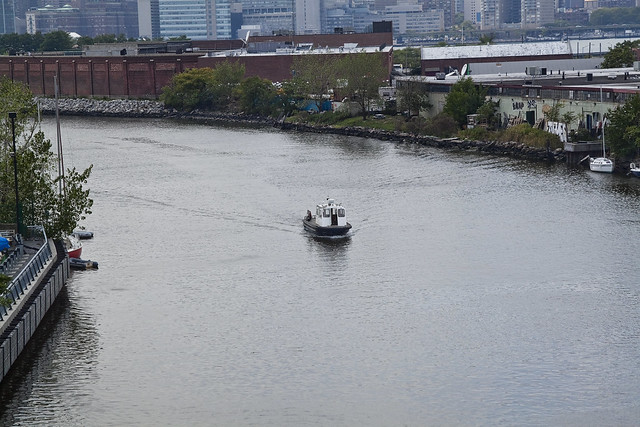
Brutally hot, vast misty shelves of humid air blanketed the terrain when the Pulaski reconstituted itself into its roadway configuration via those electrical engines that operate its double bascule mechanism. Tepid, the fetid air flow’s tortuous languor augmented that remarkable and certain odor which distinguishes the Newtown Creek watershed. At the apex of the arc which spans this part of that storied rivulet, this small boat was spied.

– photo by Mitch Waxman
As its markings indicate, this is the Emily Miller. A “Job” or Utility boat, Emily Miller is 31 feet long, 185 HP and based at Pier 7 1/2 in Staten Island at Miller’s Launch.
from millerslaunch.com
Miller’s Launch is a marine service company based on the North Shore of Staten Island, New York. With satellite terminals throughout New York, New Jersey and Connecticut, we have provided first-class service to the marine industry since 1977.

– photo by Mitch Waxman
Nothing special, really, but since I missed the Tug… I decided to take some shots of it passing anyway. For a waterway that was once the busiest on Earth, the relative scarcity of traffic on Newtown Creek these days makes any vessel plying its poison expanse notable.

– photo by Mitch Waxman
My endless wanderings found your humble narrator once more at the Newtown Creek Waste Water Treatment Plant Nature Walk, always an easy egress point for observing the malefic realities of Newtown Creek and one of the few water level access points open to the general public along the great canal. To my wonder and joy, I found the tugboat that I had missed when the Pulaski (and this post) opened.

– photo by Mitch Waxman
The tug is the Ruby M. operated by Dann Towing, but once once known as he Texaco Fire Chief when it was built in 1967 at the Jakobson Shipyard in Oyster Bay. Steel hulled, it is 95 feet long and has a gross tonnage of 197. It was sitting astride Whale Creek, and maneuvering a barge into position. Tugboats are seldom observed at work this close, and certainly -in my limited experience- it is a rare thing to see one in such a nearly static position relative to the camera.
Normally, you have to shoot fast to capture one, as it is hurtling past.
The Newtown Creek Waste Water Treatment Plant, incidentally, sits on the site of one those insane fires which Greenpoint seems to have been quite prone to and distinguished by during the heady days of the industrial revolution. Check out this NYtimes article from 1900 which describes the horror.

– photo by Mitch Waxman
Daring contact with that which might exist in the shallow depths, your humble narrator descended those threatening steps found at the Nature Walk, and was rewarded with this found composition. Unlike most of the photos presented here, its presence is not meant to advance a narrative or illustrate a point- I just think its a neat shot.

– photo by Mitch Waxman
Having little else to do, I hung around for a while to see if the Ruby M. was about to do something interesting. It didn’t, just repositioning itself further up the creek and tying off to a different barge than the one they had just delivered. Emily Miller’s role in the transaction seemed to have been completed as well, as it advanced past the rail bridges spanning the Dutch Kills tributary of the Newtown Creek.
mother of invention

– photo by Mitch Waxman
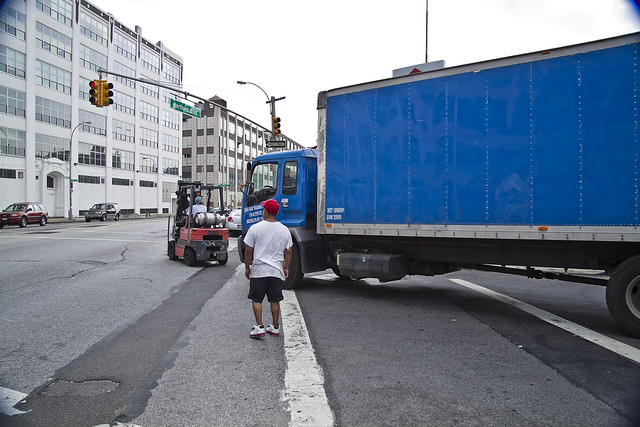
Another recent bit of serendipity experienced during a random walk, this time a bit further down Northern Blvd. and directly across the street from the Standard Motor Products building on 39th street, it seems that the good fellows who operate this largish delivery truck had experienced an unlucky turn when its engine suddenly stranded them. Luckily, they seemed to have a tiny red forklift on board, of a sort which I’ve always heard referred to as a “Bobcat”.
from wikipedia
Forklifts are rated for loads at a specified maximum weight and a specified forward centre of gravity. This information is located on a nameplate provided by the manufacturer, and loads must not exceed these specifications. In many jurisdictions it is illegal to remove or tamper with the nameplate without the permission of the forklift manufacturer.
An important aspect of forklift operation is that most have rear-wheel steering. While this increases maneuverability in tight cornering situations, it differs from a driver’s traditional experience with other wheeled vehicles. While steering, as there is no caster action, it is unnecessary to apply steering force to maintain a constant rate of turn.
Another critical characteristic of the forklift is its instability. The forklift and load must be considered a unit with a continually varying centre of gravity with every movement of the load. A forklift must never negotiate a turn at speed with a raised load, where centrifugal and gravitational forces may combine to cause a disastrous tip-over accident. The forklift are designed with a load limit for the forks which is decreased with fork elevation and undercutting of the load (i.e. load does not butt against the fork “L”). A loading plate for loading reference is usually located on the forklift. A forklift should not be used as a personnel lift without the fitting of specific safety equipment, such as a “cherry picker” or “cage”.

– photo by Mitch Waxman
The inert truck was borrowing its motive power from the smaller and self propelled tool. Its driver clearly seemed embarrassed by all the attention he garnered. Several of us stood on the corners, males all, sporting broad smiles and cheering him on while he waited for a red light to turn. This sort of situation appeals to we men, I don’t know why, but it does.
I was betting on either the inadequate chain just sundering into constituents, or the forklift burning out its transmission before it moved the giant blue vehicle more than a couple of feet.
from wikipedia
A high-tensile chain, also referred to as a transport chain, is a link chain with a high tensile strength used for drawing or securing loads. This type of chain usually consist of broad (thick/heavy) metal, oblong torus-shaped links for high strength. All the links of the chain are usually identical, and on the ends are usually two hooks of the appropriate size and strength to slide easily over one chain link but small enough not let the links slip by. When the ability to grasp the load is required, a slip hook is used.
The chain used for tire chains on tractors and some automobiles for better traction is very similar; usually consisting of the same type of link, especially so for snow chains; however, instead of being a single chain, it is more of a network of interconnected chains with no hooked ends; the size and design of the network depending on the tire it was intended for.

– photo by Mitch Waxman
The signal turned, and that tiny forklift and its driver wouldn’t let anything like the laws of Physics or the limits of engineering stop them from getting the truck moving.
Whom, indeed, says that an ant can’t move a rubber tree plant? Whom?
from wikipedia
They usually range in size 4 to 7 m in length, with smaller or larger sizes existing but being rare in North America. They usually have a garage door-like rear door that rolls up. On some box trucks, the cargo area is accessible from the cab through a small door.
Box trucks are usually used by companies that need to haul appliances or furniture. They are also used as moving trucks which can be rented from companies such as U-Haul or Ryder.
In North America, Ford, Dodge and Chevrolet/GMC have historically been the most common manufacturers of conventional cab/chassis to which various producers (called body builders or upfitters) attach the box that holds cargo. Isuzu, Mitsubishi Fuso and UD/Nissan Diesel have been the most common marketers of cabover-type medium duty cab/chassis used as platforms for box trucks. In North America, these trucks can range from Class 3 to Class 7 (12,500 lb. to 33,000 lb. gross vehicle weight rating, or GVWR).
– photo by Mitch Waxman
The drivers around these parts- borderland and angle between Sunnyside, Astoria, and Dutch Kills- are not exactly a sagacious or patient lot. Normal practice for them is to hit their horns in the quarter second before the traffic light goes from red to green, and to accelerate precipitously in an effort to “beat the lights”. Queens Plaza is nearby, and their probable destination of Manhattan- unlike Queens- is a heavily regulated and well policed thicket of traffic jams. This is their last chance to see the sky.
Well… not for long.
from wikipedia
A gross vehicle weight rating (GVWR) is the maximum allowable total mass of a road vehicle or trailer when loaded – i.e including the weight of the vehicle itself plus fuel, passengers, cargo, and trailer tongue weight.
The difference between gross weight and curb weight is the total passenger and cargo weight capacity of the vehicle. For example, a pickup truck with a curb weight of 4,500 pounds (2,041 kg) might have a cargo capacity of 2,000 pounds (907 kg), meaning it can have a gross weight of 6,500 pounds (2,948 kg) when fully loaded.

– photo by Mitch Waxman
Witness the tenacity and determination of the American workforce- its inchoate improvisations and hazard ridden solutions that keep the machines running no matter what, its complete disregard for official procedure and personal safety -unstoppable, indefatigable, the children of necessity.
from wikipedia
New York State Route 25A (NY 25A) is a New York State highway and the main east–west route for most of the North Shore of Long Island, running from the Queens Midtown Tunnel in the New York City borough of Queens at its western terminus to Calverton in Suffolk County at its eastern end.
Known for its scenic route through decidedly lesser-developed areas such as Brookville, Fort Salonga, Centerport, and the Roslyn Viaduct, 25A begins as 21st Street in Long Island City. As you go farther through 25A, it is then known as Jackson Avenue for a short period and is variously named Northern Boulevard east of Queens Plaza (NY 25), North Hempstead Turnpike, Main Street, Fort Salonga Road, and North Country Road. It merges with NY 25 for approximately 1.5 miles (2.4 km) in Smithtown.
Old School

– photo by Mitch Waxman
Wandering aimlessly, your humble narrator recently encountered this rather badly equipped automobile just off Northern Blvd. The historic cradle of the automobile industry in New York City, this stretch of the great thoroughfare hosts several multi acre car lots, including the famous Major Auto World. This is the corner of 44th street.
from fundinguniverse.com
Bruce Bendell and his brother Harold began operating a Brooklyn carwash and auto repair shop in 1972. Subsequently they and their father sold used cars and leased new cars in Brooklyn before purchasing Major Chevrolet, a Long Island City distributor, in 1985. At this time the dealership was in decline, with only 500 cars and $10 million in annual sales. By 1990 sales had increased tenfold. In 1996 Bendell’s Major Automotive Group was doing about $180 million a year in business. One of New York’s largest auto dealerships, it now consisted of six franchises, including Major Chevrolet/Geo; Major Dodge; and Major Chrysler, Plymouth, Jeep Eagle, in Long Island City, plus, in Woodside–another Queens community–Major Subaru, in addition to Major Fleet and Leasing, the leading supplier of taxis and police cars in New York and also a lessor of trucks.

– photo by Mitch Waxman
I haven’t witnessed a car deconstructed in this manner for many years, perhaps as many as twenty. Once a common sight in the City of Greater New York, before “Giuliani Time“, this car was stripped of wheels and electronics, and the entire act probably took less than five minutes to accomplish- if the professionalism of the thieves guild has held up since the old days.
from wikipedia
Starting in 2005, New York City achieved the lowest crime rate among the ten largest cities in the United States. Since 1991, the city has seen a continuous fifteen-year trend of decreasing crime. Neighborhoods that were once considered dangerous are now much safer. Violent crime in the city has dropped by three quarters in the twelve years ending in 2005 with the murder rate at its lowest then level since 1963 with only 539 murders that year, for a murder rate of 6.58 per 100,000 people, compared to 2,245 murders in 1990. In 2009, the low would be displaced. Among the 182 U.S. cities with populations of more than 100,000, New York City ranked 136th in overall crime.

– photo by Mitch Waxman
I’ve been sort of expecting to see this sort of thing to start up again, and no, it’s not because there are fewer police these days.
Classic right wing thinking, a sort of disastrous chest thumping and braggadocio practiced by the safe and protected, is to proclaim “more cops” as a panacea for any and all of society’s ills. I thought that the right had learned the lesson of this at Waco, and at Ruby Ridge. We don’t need more cops, we just have to offer them better pay, support staff, and on the job training- but I guess that’s latent socialism talking.
Happy Monday.
an article from 1993, nearly twenty years ago, at the nytimes…
Last year, from January through September, 94,724 vehicles were stolen in New York City. That’s about 126,000 cars a year, or 345 a day. New York City leads the U.S. in auto thefts, with 139,977 in 1991, or twice the number reported by the second place finisher, Los Angeles. Despite the number of cases, or perhaps because of it, the police seem uninterested in the average theft.

– photo by Mitch Waxman
The Police clean up the mess after a crime- but they seldom are there when it’s being committed. Even during “Giuliani Time” or the long and notable tenure of the current Commissioner, the combination of a booming job market and mandatory sentencing were the direct causal factors in a reduction of crime here in the Naked City. The spate of 10-15 year sentences handed out so liberally in the 1990’s are coming to an end, and New Yorkers will once again know the true meaning of the word “Scumbag”.
from nyc.gov
If Your Car Does Get Stolen
Report theft to police.
- Obtain form MV78B “License Plate Form” from your local police precinct.
- Notify your insurance company.
- Submit Form MV78B to Department of Motor Vehicle.
- Retain a copy of Department of Motor Vehicle Form as a receipt.
NOTE: False reporting of vehicle theft is a crime and can be punishable by a fine or imprisonment.

– photo by Mitch Waxman
“It’s the economy, stupid”- When your baby is hungry, you do crazy things to put food on the table. The parents of fat, happy babies generally don’t do this to automobiles- or strap dynamite to themselves and blow up buses for that matter. Old school crime like this happens quickly, this car was probably stripped down within minutes, and the fact that a “chop shop” didn’t dissect it for black market body parts also speaks to the greater economy’s relative weakness.
from wikipedia
In his first term as mayor, Giuliani, in conjunction with New York City Police Department Commissioner Bill Bratton, adopted an aggressive enforcement-deterrent strategy based on James Q. Wilson’s “Broken Windows” approach. This involved crackdowns on relatively minor offenses such as graffiti, turnstile jumping, cannabis possession, and aggressive “squeegeemen”, on the theory that this would send a message that order would be maintained. Giuliani and Bratton also instituted CompStat, a comparative statistical approach to mapping crime geographically and in terms of emerging criminal patterns, as well as charting officer performance by quantifying criminal apprehensions. Critics of the system assert that it creates an environment in which police officials are encouraged to underreport or otherwise manipulate crime data.

– photo by Mitch Waxman
We’ve become accustomed to walking about the city, these days, as if we were safe or something. That existential horror did not lurk along the brightly lit path of shambolic corporate fantasies and elaborate real estate schemes, and that a nightmare population of atavist monsters were not returning from exile to walk amongst us, and do what they wilt- which shall become the whole of the law.
Again.
also from the nytimes
A raging crack epidemic in pockets of New York poured people into its jails starting in the late 1980s and early 1990s. The population peaked in 1992, according to correction officials, when the daily average hit 21,449 and the annual intake reached 111,045.
But by the end of the last fiscal year on June 30, 2009, the average daily population had dwindled to 13,362, while the number of inmates admitted that year shrank to 99,939. This year, both figures appear likely to be even lower.
Project Firebox 8

– photo by Mitch Waxman
This maladjusted servant of the City of Greater New York enjoys a tumultuous existence on 48th Avenue in Long Island City, not far from that tendril of cuprous cupidity known as Dutch Kills- a tributary waterway to the Newtown Creek. Your humble narrator has witnessed this firebox’s abuse filled duties for quite some time. It seems to be a regular target for trucks, and I’ve seen it reinserted into its assigned place several times. How do you not notice a big red box?
tightly compressed

– photo by Mitch Waxman
Perhaps, just maybe, a deal of some kind can be struck? A way to mitigate the damage, lessen the blow, come away a winner by losing less?
Would that I had never opened that damned letter… Stumbling back to Astoria, I found my self drawn to the Empty Corridor, where certain factory windows contain observers who monitor the street.
Shrouded in darkness and cigarette smoke, these watchers on high maintain a vigil over the street. If one is thought suspect by them, lesser employees of their masters will approach. Clad in the aspect of law enforcement, their manner will be aggressive, rough, and dismissive. Don’t stray too near, look too closely, or dally too long- or they will come.
from wikipedia
Industry terms for various security personnel include: security guard, security agent, security officer, safety patrol, private police, company police, security enforcement officer and public safety. Other job titles in the security industry include bouncer, bodyguards, executive protection agent loss prevention, alarm responder, hospital security officer, mall security officer, crime prevention officer, private patrol officer, and private patrol operator.
State and local governments sometimes regulate the use of these terms by law—for example, certain words and phrases that “give an impression that he or she is connected in any way with the federal government, a state government, or any political subdivision of a state government” are forbidden for use by California security licensees by Business and Professions Code Section 7582.26. So the terms “private homicide police” or “special agent” would be unlawful for a security licensee to use in California. Similarly, in Canada, various acts specifically prohibits private security personnel from using the terms Probation Officer, law enforcement, police, or police officer.

– photo by Mitch Waxman
Real Police, in all their clever designations and insignia, both demand and are entitled to decorum and procedure in their dealings with you. It is remarkable when they step out of this custom, and shocking to behold.
Those who merely dress like Police however, are bound by no rule save their own, in these lonely places found alongside fences and walls. Private citizens, employed as bully and thug by private and public interests alike, these guardsmen are often armed with club and baton and carry restraints and chemical deterrent weaponry such as capsaicin sprays. Guided by the observers above, they are sent to “let you know they are there”.
Accusations of “scouting” for some criminal enterprise, or operating at the behest of international terrorism are often offered to innocent photographers wandering past in a postal induced panic.
also from wikipedia
Patrolling is usually a large part of a security officer’s duties. Often these patrols are logged by use of a guard tour patrol system, which require regular patrols. The most commonly used form used to be mechanical clock systems that required a key for manual punching of a number to a strip of paper inside with the time pre-printed on it.
Recently, electronic systems have risen in popularity due to their light weight, ease of use, and downloadable logging capabilities. Regular patrols are, however, becoming less accepted as an industry standard, as it provides predictability for the would-be criminal, as well as monotony for the security officer on duty.
Random patrols are easily programmed into these systems, allowing greater freedom of movement and unpredictability. Global positioning systems are also easing their way into the market as a more effective means of tracking officer movement and patrol behavior.

– photo by Mitch Waxman
My vast physical cowardice, honed to a fine art during the violent and often racially charged atmosphere which was 1980’s Brooklyn, has taught your humble narrator one of the few bits of wisdom in his cache. Simply put, keep moving. No matter what, never, ever, present a stationary target to any group of people who dress the same way – keep moving.
Whether it be a group of kids who show all affection toward wearing one of the primary colors that are throwing debris at you, or an encounter with a noxious creature of the street attempting to consume some part of you, junkyard dogs are barking at you, or – suddenly- you find yourself in a crowd which sprang up out of nowhere and is composed of a seemingly homogenous group – keep moving.
You cannot bargain with the Security men, you just keep moving.
from schneier.com
What is it with photographers these days? Are they really all terrorists, or does everyone just think they are?
Since 9/11, there has been an increasing war on photography. Photographers have been harassed, questioned, detained, arrested or worse, and declared to be unwelcome. We’ve been repeatedly told to watch out for photographers, especially suspicious ones. Clearly any terrorist is going to first photograph his target, so vigilance is required.
Except that it’s nonsense. The 9/11 terrorists didn’t photograph anything. Nor did the London transport bombers, the Madrid subway bombers, or the liquid bombers arrested in 2006. Timothy McVeigh didn’t photograph the Oklahoma City Federal Building. The Unabomber didn’t photograph anything; neither did shoe-bomber Richard Reid. Photographs aren’t being found amongst the papers of Palestinian suicide bombers. The IRA wasn’t known for its photography. Even those manufactured terrorist plots that the US government likes to talk about — the Ft. Dix terrorists, the JFK airport bombers, the Miami 7, the Lackawanna 6 — no photography.
Given that real terrorists, and even wannabe terrorists, don’t seem to photograph anything, why is it such pervasive conventional wisdom that terrorists photograph their targets? Why are our fears so great that we have no choice but to be suspicious of any photographer?
Because it’s a movie-plot threat.
also: check out this Newtown Pentacle posting of February 22, 2009 for a whole lot more on this “dimly lit and illimitable corridor”.

– photo by Mitch Waxman
The hand written note, affixed to that hated letter which shattered my illusion of joy, was written on an odd scrap of paper. Once a common enough material, the brown paper grocery sack is an increasingly rare sight these days, and when one suddenly finds a scrap of one inserted into a government postal package it is a remarkable occurrence. Also of some interest was that the hand written insert bore a style of handwriting seldom seen in modern times, but which scholars of the American Civil War would recognize for its extravagance and flourish.
It smelled, vaguely, of salt cod.
from wikipedia
Margaret Ethridge Knight (February 14, 1838 – October 12, 1914) was an American inventor. She was born in York, Maine to James Knight and Hannah Teal. James Knight died when Margaret was a little girl. Knight went to school until she was twelve and worked as a cotton mill worker from ages twelve through 56. In 1868, while living in Springfield, Massachusetts, Knight invented a machine that folded and glued paper to form the flat bottomed brown paper bags familiar to shoppers today.
Knight built a wooden model of the device, but needed a working iron model to apply for a patent. Charles Annan, who was in the machine shop where Knight’s iron model was being built, stole her design and patented the device. Knight filed a successful patent interference lawsuit and was awarded the patent in 1873. With a Massachusetts business man, Knight established the Eastern Paper Bag Co. and received royalties.

– photo by Mitch Waxman
That affixed note: whose hand written words on brown kraft paper were pinned to the crisp white sheets of the machine generated official correspondence, had offered some sort of address or manner of contact…
Perhaps, I could convince its scribe that I meant no offense, and acted only out of curiosity. Woe to the humble narrator who stares too long at the burning thermonuclear eye of god itself, for wrath will be drawn down from those who are born to the purple. The veiled threat on that brown paper, with its pulpy fish smelling surface, was written in pencil.
The shiny lines were no graphite and clay smear either, this atavist screed seemed to been scratched down with a pencil that was leaden- in the manner of a Roman or Egyptian Stylus.
The Security men had lost interest in me at this point, incidentally, having determined that your humble narrator was facile and a threat to none except himself.
from a Newtown Pentacle post of June 27th, 2009 about the history of this stretch of 51st avenue
In 1908, a fire at the nearby Blanchard Building- which housed the works of J.F. Blanchard, makers of fireproof doors and shutters- was started by an inferno at the Pratt & Lambert varnish works next door. The fire soon began to spread and a great crowd watched as groups of firemen tried to battle the out of control blaze. The great fear was that the nearby Columbia Paper Bag company would be set alight, which would provide ample fuel for an inferno that might spread beyond Borden Avenue and to the shores of the Newtown Creek.

– photo by Mitch Waxman
Sliding into one of my deep moods, the black dog of depression began to nip at my heels, and I forced myself to keep on walking- to keep moving. There seemed little point in bargaining with some mythical sky father anyway, as God hates me.
from wikipedia
The perceived persecution may involve the theme of being followed, harassed, cheated, poisoned or drugged, conspired against, spied on, attacked, or obstructed in the pursuit of goals. [citation needed] Sometimes the delusion is isolated and fragmented, but sometimes are well-organized belief systems involving a complex set of delusions (“systematized delusions”). People with a set of persecutory delusions may believe, for example, they are being followed by government organizations because the “persecuted” person has been falsely identified as a spy. These systems of beliefs can be so broad and complex that they can explain everything that happens to the person.


