Posts Tagged ‘Long Island City’
Tales of Calvary 3

-photo by Mitch Waxman
Swirling, my thoughts.
A vast and byzantine pattern which extends beyond even the coming of the Europeans into the mist of olden days, traced by rail and road, reveals itself step by step as the burning eye of god itself leads me to and fro across the glass strewn Newtown Pentacle.
Bits of information, nuggets of pregnant fact, theosophical themes and mystic iconography obfuscating its truths and meaning, a maelstrom of barking black dogs crowds my mind. Cowardly and infirm, I run to the grave.
Solace is found amongst the tomb legions, and the nepenthe of their silence.
from the Brooklyn Daily Eagle in 1880, via junipercivic.com
The extension of Calvary Cemetery by the addition of one hundred acres occasions the demolition of the Alsop mansion, of historic interest. The Alsop family was distinguished n the annals of Newtown down to recent date. Now but one descendant remains, and he long ago quitted his ancestral home. Thomas Wandell was the founder of the Alsop family, through Richard Alsop, his nephew, when be brought from England, while a mere boy, about the year 1665 and adopted his son and heir. The one act in mr. Wandell’s life in Newtown which serves to perpetuate his name in local history was his effort to thwart the burning of human beings for witchcraft. He was foreman of the jury that tried Ralph Hall and his wife, and acquitted them…

-photo by Mitch Waxman
Researches into the hallowed grounds of Calvary Cemetery have hinted at a lost mausoleum, whose hidden entrance was last known in the 1900’s – and which served as an exclusive tomb for Catholic clergy.
Neighborhood gossips whisper of hidden rites and orgiastic meetings, conducted by caribbean cultists and drug crazed adolescents who dance in candlelight upon Calvary’s swollen ground, on moonless nights.
Personal observation has served a buffet of puzzling evidences, odd coincidence, and terrifying implication. If you dial the correct number at midnight, who – or indeed what- might answer?
from the Annals of Newtown
Mr. Wandell, according to reminiscence in the Alsop family, had been a major in Cromwell’s army; but, having some dispute with the protector, was obliged to flee for safety, first to Holland, and thence to America. But some doubt of this may be justly entertained; because Mr. Wandell was living at Mespat Kills in 1648, which was prior to the execution of King Charles, and when Cromwell enjoyed but a subordinate command in the parliamentary army.
Mr. Wandell, the widow of Wm. Herrick, whose plantation on Newtown Creek, (originally patented to Richard Brutnell,) he bought in 1659, afterwards adding to it fifty acres, for which Richard Colefax had obtained a patent in 1652. On this property, since composing the Alsop farm, Mr. Wandell resided. He was selected, in 1665, as one of the jury for the trial of Ralph Hall and his wife for witchcraft, (the only trial for witchery in this colony,) and shared the honor of acquitting the accused. Some years later, he made a voyage to England, returning by way of Barbadoes, and, it is supposed, brought with him from England his sister’s son, Richard Alsop, who, about this time, came to America, and was adopted by Mr. Wandell as his heir, he having no issue. He d. in 1691, and was interred on the hill occupied by the Alsop cemetery. Many years ‘after his death, the silver plate of his coffin was discovered, in digging a new grave.

-photo by Mitch Waxman
Shrouded by ancient copyright and purpose driven obscurity, the building of Calvary was a gargantuan project.
Hints of some enormous underground water calvert electrify my imaginations. The notion of a tunneled world beneath the sepulchral depth, collecting storm driven torrents of rain that would otherwise carry this vast attempt at elysian splendor into the nearby Newtown Creek (in the manner of some macabre mudslide), and the anticipation of where- and what- this system of sewers might empty into fill me with an overwhelming and loathsome joy.
from “A history of Long Island” at archive.org
At ye Court of Assizes held in New Yorke ye 2d day of October 1665 &c.
The Tryall of Ralph Hall and Mary his wife, upon suspicion of Witchcraft.
The names of the Persons who served on the Grand Jury: Thomas Baker, fforeman of ye Jury, of East Hampton ; Capt. John Symonds of Hempsteed ; Mr. Hallet, Anthony Waters, Jamaica ; Thomas Wandall of Marshpath Kills ; Mr. Nicolls of Stamford ; Balthazer de Haart, John Garland, Jacob Leisler, Anthonio de Mill, Alexander Munro, Thomas Searle, of New Yorke.
The Prisoners being brought to the Barr by Allard Anthony, Sheriffe of New Yorke,
This following Indict was read, first against Ralph Hall and then agst Mary his wife, vizt.
The Constable and Overseers of the Towne of Seatallcott, in the East Riding of Yorkshire upon Long Island, Do Present for our soveraigne Lord the King, That Ralph Hall of Seatallcott aforesaid, upon ye 25th day of December ; being Christmas day last, was Twelve Monthes, in the 15th yeare of the Raigne of our Soveraigne Lord, Charles ye
Second, by the Grace of God, King of Eng- land, Scotland, ffrance and Ireland, Defender of the ffaith &c, and severall other dayes and times since that day, by some detestable and wicked Arts, commonly called Witchcraft and Sorcery, did (as is suspected) maliciously and feloniously, practice and Exercise at the said Towne of Seatalcott in the East Riding of Yorkshire on Long Island aforesaid, on the Person of George Wood, late of the same place by which wicked and detestable Arts, the said George Wood (as is suspected) most dangerously and mortally sickned and languished. And not long after by the aforesaid wicked and detestable Arts, the said George Wood (as is likewise suspected) dyed.

-photo by Mitch Waxman
Calvary Cemetery is very much alive, teeming with a population of wild cats, rabbits, migratory birds. A sort of ecosystem exists here, but disturbing subsidences are common, the soil collapsing into a familiar rectangular pattern.
At intervals throughout the cemetery, there are oddly shaped concrete pillboxes- clearly hollow- which are secured with heavy iron lids that are often padlocked. Once, I dared to look into an unlocked one, and the dread implications of a staircase allowing egress down into a corridor roughly 15 feet below the surface, and the fresh muddy footprints leading away into that underworld nearly brought on one of my nervous attacks.
But- hatches abound in the Newtown Pentacle, and it is best not to dwell on all it is, that might be lurking down there.
Samuel Dibble accused his father-in-law, William Graves of witchcraft in the death of his wife, Abigail. There was a history of disagreement between Samuel and his father-in-law over his wife’s dowry. Abigail suffered horribly during the birth of her daughter (with a condition now possibly diagnosed as eclampsia (toxemia)) and Samuel blamed William Graves and depositions were taken in his complaint against him. The outcome of these depositions is unknown, however, it is likely that there was no severe action taken against William Graves as he lived another twelve years and died in Newtown, Long Island.

-photo by Mitch Waxman
Meditating on the oddly suppressed events that have occurred here at Calvary, my mind reels with implied meanings and unheralded imaginings.
On Christmas Eve of 1996, “vandals” overturned between 50 and 75 headstones.
Recently, Crows- the name I’ve coined for the large population of metal collectors who scavenge and pry to feed raw material to the recycling industry along the Newtown Creek – have been accused of stealing valuable copper ornaments adorning the mausoleums here.
Evidences of unwholesome activities may be found all along the great walls, adorned with the spear motif of the high iron gates that surmount and complete them, which seal the great ossuary off from its environs. In the waning years of the 19th century- 1866 to be exact- the Newtown Board of Health was forced to bring charges in courtagainst the cemetery for improper treatment of the bodies of the poor.
From nycgovparks.org
In the five years between 1793 and 1798, New York City suffered terrible outbreaks of yellow fever, and by the end of the crisis, the city had lost nearly five percent of its population. An investigation into the causes of the outbreaks found shockingly unsanitary conditions, and the City responded with sweeping health reforms. Those reforms effectively staved off yellow fever for several years, but in the summer of 1803, the disease struck again. In 1805, the City created the Board of Health, which used its powers to evacuate residents from all streets near the East River, where the epidemic hit the hardest. This successfully warded off the disease for another 14 years. In 1830, a Manhattan ordinance forbade burials below Canal Street, and land in the suburbs was set aside for cemeteries. Newtown, the region between Brooklyn and Queens, was the site of so many cemeteries that it was often called “the city of the dead.”

-photo by Mitch Waxman
Today, visual inspection will confirm the Review Avenue and Laurel Hill Blvd. fences as being a favorite spot for illegal dumping of both construction debris and deceased animals. Directly across the street from the Review Avenue gate, at the former Penny Bridge Calvary railroad stop- fascist iconography adorns the scene.
and from “The Annals of Newtown” at bklyn-genealogy-info.com
This cemetery, which is located at Laurel Hill, was set apart and consecrated in 1848. It is one of the most accessible rural cemeteries near New York, and it would be difficult to select a lovelier or fitter spot as a place of sepulture. The old ground comprised one hundred and ten acres, but in 1853 a charter was obtained from the State by the trustees of St. Patrick’s cathedral, New York city, for 250 acres; 165 acres of this are now enclosed. The artesian well in that part of the enclosure called New Calvary was sunk in 1879. It is 606 feet deep and 6 3/4 inches in diameter, and was bored in white granite for a large part of its depth. Last year 32,000 persons died in the city of New York, and of this number 15,500 were buried in Calvary. The cemetery keeps one hundred and fifty men regularly employed, and two hundred more are kept at work by the relatives and friends of the deceased. Here may be found some of the choicest of materials and the finest models in monumental structure; and here we may mention as worthy of note the vault and chapel built by John Johnston, at a cost of $75,000, and regarded as one of the finest to be found in any ground. This cemetery is to the Catholics of New York what Greenwood is to the Protestant population. Since 1872 Hugh Moore has been the general superintendent, and to his ability much of the beauty and attractiveness of the place is due; he has been assisted by Michael Rowen. The mortuary chapel, of fine architectural design and finish, was built in 1856. The present chaplain is Rev. M.J. Brennan.
Tales of Calvary 2- Veterans Day

-photo by Mitch Waxman
21 Roman Catholic Union soldiers are interred amongst the 365 acres of first Calvary Cemetery in Queens, nearby the cuprous waters of the much maligned Newtown Creek.
The wars of the 20th century, terrible in scope and vulgar in effect, cause us to overlook these men who vouchsafed the American Republic in the 19th century as we focus in on the veterans of the second thirty years war which modernity myopically calls World Wars One and Two. Woodrow Wilson proclaimed a federal holiday called Armistice Day in 1919, celebrating the anniversary of the legal end of the first World War in 1918. Congress agreed, seven years later, and then took six years to pass an act which made Armistice day an official United States federal holiday celebrated on November 11 annually.
Ed Rees, a populist Representative from the state of Kansas during the post World War 2 era, spearheaded a successful campaign in 1953 to have “Armistice Day” reclassified as “All Veterans Day” so as to include the veterans of WW2, and the ongoing conflicts fought by our “permanent government” on the world stage.
from nycgovparks.com
On April 28, 1863, the City of New York purchased the land for this park from the Trustees of St. Patrick’s Cathedral and granted Parks jurisdiction over it. The land transaction charter stated that Parks would use the land as a burial ground for soldiers who fought for the Union during the Civil War (1861-65) and died in New York hospitals. Parks is responsible for the maintenance of the Civil War monument, the statuary, and the surrounding vegetation. Twenty-one Roman Catholic Civil War Union soldiers are buried here. The last burial took place in 1909…
The monument features bronze sculptures by Daniel Draddy, fabricated by Maurice J. Power, and was dedicated in 1866. Mayor John T. Hoffman (1866-68) and the Board of Aldermen donated it to the City of New York. The 50-foot granite obelisk, which stands on a 40 x 40 foot plot, originally had a cannon at each corner, and a bronze eagle once perched on a granite pedestal at each corner of the plot. The column is surmounted by a bronze figure representing peace. Four life-size figures of Civil War soldiers stand on the pedestals. In 1929, for $13,950, the monument was given a new fence, and its bronze and granite details replaced or restored. The granite column is decorated with bronze garlands and ornamental flags.

-photo by Mitch Waxman
Many of the combatant nations observe November 11th as Armistice Day, or Remembrance Day.
It is hard for we moderns to conceive of the psychological pathologies of the post Victorian era, as our “end of the world scenario” is played out as either an expanding cloud of nuclear fire, or some “romeroesque” dystopia populated by hordes of disease maddened and resource starved ghouls- either way- it involves the apocalyptic ascendance of one of the “ism’s”.
Have no doubts though, that the world which created Calvary ended in an apocalypse, and our modern world was built upon the ashes of the Fin de Siècle.
from wikipedia
In many parts of the world people take a two-minute moment of silence at 11:00 a.m. as a sign of respect for the roughly 20 million people who died in the war, as suggested by Edward George Honey in a letter to a British newspaper although Wellesley Tudor Pole established two ceremonial periods of remembrance based on events in 1917.

-photo by Mitch Waxman
The soils of Calvary, a vast cocktail of loathsome and ghoulish ichor, contain many Civil War dead- as well as citizen soldiers from every conflict since. Forgotten and long neglected, the obelisk and its attendant bronzes are in a tremulous condition, etched at by a century of pervasive industrial pollution arising from Newtown Creek, and the greater city beyond.
from a newtown pentacle post, from july 31 of 2009, titled “Up and through Calvary”
Daniel Draddy was an irish speaker from County Cork, and the son of John Draddy- a stonecarver and prolific author in the Irish language who hailed from a family on Quaker Road. In context, they came from what modernity would describe as “an oppressed religious underclass involved in an ethnic and cultural war with an aggressive and powerful neighbor willing and and able to actively engage in state sponsored genocide and ethnic cleansing“ but which they would have called the Irish Potato Famine.
Daniel maintained his marble studios on 23rd street in Manhattan, near the east river. Known as a cultured and gracious host, he was beloved by the Tammany men. Contemporaries describe him as a first class carver, mechanic, historian, and he had the ability to write in the Irish language “druidically”.
Resemblance of the monuments to the tombs of ancient Egypt is no accident. The men who built this were Free and Accepted Masons.
This is masonic iconography, with its obelisk splitting the solar wisdom into the four cardinal directions and the four deities of the spaces found between standing watch at intersecting 45 degree vectors. Such falderol was quite in vogue after the Civil War, look at the Capitol Dome or Supreme Court building in Washington D.C. for similar thematic elements.
Don’t forget- Draddy was a stonecutter, from a family of stonecutters. That made him a Free and Accepted Mason, who’s existential threat was the subject of much Catholic liturgy. The Masons, especially after their successes in the Lowlands and North America in the 17th and 18th centuries, were considered a dangerous fifth column in the power structure of Europe. In the United States, the origins of the mythology surrounding them was beginning to form. In the 19th century men like Draddy would have been considered as subscribing to an “ism”, and its odd to find such iconography in a Catholic cemetery. The Church bore a special antipathy toward the Masons in this period of time, and even today they officially shun members.

-photo by Mitch Waxman
The statues here at Calvary’s Soldiers Monument seem to have been the original castings of a much reproduced statuary design. Placed here in 1866, they predate the identical statues found at Green-Wood Cemetery, and exact issuance of the mold has been confirmed in New England, North Carolina, and all over New York State. As early as 1875, fumes from a nearby Ammonia Factory at Newtown Creek were graving pitted marks into them.
Check out this amazing nytimes.com report of the ceremonies held, at this very spot- on Memorial Day, June 1, 1875.
In accordance with a resolution to celebrate the ceremony of decorating the graves of their dead comrades with more impressiveness than had attended that event in the past, John A. Rawlius Post, No. 80, with the members of the veteran corps of the old Sixty-ninth Regiment, Meagher’s Irish Brigade, Corcoran’s Irish Legion…
Observation, Speculation, and musing- the thinking out loud section
During the Civil War, the United States Union organized its troops by State, City, and town- hence the “XXth New York Regiment” or the “XXrd Illinois”. What this meant, in a meat grinder conflict like the Civil War with its high casualties, was that an entire neighborhood or town could lose ALL of its sons in a single battle.
The long economic decline of upstate New York, New England- especially Massachusetts- began soon after the Civil War partly because of this depopulation- and a generation of widows it created (the decline of “green energy” powered cotton cloth production in area textile mills is a major factor as well). The population important to politicians ceased being the rural mill town or agrarian producer and shifted to the newly crowded urban centers. In “the country”, a fascination with Spiritualism took hold while “the cities” set about building concrete cathedrals.
Radical politics, moralist movements, and fringe religion ruled in a depopulated countryside. The worn out land of the family farm wound inexorably toward a dust bowl, and there was no way to keep your sons and daughters from moving to “The City” and its possibilities. Stricken by endemic poverty, disease, ethnic violence, and starvation, the reality of “the good old days” before the Fin de Siècle is something that just doesn’t jibe with “you could leave your doors unlocked when you went to sleep, back then” that my grandfather used to proclaim.
The next generation of women that came along, who saw their widowed mothers and aunts running businesses and farms and participating in government– they were the Suffragettes.
More on “The White Lady of Astoria”

– photo by Mitch Waxman
Our Halloween posting, describing spectral phenomena experienced by residents on my old block – 44th street between Broadway and 34th avenue, which lies nestled amongst the lowland hillocks of Astoria, has drawn a reply from the Greater Astoria Historical Society.
from astorialic.org
The Greater Astoria Historical Society, chartered in 1985, is a non-profit organization supported by the Long Island City community. We are dedicated to preserving our past and using it to promote our community’s future. The Society hosts field trips, walking tours, slide presentations, and guest lectures to schools and the public. Regular meetings are usually held the first Monday of the month at 7:00 PM in Quinn’s Gallery, 35-20 Broadway, Long Island City.

– photo by Mitch Waxman
The Greater Astoria Historical Society (located on the 4th floor of the Quinn building here in Astoria)– in addition to hosting multitudinous walking tours of the area and producing a schedule of lectures and scholarly exhibitions focusing on the culture, community, and history of northwestern Queens- serves as a vouchsafe location for rare documents and publications which discuss their area of study. Additionally, GAHS preserves several historic artifacts, some of which were saved literally, from the wrecking ball due to direct intervention.
I am fairly certain that the Dee translation of a certain book, missing page 751- of course, is hidden away somewhere in their vaults.
From their towering vantage point- an eagle’s nest which affords an overview of the entire city- these ascended masters share hard won knowledge generously with initiates, even ones as unworthy as your humble narrator.
from wikipedia
The holdings of the Greater Astoria Historical Society, on loan and owned, include a collection of rare and unusual items available for public perusal. The GAHS maintains a Library/Research Center that contains over 10,000 items, including books and publications on local history, a photographic record of the community, and neighborhood ephemera and memorabilia. The GAHS holdings include dozens of antiquarian atlases and thousands of historic maps of Queens, New York and surrounding areas from the now defunct Belcher Hyde map company among others. The holdings also include an almost complete run (or the morgue file) of the Long Island Star Journal, “a daily paper that informed the community about local and world news until it folded in 1968. A banner across the Star-Journal masthead reminded readers that the newspaper’s name came from the merger of the Long Island Daily Star (1876) and the North Shore Daily Journal–The Flushing Journal (1841).”

– photo by Mitch Waxman
The missive received from the GAHS Lamasery, which came in prompt response to the “White Lady of Astoria” posting on the morning of Hallowmas, has been delayed in reaching the readers of this- your Newtown Pentacle- due to the burden of developing hundreds of photos from the 2009 New York City Marathon and the startling revelations brought forward on research about a certain grave I found in Calvary Cemetery (more on that next week).

– photo by Mitch Waxman
My initial instincts, based on badly scanned and somewhat inaccurate historical maps of the area found around the web, were to postulate about the nearby Moore Jackson colonial era cemetery which is hidden in weedy obscurity a few blocks away. Here’s a google map of the scene today.

From the "Annals of Newtown, 1852" courtesy of Pefagan's great site- pefagan.com
Misreading one of these maps, I placed a colonial era farmhouse inaccurately, and began building a case in my notebook for the White Lady being a phantasmic echo of Mrs. Jackson (as in Jackson avenue). This is a bad habit of mine, connecting dots, and I’m trying to avoid it- so while attending a couple of GAHS events in October, I mentioned my ghost story to officers of the Society. Notice that at the center of the map, where the “S.A. Halsey Late Whitfield’s” script is found- just below that (I believe) is the corner of modern 44th street and Newtown Road.

– photo by Mitch Waxman
I have met a few individuals, since I began wandering the Newtown Pentacle, who are authentic experts on those subjects which we explore together at this page. Esoteric history buffs and antiquarian enthusiasts abound in the community, yet certain individuals (you know who you are) stand head and shoulders above the rest. The encyclopedic knowledge and generous nature of these irascible hierophants has given my poor ramblings a grounding, and helped me to grasp at a secret history, hidden all around us. I call these folks, ascended masters all, “The Rabbi’s”.
Amongst this group of “rabbi’s”, if the subject is Astoria, the folks you’ll want to speak to are Bob Singleton and Richard Melnick of the Greater Astoria Historical Society.

– photo by Mitch Waxman
Here, in its entirety, is their message- used with permission-
I know of no story from that area’s history that would relate to this. It was marshy pasture and undeveloped until about 100 years ago. Northern Blvd. was basically a causeway built through a swamp. The Sunnyside Yards was the head of a millpond dammed at Queens Plaza.
No stories with the Gosman etc. families that owned it, and TNT Auto is the only location of something historic: the old Sunnyside Hotel that gave Sunnyside its name.
However, at 43-44 and 31st Ave-Newtown Road is the approx. location of the infamous Hallet Family massacre where two slaves killed both parents and all their kids in the first capital crime of Queens (ca. 1705 or so). Slaughtered them as they wanted their farm. Both slaves (She was Black and He was Indian) were subject to horrible executions (burning at the stake, I believe) in Flushing.
The area of Newtown Road (original wagon road to their grandfather Hallet farm made about 1652) was always considered haunted in the 19th century. I can personally attest to feeling uneasy as I walked along it at night, particularly the area where the apartment building with courtyard to the south of the street around 45th St.
Wonder if the ‘White Woman’ was the wife who fled and tried to run thorugh the swamp to the nearest homes which would have been along Middleberg Ave on the other side of today’s Sunnyside Yards. Your location would have been the approx. place of the millpond that might have stopped her or been imperfectly frozen.
What was the period of her attire?
P.S. ‘East Astoria’ is historically the area north of Astoria Blvd about 40th St or so. The area that you live in was historically called ‘The German Settlement’.

44th and Newtown Road looking toward Broadway and my former apartment, nearly at the spot mentioned by GAHS above – photo by Mitch Waxman
Massive NYC 2009 Marathon Photo set

– photo by Mitch Waxman
The 2009 NYC Marathon came hurtling through Long Island City just this past Sunday, which was November the First- which is also the celebrated anniversary of the abdication of the last Sultan of the House of Osman, and World Vegan Day. A fairly detailed posting about the 2008 Marathon which has lots of history on the race and running, as well as discussion of the Physical Culture movement, can be accessed here.

– photo by Mitch Waxman
Arriving early, a conspiritor and I nonchalantly greeted the small army of affable NYPD personnel, and mounted the Pulaski Bridge. At around 9am, the disabled competitors came barreling through. I can’t really think of what to call these devices. Wheelchair just doesn’t do technology like this justice. Affably, the NYPD then asked us to clear off the bridge.

– photo by Mitch Waxman
I followed the course as the Marathon runners blasted along. For me, the real show is always the sideline, but I shot a lot of pictures of the competitors between 9 and 12:30 in Long Island City.
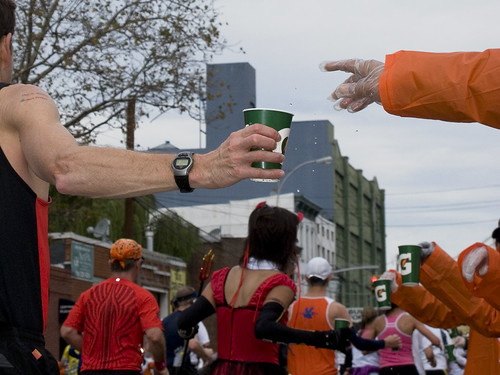
– photo by Mitch Waxman
If you’re a 2009 NYC marathon runner, looking for photos you might be in, click here to reach a huge set at flickr with the full range of shots.

– photo by Mitch Waxman
All along the route, bands were playing. This kid with the Tuba was in a school band that just finished playing “Play that funky music, white boy”.

– photo by Mitch Waxman
Hard rock bands also lined the route- these iconic minstrels were staked out directly across the street from the Citibank Megalith. The runners, toward the ever shadowed cobbles of sin pitted Queens Plaza, were Manhattan bound.

– photo by Mitch Waxman
In a Dark… room
Oh the pain… developing the photos shot at the 2009 NY Marathon hurts…

– photo by Mitch Waxman
I got there early, and actually managed to shoot not only the disabled competitors, but was in position when the “head of the snake” first came through LIC.
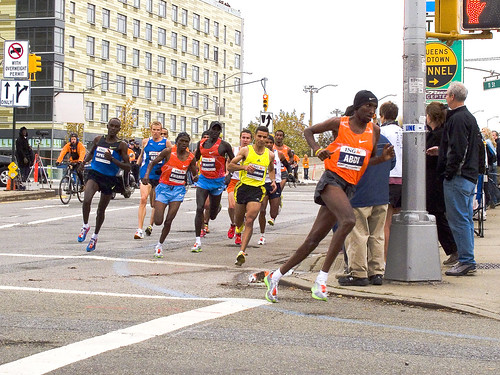
Head of the Pack, 2009 men’s Marathon- photo by Mitch Waxman
I’ll have the whole batch ready by tomorrow. As well, knowledgeable friends have weighed in on our Halloween posting, and I’ll be posting their input later on tonight.
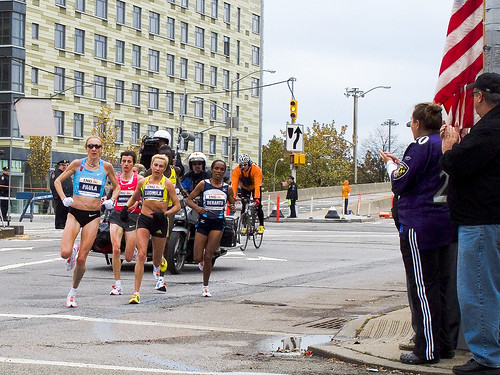
Head of the Pack, 2009 women’s Marathon – photo by Mitch Waxman
They’ll all be dropping into this set at flickr, over the course of the next 24 hours. You also won’t believe some of what I saw at Calvary, later in the afternoon.


