Posts Tagged ‘Long Island City’
shining city

– photo by Mitch Waxman
Gantry Plaza State Park, along the waterfront in the Tower Town section of Long Island City, offers fine panoramas of the shield wall of Manhattan’s east side. Some of my friends tell me that Long Island CIty is best exploited photographically in the early morning, when the burning thermonuclear eye of god itself is still in the east, illuminating the Shining City. For me it’s sunset.
from nysparks.state.ny.us
Gantry Plaza State Park is a 12-acre riverside oasis that boasts spectacular views of the midtown Manhattan skyline, including the Empire State Building and the United Nations. Enjoy a relaxing stroll along the park’s four piers or through the park’s manicured gardens and unique mist fountain. Along the way take a moment to admire the rugged beauty of the park’s centerpieces – restored gantries. These industrial monuments were once used to load and unload rail car floats and barges; today they are striking reminders of our waterfront’s past. With the city skyline as a backdrop and the gantries as a stage, the park’s plaza is a wonderful place to enjoy a spring or summer concert or to enjoy the Macy’s Fourth of July fireworks display.Recreational facilities include basketball courts, playgrounds, handball courts, and a fishing pier with its own cleaning table.

– photo by Mitch Waxman
The funny thing, of course, if that if a 19th century citizen of the independent cities of Long Island City or Manhattan were to observe the modern scene- their first question would be “What happened to all the ships and factories?”.
from fordham.edu
Shipyards lined both the Manhattan and Brooklyn banks of the East River. In the heyday of New York’s port, the ships being built were primarily square-rigged crafts made of wood, especially oak. The raw materials for ships were readily available on the mainland and the labor force in New York did not lack members, especially during the 19th century, when immigrants were pouring in from Europe en masse. While Europeans experimented with the building of iron ships, Americans perfected the art of building the wooden ship.
Renowned for the quality and style of the ships it manufactured, the Port of New York was also known for the sheer quantity of ships that were built there. The East River was the most concentrated area of shipbuilding in the United States. The three greatest shipyards of the East River were probably the Webb-Eckford yard, the Bergh-Westervelt yard, and the Brown-Bell yard. These produced some of the most famous ships and made a fortune in the business, but they represent only a small fraction of the multiple and diverse shipyards dominating the East River.
Commercial yards made up a vast majority of the East River shipbuilding industry, but the government also took advantage of the area to establish a shipyard. The New York Naval Shipyard was established on the site of a former mercantile shipyard, located on the Brooklyn bank, in 1801. It built and outfitted approximately 100 vessels during the War of 1812 and was called upon again during the Civil War to build nine-gun steam sloops and eight-gun side-wheel double-enders. Established by John Quincy Adams, the New York Naval Shipyard continued to build ships well into the 20th century, until it was finally abandoned in 1966.

– photo by Mitch Waxman
The East River was once bursting with industry, and was lined by docks. Famously dangerous, the docks of New York and its corollary municipalities were the first melting pot. When a ship’s cargo was being unloaded and a new one loaded, a process that might take as long as a week, the crews of itinerant sailors would pass the time in flophouses and bars which lined the waterfront. Established society shunned the waterfront, with its temporary populations of tattooed sailors and the mongrel contagion of ideas and exotic possibilities they carried with them.
from earlysda.com
At about 8 o’clock P. M., two lines of people were formed to march each side of the street. Wax candles, about three inches in circumference and four feet long, were now lighted, and given into the hands of each man in the procession. The corpse, which was richly dressed, and adorned with fresh flowers, was placed in a little basket with four handles, four little boys carrying it. It looked like a sweet little child asleep. The procession, with the priest ahead of the child in the middle of the street, and two long lines of men with lighted candles on each side, was rather an imposing sight in the dark night. The walk was about one mile and a half, to an ancient-looking stone church in the upper town. As we passed into the church I saw one of the flagging stones of the floor raised up, and a small pile of bones and dirt beside it. The consul told me the little child was to be put in there. The child was set down by the altar. The priest occupied but a few moments in speaking, then took up a long-handled cup or ball, perforated with holes like a grater, through which, as he uttered a few words, he sprinkled the child with what they call holy water, some of which, whether by accident or otherwise, feel on us who stood at the head of the procession. After this part of the ceremony, all but the child returned in order with the procession. Mr. Harden, the consul, on returning, told me how the child would be disposed of. Two black slaves would strip it of all its clothing, cover it with quick-lime to eat off its flesh, then pound it down in that hole with the other bones and dust, until the stone would lie in its place again. They would have its clothing for their labor. Thus, in this dilapidated charnel-house, and place for divine worship, they disposed of their dead. I was told that Paraiba was one of the oldest towns in South America, being of nearly three hundred years’ standing.
After disposing of our cargo here, we invested our funds in hides and skins, and sailed for New York. After a pleasant and prosperous passage of some thirty days, with the exception of cold, freezing storms on our coast, we arrived at the quarantine ground several miles below the city of New York about the last of March, 1826. As we had no sickness on board, I was allowed the privilege on Sunday of taking my crew with me to hear service at the Dutch Reformed church. This was the first religious assembly I had met with since I covenanted to serve God, and I enjoyed it much. It seemed good to be there. In a few days we were relieved from quarantine, and I was made glad in meeting my companion and sister in New York. My brother F. took my place on board the Empress for another South American voyage, and I left for Fairhaven, to enjoy for a season the society of my family and friends, after an absence of some twenty months.
Like something from the 19th century…

– photo by Mitch Waxman
Big Allis from the Roosevelt Avenue bridge on a cold and humid day, belching Dickensian clouds of steam out over the East River.
from wikipedia
Big Allis, formally known as Ravenswood No. 3, is a giant electric power generator originally commissioned by Consolidated Edison Company (ConEd) and built by the Allis-Chalmers Corporation in 1965. Currently owned by Transcanada Corp., it is located on 36th Avenue and Vernon Boulevard in western Queens, New York.
During 1963, Allis-Chalmers announced that ConEd had ordered the “world’s first MILLION-KILOWATT unit…big enough to serve 3,000,000 people.” This sheer scale helped the plant become popularly known as “Big Allis”.
At the time of its installation, it was the world’s largest energy generating facility. It is located on the Ravenswood site, consisting of Units 1, 2, 3 and 4, as well as several small Gas Turbines (GTs), and an oil farm. The site overall produces about 2,000 MW, or approximately 16% of New York City’s current energy needs. The current installed capacity of Big Allis is around 980 MW.
The Ravenswood, Queens site also includes a steam generation plant consisting of four B&W boilers, commonly known as “The A House”, owned by Con Edison but run by employees of Transcanada. It helps in the supply of steam to Manhattan.
the king in yellow, brick

Matthews Model Flats, Astoria – photo by Mitch Waxman
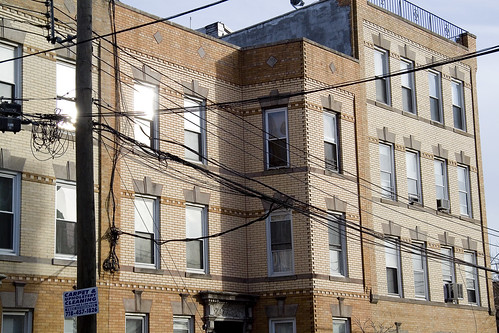
As mentioned in the past, Newtown Pentacle HQ is embedded within one of the few corner to corner blocks of Matthews Model Flats remaining in Astoria, Queens. This is also one of the postings where I’m thinking out loud, so if your humble narrator is in error, let me know.
Yellow bricks, which once distinguished much of western Queens, compose the street faces of these buildings. This particular stretch of Matthews flats in Astoria is just about a hundred years old (1911), as is a lot of the building stock in what I’ve been told was called “the German Section”- “back in the day”. Model tenements, as they were known, and while walking my little dog Zuzu one morning I began to ponder those bricks. Those yellow bricks.
Everywhere you go, from Ridgewood to Greenpoint, Maspeth and Astoria- you see those bricks.
from an EXCELLENT illustrated history of Brick manufacturing in the New World at brickcollecting.com
The first bricks in the English colonies in North America were probably made in Virginia as early as 1612. New England saw its first brick kiln erected at Salem, Massachusetts in 1629. The Dutch colonists in New Amsterdam imported yellow bricks from Holland, which imparted a Dutch character to the architecture of the city. The excellent quality and abundance of local clays in the colonies made it unnecessary to import bricks from across the Atlantic. Brick-making centers developed in Fort Orange (what is now Albany), New York; near Philadelphia, Pennsylvania; and Burlington and Trenton, New Jersey, as well as along the Raritan River.

Grand 30th avenue, Astoria – photo by Mitch Waxman
One of the real pleasures encountered when working on postings for this, your Newtown Pentacle, are the moments when I suddenly have to research something mundane because I realize that I actually know nothing about the subject. In this case, it’s bricks.
A couple of years ago, I pursued knowledge of industrial Honey production– How, exactly, do all those millions of gallons of honey get to the little bottles in your supermarket? What can the industrial process be, I asked. The answers are pedantic, complex, and suffice to say that China is the world’s Honey superpower and that Honey was arguably the first industrial commodity.
The story of these yellow Kriescher bricks however, has something for everyone.
also from brickcollecting.com
The Manhattan Fire Brick and Enameled Clay Retort Works (as described in New York Illustrated (New York: D.Appleton & Co., 1876) was located on East 15th Street near the East River. Henry Maurer learned the fireclay manufacturing business in his uncle’s firm, Maurer & Weber, and then established his own firm which relocated from New York and Staten Island to Maurer, New Jersey, in 1874
There were several firms in New York City that took advantage of the nearby deposits of fire clay and manufactured both clay retorts and fire bricks. In 1845 Balthazar Kreischer established a fire-brick works in Manhattan, later known as the New York Fire Brick and Clay Retort Works; Kreischer acquired a fire-clay deposit on Staten Island in 1852 and established a works there which eventually replaced the Manhattan factory (his son’s house, the Charles Kreischer House and the workers’ houses for the company, the Kreischerville Worker’s Houses are both designated New York City Landmarks). Joseph K. Brick established the Brooklyn Clay Retort and Fire Brick Works in 1854. The Maurer & Weber Company later known as the Manhattan Fire Brick and Enameled Clay Retort Works, opened in 1863.
In 1868 John Cooper established a business, later known as the Greenpoint Fire Brick and Sewer Pipe Works, at 413-421 Oakland Street, Brooklyn. While there were 350 fire brick manufacturers in the United States in 1895, the New York-New Jersey area remained one of the major fire brick manufacturing centers.
Matthews Houses – photo by Mitch Waxman
19th century businessmen were either merchant princes or robber barons, depending on your point of view. Both are accurate, but suffice to say that communities of labor would cluster around the industrialist, corollary industry would arise to support growing populations around the main mill, and even competitors would often locate in their vicinity to take advantage of locale and the skilled worker population. This is why you find financial, garment, and flower districts in Manhattan and its also why Astoria is visually distinct from the neighborhoods around it.
William Steinway was here, and his interests were larger than just pianos. Steinway was a primal force in digging the first Subway Tunnel from Queens to Manhattan (completed by Michael Degnon, of course), and was a major player in the Queens Trolley business. Wealthy, philanthropic, and well regarded by all reports- Steinway’s Piano mill pulled a population to it. Out on Staten Island, Balthazar Kreischer worked a somewhat coarser but technologically sophisticated operation that made… Bricks.
from boards.ancestry.com
…trying to find the descendants of Balthasar KREISCHER (3.13.1813-8.15.1886) of the Kreischer & Sons Brick Company of Staten Island, and interred in The Green-Wood Cemetery of Brooklyn, New York.
Descendants/Family include his 4 daughters Catherine KREISCHER-WEBER, Fredricka P. KREISCHER, Louisa Albertina KREISCHER-STEINWAY and Caroline L. KREISCHER-ELLIS and his 3 sons: Charles C. KREISCHER, Edward B. KREISCHER and George F. KREISCHER. Some Kreischers settled into Brooklyn.
Louisa Albertina KREISCHER-STEINWAY (d. 6.30.1926) married Albert STEINWAY (b. 6.10.1849- d. 5.14.1877), the youngest son of of Steinway & Sons Piano Mfgr. of Astoria, New York, and had 2 daughters: Henrietta Julia STEINWAY and Ella Frederica STEINWAY. Louisa, Albert and Frederick P. Kreischer are interred in the Steinway mausoleum in Green-Wood Cemetery of Brooklyn, NY.

Maspeth Matthews Houses – photo by Mitch Waxman
Both great men were successful and accepted, rich beyond avarice, and had children. Steinway’s son Albert married Kreischer’s daughter Louisa, connecting the two families in business and standing. Both men also had holdings and interests in the burgeoning railroad business, Kreischer an investor in the Vanderbilt’s Staten Island Railroad and Steinway a rail mogul in Queens. Many of these yellow brick homes, so typical of ancient Queens, lie along the route that trolley tracks once followed.
My supposition is that Kreischer received a family discount for moving his product around on Steinway’s rails, and use of Kreischer Brick in a new project bought some good will from the Steinways- known for their generous nature and political connections in New York, Newtown, and the upstart Long Island City with its scandalous political class.
This is theory, of course, but sounds kind of like the way things worked in 19th century New York when the “old boys” club ruled. Again- theory.
from astorialic.org
“It was reported on the street on Friday that Gleason had sold his railway interests to the Steinway syndicate for $275,000. It has been reported for a long time that the Gleason roads did not pay. The road up Borden Avenue to Calvary Cemetery [in Woodside] was not well patronized. There are not many people who go to Blissville [Sunnyside] unless it is to visit the dead. The Blissville people as a rule do not travel much and when they do they patronize the Greenpoint line in preference to Gleason’s, thus his exchequer has suffered, and again the cars to the cemetery are cold this winter, and the conductors lugubrious on account of the scarcity of pennies and passengers, and a traveler after a survey of one of the cars, is tempted to foot it in preference to riding in an open car, as they had to do on Christmas Day.”

St. Joseph’s RC Church, Grand 30th avenue, Astoria – photo by Mitch Waxman
Louisa’s brother Edward, it seems, met a tragic end.
Check out this page at thecabinet.com, which tells a detailed story of that Kreischer Mansion where Edward lost his life, which describes ghostly phenomena and the violent history experienced by those who have inhabited it since.
Also, don’t miss forgotten-ny’s page on the Steinways and Kreischer’s
after cycles incalculable

– photo by Mitch Waxman
The Romans had one of their very practical holidays scheduled for this week of the year, a mostly forgotten rite called the Lemuralia.
from wikipedia
In Roman religion, the Lemuralia or Lemuria was a feast during which the ancient Romans performed rites to exorcise the malevolent and fearful ghosts of the dead from their homes. The unwholesome spectres of the restless dead, the lemures or larvae were propitiated with offerings of beans. On those days, the Vestals would prepare sacred mola salsa, a salted flour cake, from the first ears of wheat of the season.

– photo by Mitch Waxman
The notion of vengeful ghosts, whom the Romans would call- in hushed whispers- the Larvae is ancient and seems to be bred into the human specie.
Those who celebrated the Lemuralia, walked barefooted, washed their hands three times, and threw nine times black beans behind their backs, believing by this ceremony to secure themselves against the Lemures (Varro, Vita pop. Rom. Fragm. p241, ed. Bipont.; Servius, ad Aen. I.276).

– photo by Mitch Waxman
The Egyptians had their Khu, and China has the Hungry Ghosts, even the Inuit tradition carries a haunting cadre of supernormal entities.
from wikipedia
In Roman mythology, lemures (singular lemur) were shades or spirits of the restless or malignant dead, and are probably cognate with an extended sense of larvae (sing. larva = mask) as disturbing or frightening. Lemures is the more common literary term but even this is rare: it is used by Horace, and by Ovid in his Fasti. Lemures may represent the wandering and vengeful spirits of those not afforded proper burial, funeral rites or affectionate cult by the living: they are not attested by tomb or votive inscriptions. Ovid interprets them as vagrant, unsatiated and potentially vengeful di manes or di parentes (ancestral gods of the underworld). To him, the rites of their cult suggest an incomprehensibly archaic, quasi-magical and probably very ancient rural tradition. Much later, St. Augustine describes both the lemures and the larvae as evil and restless manes that torment and terrify the living: lares, on the other hand, are good manes.

– photo by Mitch Waxman
Of course, our life here in the Newtown Pentacle is defined by more mundane concepts and material realizations. The Larvae we experience in early May, like these enigmatic critters found near the Hunters Point Ave. Station on Skillman Avenue, are decidedly “normal” and also happen to be native New Yorkers.
Your humble narrator has stumbled before, but with extensive comparison to extant critter speciation via the google… I’m going to go out on a limb here and proclaim these squirming masses of endless hunger Malacosoma Americanum!!! That’s the Eastern Tent Caterpillar to you, Lords and Ladies!!!
and apologies for the “out on a limb” pun- couldn’t resist…
(and also, I could be totally wrong- but these guys look like Malacosoma Americanum to me- if you can confirm or deny, please leave a comment)
from wikipedia
The newly hatched caterpillars initiate the construction of a silk tent soon after emerging. They typically aggregate at the tent site for the whole of their larval life, expanding the tent each day to accommodate their increasing size. Under field conditions, the caterpillars feed three times each day, just before dawn, at mid-afternoon, and in the evening after sunset. During each bout of feeding the caterpillars emerge from the tent, add silk to the structure, move to distant feeding sites en masse, feed, then return immediately to the tent where they rest until the next activity period. The exception to this pattern occurs in the last instar when the caterpillars feed only at night. The caterpillars lay down pheromone trails to guide their movements between the tent and feeding sites. The insect has six larval instars. When fully grown, the caterpillars disperse and construct cocoons in protected places. The adult moths (imago) emerge about two weeks later. They are rather strictly nocturnal and start flying after nightfall, then possibly stop some hours before dawn. Mating and oviposition typically occur on the same day as the moths emerge from their cocoons; the females die soon thereafter.

– photo by Mitch Waxman
Positively raining down from the trees, vast chaotics of these crawlers were observed the other day trying to cross Skillman Avenue, heading eastward.
The Eastern Tent Caterpillar, Malacosoma americanum (Fabricius) is reported to have been present in the United States since the 1600’s, and is responsible for forming unsightly silk-webbed nests at branch forks. Their population peaks every 8 to 10 years, when large infestations can completely defoliate trees in late spring/early summer.

– photo by Mitch Waxman
Virtually impossible to find footing which did not render a horrible and crushing extermination, I nevertheless scuttled forth and picked my way amongst them. In the back of my mind, I wondered what evolutionary adaptations they might have developed to accommodate the environmental hostility of this section of Long Island City. There is a High School across the street, of course- surrounded by the tunnels, trains, highways, bridges, and the cemented reality of an area defined by the junction of the main waterway of the Newtown Creek with its bubbly tributary- the canalized Dutch Kills. Just a block away is the Empty Corridor.
from esf.edu
These caterpillars produce the conspicuous silken tents commonly seen in the spring on branches of favored host trees. The tents consist of numerous layers of dense silk webbing which contain much excrement and numerous molted skins.
The female moths are dull reddish-brown with a wing expanse of 1 1/2 to 2 inches. Males are smaller. The front wings of each are crossed by two whitish, oblique, parallel lines.
Mature larvae, or caterpillars, are 2 to 2 1/2 inches long. The head and body are generally deep black. There is a white stripe along the back of the body and a row of oval, pale blue spots on each side. There are many short, irregular brownish markings on the side of each body segment. Long, fine, brown hairs sparsely clothe the body.

– photo by Mitch Waxman
These wriggling americans were pursuing some unknown goal in the direction of that High School, and the actions of automotive traffic along Skillman Avenue upon their migration is a detail best left unheralded. Vast hatcheries of avian predators swirled above.
from nysipm.cornell.edu
Manual destruction of egg masses and tents is an excellent way to control populations. Be advised that the hairs on caterpillars may be irritating to skin.
Twigs encased by egg masses should be pruned out. Tents can also be pruned out or be destroyed by winding around a stick or with a strong jet of water (the best time to destroy tents is before caterpillars leave to feed). Do not attempt to burn tents as this can cause more harm than good.
Tent destruction has another benefit in that it exposes caterpillars to birds and other natural enemies which can help keep populations in check. Eastern tent caterpillars are parasitized by braconid, ichneumonid, and chalcid wasps.
Other control options are available: Bacillus thuringiensis var. kurstaki is useful in the early spring when applied to young larvae, as is insecticidal soap which should be used when caterpillars are out of tents and feeding on leaves. Take care to avoid applying soaps in unsuitable weather conditions (like hot temperatures) as this can lead to phytotoxicity and leaf damage.

– photo by Mitch Waxman
The univoltine holocaust playing out all around me forced me to rumination, a meditative practice whose purpose is to ward off the periodic moments of panic and fainting which have so afflicted me in the past. Feckless quisling and physical coward both, your humble narrator revels in heroic tales of the past, for the future is a paralysis of logical progressions and dire portent.
from wikipedia
The origin of the festival of All Saints celebrated in the West dates to May 13, 609 or 610, when Pope Boniface IV consecrated the Pantheon at Rome to the Blessed Virgin and all the martyrs; the feast of the dedicatio Sanctae Mariae ad Martyres has been celebrated at Rome ever since. The chosen day, May 13, was a pagan observation of great antiquity, the culmination of three days of the Feast of the Lemures, in which the malevolent and restless spirits of the dead were propitiated. Liturgiologists of the Middle Ages based the idea that this Lemuria festival was the origin of that of All Saints on their identical dates and on the similar theme of “all the dead”.
The feast of All Saints, on its current date, is traced to the foundation by Pope Gregory III (731–741) of an oratory in St. Peter’s for the relics “of the holy apostles and of all saints, martyrs and confessors, of all the just made perfect who are at rest throughout the world”, with the day moved to November 1.

– photo by Mitch Waxman
Negative thoughts, though, on a sunny warm day in the City of Greater New York will only attract attention to you. Best to throw open the psychic windows and air the mental house out, clean up and organize for the coming summer. Perhaps the Romans had something after all, the Lemuralia was always accompanied by a general cleaning of the home, a spring cleaning.
from wikipedia
On Sunday, 13 May 1917, ten year old Lúcia Santos and her younger cousins, siblings Jacinta and Francisco Marto, were tending sheep at a location known as the Cova da Iria near their home village of Fátima in Portugal. Lúcia described seeing a woman “brighter than the sun, shedding rays of light clearer and stronger than a crystal ball filled with the most sparkling water and pierced by the burning rays of the sun.” Further appearances are reported to have taken place on the thirteenth day of the month in June and July. In these, the woman exhorted the children to do penance and to make sacrifices to save sinners. The children subsequently wore tight cords around their waists to cause pain, abstained from drinking water on hot days, and performed other works of penance. Most importantly, Lúcia said that the lady had asked them to pray the rosary every day, repeating many times that the rosary was the key to personal and world peace. This had particular resonance since many Portuguese men, including relatives of the visionaries, were then fighting in World War I.
According to Lúcia’s account, in the course of her appearances, the woman confided to the children three secrets, now known as the Three Secrets of Fátima.

– photo by Mitch Waxman
The Lemures are always with us, after all, and they’ll always be back.
Have a good day on the 13th of May, eat something bad for you with someone you love- and fellows- wash your hands and throw some black beans around the neighborhood later. You never know.
I really have to recommend against walking bare footed, however.
Searching for Gilman

– photo by Mitch Waxman
For several months I have been searching Calvary Cemetery in a non systematic manner for 2 particular locations. Thwarted time and again by false leads and incorrect addressing, both sites have remained elusive. One grave is the final resting place of Tess Gardella– the actress who portrayed Aunt Jemima- and the other is that of an enigma from the early 20th century whose name was Gilman.
from wikipedia
Aunt Jemima is a trademark for pancake flour, syrup, and other breakfast foods currently owned by the Quaker Oats Company. The trademark dates to 1893, although Aunt Jemima pancake mix debuted in 1889. The Quaker Oats Company first registered the Aunt Jemima trademark in April, 1937.
The name “Jemima” is biblical in origin. Jemima is the King James Version’s rendering of the feminine Hebrew name יְמִימָה (Yəmīmā), the first of Job’s daughters born to him at the end of his namesake book of the Bible.
The term “Aunt Jemima” is sometimes used colloquially as a female version of the derogatory label “Uncle Tom”. In this context, the slang term “Aunt Jemima” falls within the “Mammy archetype”, and refers to a friendly black woman who is perceived as obsequiously servile or acting in, or protective of, the interests of whites. The 1950s television show Beulah came under fire for depicting a “mammy”-like black maid and cook who was somewhat reminiscent of Aunt Jemima. Today, the terms “Beulah” and “Aunt Jemima” are regarded as more or less interchangeable as terms of disparagement in popular discourse.

– photo by Mitch Waxman
Somewhere in the viridian depths of Calvary Cemetery lies an unremarked merchant from Massachusetts, who died in an accident along the delirious Newtown Creek in 1931. No obituary I can find discusses him, and Gilman slid unnoticed into the hallowed loam of Calvary’s charitable sections. His anonymity came to an end when, according to neighborhood sources and contemporary diarists, a relict 3 masted schooner arrived at the Penny Bridge docks and ordered an eccentric monument be erected on Gilman’s resting place. The captain of that black ship, a leathery bastard named Marsh, collected Gilman’s belongings and sailed via Newtown Creek to the East River, turning North toward Hell Gate- ultimately disappearing into the mists of Long Island Sound heading for New England.
from noaa.gov
Click here for : Hell Gate and Its Approaches
This nautical chart depicts Hell Gate, a narrow channel on the East River, at the confluence of the Harlem River, which connects Long Island Sound with New York Harbor. The chart shows Hell Gate in 1851, which is the year that the U.S. Army began blasting ledges and rocks within Hell Gate to ensure safe passage through the channel.

– photo by Mitch Waxman
Rumors that this man was the same Gilman mentioned by members of the Boston Police Department in 1920, in connection with investigations into a string of sensational murders and for connections to a certain group of anarchists thought to be operating within the city. The Back Bay area of Boston, of course, is associated with the illustrious architect Arthur Delevan Gilman– but there doesn’t seem to be any involvement with Calvary’s mysterious Gilman other than a tangential coincidence of names.
from wikipedia
The Back Bay neighborhood was created when a parcel of land was created by filling the tidewater flats of the Charles River. This massive project was begun in 1857. The fill to reclaim the bay from the water was obtained from Needham, Massachusetts. The firm of Goss and Munson, railroad contractors, built 6 miles (9.7 km) of railroad from Needham, and their 35-car trains made 16 trips a day to the Back Bay. The filling of present-day Back Bay was completed by 1882; filling reached the existing mainland at Kenmore Square in 1890, and finished in the Fens in 1900. The project was the largest of a number of land reclamation projects, beginning in 1820, which, over the course of time, more than doubled the size of the original Boston peninsula. It is frequently observed that this would have been impossible under modern environmental laws.
Back Bay’s development was planned by architect Arthur Gilman with Gridley James Fox Bryant. Strict regulations produced a uniform and well-integrated architecture, consisting mostly of dignified three- and four-story residential (or once-residential) brownstones.

– photo by Mitch Waxman
Both saint and sinner alike can be found in the emerald devastations of First Calvary- governors, mayors, and priests share in the loam with common laborer and notorious gangster. There are multitudes here, vast tomb legions awaiting only the advent of their messiah to rise and walk the earth. Gilman is amongst the many, lost in the crowd. I will find him, and the notable monument raised in his honor- it is just a matter of time.
from wikipedia
While the Christian doctrine of resurrection conforms to Jewish belief, there is, however, a minority point of view, held by certain Jewish mystics and others,[who?] which asserts that those Jewish beliefs are in contradiction with the resurrection as taught by Isaiah (Isaiah 8:16 and 26:19) and Daniel (12:1 and 13) in which the resurrection was understood as being a doctrine of physical ‘Rebirth’.
Jesus appears to have been in general agreement with the position held by the Pharisees, as illustrated by his response to a question regarding marriage at the resurrection (Matthew 22:23-32, Mark 12:18-27 and Luke 20:27-40).
Most Christian churches continue to uphold the belief that there will be a general resurrection of the dead at “the end of time”, as described Paul when he said, “…he hath appointed a day, in the which he will judge the world…” (Acts 17:31 KJV) and “…there shall be a resurrection of the dead, both of the just and unjust.” (Acts 24:15 KJV).
Many of the early Church Fathers cited the Old Testament examples listed in the Judaism section above as either foreshadowing Jesus’s resurrection, or foreshadowing or prophesying a future resurrection of all the dead.

– photo by Mitch Waxman
Gilman, I have no first name or exact date of interment- which intensifies the difficulty in locating him- was supposedly a dealer in far eastern art. What his purpose was in coming to the Newtown Pentacle remains shadowed. Veiled references to the illegal importation of statuettes from the south Pacific, and distribution of these items to radical theosophists and heretic Masons in the Greenpoint and Maspeth neighborhoods can be gleaned from antiquarian sources but nothing definite enough for the consideration of the Lords and Ladies of Newtown has emerged. The statuettes it is said, are the product of the lost Saudeleur culture from Nan Madol found on fabled Pohnpei, and an item of particular interest to certain occultists.
from wikipedia
Nan Madol was the ceremonial and political seat of the Saudeleur dynasty, which united Pohnpei’s estimated 25,000 people. Set apart on the main island of Pohnpei, it was a scene of human activity as early as the first or second century AD. By the 8th or 9th century islet construction had started, but the distinctive megalithic architecture was probably not begun until perhaps the 12th or early 13th century.
Little can be verified about the megalithic construction. Pohnpeian tradition claims that the builders of the Lelu complex on Kosrae (likewise composed of huge stone buildings) migrated to Pohnpei, where they used their skills and experience to build the even more impressive Nan Madol complex. However, this is unlikely because radiocarbon dates have placed the construction of Nan Madol prior to that of Lelu. Like Lelu, one major purpose of constructing a separate city was to insulate the nobility from the common people.
A local story holds that when Nan Madol was being built a powerful magician living in the well inhabited region on the northwest of the island was solicited, and that his help was a major factor in completing the buildings. In particular, he was responsible for supplying the huge stone “logs” used in much of Nan Madol by “flying” them from their source to the construction site.
…Supposedly there was an escape tunnel beginning at the center of Nan Madol and boring down through the reef to exit into the ocean. Scuba divers continue to look for this “secret” route, but so far a complete tunnel has yet to be discovered.

– photo by Mitch Waxman
Gilman is meant to have been killed in a curious accident on the Queens bank of Newtown Creek in Blissville, when a bail of paper fell from a second story warehouse window along the negligent shoreline of the Newtown Creek. Crushed, the peculiar condition of his body was remarked on by several hardened Detectives used to such sights. Speculations that he had been previously deformed by Polio or some other childhood disease were made, but before our era of “antigenic vaccination as public policy” was enacted, monstrous alterations of the human form by disease organisms were a common sight. Disfigurements caused by Smallpox and Leprosy or the ravages of Tertiary Syphilis are seldom observed by we happy few that enjoy the luxury of western modernity.
from wikipedia
Tertiary syphilis usually occurs 1–10 years after the initial infection, however in some cases it can take up to 50 years. This stage is characterized by the formation of gummas, which are soft, tumor-like balls of inflammation known as granulomas. The granulomas are chronic and represent an inability of the immune system to completely clear the organism. They may appear almost anywhere in the body including in the skeleton. The gummas produce a chronic inflammatory state in the body with mass effects upon the local anatomy. Other characteristics of untreated tertiary syphilis include neuropathic joint disease, which is a degeneration of joint surfaces resulting from loss of sensation and fine position sense (proprioception). The more severe manifestations include neurosyphilis and cardiovascular syphilis. In a study of untreated syphilis, 10% of patients developed cardiovascular syphilis, 16% had gumma formation and 7% had neurosyphilis.
Neurological complications at this stage can be diverse. In some patients manifestations include generalized paresis of the insane, which results in personality changes, changes in emotional affect, hyperactive reflexes and Argyll-Robertson pupil. This is a diagnostic sign in which the small and irregular pupils constrict in response to focusing the eyes, but not to light. Tabes dorsalis, also known as locomotor ataxia, a disorder of the spinal cord, often results in a characteristic shuffling gait.

– photo by Mitch Waxman
Somewhere, amongst those who eternal lie, is Gilman. The disturbing detail that troubled the Detectives who investigated the reports of his death, the one that made for saloon conversation and idle speculation by neighborhood wags, was the fact that this deceased dealer in illicit eastern art had six fingers on both hands and that these polydactyl appendages were webbed all the way to the nail beds. Not much could be said about Gilman’s face, for the rodent population of Newtown Creek had discovered him long before the Police did.
Additionally, his shorter than normal legs also bore long healed scars that suggested some intense surgical experience- participation in the Civil War was speculated on by area Police, when Gilman would have been a young man. Amongst his few possessions was a watercolor postcard of some southern Plantation labeled as “Carfax Plantation, James River, Virginia”, which was quite out of place in the pockets of a Massachusetts trader who died alone during the middle of the night along Newtown Creek. Further speculations held out the possibility that Gilman hailed from a degenerate or illegitimate offshoot of the famed Gilman family of Exeter, New Hampshire.
Where and who is he? Where is Gilman?
from wikipedia
Winthrop Sargent Gilman (1808-1884) was head of the banking house of Gilman, Son & Co. in New York City. He was born in Marietta, Ohio to merchant Benjamin Ives Gilman and Hannah (Robbins) Gilman. Benjamin Ives Gilman, born in 1766, was a native of Exeter, New Hampshire, where his ancestors were among the most prominent early settlers and where he graduated in the first class of the Phillips Exeter Academy.
In 1837 Winthrop Sargent Gilman let the abolitionist Elijah Parish Lovejoy hide his printing press in one of Gilman’s warehouses in Alton, Illinois. In the ensuing riot the angry mob burned Gilman’s warehouse to the ground and killed Lovejoy. Following the Alton riots, Gilman moved to New York City and entered the family banking business.
He was married to Abia Swift Lippincott Gilman, who in 1900 narrowly escaped burning to death from a gasoline torch in front of the Charles Scribner mansion at 12 East Thirty-eighth Street.
Winthrop Gilman had an abiding interest in science and built a private observatory at his home ‘Fern Lodge’ at the Palisades, New York, where he frequently observed meteors.


