Archive for the ‘Heron’ Category
Happy New Year

– photo by Mitch Waxman
Just a short one today, welcome to 2013. Be back tomorrow with something new.
kaleidoscopic rotation
“follow” me on Twitter at @newtownpentacle

– photo by Mitch Waxman
The thanks I give today is to the Audubon Society, for bringing me out to South Brother Island with them when they were doing a count of nesting shorebirds back in the spring, whereupon I was able to capture the image above. Probably my favorite shot of 2012, at least so far, and given the relatively late calendrical date- odds on favorite for this years “best of show”. Not a turkey, rather a night heron, by the way.
gleaming image

– photo by Mitch Waxman
It should be mentioned that under normal circumstance, the narration recited on board one of the Newtown Creek boat tours which I’ve been a part of in the recent past has been “the straight story”. By that, I mean that the normal narrative which readers of this blog have grown used to is toned down a bit, and a more mainstream presentation is offered. There are still plenty of “night soil and offal dock” stories, but as I have a relatively short amount of time to tell the story of Newtown Creek, a lot of the more… colourful… stuff gets trimmed out. Luckily, the Newtown Creek Alliance is producing a “spooky” Halloween tour this Saturday (October 27), and I get to go to town on this one.

– photo by Mitch Waxman
In addition to weaving the Blissville Banshee, Maspeth Gypsies, and witch panics into my speech- there are two other factors which make this tour special. First and foremost is the price, subsidized by grant money from the NYCEF fund of the Hudson River Foundation – which allows NCA to offer the trip at an amazing price of just $25. Secondly, the time at which we will be embarking is late in the afternoon, which should offer spectacular sunset lighting of the Creek for photographers and sensitives alike.

– photo by Mitch Waxman
This is a two hour excursion, leaving from Manhattan’s South Sea Seaport on board a comfortable NY Water Taxi (which, yes, has bathroom facilities). NCA is encouraging the wearing of seasonal costuming to celebrate and acknowledge the Halloween holiday. Scheduled speakers include your humble narrator and NCA Executive Director Kate Zidar. Whatever there is, which cannot possibly exist, lurking in the Black Mayonnaise which underlies the cursed waters of that cataract of agony known as the Newtown Creek has refused to make an appearance sans ritual sacrifice- something NCA cannot have any involvement with due to the intricacies of its 501/3c non profit status. The thing in the megalith will be watching, however.

– photo by Mitch Waxman
The question of what sort of costume I will be wearing is still up in the air. Attempts to borrow a death cloak have so far been unsuccessful, despite the fact that several people I know own such raiments. Click the banner just below this paragraph for ticketing information and fulfillment. Do you dare to enter this nightmare world of the Newtown Creek, or will you instead cling to the illusion of sanity which exists beyond its banks?
Also- Upcoming Newtown Creek tours and events:

for more information on the October 27th Newtown Creek Boat Tour, click here

for more information on the November 9th Newtown Creek Magic Lantern Show, click here

for an expanded description of the November 11th Newtown Creek tour, please click here
something disquieting

– photo by Mitch Waxman
Truly does one struggle against the darkness. A vast and slavering dog, it is checked and kept by sturdy chains with a stout collar, but it is always just a few steps behind. Were it let loose, the very pillars of the world would crumble and shake. Caged, a storm rages, with cyclonic fires whose winds carry exultations of lament- and all of hell follows in its wake. Better to get out than dwell upon existential angst, and visit that ribbon of urban neglect known as the fabled Newtown Creek, so off I went.

– photo by Mitch Waxman
Witness, if you will, the sort of life which inhabits this debased waterway. Once common, wading birds like this (presumptively) Great Blue Heron have returned to the shallows and sediment mounds in recent years. While photographing this nearly cryptic specie, your humble narrator was approached by a private security man. Girding for the usual lecture given by the “rent a cops” of the Creeklands, I was instead pleasantly surprised when the fellow engaged me in conversation.

– photo by Mitch Waxman
The guardsman claimed that he had witnessed a startling and unexpected mammalian apparition on more than one occasion at Maspeth Creek. The animal he described as inhabiting the shoreline cannot possibly be here, as it would defy all logic and sense. Dogs, cats, rats- even raccoons and coyotes have been reported with some frequency over the years. Their presence is logical, explainable, and entirely mundane. The security guard however, told me that he has seen a Beaver here. “A musk rat” I suggested? “No, a beaver”, he said.
eery pinnacle
– photo by Mitch Waxman
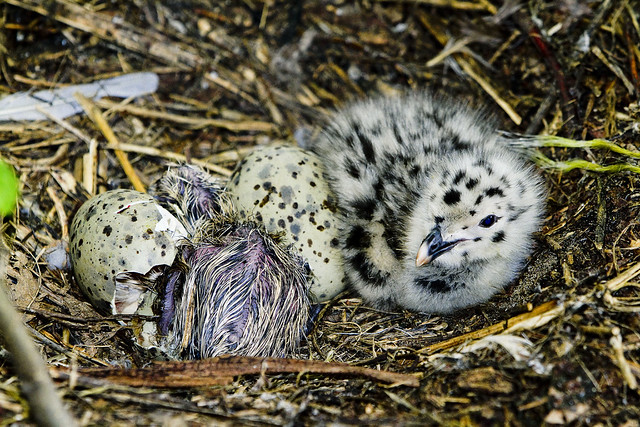
Until you’ve had a flock of baby birds vomit on you, you haven’t really lived.
It seems that such regurgitation is just part of the daily grind here on South Brother island, an unassuming prominence found on the East River. Heavily wooded, the island is owned and managed by the Government(s) and it is usually “verboten” for primates to even visit.
from wikipedia
South Brother Island is one of a pair of small islands in the East River situated between the Bronx and Riker’s Island, New York City and is 7 acres (28,000 m2) in size. It is uninhabited. The other island, larger and better known, is North Brother Island. Until 1964, South Brother Island was part of Queens County, but it is now part of Bronx County. It had long been privately owned, but was purchased by the city in 2007. Together, the two Brother Islands, North and South, have a land area of 81,423 square meters, or 20.12 acres (81,400 m2).

– photo by Mitch Waxman
Your humble narrator managed to insert himself into a scientific survey of the breeding colony of Cormorants, Herons, and Egrets which thrive upon the riverine island. The island has been allowed to go feral, and is positively overrun by seabirds. Upon arriving there via a Zodiac boat, one of the fellows employed by the NRG (Natural Resources Group) of the NYC Parks Dept. asked me if I knew what poison ivy looked like.
Informing him that he should just assume my general ignorance about all things, he remarked- you’re standing in it.
from wikipedia
Toxicodendron radicans, better known as poison ivy (older synonyms are Rhus toxicodendron and Rhus radicans), is a poisonous North American plant that is well known for its production of urushiol, a clear liquid compound found within the sap of the plant that causes an itching, or sometimes painful rash in most people who touch it. The plant is not a true ivy (Hedera).
Poison ivy can be found growing in any of the following three forms:
- as a trailing vine that is 10–25 cm tall (4 to 10 inches)
- as a shrub up to 1.2 m tall (4 feet)
- as a climbing vine that grows on trees or some other support

– photo by Mitch Waxman
The party split into two groups, and the one I accompanied headed into the stand of trees which comprises the center of the island. Thick and overgrown, the darkness of the place was palpable, and a raucous chorus of bird calls was emanating from the canopy above. The mission was to count the number of nests installed (in this section by Cormorants) and whenever possible- to count the number of eggs and or hatchlings.
The other group was busy exploring Heron territory.
from wikipedia
The Black-crowned Night Heron (Nycticorax nycticorax), commonly abbreviated to just Night Heron in Eurasia, is a medium-sized heron found throughout a large part of the world, except in the coldest regions and Australasia (where replaced by the closely related Rufous Night Heron, with which it has hybridized in the area of contact).

– photo by Mitch Waxman
This was by no means an easy task, given the sort of terrain encountered.
Once- the Newtown Creek’s watershed would have resembled this scene, thought a humble narrator, when a half digested fragment of fish dropped out of the sky and bounced off my boonie hat. It was quickly explained to me that this was normal, expected, and part of their daily round. The floor of the place was a spongy mass of fallen branches, mulch, and guano.
An intense smell of ammonia forced me back to the beach a couple of times.
from wikipedia
Regurgitation is used by a number of species to feed their young. This is typically in circumstances where the young is at a fixed location and a parent must forage or hunt for food, especially under circumstances where the carriage of small prey would be subject to robbing by other predators or the whole prey is larger than can be carried to a den or nest. Some birds species also occasionally regurgitate pellets of indigestible matter such as bones and feathers. Penguins are known to regurgitate in order to feed their young ones.
– photo by Mitch Waxman
Shooting conditions were difficult, with dense foliage and few clearings. The humidity was nearly unbearable. The instructions I had received from the group leader indicated that I should dress in long sleeves, full length pants, and wear heavy boots.
Conditions on the island indeed demanded such cautions, but heat and humidity plus the aforementioned ensemble worn with a hat while carrying a camera bag and around six pounds of camera and lens made for an uncomfortable morning.
Karmic justice, I suppose, for all the complaining about being cold I subjected you to during the winter at this- your Newtown Pentacle.
this page at nysl.nysed.gov lists all the complaint departments in New York State
Complaint Departments
New York State government information and resources on Complaint Departments.
Consumer Information
WWW.NY.GOV – cick on “Complaints.
Attorney General’s Office
Complaints – Includes a section on “Complaints for Other Agencies” to help people contact the appropriate agency…

– photo by Mitch Waxman
It should be mentioned that I absolutely detest camping out, abhor hikes in the woods, and am- by definition- a City Boy. Nature wants to eat you, and will at the very first chance it gets. You might be disarmed by the coy attractions of these baby birds, but give them the chance and they’d rip you to shreds.
Then they’d vomit the bits back out onto the next guy who visits this island.
It did occur to me that this might be a safe haven in case of a zombie apocalypse, but the nearby North Brother Island would probably be a better choice. Seriously, I’m not just being paranoid, nature can be messed up, and given several recent headlines– might be time to start formulating a plan for upcoming Nights, Dawns, and Days.
from wikipedia
The bird family Phalacrocoracidae is represented by some 40 species of cormorants and shags. /ˈkɔrmərənt/ Several different classifications of the family have been proposed recently, and the number of genera is disputed.

– photo by Mitch Waxman
In the real world, of course, such fancies fall before the hard materialism of the empirical mindset, and this mission I was accompanying dwelt naught upon such extravagant thinking. They were doing the hard work of field science, collecting data and samples for later analysis. The South Brother Island was acquired by the Parks people in 2008 and the notion of dedicating the tiny island(s) as a refuge for seabirds is actually pretty darned cool.
from nycgovparks.org
In 2001, the City assigned Parks jurisdiction over the publicly-owned lands extending outward from the shores of South Brother Island. The island itself was owned by Hampton Scows, Inc. The recent acquisition of South Brother Island was directly negotiated and completed with approximately $2 million in funds allocated by Congressman Jose Serrano through NOAA’s Coastal and Estuarine Land Conservation Program.
The acquisition was executed by The Trust for Public Land on behalf of the recipients of the NOAA funding, The Wildlife Conservation Society and The Point Community Development Corporation. The Trust for Public Land then donated South Brother Island to Parks for public ownership, management, and natural resource protection.

– photo by Mitch Waxman
An interesting auditory effect was noticed, incidentally, which rendered the vocalizations of the avian multitudes into something akin to that which you would hear coming from a crowded lunchroom full of school kids. This blended with a syncopated call and response of what sounded like calisthenics PE over at Rikers Island, a short distance away.
Note- the island is strictly off limits (said status is zealously enforced by several of the different harbor officialdoms and gendarmes). I was the guest of a highly trained and dedicated crew who catechized me on the rules of the place and watched my every step to insure that no harm came to anything living here. It is illegal, in the extreme, to visit this place without prior approval from the authorities.
Despite my dripping sarcasm and good natured kvetching about the trip, the folks I was with are really fighting the good fight here, gathering data in difficult conditions in order to understand the breeding habits of endangered wildlife to foment the survival of said species in the harbor of New York.
check out this 2007 report from harborestuary.org, which contains data supplied by some of the folks on this trip, and is an earlier iteration of what they were up to just a few days ago.
Also:
June 16th, 2012- Newtown Creek Alliance Dutch Kills walk

– photo by Mitch Waxman
The Newtown Creek Alliance has asked that, in my official capacity as group historian, a tour be conducted on the 16th of June- a Saturday. This walk will follow the Dutch Kills tributary, and will include a couple of guest speakers from the Alliance itself, which will provide welcome relief for tour goers from listening to me rattle on about Michael Degnon, Patrick “Battle Ax” Gleason, and a bunch of bridges that no one has ever heard of.
for June 16th tickets, click here for the Newtown Creek Alliance ticketing page
June 23rd, 2012- Atlas Obscura Thirteen Steps around Dutch Kills walk

– photo by Mitch Waxman
Additionally- the “Obscura Day” Thirteen Steps around Dutch Kills tour proved that the efficacy and charms of the Newtown Creek’s least known tributary, with its myriad points of interest, could cause a large group to overlook my various inadequacies and failings. The folks at Atlas Obscura, which is a fantastic website worthy of your attentions (btw), have asked me to repeat the tour on the 23rd of June- also a Saturday.
for June 23rd tickets, click here for the Atlas Obscura ticketing page
June 30th, 2012- Working Harbor Committee Kill Van Kull walk

– photo by Mitch Waxman
My various interests out on the sixth borough, NY Harbor, have brought me into association with the Working Harbor Committee. A member of the group’s Steering Committee- I also serve as the “official” group photographer, am chairman and principal narrator of their annual Newtown Creek Boast Tour, and occasionally speak on the microphone during other tours (mainly the Brooklyn one). This year, the group has branched out into terrestrial explorations to compliment the intense and extant schedule of boat tours, and I’m going to be leading a Kill Van Kull walking tour that should be a lot of fun.
The Kill Van Kull, or tugboat alley as its known to we harbor rats, is a tidal strait that defines the border of Staten Island and New Jersey. A busy and highly industrialized waterfront, Working Harbor’s popular “Hidden Harbor – Newark Bay” boat tours provide water access to the Kill, but what is it like on the landward side?
Starting at the St. George Staten Island Ferry terminal, join WHC Steering Committee member Mitch Waxman for a walk up the Kill Van Kull via Staten Islands Richmond Terrace. You’ll encounter unrivaled views of the maritime traffic on the Kill itself, as well as the hidden past of the historic maritime communities which line it’s shores. Surprising and historic neighborhoods, an abandoned railway, and tales of prohibition era bootleggers await.
The tour will start at 11, sharp, and you must be on (at least) the 10:30 AM Staten Island Ferry to meet the group at St. George. Again, plan for transportation changes and unexpected weirdness to be revealed to you at MTA.info.
For June 30th tickets, click here for the Working Harbor Committee ticketing page


 The Newtown Pentacle