Archive for the ‘Lower Manhattan’ Category
drift pleasantly

– photo by Mitch Waxman
As mentioned in the past, my habit is to turn up early for appointments and engagements. Accordingly, before one of the many Working Harbor Committee excursions leaving from South Street Seaport this summer, your humble narrator found himself wandering around lower Manhattan with an hour or so to kill.
– photo by Mitch Waxman
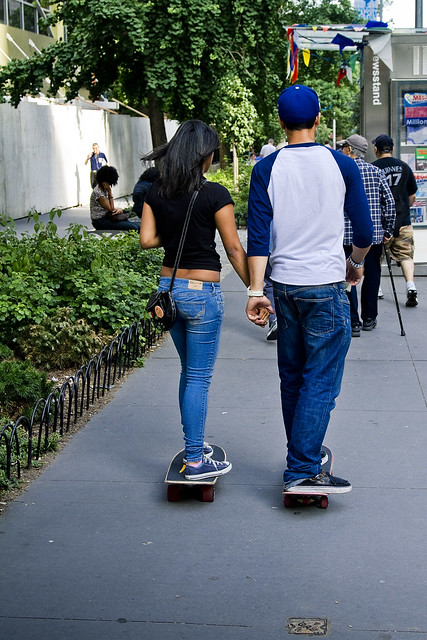
This young couple came rolling past me, texting and skate boarding while holding hands. They were young, at most sixteen. Seemed to be locals, likely from one of the many apartment complexes which neighbor Fulton Street.

– photo by Mitch Waxman
There was just something really sweet about these kids, who seemed to be lost in their own little world. The sight of them made even one as calcified as myself smile.

– photo by Mitch Waxman
Then, as is the case with such cycles of life, the young lovers were forced to separate as their path became blocked by others. The fellow hopped over the curb and headed south while the young lady continued toward some eastern destination.
diurnal prison

– photo by Mitch Waxman
During the colonial era, there were small operators who exploited the route in two masted ships called Periaugers, but it wasn’t until 1817- when a farm boy from Staten Island started a motorized service- that the most popular tourist destination in New York City truly got started. The farm boy bought a steamboat called Nautilus with a loan from his mother, which was captained by his brother in law. Not many people would recognize the name of that Captain- John DeForest- but it’s easy to be overlooked in the historical record when your brother in law was named Cornelius Vanderbilt.

– photo by Mitch Waxman
The consolidated City of New York took possession of the route from the Vanderbilts in 1905, as the family had moved into decidedly less maritime interests like railroads and real estate speculation. It’s run by the NYC DOT today, and is the most reliable of all the mass transit systems in the entire city with a 96% on time rate. The particular ferry boat in these shots is the Guy V Molinari, named for the long sitting and dynastic Borough President of Staten Island.

– photo by Mitch Waxman
An astounding set of statistics accompanies the huge orange boats which trawl back and forth between Staten and Manhattan Islands. The service crosses the archipelago some 35,000 times annually, carrying 60,000 people per day- which resolves to some 20 million riders per year. All free. The Ferry was the origin of the Vanderbilt empire, and when Cornelius Vanderbilt died in 1877- he was worth some 100 million dollars, which would be worth something like two billion today. He was born a pauper in 1794.

– photo by Mitch Waxman
The ferry terminals at both ends of the approximately 30 minute trip have recently been modernized and upgraded. Whitehall terminal in Manhattan allows connection to subway and bus lines, and on the Staten Island “St. George” side- you can catch the bus or Staten Island rail. Hundreds are employed directly by the operation, with a “long tail” of suppliers and contractors supplying various services and employing thousands more. The City recently issued an “RFP” or “Request For Proposal” for new and modernized ferry boats to augment the aging fleet.
devour and dissolve

– photo by Mitch Waxman
Just a short one today, as your humble narrator is quite the crunchy critter due to the exertions of yesterday’s Newtown Creek Tour committed for the Working Harbor Committee. The shot above is from the 5th of June, in this year, from an interesting vantage on the water near New Jersey.
Back tomorrow with some announcements of new tour dates, and something a bit more expansive to sink your teeth into. Here’s another shot of the same scene- capturing the spectacular, and high altitude, cloud formation in some detail and framed vertically.

– photo by Mitch Waxman
time worn

– photo by Mitch Waxman
One hundred and twenty nine years ago- on May 30, 1883- 12 people were killed and 35 wounded upon the Brooklyn Bridge in what would best be described as constituting a personal nightmare scenario to your humble narrator. I’ve never liked crowds, and shy away from congested areas where a sudden panic might carry me toward apotheosis randomly. Surely this is born of an experience in racially polarized South Brooklyn back in the early 1980’s when I found myself swept in the surge of a small race riot while onboard a bus.
from nytimes.com
A woman fell down the wooden steps at the end of the New-York approach to the Brooklyn bridge yesterday afternoon while the pathway was crowded with thousands of men, women, and children walking and passing one another. As she lost her footing another woman screamed, and the throng behind crowded forward so rapidly that those at the top of the steps were pushed over and fell in a heap.

– photo by Mitch Waxman
Weak, poorly developed physically, and given to panic- a young narrator watched with growing horror as a group of “Cugenes” (slang for Italian kids in my old hood) approached the Bushwick bound B78 bus intent on ferreting out a certain African American youth with whom they had a conflict. The Cugenes come onto the bus swinging, and as tribal affiliations ruled the day- the pushing started. I found myself a helpless and unwilling cork bobbing on a sea of witless hatred, an experience which has stayed with me to this day.
from wikipedia
The Brooklyn Bridge is one of the oldest suspension bridges in the United States. Completed in 1883, it connects the New York City boroughs of Manhattan and Brooklyn by spanning the East River. With a main span of 1,595.5 feet (486.3 m), it was the longest suspension bridge in the world from its opening until 1903, and the first steel-wire suspension bridge.
Originally referred to as the New York and Brooklyn Bridge and as the East River Bridge, it was dubbed the Brooklyn Bridge, a name from an earlier January 25, 1867 letter to the editor of the Brooklyn Daily Eagle, and formally so named by the city government in 1915. Since its opening, it has become an icon of New York City, and was designated a National Historic Landmark in 1964 and a National Historic Civil Engineering Landmark in 1972.

– photo by Mitch Waxman
Unending nightmares of such situations guide me to this day, and one is quite phobic about being trapped within a crowd without egress or a clear pathway of escape. I think it’s part of the reason that places like Times Square fill me with nameless dread, and I prefer the concrete desolations of the sparsely populated Newtown Creek.
I’m all ‘effed up.
from chroniclingamerica.loc.gov
A terrible disaster occurred yesterday afternoon on tho East River Bridge, by which twelve persons lost their lives and a great many others were injured more or less seriously. While there were no less than 15,000 persons on the Bridge, a blockade was formed on the footpath at the head of a flight of steps nine feet high extending from the masonry above the anchorage to the first iron truss, the same place at which blockades of people have occurred heretofore. A panic followed the pushing and struggling in which men and women tried to free themselves from the crowd. In the midst of this rush, started, it is thought by a gang of roughs, either thoughtlessly or with mischievous intent, several persons were carried over the edge of the steps. They fell on the landing and at the foot of the stairs, ethers stumbled on them, and more than forty persons were trampled underfoot by the panic-stricken multitude.
primitive ruins
– photo by Mitch Waxman
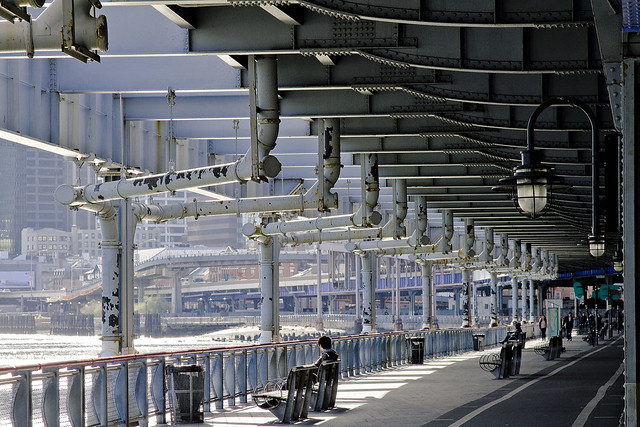
Recent business brought me to Manhattan, and an opportunity to walk along the East River while moving downtown presented itself. A spectacular promenade has recently emerged along the coast of the Shining City, much of which is unfortunately cement. Shiny and new, the sections above Corlears Hook made me a little nervous, as if one had wandered into an architect’s drawing populated by spandex wearing fitness models riding bicycles and running determinedly. Downtown, between East River Bridge Two and One (Manhattan and Brooklyn) this waterfront parkland was just grungy and old enough to feel lived in, by ordinary folk.

– photo by Mitch Waxman
It is difficult to complain about these open air trottoirs, which allow the citizenry a chance to gaze at the splendors of the harbor, especially given what these areas were like a mere 20-30 years ago. Trash strewn and off limits, New York had left its waterfront to rot away. The great shame of it all, and this is where the kvetching and Monday morning quarterbacking comes in, is that the infrastructure of docks and wharfs which literally made New York great is gone- never to return. Once something becomes a park, it is virtually impossible for it to return to other usage. No ship will be arriving here ever again.

– photo by Mitch Waxman
It’s the way of things, of course, and long ago was it decided that maritime interests were unimportant to Manhattan. So few are the docks on the island nowadays that it is scantly possible to find a berth. Word has it that the various waterfront vision plans include the usage of “temporary” or “floating” docks at some point in the future, but the days when a ship could unexpectedly arrive in the City- laden with some mysterious cargo from the south seas- seem to be over.


 The Newtown Pentacle