Posts Tagged ‘Astoria Park’
from Hells Gate, loosed upon the world

– photo by Mitch Waxman
The Friday of memorial day weekend, your humble narrator stumbled into the wilds of Astoria, headed for Astoria Park. Astoria Park is at the western end of Queens, and adjoins the East River, hosting parts of both the mighty Triboro Bridge and the sublime exemplar of bridge engineering called Hellgate. Named for the section of the East River it crosses, Hellgate was my intended destination and subject, and I was hoping for some visually interesting rail traffic to be crossing the great bridge. Frustrated by a gray and humid day, the Acela and other Amtrak traffic was observed, as well as a curious CSX double engine. Then…
from nycgovparks.org
Astoria Park, on the west shore of Queens, extends from south of the Triborough Bridge to north of the Hell Gate Bridge. With a panoramic view of the skyscrapers of midtown Manhattan in the south to the Hell Gate channel in the north, the scenery presents the diverse landscape of New York City. The Hell Gate channel, formed by faults deep underground, contains some of the deepest water in New York Harbor. Its treacherous reefs bear picturesque names such as “Hen and Chickens,” “Pot Rock,” “Bread & Cheese,” and “Bald Headed Billy.”
Throughout the centuries the stunning natural beauty of this location has attracted visitors and settlers. Before the arrival of European colonists, a trail passed by the site, and an Indian village flourished at Pot Cove. Local inhabitants grew maize on the shores, fished in Hell Gate, and drew water from Linden Brook, a small stream that still flows under Astoria Park South. In the mid-1600s the Dutch parceled out this land to various owners, including William Hallet whose grant embraced hundreds of acres. During the American Revolution, several British and Hessian regiments were stationed in the area. On November 25, 1780 the frigate Hussar and its five-million-dollar cargo sank to the bottom of Hell Gate, where despite some removal of cannons, the treasure still remains.

– photo by Mitch Waxman
I’ve become pretty familiar with NY Harbor in the last year, and can identify some of the common types of ships that cross its waters. Every now and then, however, a mysterious craft- an unidentified floating object or UFO if you will- crosses in front of me. Proceeding south, this catamaran (actually a trimaran) was nearly devoid of markings- which is remarkable in itself- and moving at a tremendous clip. Its “colorway” and hull shape instantly said “military” to me, but I could not recognize its specie.
from wikipedia
The first trimarans were built by indigenous Polynesians almost 4,000 years ago, and much of the current terminology is inherited from them. Multihull sailboats (catamarans and trimarans) gained favor during the 1960s and 1970s. Modern recreational trimarans are rooted in the same homebuilt tradition as other multihulls but there are also a number of production models on the market. A number of trimarans in the 19–36-foot lengths (5.8–11 m) have been designed over the last 30 years to be accommodated on a road trailer. These include the original Farrier – Corsair folding trimarans – and original John Westell swing-wing folding trimaran (using the same folding system later adopted also on Quorning Dragonfly) and like trimarans. Many sailboat designers have also designed demountable trimarans that are able to be trailered (like the SeaCart 30 by Oceanlake Marine).
The trimaran design is also becoming more widespread as a passenger ferry. In 2005 the 127-metre trimaran (417 ft) Benchijigua Express was delivered by Austal to Spanish ferry operator Fred. Olsen, S.A. for service in the Canary Islands. Capable of carrying 1,280 passengers and 340 cars, or equivalents, at speeds up to 40 knots, this boat was the longest aluminum ship in the world at the time of delivery. The trimaran concept has also been considered for modern warships. The RV Triton was commissioned by British defence contractor QinetiQ in 2000. In October 2005, the United States Navy commissioned for evaluation the construction of a General Dynamics Littoral Combat Ship (LCS) trimaran designed and built by Austal.

– photo by Mitch Waxman
Evocative, as on one hand it resembled a radar dodging stealth aircraft for the odd angles and aerodynamic shape, on the other it suggested a modern combat tank with its armor designed to deflect rather than defeat ballistic weapons.
The ship, nevertheless, was kicking up a huge wake and was shooting water behind it- some 10-20 feet high- as it rocketed down the East River.
from wikipedia
The littoral zone refers to that part of a sea, lake or river that is close to the shore. In coastal environments the littoral zone extends from the high water mark, which is rarely inundated, to shoreline areas that are permanently submerged. It always includes this intertidal zone and is often used to mean the same as the intertidal zone. However, the meaning of “littoral zone” can extend well beyond the intertidal zone.
There is no single definition. What is regarded as the full extent of the littoral zone, and the way the littoral zone is divided into subregions, varies in different contexts (lakes and rivers have their own definitions). The use of the term also varies from one part of the world to another, and between different disciplines. For example, military commanders speak of the littoral in ways that are quite different from marine biologists.
The adjacency of water gives a number of distinctive characteristics to littoral regions. The erosive power of water results in particular types of landforms, such as sand dunes, and estuaries. The natural movement of the littoral along the coast is called the littoral drift. Biologically, the ready availability of water enables a greater variety of plant and animal life, and the additional local humidity due to evaporation usually creates a microclimate supporting unique types of organisms.
The word “littoral” is used both as a noun and an adjective. It derives from the Latin noun litus, litoris, meaning “shore”. (The doubled ‘t’ is a late medieval innovation and the word is sometimes seen in the more classical-looking spelling ‘litoral’.)

– photo by Mitch Waxman
The “colorway” and camouflage of the craft suggested that the futurists of Britain still have modern adherents, long after the last of the “dazzle ships” were launched.
For those of you not in the know, the Dazzle Ships were an experiment in “breaking up the shape” of large combat vessels against the horizon, an attempt to reduce the visual profile of capital ships and reduce the ability of submariners to target vital areas of said ships. Dazzle works best at distance, which is what modern naval combat is all about.
from wikipedia
At first glance Dazzle seems unlikely camouflage, drawing attention to the ship rather than hiding it, but this technique was developed after the Allied Navies were unable to develop effective means to disguise ships in all weather.
Dazzle did not conceal the ship but made it difficult for the enemy to estimate its type, size, speed and heading. The idea was to disrupt the visual rangefinders used for naval artillery. Its purpose was confusion rather than concealment. An observer would find it difficult to know exactly whether the stern or the bow is in view; and it would be equally difficult to estimate whether the observed vessel is moving towards or away from the observer’s position.
Rangefinders were based on the co-incidence principle with an optical mechanism, operated by a human to compute the range. The operator adjusted the mechanism until two half-images of the target lined up in a complete picture. Dazzle was intended to make that hard because clashing patterns looked abnormal even when the two halves were aligned. This became more important when submarine periscopes included similar rangefinders. As an additional feature, the dazzle pattern usually included a false bow wave to make estimation of the ship’s speed difficult.

– photo by Mitch Waxman
As mentioned, my computer was down for the holiday weekend, but Our Lady of the Pentacle allowed me to use her laptop and I managed to get a few of these images out to that clandestine and anonymous network of maritime enthusiasts and quasi governmental experts who advise, comment, or offer corrections to your Newtown Pentacle. Credit for identifying this craft goes out to them, and I wish that they would allow me to sing praise publicly, but certain conflicts of interest or oaths of secrecy demand that they must always be referred to as “anonymous sources”. In this case, the ultimate sources will be referred to as Daidalos and Icaros (hey, it is Astoria Park).
from wikipedia
It is in images, not in texts that Daedalus is seen with wings; many Greek myths appear to have been invented to make sense of known but inexplicable images. The most familiar literary telling explaining Daedalus’ wings is a late one, that of Ovid: in his Metamorphoses (VIII:183-235) Daedalus was shut up in a tower to prevent his knowledge of his Labyrinth from spreading to the public. He could not leave Crete by sea, as the king kept strict watch on all vessels, permitting none to sail without being carefully searched. Since Minos controlled the land and sea routes, Daedalus set to work to fabricate wings for himself and his young son Icarus. He tied feathers together, from smallest to largest so as to form an increasing surface. The larger ones he secured with thread and the smaller with wax, and gave the whole a gentle curvature like the wings of a bird. When the work was done, the artist, waving his wings, found himself buoyed upward and hung suspended, poising himself on the beaten air. He next equipped his son in the same manner, and taught him how to fly. When both were prepared for flight, Daedalus warned Icarus not to fly too high, because the heat of the sun would melt the wax, nor too low, because the sea foam would soak the feathers.

– photo by Mitch Waxman
Daidalos was actually stumped when the photos arrived, and neither of us could make any sense of the only marking- a string of tiny numbers on the hull- of this unidentified floating object. High flying, Icaros received the shots from the latter, and contacted high ranking members of a certain governmental entity. This entity- let’s just say that they have lots of boats and planes, and boats that are airports, and boats that carry nuclear missiles and stay underwater for months at a time, and a lot of the people who work for it wear white dress uniforms– claimed the ship as theirs!
from wikipedia
From the time of its inception, the military played a decisive role in the history of the United States. A sense of national unity and identity was forged out of the victorious Barbary Wars, as well as the War of 1812. Even so, the Founders were suspicious of a permanent military force and not until the outbreak of World War II did a large standing army become officially established.
The National Security Act of 1947, adopted following World War II and during the onset of the Cold War, created the modern U.S. military framework; the Act merged previously Cabinet-level Department of War and the Department of the Navy into the National Military Establishment (renamed the Department of Defense in 1949), headed by the Secretary of Defense; and created the Department of the Air Force and National Security Council.
The U.S. military is one of the largest militaries in terms of number of personnel. It draws its manpower from a large pool of volunteers; although conscription has been used in the past in various times of both war and peace, it has not been used since 1972. As of 2010, the United States spends about $692 billion annually to fund its military forces, constituting approximately 43 percent of world military expenditures. The U.S. armed forces as a whole possess large quantities of advanced and powerful equipment, which gives them significant capabilities in both defense and power projection.

– photo by Mitch Waxman
What you have just seen, lords and ladies, shooting down the East River at high speed was described as a (JHSV) Joint High Speed Vessel.
A JHSV can comfortably carry 300 fully armed MARINES, or up to 600 in a pinch. Alternatively, it can move multiple main battle tanks- the astounding M1 Abrams. Just so you understand, 600 is near the low end of Battalion strength, and 600 U.S. Marines could probably claim a beachhead in Hell itself if they were asked to. It also has a landing pad for a helicoptor.
This ship is huge… but a helicoptor pad?
from navy.mil
Description
The JHSV program is procuring high-speed transport vessels for the Army and the Navy. These vessels will be used for fast intra-theater transportation of troops, military vehicles and equipment. The JHSV program merges the previous Army Theater Support Vessel (TSV) and the Navy High Speed Connector (HSC), taking advantage of the inherent commonality between the two programs.
JHSV will be capable of transporting 600 short tons 1,200 nautical miles at an average speed of 35 knots. The ships will be capable of operating in shallow-draft ports and waterways, interfacing with roll-on/roll-off discharge facilities, and on/off-loading a combat-loaded Abrams Main Battle Tank (M1A2). Other joint requirements include an aviation flight deck to support day and night air vehicle launch and recovery operations.
JHSV is a commercial-design, non-combatant transport vessel, and does not require the development of any new technology. JHSV is being built to American Bureau of Shipping (ABS) High Speed Naval Craft Guide. Systems onboard will be based on commercial ABS steel vessel rules. As such, it does not require the survivability and ability to sustain damage like the LCS. It has no combat system capability and no ability to support or use LCS mission modules. It will leverage non-developmental or commercial technology that is modified to suit military applications. Select military features include Aviation; Command, Control, Communications, Computers, and (Military) Intelligence; and Firefighting for the Mission Bay. NVR does not apply to any part of JHSV.
As a non-combatant sealift ship, the Navy variant of JHSV will be crewed by civilian mariners, either employed by or under contract to the Navy’s Military Sealift Command. U.S. Army vessels will be crewed by Army craft masters. Both versions will require a crew of approximately 22-40 people, but will have airline style seating for more than 300 embarked forces and fixed berthing for approximately 100 more.
However… This is not a JHSV!!!
This here is the M80 Stiletto.

– photo by Mitch Waxman
Check out this video at youtube which explains the Stiletto’s potential in great detail, and supplies 3D animation for operational scenarios.
With the formal roll-out of the 88-foot Stiletto stealth ship and its cutting-edge “M-Hull” wave-damping design, that legacy takes another step forward. The Stiletto is part of Project WolfPac, which aims to test new concepts of shallow-water and riverine warfare organized around swarms of smaller, affordable ships linked by communications. The Stiletto can slip into shallow waters, launching inflatable boats and even UAVs while serving as a communications hub via its “electronic keel.” Best of all, the M-Hull significantly reduces the pounding its occupants take from waves – poundings that often result in back injuries that cut careers short, or leave sailors with lingering disabilities in later life.
and from wikipedia
The 88-foot (27 m) long vessel has a notable hull design, an M-shaped hull that provides a stable yet fast platform for mounting electronic surveillance equipment or weapons, or for conducting special operations. The hull design does not require foils or lifting devices to achieve a smooth ride at high speeds in rough conditions. Its shallow draft means the M80 Stiletto can operate in littoral and riverine environments and potentially allows for beach landings.
The M80 Stiletto is equipped with four Caterpillar, Inc. C32 1232 kW (1652 HP) engines yielding a top speed in excess of 50 knots (90 km/h) and a range of 500 nautical miles (900 km) when fully loaded. It can be outfitted with jet drives for shallow water operations and beaching.
It has a topside flight deck for launching and retrieving UAVs and a rear ramp that can launch and recover an 11-meter rigid-hull inflatable boat (RIB) or Autonomous Underwater Vehicle (AUV).
It weighs 45 tons unloaded, light enough that it can be hoisted onto a cargo ship, while still able to carry up to 20 tons of cargo in the 1,996 square feet (200 m2) of usable interior space. The ship is 88.6 feet (27.0 m) in length, with a width of 40 feet (12 m) and a height of 18.5 feet (5.6 m), yet has a draft of only 2.5 feet (0.8 m).
The M80 Stiletto is the largest U.S. naval vessel built using carbon-fiber composite and epoxy building techniques, which yields a very light but strong hull. The prototype M80 Stiletto is expected to be in use in less than one year. Ships are expected to cost between $6 and $10 million
The Hermetic Hungarian responds

Down under the Hell Gate Bridge Onramp- DUHGBO – photo by Mitch Waxman
A recent posting- Hungry Ghosts– detailed the lengthy and pedantic debate over the merits of Film vs. Digital photography enjoyed by myself and that erudite Manhattanite known to long time readers of this Newtown Pentacle as the Hermetic Hungarian.
The Hungarian responds:
32. Not 22. Two times 16. And they are all great. Ain’t gonna scan ’em. Projected ’em from my 2-1/4″ slide projector. Dee-lish.
And it’s not that I dislike digital, it’s that there is no digital equivalent of black & white. A photo-chemical process which leaves traces of its origins throughout the process. Palimpsests. Ghosts.
I’m probably gonna get a G-11 or used G-10 (it was the stupid human interface that put me off the S-90, not to mention Adobe’s brain-dead policies) to fool with while I wait for version 2 of Leica’s digital M-9 to come out. Upon which I will then be able to attach all but two of my 14 Leica lenses. (To be fair, one of my lenses can only go on my vintage 1948 Leica IIIf due to the extreme distance the rear element projects into the body. It would kill a modern body with a built-in meter).
–Légmentesen Magyar AKA “HH”

Review Ave. trucking – photo by Mitch Waxman
Back on track tomorrow, with a proper posting, did you realize we’re in the midst of the Lemuralia?
hungry ghosts

– photo by Mitch Waxman
On a recent sunlit afternoon, the Hermetic Hungarian ventured forth from the Shining City once again. Recovered from a spell of bad dreams which our recent visit to the Grand Ave. Bridge- with all its loathsome implications- had awakened in him, the studied recluse announced that a new digital camera was in his possession which needed a test drive. Always an atavist and luddite, the Hermetic Hungarian (HH from this point on) had already decided that it was inferior to the chemical emulsion process of image capture- film- which he has spent much time mastering.
This, like the Mac vs. PC debate, is a conversation that your humble narrator does not wish to have anymore.
from wikipedia
Operating system advocacy is the practice of attempting to increase the awareness and improve the perception of a computer operating system. The motivation behind this may be to increase the number of users of a system, to assert the superiority of one choice over another or out of brand loyalty, pride in an operating system’s abilities, or to persuade software vendors to port specific applications or device drivers to the platform.
Operating system advocacy can vary widely in tone and form, from published comparisons to heated debates on mailing lists and other forums. In its most extreme forms it can veer into zealotry. Advocates are often normal users who devote their spare time to advocacy of their operating system of choice; many have a deep and abiding interest in the use, design and construction of operating systems and an emotional investment in their favourite operating system.

– photo by Mitch Waxman
Allow me to lift the curtain for this post- and talk shop.
Once upon a time, in the brash days of youth, I too shot film. I carried a Yashica FX3 fully manual, 1984 vintage camera, which I still have. Unfortunately, the cost of the film itself and the consequent expense of development and printing cramped my urge to shoot and shoot. For years, I had a goofy point and shoot 35mm camera, which has long disappeared into gadget heaven. When the Canon Elph’s first came out, I was hooked on digital and haven’t looked back since. Yes, the recording medium of film is capable of capturing and storing FAR more information than a digital shot can- even today. But- as I’ve mentioned in the past- I work in the advertising industry.
from nycgovparks.org
Astoria Park, on the west shore of Queens, extends from south of the Triborough Bridge to north of the Hell Gate Bridge. With a panoramic view of the skyscrapers of midtown Manhattan in the south to the Hell Gate channel in the north, the scenery presents the diverse landscape of New York City. The Hell Gate channel, formed by faults deep underground, contains some of the deepest water in New York Harbor. Its treacherous reefs bear picturesque names such as “Hen and Chickens,” “Pot Rock,” “Bread & Cheese,” and “Bald Headed Billy.”
Throughout the centuries the stunning natural beauty of this location has attracted visitors and settlers. Before the arrival of European colonists, a trail passed by the site, and an Indian village flourished at Pot Cove. Local inhabitants grew maize on the shores, fished in Hell Gate, and drew water from Linden Brook, a small stream that still flows under Astoria Park South. In the mid-1600s the Dutch parceled out this land to various owners, including William Hallet whose grant embraced hundreds of acres. During the American Revolution, several British and Hessian regiments were stationed in the area. On November 25, 1780 the frigate Hussar and its five-million-dollar cargo sank to the bottom of Hell Gate, where despite some removal of cannons, the treasure still remains.

– photo by Mitch Waxman
What used to happen when a photo entered the agency was that a medium or large format “chrome”- which is a sort of giant slide- would be handed off from photographer to agency (and still does, sometimes). This chrome would then be photostat reproduced (in the very old days) and it’s “for position only or F.P.O.” representation would be worked into a mechanical board so that the printer would understand where to place it or “strip it in”. When the Macintosh came along, the chrome would instead be scanned, at first by highly specialized devices called drum scanners and later by advanced versions of tabletop scanners.
The digital scan actually matters more than the original at this moment, and the tipping point from film to digital was reached when the ad agencies began requesting digital files from their photographers.
from omh.state.ny.us
Kirby Forensic Psychiatric Center, a maximum security hospital of the New York State Office of Mental Health (OMH), opened in 1985 and provides secure treatment and evaluation for the forensic patients and courts of New York City and Long Island. Most patients are received through the courts under Criminal Procedure Law (CPL) or through the OMH Commissioner’s office via the New York State Code of Rules and Regulations (NYSCRR) regarding hospitalization of the mentally ill.
Treatment is provided in accordance with the current standards of professional care outlined by the Joint Commission of Accreditation of Health Organizations (JCAHO) and is carried out with respect for each patient’s privacy and rights, in agreement with his/her level of functioning and need for security. KFPC has an active staff education program as well as academic affiliations with several metropolitan area colleges and universities, to help assure quality treatment and state of the art care.
and from wikipedia
The Manhattan Psychiatric Center is a New York-state run psychiatric hospital on 125th Street on Ward’s Island in New York City. As of 2009 it had 509 beds. The current building is 14-stories tall.
The hospital’s roots date to 1848 when Ward’s Island was designated the reception area for immigrants. Some additional structures were originally part of Blackwell’s Island Lunatic Asylum, which opened around 1863.
The building was significantly enlarged in 1871, and a Kirkbride Plan style building was built. After the immigration entry shifted to Ellis Island in 1892 the state took it over from Manhattan in 1899 and expanded it even further. At the time, it had 4,400 beds and was the largest psychiatric hospital in the world.
At the time it was one of two psychiatric hospitals for residents of Manhattan that had been take over by the state. The other psychiatric hospital would become the Central Islip Psychiatric Center in Central Islip, New York. Both hospitals were referred to as Manhattan State Hospital.
It later became the Manhattan Psychiatric Center. The facility is currently run by the New York State Office of Mental Health.

– photo by Mitch Waxman
Its taken the camera companies a while to catch up with the desktops, but they’re getting close- the high end Canons, for instance, do 25.3 megapixel shots (which I’ve retouched and let me say that these are well wrought images).
My current cameras- the Canon G10 and Canon T1i both hit 15 megapixels, giving me ample detail and clarity. I’ve got fairly quick SDHC cards in them, which allows burst shooting, and at any given time I’m ready to pop off a couple of thousand exposures. The batteries in both are rechargeable, and once the photos are copied to my desktop- the cards are formatted and used over and over. Film never offered me this kind of freedom to just shoot and shoot.
from wirednewyork.com
The massive beauty and advanced technology of the Hell Gate Bridge (more properly the New York Connecting Railroad Bridge) contrast sharply with nineteenth-century descriptions of the channel that it spans. Named for the dangerous rocks and perilous waters at the confluence of the East and the Harlem Rivers, Hell Gate is surrounded by Manhattan, Queens, and three islands: Wards, Randalls, and Roosevelt (formerly called Blackwell’s, then Welfare). Philip Hone (1780 -1851), writing of an 1844 visit there, described “the delightful scene: the clumps of fine old trees clothed in the gorgeous foliage of autumn, the lawn still bright and green, the mild, refreshing breeze, the rapid waters of Hell Gate covered with sailing vessels and steamboats -all combined to present a picture of consummate beauty.“

– photo by Mitch Waxman
HH, however, feels limited by digital- as do other “old school” photographers encountered during my long walks through and around the Newtown Pentacle. He lugs around a gigantic medium format film camera, which is a best of breed sort of machine. Coney Island Mike, another friend of the Pentacle, also decries the prevailing winds of technological advancement and pines for some 1970’s golden age of film availability and creative darkroom techniques.
I really do see the point, as mentioned above, film does capture and contain more information than any digital image can- so far.
from wikipedia
Construction was overseen by Gustav Lindenthal, whose original design left a gap of 15 feet (4.6 m) between the steel arch and the masonry towers. Fearing that the public assumed that the towers were structurally integral to the bridge, Lindenthal added aesthetic girders between the upper chord of the arch and the towers to make the structure appear more robust. The original plans for the piers on the long approach ramps called for a steel lattice structure. The design was changed to smooth concrete to soothe concerns that asylum inmates on Ward’s and Randall’s islands would climb the piers to escape.
The engineering was so precise that when the last section of the main span was lifted into place, the final adjustment needed to join everything together was 1⁄2 inches (12.7 mm). The bridge was completed on September 30, 1916.
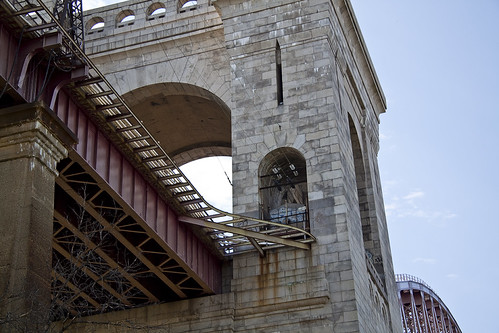
– photo by Mitch Waxman
Back at my day job as photo retoucher and advertising industry print production specialist, however, I can tell you that its the digital file that’s going to the printer- not a piece of film. That makes anything shot in film second generation at best. Of course, many of the images I present here are highly processed- shot in raw format, sharpened or color corrected in photoshop, or produced by esoteric digital sleight of hand like “tilt shifting” or HDR.
(all the shots in this post are “straight” shots, raw files which were fed through my normal workflow)
from nycroads.com
PROVIDING A MUCH-NEEDED RAILROAD CONNECTION: In 1892, Oliver W. Barnes, an engineer associated with Pennsylvania Railroad president Alexander J. Cassatt and bridge designer Gustav Lindenthal, conceived plans for the Hell Gate Bridge. Cassatt saw the Hell Gate project – originally called the “East River Arch Bridge” – as an opportunity to bring rail traffic from Pennsylvania Railroad routes in New Jersey and points west through New York City to New England. The project was to also tie into the Long Island Rail Road routes, in which the Pennsylvania Railroad had a controlling interest. Meanwhile, Lindenthal saw the Hell Gate project as his chance to construct his Hudson River Bridge, a suspension bridge with a 2,800-foot-long main span that would have been the longest in the world. That same year, the New York Connecting Railroad was incorporated to help realize this plan.
In 1904, Lindenthal, who oversaw the opening of the Williamsburg Bridge and the construction of the ongoing Manhattan Bridge and Queensboro Bridge projects, was chosen as consulting engineer and bridge architect by the Pennsylvania Railroad, which had just acquired the New York Connecting Railroad. Under these auspices, Lindenthal was engaged in a project to connect the tracks of the Pennsylvania Railroad in New Jersey, the Long Island Rail Road in Queens, and the New York, New Haven and Hartford Railroad in the Bronx. Although the project allowed Lindenthal to design the Hell Gate span, it would not include his long-sought goal: a great suspension bridge across the Hudson River. Instead, the Pennsylvania Railroad decided to use exclusive tunnels for rail traffic across the Hudson and East rivers.

– photo by Mitch Waxman
One of the mantras that I’ve followed since my heady days at art school (School of Visual Arts) where I studied Illustration and Comic Book art is that you don’t need to use expensive mediums to make a good image. In accordance, my friends and I used to draw comics on brown paper bags or whatever other commonplace material we could procure. Later on in life, I will admit to the occasional red sable brush purchase, but by and large most of my “kit” came from staples and I’ve done comic cover art that was colored with Crayola Markers in the past.
I try to follow this philosophy with photography, which is the greatest way to spend money- short of crack addiction- that America has ever found.
from wikipedia
On June 15, 1904, the General Slocum caught fire and burned to the waterline in New York’s East River. At the time of the accident she was on a chartered run carrying members of St. Mark’s Evangelical Lutheran Church (German Americans from Little Germany, Manhattan) to a church picnic. An estimated 1,021 of the 1,342 people on board were killed. The General Slocum disaster was the New York area’s worst disaster in terms of loss of life until the September 11, 2001 attacks.[2] The events surrounding the General Slocum fire have appeared in a number of books, plays and movies through the years.

– photo by Mitch Waxman
Fantasies about radio triggers and tripods that cost more than my first car bounce in my head, and I fiend for trick and ultra wide angle lenses. I pore over the BH Photo catalog in the manner of a fetishist, but it’s just camera pornography to me. I can barely afford to feed my little dog Zuzu these days, and Our Lady of the Pentacle has suggested homespun garments for next winter. HH however, insists that no digital camera he’s yet found suits him. I suggested either a Canon G10 or G11 to him, or if portability was a consideration- the very attractive Canon S90.
from wikipedia
Amtrak is no longer required by law, but is encouraged, to operate a national route system.[ Amtrak has some presence in all of the 48 contiguous states except Wyoming and South Dakota. Service on the Northeast Corridor, between Boston, Massachusetts, and Washington, D.C., as well as between Philadelphia and Harrisburg, Pennsylvania, is powered by overhead wires; for the rest of the system, diesel locomotives are used. Routes vary widely in frequency of service, from three trips weekly on the Sunset Limited (Los Angeles, California, to New Orleans, Louisiana), to weekday service several times per hour on the Northeast Corridor, (New York City to Washington, D.C.) Amtrak also operates a captive bus service, Thruway Motorcoach, which provides connections to train routes.
The most popular and heavily used services are those running on the Northeast Corridor (NEC), which include the Acela Express, and Northeast Regional. The NEC serves Boston, Massachusetts; New York City; Philadelphia, Pennsylvania; Baltimore, Maryland; Washington, D.C.; and many communities between. The NEC services accounted for 10.0 million of Amtrak’s 25.7 million passengers in fiscal year 2007. Regional services in California, subsidized by the California Department of Transportation are the most popular services outside of the NEC and the only other services boasting over one million passengers per annum. The Pacific Surfliner, Capitol Corridor and San Joaquin services accounted for a combined 5.0 million passengers in fiscal year 2007.

– photo by Mitch Waxman
These shots, of course, were accomplished with my increasingly trusty DSLR- the Canon T1i, but the vast majority of photos you’ve endured at this blog have emanated from the Canon G10. The S90 is functionally a G10 with a smaller lens and form factor, will be dramatically discounted around Christmas, and HH ordered one to try out. That’s how we ended up in Astoria Park. Originally, we planned on walking the Triborough Bridge, but last minute information reached me that the Bridge has a series of “Photography Prohibited” signs posted and we decided that it just wasn’t worth the potential hassles with the law.
That’s what the eggheads call a “chilling effect on civil liberties” in action, by the way.
from railroad.net
As a retired TBTA sgt, I can definetly state that photography IS STRICTLY FORBIDDEN on all bridges & tunnels operated by that agency. This edict has been in effect for many years, but it was not strictly enforced before 9/11/01. It is now. Signs prohibiting “filming” are, (and have been all along) posted at all facilities. Summonses can, & usually will be issued (criminal court “C’ summonses) to filmers/videotapers who are seen “filming” on TBTA property (mainly bridges, tunnels and toll plazas, but also in other areas under control of the TBTA).

– photo by Mitch Waxman
Over the course of an hour or so, your humble narrator cracked out a couple of hundred exposures, a few of which were good enough to “show”. HH shot 22. I had mine “developed” and online within 48 hours (I was busy) and HH waited a full week for his transparencies to be shipped to him. Are HH’s shots superior to mine? I still don’t know, because he hasn’t managed to scan them yet. I’m not mocking him, nor deriding film, just stating that immediacy is a selling point for me as well.
As a good American, I crave and demand instant satisfaction, sometimes for urges I don’t know I have yet.
from wikipedia
Ward’s Island is situated in the East River in New York City. Administratively it is part of the borough of Manhattan. It is bridged by rail to the borough of Queens by the Hell Gate Bridge and it is joined to Randall’s Island to the north by landfill. The two Islands together are run by the Randall’s Island Sports Foundation under a partnership agreement with the New York City Department of Parks and Recreation. Together, the two islands form New York County’s Census Tract 240, which had a total population of 1,386 living on 2.2 km² of land area, according to the United States Census, 2000.
Viaducts leading to the Robert F. Kennedy Triborough Bridge and Hell Gate bridges pass overhead. Vehicular access is by the Little Hell Gate bridge from Randall’s Island, while a narrow pedestrian and bicycling bridge, Ward’s Island Bridge, links the island to the east side of Manhattan in Harlem.

– photo by Mitch Waxman
The Hermetic Hungarian of course, feels the least melancholy when surrounded by relict technologies. The upper west side rooms he occupies enjoy shelves of watch making equipment and rare mechanisms which originate in the darkest corners of Europe. His current project is to end time mechanically, freezing the world’s motion by the actions of a vast clockwork which he is assembling in accordance with instructions found on a scroll that might be written in Sanskrit that HH claims were scribed by some mad monk.
At my insistence, he has not installed a battery or self winding mechanism on the device, so sleep easily, my Lords and Ladies of Newtown.
from wikipedia
The Bhavacakra is represented as being held by the jaws, hands, and feet of a fearsome figure who turns the wheel. The exact identity of the figure varies. A common choice for the figure is Yama, the god of death or Kala the lord of time. This figure is also known as the “Face of Glory” or Kirtimukha.
There is always a figure or symbol in the upper left and the upper right. The exact figure or symbol varies; common examples include the moon, a buddha, or a bodhisattva. In the picture of the Tibetan Bhavacakra in Sera, Lhasa the clouds take the shapes of certain Buddhist symbols, eg. svastika.
Catherine Turecamo at HellsGate, and camera news

– photo by Mitch Waxman
Technical upgrades have occurred here in Pentacle HQ. A new DSLR, which was quite unaffordable, has been purchased from the unknowable levantines at BH Photo. The trusty Canon G10, in use since its issuance in late 2008, is off to Canon for warranty service owing to the defects that have appeared on its lens. Said scratches seem to originate from the mechanical action of the external housing which are meant to protect the lens element. These scratches have, after shooting some 17,000 exposures in the last year, become quite noticeable and are getting in the way. The G10 will return to Newtown Pentacle service upon repair, and is highly recommended to all for its versatile nature, manual shooting modes, ability to save in RAW format, and crisp lens- although it falls apart in low light and is useless at high ISO speeds. The flash is also pathetic.

– photo by Mitch Waxman
Deciding to take the plunge into the DSLR world, our lady of the Pentacle and myself worked out a budget, and research on what was available in my price point began. Things narrowed to the Nikon D90 and Canon Rebel T1i (or 500D). The Nikon is wielded by a buddy of mine to great effect, and offers the promise of a “full size” sensor. The Nikon ecosystem of accessory lenses and other bits is also a little less expensive than commensurate equipment in the Canon range. The Canon, however, matches the 15 megapixel spec of the G10 (also a Canon) and also offers an operating system that seemed a bit more organic to me. I use a Mac, always have, and have quit jobs that forced me to use a windows PC in the past. Organic matters to me, which is why a Sony camera was never considered. (imho Sony makes the best Hardware-Everything, and the worst software-Everything).

– photo by Mitch Waxman
So, having spent a ton of money I don’t have, the plunge was taken on the Canon T1i and a couple of decent lenses. Of course, this is after “the season” for photography in New York, which is actually most of the time- just not in December and January. Harsh shadow and blown highlights, overcast skies and leaden water- trademarks of the winter sun here in the Newtown Pentacle- the angle and frequency of the light is all wrong except in the early morning and late afternoon. Photography types term this as “golden hour”, which somehow sounds “dirty” to me.
So, on one of the few sunny days enjoyed of late, your humble narrator pulled the filthy black raincoat off its hook and scuttled forth to find what I could find. Hells Gate is always a good choice for experimenting with a new gizmo. Astoria Park is just about as safe these days as you can expect to be when out in public, and there’s always something interesting going on. I shot these with the “long lens”, which is fancy way of saying telephoto.
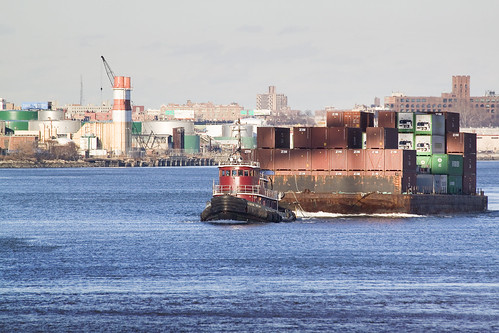
– photo by Mitch Waxman
That’s the Catherine Turecamo, a 1972 vintage 199 ton 3,200 HP tugboat, operated by the Moran towing company. It was built at the Main Iron Works in Louisiana as the MIss Lynn.
from morantug.com
Moran Towing Corporation has provided tugboat services to the Port of New York since 1860. The company began with Michael Moran’s purchase of-one-half interest in a tugboat. In the years since, the fleet with the white M logo on its stacks has become the largest in the port,and on the U.S. East and Gulf Coasts. The port of New York-New Jersey provides access to the most concentrated and affluent consumer market in the world. Its facilities include terminals operated by the Port Authority of NY & NJ and privately operated terminals. Over 16 million tons of cargo pass through the port on an annual basis, transported aboard various types of ships, including container ships, tankers and barges. The New York division also services the Port of Albany, located 145 miles up the Hudson River from New York City. Albany is a hub for commercial trade in its region, due to its proximity to the New York State Barge Canal and its excellent inland transportation network.

– photo by Mitch Waxman
The new camera was a little awkward to handle at first, and I was self conscious of it as well. This was a big “honking” camera, weighing four times what my familiar “rangefinder-sized” G10 did. I practiced tracking the tugboat with it, zooming in and out and so on. I think the shots came out alright- if you click through to the photo’s Flickr page and check out its larger incarnations- you’ll see some real detail in them. This is one of the places where the higher megapixel count of the Canon matters to me, and justified buying into its franchise.
Trust me on this one, I’m an advertising retoucher photoshop guy by day, and resolution matters. A lot.

– photo by Mitch Waxman
I’m only a couple of thousand shots in, a month later. Its been a busy month somehow, with holiday obligation and hiding in my warm burrow awaiting spring. Meanwhile, I’ll be learning how to use this new gizmo.
Incidentally, on the subject of gizmos, anyone out there have anything to say on geotagging? Leave me a comment or contact me, if you do.
Gangster town

– photo by Mitch Waxman
I’m hooked on a few basic cable crime “reality shows” at the moment, as I sit out the “dark and cold” season. My favorite of these entertainments, so far, is the lurid charm of “Mobsters“. Cheaply produced by overseas staff, the show presents a basic reportage of the New York organized crime story- as told by federeal prosecutors for an international audience. A topical and shallow montage of the “official” story is what TV shows such as “best of breed” “Mobsters” present, as it were or as I’ve termed it- Mobster-Porn.
What I find interesting about the storytelling technique of these shows are the usage of long tracking shots featuring Astoria which underpin the narrative. The shot above, for instance, is similar to one of the mobster-porn standbys. Usually this is used to demonstrate an ethnic neighborhood, a tracking shot interspersed with depression era stock footage of the lower east side, which birthed the racketeer focused on in a particular week’s episode.
Ironically, this is one of the nicest blocks in all of Astoria, a nearly suburban lane which abuts Astoria Park.

– photo by Mitch Waxman
In the past, I’ve mentioned that Newtown Pentacle HQ is housed in a Matthews Model Flat “new model tenement” apartment. The particular block I live on is the setting of much of “A Bronx Tale“- Sonny’s Bar (in reality a Karate Studio) is on the corner, as is the apartment house Robert DeNiro was meant to live in. The church seen in the film is St. Joseph’s and the funeral home is across the street from it on 30th avenue. The school attended by the kids in the film is a block away as well. Area delis and restaurants proudly sport pictures of the great actor stuffing their wares into himself and exhibiting his trademark grin.

– photo by Mitch Waxman
Of course the hollywood angle in using Astoria for its location shoots is that the older housing stock and relict buildings of the ancient village are reminiscent of what Manhattan once looked like. The radical theory of Urban Renewal practiced in the 20th century, which has only just gotten around to Long Island City and North Brooklyn using the alias “up-zoning”, wiped out the old “New York” in Manhattan.
Ironically, many of the Racketeers showcased by “Mobsters” made the predominance of their fortunes in enterprises that were directly related to this Urban Renewal. Gambling was their primary source of income before the politicians offered up lucrative construction and carting work in the 50’s, especially a certain racket called “the numbers”. Ahh, the good old days…
Fascination with the “outlaw” archetype is buried deeply in the psyche of westerners, but trust me when I say that to be in the presence of such characters is actually not very much fun. Its a little scary hanging out with people for whom killing other people is “just another day at the office”. It’s not just the mobsters that make me nervous, of course, off-duty cops and soldiers also make me uneasy. I’m no warrior.

– photo by Mitch Waxman
The effect of this media imagery on the kids of the ancient village is profound. Admittedly, their major cultural influences in the decadent 21st century emanate from the violent gang cultures of the 1990’s, but maturing in an age which delights in youtube cruelty and televised urban warfare has had risible effects on the latest New Yorkers.
Of course, they aren’t acting like real gangsters, just emulating things that they see on TV- acting like actors acting like gangsters. A lot of blood gets spilled in this kabuki, but that’s all it really is, as the old rackets don’t pay as well as they used to and the new ones have a high mortality rate. Crime went official back in the 70’s, anyway, when Lotto was invented and the politicians muscled their way into the numbers. The government will be getting into the “new rackets” soon enough- organ brokering and drug legalization come to mind.
Modern New Yorkers know who runs the modern numbers racket, because the citizenry is always forced to pay “mob tax” in gangstertown, no matter who collects it. There’s only two warring crime families left these days, and they’re headquartered at executive palaces in Albany- not sipping espresso in some outer borough Salumeria.


 The Newtown Pentacle