Archive for the ‘Astoria’ Category
ritual nature
Walking up 31st street, in today’s post.

– photo by Mitch Waxman
I’ve always wondered about the usage of “up” and “down” when referring to local destinations, since such determinations should logically be circumstance based. Saying that, I know people who say “up on Ditmars” that actually live there and everyone in Astoria refers to Queens Plaza and Long Island City as “down there.” It’s weird. Additionally, you ever notice that most people will say “I HAVE to go into the City” versus “I WANT to go into the City”? Manhattan is the place for “have to” I guess. If you live in Astoria, and you “have to” you either need to go down to Broadway for the R/M subway, or over to 31st street for the N/W elevated.
As mentioned yesterday, 31st street in Astoria used to be Debevoise Avenue prior to the consolidation of the City of Greater New York, during and before the time that Astoria itself was part of an independent municipality called Long Island City which existed from 1870 to 1899. Before 1870, Astoria was officially a “village.” Shortly after NYC consolidation, and the opening of the Queensboro Bridge in 1909, the aforementioned subways started snaking out of Manhattan and off the bridge into Queens, and later on through underground and underwater tunnels. It’s hard to imagine today, but a century ago, Astoria was considered to be a suburb.

– photo by Mitch Waxman
First off, the government did not build or design the entire subway system. This is a really complicated subject, btw, and I’d recommend talking to the actual historical experts at the NYC Transit Museum about it if you’re interested.
NYC underwrote and facilitated a lot of the system, but the subways were built largely by two private companies – the IRT or “Inter Borough Rapid Transit Company” (which had already merged with and devoured the BRT or Brooklyn Rapid Transit Company) and the BMT or “Brooklyn Manahattan Transit Corporation.” There was also an IND or “Independent City-Owned Rapid Transit Railroad,” which was – in fact – a governmental entity. IRT (MTA “A” division) and BMT (MTA “B” division) built lines have different car widths and specifications, meaning that even today – more than a hundred years later – you can’t run one Division’s train set through another’s station due to the width of the cars and platforms. Same sort of thing is true for LIRR and Metro North, believe it or not.
The BMT Astoria line tracks were originally part of the IRT system, just like the Flushing or 7 line. Both use a platform at the Queensboro Bridge, but they split up after that station to work their different routes. The Astoria line opened on the 1st of February in 1917, and its station specifications were built to IRT (Inter Borough Rapid Transit Company) standards. In 1920, the 60th street tunnel opened, which allowed BMT (Brooklyn Manahattan Transit Company) trains to reach Queensboro, where you could transfer to the local bound IRT Astoria line trains. In 1923, BMT had figured out how to run their rolling stock as shuttles through IRT stations on the Flushing Line, but that didn’t last too long. In 1940, both BMT and IRT were bought by NYC from their shareholders and merged with IND into one entity owned outright by the City of New York. About 1949, as far as I’ve been able to figure it, the platforms on the Astoria line were altered to allow the wider BMT train sets to operate along it, and the Flushing line became IRT only. The Astoria line ended up becoming the northern terminus of the BMT’s Brighton/Broadway local service with the equivalent of the modern day N and W lines running up 31st street to the terminal stop at Ditmars Blvd.
Whew!

– photo by Mitch Waxman
As a note, I have assiduously avoided writing about the Dual Contracts era for nearly a decade now. Finally trapped myself into talking about it, so mark your calendars.
One thing which always occurs to me when walking up 31st street is the relative lack of street level retail activity along it. There’s shops and all that sure, but you don’t see the sort of thriving commercial activity which you do along Roosevelt Avenue under the 7 line. I’ve always wondered why.
More tomorrow.
“follow” me on Twitter- @newtownpentacle
vague hints
Astoria, will thy wonders never cease?

– photo by Mitch Waxman
The other night, a brief respite from the stinging cold occurred and I stumbled out of HQ into the looming dusk. My ideation involved no destination, rather it was just a desire to give my internally lubricated parts a chance to operate. There’s so much sitting and hiding from the cold this time of year that a man of my age finds himself stiffening up without a regular scuttle. During warmer climes, I’m out and about all the time, but this is the time of year for which I build a pile of books to consume and address long standing projects. That means that when I do start moving around again, it hurts, and there’s sounds traveling along my skeleton which I do not like. Stretching my leg the other day created a resonance that sounded like hitting the strings of a Cello with a sack of oysters.
You’re about to see the big project I’ve been consumed by for the last few months at the start of Februrary, incidentally, which is what a lot of this sitting in front of my desk has revolved around. It’s the start of a whole chain of “stuff” which I’ve been working on, which will be revealed over the coming months.
My path carried me down Astoria’s Broadway, and at the corner of 35th street, my eye was caught by the signage of Dave Shoes. I’m sure I’ve mentioned this subject in the past, but I’m fascinated by the offerings of this small business.

– photo by Mitch Waxman
A bit of quick research revealed that a man’s foot requiring a “size 18” shoe can be expected to display a heel to “big” toe length of thirteen and five sixteenth inches, and that a six “E” shoe width translates out to a foot of some six and one eighth inches across. That’s a pretty big foot. Apparently the average American male can be expected to wear a “size ten” and “d” or “m” width shoe.
I’ve experienced a certain foible of human biology which younger readers probably haven’t, as of yet. That’s the tendency of the human foot to spread out and its arch to become more shallow as you grow older. In High School and early college, already fully grown, I wore a size nine and one half shoe. By the time I was thirty, a size ten was required. These days, an eleven is what I buy at the shoe shops. Presuming I somehow make it through another twenty years, my shoes will likely look like swimmer’s fins with my toes extending several feet out in front of me, and it’s likely I won’t be scuttling but instead flopping along the bulkheads like a seal by then. I’ll probably be a much better swimmer, so there’s a silver lining. Saying all that, barring some cartoonish interaction with a steam roller, I doubt I’ll ever be shopping for a size 18 6E shoe.
A humble narrator will likely need to forgo the usage of escalators in this dire future.

– photo by Mitch Waxman
Modernity is so boring. 31st street? Really? Can’t we just go back to Debovoise Avenue, which is what 31st used to be called in Astoria’s 19th century? I’ll admit that the old system, when 31st avenue was Jamaica Avenue and 30th was Grand Avenue, was a bit confusing to outsiders but at least Astoria was safer in case of an invasion. The north/south streets and east/west avenues and using numbers instead of names are some times called the Philadelphia plan. The “Commissioners Plan” rules the roost in Manhattan, where the streets are east/west and the avenues north/west, as a note. Post NYC Consolidation, the new powers that be in City Hall created the modern day street grid of Queens by renaming all of the hodge podge street names offered by all the independent towns, cities, and villages that predict dated 1898.
That’s why you’ll encounter those corners where time and space bend in on themselves like 31st avenue at 31st street.
More tomorrow.
“follow” me on Twitter- @newtownpentacle
meagre documentary
Mind your yum yums, it’s cold outside.

– photo by Mitch Waxman
Intrigued by some of the sights observed and recorded at Flushing Bay recently, a humble narrator decided that a return to the premise was required. My goal destination was the corner of 31st drive and Ditmars Blvd., where the NYC Parks Department offers free passage over the Grand Central Parkway via a pedestrian bridge that terminates at the entrance to their “Flushing Bay Promenade” facility. Of course, waking up in Astoria introduces a lot of “how do I get there” questions when discussing the north eastern shorelines of Queens. I could always take the just walk or use the 7 line to get to Main Street in Flushing and then walk back in westerly direction thought I, but remembrances that I had publicly vowed to ride a variety of bus routes offered by the MTA here in Queens came to mind.
A short interval later, I had my route and schedule figured out and accordingly set off into the crisp January cold.

– photo by Mitch Waxman
The walking to the bus thing could have been alternatively accomplished by using another bus – the Q101, I believe – which proceeds along Steinway Street. The bus which I was planning on traveling to East Elmhurst’s border with Flushing was the Q19, which stops at Steinway and Astoria Boulevard. Quite a pleasant walk through the neighborhood HQ is found in, however, involves the diagonal path of Newtown Road, which supposedly predates the street grid surrounding it.
Newtown Road intersects Steinway Street at 30th avenue, and from there it’s a three block walk to the bus stop. All told, it was about seven blocks from door to bus. Three if I’d taken the 101, of course, but seven blocks away is “around the corner” for one such as myself and it was quicker to just walk. I arrived at the correct spot with five minutes to spare for the arrival of a Q19 meant to arrive at about 4:12.

– photo by Mitch Waxman
Roughly thirty minutes later, I was still waiting for the Q19. The printed schedule on the box thing mounted on the pole dictated (as did the MTA site) that there should have been two Q19’s passing this stop during that half hour interval. The 4:36 was there just about on time, but was packed with throngs of people. Other than the unpleasant jostling you’d expect in a crowded bus, the ride went smoothly and seemed to be on schedule. Apologies again, unknown lady, for the tripod incident.
At least I arrived at my destination just when I expected to do so at 102nd street and Astoria Blvd., about two and half miles from Steinway Street. More tomorrow.
“follow” me on Twitter- @newtownpentacle
astute pupils
into the cold waste…
– photo by Mitch Waxman
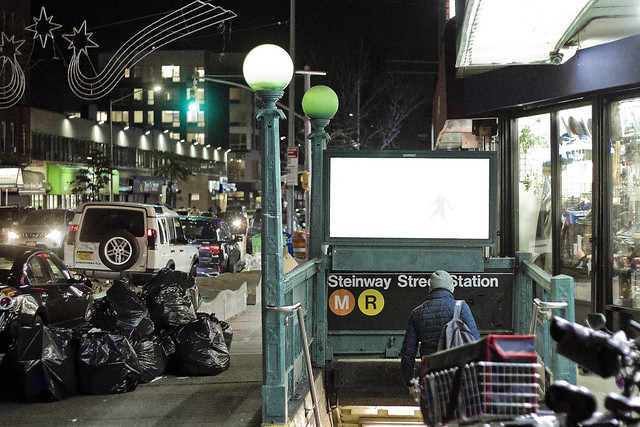
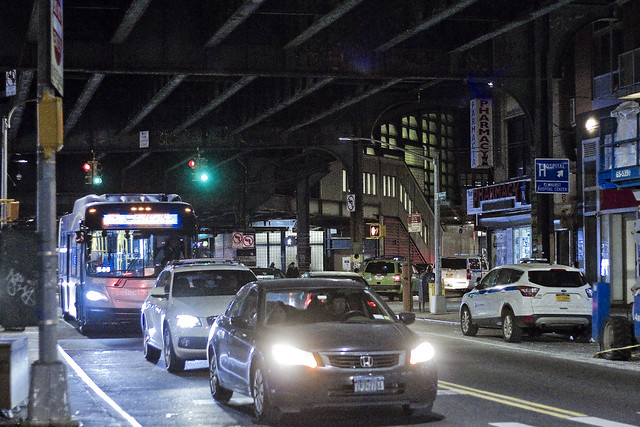
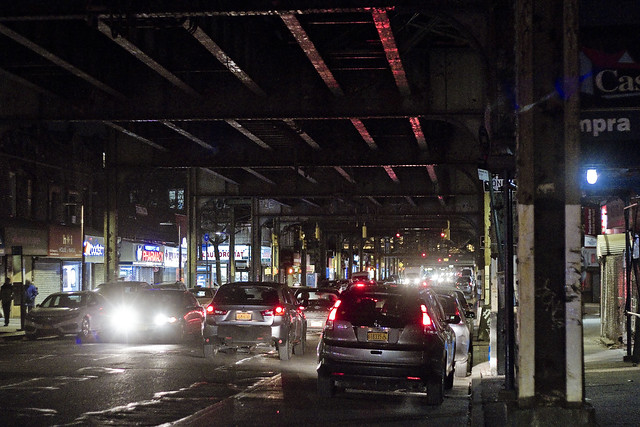
Multiple layers of insulating clothing were draped off of the slowly rotting corpse which houses a humble narrator, just the other night, and out into the freezing temperatures did I go. As mentioned countless times in the past, one has a particular vulnerability to cold weather, which is at odds with and forms a comorbidity revolving about my aversion to boredom. Accordingly, my plan was to avoid the waterfront this particular evening and spend my time inhabiting the steel shadowed corridor of Roosevelt Avenue and limit my evening constitutional to just over two hours spent in the cold.
Strategically speaking, one needed to acquire imagery for this and other posts, and my tactics involved the usage of the NYCTA system to put myself in a fairly interesting place and then walk back to HQ the “long way round.”
– photo by Mitch Waxman
Ever a stickler for grammatically annoying others, the different meanings of a strategy versus a tactic is something which drives me mad. While browsing a military surplus website, one came upon an offering for two items – a tactical briefcase and a tactical pen. The briefcase was merely a fairly ugly bag constructed from the sort of fabrics commonly found in military items like rucksacks, and the pen was designed and constructed in a manner where it could double as a stabbing weapon. What sort of tactic either of these items represented is beyond me.
A strategy is an overarching plan formulated to achieve a goal – “I shall conquer France, using my portfolio of mad scientist inventions, along multiple fronts in pursuance of causing their Government to collapse while stretching the capabilities of their military out.” A tactic is – “The race of Atomic Supermen I’ve been breeding in the jungles of the Amazon will invade from the Atlantic seaboard,” or “while my volcano cannons bombard their Mediterranean coast, freezes rays will shine on Paris and bury it in ice.” Actions committed are tactical, the overall plan is the strategy, and neither briefcases nor pens could be considered as being strategic nor tactical. Your goal in a game of Chess is to capture the opponent’s King, the strategy involves how you plan to do it, and each piece you move is tactic.
As a note, I’ve spent a lot of time thinking about conquering France using science fiction weapons.
– photo by Mitch Waxman
I’m also obsessed with the word “Carpenter” at the moment. A carpenter doesn’t “carpent” at work, yet the job indicates that they do. The word entered the English language via Old French (which in turn got it from Roman Latin) around the time that the Normans took over in England. It replaced the Germanic sounding “wright” for the trade, although there are a bunch of distinctions in the carpentry world describing what you would do at work (joiner, cooper, finisher etc.) that also indicate skill levels. An interesting bit of linguistics that I recently got turned on to involves the Normans, actually, and how when they set themselves up as the Old French speaking Lords of the Manor in England the English language began to change. Common people ate mutton (Germanic English) whereas the Normans ate lamb (Old French) for example. In essence, if you’re saying a word in English and the tongue is lifting and hitting the frontal roof of the mouth (lightning, for example) it comes from Old French, and if the tongue is on the bottom of the mouth and bunched up at the back (woodworker) its from the Germanic influenced pre conquest language. I can’t speak too intelligently about this subject, as I’ve just encountered the topic, but it’s a pretty interesting one.
These are the sort of things one ponders (tactic) as I’m trying to stay warm (strategy) whilst wandering the streets of Queens in the January dark.
“follow” me on Twitter- @newtownpentacle
boyhood antiquarianism
East side, west side, all around the town.
– photo by Mitch Waxman
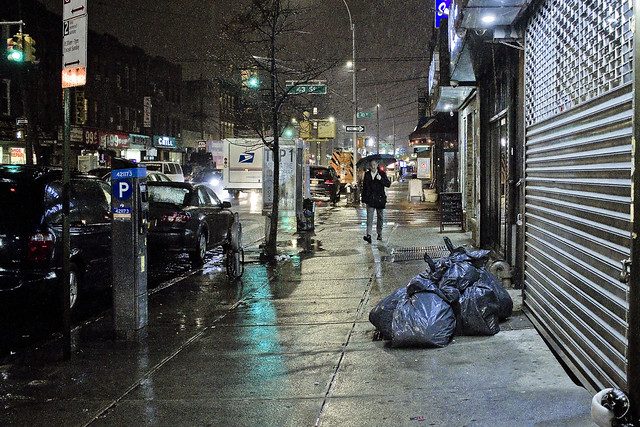
A third arm would come in handy when shooting in the rain, as managing both umbrella and camera is a bit of a chore. I’ve spent my life waiting for a “disruptive new take” on umbrellas, but the current generation of engineers seems obsessed with reinventing key chains instead. The giant golf umbrella I’m currently using is huge and sturdy, and came into my possession as a bit of branded “shwag” manufactured by some non profit group. It’s a bit of a carry though, and has a tendency to catch the wind due to its immense circus tent like size. Have we reached “peak umbrella” or is there a revolution in handheld rain shelter on the horizon? I’m talking to you, Elon Musk.
Often, a humble narrator finds himself dreaming about an umbrella that is deployed along the spine and straight up out of my backpack, which would leave both of my arms free for other tasks.

– photo by Mitch Waxman
The problem with umbrellas ultimately come down to their tendency to catch the wind, so the perfect solution to shooting in the rain would involve the deployment of some Star Trek or Dune style personal shielding of the electromagnetic type. You’d just need a gizmo that could pump out a massive amount of electromagnetic radiation and another that formed a magnetic bottle around yourself. Of course, this would destroy your personal electronics, likely disrupt the bio electrical functioning of the body, induce instant cancer in both you and everybody within a few hundred yards, but you’d be dry and the lens wouldn’t be spotted with rain drops.
On a related note – a general consensus, arrived at by the squad of morons and malcontents whom I spend my time with, states that googling any health concern you might be experiencing returns a result that it’s likely some type of cancer. Also, the cancer isn’t regular cancer, it’s super cancer. That’s the kind of cancer where the tumor rips itself free of your body and then prowls around in search of new victims, usually puppies and young children. The Super Cancers can attach themselves to infrastructure, throwing out whip like tentacles that snatch birds out of the air mid flight and plucking fish from the sea. Funnily enough, the only known method for killing Super Cancer, which is bullet and fire resistant, is Monsanto’s Roundup Weed Killer. Go figure.

– photo by Mitch Waxman
Engineers are depressingly grounded in the laws of the physical universe, I find. One discovered this several years ago when I was espousing the use of heat guns in place of shovels for wintertime sidewalk snow and ice clearance. Despite my brilliant moment of transcendent realization, all that my engineer friends could talk about were the laws of energy conservation, Isaace Newtwon, and that the amount of energy required to melt ice in subzero temperatures would be incalculable. Next thing you know, they were telling me that my other dream of creating my own race of Atomic Supermen by exposing tank dwelling fetuses to gamma rays would just result in filling an intensive care ward with handicapped children afflicted by Super Cancer were they to be birthed. Pfah.
Shit on my parade? Go design a better umbrella, kid.
“follow” me on Twitter- @newtownpentacle


 The Newtown Pentacle