Archive for the ‘Hells Gate’ Category
hungry ghosts

– photo by Mitch Waxman
On a recent sunlit afternoon, the Hermetic Hungarian ventured forth from the Shining City once again. Recovered from a spell of bad dreams which our recent visit to the Grand Ave. Bridge- with all its loathsome implications- had awakened in him, the studied recluse announced that a new digital camera was in his possession which needed a test drive. Always an atavist and luddite, the Hermetic Hungarian (HH from this point on) had already decided that it was inferior to the chemical emulsion process of image capture- film- which he has spent much time mastering.
This, like the Mac vs. PC debate, is a conversation that your humble narrator does not wish to have anymore.
from wikipedia
Operating system advocacy is the practice of attempting to increase the awareness and improve the perception of a computer operating system. The motivation behind this may be to increase the number of users of a system, to assert the superiority of one choice over another or out of brand loyalty, pride in an operating system’s abilities, or to persuade software vendors to port specific applications or device drivers to the platform.
Operating system advocacy can vary widely in tone and form, from published comparisons to heated debates on mailing lists and other forums. In its most extreme forms it can veer into zealotry. Advocates are often normal users who devote their spare time to advocacy of their operating system of choice; many have a deep and abiding interest in the use, design and construction of operating systems and an emotional investment in their favourite operating system.

– photo by Mitch Waxman
Allow me to lift the curtain for this post- and talk shop.
Once upon a time, in the brash days of youth, I too shot film. I carried a Yashica FX3 fully manual, 1984 vintage camera, which I still have. Unfortunately, the cost of the film itself and the consequent expense of development and printing cramped my urge to shoot and shoot. For years, I had a goofy point and shoot 35mm camera, which has long disappeared into gadget heaven. When the Canon Elph’s first came out, I was hooked on digital and haven’t looked back since. Yes, the recording medium of film is capable of capturing and storing FAR more information than a digital shot can- even today. But- as I’ve mentioned in the past- I work in the advertising industry.
from nycgovparks.org
Astoria Park, on the west shore of Queens, extends from south of the Triborough Bridge to north of the Hell Gate Bridge. With a panoramic view of the skyscrapers of midtown Manhattan in the south to the Hell Gate channel in the north, the scenery presents the diverse landscape of New York City. The Hell Gate channel, formed by faults deep underground, contains some of the deepest water in New York Harbor. Its treacherous reefs bear picturesque names such as “Hen and Chickens,” “Pot Rock,” “Bread & Cheese,” and “Bald Headed Billy.”
Throughout the centuries the stunning natural beauty of this location has attracted visitors and settlers. Before the arrival of European colonists, a trail passed by the site, and an Indian village flourished at Pot Cove. Local inhabitants grew maize on the shores, fished in Hell Gate, and drew water from Linden Brook, a small stream that still flows under Astoria Park South. In the mid-1600s the Dutch parceled out this land to various owners, including William Hallet whose grant embraced hundreds of acres. During the American Revolution, several British and Hessian regiments were stationed in the area. On November 25, 1780 the frigate Hussar and its five-million-dollar cargo sank to the bottom of Hell Gate, where despite some removal of cannons, the treasure still remains.

– photo by Mitch Waxman
What used to happen when a photo entered the agency was that a medium or large format “chrome”- which is a sort of giant slide- would be handed off from photographer to agency (and still does, sometimes). This chrome would then be photostat reproduced (in the very old days) and it’s “for position only or F.P.O.” representation would be worked into a mechanical board so that the printer would understand where to place it or “strip it in”. When the Macintosh came along, the chrome would instead be scanned, at first by highly specialized devices called drum scanners and later by advanced versions of tabletop scanners.
The digital scan actually matters more than the original at this moment, and the tipping point from film to digital was reached when the ad agencies began requesting digital files from their photographers.
from omh.state.ny.us
Kirby Forensic Psychiatric Center, a maximum security hospital of the New York State Office of Mental Health (OMH), opened in 1985 and provides secure treatment and evaluation for the forensic patients and courts of New York City and Long Island. Most patients are received through the courts under Criminal Procedure Law (CPL) or through the OMH Commissioner’s office via the New York State Code of Rules and Regulations (NYSCRR) regarding hospitalization of the mentally ill.
Treatment is provided in accordance with the current standards of professional care outlined by the Joint Commission of Accreditation of Health Organizations (JCAHO) and is carried out with respect for each patient’s privacy and rights, in agreement with his/her level of functioning and need for security. KFPC has an active staff education program as well as academic affiliations with several metropolitan area colleges and universities, to help assure quality treatment and state of the art care.
and from wikipedia
The Manhattan Psychiatric Center is a New York-state run psychiatric hospital on 125th Street on Ward’s Island in New York City. As of 2009 it had 509 beds. The current building is 14-stories tall.
The hospital’s roots date to 1848 when Ward’s Island was designated the reception area for immigrants. Some additional structures were originally part of Blackwell’s Island Lunatic Asylum, which opened around 1863.
The building was significantly enlarged in 1871, and a Kirkbride Plan style building was built. After the immigration entry shifted to Ellis Island in 1892 the state took it over from Manhattan in 1899 and expanded it even further. At the time, it had 4,400 beds and was the largest psychiatric hospital in the world.
At the time it was one of two psychiatric hospitals for residents of Manhattan that had been take over by the state. The other psychiatric hospital would become the Central Islip Psychiatric Center in Central Islip, New York. Both hospitals were referred to as Manhattan State Hospital.
It later became the Manhattan Psychiatric Center. The facility is currently run by the New York State Office of Mental Health.

– photo by Mitch Waxman
Its taken the camera companies a while to catch up with the desktops, but they’re getting close- the high end Canons, for instance, do 25.3 megapixel shots (which I’ve retouched and let me say that these are well wrought images).
My current cameras- the Canon G10 and Canon T1i both hit 15 megapixels, giving me ample detail and clarity. I’ve got fairly quick SDHC cards in them, which allows burst shooting, and at any given time I’m ready to pop off a couple of thousand exposures. The batteries in both are rechargeable, and once the photos are copied to my desktop- the cards are formatted and used over and over. Film never offered me this kind of freedom to just shoot and shoot.
from wirednewyork.com
The massive beauty and advanced technology of the Hell Gate Bridge (more properly the New York Connecting Railroad Bridge) contrast sharply with nineteenth-century descriptions of the channel that it spans. Named for the dangerous rocks and perilous waters at the confluence of the East and the Harlem Rivers, Hell Gate is surrounded by Manhattan, Queens, and three islands: Wards, Randalls, and Roosevelt (formerly called Blackwell’s, then Welfare). Philip Hone (1780 -1851), writing of an 1844 visit there, described “the delightful scene: the clumps of fine old trees clothed in the gorgeous foliage of autumn, the lawn still bright and green, the mild, refreshing breeze, the rapid waters of Hell Gate covered with sailing vessels and steamboats -all combined to present a picture of consummate beauty.“

– photo by Mitch Waxman
HH, however, feels limited by digital- as do other “old school” photographers encountered during my long walks through and around the Newtown Pentacle. He lugs around a gigantic medium format film camera, which is a best of breed sort of machine. Coney Island Mike, another friend of the Pentacle, also decries the prevailing winds of technological advancement and pines for some 1970’s golden age of film availability and creative darkroom techniques.
I really do see the point, as mentioned above, film does capture and contain more information than any digital image can- so far.
from wikipedia
Construction was overseen by Gustav Lindenthal, whose original design left a gap of 15 feet (4.6 m) between the steel arch and the masonry towers. Fearing that the public assumed that the towers were structurally integral to the bridge, Lindenthal added aesthetic girders between the upper chord of the arch and the towers to make the structure appear more robust. The original plans for the piers on the long approach ramps called for a steel lattice structure. The design was changed to smooth concrete to soothe concerns that asylum inmates on Ward’s and Randall’s islands would climb the piers to escape.
The engineering was so precise that when the last section of the main span was lifted into place, the final adjustment needed to join everything together was 1⁄2 inches (12.7 mm). The bridge was completed on September 30, 1916.
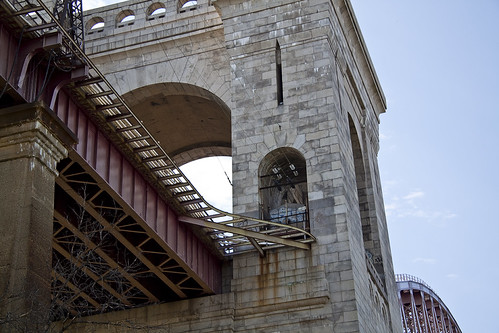
– photo by Mitch Waxman
Back at my day job as photo retoucher and advertising industry print production specialist, however, I can tell you that its the digital file that’s going to the printer- not a piece of film. That makes anything shot in film second generation at best. Of course, many of the images I present here are highly processed- shot in raw format, sharpened or color corrected in photoshop, or produced by esoteric digital sleight of hand like “tilt shifting” or HDR.
(all the shots in this post are “straight” shots, raw files which were fed through my normal workflow)
from nycroads.com
PROVIDING A MUCH-NEEDED RAILROAD CONNECTION: In 1892, Oliver W. Barnes, an engineer associated with Pennsylvania Railroad president Alexander J. Cassatt and bridge designer Gustav Lindenthal, conceived plans for the Hell Gate Bridge. Cassatt saw the Hell Gate project – originally called the “East River Arch Bridge” – as an opportunity to bring rail traffic from Pennsylvania Railroad routes in New Jersey and points west through New York City to New England. The project was to also tie into the Long Island Rail Road routes, in which the Pennsylvania Railroad had a controlling interest. Meanwhile, Lindenthal saw the Hell Gate project as his chance to construct his Hudson River Bridge, a suspension bridge with a 2,800-foot-long main span that would have been the longest in the world. That same year, the New York Connecting Railroad was incorporated to help realize this plan.
In 1904, Lindenthal, who oversaw the opening of the Williamsburg Bridge and the construction of the ongoing Manhattan Bridge and Queensboro Bridge projects, was chosen as consulting engineer and bridge architect by the Pennsylvania Railroad, which had just acquired the New York Connecting Railroad. Under these auspices, Lindenthal was engaged in a project to connect the tracks of the Pennsylvania Railroad in New Jersey, the Long Island Rail Road in Queens, and the New York, New Haven and Hartford Railroad in the Bronx. Although the project allowed Lindenthal to design the Hell Gate span, it would not include his long-sought goal: a great suspension bridge across the Hudson River. Instead, the Pennsylvania Railroad decided to use exclusive tunnels for rail traffic across the Hudson and East rivers.

– photo by Mitch Waxman
One of the mantras that I’ve followed since my heady days at art school (School of Visual Arts) where I studied Illustration and Comic Book art is that you don’t need to use expensive mediums to make a good image. In accordance, my friends and I used to draw comics on brown paper bags or whatever other commonplace material we could procure. Later on in life, I will admit to the occasional red sable brush purchase, but by and large most of my “kit” came from staples and I’ve done comic cover art that was colored with Crayola Markers in the past.
I try to follow this philosophy with photography, which is the greatest way to spend money- short of crack addiction- that America has ever found.
from wikipedia
On June 15, 1904, the General Slocum caught fire and burned to the waterline in New York’s East River. At the time of the accident she was on a chartered run carrying members of St. Mark’s Evangelical Lutheran Church (German Americans from Little Germany, Manhattan) to a church picnic. An estimated 1,021 of the 1,342 people on board were killed. The General Slocum disaster was the New York area’s worst disaster in terms of loss of life until the September 11, 2001 attacks.[2] The events surrounding the General Slocum fire have appeared in a number of books, plays and movies through the years.

– photo by Mitch Waxman
Fantasies about radio triggers and tripods that cost more than my first car bounce in my head, and I fiend for trick and ultra wide angle lenses. I pore over the BH Photo catalog in the manner of a fetishist, but it’s just camera pornography to me. I can barely afford to feed my little dog Zuzu these days, and Our Lady of the Pentacle has suggested homespun garments for next winter. HH however, insists that no digital camera he’s yet found suits him. I suggested either a Canon G10 or G11 to him, or if portability was a consideration- the very attractive Canon S90.
from wikipedia
Amtrak is no longer required by law, but is encouraged, to operate a national route system.[ Amtrak has some presence in all of the 48 contiguous states except Wyoming and South Dakota. Service on the Northeast Corridor, between Boston, Massachusetts, and Washington, D.C., as well as between Philadelphia and Harrisburg, Pennsylvania, is powered by overhead wires; for the rest of the system, diesel locomotives are used. Routes vary widely in frequency of service, from three trips weekly on the Sunset Limited (Los Angeles, California, to New Orleans, Louisiana), to weekday service several times per hour on the Northeast Corridor, (New York City to Washington, D.C.) Amtrak also operates a captive bus service, Thruway Motorcoach, which provides connections to train routes.
The most popular and heavily used services are those running on the Northeast Corridor (NEC), which include the Acela Express, and Northeast Regional. The NEC serves Boston, Massachusetts; New York City; Philadelphia, Pennsylvania; Baltimore, Maryland; Washington, D.C.; and many communities between. The NEC services accounted for 10.0 million of Amtrak’s 25.7 million passengers in fiscal year 2007. Regional services in California, subsidized by the California Department of Transportation are the most popular services outside of the NEC and the only other services boasting over one million passengers per annum. The Pacific Surfliner, Capitol Corridor and San Joaquin services accounted for a combined 5.0 million passengers in fiscal year 2007.

– photo by Mitch Waxman
These shots, of course, were accomplished with my increasingly trusty DSLR- the Canon T1i, but the vast majority of photos you’ve endured at this blog have emanated from the Canon G10. The S90 is functionally a G10 with a smaller lens and form factor, will be dramatically discounted around Christmas, and HH ordered one to try out. That’s how we ended up in Astoria Park. Originally, we planned on walking the Triborough Bridge, but last minute information reached me that the Bridge has a series of “Photography Prohibited” signs posted and we decided that it just wasn’t worth the potential hassles with the law.
That’s what the eggheads call a “chilling effect on civil liberties” in action, by the way.
from railroad.net
As a retired TBTA sgt, I can definetly state that photography IS STRICTLY FORBIDDEN on all bridges & tunnels operated by that agency. This edict has been in effect for many years, but it was not strictly enforced before 9/11/01. It is now. Signs prohibiting “filming” are, (and have been all along) posted at all facilities. Summonses can, & usually will be issued (criminal court “C’ summonses) to filmers/videotapers who are seen “filming” on TBTA property (mainly bridges, tunnels and toll plazas, but also in other areas under control of the TBTA).

– photo by Mitch Waxman
Over the course of an hour or so, your humble narrator cracked out a couple of hundred exposures, a few of which were good enough to “show”. HH shot 22. I had mine “developed” and online within 48 hours (I was busy) and HH waited a full week for his transparencies to be shipped to him. Are HH’s shots superior to mine? I still don’t know, because he hasn’t managed to scan them yet. I’m not mocking him, nor deriding film, just stating that immediacy is a selling point for me as well.
As a good American, I crave and demand instant satisfaction, sometimes for urges I don’t know I have yet.
from wikipedia
Ward’s Island is situated in the East River in New York City. Administratively it is part of the borough of Manhattan. It is bridged by rail to the borough of Queens by the Hell Gate Bridge and it is joined to Randall’s Island to the north by landfill. The two Islands together are run by the Randall’s Island Sports Foundation under a partnership agreement with the New York City Department of Parks and Recreation. Together, the two islands form New York County’s Census Tract 240, which had a total population of 1,386 living on 2.2 km² of land area, according to the United States Census, 2000.
Viaducts leading to the Robert F. Kennedy Triborough Bridge and Hell Gate bridges pass overhead. Vehicular access is by the Little Hell Gate bridge from Randall’s Island, while a narrow pedestrian and bicycling bridge, Ward’s Island Bridge, links the island to the east side of Manhattan in Harlem.

– photo by Mitch Waxman
The Hermetic Hungarian of course, feels the least melancholy when surrounded by relict technologies. The upper west side rooms he occupies enjoy shelves of watch making equipment and rare mechanisms which originate in the darkest corners of Europe. His current project is to end time mechanically, freezing the world’s motion by the actions of a vast clockwork which he is assembling in accordance with instructions found on a scroll that might be written in Sanskrit that HH claims were scribed by some mad monk.
At my insistence, he has not installed a battery or self winding mechanism on the device, so sleep easily, my Lords and Ladies of Newtown.
from wikipedia
The Bhavacakra is represented as being held by the jaws, hands, and feet of a fearsome figure who turns the wheel. The exact identity of the figure varies. A common choice for the figure is Yama, the god of death or Kala the lord of time. This figure is also known as the “Face of Glory” or Kirtimukha.
There is always a figure or symbol in the upper left and the upper right. The exact figure or symbol varies; common examples include the moon, a buddha, or a bodhisattva. In the picture of the Tibetan Bhavacakra in Sera, Lhasa the clouds take the shapes of certain Buddhist symbols, eg. svastika.
Catherine Turecamo at HellsGate, and camera news

– photo by Mitch Waxman
Technical upgrades have occurred here in Pentacle HQ. A new DSLR, which was quite unaffordable, has been purchased from the unknowable levantines at BH Photo. The trusty Canon G10, in use since its issuance in late 2008, is off to Canon for warranty service owing to the defects that have appeared on its lens. Said scratches seem to originate from the mechanical action of the external housing which are meant to protect the lens element. These scratches have, after shooting some 17,000 exposures in the last year, become quite noticeable and are getting in the way. The G10 will return to Newtown Pentacle service upon repair, and is highly recommended to all for its versatile nature, manual shooting modes, ability to save in RAW format, and crisp lens- although it falls apart in low light and is useless at high ISO speeds. The flash is also pathetic.

– photo by Mitch Waxman
Deciding to take the plunge into the DSLR world, our lady of the Pentacle and myself worked out a budget, and research on what was available in my price point began. Things narrowed to the Nikon D90 and Canon Rebel T1i (or 500D). The Nikon is wielded by a buddy of mine to great effect, and offers the promise of a “full size” sensor. The Nikon ecosystem of accessory lenses and other bits is also a little less expensive than commensurate equipment in the Canon range. The Canon, however, matches the 15 megapixel spec of the G10 (also a Canon) and also offers an operating system that seemed a bit more organic to me. I use a Mac, always have, and have quit jobs that forced me to use a windows PC in the past. Organic matters to me, which is why a Sony camera was never considered. (imho Sony makes the best Hardware-Everything, and the worst software-Everything).

– photo by Mitch Waxman
So, having spent a ton of money I don’t have, the plunge was taken on the Canon T1i and a couple of decent lenses. Of course, this is after “the season” for photography in New York, which is actually most of the time- just not in December and January. Harsh shadow and blown highlights, overcast skies and leaden water- trademarks of the winter sun here in the Newtown Pentacle- the angle and frequency of the light is all wrong except in the early morning and late afternoon. Photography types term this as “golden hour”, which somehow sounds “dirty” to me.
So, on one of the few sunny days enjoyed of late, your humble narrator pulled the filthy black raincoat off its hook and scuttled forth to find what I could find. Hells Gate is always a good choice for experimenting with a new gizmo. Astoria Park is just about as safe these days as you can expect to be when out in public, and there’s always something interesting going on. I shot these with the “long lens”, which is fancy way of saying telephoto.
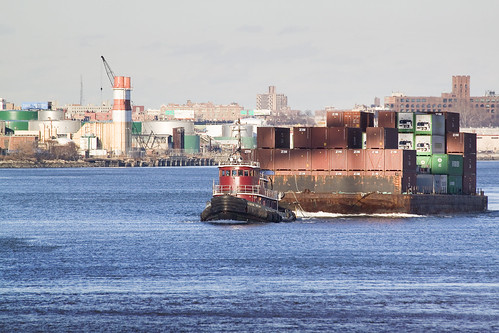
– photo by Mitch Waxman
That’s the Catherine Turecamo, a 1972 vintage 199 ton 3,200 HP tugboat, operated by the Moran towing company. It was built at the Main Iron Works in Louisiana as the MIss Lynn.
from morantug.com
Moran Towing Corporation has provided tugboat services to the Port of New York since 1860. The company began with Michael Moran’s purchase of-one-half interest in a tugboat. In the years since, the fleet with the white M logo on its stacks has become the largest in the port,and on the U.S. East and Gulf Coasts. The port of New York-New Jersey provides access to the most concentrated and affluent consumer market in the world. Its facilities include terminals operated by the Port Authority of NY & NJ and privately operated terminals. Over 16 million tons of cargo pass through the port on an annual basis, transported aboard various types of ships, including container ships, tankers and barges. The New York division also services the Port of Albany, located 145 miles up the Hudson River from New York City. Albany is a hub for commercial trade in its region, due to its proximity to the New York State Barge Canal and its excellent inland transportation network.

– photo by Mitch Waxman
The new camera was a little awkward to handle at first, and I was self conscious of it as well. This was a big “honking” camera, weighing four times what my familiar “rangefinder-sized” G10 did. I practiced tracking the tugboat with it, zooming in and out and so on. I think the shots came out alright- if you click through to the photo’s Flickr page and check out its larger incarnations- you’ll see some real detail in them. This is one of the places where the higher megapixel count of the Canon matters to me, and justified buying into its franchise.
Trust me on this one, I’m an advertising retoucher photoshop guy by day, and resolution matters. A lot.

– photo by Mitch Waxman
I’m only a couple of thousand shots in, a month later. Its been a busy month somehow, with holiday obligation and hiding in my warm burrow awaiting spring. Meanwhile, I’ll be learning how to use this new gizmo.
Incidentally, on the subject of gizmos, anyone out there have anything to say on geotagging? Leave me a comment or contact me, if you do.
Sludge Boats, baby, Sludge Boats

M/V Red Hook DEP Sludge Vessel – photo by Mitch Waxman
After processing at a water treatment facilities, which the City of New York’s DEP manages 14 of (including the vast Temple of Cloacina called the Newtown Creek Wastewater Treatment Plant), the concentrated sludge distillate produced by municipal sewage plants requires “dewatering” – it must be reduced into a semi solid called “cake”. Not every one of the 14 wastewater treatment plants has a dewatering facility, so the sludge needs to get from point A to point B via a the fleet of Sludge Vessels.
Pictured above is the sludge dock in Greenpoint, with the M/V Red Hook at dock, at the mouth of the Newtown Creek. Flowing from that aforementioned temple of “the Venus of the Sewers” to a gigantic holding tank via mechanical means, it is then pumped out to the dock and the waiting sludge boat.
from nyc.gov
Preliminary treatment
Several stories underground, wastewater flows into the plants from sewers connected to New York City’s homes and businesses. The incoming wastewater, called influent, passes through screens consisting of upright bars, spaced one to three inches apart. These bars remove large pieces of trash including rags, sticks, newspaper, soft drink cans, bottles, plastic cups and other similar items. This protects the main sewage pumps and other equipment. The garbage is transported to landfills. The main sewage pumps then lift the wastewater from the screening chamber to the surface level of the plant.
Primary treatment
Next, the wastewater enters primary settling tanks, also called sedimentation tanks, for one to two hours. The flow of the water is slowed, allowing heavier solids to settle to the bottom of the tank and the lighter materials to float. At the end of the process, the floatable trash, such as grease and small plastic material, rises and is skimmed from the top of the tanks surface.
The settled solids, called primary sludge, are then pumped through cyclone degritters — devices that use centrifugal force to separate out sand, grit (such as coffee grinds) and gravel. This grit is removed, washed and taken to landfills.
The degritted primary sludge is pumped to the plant’s sludge handling facilities for further processing. The partially treated wastewater from the primary setting tanks then flows to the secondary treatment system.

M/V North River DEP Sludge Vessel – photo by Mitch Waxman
The 1.3 billion gallon a day flow of New York City’s sewage should be defined as a third river. That’s 1,300,000,000 gallons a day or 474,500,000,000 gallons of night soil a year. 1.3 billion is the population of China.
Pictured above is the DEP Sludge Vessel M/V North River, a veteran, she was launched at Maryland Shipbuilding in 1974. Just under 324 foot long, North River can carry 102,000 cubic feet of evil juice and weighs in at 2,557 gross tons.
from nyc.gov
Secondary treatment
Secondary treatment is called the activated sludge process. This is because air and “seed” sludge from the plant treatment process are added to the wastewater to break it down further. Air pumped into large aeration tanks mixes the wastewater and sludge that stimulates the growth of oxygen-using bacteria and other tiny organisms that are naturally present in the sewage. These beneficial microorganisms consume most of the remaining organic materials that are polluting the water and this produces heavier particles that will settle later in the treatment process.Wastewater passes through these bubbling tanks in three to six hours.
The aerated wastewater then flows to the final settling tanks which are similar to the primary settling tanks. Here the heavy particles and other solids settle to the bottom as secondary sludge. Some of this sludge is re-circulated back to the aeration tanks as “seed” to stimulate the activated sludge process. The returned sludge contains millions of microorganisms that help maintain the right mix of bacteria and air in the tank and contribute to the removal of as many pollutants as possible.
The remaining secondary sludge is removed from the settling tanks and added to the primary sludge for further processing in the sludge handling facilities.Wastewater passes through the settling tanks in two to three hours and then flows to a disinfection tank.
Disinfection
Even after primary and secondary treatment, diseasecausing organisms may remain in the treated wastewater. To disinfect and kill harmful organisms, the wastewater spends a minimum of 15-20 minutes in chlorine-contact tanks mixing with sodium hypochlorite, the same chemical found in common household bleach. The treated wastewater, or effluent, is then released into local waterways. Disinfection is an essential step because it protects the health of people who use local beaches and enjoy other recreational activities on or near the water.

M/V Newtown Creek DEP Sludge Vessel – photo by Mitch Waxman
Identical in dimension and capacity to the North River, the 1967 vintage DEP Sludge Vessel M/V Newtown Creek passed under mighty Triborough and crossed Hells Gate. M/V Newtown Creek was laid down by the Wiley Manufacturing Co. Back in the days of ocean dumping, these ships were amongst a small fleet of tugs, barges, and older sludge boats that would “do the deed“.
from nyc.gov
Sludge treatment
The following are typical stages of the sludge treatment process.
Thickening
The sludge produced by primary and secondary treatment is approximately 99% water and must be concentrated to enable its further processing. Thickening tanks allow the sludge to collect, settle and separate from the water for up to 24 hours. The water is then sent back to the head of the plant or to the aeration tanks for additional treatment.
Digestion
After thickening, the sludge is further treated to make it safer for the environment. The sludge is placed in oxygenfree tanks, called digesters, and heated to at least 95 degrees Fahrenheit for between 15 to 20 days. This stimulates the growth of anaerobic bacteria, which consume organic material in the sludge. Unlike the bacteria in the aeration tanks, these bacteria thrive in an oxygen-free or “anaerobic” environment. The digestion process stabilizes the thickened sludge by converting much of the material into water, carbon dioxide and methane gas. The black sludge that remains after digestion has the consistency of pea soup and has little odor. This is called digested sludge.
Methane gas is often used as an energy source at the City’s wastewater treatment plants. The gas may be used in engines to produce electricity or directly drive plant equipment. Gas is also used in boilers to provide heat for digestion and plant-wide buildings. Currently, DEP and the New York Power Authority (NYPA) have jointly installed fuel cells at four of the City’s water pollution control plants; 26th Ward, Red Hook, Oakwood Beach and Hunts Point. Fuel cells convert the methane gas and carbon dioxide into heat and electricity that is then used to operate the plants. This technology contributes to New York City’s efforts to enhance clean air operations at its facilities. There is a significant reduction in air emissions as a result of using fuel cells.
Digester sludge is pumped from sludge storage tanks to a dewatering facility. At some treatment plants, where there are no dewatering facilities on site, the sludge is transported for processing through a pipeline or by a sludge boat to a plant that has a dewatering facility.

M/V Newtown Creek DEP Sludge Vessel, close-up – photo by Mitch Waxman
Once requiring a crew of as many of 20, the City now runs these ships with a mere 6. Semiautomated, M/V Newtown Creek and North River are nevertheless more than twice the size of the original model Sludge Vessels like the Owl’s Head.
from nyc.gov
Dewatering reduces the liquid volume of sludge by about 90%. New York City operates dewatering facilities at eight of its 14 treatment plants. At these facilities, digested sludge is sent through large centrifuges that operate like the spin cycle of a washing machine. The force from the very fast spinning of the centrifuges separates most of the water from the solids in the sludge, creating a substance knows as biosolids. The water drawn from the spinning process is then returned to the head of the plant for reprocessing. Adding a substance called organic polymer improves the consistency of the “cake”, resulting in a firmer, more manageable product. The biosolids cake is approximately 25 to 27 percent solid material.


 The Newtown Pentacle