Archive for the ‘Astoria’ Category
Project Firebox 10

– photo by Mitch Waxman
Woe to the FDNY Firebox which finds itself on the surly triangular corners that swirl about Northern Blvd. This elegantly destroyed specimen languishes perilously close to Steinway Street’s transmogrification into 39th street near the Standard Motor Products Building, specifically 36th avenue and 41st street.
As a point of interest, this is the eastern extant of 36th avenue, with its western terminus obviated by the Roosevelt Island Bridge at the East River.
lively antics

– photo by Mitch Waxman
Shackled by impotent pride and stalled ambitions, your humble narrator can often be observed scuttling along area sidewalks, a strange old man identified by malign aspect and the odd omnipresence of a camera. A great dread is experienced when someone on the street perceives my phantasmic presence, and I am forced into an encounter with someone who is unashamedly alive. Just such an encounter was had near Hells Gate on the East River, near Astoria Park, at the end of June 2010.
from nycgovparks.org
Although widely known for its beautiful pool, the oldest and largest in the city, Astoria Park offers more than aquatic pleasures. Outdoor tennis courts, a track, a bandstand, multiple trails, basketball courts, and playgrounds lure visitors from the five boroughs and beyond. And the views! Sitting on the edge of the East River and resting between the Triborough Bridge and Hell Gate Bridge, the park offers shoreline sights and sounds that make the benches along its perimeter popular spots year-round.

– photo by Mitch Waxman
This gentleman informed me that he was an ethnic musician, and made his living playing hellenic folk music at area “tavernas” and at weddings. The instrument he carried was crafted by his ancestors, and he carried it with him to America when he arrived here in the early 1960’s. He did tell me his name, but I did not write it down. It might have been Peter. Perhaps George.
also from nycgovparks.org
Due to its proximity to Hell Gate, a turbulent area in the East River, this playground has been named for the monster Charybdis. According to Greek mythology, Charybdis was the daughter of Poseidon, the god of the sea. As a young nymph, she flooded lands to add to her father’s kingdom until Zeus, the supreme ruler of the gods, turned her into a monster.
Charybdis and her partner Scylla are personifications of the violent waters in the Straits of Messina, which separate Sicily from the Italian peninsula. Charybdis was said to dwell under a fig tree on the Sicilian shore and, three times each day, drink from the strait and spit the water back into the strait several hours later, creating perilous whirlpools and terrifying sailors. In The Odyssey, by Homer, the hero survived Charybdis’s wrath by clinging to a tree for hours until she spit out the water and his raft floated to the surface.

– photo by Mitch Waxman
Practiced, his hands flew along the fret boards, and he demonstrated musical forms that are typical of the island cultures of the Hellenic Republic which is known as Greece to the english speaking world. His serenade was lilting, thrilling, and reminded me of the Greek musical genre called Rembetiko.
from wikipedia
The melodies of most rebetiko songs are thus often considered to follow one or more dromos or dromoi (gr. δρόμος, plural δρόμοι). The names of the dromoi are derived in all but a few cases from the names of various Turkish modes, known in Turkish as makam.
However, the majority of rebetiko songs have been accompanied by instruments capable of playing chords according to the Western harmonic system, and have thereby been harmonized in a manner which corresponds neither with conventional European harmony, nor with Ottoman art music, which is a monophonic form normally not harmonized. Furthermore, rebetika has come to be played on instruments tuned in equal temperament, in direct conflict with the more complex pitch divisions of the makam system.

– photo by Mitch Waxman
He described the instrument he wielded as being well over a century old, and suggested that it had certain supernatural powers against which the female gender possesses no defense. He also claimed he could calm stormy seas with it, but one thing life in Astoria has taught me is that when a Greek guy is telling a good story well – just go with it.
from wikipedia
This is the classical type of bouzouki that was the mainstay of most Rebetiko music. It has fixed frets and it has 6 strings in three pairs. In the lower-pitched (bass) course, the pair consists of a thick wound string and a thin string tuned an octave apart. The conventional modern tuning of the trichordo bouzouki is Dd-aa-dd. This tuning was called the “European tuning” by Markos Vamvakaris, who described several other tunings, or douzenia, in his autobiography. The illustrated bouzouki was made by Karolos Tsakirian of Athens, and is a replica of a trichordo bouzouki made by his grandfather for Markos Vamvakaris. The absence of the heavy mother of pearl ornamentation often seen on modern bouzoukia is typical of bouzoukia of the period. It has tuners for eight strings, but has only six strings, the neck being too narrow for eight. The luthiers of the time often used sets of four tuners on trichordo instruments, as these were more easily available, since they were used on mandolins.

– photo by Mitch Waxman
Charming guy, he was intent on hanging out at the park and mentioned something about the fishes wanting to hear some Rembetiko as I was taking my leave of him.
from wikipedia
Greek emigration to the United States started in earnest towards the end of the 19th century. From then onwards, and in the years following the Asia Minor Disaster, until immigration became restricted in the mid-1920s, a great number of Greeks emigrated to the United States, bringing their musical traditions with them. American companies began recording Greek music performed by these immigrants as early as 1896. The first Greek-American recording enterprises made their appearance in 1919. From the latter years of the second decade of the century there exist a number of recordings that can be considered as rebetiko, a few years before such songs began to appear on recordings in Greece.
The music industry in the United States came to play a particular role from the mid-1930s onwards in recording rebetiko lyrics which would not have passed the censors in Greece. This phenomenon came to repeat itself during the period of the Greek military junta of 1967–1974. A notable example of American recording studios permitting some ‘bolder’ lyrics can be found in the LP “Otan Kapnizei O Loulas”, ie “When They Smoke The Hookah”, released in 1973. Releasing this album in Greece, with to its overt references to various aspects of drug use, would have been impossible at that time. It is worth noting, however, that the censorship laws invoked in Greece by Metaxas were never officially revoked until 1981, seven years after the fall of the junta. A further characteristic of American Greek recordings of the time was the continued recordings of songs in the Anatolian musical styles of rebetiko, which continued to be recorded in the United States well into the 1950s. Even songs originally recorded with typical bouzouki-baglamas-guitar accompaniment could appear in Anatolian garments.
After WWII, beginning in the early 1950s, many Greek rebetiko musicians and singers traveled from Greece to tour the United States, and some stayed for longer periods. Prominent among them were Ioannis Papaioannou, Manolis Hiotis, Vassilis Tsitsanis, Iordanis Tsomidis, Roza Eskenazi, Stratos Pagioumdzis, Stavros Tzouanakos and Ioannis Tatasopoulos, of whom the latter three died in the United States.

– photo by Mitch Waxman
Clearly he was amused by the kayakers from the LIC Boat House as they passed by, and he launched into a wild melody on his centenarian instrument.
a fun story about Hells Gate from 1899 can be accessed here at nytimes.com– here’s the headline:
A HELL GATE SEA SERPENT.; Valiant Bowery Boatmen Bring Its Headless Body Ashore
black seas of infinity

– photo by Mitch Waxman
Conversations with area wags and a wide spread network of personal friends have all pointed to a spate of dream disturbances plaguing the artistic class and those “sensitive” citizens of this Newtown Pentacle (specifically- reports have been made from Astoria, Woodside, Sunnyside, Jackson Heights, Elmhurst, Dutch Kills, Long Island City, Blissville, Maspeth, Ridgewood, Bushwick, East Williamsburg, Greenpoint).
Perhaps it is just the psychic ripple of the Hiroshima bomb, echoing through time and space, but it is nevertheless observed that a remarkable concurrence of isolated reports of nightmares and bizarre dreaming has reached and- indeed been experienced at Newtown Pentacle HQ in the last two weeks.
Such hive mind events are jungian in nature, and signal a massing of the collective unconscious, an expectation of some dire or portentous event unfolding. Accordingly, this anonymous poll (as best as I can tell it is, anyway) is offered, in an effort to document this curious pattern. If you have a moment, please offer a click to the answer below that best describes your recent experiences.
If you want to go into any detail, please feel free to send a missive here, with instructions as to whether or not it may be shared with your fellow lords and ladies… A common thread and shared imagery has been reported from unrelated sources, but I don’t want to color any possible responses by stating it quite yet.
mother of invention

– photo by Mitch Waxman
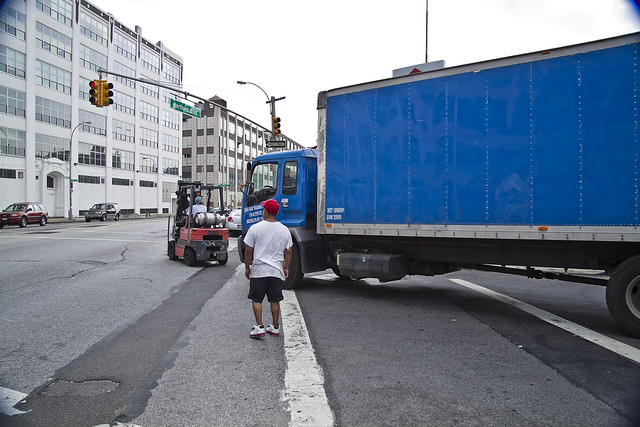
Another recent bit of serendipity experienced during a random walk, this time a bit further down Northern Blvd. and directly across the street from the Standard Motor Products building on 39th street, it seems that the good fellows who operate this largish delivery truck had experienced an unlucky turn when its engine suddenly stranded them. Luckily, they seemed to have a tiny red forklift on board, of a sort which I’ve always heard referred to as a “Bobcat”.
from wikipedia
Forklifts are rated for loads at a specified maximum weight and a specified forward centre of gravity. This information is located on a nameplate provided by the manufacturer, and loads must not exceed these specifications. In many jurisdictions it is illegal to remove or tamper with the nameplate without the permission of the forklift manufacturer.
An important aspect of forklift operation is that most have rear-wheel steering. While this increases maneuverability in tight cornering situations, it differs from a driver’s traditional experience with other wheeled vehicles. While steering, as there is no caster action, it is unnecessary to apply steering force to maintain a constant rate of turn.
Another critical characteristic of the forklift is its instability. The forklift and load must be considered a unit with a continually varying centre of gravity with every movement of the load. A forklift must never negotiate a turn at speed with a raised load, where centrifugal and gravitational forces may combine to cause a disastrous tip-over accident. The forklift are designed with a load limit for the forks which is decreased with fork elevation and undercutting of the load (i.e. load does not butt against the fork “L”). A loading plate for loading reference is usually located on the forklift. A forklift should not be used as a personnel lift without the fitting of specific safety equipment, such as a “cherry picker” or “cage”.

– photo by Mitch Waxman
The inert truck was borrowing its motive power from the smaller and self propelled tool. Its driver clearly seemed embarrassed by all the attention he garnered. Several of us stood on the corners, males all, sporting broad smiles and cheering him on while he waited for a red light to turn. This sort of situation appeals to we men, I don’t know why, but it does.
I was betting on either the inadequate chain just sundering into constituents, or the forklift burning out its transmission before it moved the giant blue vehicle more than a couple of feet.
from wikipedia
A high-tensile chain, also referred to as a transport chain, is a link chain with a high tensile strength used for drawing or securing loads. This type of chain usually consist of broad (thick/heavy) metal, oblong torus-shaped links for high strength. All the links of the chain are usually identical, and on the ends are usually two hooks of the appropriate size and strength to slide easily over one chain link but small enough not let the links slip by. When the ability to grasp the load is required, a slip hook is used.
The chain used for tire chains on tractors and some automobiles for better traction is very similar; usually consisting of the same type of link, especially so for snow chains; however, instead of being a single chain, it is more of a network of interconnected chains with no hooked ends; the size and design of the network depending on the tire it was intended for.

– photo by Mitch Waxman
The signal turned, and that tiny forklift and its driver wouldn’t let anything like the laws of Physics or the limits of engineering stop them from getting the truck moving.
Whom, indeed, says that an ant can’t move a rubber tree plant? Whom?
from wikipedia
They usually range in size 4 to 7 m in length, with smaller or larger sizes existing but being rare in North America. They usually have a garage door-like rear door that rolls up. On some box trucks, the cargo area is accessible from the cab through a small door.
Box trucks are usually used by companies that need to haul appliances or furniture. They are also used as moving trucks which can be rented from companies such as U-Haul or Ryder.
In North America, Ford, Dodge and Chevrolet/GMC have historically been the most common manufacturers of conventional cab/chassis to which various producers (called body builders or upfitters) attach the box that holds cargo. Isuzu, Mitsubishi Fuso and UD/Nissan Diesel have been the most common marketers of cabover-type medium duty cab/chassis used as platforms for box trucks. In North America, these trucks can range from Class 3 to Class 7 (12,500 lb. to 33,000 lb. gross vehicle weight rating, or GVWR).
– photo by Mitch Waxman
The drivers around these parts- borderland and angle between Sunnyside, Astoria, and Dutch Kills- are not exactly a sagacious or patient lot. Normal practice for them is to hit their horns in the quarter second before the traffic light goes from red to green, and to accelerate precipitously in an effort to “beat the lights”. Queens Plaza is nearby, and their probable destination of Manhattan- unlike Queens- is a heavily regulated and well policed thicket of traffic jams. This is their last chance to see the sky.
Well… not for long.
from wikipedia
A gross vehicle weight rating (GVWR) is the maximum allowable total mass of a road vehicle or trailer when loaded – i.e including the weight of the vehicle itself plus fuel, passengers, cargo, and trailer tongue weight.
The difference between gross weight and curb weight is the total passenger and cargo weight capacity of the vehicle. For example, a pickup truck with a curb weight of 4,500 pounds (2,041 kg) might have a cargo capacity of 2,000 pounds (907 kg), meaning it can have a gross weight of 6,500 pounds (2,948 kg) when fully loaded.

– photo by Mitch Waxman
Witness the tenacity and determination of the American workforce- its inchoate improvisations and hazard ridden solutions that keep the machines running no matter what, its complete disregard for official procedure and personal safety -unstoppable, indefatigable, the children of necessity.
from wikipedia
New York State Route 25A (NY 25A) is a New York State highway and the main east–west route for most of the North Shore of Long Island, running from the Queens Midtown Tunnel in the New York City borough of Queens at its western terminus to Calverton in Suffolk County at its eastern end.
Known for its scenic route through decidedly lesser-developed areas such as Brookville, Fort Salonga, Centerport, and the Roslyn Viaduct, 25A begins as 21st Street in Long Island City. As you go farther through 25A, it is then known as Jackson Avenue for a short period and is variously named Northern Boulevard east of Queens Plaza (NY 25), North Hempstead Turnpike, Main Street, Fort Salonga Road, and North Country Road. It merges with NY 25 for approximately 1.5 miles (2.4 km) in Smithtown.
Old School

– photo by Mitch Waxman
Wandering aimlessly, your humble narrator recently encountered this rather badly equipped automobile just off Northern Blvd. The historic cradle of the automobile industry in New York City, this stretch of the great thoroughfare hosts several multi acre car lots, including the famous Major Auto World. This is the corner of 44th street.
from fundinguniverse.com
Bruce Bendell and his brother Harold began operating a Brooklyn carwash and auto repair shop in 1972. Subsequently they and their father sold used cars and leased new cars in Brooklyn before purchasing Major Chevrolet, a Long Island City distributor, in 1985. At this time the dealership was in decline, with only 500 cars and $10 million in annual sales. By 1990 sales had increased tenfold. In 1996 Bendell’s Major Automotive Group was doing about $180 million a year in business. One of New York’s largest auto dealerships, it now consisted of six franchises, including Major Chevrolet/Geo; Major Dodge; and Major Chrysler, Plymouth, Jeep Eagle, in Long Island City, plus, in Woodside–another Queens community–Major Subaru, in addition to Major Fleet and Leasing, the leading supplier of taxis and police cars in New York and also a lessor of trucks.

– photo by Mitch Waxman
I haven’t witnessed a car deconstructed in this manner for many years, perhaps as many as twenty. Once a common sight in the City of Greater New York, before “Giuliani Time“, this car was stripped of wheels and electronics, and the entire act probably took less than five minutes to accomplish- if the professionalism of the thieves guild has held up since the old days.
from wikipedia
Starting in 2005, New York City achieved the lowest crime rate among the ten largest cities in the United States. Since 1991, the city has seen a continuous fifteen-year trend of decreasing crime. Neighborhoods that were once considered dangerous are now much safer. Violent crime in the city has dropped by three quarters in the twelve years ending in 2005 with the murder rate at its lowest then level since 1963 with only 539 murders that year, for a murder rate of 6.58 per 100,000 people, compared to 2,245 murders in 1990. In 2009, the low would be displaced. Among the 182 U.S. cities with populations of more than 100,000, New York City ranked 136th in overall crime.

– photo by Mitch Waxman
I’ve been sort of expecting to see this sort of thing to start up again, and no, it’s not because there are fewer police these days.
Classic right wing thinking, a sort of disastrous chest thumping and braggadocio practiced by the safe and protected, is to proclaim “more cops” as a panacea for any and all of society’s ills. I thought that the right had learned the lesson of this at Waco, and at Ruby Ridge. We don’t need more cops, we just have to offer them better pay, support staff, and on the job training- but I guess that’s latent socialism talking.
Happy Monday.
an article from 1993, nearly twenty years ago, at the nytimes…
Last year, from January through September, 94,724 vehicles were stolen in New York City. That’s about 126,000 cars a year, or 345 a day. New York City leads the U.S. in auto thefts, with 139,977 in 1991, or twice the number reported by the second place finisher, Los Angeles. Despite the number of cases, or perhaps because of it, the police seem uninterested in the average theft.

– photo by Mitch Waxman
The Police clean up the mess after a crime- but they seldom are there when it’s being committed. Even during “Giuliani Time” or the long and notable tenure of the current Commissioner, the combination of a booming job market and mandatory sentencing were the direct causal factors in a reduction of crime here in the Naked City. The spate of 10-15 year sentences handed out so liberally in the 1990’s are coming to an end, and New Yorkers will once again know the true meaning of the word “Scumbag”.
from nyc.gov
If Your Car Does Get Stolen
Report theft to police.
- Obtain form MV78B “License Plate Form” from your local police precinct.
- Notify your insurance company.
- Submit Form MV78B to Department of Motor Vehicle.
- Retain a copy of Department of Motor Vehicle Form as a receipt.
NOTE: False reporting of vehicle theft is a crime and can be punishable by a fine or imprisonment.

– photo by Mitch Waxman
“It’s the economy, stupid”- When your baby is hungry, you do crazy things to put food on the table. The parents of fat, happy babies generally don’t do this to automobiles- or strap dynamite to themselves and blow up buses for that matter. Old school crime like this happens quickly, this car was probably stripped down within minutes, and the fact that a “chop shop” didn’t dissect it for black market body parts also speaks to the greater economy’s relative weakness.
from wikipedia
In his first term as mayor, Giuliani, in conjunction with New York City Police Department Commissioner Bill Bratton, adopted an aggressive enforcement-deterrent strategy based on James Q. Wilson’s “Broken Windows” approach. This involved crackdowns on relatively minor offenses such as graffiti, turnstile jumping, cannabis possession, and aggressive “squeegeemen”, on the theory that this would send a message that order would be maintained. Giuliani and Bratton also instituted CompStat, a comparative statistical approach to mapping crime geographically and in terms of emerging criminal patterns, as well as charting officer performance by quantifying criminal apprehensions. Critics of the system assert that it creates an environment in which police officials are encouraged to underreport or otherwise manipulate crime data.

– photo by Mitch Waxman
We’ve become accustomed to walking about the city, these days, as if we were safe or something. That existential horror did not lurk along the brightly lit path of shambolic corporate fantasies and elaborate real estate schemes, and that a nightmare population of atavist monsters were not returning from exile to walk amongst us, and do what they wilt- which shall become the whole of the law.
Again.
also from the nytimes
A raging crack epidemic in pockets of New York poured people into its jails starting in the late 1980s and early 1990s. The population peaked in 1992, according to correction officials, when the daily average hit 21,449 and the annual intake reached 111,045.
But by the end of the last fiscal year on June 30, 2009, the average daily population had dwindled to 13,362, while the number of inmates admitted that year shrank to 99,939. This year, both figures appear likely to be even lower.


 The Newtown Pentacle