Archive for the ‘East River’ Category
weedy walls
Note- This is a reblog of a Newtown Pentacle posting from June 5, 2010 titled: from Hells Gate, loosed upon the world

– photo by Mitch Waxman
The Friday of memorial day weekend, your humble narrator stumbled into the wilds of Astoria, headed for Astoria Park. Astoria Park is at the western end of Queens, and adjoins the East River, hosting parts of both the mighty Triboro Bridge and the sublime exemplar of bridge engineering called Hellgate. Named for the section of the East River it crosses, Hellgate was my intended destination and subject, and I was hoping for some visually interesting rail traffic to be crossing the great bridge. Frustrated by a gray and humid day, the Acela and other Amtrak traffic was observed, as well as a curious CSX double engine. Then…
from nycgovparks.org
Astoria Park, on the west shore of Queens, extends from south of the Triborough Bridge to north of the Hell Gate Bridge. With a panoramic view of the skyscrapers of midtown Manhattan in the south to the Hell Gate channel in the north, the scenery presents the diverse landscape of New York City. The Hell Gate channel, formed by faults deep underground, contains some of the deepest water in New York Harbor. Its treacherous reefs bear picturesque names such as “Hen and Chickens,” “Pot Rock,” “Bread & Cheese,” and “Bald Headed Billy.”
Throughout the centuries the stunning natural beauty of this location has attracted visitors and settlers. Before the arrival of European colonists, a trail passed by the site, and an Indian village flourished at Pot Cove. Local inhabitants grew maize on the shores, fished in Hell Gate, and drew water from Linden Brook, a small stream that still flows under Astoria Park South. In the mid-1600s the Dutch parceled out this land to various owners, including William Hallet whose grant embraced hundreds of acres. During the American Revolution, several British and Hessian regiments were stationed in the area. On November 25, 1780 the frigate Hussar and its five-million-dollar cargo sank to the bottom of Hell Gate, where despite some removal of cannons, the treasure still remains.

– photo by Mitch Waxman
I’ve become pretty familiar with NY Harbor in the last year, and can identify some of the common types of ships that cross its waters. Every now and then, however, a mysterious craft- an unidentified floating object or UFO if you will- crosses in front of me. Proceeding south, this catamaran (actually a trimaran) was nearly devoid of markings- which is remarkable in itself- and moving at a tremendous clip. Its “colorway” and hull shape instantly said “military” to me, but I could not recognize its specie.
from wikipedia
The first trimarans were built by indigenous Polynesians almost 4,000 years ago, and much of the current terminology is inherited from them. Multihull sailboats (catamarans and trimarans) gained favor during the 1960s and 1970s. Modern recreational trimarans are rooted in the same homebuilt tradition as other multihulls but there are also a number of production models on the market. A number of trimarans in the 19–36-foot lengths (5.8–11 m) have been designed over the last 30 years to be accommodated on a road trailer. These include the original Farrier – Corsair folding trimarans – and original John Westell swing-wing folding trimaran (using the same folding system later adopted also on Quorning Dragonfly) and like trimarans. Many sailboat designers have also designed demountable trimarans that are able to be trailered (like the SeaCart 30 by Oceanlake Marine).
The trimaran design is also becoming more widespread as a passenger ferry. In 2005 the 127-metre trimaran (417 ft) Benchijigua Express was delivered by Austal to Spanish ferry operator Fred. Olsen, S.A. for service in the Canary Islands. Capable of carrying 1,280 passengers and 340 cars, or equivalents, at speeds up to 40 knots, this boat was the longest aluminum ship in the world at the time of delivery. The trimaran concept has also been considered for modern warships. The RV Triton was commissioned by British defence contractor QinetiQ in 2000. In October 2005, the United States Navy commissioned for evaluation the construction of a General Dynamics Littoral Combat Ship (LCS) trimaran designed and built by Austal.

– photo by Mitch Waxman
Evocative, as on one hand it resembled a radar dodging stealth aircraft for the odd angles and aerodynamic shape, on the other it suggested a modern combat tank with its armor designed to deflect rather than defeat ballistic weapons.
The ship, nevertheless, was kicking up a huge wake and was shooting water behind it- some 10-20 feet high- as it rocketed down the East River.
from wikipedia
The littoral zone refers to that part of a sea, lake or river that is close to the shore. In coastal environments the littoral zone extends from the high water mark, which is rarely inundated, to shoreline areas that are permanently submerged. It always includes this intertidal zone and is often used to mean the same as the intertidal zone. However, the meaning of “littoral zone” can extend well beyond the intertidal zone.
There is no single definition. What is regarded as the full extent of the littoral zone, and the way the littoral zone is divided into subregions, varies in different contexts (lakes and rivers have their own definitions). The use of the term also varies from one part of the world to another, and between different disciplines. For example, military commanders speak of the littoral in ways that are quite different from marine biologists.
The adjacency of water gives a number of distinctive characteristics to littoral regions. The erosive power of water results in particular types of landforms, such as sand dunes, and estuaries. The natural movement of the littoral along the coast is called the littoral drift. Biologically, the ready availability of water enables a greater variety of plant and animal life, and the additional local humidity due to evaporation usually creates a microclimate supporting unique types of organisms.
The word “littoral” is used both as a noun and an adjective. It derives from the Latin noun litus, litoris, meaning “shore”. (The doubled ‘t’ is a late medieval innovation and the word is sometimes seen in the more classical-looking spelling ‘litoral’.)

– photo by Mitch Waxman
The “colorway” and camouflage of the craft suggested that the futurists of Britain still have modern adherents, long after the last of the “dazzle ships” were launched.
For those of you not in the know, the Dazzle Ships were an experiment in “breaking up the shape” of large combat vessels against the horizon, an attempt to reduce the visual profile of capital ships and reduce the ability of submariners to target vital areas of said ships. Dazzle works best at distance, which is what modern naval combat is all about.
from wikipedia
At first glance Dazzle seems unlikely camouflage, drawing attention to the ship rather than hiding it, but this technique was developed after the Allied Navies were unable to develop effective means to disguise ships in all weather.
Dazzle did not conceal the ship but made it difficult for the enemy to estimate its type, size, speed and heading. The idea was to disrupt the visual rangefinders used for naval artillery. Its purpose was confusion rather than concealment. An observer would find it difficult to know exactly whether the stern or the bow is in view; and it would be equally difficult to estimate whether the observed vessel is moving towards or away from the observer’s position.
Rangefinders were based on the co-incidence principle with an optical mechanism, operated by a human to compute the range. The operator adjusted the mechanism until two half-images of the target lined up in a complete picture. Dazzle was intended to make that hard because clashing patterns looked abnormal even when the two halves were aligned. This became more important when submarine periscopes included similar rangefinders. As an additional feature, the dazzle pattern usually included a false bow wave to make estimation of the ship’s speed difficult.

– photo by Mitch Waxman
As mentioned, my computer was down for the holiday weekend, but Our Lady of the Pentacle allowed me to use her laptop and I managed to get a few of these images out to that clandestine and anonymous network of maritime enthusiasts and quasi governmental experts who advise, comment, or offer corrections to your Newtown Pentacle. Credit for identifying this craft goes out to them, and I wish that they would allow me to sing praise publicly, but certain conflicts of interest or oaths of secrecy demand that they must always be referred to as “anonymous sources”. In this case, the ultimate sources will be referred to as Daidalos and Icaros (hey, it is Astoria Park).
from wikipedia
It is in images, not in texts that Daedalus is seen with wings; many Greek myths appear to have been invented to make sense of known but inexplicable images. The most familiar literary telling explaining Daedalus’ wings is a late one, that of Ovid: in his Metamorphoses (VIII:183-235) Daedalus was shut up in a tower to prevent his knowledge of his Labyrinth from spreading to the public. He could not leave Crete by sea, as the king kept strict watch on all vessels, permitting none to sail without being carefully searched. Since Minos controlled the land and sea routes, Daedalus set to work to fabricate wings for himself and his young son Icarus. He tied feathers together, from smallest to largest so as to form an increasing surface. The larger ones he secured with thread and the smaller with wax, and gave the whole a gentle curvature like the wings of a bird. When the work was done, the artist, waving his wings, found himself buoyed upward and hung suspended, poising himself on the beaten air. He next equipped his son in the same manner, and taught him how to fly. When both were prepared for flight, Daedalus warned Icarus not to fly too high, because the heat of the sun would melt the wax, nor too low, because the sea foam would soak the feathers.

– photo by Mitch Waxman
Daidalos was actually stumped when the photos arrived, and neither of us could make any sense of the only marking- a string of tiny numbers on the hull- of this unidentified floating object. High flying, Icaros received the shots from the latter, and contacted high ranking members of a certain governmental entity. This entity-let’s just say that they have lots of boats and planes, and boats that are airports, and boats that carry nuclear missiles and stay underwater for months at a time, and a lot of the people who work for it wear white dress uniforms– claimed the ship as theirs!
from wikipedia
From the time of its inception, the military played a decisive role in the history of the United States. A sense of national unity and identity was forged out of the victorious Barbary Wars, as well as the War of 1812. Even so, the Founders were suspicious of a permanent military force and not until the outbreak of World War II did a large standing army become officially established.
The National Security Act of 1947, adopted following World War II and during the onset of the Cold War, created the modern U.S. military framework; the Act merged previously Cabinet-level Department of War and the Department of the Navy into the National Military Establishment (renamed the Department of Defense in 1949), headed by the Secretary of Defense; and created the Department of the Air Force and National Security Council.
The U.S. military is one of the largest militaries in terms of number of personnel. It draws its manpower from a large pool of volunteers; although conscription has been used in the past in various times of both war and peace, it has not been used since 1972. As of 2010, the United States spends about $692 billion annually to fund its military forces, constituting approximately 43 percent of world military expenditures. The U.S. armed forces as a whole possess large quantities of advanced and powerful equipment, which gives them significant capabilities in both defense and power projection.

– photo by Mitch Waxman
What you have just seen, lords and ladies, shooting down the East River at high speed was described as a (JHSV) Joint High Speed Vessel.
A JHSV can comfortably carry 300 fully armed MARINES, or up to 600 in a pinch. Alternatively, it can move multiple main battle tanks- the astounding M1 Abrams. Just so you understand, 600 is near the low end of Battalion strength, and 600 U.S. Marines could probably claim a beachhead in Hell itself if they were asked to. It also has a landing pad for a helicoptor.
This ship is huge… but a helicoptor pad?
from navy.mil
Description
The JHSV program is procuring high-speed transport vessels for the Army and the Navy. These vessels will be used for fast intra-theater transportation of troops, military vehicles and equipment. The JHSV program merges the previous Army Theater Support Vessel (TSV) and the Navy High Speed Connector (HSC), taking advantage of the inherent commonality between the two programs.
JHSV will be capable of transporting 600 short tons 1,200 nautical miles at an average speed of 35 knots. The ships will be capable of operating in shallow-draft ports and waterways, interfacing with roll-on/roll-off discharge facilities, and on/off-loading a combat-loaded Abrams Main Battle Tank (M1A2). Other joint requirements include an aviation flight deck to support day and night air vehicle launch and recovery operations.
JHSV is a commercial-design, non-combatant transport vessel, and does not require the development of any new technology. JHSV is being built to American Bureau of Shipping (ABS) High Speed Naval Craft Guide. Systems onboard will be based on commercial ABS steel vessel rules. As such, it does not require the survivability and ability to sustain damage like the LCS. It has no combat system capability and no ability to support or use LCS mission modules. It will leverage non-developmental or commercial technology that is modified to suit military applications. Select military features include Aviation; Command, Control, Communications, Computers, and (Military) Intelligence; and Firefighting for the Mission Bay. NVR does not apply to any part of JHSV.
As a non-combatant sealift ship, the Navy variant of JHSV will be crewed by civilian mariners, either employed by or under contract to the Navy’s Military Sealift Command. U.S. Army vessels will be crewed by Army craft masters. Both versions will require a crew of approximately 22-40 people, but will have airline style seating for more than 300 embarked forces and fixed berthing for approximately 100 more.
- Primary Function: The JHSV Program will provide high speed, shallow draft transportation capability to support the intra-theater maneuver of personnel, supplies and equipment for the U. S. Navy, Marine Corps, and Army.
- Builder: Austal USA
- Propulsion: Water Jet
- Length: 103 Meters (338 feet)
- Beam: 28.5 meters (93.5 feet)
- Displacement: 600 short tons
- Draft: < 15 feet (4.57 meters)
- Speed: 35-40 knots
- Range: 1,200 nautical miles
- Crew: 22-40 civilian mariners/U.S. Army craft masters
- Homeport: No homeport – construction has yet to begin.
However… This is not a JHSV!!!
This here is the M80 Stiletto.

– photo by Mitch Waxman
Check out this video at youtube which explains the Stiletto’s potential in great detail, and supplies 3D animation for operational scenarios.
With the formal roll-out of the 88-foot Stiletto stealth ship and its cutting-edge “M-Hull” wave-damping design, that legacy takes another step forward. The Stiletto is part of Project WolfPac, which aims to test new concepts of shallow-water and riverine warfare organized around swarms of smaller, affordable ships linked by communications. The Stiletto can slip into shallow waters, launching inflatable boats and even UAVs while serving as a communications hub via its “electronic keel.” Best of all, the M-Hull significantly reduces the pounding its occupants take from waves – poundings that often result in back injuries that cut careers short, or leave sailors with lingering disabilities in later life.
and from wikipedia
The 88-foot (27 m) long vessel has a notable hull design, an M-shaped hull that provides a stable yet fast platform for mounting electronic surveillance equipment or weapons, or for conducting special operations. The hull design does not require foils or lifting devices to achieve a smooth ride at high speeds in rough conditions. Its shallow draft means the M80 Stiletto can operate in littoral and riverine environments and potentially allows for beach landings.
The M80 Stiletto is equipped with four Caterpillar, Inc. C32 1232 kW (1652 HP) engines yielding a top speed in excess of 50 knots (90 km/h) and a range of 500 nautical miles (900 km) when fully loaded. It can be outfitted with jet drives for shallow water operations and beaching.
It has a topside flight deck for launching and retrieving UAVs and a rear ramp that can launch and recover an 11-meter rigid-hull inflatable boat (RIB) or Autonomous Underwater Vehicle (AUV).
It weighs 45 tons unloaded, light enough that it can be hoisted onto a cargo ship, while still able to carry up to 20 tons of cargo in the 1,996 square feet (200 m2) of usable interior space. The ship is 88.6 feet (27.0 m) in length, with a width of 40 feet (12 m) and a height of 18.5 feet (5.6 m), yet has a draft of only 2.5 feet (0.8 m).
The M80 Stiletto is the largest U.S. naval vessel built using carbon-fiber composite and epoxy building techniques, which yields a very light but strong hull. The prototype M80 Stiletto is expected to be in use in less than one year. Ships are expected to cost between $6 and $10 million
mighty dome

– photo by Mitch Waxman
Queensboro beckons as always, when business in the Shining City calls. It is best not to muse about Friday the 13th of April, which is one of those special dates which have been remarked upon in the past at this- your Newtown Pentacle, rather than engage in simple triskaidekaphobia. Simply put, there are certain dates on the calendar during which momentous events just seem to cluster. Births, deaths, the fall of empires. For instance, in 1204 AD, Crusaders conquered Constantinople, eradicating the joy which the date had brought to the citizenry of the Eastern Roman Empire (the Romoloi, as they would have called themselves) as the anniversary of the death of a legendary King of the Bulgars and implacable enemy of the second Rome- Krum the Horrible- who died in 814 AD.
from wikipedia
While Nikephoros I and his army pillaged and plundered the Bulgarian capital, Krum mobilized as many soldiers as possible, giving weapons even to peasants and women. This army was assembled in the mountain passes to intercept the Byzantines as they return to Constantinople. At dawn on July 26 the Bulgarians managed to trap the retreating Nikephorus in the Vărbica pass. The Byzantine army was wiped out in the ensuing battle and Nikephorus was killed, while his son Staurakios was carried to safety by the imperial bodyguard after receiving a paralyzing wound to the neck. It is said that Krum had the Emperor’s skull lined with silver and used it as a drinking cup.

– photo by Mitch Waxman
This is the birthday of Thomas Jefferson and Butch Cassidy, and the traditional New Years day in Laos, Cambodia, and Thailand- referred to as Chaul Chnam Thmey in Khmer, Songkan in Laotian, and Songran in Thai. Additionally, this is the anniversary of an oxygen tank exploding on the Apollo 13 spacecraft in 1970, while enroute to the moon.
from wikipedia
Apollo 13 was the seventh manned mission in the American Apollo space program and the third intended to land on the Moon. The craft was launched on April 11, 1970, at 13:13 CST from the Kennedy Space Center, Florida, but the lunar landing was aborted after an oxygen tank exploded two days later, crippling the service module upon which the Command Module depended. Despite great hardship caused by limited power, loss of cabin heat, shortage of potable water, and the critical need to jury-rig the carbon dioxide removal system, the crew returned safely to Earth on April 17.

– photo by Mitch Waxman
Handel’s Messiah was performed for the first time in 1742, Fort Sumter surrendered to Confederate forces in 1861, starting the American Civil War. All of this, and lots more, happened on April 13th, which in 2012 falls on a Friday. None of these events though, explain the crude cruciform graffiti recently observed on the Queensboro Bridge pedestrian walkway.
from wikipedia
The Queensboro Bridge is a double cantilever bridge, as it has two cantilever spans, one over the channel on each side of Roosevelt Island. The bridge does not have suspended spans, so the cantilever arm from each side reaches to the mid-point of the span. The lengths of its five spans and approaches are as follows:
- Manhattan to Roosevelt Island span length (cantilever): 1,182 ft (360 m)
- Roosevelt Island span length: 630 ft (190 m)
- Roosevelt Island to Queens span length (cantilever): 984 ft (300 m)
- Side span lengths: 469 and 459 ft (143 and 140 m)
- Total length between anchorages: 3,724 ft (1,135 m)
- Total length including approaches: 7,449 ft (2,270 m)

– photo by Mitch Waxman
Perhaps the folks in the Shining City know something about what might be lurking in Western Queens, scuttling about in the night, and have opted to install wards and sigils on the crossing to keep it out of Manhattan.
from wikipedia
The term sigil derives from the Latin sigillum, meaning “seal”, though it may also be related to the Hebrew סגולה (segula meaning “word, action, or item of spiritual effect, talisman”). The current use of the term is derived from Renaissance magic, which was in turn inspired by the magical traditions of antiquity.
In medieval ceremonial magic, the term sigil was commonly used to refer to occult signs which represented various angels and demons which the magician might summon. The magical training books called grimoires often listed pages of such sigils. A particularly well-known list is in The Lesser Key of Solomon, in which the sigils of the 72 princes of the hierarchy of hell are given for the magician’s use. Such sigils were considered to be the equivalent of the true name of the spirit and thus granted the magician a measure of control over the beings.
primitive ruins
– photo by Mitch Waxman
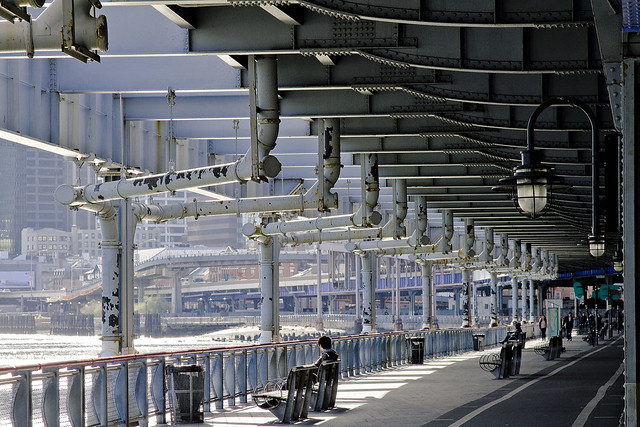
Recent business brought me to Manhattan, and an opportunity to walk along the East River while moving downtown presented itself. A spectacular promenade has recently emerged along the coast of the Shining City, much of which is unfortunately cement. Shiny and new, the sections above Corlears Hook made me a little nervous, as if one had wandered into an architect’s drawing populated by spandex wearing fitness models riding bicycles and running determinedly. Downtown, between East River Bridge Two and One (Manhattan and Brooklyn) this waterfront parkland was just grungy and old enough to feel lived in, by ordinary folk.

– photo by Mitch Waxman
It is difficult to complain about these open air trottoirs, which allow the citizenry a chance to gaze at the splendors of the harbor, especially given what these areas were like a mere 20-30 years ago. Trash strewn and off limits, New York had left its waterfront to rot away. The great shame of it all, and this is where the kvetching and Monday morning quarterbacking comes in, is that the infrastructure of docks and wharfs which literally made New York great is gone- never to return. Once something becomes a park, it is virtually impossible for it to return to other usage. No ship will be arriving here ever again.

– photo by Mitch Waxman
It’s the way of things, of course, and long ago was it decided that maritime interests were unimportant to Manhattan. So few are the docks on the island nowadays that it is scantly possible to find a berth. Word has it that the various waterfront vision plans include the usage of “temporary” or “floating” docks at some point in the future, but the days when a ship could unexpectedly arrive in the City- laden with some mysterious cargo from the south seas- seem to be over.
vast enclosure

– photo by Mitch Waxman
When you cut things down to the bone, and ask yourself the question “Who was the New Yorker that most profoundly changed the City?” it always comes back to one fellow. Ray Kelly or Mike Bloomberg would vie for the crown in modernity, in the long view of history Alexander Hamilton, DeWitt Clinton, Boss Tweed, or the Roebling clan have major claims on the title. Robert Moses would tell you that it was himself, and arguably, so would Osama Bin Laden.
In the opinion of a humble narrator, the crown belongs to one man- a Swedish immigrant named Othmar Ammann, and today is his birthday.
from wikipedia
Othmar Hermann Ammann (March 26, 1879 – September 22, 1965) was a American structural engineer whose designs include the George Washington Bridge, Verrazano-Narrows Bridge, and Bayonne Bridge.

– photo by Mitch Waxman
Brooklyn Bridge has the fame, Williamsburg Bridge the infamy, Manhattan Bridge is overlooked. The bridges of Othmar Ammann, however, are the ones which shaped the modern megalopolis and allowed the expansion and diaspora of New York’s laborers from the tenement neighborhoods of the five boroughs to the suburban satellites of modernity. The vast populations of Long Island and New Jersey and Westchester who commute into the city on a daily basis would have never achieved their current size, were Ammann removed from the story.
As a side note, and just to toot my own horn for a moment, the shot above was published last year in the New York Times- check it out here
Also from wikipedia
Othmar Ammann designed more than half of the eleven bridges that connect New York City to the rest of the United States. His talent and ingenuity helped him create the two longest suspension bridges of his time. Ammann was known for being able to create bridges that were light and inexpensive, yet they were still simple and beautiful. He was able to do this by using the deflection theory. He believed that the weight per foot of the span and the cables would provide enough stiffness so that the bridge would not need any stiffening trusses. This made him popular during the depression era when being able to reduce the cost was crucial. Famous bridges by Ammann include:
- George Washington Bridge (opened October 24, 1931)
- Bayonne Bridge (opened November 15, 1931)
- Triborough Bridge (opened July 11, 1936)
- Bronx-Whitestone Bridge (opened April 29, 1939)
- Walt Whitman Bridge (opened May 16, 1957)
- Throgs Neck Bridge (opened January 11, 1961)
- Verrazano Narrows Bridge (opened November 21, 1964)

– photo by Mitch Waxman
Othmar Ammann was a bit of an artist, his bridges achieving a rare thing for engineering projects, which is the elevation of a functional structure to the sublime. A prevailing theory in fine art and graphic design which emerged in the 20th century is “less is more”, and Ammann’s spans are manifestations of this concept in steel and cement.
from smithsonian.com
By the early 1960s, when the George Washington’s lower deck was added (as specified in the original plans), Ammann had all but eclipsed his mentor. Ammann’s other 1931 creation, the Bayonne Bridge connecting Staten Island and New Jersey, was until 1977 the world’s largest steel arch bridge — more than 600 feet longer than the previous record holder, Lindenthal’s Hell Gate Bridge.
Months before his death in 1965, Ammann gazed through a telescope from his 32nd-floor Manhattan apartment. In his viewfinder was a brand-new sight some 12 miles away: his Verrazano-Narrows suspension bridge. As if in tribute to the engineering prowess that made Ammann’s George Washington Bridge great, this equally slender, graceful span would not be surpassed in length for another 17 years.

– photo by Mitch Waxman
Eclipsed by the vain and power seeking during his sunset years, Ammann is one of the forgotten few who crafted the connections between the individual components of the archipelago islands of New York Harbor. Mighty Triborough or the graceful arch of the Bayonne Bridge speak to his sense of esthetic, and indicate that he was in touch with some higher imperative than merely moving automobiles from one place to another.
from nytimes.com
His works soar above the water, spanning the city’s rivers and connecting New York to the rest of the country. But who has heard of Othmar H. Ammann?
Donald Trump hadn’t, at least not back in 1964 when he was a high school student and his father took him to the dedication ceremony for the Verrazano-Narrows Bridge. ”It was a sad experience,” Mr. Trump recalled. ”For years, various politicians had fought the bridge. Now that it was built, I watched as these same people all got up and took credit for it, congratulating themselves and introducing one another. The only one not introduced was the man who made the bridge, Othmar Ammann.
acquired archaism
– photo by Mitch Waxman
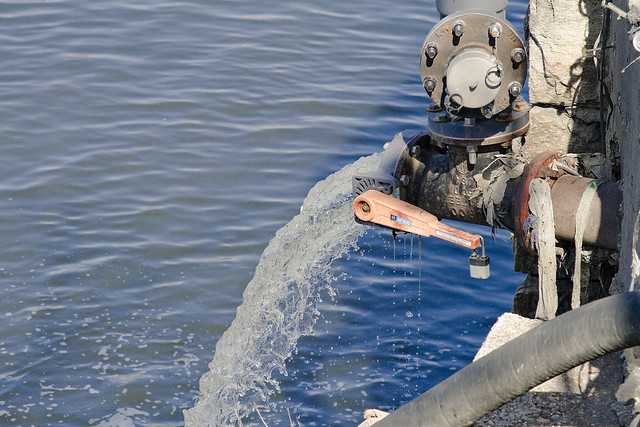
The internationalists and potentates whose congress calls itself the so called United Nations would have you observe “World Water Day” on this date. This cabal of diplomats, intriguers, and acolytes desire you to imagine and contemplate the assertion that at least a sixth of the living human infestation has no reliable access to pure water. From their headquarters in the Shining City of Manhattan- designed by the gallic crypto fascist LeCorbusier- their edict rings out, and we all must take heed of “Agenda 21”. Pictured in the shot above is the largest source of fresh water flowing into the Newtown Creek, some two to three miles from their base.
from wikipedia
World Water Day has been observed on 22 March since 1993 when the United Nations General Assembly declared 22 March as World Day for Water.
This day was first formally proposed in Agenda 21 of the 1992 United Nations Conference on Environment and Development (UNCED) in Rio de Janeiro, Brazil. Observance began in 1993 and has grown significantly ever since; for the general public to show support, it is encouraged for the public to not use their taps throughout the whole day, the day has become a popular Facebook trend.
The UN and its member nations devote this day to implementing UN recommendations and promoting concrete activities within their countries regarding the world’s water resources. Each year, one of various UN agencies involved in water issues takes the lead in promoting and coordinating international activities for World Water Day. Since its inception in 2003, UN-Water has been responsible for selecting the theme, messages and lead UN agency for the World Day for Water.

– photo by Mitch Waxman
Burgeoning, the human infestation continues to intensify upon the skin of the planet, threatening to overwhelm the fragile biosphere with a monoculture of killer apes. Sophistry and numerical manipulation make the case for Agenda 21 to play out, attempting to induce guilt and damned realization into the mainly western minds of the post industrial world, those who are well fed and watered. Your humble narrator plans on not flushing the toilet today, much to the chagrin of both “Our Lady of the Pentacle” and our little dog Zuzu. Additionally, none of us will eat or drink. A fast day will be observed for the suffering multitudes.
from unwater.org
There are 7 billion people to feed on the planet today and another 2 billion are expected to join by 2050. Statistics say that each of us drinks from 2 to 4 litres of water every day, however most of the water we ‘drink’ is embedded in the food we eat: producing 1 kilo of beef for example consumes 15,000 litres of water while 1 kilo of wheat ’drinks up’ 1,500 litres.
When a billion people in the world already live in chronic hunger and water resources are under pressure we cannot pretend the problem is ‘elsewhere’.

– photo by Mitch Waxman
The unfortunate truth, globally, is that much of the fresh water which the human infestation might consume is fouled by sewage. Whether it is agricultural lagoons of animal waste, municipal infrastructure or lack thereof, or outright industrial effluent- this is the true issue which Agenda 21 ignores. If you want to save the multitudes of the developing world- eliminate malaria and a host of other pathogens almost overnight- build sanitary sewers. Of course, we haven’t managed to swing this in New York City let alone sub Saharan Africa, so you might as well despair.
from nycgovparks.org
Social Hour: World Water Day, Thursday, March 22, 2012. 6:30 P.M.–8:00 P.M.
Celebrate World Water Day by learning more about the Croton Reservoir and Central Park’s historic role in supplying New York City with fresh drinking water. Co-presented with the NYC Department of Environmental Protection.
This event is recommended for adults (18 and over) only.
Provided at no cost to you! No advance registration. More details, including rain plans and directions, are on the Central Park Conservancy calendar.


 The Newtown Pentacle