Carrie on, wayward son
Wednesday
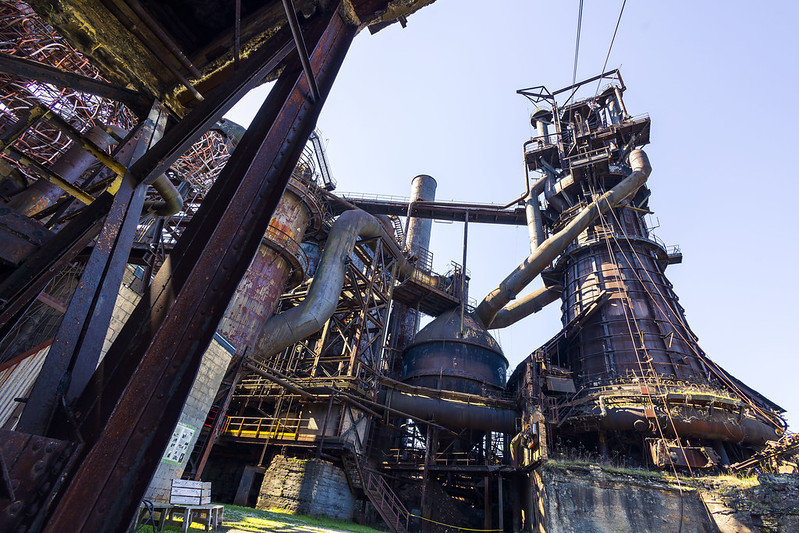
– photo by Mitch Waxman
I do wish that my knowledge base was broad enough to describe the purpose of the various ruinations on display at Pittsburgh’s Carrie Furnace in detail, or even in some sort of broad summary. I am proud that I’m intelligent enough to admit ignorance and say ‘I dunno.’
That’s always been the mark of a ‘smartie’ to me, somebody who’s willing to confess ignorance on a new topic. Stupid people make stuff up, and don’t ask questions, in my estimation.
I also wish that there was some sort of guide book which I could refer to here, but then again – I haven’t taken any of the River of Steel people’s guided tours of the site so maybe there is one. At any rate, as a ‘dirty rotten know it all’ it’s a genuine pleasure to not know things.
This is something about living in Pittsburgh which has been wonderful – novelty, and discovery.
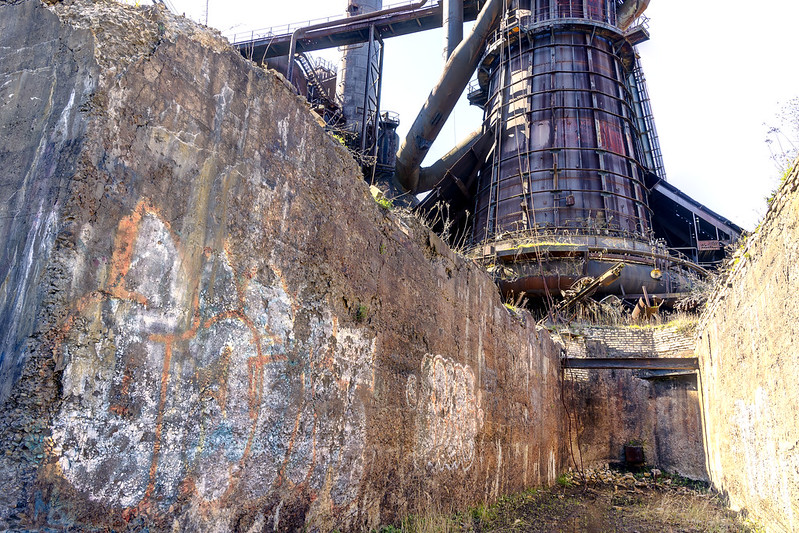
– photo by Mitch Waxman
What I can tell you is that this former steel mill is a genuine ruin. It feels a bit like visiting the Acropolis in Athens, or a Mayan pyramid in Mexico, or even wandering the Brooklyn/Queens waterfront in the late 20th century. There used to be giants here, as the saying goes.
I’ve visited the Carrie Furnace campus a few times now, and have just purchased a ticket to return on the evening of May 19th for the ‘sunset photo safari.’ Who wants to bet that it’ll be raining on that particular day?
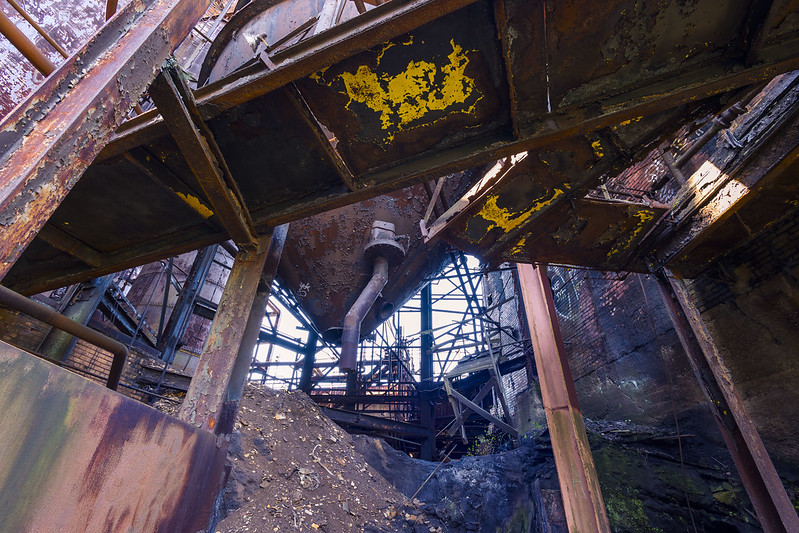
– photo by Mitch Waxman
These are all ‘tripod shots,’ as mentioned yesterday. You can certainly get away with handheld camera technique here, but I was desirous of capturing every little detail, pebble, and fleck of rust. It’s also a ‘controlled’ circumstance where you’ve got time to get fancy without having to watch your back.
The doors opened at 10 a.m., on a Sunday. I woke up early, in order to inhale a few cups of coffee and eat breakfast, which is a prerequisite for me getting busy in the early part of the day. I’m normally a late afternoon, blue hour, and night time shooter so mornings ‘ain’t usually my bag.’
I’m famously an owl, not a lark.
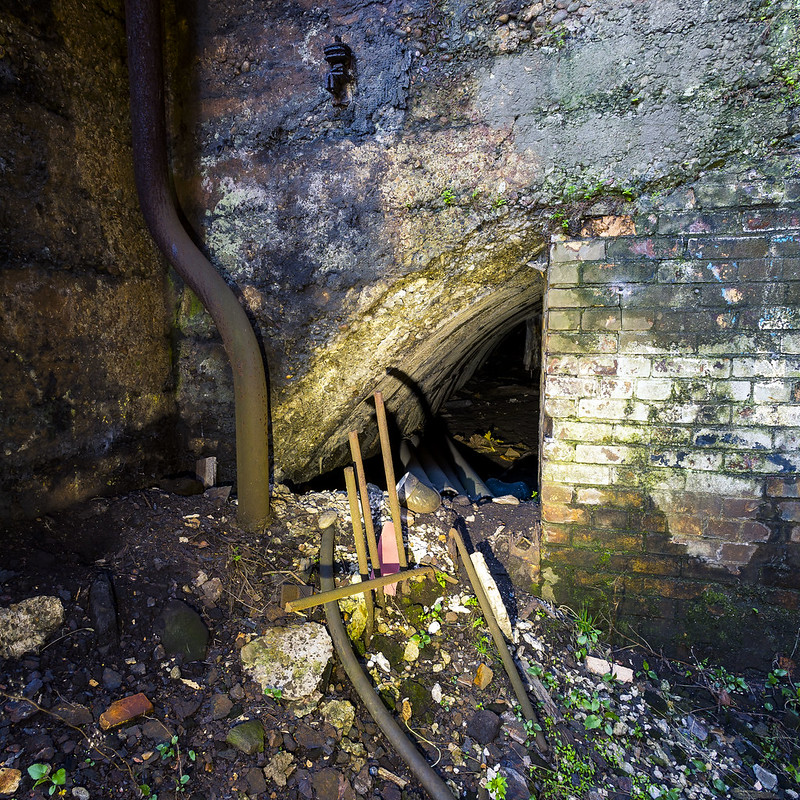
– photo by Mitch Waxman
Use was made of the fantastic little flashlight I’ve started carrying – the Nitecore T4K. It allows short bursts of 4,000 lumens of light, which allows me to leave the flash gun at home. This burst feature takes the place of a strobe and I’m able to put some bright light where I want it pretty easily, although it’s a bit of guess work to figure out how long to depress the actuator on the thing.
In normal flashlight mode, it’s got a clip which allows for attachment to the bill of my ball cap and it functions like a head lamp. The thing is also usb-c rechargeable which is a major plus. Recommended.
– photo by Mitch Waxman
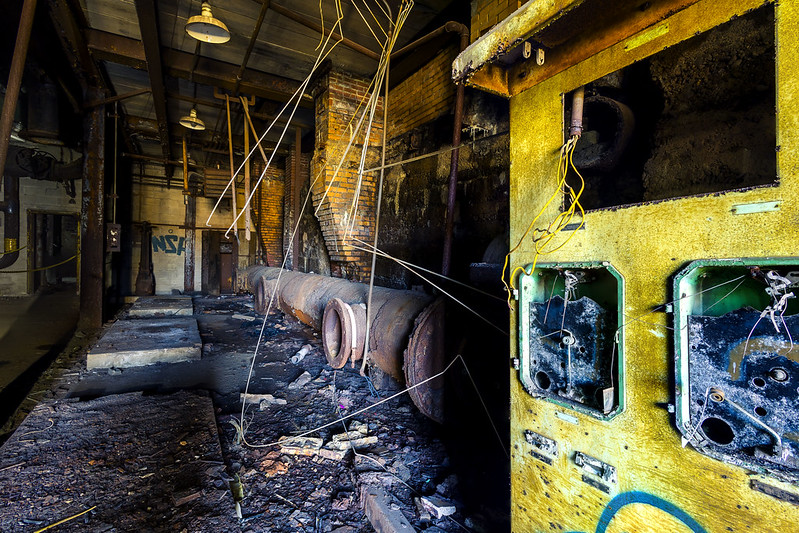
Several of the internal rooms at Carrie were open this time for casual inspection, and one took advantage of the opportunity. As mentioned above, I’d be speculating about ‘what’s what’ in this space, so I’ll avoid the temptation other than offering a vague suspicion about this equipment somehow involving gas.
Luckily, my early strategy of moving far away from the group of other photographers paid off and I had about good amount of time in this chamber all by myself.
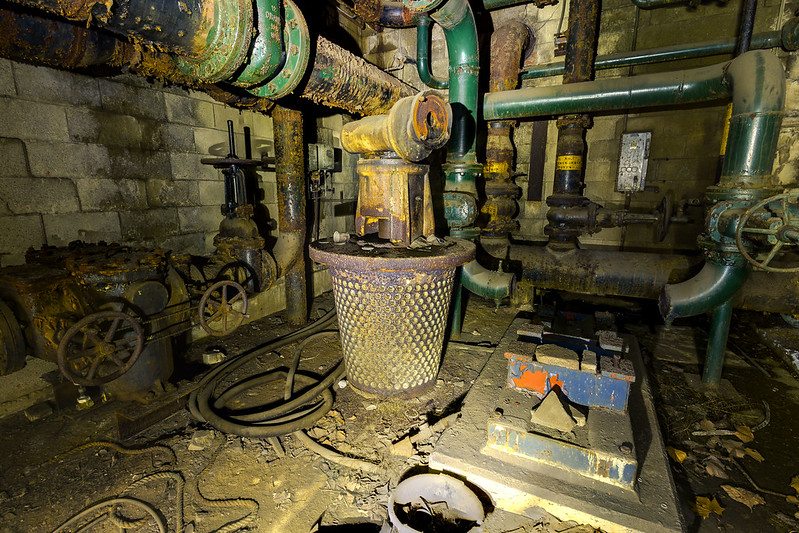
– photo by Mitch Waxman
Here’s one of the spots where that Nitecore flashlight was super useful, as everything was positively bathed in shadow. I also used the exposure stacking technique, mentioned yesterday, which allowed for some detail to pop and materialize out of the darkness.
More tomorrow.
“follow” me on Twitter- @newtownpentacle
Buy a book!
“In the Shadows at Newtown Creek,” an 88 page softcover 8.5×11 magazine format photo book by Mitch Waxman, is now on sale at blurb.com for $30.
Widdershins at Carrie Furnace
Tuesday
– photo by Mitch Waxman
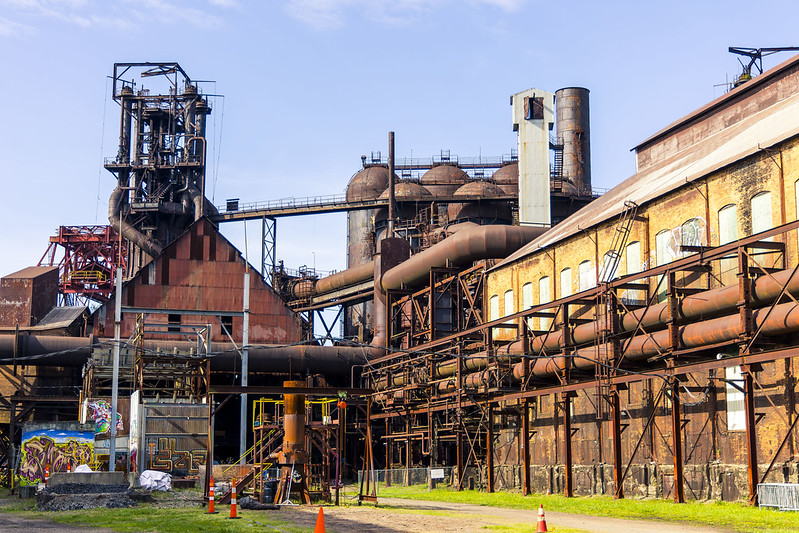
The Rivers of Steel outfit, over in Pittsburgh’s Swissvale section, recently announced a couple of opportunities to visit the Carrie Furnace site for participating in a ‘photo safari.’ It cost me $35 to gain entry to this event, which I gladly forked over.
A quick half hour drive from HQ ensued, early on a Sunday morning, and soon I was wearing a hard hat and entering the property lines of a former steel mill, located on the northern bank of the Monongahela River.
The place is a literal ruin, and there’s several safety requirements that attendees are required to oblige. None of these rules are onerous, I’d mention, especially as compared to various industrial sites which I’ve visited over the years – like the Sewer Plant in Brooklyn, or SimsMetal in Queens – both of which are found along the fabulous Newtown Creek.
– photo by Mitch Waxman
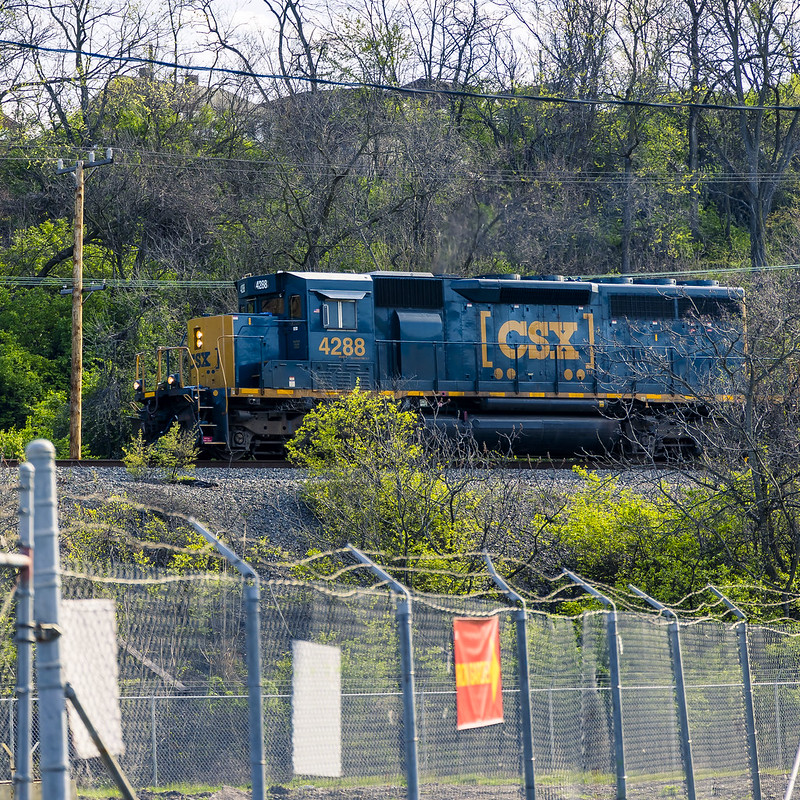
There’s a still active steel mill just down the river in a community called Braddock, and freight rail servicing the operations were spotted all morning moving just beyond Carrie’s fence lines. That’s CSX #4288 pictured above, heading towards a bridge nearby the Homestead Pump House site, and over the water to the southern bank of the Monongahela.
I’ve been to Carrie Furnace a couple of times now, and have discerned that the vast majority of attendees to these ‘photo safari’s’ seem to cluster around the first thing they see, which is – admittedly – pretty spectacular.
My plan for the morning was to get away from the madding crowd and start where most of them end, moving in a widdershins direction.
– photo by Mitch Waxman
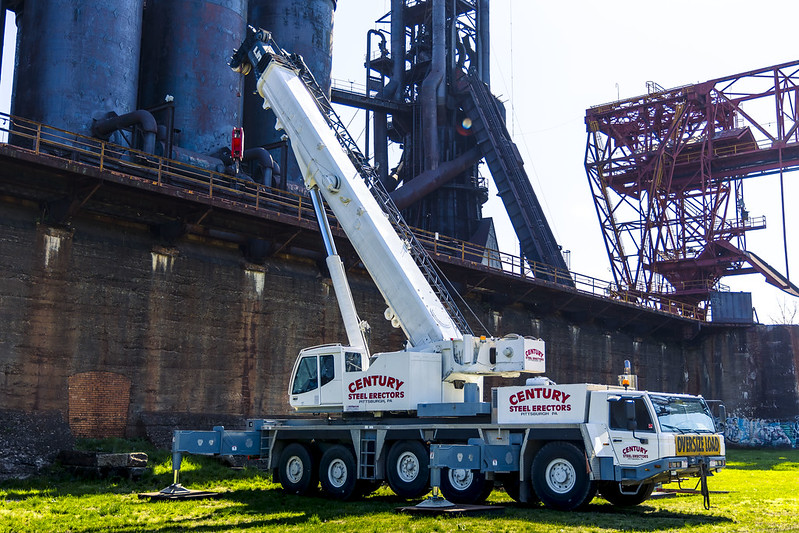
I walked the length of the property, to get to the beginning of the effort, and couldn’t resist a few shots of this crane truck. The Rivers of Steel outfit uses some of the cash from these public events to maintain and preserve the ruins here, large sections of which are in a fairly sorry state and structurally unsound. The crane truck is part of an operation to stabilize things.
My understanding of things is that Carrie was a part of the massive U.S. Steel Homestead mill, once the largest such industrial operation on the planet. The predominant section of the mill was across the river in the community which lent it the name ‘Homestead,’ but operations were spread out all over the place.
Just ask the Rivers of Steel people, they’ll tell you the whole tale of the place; the Empire State Building, and the Brooklyn Bridge, and most of Manhattan and Chicago’s skyscrapers, the rebuild of the Pacific Naval fleet after Pearl Harbor – all were accomplished with metals forged here.
– photo by Mitch Waxman
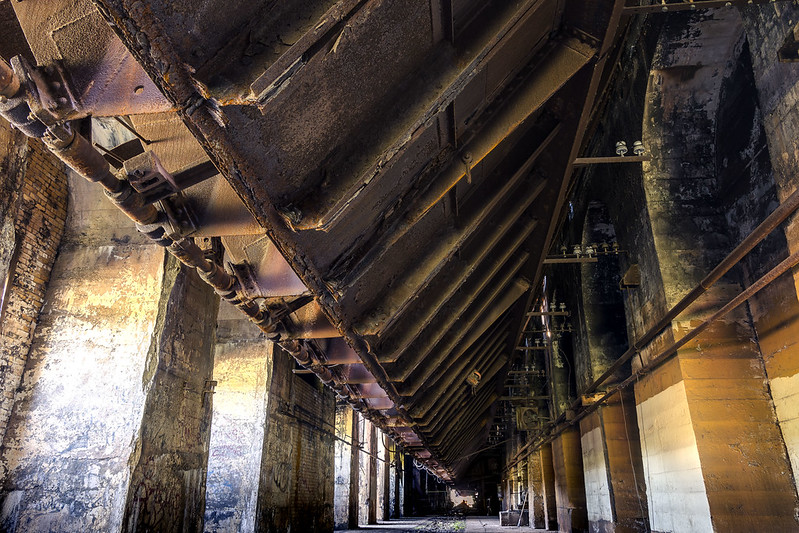
There’s a long corridor, and it would be vainglory for me to try and describe its purpose, that I haven’t paid much attention to in past visits. I thereby set up the tripod, and got busy.
This is definitely a ‘tripod’ sort of place to shoot, inside a structure with terrific amounts of industrial and architectural detail. The challenge here involves contrast, as it was relatively early in the morning and the light was harsh. At night, it would be a ‘set it and forget it’ sort of thing with long exposures.
Instead I had to rely on following the ‘focus and exposure stacking’ technique, which allowed me to compensate for the contrast.
– photo by Mitch Waxman
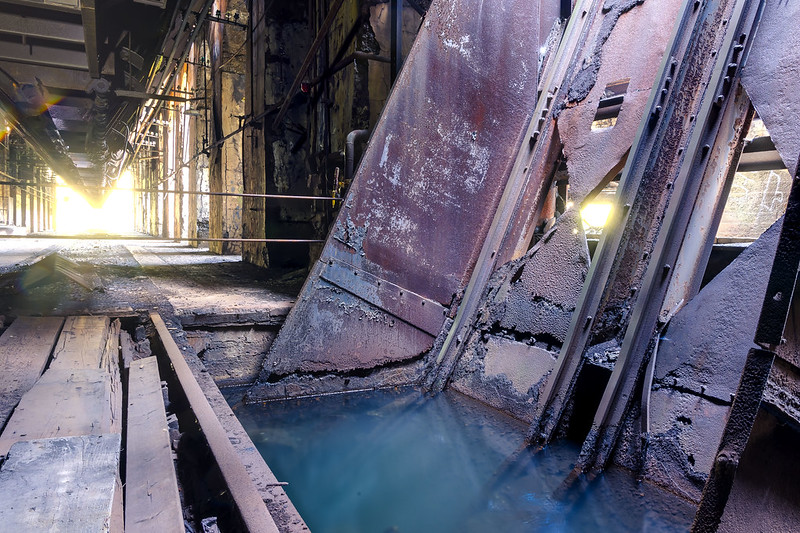
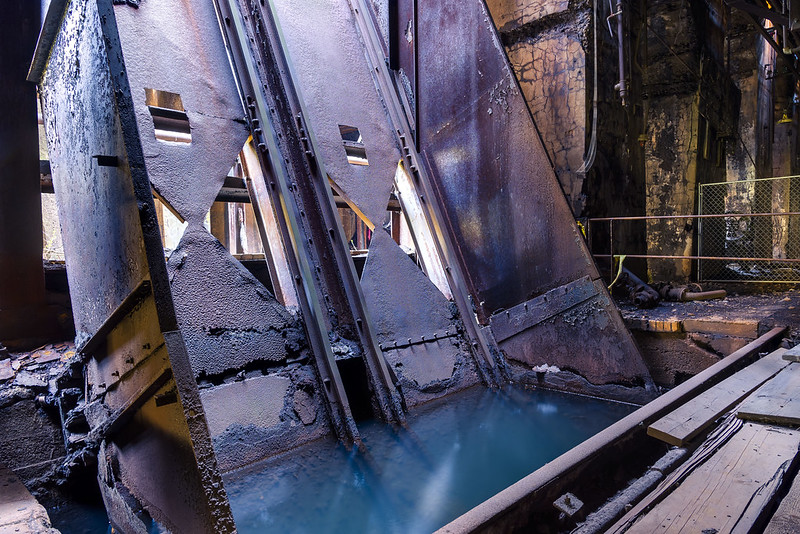
The Rivers of Steel operation sets out ‘no-go’ areas that are delineated by yellow safety tape and plastic chains. This one (and the shot below) was captured at the perimeter of one of these borders. The reason for the restriction involves the stability of the surrounding structure, which is what the people who operate that crane truck have been brought in to address.
I received a caution from one of the group’s volunteers while capturing these that I had nearly wandered too far.
– photo by Mitch Waxman
Since I was shooting in pursuance of stacking the images, I used an F4 aperture at ISO 100 and moved the point of focus around while altering the exposure time. When combined, the multiple images created an aperture equivalent of F24. Exposure times were in the 3-6 second range, but when the image was compiled this added up to about 24-30 seconds of light.
Back tomorrow with more.
“follow” me on Twitter- @newtownpentacle
Buy a book!
“In the Shadows at Newtown Creek,” an 88 page softcover 8.5×11 magazine format photo book by Mitch Waxman, is now on sale at blurb.com for $30.
Around and around
Monday
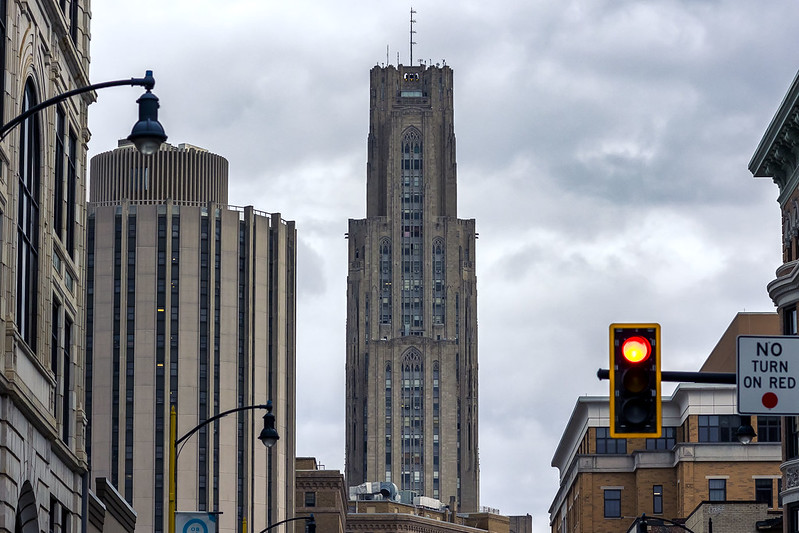
– photo by Mitch Waxman
When a humble narrator finds himself driving around Pittsburgh, the camera is always sitting on the passenger seat, and is preset for a certain kind of capture. If i find myself sitting at a light, or have pulled over somewhere and am saying ‘wow, lookit that,’ said camera is often rudely thrust through either the Mobile Oppression Platform’s moon roof or the drivers side window so that a quick image gets captured.
Recent endeavor found me heading over to the City’s ‘Oakland’ section, which is when the shot above was captured, depicting the Cathedral of Learning looming over the scene.
I was on my way to attend and observe a meeting of a local transit group, who are headquartered in this section. The irony of driving to a transit group’s meeting is not lost upon me.
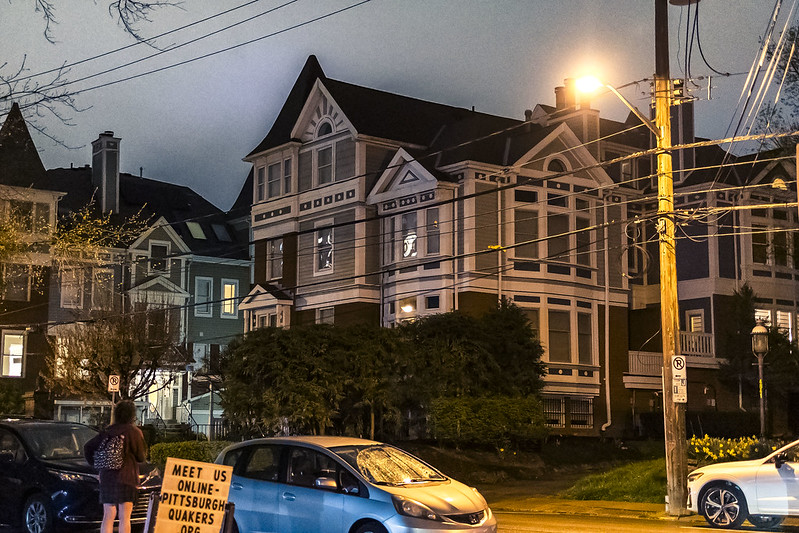
– photo by Mitch Waxman
After the event, I was struck by the manse across the street from the meeting’s address. The housing stock in this section of Pittsburgh is astoundingly well wrought. Oakland and neighboring Squirrel Hill, in my experience, are the most ‘urban’ sections of Pittsburgh in terms of overall population density. There are other sections which are also quite ‘urban,’ but these exist within the negative connotation of the term – crimey, grimey, etc. There’s a potpourri here.
Where HQ is located in the South Hills, alternatively, is quite suburban. Saying that, analogizing things back to my frame of reference back in NYC, when I say ‘suburban’ I mean the Queens/Nassau County border or the Yonkers/Westchester border and not ‘deep suburban’ like Suffolk or Putnam counties.
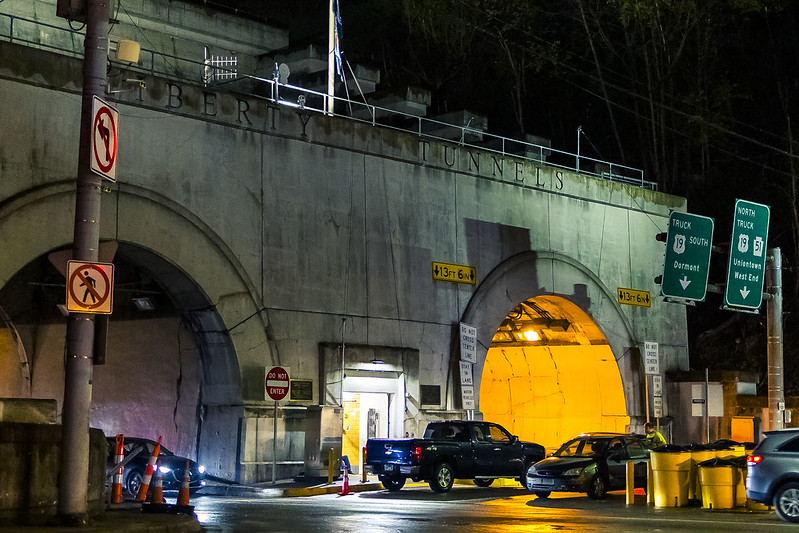
– photo by Mitch Waxman
That’s the Liberty Tunnel – or ‘tubes’ – pictured above, a mile long and hundred year old vehicle tunnel that’s punched through the base of Mount Washington on the southern bank of the Monongahela River. One was sitting at a light waiting for my chance to turn into the facility and head back home, when the fancy of getting a night shot of the place struck me. It’s a long light, after all.
The settings on the camera were previously configured, as mentioned above. Daylight wise, that means f4 and ISO 800 with the exposure settings dialed into whatever they need to be. Night wise it’s f2.8 and ISO 6400. The model of camera I use has a swivel out screen, which allows one to point it at something which would otherwise require a gymnast to use the diopter eye piece in order to compose and adjust exposure on otherwise.
Back tomorrow with something very different, at this – your Newtown Pentacle.
“follow” me on Twitter- @newtownpentacle
Buy a book!
“In the Shadows at Newtown Creek,” an 88 page softcover 8.5×11 magazine format photo book by Mitch Waxman, is now on sale at blurb.com for $30.
Western Maryland Yard, in West Virginia
Friday

– photo by Mitch Waxman
The Patomac River flows through Maryland’s Cumberland, providing a border between it and neighboring Ridgeley in West Virginia. Driving along a local street between the two municipalities, the Google Maps navigation app on my phone was continually announcing ‘Welcome to Maryland’ followed by ‘Welcome to West Virginia’ and then ‘Welcome to Maryland’ again.
One of the things I wanted to get a shot or three of on this day trip was the rail yard used by the Western Maryland Scenic Railroad, which is found on the West Virginia side of the river.

– photo by Mitch Waxman
There were a couple of people working, and I got these shots by focusing through a hole in the fencelines. I’m planning on buying a ticket to ride alomg with them on one of the regularly scheduled ‘heritage rides’ they offer, when their summer schedule starts up again. The historic trains roll between Cumberland and Frostburg in Maryland, and the tracks travel through the rolling hills of the Laurel Highlands. Should be a cool experience, I think, and maybe a few pretty pictures.
Adventure, excitement… a Jedi craves not these things. I, of course, am no Jedi. If anything, I lean a bit towards Sith, or at least I wear a lot of black clothes. Emperor Palpatine seems like a nice happy guy, as he’s always laughing. That’s the sort of bloke whom I’d like to hang out with, happy people who laugh a lot, and can coincidentally shoot lightning out of their fingertips. Besides, the Jedi are kind of preachy.
I know… nerd.
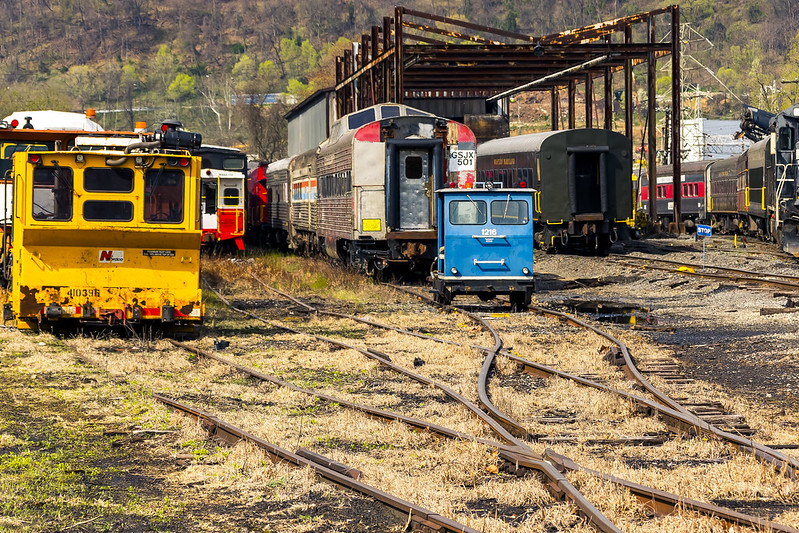
– photo by Mitch Waxman
I soon packed up my camera gear and got ‘road lunch’ at McDonald’s.
One then stopped off at a gas station and topped off the car’s gas tank, not because I was empty but instead because I was curious to see what sort of actual gas consumption the Mobile Oppression Platform had incurred over the course of roughly 130 miles of driving (mostly highway). Three and a bit gallons, as it turned out, and according to the car’s diagnostics – I was rolling about at 40.8 mpg. Gotta hand it the engineers of the Toyota Hybrid engine department, that’s better than advertised.
Back next week with something different at this – your Newtown Pentacle.
“follow” me on Twitter- @newtownpentacle
Buy a book!
“In the Shadows at Newtown Creek,” an 88 page softcover 8.5×11 magazine format photo book by Mitch Waxman, is now on sale at blurb.com for $30.
CSX Cumberland apertif
Thursday

– photo by Mitch Waxman
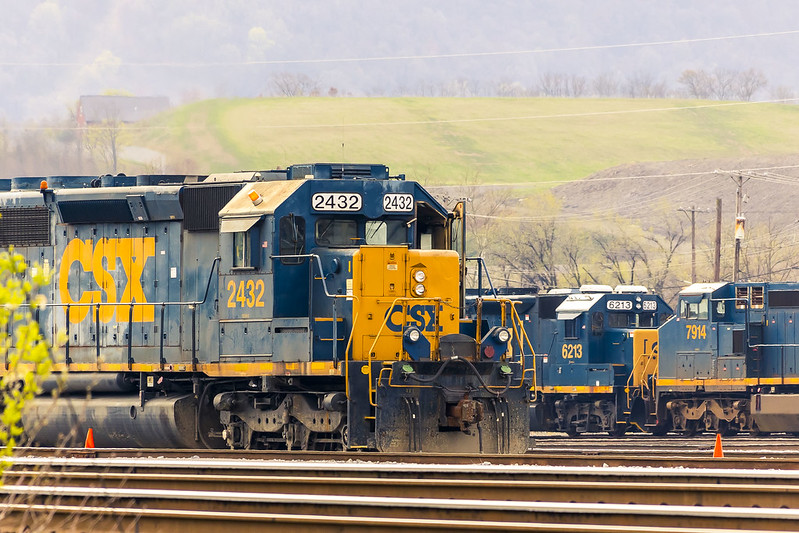
Finally, I found a point of view location for the CSX Terminal in Maryland’s city of Cumberland. Take that, jabronies.
One realizes that this quest of mine sounds fairly obsessive, and I haven’t been able to get close at all to what I really want shots of (the roundhouse), but… darn it… this is the closest I’ve managed to get to the facility and I was glad of it.
This whole ‘train thing’ has been a real learning experience, I tell you, but I’m not done yet. Learning, learning, learning.
– photo by Mitch Waxman
This is my second or third day trip to this area, which is about a two hour drive, and what I’d consider to be the southeastern corner of the Pittsburgh metroplex. A significant section of the journey takes place on the modern incarnation of the ‘National Road’ – Route 40, which dates back to 1812, and travels through the Laurel Highlands. If you’re interested in seeing an absolutely gorgeous section of the eastern United States – put the Laurel Highland on your list.
Cumberland is high on my ‘to explore’ list, and I’ll definitely be trying to pay the place a good amount of attention while waving the camera around.

– photo by Mitch Waxman
An oddly painted track maintenance unit was spotted at the Cumberland Terminal, all decked out in the sort of urban camouflage pattern which the military favors. Can’t imagine why you’d paint equipment like this in such a manner, but there you go. Normally these sorts of things are brightly painted so you can’t ‘not notice’ them.
Back tomorrow.
“follow” me on Twitter- @newtownpentacle
Buy a book!
“In the Shadows at Newtown Creek,” an 88 page softcover 8.5×11 magazine format photo book by Mitch Waxman, is now on sale at blurb.com for $30.


 The Newtown Pentacle