Posts Tagged ‘Long Island City’
curiously dislocated
“follow” me on Twitter at @newtownpentacle
– photo by Mitch Waxman
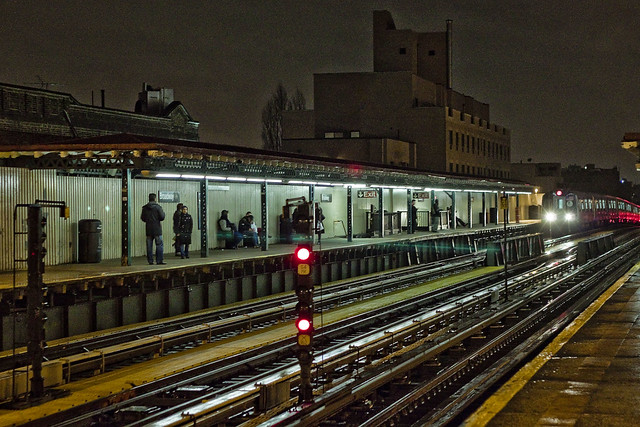
Although it is the Mother of harlots, entering Manhattan on a regular basis is periodically required of your humble narrator, for none may trade nor sell in the City of New York lest this borough’s mark is upon them. Usually this journey is accomplished along the subterranean R line, but often will one walk over to the elevated N line on the 31st street side of the neighborhood just to mix things up. You take the low road, I’ll take the high road, and I’ll be in midtown before ye…

– photo by Mitch Waxman
The Shining City, a place which your humble narrator actually lived for many years, has become lost in an inferior incarnation of itself. One does not long for the era of sin and fornication recently passed, it is the modern facade of the City which agitates. Many disagree with me, arguing for acceptance of a halcyon and quite modern era of progress and development which will eradicate the mistakes of prior centuries. All I can tell you, in retort, is that I don’t see many autochthonous smiles in Manhattan. Also, $9 is too much for a tuna sandwich.

– photo by Mitch Waxman
An echo chamber, things there are no longer hot, nor cold- rather they are lukewarm. Don’t get me wrong, there ain’t no mountain spring water running out here in Astoria neither, there are oodles of things wrong in Brooklyn and Queens. I’m sure the Bronx and …Staten Island… likely have some problems too. I’m just saying that we don’t export them, unlike the unsustainable island of Manhattan, and that I- for one- am a lot more comfortable and likelier to be smiling here in Queens.
curious noises
“follow” me on Twitter at @newtownpentacle

– photo by Mitch Waxman
Admission that Malthus was probably right in adopting a dire tone is offered, something which occurred to me while sitting in a dank concrete bunker and waiting interminably for a Manhattan bound Subway. The worst of all possible situations – alone with my own blasphemous and fever inducing thoughts. Racing phantasms leapt about behind my brow, as train after train exited Manhattan moving east. Each electrically powered chain of metal boxes which entered and left this dripping subterranean bunker seemed to be full of humans, but it is impossible to say with certainty who- or indeed “what”- might have been cradled within.
Finally, a cyclopean shape appeared in the distance of the cement corridor.

– photo by Mitch Waxman
Realization that the alloyed conveyance proceeding in the particular direction desired by one such as myself was at hand resulted in a humble narrator sitting uncomfortably amongst the many. Judgement and condemnation was surely brewing in their minds, as furtive glances revealed hostile stares. At the other end of the car were a group of teenagers, and I was reminded of media reports describing the peer group’s outré and often violent delinquency as well as rumors detailing their drug fueled rampages. The practice of running rampant is prevalent in the youth of these degenerate days, after all.
Toward the corner which I faced, an older woman was knitting, just a bit too nonchalantly for my taste.
Perspiration began to drip coldly down my back, which was fully hidden beneath a filthy black raincoat which smells of sewers and wood smoke, and my breathing became erratic.

– photo by Mitch Waxman
Imminent, waves of sudden panic eliminated my desire to enter the Shining City of Manhattan onboard this crowded contraption. One departed this underworld, carven into the marshy soils of Queens itself, to once more gaze upon the greasy skies of Long Island City. Standing in a small patch of transmission oil and shattered glass, as a castaway McDonalds bag found its wind blown course to my leg while some strange but obviously relieved inebriate urinated into a phone booth, calm reason once again overtook me. Home, at last.
Down in those concrete catacombs, how can one ever know what horrors are of the mind alone or hint at what there may be that is lurking down there?
inexorably crawling
“follow” me on Twitter at @newtownpentacle

– photo by Mitch Waxman
One is fascinated by the automotive corridor through western Queens that is known as Northern Blvd. It is literally an “automotive corridor” as in the sense of it being a busy vehicular roadway, but it is also an industrial corridor which speaks of a forgotten moment in NY history when automobiles were manufactured in the five boroughs. This is largely a start of the twentieth century sort of thing, of course, but it was a pretty big deal back in the 1920’s.
That’s before the American auto industry consolidated itself around the City of Detroit, of course.

– photo by Mitch Waxman
Standard Motor Products is still located at the corner of Steinway/39th street and Northern, of course, but they don’t make anything here anymore- it’s just offices. At that, SMP only uses a small section of their former factory, which famously carries a modern day rooftop farm at its crown. This “history of the automobile industry in Queens” thing is a topic which has been gathering steam and certain interest for your humble narrator of late, but my research has only just begun and intelligent presentation of fact is still far off in the future.

– photo by Mitch Waxman
There is still a significant amount of auto related commerce going on around these parts, but it’s all about sales these days, not manufacture. An incalculable number of used… sorry… industry parlance is “pre owned”… cars are available along that stretch of Northern Blvd. which sits happily between Queens Plaza and the Grand Central Parkway. Something I’m working on, one of many background tasks and research projects performed and underway here at Newtown Pentacle HQ.
ever permitted

– photo by Mitch Waxman
Pulsing and pallid, that corpulent jelly which comprises my physical domain and imprisons my conscious mind was carrying me down Jackson Avenue in Long Island City and past the fabled Court Square Diner, whereupon a face melting realization of a recent vehicular disaster confronted me. It would seem that the MTA department of the municipality has one less truck in its fleet roster.

– photo by Mitch Waxman
As painful as it would be for them to encounter a creature such as myself, contact was made with the MTA employees who were vouchsafing the wreck while awaiting a tow vehicle which would secure its disposition.
Note: It isn’t fair to inflict my nauseous presence on the unsuspecting innocents who surround me, nor is it alright to ask them to endure the many disgusting qualities of what might be described as my “vocalizations.” Selfishly, I elected to attempt contact with one of the humans, in an attempt to find out what happened. Apologies offered to all offended parties. Don’t hurt me.
Queries as to the well being of the driver were answered by assurances of continuing good health, but adherence to an institutional policy which required visiting a hospital to professionally confirm and assess said status was obeyed and that was where the driver found himself.

– photo by Mitch Waxman
A smell of refined petroleum derivates hung in the air, and once contact with this clearly shaken employee of the great human hive was reliably completed, my camera found itself employed. Indications offered by that stalwart representative opined that the municipal truck was operated in accordance with traffic regulation, but that another large vehicle was not, which resulted in a collision.
The area is well patrolled by security cameras, one would presume this will be an easy supposition to corroborate thusly.

– photo by Mitch Waxman
The reportage continued that the MTA truck had careened off the second vehicle and the driver lost control of the heavy vehicle. The truck’s wild course carried it away from the equator of the street and in the process it eliminated a metal lamp post and crashed up on the pedestrian lane, known colloquially and conventionally as the sidewalk.
Nervous anticipation nagged at me, as wild paranoid wonderings about sparks falling from the elevated subway tracks mixing with… the petroleum vapors… no… such things do not happen… At this moment, my headphones were back in place and playing through a long list of songs- thats when this random ditty started piping directly into my auditory orifices.
I spun around and started walking toward Astoria in a loose dog trot.
potent interest
“follow” me on Twitter at @newtownpentacle

– photo by Mitch Waxman
A carven forest of infinite sorrow and cosmic loss, Calvary Cemetery here in Queens often brightens the mood of one such as myself.
Deeply jaundiced by the acts and betrayals of the living, a humble narrator has little choice but to reacquaint himself constantly with an era when honor and the keeping of ones word was the masculine ideal. Unfortunately we live in a debased age, wherein petty monsters are allowed to terrorize the townsfolk freely. Such creatures stalk every century of course, but in ours, the acts of vengeance one may enact against an opponent are considerably circumscribed by custom and law.
You just can’t punch a guy in the nose and be done with it anymore.
from wikipedia
The first burial in Calvary Cemetery took place on July 31, 1848. The name of the deceased was Esther Ennis, having reportedly “died of a broken heart.” By 1852, there were 50 burials a day, half of them were poor Irish under seven years of age.

– photo by Mitch Waxman
Moral conundrums such as the one described above were less important than finding a meal for most of the 19th century Catholics who were buried here. They mostly died young, they died poor, and they most often died from avoidable diseases brought on by bad water, poor sanitation, and chronic malnutrition. Most were illiterate, violent, and alcoholics (by modern standards), and the only people looking out for them were their priests.
That “50 burials a day” number in the wiki quotation above represents an interesting organizational question to me. Around the beginning of the Civil War, the technological resources that the Roman Catholic Church would have had access to in performing these interments is easily explained as the sort of gear you’d see in a Cowboy movie- horses and wagon, pick ax, shovels and spades.
That’s a lot of digging, better than eighteen thousand graves a year, which would require a lot of cheap labor.
18,000 funerals a year also indicates a lot of clerical work, performing ceremonial functions for the cemetery itself and organizing the ritual schedules of mass and other votive tasks for funeral goers at the cemetery chapel.
from fordham.edu
In the 1840’s a massive number of Irish-Catholics immigrated to the United States. By 1855, there were over 200,000 Irish in New York City. British land policies, which sought to sweep the Irish peasants off their land, were compounded by the devastating potato famine of 1845 to 1847. A rot attacked the potato crop, on which the Irish population had become dependent. About 2 million people perished. The Irish often arrived in America with few material possessions and were forced to live in squalor.

– photo by Mitch Waxman
As detailed in the past, the first service conducted here, for Esther Ennis in 1848, was conducted by the legendary Archbishop “Dagger” John Hughes.
Hughes was a charismatic firebrand who turned the Archdiocese of New York into a powerhouse player in education, real estate, finance, and politics within a single generation. Based in Manhattan, Hughes’s Archdiocese appointed the official chaplains of the Calvary Cemetery, once a prestigious position to hold. No evidence of a modern chaplain, although there must be some modern prelate who oversees the place, was discovered upon casual inspections.
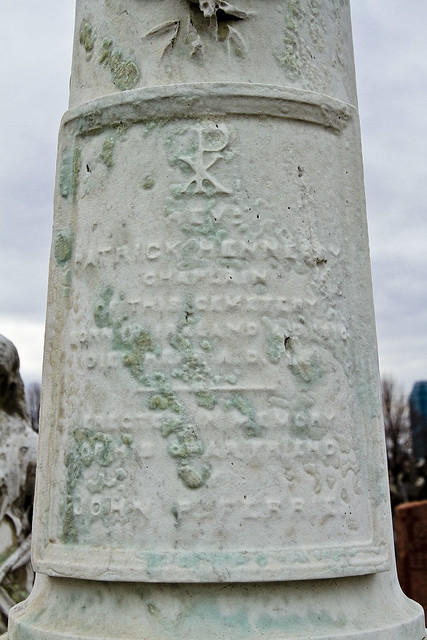
The monument in today’s posting is that of one such chaplain of Calvary Cemetery.
from wikipedia
On April 8, 1808, the Holy See raised Baltimore to the status of an Archdiocese. At the same time, the dioceses of Philadelphia, Boston, Bardstown and New York were created. At the time of its establishment, the Diocese of New York covered all of the state of New York, as well as the New Jersey counties of Sussex, Bergen, Morris, Essex, Somerset, Middlesex, and Monmouth.
Since the first appointed bishop could not set sail from Italy due to the Napoleonic blockade, Fr. Kohlman was appointed administrator. He was instrumental in organizing the diocese and preparing for the Cathedral of St. Patrick to be built on Mulberry Street. Among the difficulties faced by Catholics at the time was anti-Catholic bigotry in general and in the New York school system. A strong Nativist movement sought to keep Catholics out of the country and to prevent those already present from advancing.
– photo by Mitch Waxman
Lords and Ladies, gaze upon the inscription marking this marble as the monument of the First Chaplain of Calvary Cemetery, Rev. Patrick Hennessy.
This column, decorated and inscribed with iconography denoting the burial place of a Roman Catholic Priest, has stood here in section 3 since 1861. It adjoins two other monuments recently described at this, your Newtown Pentacle- the Connell obelisk from “whispered warnings,” and what turned out to be the Jeanne Du Lux and John P. Ferrie monument from “anxious band” and “doubly glad.”
from 1876’s “The visitor’s guide to Calvary cemetery, with map and illustrations” by J. J. Foster, courtesy archive.org
REV. PATRICK HENNESSY, Late Chaplain of the Cemetery, on which are the usual priestly insignia.
In the rear of the monument are statues representing ” Faith,” ” Hope,” and ” Charity,” angels in kneeling posture, and many others. Marble vases containing blooming flowers are scattered around, somewhat relieving the bare aspect of the ground, which is paved with small square-cut flagging, in which is a door leading to the vaults beneath. The whole plot is surrounded with substantial rails of marble.

– photo by Mitch Waxman
According to the quotation above, there is a subterranean vault which lies forgotten below the very spot upon which I stood while shooting the closer in photos which appear above.
Such occluded knowledge and latent danger is nepenthe, of course, for one such as myself. References gleaned from study of ancient tomes indicates that Rev. Hennessy actually lived within the gates of the cemetery itself, but that comes from a single source and is therefore not 100% reliable. If accurate, however, the structure would have been found at the foot of the hill which Section 9 sits upon.
One suspects that unlike myself, who is a vast physical and psychological coward known for his fits of shrieking laughter and terrifying pauses, an Irish priest from the New York of 1861 would have found little problem with straightening his back up and punching some rogue right square in the nose.
an obituary published on January 28 of 1861, found at the NYTimes archive, discusses the passing of Rev. Hennessy
HENNESSY. — At his residence, on Long Island, on Saturday, Jan. 26, Rev. PATRICK HENNESSY, in the 51st year of his age.
His funeral will take place from the Church at Calvary Cemetery, at 10 o’clock A.M., this day, (Monday.) 28th inst. His friends, and the reverend clergy, are respectfully invited to attend.


 The Newtown Pentacle