Posts Tagged ‘Long Island City’
Project Firebox 54

– photo by Mitch Waxman
Cruelly grafiti’d, the sentinel stands on the corner of Van Dam and Hunters Point in Queens. It witnesses thousands passing by daily in motor vehicular transit. How many in turn acknowledge it?
trembling protest
“follow” me on Twitter at @newtownpentacle

– photo by Mitch Waxman
Just the other day, one was strolling along Jackson Avenue in Long Island City and enjoying the late afternoon haze of auto exhaust when I decided to avoid a group of rough and aggressive looking youngsters by ducking down a dead end called Dutch Kills Street. Haughty and diffident, these unscrupulous looking minors had perhaps reached the third grade, but realizing that they have spent their short lifetime playing violent video games and were therefore potential killers, your humble narrator decided to walk the familiar path of ignominy and hide from them.
– photo by Mitch Waxman
Such physical cowardice has often proven to be the better part of valor for one such as myself, a shunned and awkward thing which resembles a man. Dutch Kills Street, where the native art form of Queens (illegal dumping) is practiced wholly, is overflown by structures sprouting out from the Great Machine at nearby Queens Plaza. Vehicular traffic departing and approaching the mighty Queensboro bridge hurtles along overhead, and the street grade lanes end at the fence lines of the titan Sunnyside Yards..

– photo by Mitch Waxman
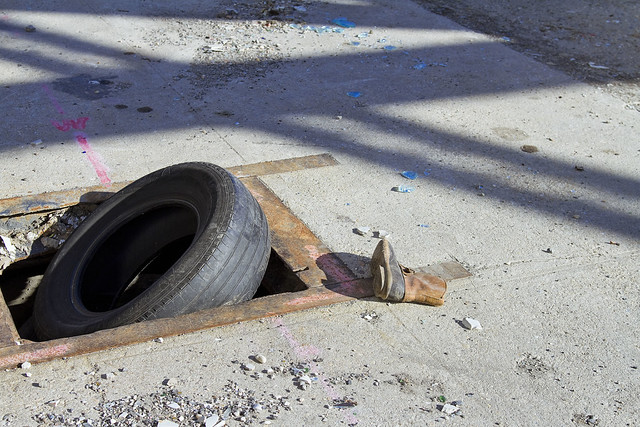
At the end of the street was observed another of the curious shoes which I’ve been noticing scattered around in similarly desolate locales over the last few months. Odd bordering on obsequious, the presence of just one half of the mated pair- again and again- just makes a little bell go off in my head when I see it. It is common to see all sorts of domestic and personal goods scattered about the neighborhoods surrounding the fabled Newtown Creek, but the homogeneity of these singular shoe sightings simply suggests something sinister and suspicious.

– photo by Mitch Waxman
The rough looking group of third graders had noisily passed the intersection of Jackson and Dutch Kills, heading towards Tower Town down in Hunters Point. They were assembled in a “skirmish line” formation, walking abreast of each other while in the company of a group of women who seemed to have some measure of control over their movements. Some of these women had far younger children with them, who were being transported in bizarre cart like machines- whose appearance I did not like, I should add- which I found disconcerting. Your humble narrator hid behind a pile of trash for awhile, then fled the scene with haste.
found unconscious
“follow” me on Twitter at @newtownpentacle

– photo by Mitch Waxman
Whilst roaming about Long Island City recently, one has come to the realization that the long economic doldrums affecting and stultifying the rapacious desires of the Real Estate Industrial Complex have seemingly come to an end. A recent flurry of high profile constructions, demolitions of centuried warehouses, and industrial tumult points to this fact.
Accordingly, this means that several long standing structures are likely not long for this world.

– photo by Mitch Waxman
Your humble narrator has little need for sprockets, bearings, or pulleys. However, this business on Jackson Avenue hosts a charming mid 20th century bit of signage which answers some need which dare not speak its name within me. A resume and history of “Century Rubber Supply” is beyond my capability or desire to delve into, and I’ve never shopped there, I just like their signage. Enormous construction efforts are underway all around the diminutive structure, and the rest of the block it occupies has shed itself of tenants.
In Long Island City, this indicates that the bell is tolling.

– photo by Mitch Waxman
The malign ideation that dwells within the Megalith and its infinite army of acolytes seem to be on the right side of history. Sooner than later, one fears, the idiosyncratic wonders of Long Island City will soon be entirely replaced by shield walls of glass and steel.
Bland homogenization which stinks of the Crypto Fascist theories of LeCorbusier ruling the future is my fear, but that’s an opinion, and like the anus- everyone has one.
A singular question which will stain the lips of all the still unborn Queensicans of future times, I fear, will be: “where might I buy some sprockets?”. The very old folk who remember an earlier time will remain silent when their children offer this query, lest what else may have been lost is asked about.
shines thinly
“follow” me on Twitter at @newtownpentacle

– photo by Mitch Waxman
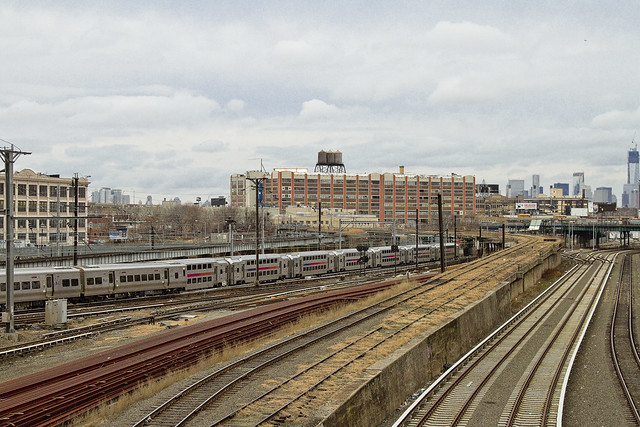
Early will your humble narrator be rising today, with intentions of loitering about the neighborhood for an extended period. It’s been a few weeks since my last merry perambulation carried me across the Pentacle and I look forward to where my feet may take me.
– photo by Mitch Waxman
Supernal glories abound, sights to see and inventory. Queens is calling.

– photo by Mitch Waxman
Of course, that thing which cannot possibly exist at the cupola of the Sapphire Megalith in Long Island City will be watching. What’s a Saturday without a sense of latent menace and paranoia, after all?
“The Street” by H.P. Lovecraft
“follow” me on Twitter at @newtownpentacle

– photo by Mitch Waxman
All text in today’s post from “The Street” by H.P. Lovecraft, courtesy wikisource
There be those who say that things and places have souls, and there be those who say they have not; I dare not say, myself, but I will tell of the Street.
Men of strength and honour fashioned that Street: good valiant men of our blood who had come from the Blessed Isles across the sea. At first it was but a path trodden by bearers of water from the woodland spring to the cluster of houses by the beach. Then, as more men came to the growing cluster of houses and looked about for places to dwell, they built cabins along the north side, cabins of stout oaken logs with masonry on the side toward the forest, for many Indians lurked there with fire-arrows. And in a few years more, men built cabins on the south side of the Street.
Up and down the Street walked grave men in conical hats, who most of the time carried muskets or fowling pieces. And there were also their bonneted wives and sober children. In the evening these men with their wives and children would sit about gigantic hearths and read and speak. Very simple were the things of which they read and spoke, yet things which gave them courage and goodness and helped them by day to subdue the forest and till the fields. And the children would listen and learn of the laws and deeds of old, and of that dear England which they had never seen or could not remember.

– photo by Mitch Waxman
There was war, and thereafter no more Indians troubled the Street. The men, busy with labour, waxed prosperous and as happy as they knew how to be. And the children grew up comfortable, and more families came from the Mother Land to dwell on the Street. And the children’s children, and the newcomers’ children, grew up. The town was now a city, and one by one the cabins gave place to houses—simple, beautiful houses of brick and wood, with stone steps and iron railings and fanlights over the doors. No flimsy creations were these houses, for they were made to serve many a generation. Within there were carven mantels and graceful stairs, and sensible, pleasing furniture, china, and silver, brought from the Mother Land.
So the Street drank in the dreams of a young people and rejoiced as its dwellers became more graceful and happy. Where once had been only strength and honour, taste and learning now abode as well. Books and paintings and music came to the houses, and the young men went to the university which rose above the plain to the north. In the place of conical hats and small-swords, of lace and snowy periwigs, there were cobblestones over which clattered many a blooded horse and rumbled many a gilded coach; and brick sidewalks with horse blocks and hitching-posts.
There were in that Street many trees: elms and oaks and maples of dignity; so that in the summer, the scene was all soft verdure and twittering bird-song. And behind the houses were walled rose-gardens with hedged paths and sundials, where at evening the moon and stars would shine bewitchingly while fragrant blossoms glistened with dew.

– photo by Mitch Waxman
So the Street dreamed on, past wars, calamities, and change. Once, most of the young men went away, and some never came back. That was when they furled the old flag and put up a new banner of stripes and stars. But though men talked of great changes, the Street felt them not, for its folk were still the same, speaking of the old familiar things in the old familiar accounts. And the trees still sheltered singing birds, and at evening the moon and stars looked down upon dewy blossoms in the walled rose-gardens.
In time there were no more swords, three-cornered hats, or periwigs in the Street. How strange seemed the inhabitants with their walking-sticks, tall beavers, and cropped heads! New sounds came from the distance—first strange puffings and shrieks from the river a mile away, and then, many years later, strange puffings and shrieks and rumblings from other directions. The air was not quite so pure as before, but the spirit of the place had not changed. The blood and soul of their ancestors had fashioned the Street. Nor did the spirit change when they tore open the earth to lay down strange pipes, or when they set up tall posts bearing weird wires. There was so much ancient lore in that Street, that the past could not easily be forgotten.
Then came days of evil, when many who had known the Street of old knew it no more, and many knew it who had not known it before, and went away, for their accents were coarse and strident, and their mien and faces unpleasing. Their thoughts, too, fought with the wise, just spirit of the Street, so that the Street pined silently as its houses fell into decay, and its trees died one by one, and its rose-gardens grew rank with weeds and waste. But it felt a stir of pride one day when again marched forth young men, some of whom never came back. These young men were clad in blue.

– photo by Mitch Waxman
With the years, worse fortune came to the Street. Its trees were all gone now, and its rose-gardens were displaced by the backs of cheap, ugly new buildings on parallel streets. Yet the houses remained, despite the ravages of the years and the storms and worms, for they had been made to serve many a generation. New kinds of faces appeared in the Street, swarthy, sinister faces with furtive eyes and odd features, whose owners spoke unfamiliar words and placed signs in known and unknown characters upon most of the musty houses. Push-carts crowded the gutters. A sordid, undefinable stench settled over the place, and the ancient spirit slept.
Great excitement once came to the Street. War and revolution were raging across the seas; a dynasty had collapsed, and its degenerate subjects were flocking with dubious intent to the Western Land. Many of these took lodgings in the battered houses that had once known the songs of birds and the scent of roses. Then the Western Land itself awoke and joined the Mother Land in her titanic struggle for civilization. Over the cities once more floated the old flag, companioned by the new flag, and by a plainer, yet glorious tricolour. But not many flags floated over the Street, for therein brooded only fear and hatred and ignorance. Again young men went forth, but not quite as did the young men of those other days. Something was lacking. And the sons of those young men of other days, who did indeed go forth in olive-drab with the true spirit of their ancestors, went from distant places and knew not the Street and its ancient spirit.
Over the seas there was a great victory, and in triumph most of the young men returned. Those who had lacked something lacked it no longer, yet did fear and hatred and ignorance still brood over the Street; for many had stayed behind, and many strangers had come from distance places to the ancient houses. And the young men who had returned dwelt there no longer. Swarthy and sinister were most of the strangers, yet among them one might find a few faces like those who fashioned the Street and moulded its spirit. Like and yet unlike, for there was in the eyes of all a weird, unhealthy glitter as of greed, ambition, vindictiveness, or misguided zeal. Unrest and treason were abroad amongst an evil few who plotted to strike the Western Land its death blow, that they might mount to power over its ruins, even as assassins had mounted in that unhappy, frozen land from whence most of them had come. And the heart of that plotting was in the Street, whose crumbling houses teemed with alien makers of discord and echoed with the plans and speeches of those who yearned for the appointed day of blood, flame and crime.

– photo by Mitch Waxman
Of the various odd assemblages in the Street, the Law said much but could prove little. With great diligence did men of hidden badges linger and listen about such places as Petrovitch’s Bakery, the squalid Rifkin School of Modern Economics, the Circle Social Club, and the Liberty Cafe. There congregated sinister men in great numbers, yet always was their speech guarded or in a foreign tongue. And still the old houses stood, with their forgotten lore of nobler, departed centuries; of sturdy Colonial tenants and dewy rose-gardens in the moonlight. Sometimes a lone poet or traveler would come to view them, and would try to picture them in their vanished glory; yet of such travelers and poets there were not many.
The rumour now spread widely that these houses contained the leaders of a vast band of terrorists, who on a designated day were to launch an orgy of slaughter for the extermination of America and of all the fine old traditions which the Street had loved. Handbills and papers fluttered about filthy gutters; handbills and papers printed in many tongues and in many characters, yet all bearing messages of crime and rebellion. In these writings the people were urged to tear down the laws and virtues that our fathers had exalted, to stamp out the soul of the old America—the soul that was bequeathed through a thousand and a half years of Anglo-Saxon freedom, justice, and moderation. It was said that the swart men who dwelt in the Street and congregated in its rotting edifices were the brains of a hideous revolution, that at their word of command many millions of brainless, besotted beasts would stretch forth their noisome talons from the slums of a thousand cities, burning, slaying, and destroying till the land of our fathers should be no more. All this was said and repeated, and many looked forward in dread to the fourth day of July, about which the strange writings hinted much; yet could nothing be found to place the guilt. None could tell just whose arrest might cut off the damnable plotting at its source. Many times came bands of blue-coated police to search the shaky houses, though at last they ceased to come; for they too had grown tired of law and order, and had abandoned all the city to its fate. Then men in olive-drab came, bearing muskets, till it seemed as if in its sad sleep the Street must have some haunting dreams of those other days, when musketbearing men in conical hats walked along it from the woodland spring to the cluster of houses by the beach. Yet could no act be performed to check the impending cataclysm, for the swart, sinister men were old in cunning.

– photo by Mitch Waxman
So the Street slept uneasily on, till one night there gathered in Petrovitch’s Bakery, and the Rifkin School of Modern Economics, and the Circle Social Club, and Liberty Cafe, and in other places as well, vast hordes of men whose eyes were big with horrible triumph and expectation. Over hidden wires strange messages traveled, and much was said of still stranger messages yet to travel; but most of this was not guessed till afterward, when the Western Land was safe from the peril. The men in olive-drab could not tell what was happening, or what they ought to do; for the swart, sinister men were skilled in subtlety and concealment.
And yet the men in olive-drab will always remember that night, and will speak of the Street as they tell of it to their grandchildren; for many of them were sent there toward morning on a mission unlike that which they had expected. It was known that this nest of anarchy was old, and that the houses were tottering from the ravages of the years and the storms and worms; yet was the happening of that summer night a surprise because of its very queer uniformity. It was, indeed, an exceedingly singular happening, though after all, a simple one. For without warning, in one of the small hours beyond midnight, all the ravages of the years and the storms and the worms came to a tremendous climax; and after the crash there was nothing left standing in the Street save two ancient chimneys and part of a stout brick wall. Nor did anything that had been alive come alive from the ruins. A poet and a traveler, who came with the mighty crowd that sought the scene, tell odd stories. The poet says that all through the hours before dawn he beheld sordid ruins indistinctly in the glare of the arc-lights; that there loomed above the wreckage another picture wherein he could describe moonlight and fair houses and elms and oaks and maples of dignity. And the traveler declares that instead of the place’s wonted stench there lingered a delicate fragrance as of roses in full bloom. But are not the dreams of poets and the tales of travelers notoriously false?
There be those who say that things and places have souls, and there be those who say they have not; I dare not say, myself, but I have told you of the Street.


 The Newtown Pentacle