Posts Tagged ‘New York City’
any time
Just a single shot in today’s post.

– photo by Mitch Waxman
As is occasionally the case, a humble narrator needs to take a short break. This week, single images will greet you, as is the case with the one above depicting a Night Heron – a critter which I encountered on North Brother Island a few years ago.
“follow” me on Twitter- @newtownpentacle
deserved imprisonment
A few shots from the Shining City, in today’s post.

– photo by Mitch Waxman
While on the way to Old St. Pat’s for the Irish language mass a week or two ago, a bit of my spare Manhattan time was filled by wandering about. Over in the East Village, one of my favorite bits of historical neon – the Block Drugs sign – was observed and recorded.

– photo by Mitch Waxman
One had taken the 7 from Queens to Manhattan, which deposited me in midtown. I had elected to walk down Park Avenue for one reason or another. One of the reasons was that since Park is a bit wider than most of Manhattan’s north south streets – there would be available light rather than perpetual shadow.
Don’t worry, the Mayor’s new Mandatory Inclusionary Housing rules and zoning changes will soon eliminate any shard of pesky sunlight which might strike the ground.

– photo by Mitch Waxman
Always on the lookout for something “iconic,” this early morning lineup of taxis at Grand Central Terminal caught my eye as I scuttled forth from the 7 train’s exit.
Have a good Friday, all.
“follow” me on Twitter- @newtownpentacle
powered by
Sorry for the late update today, daylight savings time finally caught up with me.

– photo by Mitch Waxman
Back tomorrow with something a bit more substantial.
“follow” me on Twitter- @newtownpentacle
outer banks
Flushing Cemetery, in Today’s Post.

– photo by Mitch Waxman
It seems that, back in 1853, the 20 acre Purchase Farm was bought and repurposed for usage as Flushing Cemetery. In 1875, the Whitehead Duryea Farm’s 50 acres were incorporated into the property, which more or less created the modern shape of the institution (there were a few minor additions added here and there). Flushing is a bit of the “unknown country” for me, and I usually just refer people to Queens Borough Historian and Flushing native Dr. Jack Eichenbaum when the subject arises.
Not too long ago, my pal Cav and I jumped into his “automobile” and went to check Flushing Cemetery out as the best curative for ignorance is investigation.
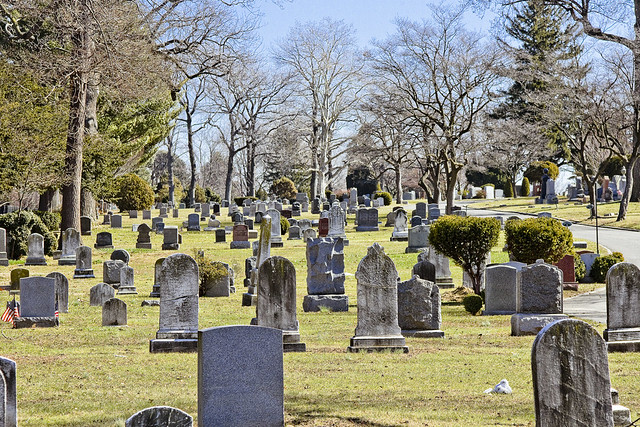
– photo by Mitch Waxman
Cursory research reveal there to be around 41,000 people whose last address is here. There are several notables, including musicians, actors, and revered statesmen interred in Flushing Cemetery. The place was in a VERY good state of repair during my visit to the place during the last weeks of 2016’s winter.

– photo by Mitch Waxman
The plots and sections we visited revealed a large number of German sounding names on them, and the dates on the monuments ran a gamut from the middle 19th to early 21st centuries.

– photo by Mitch Waxman
The marble monuments showed the “rotting” sort of decay that is caused by acid rain and subsequent water infiltration, causing their carven screeds to be obscured, unreadable, or lost. You see this sort of thing in a more advanced form at Calvary Cemetery in Blissville, where certain monuments have the appearance of melted ice cream. Observationally, granite monuments seem to endure longer in NYC’s peculiar and polluted atmospherics.
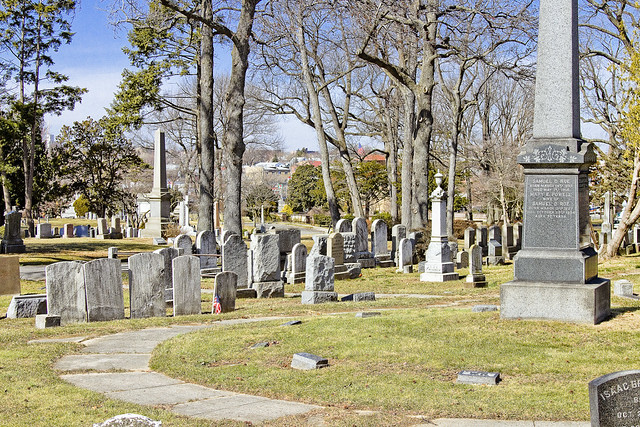
– photo by Mitch Waxman
The fellow who plotted out the cemetery back in 1853 was a Civil Engineer named Horace Daniels, and he seems to have embraced using a lot of curving paths. It’s likely there’s a ton of original design elements missing from the scene above – railings, statuary, plantings, etc.
Flushing used to be known for horticulture, “back in the day.”

– photo by Mitch Waxman
The Bowne plot was stumbled upon, specifically the Walter Bowne one. Yes, Bowne House, Bowne Street.

– photo by Mitch Waxman
I won’t attempt to tell you anything else about the Bownes, as Flushing is outside of my area of expertise.
I just came here on a day trip, and would advise that you seek out and chat with Dr. Jack Eichenbaum. Dr. Jack can discuss the Bownes in greater detail and scope than I can. The East River and Newtown Creek coastlines are where my knowledge of Queens history is both detailed and well studied.

– photo by Mitch Waxman
“Quite Lovely” thought a humble narrator, upon noticing a surviving iron railing on the Bowne Plot, with its cast iron chains designed with the appearance of a tasseled rope.
“follow” me on Twitter- @newtownpentacle
mapped egress
The horror, in Today’s Post.
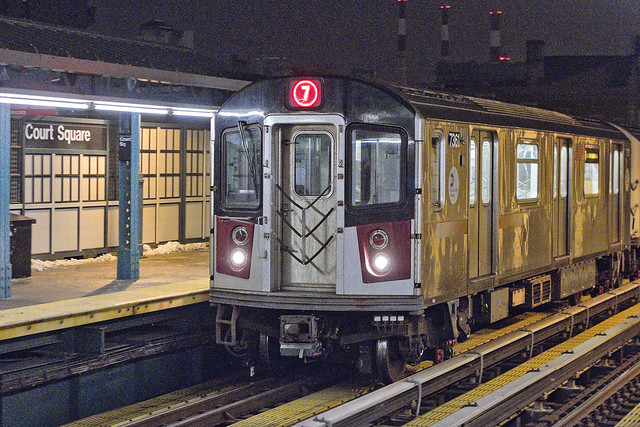
– photo by Mitch Waxman
My post last Friday about the 7 line got me thinking about the Subways of Western Queens, which are referred to as “the horror” in conversations with Our Lady of the Pentacle.
It was the 3rd of April, in 1913, that the City of New York purchased the (Steinway) tunnels utilized by what would become known as the 7 line from August Belmont, and in 1915 service started on June 22. They didn’t know it at the time, but those old timey types were creating the most photogenic of all of New York City’s subway lines.

– photo by Mitch Waxman
Even when it’s underground, such as the busted ass Vernon Jackson stop, the IRT line’s 7 looks good. It’s when it moves into Sunnyside and Woodside that the 7 looks best, of course, but there are few stops in Queens where it doesn’t look pretty cool to this itinerant photographer – notably the stop pictured above and the last one in Flushing are comparatively kind of “meh.”
Everything looks terrible in Manhattan, and nobody would go there if they weren’t paid to do so.
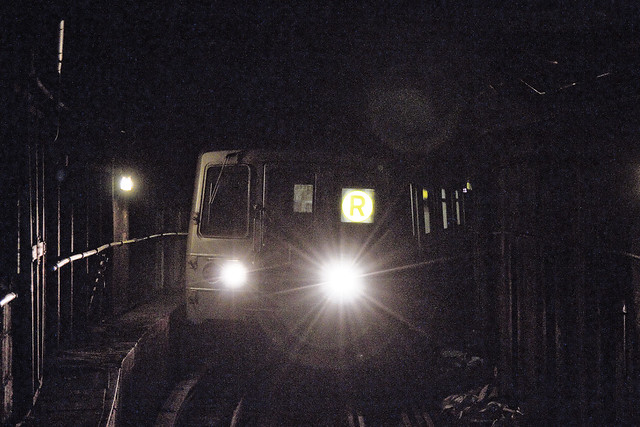
– photo by Mitch Waxman
In comparison, the R – which travels on the IND – is the reliable but visually uninteresting line. It didn’t reach Queens until 1920, but back then it only went to Queens Plaza. The modern route, which goes all the way to Forest Hills, was established in 1949 – but back then it was known as the “RR.”

– photo by Mitch Waxman
The interesting thing about the Court Square station, to me at least, is that – at least these days – it offers a free transfer between the IND and IRT systems. Downstairs, you’ve got the G, M, and E lines, and upstairs the 7. To continue with the arcane Subway knowledge – the G line became active in 1933, but it was known as the GG back then. The E also came online in 1933, and it is one of the Subway lines that never sees the light of day operationally as its entire route is underground.

– photo by Mitch Waxman
The M is something of a newcomer to the IND Sixth Avenue tracks, although the line was officially designated as early as 1914. It wasn’t until 2010 that the line was routed into its current path mirroring the R service. It actually pisses me off, M wise, that if I wanted to go to Ridgewood – a mere five miles from Newtown Pentacle HQ on Astoria’s southern border – I would need to endure an hour and change long journey through the Shining City to get there.
Before you inform me – yes – I know all about taking the R to Newtown Grand Avenue and catching the bus – I do it all the time.
“follow” me on Twitter- @newtownpentacle


