Archive for July 2009
That’s Just Grand

-photo by Mitch Waxman
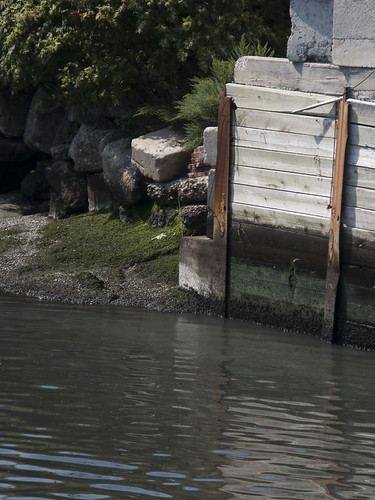
In 1894, George Roeschman (an employee of Hardy, Voorhies and co.- a lumber yard on Grand St. in Williamsburg) was accosted by 3 men as he was trying to cross the Grand St. Bridge over the Newtown Creek. He was struck over the head, had a sack pulled over him, and roughly thrown to his fate in the inky waters. After scrambling up the slimy banks, Roeschman didn’t report the crime to Police officials immediately for fear of retribution by these highwaymen. Four bodies had recently been found along this branch of the Newtown Creek, all were victims of a similar modus operandi.
-photo by Mitch Waxman
In the same year, on October 16, the body of a 40 year old man was found nearby. His identity was never ascertained and he has lain in centuried silence at the City’s potter’s field since.

-photo by Mitch Waxman
Nearby, a scoundrel named Pete Hess and his friend Schulz once buried a baby, alive, in the mud of the Newtown Creek. Both men received lengthy stretches at Sing-Sing for the murder of “Baby Wertheimer”.
There is a long history of criminal derring-do associated with the Newtown Creek. Check out this NYtimes article from 1996 for the story of Captain Lau and the Barones.
Newtown Creek musings

enormous stitched panorama, Pulaski Bridge- photo by Mitch Waxman- (click images for larger views at flickr, worth it)
Over the last several weeks- I have been honored to encounter an interesting community of historians, photographers, and maritime enthusiasts. A lot of these people asked me how I got so into this whole history thing. My standard answer has been “Newtown Creek”.
My long suffering wife has often been reduced to a stupor by my endless musings over the deeper meanings represented by the curious location of some manhole cover I found on Northern Blvd, or speculations about the carefully obscured origins of our modern city.
If you are religious, pray for her strength and tenacity against these spouse inflicted irritations to her infinite patience, if you’re not a churchgoer- raise a glass in her name and toast- to our lady of the Pentacle.

Newtown Creek, NYC panorama, Queens museum of art- photo by Mitch Waxman
Since I found the place, (like most New Yorkers, I had no idea that Newtown Creek even existed a few years ago) the Newtown Creek has had some kind of hold on me. My actual first reaction was:
Putrid, this dripping eidolon of unwholesome revelation which sits between Brooklyn and Queens is an abomination- a comfirmation of all that is unclean- unholy- and detestable. A ghoulish shade of decay, antiquity, and dissolution hanging about it- the Newtown Creek has that awful bearing which, in any sane world, a merciful earth should not have to endure.

Newtown Creek- photo by Mitch Waxman
My inclinations and interests have always tended to touch upon those subjects ignored and shunned by the madding crowd. After all, have I wandered through nitre choked graveyards in winter, and amidst the cloaking shadows of the urban wastelands in the hellish inferno of a New York heat wave for any reason other than joy? What drew me to the story of the Newtown Creek, at first, was the quivering green immensity of the place- the horror- which is nepenthe to me. The esthetics of the place began to infiltrate and infect me.

Rail Bridge near the junction of the Dutch Kills and the Newtown Creek- 3 exposure HDR photo by Mitch Waxman
I started reading up on the Newtown Creek, and found the Newtown Creek Alliance, and saw youtube videos from Riverkeeper, and read the history (Greater Astoria Historical Society‘s LIC book is a must have), and followed Forgotten-NY around the place (via their gold standard website). I found my long walks less and less of a burden, and I became mezmerized by the idea of exploring this strange and horribly exciting place. Camera in hand, I set out on foot. If you want to see anything in New York, you have to be on foot.

Petro history- from Newtown Creek Alliance tour of the Newtown Creek- photo by Mitch Waxman
There is a beauty to this cradle of the industrial revolution that contemporary reading would call Dickensian. Its the wide open skylines (squat, most buildings are under 3 stories, and loading docks are set back from the street to allow trucks to berth), the maddening shadows dropping off the elevated highway whose roadways- in some places- are over 10 stories above, and the sudden drop-offs whenever fenced off bulkheads signal the presence of water. Its the supernal way that the oddly colored water dapples reflected orange or green light up into the underpinnings of those highways, or the constant appearances of rail tracks both active and abandoned. Perhaps- its just the counterpoint of a shining city hanging over the miasmic occlusion rising off of the Newtown Creek.

from Metropolitan Avenue Bridge- (click images for larger views at flickr, worth it)- photo by Mitch Waxman
Maybe its the sure knowledge that change and progress have arrived in Long Island City again, and that in the near future all of this will be gone- buried under towering apartment houses and obscured by cosmetic improvements meant to obscure the past and hide what it is that may still lurk down here.

LIE- stitched panorama photo by Mitch Waxman- (click images for larger views at flickr, worth it)
All these things I have seen…

-Photo by Mitch Waxman
Ribald pleasures have colored the recent holiday- celebrating the rebellion against the Hanoverian King of England, George the third, here in the Newtown Pentacle. Although a solidly Tory part of the colony of New York in 1776, Astoria defines itself as a fiercely federalist district of the United States in modernity. Expressions of this pride in the Republic developed in an autochthonic fashion in a thousand different locations, and manifested in a citywide orgy of carnivorous gluttony that might do any German prince proud. The fat and happy children of our saturnine village were then treated to a vast and uncoordinated campaign of pyrotechnic detonations perpetrated by an army of unpaid and unsolicited volunteers.
Glinting suggestions of fear filled canine eyes, staring from beneath beds and behind partially closed closet doors was hinted at by whispers in the darkness of Astoria’s landscaped and wooded yards.
I also enjoyed two noteworthy experiences upon the Hudson River, which I will be discussing in detailed postings later this week.
Astoria was here in 1776, but wasn’t called that yet- it was Hallet’s Point at the time. Another German Prince would someday put Astoria on the map, one who dreamt of the music of the spheres. That man would be called… but this post isn’t about him, or even about about the most successful terrorist operation in history- its about Newtown Road.

-Photo by Mitch Waxman
Newtown Road winds through the street grid of Eastern Astoria. Distinct and geographically separated from the fabled Newtown Creek, this ancient pathway was one of the principal sites where British troops were garrisoned after the Revolutionary War’s Battle of Brooklyn, before they were sent to pursue the rebels across Manhattan. These troops were here to inflict disaster on the colonial army of Washington, and upon those that might support the rebel cause. Incidentally, Forgotten-NY has been down Newtown Road before, check out their slant on the place here.

-Photo by Mitch Waxman
Amongst their number were the Seventeenth regiment of Light Dragoons, the Maryland Loyalist, and the Royal Highlanders— commanded by Lieutenant Colonel Thomas Sterling— with cannon and horse; and the thirty-third regiment commanded by Lord Cornwallis himself. Also, a motley band of Hessian and mercenary irregulars were attached to the main garrison. Their connection with the place ended when they crossed the East River -at the mouth of Newtown Creek moving west into Manhattan’s Kip’s Bay (approximately 34th street)— to pursue and harass the rebels. I need not recount the story of Washington’s ignominious retreat or the ghoulish horrors heaped upon occupied New York City by the vengeful British Empire.

-Photo by Mitch Waxman
During the eighteenth century, this meandering street followed a stream which the local Mespaetche indians described as “bad water.” This stream still flows beneath the modern streets, in dank tunnels and dripping stone sewers. Remember, the actual ground is a minimum of ten to twenty feet down in New York City. Who can say what else may be buried down there, and perhaps— what else may still exist down there.
Dutch Kills, or let the Photos do the Walking
Anything you may experience, in situ, by following these walking directions is at your OWN RISK, and is offered by the Newtown Pentacle for documentary and entertainment purposes only. Remember- the rule we follow at the Newtown Pentacle is to NEVER trespass. Like Vampires, Newtownicans should wait to be invited into a house before they can do their work. To wit.
Feel like taking a walk? I’ll show you something cool… Bring your camera- and ID

Truck at 47th avenue and 28th street, Long Island City -photo by Mitch Waxman
from wikipedia
Dutch Kills is a sub-division of the larger neighborhood of Long Island City in the New York City borough of Queens. It was a hamlet, named for its navigable tributary of Newtown Creek, that occupied what today is centrally Queensboro Plaza. Dutch Kills was an important road hub during the American Revolutionary War, and the site of a British Army garrison from 1776 to 1783. The area supported farms during the 19th Century, and finally consolidated in 1870 with the villages of Astoria, Ravenswood, Hunters Point, Middletown, Sunnyside and Bowery Bay to form Long Island City.
Dutch Kills is one of the extant branches of the Newtown Creek, and located not too far from the Degnon Terminal complex (part of the Sunnyside Yards).
Get to 47th avenue and 28th street, early morning or late afternoon are probably best because of the whole sunlight east west thing. Weekends are good because there is a lot less going on in the industrial zones of the Newtown Pentacle.
Assuming you’re coming from the north (skillman or thomson avenues)- You’ll find a series of construction sites behind and to the left of you, and a cement factory (New York Concrete Supply)in front of you. Cross the street and make a left. Look west, and you’ll be reassured by seeing Manhattan.
I’m going to say this over and over- but be REALLY MINDFUL OF TRUCKS, and… be a smart new yorker- if you’re snapping pics and a guy who looks just like a mobster walks in front of you in Long Island City- He doesn’t just look like a mobster- HE IS A MOBSTER. Don’t be a schmuck.
View Dutch Kills in a google map

Concrete Trucks on 47th avenue, Long Island City -photo by Mitch Waxman
Walk to 29th street, which is a very dangerous place for pedestrians. BE CAREFUL. There is no sidewalk, and it is a shortcut to Thomson Avenue and Queens Blvd for traffic coming off the LIE. To your right is Dutch Kills, at its terminus. By the way, the concrete guys REALLY don’t like having their pictures taken.

Concrete Trucks on 29th street, Long Island City -photo by Mitch Waxman
Make the right at the corner of 29th street. DO NOT CLIMB DOWN ON TO THE RUSTY BARGE, you will get hurt and fall into the water with an open wound. When you smell the water, you’ll understand my warnings. 29th street is VERY dangerous. Lots of great Creek kind of shots, but mind yourself, there’s better stuff ahead with safe vantage points.

Dutch Kills from 29th street -photo by sweetpea212– a member of our Newtown Pentacle Flickr group
All along the Newtown Creek, there are abandoned barges and other vessels. This particular one has been sitting here for at least 3 years. Resist the urge, urban explorers, its not worth it. Also, note the storm sewer in the center of the above shot.

Structure I am desirous of having a chance to get inside legally, with my camera -photo by Mitch Waxman
At the other end of 29th street- Welcome to an insanely dangerous parking and loading dock for the crumbling Hunterspoint Steel building.
Big old factory on Hunters Point Avenue, has severed rail tracks and abandoned waterfront loading docks. Has a “for sale” sign on it. Perfect lair for supervillian, close to highway and trains.
from trainsarefun.com:
track map as of 1966 for the area- legend is
7 Staley Elevator 8 Conran Supply 9 Best Wholesale 9a Masbrook Wholesale 9b Saxon Paper 10 Principe Danna 11 Sunshine Biscuit (Garage) 12 Sunshine Biscuit (Factory) 13 Bell River Corp. 14 American Chicle Corp. 15 Equitable Paper Corp. 16 Wheeling Corrugated 17 Gimbel Bros. 18 R.H. Macy 19 Simons 20 Concrete Steel 21 Phillip A. Hunt 21a Saxon Paper 22 Standard Wine & Liquor 23 Harrison Building 24 J.H. Rhodes 25 Hunters Point Steel 26 Standard Folding Box Company 27 United Parcel 28 Star Liquor 29 Viking Criterion Paper

CAREFULLY cross Hunter’s Point Avenue and make a right. Proceed to the Hunters Point Avenue Bridge.

Water the color of Tea, from Hunters Point Avenue Bridge -photo by Mitch Waxman
Hunters Point Avenue Bridge. Stop and look around. Take pictures- this is a great vantage point. This is the place you are also most likely to exchange friendly greetings with law enforcement or private security. Be nice, smile- you’re not doing anything wrong- and you even remembered to carry ID.

Water the color of antifreeze, from Hunters Point Avenue Bridge -photo by Mitch Waxman
Most of the cops who’ve pulled over and asked me what I’m up to are just doing their job. So are we, lords and ladies of Newtown.
The Police respond to fear and anger in ways injurious to your freedom. You be nice, and so will they. Its really not an adversarial encounter unless you make it so. If they’re jerks, insist on a supervisor or superior officer’s involvement (which may mean a trip to the station house- adventure!). Young cops are zealous and eager to enforce, older cops don’t want their retirement to get jammed up with a civil rights case. An older cop will also realize that you’re “harmless” faster than a young one.
Here’s a great description of your rights as a photographer. Besides, the commish has already pronounced NYPD’s stand on photography.

Dirty Birds, from Hunters Point Avenue Bridge -photo by Mitch Waxman
The Hunters Point Avenue Bridge over Dutch Kills is a Bascule bridge.
from the NYC.gov DOT website:
Easily the most popular type of movable bridge in existence today, bascule bridges are designed to pivot on a fixed axis. Usually this type of bridge consists of movable ‘leaves’ fixed to each end of the channel. The leaves are precisely counterbalanced by weights of sufficient size that relatively little motor power is required for their operation – usually just enough to overcome inertia, frictional resistance, wind and snow loads.
Bascule bridges are simple and speedy to operate, and because of the relatively small amount of electricity needed for movement, cost efficient.
The Hunters Point Avenue Bridge offers spectacular views north and south. That’s the concrete factory from the first photos in the distance.

from Hunters Point Avenue Bridge looking north -photo by Mitch Waxman
There’s a surreal beauty to this tributary of the Newtown Creek, an isolated loneliness. It’s a dead place, the corpse of a mighty age of enterprise.

from Hunters Point Avenue Bridge, looking north -photo by Mitch Waxman
Looking north, the LIE bridges the Dutch Kills.
Yes, these trees and plants are hideously overgrown and show all the signs of having been fed from some morbid nutrition. There is a tenebrous darkness that radiates about them… I know. The fact though, is that if you give nature just a little time, even here in the home of the darkest industrial mills… It’s kind of a nice idea- isn’t it- rebirth.
from Queens Borough, New York City, 1910-1920
During 1914 bulkhead lines were established by the United States Government for Dutch Kills Creek, a tributary of Newtown Creek, thus putting this stream under the jurisdiction of the War Department. The bulkhead lines as approved on October 29, 1914, give a width varying from 200 feet at its junction with Newtown Creek to 150 feet at the head of the stream, and include a large basin in the Degnon Terminal where car floats can be docked. The widths of the channel to be dredged under the appropriation of $510,000 mentioned previously, range from 160 feet at Newtown Creek to 75 feet at the turning basin. The Long Island Railroad plans to establish at this point a large wholesale public market, estimated to cost nearly $5,000,000.
Among the larger industrial plants in the Degnon Terminal served by this stream are : Loose Wiles Biscuit Company, American Ever Ready Works, White Motor Company, Sawyer Biscuit Company, Defender Manufacturing Company, Pittsburg Plate Glass Company, Marcus Ward, Brett Lithograph Company, Waldes, Inc., Norma Company of America, Manhattan-Rome Company, American Chicle Co. and The Palmolive Co.

from Hunters Point Avenue Bridge, looking southeast -photo by Mitch Waxman
Continue down Hunters Point Avenue and make a left at 27th street. (as of 6/27/2009- intersection at Borden still closed due to bridge reconstruction).
A fantastic series of abandoned industrial buildings are on the left. Photograph quickly, Newtownicans, these are being torn to shreds by those dastardly developers right now.

Creek Car, from 27th street -photo by Mitch Waxman
My favorite spot on these 3,000 feet in Queens is (was) undoubtedly the corner of Borden Avenue and 27th street. On your right is an abandoned strip club called Infinity, in front of you is the Borden Avenue Bridge, to your left and below is the Dutch Kills, above you is the LIE.

Water the color of ice -photo by Mitch Waxman
The west bank of Dutch Kills was always an easy shot for me in the mornings and early afternoon. Unfortunately, the construction of the coffer dam for the bridge reconstruction has removed many of the charismatic and idiosyncratic features I’m so drawn to. What foul battrachian horrors might lurk in the slime down there, and who can guess what it is that the construction might have stirred up?

Same vantage as above, in a different season -photo by Mitch Waxman
Ghosts are found here. Phantoms of the clear eyed mariners who inhabited this world, drifting by in wooden ships. Protruding from cement and clinging mud alike are the skeletal remains of rail lines which led from factory floor to dock, defining both building and waterway. Every fallow and abandoned spot finds nature battling to rescue her ruined child from the degradations heaped upon it.

And they built a giant steel highway 106 feet over it.-photo by Mitch Waxman
The pacific quality of the water in these photos, with their mirror like reflectivity, actually betrays a numbing truth. The stillness of the water in this crumbling canal allows it to steadily accrete a sedimentary ichor of pollutants which cake the shorelines, and its percentage of dissolved oxygen is so low that these opaque and stench producing depths can be described as stagnant and injurious to life.
Denied the curative effects of erosion, as provided by strong tide and swift current, the concentration of pollutants here seems worse than anywhere else on the Newtown Creek waterway- except for the lamentable Maspeth Creek. Floating poop is the least of it, there’s lead and arsenic and dioxin in that mud. Who can guess it is that might be breeding down there? What foul congress of poisons awaits the future?
from an army corps of engineers documeent discussing precautions for the collecting, handling, and testing of Dutch Kills sediments:
All individuals involved in handling contaminated sediment are required to use protective equipment and to submit to blood and urine tests. The protective equipment consists of:
from nycroads.com
BEGINNING OUT OF THE TUNNEL: The first section of the Long Island Expressway, a one-mile-long, six-lane viaduct over Long Island City, Queens, opened to traffic in 1940 after one year of construction. The new viaduct, whose opening coincided with that of the twin-tube Queens-Midtown Tunnel at its western terminus, had its eastern terminus at the new Brooklyn-Queens Expressway (I-278). At its highest point, the viaduct rises 106 feet above Dutch Kills

Borden Avenue Bridge -photo by Mitch Waxman
Well, here we are, on the Borden Avenue Bridge. Check out these flashy drawbridge lights. Isn’t that cool? Told you I’d show you something cool…
from the DOT website on the history of the Borden Avenue Bridge, which spans Dutch Kills.
Borden Avenue is a two-lane local City street in Queens. Borden Avenue runs east-west extending from Second Street at the East River to Greenpoint Avenue. The Borden Avenue Bridge over Dutch Kills is located just south of the Long Island Expressway between 27th Street and Review Avenue in the Sunnyside section of Queens. Borden Avenue Bridge is a retractile type moveable bridge. The general appearance of the bridge remains the same as when it was first opened in 1908. The bridge structure carries a two-lane two-way vehicular roadway with sidewalks on either side. The roadway width is 10.5m and the sidewalks are 2.0 m. The west approach and east approach roadways, which are wider than the bridge roadway, are 15.3m and 13.0m respectively. The bridge provides a horizontal clearance of 14.9m and a vertical clearance in the closed position of 1.2m at MHW and 2.7m at MLW.
As part of the construction of Borden Avenue in 1868, a wooden bridge was built over Dutch Kills. This bridge was later replaced by an iron swing bridge, which was removed in 1906. The current bridge was opened on March 25, 1908 at a cost of $157,606. The deck’s original design consisted of creosote-treated wood blocks, with two trolley tracks in the roadway. Character-defining features of this bridge include the stucco-clad operator’s house, four pairs of rails, and a rock-faced stone retaining wall. The gable-on-hip roof of the operator’s house retains the original clay tile at the upper part. Although alterations have been made, the bridge is a rare survivor of its type and retains sufficient period integrity to convey its historic design significance.
The bridge will be closed for construction through July 2009. In addition, there will be parking restrictions in the vicinity of the bridge from January through July 2009 at all times from 25th Street to 30th Place between Borden Avenue and Hunter’s Point/49th Avenue and from 50th Avenue to 51st Avenue between 27th Street and 25th Street.

There are also two LIRR rail bridges, visible from Borden Avenue, which are articulated (moving) across the Dutch Kills. Shot taken from upon the waters of the Newtown Creek looking North -photo by Mitch Waxman


 The Newtown Pentacle