Archive for January 2010
The Newtown Creek Community Health Harm Narratives Project

– photo by Mitch Waxman
Andrea Muraskin of the CHHNP asked if I could post this and help get the word out about this project, all text by CHHNP-
Attention Residents of Greenpoint, East Williamsburg, and Maspeth:
Are you worried about health problems caused by the pollution in your neighborhood?
Would you like the opportunity to tell your story?

– photo by Mitch Waxman
If yes, then you may want to be interviewed for a community health project that aims to document the public health concerns of individuals residing in communities along Newtown Creek in NYC. If you live, or have ever lived in Greenpoint or East Williamsburg, Brooklyn or Maspeth, Queens, you are invited to participate in the Newtown Creek Community Health and Harm Narrative Project, as study which hopes to capture residents’ experience with illness and environmental pollution in their neighborhoods.
Participation will provide you with an opportunity to have your story documented in your own words. With your permission, the information you disclose will be displayed in written and audio format on the website http://www.habitatmap.org and in a written report that will be disseminated to community members, media outlets, elected officials, and other interested parties.

Community involvement is important. Make your voice heard!
If you have any questions or are interested in participating, please contact Yvonne Kodl at:newtowncreekstudy@gmail.com or
(718) 566-1359.
Please note: The study is in the concluding portion of its interview phase. If you are interested, please contact us as soon as possible.
The Newtown Creek Community Health and Harm Narrative Project is a collaboration between the Urban Public Health Department of Hunter College, HabitatMap, and the Newtown Creek Alliance.
Media Links
Television: Brooklyn Community Access Television ,
Radio: Leonard Lopate on WNYC
Newspaper: NY Daily News http://www.nydailynews.com/ny_local/brooklyn/2009/06/22/2009-06-22_newtown.html
Blog:http://www.nylcv.org/ecopoliticsdaily/20091112_newtown_creeks_neighbors_speak_out_on_health_concerns

– photo by Mitch Waxman
Tales of Calvary 8- the Abbot

– photo by Mitch Waxman
While wandering through Calvary Cemetery recently, I came upon a curious monument whose sculptural elements included a life sized portrait, and whose dedication was meant to honor a man named Florence Scannell. The stone additionally bore a curious screed- “The Abbot”. “Dedicated to the memory of Florence Scannell by his brother John J.” is displayed prominently on its face. This stirred a sleeping memory, and I tried to remember why the name Scannell is so important. I said it out loud- John J. Scannell?
Wait a minute… John J. Scannell was the first chief of the NYFD, grand sachem of Tammany Hall, and a notorious turn of the century raconteur who became “king of the hill” in the often violent political world of 19th century New York City politics.
Bare knuckled, the electoral system back then resembled modern gang wars. Bearded men were paid to vote, taken to a barber shop for a shave and a shot of whiskey, and then paid to vote again. Paid armies of volunteers rousted saloons and bars that supported their political enemies. With political bosses paying the tab, taverns became organizing points for local “get out the vote” efforts. The poor didn’t care, for a day they could drink enough to forget and even eat a real meal- with meat, and all they had to do was vote the way they were told. The bosses were the bosses, and your place in “the line” could be revoked at any time if you fell out of favor with them. There was no “safety net”, so you had to just “go along”. Sometimes the other party would send gangs of street toughs into their opponents establishments- “bar busting”.
For more on the milieu of political life for the working class of the 19th century, I would suggest a gander at “The Jungle” Upton Sinclair’s “progressive” propaganda piece, or taking a peek at Jacob Riis’s “How the Other Half Lives“.
The Scannell brothers are described as having been engaged in such “bar busting” activities in 1869, when brother Florence ran for Alderman from the 18th ward against a Tammany candidate. At 23rd st. and second avenue, on Dec. 3rd, a Tammany man named Thomas Donaghue ran afoul of the Scannells, who were employed to “clean out” and “bust” the saloon he owned and operated.
from pbs.org
The year 1898 ushered in a new era of firefighting. On midnight of January 1, 1898, Greater New York was formed by uniting the five boroughs, Manhattan, Brooklyn, Queens, the Bronx, and Staten Island. The Board of Fire Commissioners was replaced by a single Commissioner, John J. Scannell, who had been head of the Board since 1894 and was appointed by Mayor R.A. Van Wyck. All of the area’s volunteer departments were to be replaced by the FDNY, and Chief Hugh Bonner assumed control of three paid departments: New York, Brooklyn, and Long Island; 121 engines, 46 trucks, one horse wagon, and a water tower; in all, 309 square miles of firefighting territory.

– photo by Mitch Waxman
The Scannells and a dozen of their men produced weapons and engaged in a fierce battle with Donaghue’s own crew of toughs. Gunfire erupted and Florence Scannel was shot in the back, the bullet embedding itself in his spinal column. Rushed to the nearby Bellevue Hospital, Florence suffered a lingering death, finally passing on July 10, 1870, with his brother John at his side. John J. Scannell swore an oath to avenge his brother, and kill the man who shot him in the back– the Tammany man, Thomas Donaghue.
Donaghue’s handlers fixed things up with the courts, and he returned to his familiar Saloon on 23rd st. and second avenue.
On Sept. 19th, at the corner of 17th and third, an odd looking man wearing a slouched hat and fake beard stepped out of the shadows and blasted a hole in Donaghue’s chest with a derringer pistol. Donaghue ultimately survived this attempt on his life, and Scannell discarded his disguise as he escaped his pursuers fleeing through Irving Place and Union Square. John J. later surrendered to a Police Sgt. after taking refuge on Long Island, and was indicted by a Grand Jury for the crime, but was never charged and released on $10,000 bail.
That’s $10,000 in 1870…
In November of 1872, Donaghue was attending an auction at the Apollo Theatre on 28th street, and a man wearing a cloak and slouch hat approached him. A large caliber pistol was produced and the middle of Donaghue’s face disappeared. Four more shots, three in the face, were pumped into the now prostrate Donaghue. The killer fled and was apprehended by a Police Captain named McElwain, who immediately identified the assassin as John J. Scannell. Such quick identification of Scannell was possible only because the arresting officer had been the one who arrested him for the the earlier attempt on Donaghue, when he was a Sgt.
The event was seminal, for as John J. Scannell sat in a gaol called “The Tombs”, another sat beside him. That night, John J. Scannell met Richard Croker. Someday, they would become “The Big Two” at Tammany Hall and rule over New York City.

– photo by Mitch Waxman
John J. Scannell was born on the lower East Side of Manhattan and found early work as a horse dealer- moving on to Saloon Keeper and then Professional Gambler. Charged with the murder of Donaghue, he pled insanity, and after a 3 month stint in an asylum in Utica, returned to local politics. He owned horses and raced them on the national circuit, as did Richard Croker. Rising in Tammany with his partner Croker, Scannell ran the 25th electoral district in Manhattan for many years, and desired the post of NYFD commissioner in that newly unified pile of gold called “the City of Greater New York”. Protests were recorded citywide, but Mayor Van Wyck appointed him chief of the newly unified citywide firefighting brigades. He served in that capacity until 1901, and fought corruption charges associated with his appointment until 1906 in court. At 67, in 1907, Scannell was sued for $15,000 for kissing the daughter of his housekeeper 3 times without consent.
Scannell died at 78 in Jamaica, Queens- far from his retirement estate in Freeport, L.I.
The Abbot, as it turns out, is a Horse.

– photo by Mitch Waxman
Scannell paid the scandalous amount of $26,500 at a Madison Square auction, the highest ever paid for a single Horse to that time, to purchase the Abbott.
That’s $26,500 in 1900…
The obituary for the Horse is actually longer than the one for the owner. The fact that Scannell engraved a Horse’s name on the monument to his dead brother, and his own eventual grave marker, shows the esteem felt by Scannell himself for the animal. Oddly enough, and this is a rare thing for Calvary Cemetery, The NYTimes once did an article on the raising of this monument which happened in 1914.
Hey, you never know what you’re going to find at Calvary Cemetery.
Taxi town

– photo by Mitch Waxman
When the intrepid shutterbug wanders around the back streets and hidden lanes of Long Island City (in particular) and North Western Queens (in general), the sheer number of Taxis observed is astounding. In the post WW2 period many, many Taxi garages and dispatchers relocated their fleet garages (mainly from the west side of Manhattan, whose rising real estate valuations priced such large footprint business out of the borough) in the area due to its proximity to Manhattan and the easy (free) egress offered to the business districts of the shining City by the Queensboro Bridge. Also, the land was cheap, by New York standards.
note:
The inexpensive nature of the land in Long Island City during the last half of the 20th century presents an inexplicable paradox given the paradise that LIC – south of the bridge- is reported to have been during the 1970’s and 80’s by comment threads at LIQCity.
I just can’t let this one go, by the way. A general excoriation of this blog and me personally has been detailed in the comment thread there by a few dedicated trolls who have focused on half a sentence in a 1,000 word post that was part of a 3,000 word sum up editorial at the end of the year.
When confronted to back up a statement, I supplied primary source material and was then told “don’t believe what you read”. So far, they’ve made intonations and accusations about my sexual preferences, called me amateur, lazy, gullible, self promoting, on drugs, like a spoiled 2 year old, an untalented liar, having written a “disgraceful and distasteful article complete with racist undertones”, making false claims about having lived in NYC all my life, and one anonymous poster has suggested “Think about it. A few years ago it was an Italian neighborhood. It’s okay to use that locution, right? Well, not for nothin’, but only idiots would try to get away with anything around here”. To my ears, that is the epitome of racist undertone- suggesting that stereotypical organized crime elements kept LIC safe and are exactly the sort of thing that they are all so upset about. I respond here, as comments at Newtown Pentacle are moderated and require you to sign your name, and I don’t participate in acrimonious flame wars.
Notice that at no point do they supply anything besides anonymous anecdotes in argument. The difference between these “anon” posters and myself is that I sign my name to things that I write, and can back up what I say. I fully expect to be connected to global terror and accused of being a sexual predator before the weekend is over. Also, the notion that I would use the tragic death of a car service driver to “promote myself” is anathema and personally offensive. I take my battles outside, to the street, where it counts. Coward.
from nyc.gov
What is the New York City Taxi & Limousine Commission?
The New York City Taxi and Limousine Commission (TLC), created in 1971, is the agency responsible for licensing and regulating New York City’s medallion (yellow) taxicabs, for-hire vehicles (community-based liveries and black cars), commuter vans, paratransit vehicles (ambulettes) and certain luxury limousines. The Commission’s Board consists of nine members, eight of whom are unsalaried Commissioners. The salaried Chair/Commissioner presides over regularly scheduled public Commission meetings, and is the head of the agency, which maintains a staff of approximately 400 TLC employees assigned to various divisions and bureaus. The Hon. Matthew W. Daus was named as Mayor Rudolph W. Giuliani’s designee to the Chair of the TLC in June 2001 and was unanimously confirmed by the New York City Council on August 22, 2001. He was then reappointed by Mayor Bloomberg in July 2003 and was again unanimously confirmed by the New York City Council on July 23, 2003.
The TLC licenses and regulates over 50,000 vehicles and approximately 100,000 drivers, performs safety and emissions inspections of the more than 13,000 medallion taxicabs three times each year, and holds numerous hearings for violations of City and TLC rules and regulations, making it the most active taxi and limousine licensing regulatory agency in the United States.To find out more about the TLC, or to review the agency’s procedures, rules and regulations and programs, you may review the constantly updated information available throughout this web site, or you may call the TLC’s Customer Service Hotline at 311.

– photo by Mitch Waxman
Omnipresent, the New York City Yellow cab is available for hire and will take you just about anywhere. A point is made, by your humble narrator, to converse with Cab drivers. Often, the conversation will involve their native country – which is what I’m really interested in- or their “immigrant story”. Eye opening, some of the stories I’ve been told about life in the far and middle east have changed my perceptions and corrected certain misconceptions acquired through ignorance and cultural prejudices. Ultimately, the one thing all cab drivers seem to have in common is a shared hatred of the Van Wyck.
from nyc.gov
The Following Vehicles are Currently in Use as New York City Taxicabs
- 2009-Ford Crown Victoria Stretch
- 2009-Chevrolet Malibu Hybrid
- 2009-Saturn Aura Hybrid
- 2009-Chevrolet Malibu Hybrid
- 2009-Volkswagen Jetta Clean Diesel Sedan
- 2009-Lexus RX400h
- 2009-Toyota Camry Hybrid
- 2009-Toyota Prius-48 mpg city
- 2009-Toyota Highlander Hybrid (4WD)
- 2009-Saturn Vue Greenline
- 2009-Nissan Altima Hybrid
- 2009-Ford Escape Hybrid (2WD)
- 2009-Mercury Mariner Hybrid (AWD)
- 2010-Ford Crown Victoria Stretch
- 2010-Volkswagen Jetta Clean Diesel Sedan
- 2010-Lexus RX450h
- 2010-Lexus HS250h
- 2010-Toyota Camry Hybrid
- 2010-Toyota Prius-48 mpg city
- 2010-Toyota Highlander Hybrid
- 2010-Nissan Altima Hybrid
- 2010-Ford Escape Hybrid (2WD)
- 2010-Ford Fusion Hybrid
- 2010-Mercury Milan Hybrid
- 2010-Mercury Mariner Hybrid (AWD)
The following are the approved for use as Wheelchair Accessible Taxicabs:
- 2007-Eclipse Mobility Dodge Caravan
- 2007-Eldorado National Mobility Chevrolet Uplander
- 2007-2008 Autovan Toyota Sienna
- 2007-2008 Freedom Motors Toyota Sienna Kneelvan
- 2008-2009 Freedom Motors Toyota Sienna Kneelvan
Additional vehicle models come on the market from time to time that may comply with TLC rules. Any questions about a vehicle model not listed above, or about any vehicle retirement issue, should be referred to TLC hack site at (718) 267-4501.

– photo by Mitch Waxman
Because of the presence of the fleet garages, one will observe hundreds of smashed and destroyed vehicles which have been towed home for repair. Self employed on the whole, the shift drivers of New York’s Taxi fleets must maintain and pay for their own health insurance. When they are sick or injured and can’t work, they don’t get paid. I’ve often wondered why the city doesn’t offer a buy-in to the generous and inexpensive (due to the size of “the plan”) health insurance plan enjoyed by other employees of the City, to help these defacto city workers afford coverage. During the transit strike a few years ago, the municipality depended heavily on these folks, it would only be fair to thank them somehow. Taxi drivers, however, are a maligned and oft abused group.
from yellowcabnyc.com
For the city’s cabbies, the quest for a bathroom is no potty joke.
Finding bladder relief is a daily dilemma for the city’s 44,000 cabbies, who typically work 12 hour shifts and cruise miles away from their garages. And the hunt for a toilet is getting harder as new bike lanes and MUNI meters make it harder to jump out without getting ticketed.

– photo by Mitch Waxman (note: this was a film shoot in progress, down in LIC)
Cab drivers are victimized by anybody who feels like it. During the last quarter of the 20th century, it became an increasingly dangerous job. Casual racism and derogatory comments are suffered by drivers, as well as robbery and theft of services. Drivers often say that the reason they don’t want to go to some outlying area of the city is fear of the passenger exiting the vehicle with the meter still running. Also, as a cab at the middle and end of its shift is carrying a decent amount of cash, they are prime targets for robbery. The city also preys upon the yellow cabs, with NYPD ticket blitz tactics and an ever shifting mosaic of rules and regulations.
from nyc.gov
Are drivers required to know how to get to any destination in New York City?
Drivers are required to know the streets of Manhattan as well as major destinations in the other boroughs. Additionally, all New York City Taxi and Limousine Commission licensed taxi drivers must have a map available to them when on duty. If they do not, they are in violation of TLC rules and regulations. In addition, as per TLC rules, they are required to know the “lay of the land”, that is, have extensive knowledge of the NYC area. Taxi drivers are not permitted to refuse service, because they do not know how to reach a destination. They must consult their 5-borough map to identify the best route to any destination within the 5 boroughs.

– photo by Mitch Waxman
Like all New Yorkers, I count on yellow cabs being available as soon as I step off the curb and stick my hand out. A preference for mass transit is enjoyed here at Newtown Pentacle HQ, but every now and then when time is short and the vagaries of the MTA cannot be counted on, a Taxi is the way to go. As mentioned above, I make it a point to chat with willing drivers, and have learned many interesting things about the modern taxi industry, which contrasts with the experiences of an uncle who owned and drove a Checker cab in NYC for 30 years (retiring in the mid 70’s). Once, a modern driver shared his “drivers manual” with me, which was fascinating.
from wikipedia
The first taxicab company in New York was the New York Taxicab Company, which in 1907 imported 600 gasoline-powered cars from France. The cars were painted red and green. Within a decade several more companies opened business and taxicabs began to proliferate. The fare was 50 cents a mile, a rate only affordable to the relatively wealthy. Previous taxis, including the one that killed Henry Bliss in 1899, were electric.
By the 1920s, industrialists recognized the potential of the taxicab market. Automobile manufacturers like General Motors and the Ford Motor Company began operating fleets. The most successful manufacturer, however, was the Checkered Cab Manufacturing Company. Founded by Morris Markin, Checker Cabs produced the large yellow and black taxis that became one of the most recognizable symbols of mid-20th century urban life. For many years Checker cabs were the most popular taxis in New York City.

– photo by Mitch Waxman
The drivers manual, and this was back in the 1990’s so it’s a bit of a hazy memory, had a table towards the back of the book which described flat fees and regulations for a New York City Taxi to charge when a passenger wants to go to a locale wildly outside of the NY area. At least back then, a cab (which had the right of refusal for such exo-destinations) could be hailed, and the driver told “I need to go to Kansas City”. The driver could only be expected to drive a certain number of hours per day, would have to provided with accommodations and meals, and would be expecting quite a bit more than the usual buck or two tip. A longtime fantasy of mine has been to take a trip to San Francisco in an NYC yellow cab with a documentary film crew- the fare of said trip, back in the ’90’s, would have been (as I said hazy memory, I might be flubbing this number) around $3,800 + fuel, hotels, meals, and tip.
from pubadvocate.nyc.gov
On-duty New York City taxis, or yellow cabs, must take passengers to any destination within the five boroughs, Westchester County, Nassau County and Newark Airport. Unless traffic is tied up or the passenger requests otherwise, the driver is required to take the shortest route. To complain about a cab or cabbie, or find out about lost items, call the Taxi and Limousine Commission. Because there are over 40,000 licensed taxi drivers and over 11,000 licensed taxi cabs, try to have the following information ready: the driver’s name and license number and the taxi medallion number. In addition to yellow cabs, for-hire vehicles (FHVs) carry passengers around town. FHVs, commonly used in all five boroughs, serve passengers by prior arrangement and cannot stop for a hailing customer. FHVs come in three styles and price ranges: car services, black cars, and limousines. The NYC diamond decal on the windshield of licensed FHVs distinguishes them from unlicensed gypsy cabs. Write to the Taxi and Limousine Commission at the above address with complaints about FHVs. Your letter should include the license plate number, the name of the dispatch company, the date and time of the incident, and a brief description of the incident. Allegations of overcharging will be addressed immediately, other complaints less rapidly, and incidents that involve the police will take longer.
Monday through Friday, 8 am to 4 pm
Taxi and Limousine Commission
40 Rector Street, 5th Floor (212) NYC-TAXI (692-8294)

note: the above photo is “highly processed” and is a composited shot of something like six individual photos “photshopped” together. Just in the name of full disclosure, as I wouldn’t want to be accused of being a “liar” – photo by Mitch Waxman
from wikipedia
By the mid-1980s and into the 1990s the demographic changes among cabbies began to accelerate as new waves of immigrants arrived in New York. Today, according to the 2000 U.S. Census, of the 62,000 cabbies in New York 82 percent are foreign born: 23 percent are from the Caribbean (the Dominican Republic and Haiti), and 30 percent from South Asia (India, and Pakistan).
Some drivers became puzzled about why the TLC isn’t scrutinized for profiling the demographic make-up of cab permit holders, while drivers are scrutinized for superficial evaluation, mis-characterized as racism.
The production of the famous Checker Cab had stopped and although there were still many in operation, the Chevrolet Caprice and Ford Crown Victoria became the industry top choices. Large frame, rear-wheel drive, former police cruisers, available at auctions provide a steady supply of used, well-maintained cars for cab fleets nationwide.
The working conditions of cabbies have changed as crime in New York has plummeted, while the cost of medallions has increased. Fewer cabbies own their taxicabs than in previous times. The TLC bureaucracy involved makes single-cab and small-fleet operations less attractive.
Wednesday linkage

– photo by Mitch Waxman
So, it seems that the “In the Cold Waste” postings (1, 2, and 3) from last week stirred the fecal material a little bit when LIQcity and Queenscrap linked into them. If you’re inclined, check out the comment threads on their posts, my favorite one by far is from an anonymous commenter at LIQcity that said “The Newtown Pentacle person has to learn to write. I feel like Liberace or Elton John are his inspiration“.
If you want to hurt me, compare me to some latter day August Derleth, or call me an unlettered and revisionist neo-prudentialitarian with no scholarly legs to stand on- but Elton John? I’m just interested in stuff, some guy in a filthy black raincoat on the side of the road, nobody cares what I think but I still have the right to an opinion or two. Conversely, I can and will defend my opinions and admit when I’m wrong.
Maybe I do find the story of Liberace somewhat inspirational. I do prefer Elton’s vocals on “Pinball Wizard” from the movie album to the straight up Daltrey version.

– photo from wikipedia

– photo by Mitch Waxman
Discomforting and odd as it is, the theme music for most days is not Liberace or Elton John, it’s actually sides 2 & 3 of “The Wall“-
and speaking of England… Check out this post at BoingBoing about the “war on Photography” over in Britain.
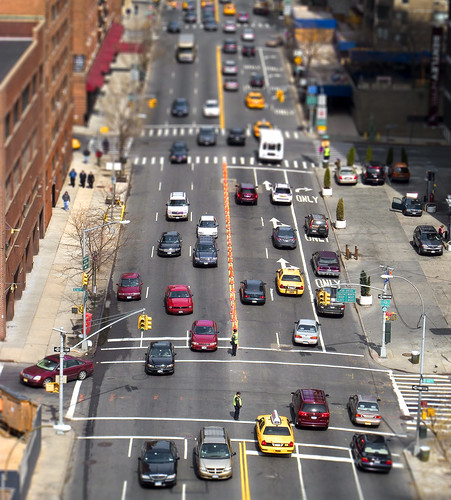
– photo by Mitch Waxman
Also, I haven’t mentioned the podcast bliss that is Dan Carlin, have I? If podcasting could win an Academy Award, Dan would own many little statues for his recent “Ostfront” episodes of the Hardcore History series, exploring the deep history of the War on the Eastern Front between Nazi and Soviet during World War 2 (proving the point that you never want to piss off a Russian in his house, those people are insane and cannot be beaten on their home turf).
Ostfront factoid: During a spell of severe weather which had destroyed a road, the Russians marched their German POW’s to a ditch and forced them to lie down in it- spaced out in regular intervals. The Soviets poured water into the ditch, allowing the russian winter to freeze the dead solid and build them a corduroy road out of their enemies. Don’t screw around with a Russian in his house. Crazy.
Carlin’s “Common Sense” show is the most cogent discussion of modern politics I’ve been able to find anywhere. Available through iTunes, Podcast Alley, and others, follow this link to dancarlin.com to check out the king of the hill and listen to some actual editorial journalism.

And just as a note, today, January 6, is Three kings Day.
Tales of Calvary 7

– photo by Mitch Waxman
I just can’t sit on this one anymore. After a spree of “all cemetery” postings in November and December, I decided to take a step back from the grave, but I just can’t stop myself…
Promises would be offered to you, lords and ladies of Newtown, not to spend too much time amongst the dead in these first days of the new year, but I’d probably break them.
Paper fades, buildings fall, but Calvary is eternal and undying. Dripping in its centuried silence and nitre choked glory, the emerald desolations of Calvary Cemetery offer a pastoral transit between tumultuous neighborhoods in the Newtown Pentacle, and that weird old man in the filthy black raincoat you might glimpse as you drive by is often your humble narrator.

– photo by Mitch Waxman
On this particular day, a sunny Saturday (Thanksgiving weekend in 2009), I wasn’t transiting Calvary.
I had come here with a definite purpose, searching for the grave of a man who died in the early 30’s rumored to have been involved with the illegal smuggling of strange statuettes into the United States in the 1920’s from some impossibly remote pacific island. This man, a Massachusetts merchant named Gilman, was killed in a freak nocturnal accident, apparently by a bale of paper which had fallen out of some warehouse window along the Newtown Creek. His oddly deformed body was found by workmen the next morning, and the Coroner pronounced the death accidental. The victim was buried in Calvary’s public section as an act of charity, and under the assumption that Gilman was an Irish name. His belongings and personal valuables, made from some queer kind of gold sculpted into wild and heretical forms, were collected by a schooner captain whose three masted ship appeared unbidden at the Penny Bridge docks one night during an unnaturally thick fog. The Captain, a Massachusetts trader named Marsh, paid for a custom and eccentric grave marker to be erected for this Gilman fellow somewhere in Calvary. It remains elusive, but I shall find it- I found Al Smith!
As is often the case, my befuddled and inept investigations were swept wildly off course by a highly suggestible and credulous nature which makes me vulnerable to wild flights of shivering cowardice and shameful paranoia. Such timidity does not suit one who stands and stares into whatever abyss happens to be before him, and what I saw chilled me with its wild possibilities. It was Thanksgiving weekend, and Calvary was as quiet as… well… a tomb.

– photo by Mitch Waxman
As seen in the above shots, the overgrown monument with its vine covered cupola intrigued and drew my attention. In accordance with usual methods, the object was photographed from many angles, and my path led me widdershins around it. As mentioned in the last paragraph, thanksgiving weekend had evinced a general evacuation of the area surrounding that bulkheaded duct of urban horror called the Newtown Creek, and like their counterparts in the spires of Manhattan it would seem that the workers of Calvary got off early on the previous Wednesday. Just dropped their shovels, as it were.
That’s when I saw it, said “oh. oh… no… just keep walking… don’t take any pictures of…”. Unfortunately, my finger was already depressing the button on my camera. I had lost all control, and still can’t stop myself from posting about it weeks later… I’m all ‘effed up.
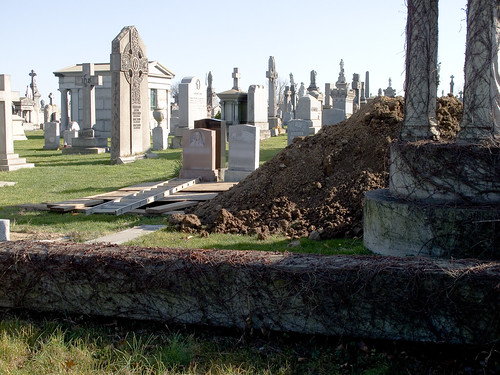
– photo by Mitch Waxman
In the interest of full disclosure, the names on the two grave markers are obscured as they were modern burials. If a grave is at least older than me, I feel fine about publishing a photo or talking about who it holds. If it’s an early 1900’s burial- fair game. (note: a cool thing happened recently- a sepulchral portrait, randomly chosen and published in the Mt. Zion series of postings, resulted in a certain Pentacle reader seeing his grandmother’s face for the first time) These interments, however, date from the early 1990’s and later. The context of this post demands some discretion, and censoring the names of the deceased whose graves are seen is definitely the right thing to do.
Now on to something you don’t normally see… and I am cognizant that the presentation of the following is vulgar and in very bad taste. I just can’t stop myself… Its like some alien thing is controlling me…

– photo by Mitch Waxman
There is a limited amount of time that one can tolerate solitary exposure to Calvary Cemetery, as the marble crown of Laurel Hill is a sort of psychic Chernobyl. It preys upon you- this place- in subtle ways, and comes at you in a manner not unlike the gradual stupefaction brought on by liquor. On New Year’s Eve, someone offered me three plots here for free, and withdrew the offer when I explained what a gravesite in Old Calvary is actually worth. Coincidence? hmmm… The place has noticed me, and it is trying to draw me further in…
Like ionizing radiation, whose damage to healthy living flesh is calculated by a multiplex of intensity and duration, whatever it is that lurks in the aether of Calvary is invisible, insidious, and real. Looking into an open grave like this, in this place, carries the comparable psychic risks of unshielded exposure to the thermonuclear eye of god itself.

– photo by Mitch Waxman
What I can’t do, is use my favorite catch phrase. The “who can guess…” one. Horrors too horrible for the graves holding lurk into the abyss, and loathsomeness waits below, but…
That’s what I was thinking as I passed out, again, in a dead faint. Luckily I fell backwards.


 The Newtown Pentacle