Archive for the ‘Astoria’ Category
elysian realm

– photo by Mitch Waxman
This Saturday, for a change, we’re not going to present a “Project Firebox” posting, and will instead talk a little bit about the holiday weekend. What the British (or most of the rest of the world) might call a “bank holiday”, the truth of what the three day weekend represents is lost within the dross usage and little understood idioms of the modern tongue.
The truth of the term is met by merely sounding it out. This is a secular holiday, a “holi” “day”, or holy day.
From a representative democratic point of view and sensibility, this “holiday” is meant to be like Yom Kippur or Good Friday- serious business.
from a November 2009 posting, “Tales of Calvary 2- Veterans Day“, about the antipode of this seasonal holiday- Veteran’s Day (which discusses the monument in some detail)–
The statues here at Calvary’s Soldiers Monument seem to have been the original castings of a much reproduced statuary design. Placed here in 1866, they predate the identical statues found at Green-Wood Cemetery, and exact issuance of the mold has been confirmed in New England, North Carolina, and all over New York State. As early as 1875, fumes from a nearby Ammonia Factory at Newtown Creek were graving pitted marks into them.

– photo by Mitch Waxman
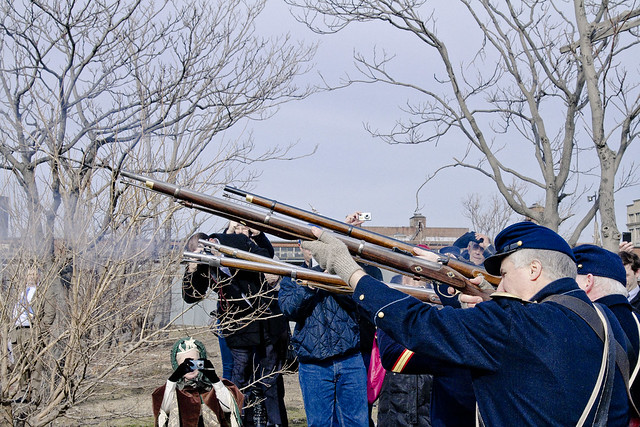
The original intent of the holiday was to honor the dead of the Civil War… well, all wars, supposedly… but they were really talking about the Civil War in 1868 when Memorial Day (then Decoration Day) appeared on the American Calendar. Someday the eleventh of September will replace Labor Day, as the term “Union” will mean little to future generations, and summer will end “officially” in the second week of the ninth month rather than the last of the eighth. Some politician will have assigned it a name by then- “Never Forget Day” or something, I’d wager.
There are some wounds which will never heal, even in the fullness of time.
from wikipedia
Memorial Day is a federal holiday observed annually in the United States on the last Monday of May. Formerly known as Decoration Day, it originated after the American Civil War to commemorate the fallen Union soldiers of the Civil War. (Southern ladies organizations and southern schoolchildren had decorated Confederate graves in Richmond and other cities during the Civil War, but each region had its own date. Most dates were in May.) By the 20th century Memorial Day had been extended to honor all Americans who have died in all wars. Memorial Day is a day of remembering the men and women who died while serving in the United States Armed Forces. As a marker it typically marks the start of the summer vacation season, while Labor Day marks its end.
– photo by Mitch Waxman
The smell of BBQ will rise above Queens and Brooklyn, as always, and the Manhattan people will order take out Chinese and I really couldn’t tell you what will be happening in the Bronx and Staten Island. There will be parades of Veterans, kids will skin their knees playing ball, and many of their Moms and Dads will get way too drunk. Fatty meats and cold drinks will swell many bellies.
All the kids will get sunburns, and go to bed knowing that the freedom of summertime has finally arrived.
Somewhere far away, however, other American kids with rifles in their hands will nervously stare out into the darkness of the desert, or listen intently for movement at mountain passes, and desperately hope that this will be a quiet night. Their BBQ is back at base, and like freedom- home is infinitely far away.
from usmemorialday.org
Memorial Day was officially proclaimed on 5 May 1868 by General John Logan, national commander of the Grand Army of the Republic, in his General Order No. 11, and was first observed on 30 May 1868, when flowers were placed on the graves of Union and Confederate soldiers at Arlington National Cemetery. The first state to officially recognize the holiday was New York in 1873. By 1890 it was recognized by all of the northern states. The South refused to acknowledge the day, honoring their dead on separate days until after World War I (when the holiday changed from honoring just those who died fighting in the Civil War to honoring Americans who died fighting in any war). It is now celebrated in almost every State on the last Monday in May (passed by Congress with the National Holiday Act of 1971 (P.L. 90 – 363) to ensure a three day weekend for Federal holidays), though several southern states have an additional separate day for honoring the Confederate war dead: January 19 in Texas, April 26 in Alabama, Florida, Georgia, and Mississippi; May 10 in South Carolina; and June 3 (Jefferson Davis’ birthday) in Louisiana and Tennessee.

– photo by Mitch Waxman
The Memorial Day holiday was created by those who would implicitly understand the situation of the latter. They suffered the same sort of dysentery, horror, and mission- and also watched friends get cut down by anonymous artillery fire in some faraway land.
By the end of the Civil War, there were no victors, only survivors. These survivors wanted us to learn from their trials, and set an annual date for us to sit and think- long and hard- about how high a price certain things are worth.
The same can be said of the veterans of every mechanized “modern conflict” fought since the advent and introduction of the war machines in the 1860’s.
from nycgo.com
Memorial Day isn’t just an excuse for springtime sales and a three-day weekend—it is, first and foremost, a time to honor those citizens who’ve served the United States in times of war. NYC honors our fallen heroes with parades all over the City. The Little Neck–Douglaston parade in Queens is reputedly the largest of its kind. You can also attend Brooklyn’s Memorial Day Parade (145 years old!), which begins at Third Avenue and 87th Street. In Manhattan, head uptown for a smaller parade in Inwood that begins at Broadway and Dyckman Street. Check the City’s events calendar for a full list of events and start times.

– photo by Mitch Waxman
Given that this is also “Fleet Week”, might a humble narrator suggest that if you see a Marine or Sailor at the bar- have the bartender anonymously send over a beer on your tab.
Thanks of a grateful nation, and all that.
form or matter

– photo by Mitch Waxman
Gaze in bewilderment upon the under cobbled lanes of fabled Astoria, hoary and venerable, one of the last locations within the megalopolis which actually resembles New York City. The human infestation is dense here, where an effervescent melange of cultures nevertheless vies to ignore each others presence. Many of my neighbors have told tall tales of “back home”, all of which are unsavory to my American ears. The wonder of this place is that the cultural stressors which tear and gnash have more to do with parking spots and loud music than centuries old blood feuds and the inheritances of Eurasian nationalism.
People in Astoria pride themselves on minding their own business, which has become kind of an issue of late.
from wikipedia
A blood feud is a feud with a cycle of retaliatory violence, with the relatives of someone who has been killed or otherwise wronged or dishonored seeking vengeance by killing or otherwise physically punishing the culprits or their relatives. Historically, the word vendetta has been used to mean a blood feud. The word is Italian, and originates from the Latin vindicta (vengeance). In modern times, the word is sometimes extended to mean any other long-standing feud, not necessarily involving bloodshed. Sometimes, it is not mutual but a prolonged series of hostile acts waged by one person against another without reciprocation.

– photo by Mitch Waxman
Do not mistake the place for a paradise, nor blankly accept the soporific descriptions of Astoria offered by Real Estate Industrial Complex operatives or the political class. One cannot ignore the omnipresent darkness which emerges in the ancient village. Just down my block, a couple of summers ago, an old man died in his house at the height of summer and his mouldering corpse lay undiscovered for several weeks- the explosive result forced a tear down renovation of his living quarters- an expense which forced his landlord to sell the building. Another neighbor, suffering from severe depression, attempted suicide via hanging several years ago. He was clinically dead when the paramedics arrived, but resuscitated. Unfortunately, other members of his creed, adherents to ancient superstition, believe him to be animated by the devil itself and shun him. “The Man with no Soul”, as he is called, wanders the neighborhood blankly and brain damaged.
Also, there is the odd fat man on 34th avenue and his criminal army of juvenile devotees…
from wikipedia
A nachzehrer is created most commonly after suicide, and sometimes from an accidental death. According to German lore, you don’t become one from being bitten, or scratched. It is just something that happens. Nachzehrers are also related to sickness and disease. If a large group of people died of the plague, the first person to have died is believed to be a nachzehrer.
Typically a Nachzehrer devours its family members upon waking. Its also been said that they devour themselves, including their funeral shroud, and the more of themselves they eat, the more of their family they physically drain. It is not unlikely that the idea of the dead eating themselves might have risen from bodies in open graves who had been partly eaten by scavengers like rats.
Some Kashubes believed that the Nachzehrer would leave its grave, shapeshifting into the form of a pig, and pay a visit to their family members to feast on their blood. In addition, the Nachzehrer was able to ascend to a church belfry to ring the bells, bringing death to anyone who hears them. Another lesser known ability of the Nachzehrer is the power it had to bring death by causing its shadow to fall upon someone. Those hunting the Nachzehrer in the graveyard would listen for grunting sounds that it would make while it munched on its grave clothes.

– photo by Mitch Waxman
Brutal homicides and bizarre occurrences permeate the recent past here- on the corner pictured above, there was a gun battle and fatal shooting just last year. An uptick in public drunkenness, petty vandalism, and large groups of carousing youths has been commented on more than once by area wags in recent months. Disturbingly, the social contract seems so tattered that public defecation and urination are now the norm on Broadway, despite the easy availability of lavatories at any number of bars and restaurants. As is the way with Queens, many complain, but few step forward to confront and chase away the chaos.
They shrug, and accept, and forget all about Kitty Genovese.
from wikipedia
Catherine Susan “Kitty” Genovese (July 7, 1935 – March 13, 1964) was a New York City woman who was stabbed to death near her home in the Kew Gardens neighborhood of the borough of Queens in New York City, on March 13, 1964.
The circumstances of her murder and the lack of reaction of numerous neighbors were reported by a newspaper article published two weeks later; the common portrayal of neighbors being fully aware but completely nonresponsive has since been criticized as inaccurate. Nonetheless, it prompted investigation into the social psychological phenomenon that has become known as the bystander effect or “Genovese syndrome” and especially diffusion of responsibility.
Project Firebox 43

– photo by Mitch Waxman
Lonely for olden times, this lonely sentinel stands vigil on Vernon blvd. in Queens. Once, it saw ferries and trolley lines busily engaging in their occupation, today it witnesses only automobiles coming and going from a big box store across the street.
weedy walls
Note- This is a reblog of a Newtown Pentacle posting from June 5, 2010 titled: from Hells Gate, loosed upon the world

– photo by Mitch Waxman
The Friday of memorial day weekend, your humble narrator stumbled into the wilds of Astoria, headed for Astoria Park. Astoria Park is at the western end of Queens, and adjoins the East River, hosting parts of both the mighty Triboro Bridge and the sublime exemplar of bridge engineering called Hellgate. Named for the section of the East River it crosses, Hellgate was my intended destination and subject, and I was hoping for some visually interesting rail traffic to be crossing the great bridge. Frustrated by a gray and humid day, the Acela and other Amtrak traffic was observed, as well as a curious CSX double engine. Then…
from nycgovparks.org
Astoria Park, on the west shore of Queens, extends from south of the Triborough Bridge to north of the Hell Gate Bridge. With a panoramic view of the skyscrapers of midtown Manhattan in the south to the Hell Gate channel in the north, the scenery presents the diverse landscape of New York City. The Hell Gate channel, formed by faults deep underground, contains some of the deepest water in New York Harbor. Its treacherous reefs bear picturesque names such as “Hen and Chickens,” “Pot Rock,” “Bread & Cheese,” and “Bald Headed Billy.”
Throughout the centuries the stunning natural beauty of this location has attracted visitors and settlers. Before the arrival of European colonists, a trail passed by the site, and an Indian village flourished at Pot Cove. Local inhabitants grew maize on the shores, fished in Hell Gate, and drew water from Linden Brook, a small stream that still flows under Astoria Park South. In the mid-1600s the Dutch parceled out this land to various owners, including William Hallet whose grant embraced hundreds of acres. During the American Revolution, several British and Hessian regiments were stationed in the area. On November 25, 1780 the frigate Hussar and its five-million-dollar cargo sank to the bottom of Hell Gate, where despite some removal of cannons, the treasure still remains.

– photo by Mitch Waxman
I’ve become pretty familiar with NY Harbor in the last year, and can identify some of the common types of ships that cross its waters. Every now and then, however, a mysterious craft- an unidentified floating object or UFO if you will- crosses in front of me. Proceeding south, this catamaran (actually a trimaran) was nearly devoid of markings- which is remarkable in itself- and moving at a tremendous clip. Its “colorway” and hull shape instantly said “military” to me, but I could not recognize its specie.
from wikipedia
The first trimarans were built by indigenous Polynesians almost 4,000 years ago, and much of the current terminology is inherited from them. Multihull sailboats (catamarans and trimarans) gained favor during the 1960s and 1970s. Modern recreational trimarans are rooted in the same homebuilt tradition as other multihulls but there are also a number of production models on the market. A number of trimarans in the 19–36-foot lengths (5.8–11 m) have been designed over the last 30 years to be accommodated on a road trailer. These include the original Farrier – Corsair folding trimarans – and original John Westell swing-wing folding trimaran (using the same folding system later adopted also on Quorning Dragonfly) and like trimarans. Many sailboat designers have also designed demountable trimarans that are able to be trailered (like the SeaCart 30 by Oceanlake Marine).
The trimaran design is also becoming more widespread as a passenger ferry. In 2005 the 127-metre trimaran (417 ft) Benchijigua Express was delivered by Austal to Spanish ferry operator Fred. Olsen, S.A. for service in the Canary Islands. Capable of carrying 1,280 passengers and 340 cars, or equivalents, at speeds up to 40 knots, this boat was the longest aluminum ship in the world at the time of delivery. The trimaran concept has also been considered for modern warships. The RV Triton was commissioned by British defence contractor QinetiQ in 2000. In October 2005, the United States Navy commissioned for evaluation the construction of a General Dynamics Littoral Combat Ship (LCS) trimaran designed and built by Austal.

– photo by Mitch Waxman
Evocative, as on one hand it resembled a radar dodging stealth aircraft for the odd angles and aerodynamic shape, on the other it suggested a modern combat tank with its armor designed to deflect rather than defeat ballistic weapons.
The ship, nevertheless, was kicking up a huge wake and was shooting water behind it- some 10-20 feet high- as it rocketed down the East River.
from wikipedia
The littoral zone refers to that part of a sea, lake or river that is close to the shore. In coastal environments the littoral zone extends from the high water mark, which is rarely inundated, to shoreline areas that are permanently submerged. It always includes this intertidal zone and is often used to mean the same as the intertidal zone. However, the meaning of “littoral zone” can extend well beyond the intertidal zone.
There is no single definition. What is regarded as the full extent of the littoral zone, and the way the littoral zone is divided into subregions, varies in different contexts (lakes and rivers have their own definitions). The use of the term also varies from one part of the world to another, and between different disciplines. For example, military commanders speak of the littoral in ways that are quite different from marine biologists.
The adjacency of water gives a number of distinctive characteristics to littoral regions. The erosive power of water results in particular types of landforms, such as sand dunes, and estuaries. The natural movement of the littoral along the coast is called the littoral drift. Biologically, the ready availability of water enables a greater variety of plant and animal life, and the additional local humidity due to evaporation usually creates a microclimate supporting unique types of organisms.
The word “littoral” is used both as a noun and an adjective. It derives from the Latin noun litus, litoris, meaning “shore”. (The doubled ‘t’ is a late medieval innovation and the word is sometimes seen in the more classical-looking spelling ‘litoral’.)

– photo by Mitch Waxman
The “colorway” and camouflage of the craft suggested that the futurists of Britain still have modern adherents, long after the last of the “dazzle ships” were launched.
For those of you not in the know, the Dazzle Ships were an experiment in “breaking up the shape” of large combat vessels against the horizon, an attempt to reduce the visual profile of capital ships and reduce the ability of submariners to target vital areas of said ships. Dazzle works best at distance, which is what modern naval combat is all about.
from wikipedia
At first glance Dazzle seems unlikely camouflage, drawing attention to the ship rather than hiding it, but this technique was developed after the Allied Navies were unable to develop effective means to disguise ships in all weather.
Dazzle did not conceal the ship but made it difficult for the enemy to estimate its type, size, speed and heading. The idea was to disrupt the visual rangefinders used for naval artillery. Its purpose was confusion rather than concealment. An observer would find it difficult to know exactly whether the stern or the bow is in view; and it would be equally difficult to estimate whether the observed vessel is moving towards or away from the observer’s position.
Rangefinders were based on the co-incidence principle with an optical mechanism, operated by a human to compute the range. The operator adjusted the mechanism until two half-images of the target lined up in a complete picture. Dazzle was intended to make that hard because clashing patterns looked abnormal even when the two halves were aligned. This became more important when submarine periscopes included similar rangefinders. As an additional feature, the dazzle pattern usually included a false bow wave to make estimation of the ship’s speed difficult.

– photo by Mitch Waxman
As mentioned, my computer was down for the holiday weekend, but Our Lady of the Pentacle allowed me to use her laptop and I managed to get a few of these images out to that clandestine and anonymous network of maritime enthusiasts and quasi governmental experts who advise, comment, or offer corrections to your Newtown Pentacle. Credit for identifying this craft goes out to them, and I wish that they would allow me to sing praise publicly, but certain conflicts of interest or oaths of secrecy demand that they must always be referred to as “anonymous sources”. In this case, the ultimate sources will be referred to as Daidalos and Icaros (hey, it is Astoria Park).
from wikipedia
It is in images, not in texts that Daedalus is seen with wings; many Greek myths appear to have been invented to make sense of known but inexplicable images. The most familiar literary telling explaining Daedalus’ wings is a late one, that of Ovid: in his Metamorphoses (VIII:183-235) Daedalus was shut up in a tower to prevent his knowledge of his Labyrinth from spreading to the public. He could not leave Crete by sea, as the king kept strict watch on all vessels, permitting none to sail without being carefully searched. Since Minos controlled the land and sea routes, Daedalus set to work to fabricate wings for himself and his young son Icarus. He tied feathers together, from smallest to largest so as to form an increasing surface. The larger ones he secured with thread and the smaller with wax, and gave the whole a gentle curvature like the wings of a bird. When the work was done, the artist, waving his wings, found himself buoyed upward and hung suspended, poising himself on the beaten air. He next equipped his son in the same manner, and taught him how to fly. When both were prepared for flight, Daedalus warned Icarus not to fly too high, because the heat of the sun would melt the wax, nor too low, because the sea foam would soak the feathers.

– photo by Mitch Waxman
Daidalos was actually stumped when the photos arrived, and neither of us could make any sense of the only marking- a string of tiny numbers on the hull- of this unidentified floating object. High flying, Icaros received the shots from the latter, and contacted high ranking members of a certain governmental entity. This entity-let’s just say that they have lots of boats and planes, and boats that are airports, and boats that carry nuclear missiles and stay underwater for months at a time, and a lot of the people who work for it wear white dress uniforms– claimed the ship as theirs!
from wikipedia
From the time of its inception, the military played a decisive role in the history of the United States. A sense of national unity and identity was forged out of the victorious Barbary Wars, as well as the War of 1812. Even so, the Founders were suspicious of a permanent military force and not until the outbreak of World War II did a large standing army become officially established.
The National Security Act of 1947, adopted following World War II and during the onset of the Cold War, created the modern U.S. military framework; the Act merged previously Cabinet-level Department of War and the Department of the Navy into the National Military Establishment (renamed the Department of Defense in 1949), headed by the Secretary of Defense; and created the Department of the Air Force and National Security Council.
The U.S. military is one of the largest militaries in terms of number of personnel. It draws its manpower from a large pool of volunteers; although conscription has been used in the past in various times of both war and peace, it has not been used since 1972. As of 2010, the United States spends about $692 billion annually to fund its military forces, constituting approximately 43 percent of world military expenditures. The U.S. armed forces as a whole possess large quantities of advanced and powerful equipment, which gives them significant capabilities in both defense and power projection.

– photo by Mitch Waxman
What you have just seen, lords and ladies, shooting down the East River at high speed was described as a (JHSV) Joint High Speed Vessel.
A JHSV can comfortably carry 300 fully armed MARINES, or up to 600 in a pinch. Alternatively, it can move multiple main battle tanks- the astounding M1 Abrams. Just so you understand, 600 is near the low end of Battalion strength, and 600 U.S. Marines could probably claim a beachhead in Hell itself if they were asked to. It also has a landing pad for a helicoptor.
This ship is huge… but a helicoptor pad?
from navy.mil
Description
The JHSV program is procuring high-speed transport vessels for the Army and the Navy. These vessels will be used for fast intra-theater transportation of troops, military vehicles and equipment. The JHSV program merges the previous Army Theater Support Vessel (TSV) and the Navy High Speed Connector (HSC), taking advantage of the inherent commonality between the two programs.
JHSV will be capable of transporting 600 short tons 1,200 nautical miles at an average speed of 35 knots. The ships will be capable of operating in shallow-draft ports and waterways, interfacing with roll-on/roll-off discharge facilities, and on/off-loading a combat-loaded Abrams Main Battle Tank (M1A2). Other joint requirements include an aviation flight deck to support day and night air vehicle launch and recovery operations.
JHSV is a commercial-design, non-combatant transport vessel, and does not require the development of any new technology. JHSV is being built to American Bureau of Shipping (ABS) High Speed Naval Craft Guide. Systems onboard will be based on commercial ABS steel vessel rules. As such, it does not require the survivability and ability to sustain damage like the LCS. It has no combat system capability and no ability to support or use LCS mission modules. It will leverage non-developmental or commercial technology that is modified to suit military applications. Select military features include Aviation; Command, Control, Communications, Computers, and (Military) Intelligence; and Firefighting for the Mission Bay. NVR does not apply to any part of JHSV.
As a non-combatant sealift ship, the Navy variant of JHSV will be crewed by civilian mariners, either employed by or under contract to the Navy’s Military Sealift Command. U.S. Army vessels will be crewed by Army craft masters. Both versions will require a crew of approximately 22-40 people, but will have airline style seating for more than 300 embarked forces and fixed berthing for approximately 100 more.
- Primary Function: The JHSV Program will provide high speed, shallow draft transportation capability to support the intra-theater maneuver of personnel, supplies and equipment for the U. S. Navy, Marine Corps, and Army.
- Builder: Austal USA
- Propulsion: Water Jet
- Length: 103 Meters (338 feet)
- Beam: 28.5 meters (93.5 feet)
- Displacement: 600 short tons
- Draft: < 15 feet (4.57 meters)
- Speed: 35-40 knots
- Range: 1,200 nautical miles
- Crew: 22-40 civilian mariners/U.S. Army craft masters
- Homeport: No homeport – construction has yet to begin.
However… This is not a JHSV!!!
This here is the M80 Stiletto.

– photo by Mitch Waxman
Check out this video at youtube which explains the Stiletto’s potential in great detail, and supplies 3D animation for operational scenarios.
With the formal roll-out of the 88-foot Stiletto stealth ship and its cutting-edge “M-Hull” wave-damping design, that legacy takes another step forward. The Stiletto is part of Project WolfPac, which aims to test new concepts of shallow-water and riverine warfare organized around swarms of smaller, affordable ships linked by communications. The Stiletto can slip into shallow waters, launching inflatable boats and even UAVs while serving as a communications hub via its “electronic keel.” Best of all, the M-Hull significantly reduces the pounding its occupants take from waves – poundings that often result in back injuries that cut careers short, or leave sailors with lingering disabilities in later life.
and from wikipedia
The 88-foot (27 m) long vessel has a notable hull design, an M-shaped hull that provides a stable yet fast platform for mounting electronic surveillance equipment or weapons, or for conducting special operations. The hull design does not require foils or lifting devices to achieve a smooth ride at high speeds in rough conditions. Its shallow draft means the M80 Stiletto can operate in littoral and riverine environments and potentially allows for beach landings.
The M80 Stiletto is equipped with four Caterpillar, Inc. C32 1232 kW (1652 HP) engines yielding a top speed in excess of 50 knots (90 km/h) and a range of 500 nautical miles (900 km) when fully loaded. It can be outfitted with jet drives for shallow water operations and beaching.
It has a topside flight deck for launching and retrieving UAVs and a rear ramp that can launch and recover an 11-meter rigid-hull inflatable boat (RIB) or Autonomous Underwater Vehicle (AUV).
It weighs 45 tons unloaded, light enough that it can be hoisted onto a cargo ship, while still able to carry up to 20 tons of cargo in the 1,996 square feet (200 m2) of usable interior space. The ship is 88.6 feet (27.0 m) in length, with a width of 40 feet (12 m) and a height of 18.5 feet (5.6 m), yet has a draft of only 2.5 feet (0.8 m).
The M80 Stiletto is the largest U.S. naval vessel built using carbon-fiber composite and epoxy building techniques, which yields a very light but strong hull. The prototype M80 Stiletto is expected to be in use in less than one year. Ships are expected to cost between $6 and $10 million
Project Firebox 42

– photo by Mitch Waxman
The never ending cacophony that is known to gentry and commoner alike as Astoria Queens often manifests physically. Boundless, the furious tumult and enthusiast spectacle of urban youth often results in the wholescale destruction of street furniture, automobiles, and sometimes- lives. Pity this servant of the public good on 36th avenue, a victim of whim and inattention.


 The Newtown Pentacle