Archive for the ‘Photowalks’ Category
distant valley
Ridgewood has its charms, lord and ladies.

– photo by Mitch Waxman
I love the esthetics of the section of Ridgewood nearby Fresh Pond Road, which offers block after block of pretty as you please row houses – many of which utilize Kreischer bricks in their street facing facades. I don’t know this neighborhood as well as I’d like to, as it’s quite a hike to walk here from Astoria. Last week, occasion carried me to Ridgewood, where this view was gathered. One plans on spending a bit more time in this section in the coming months, although I’m still a bit uncomfortable in residential areas – preferring the concrete devastations and lonely industrial zones surrounding my beloved Creek.

– photo by Mitch Waxman
This kids ride was sitting outside a deli, and it caught my eye. Haven’t seen this goofy Pelican sculpture before, normally you get horses and race cars on these things. One of my local bodega owners on Broadway in Astoria (he’s got one that sports a pink elephant) told me that he splits the earnings with the company that owns the unit 50/50, and that he can expect more than $300 a week from the thing. That’s a lot of quarters.

– photo by Mitch Waxman
Street furniture like these kid rides are the sorts of things that the big league historians typically overlook, as the “college boys” prefer to focus in on structures, infrastructure, and demographic patterns. They tend to miss the little stuff in favor of broad swath trends, in my opinion. When, exactly did “penny candy” become surprisingly expensive? When did the Bearclaw disappear from NYC? That’s where I come in. Now, you got a quarter? I want to ride the pelican.
“follow” me on Twitter- @newtownpentacle
delighted astonishment
A short trip off of a Long Island to… Staten Island.

– photo by Mitch Waxman
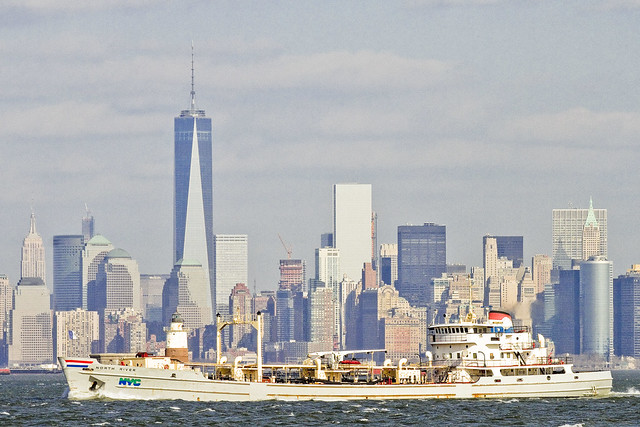
Over at the St. George Ferry terminal, on the… Staten Island… side of the harbor, one is treated to magnificent views of Lower Manhattan and it’s a pretty sure bet that you’ll see some maritime traffic. Pictured above is the Vane Brothers Sassafras towing a fuel barge, for instance.
– photo by Mitch Waxman
One such as myself is always eager to witness a DEP Sludge Boat splashing by. That’s the MV North River heading towards the Port Richmond sewer plant found a mile or so up the Kill Van Kull.

– photo by Mitch Waxman
Marjorie B. McAllister also happened by, and the bright red tug was towing a fuel barge. Even when it seems that a tug is pushing a barge, it’s still called “towing.”
“follow” me on Twitter- @newtownpentacle
damnable chance
From the very edge of the Newtown Pentacle.

– photo by Mitch Waxman
The Cemetery of the Evergreens is found near the border of East New York and Bushwick, is some 225 acres in size, and is home to around a half million corpses. For a short time, during the 1920’s, it was the busiest burying ground in the entire city. Unfortunately, during my visit, the fact that Anthony Comstock is buried here was unknown to me, for I am possessed of a strong desire to first spread out a few issues of Hustler and thereupon urinate upon his grave. If that sounds shocking, you don’t know who that “assassin of joy” called Comstock was. If I’d known he was here, I’d have brought him some porn.

– photo by Mitch Waxman
Evergreens was my second destination on a recent trip to the south eastern interval of the Pentacle, after having visited Machpela Cemetery. When entering the place, a humble narrator was in a state of willful ignorance. My friend Kevin Walsh over at Forgotten-NY has written extensively (and offered a walking tour) about the non sectarian Cemetery of the Evergreens, btw., but this was my first visit. Personally, I was blown away by the view, as the altitude of the hill that the cemetery is built into offers panoramic views of the entire geologic “soup bowl” that NYC is nestled into. The only competition for these tapophile views from Bushwick, in my experience, are those encountered at the Mt. Olivet Cemetery found a few miles to the north over in Maspeth.

– photo by Mitch Waxman
It must be mentioned, as always, that the Manhattan people look to Brooklyn and Queens to dispose of things they don’t want – which includes their dead. Back in 1847, the Rural Cemeteries Act was passed as a sanitary law. The RCA of 1847, a reaction to a recent Cholera outbreak in Manhattan’s Bloody Sixth Ward, decreed that no new burials were to take place on Manhattan Island and that the various sects and houses of worship housed thereupon must acquire properties in “the country.” Back then, “the country” meant the vastness of greater Newtown or the infinity of the City of Brooklyn (independent municipalities, I would mention, who permanently lost a significant acreage of otherwise profitable land to these cemeteries).

– photo by Mitch Waxman
Observed were a wealth of monuments representing several recent eras in the field of graphic design. Particularly well represented were early 20th century deco and nouveau motifs, and typography such as that used on the carvings above was of high quality and tasteful execution. Having spent as much time studying First Calvary as I have, which hosts monuments that are the epitome of an interval starting during the Civil War of the 1860’s right through 1900 or so (thoroughly Irish and German Catholic in type and marker styling), this sort of “moderne” approach to funereal typography caught my eye. Several examples of this sort of marker were noticed, with the one above recorded simply because the light was good.

– photo by Mitch Waxman
For as long as this – your Newtown Pentacle – has been focusing on the various cemeteries which comprise the so called “Cemetery Belt” there have been references offered for “disturbing subsidences.” Presumption is made that you have a life and don’t spend your time hunting around cemeteries, unlike me, and that a little bit of explanation as to what you’re looking at should be attempted for the non ghoul.
This is a washout, not a fresh interment. If it was a new burial, there would be a temporary marker of some kind and the soil would form a slight mound – there would also be tire marks from earth moving equipment and footprints. Additionally, notice the edges of the bald soil! which bear the shape of flowing water. No, what you’re seeing here is a disturbing subsidence, wherein either the entire casket has been shifted or damaged by hydrologic action – or the lid of the casket has simply collapsed – allowing soil to infiltrate, creating a void which caused column of loam to drop down.
As mentioned – a “disturbing subsidence.”
“follow” me on Twitter- @newtownpentacle
terrific doctrines
Today marks the 206th anniversary of Edgar Allen Poe’s birth.

– photo by Mitch Waxman
Recent opportunity found a humble narrator tramping about in Machpela Cemetery over in the Glendale section, not far from the currently undefended border of Brooklyn and Queens. This cemetery was established in 1855, part of the build out of burying grounds that followed the Rural Cemeteries Act, and when it opened visitors would have told you that this non sectarian yet overwhelmingly Jewish polyandrion was found in Newtown.

– photo by Mitch Waxman
Those of you knowledgable about Machpela have probably already guessed what drew me here – to a cemetery which sits across the street from the far larger Cypress Hills Cemetery – but I’ll be discussing “him” later in the week over at my Brownstoner column. Instead, since this is the first time that Machpela has been visited by a humble narrator, photos from a stroll around the place are presented today.

– photo by Mitch Waxman
There seemed to be quite a lot of grounds keeping issues at Machpela, with ancient trees dropping large limbs, or as above – the entire tree went down. Pictured above was a tree whose trunk had been segmented by workmen. The thing appeared to have been struck by lightning, presuming that the blasted black char observed on several of the segments was caused by atmospheric electrical discharge. The fallen tree wiped out a whole section of monuments on its way down, which were tumbled about.

– photo by Mitch Waxman
Fallen limbs were observed everywhere at Machpela, and there were a couple of places which seemed none too safe. Perhaps the unusual amount of rain and wind we’ve experienced in the last few months contributed to the carnage, but as in the shot above – many of these broken branches seem to have sat undisturbed and in the position that gravity and inertia placed them in long enough for decay to set in.

– photo by Mitch Waxman
To be fair, older cemeteries like this one suffer from conditions of severe financial hardship. All across the so called “Cemetery Belt” in Queens and Brooklyn are graveyards which were largely filled by the end of the First World War a century ago. If any surviving relatives persist in the area, the cemetery corporations find it difficult to collect any funds for the upkeep of a great great grandfather’s grave from them. New interments are few, and the operating funds available to modern management of cemeteries like Machpela are slim pickings.
“follow” me on Twitter- @newtownpentacle
rattling and beating
Meshuggenehs, all of us.

– photo by Mitch Waxman
An interesting exercise was undertaken recently, which involved the peeling back of hardened scabs and callouses. Whilst browsing the vast interwebs recently, a link carried me over to YouTube. A recording of “The Howard Stern show,” which was broadcasting live during the September 11th attacks, was perused. The reactions of Howard and his crew to the attacks as they happened put me in touch with my own experiences that day, and opened up an old wound. This touched off a spate of reviewing broadcasts, both news and scripted drama, produced in the aftermath of the attacks. One remembers the emotional numbness of the time, when it seemed that nothing would ever be funny again, and the paramount question of that moment in time – raised over and over – was “why do they hate us.”

– photo by Mitch Waxman
All these years later, the answers offered by the entertainment industry – whether asked by the hosts of what passes for news in our nation or as interpreted by dramaturges – boiled down to “freedom.” Aside from a childish lack of knowledge about the actual foreign policy of, and an unvarnished look at the actions of the United States in the second half of the 20th century, what struck me was the notion we held about ourselves back then. The general gist of what folks wanted in the months following the attacks was to “unleash” the CIA, and to teach the rest of the world “who’s the boss.” I guess we’ve got that now – with our fleets of flying robot assassins, institutional torture, and a gulag in Cuba. If you’ve got the time, I suggest you scan the web in a similar fashion, as it’s an interesting thing to see what our world was once like and how far we’ve travelled in a very short time. Remember “freedom fries”?

– photo by Mitch Waxman
An urban myth is put to rest, incidentally, in the shot above. “Ever notice how you never see a dead pidgeon” is the particular yarn, something I’ve heard repeated over and over. I see a LOT of dead pidgeons, and have photos to prove it. An urban myth which the September 11th attacks actually put to bed was the efficacy of the so called “Emergency Alert System,” whose tests interrupted television and radio broadcast throughout my childhood. It was nowhere to be found on 911, despite there being an actual emergency in my area. Additionally, the Emergency Alert System didn’t seem to activate during Hurricane Sandy either.
“follow” me on Twitter- @newtownpentacle
 The Newtown Pentacle