Posts Tagged ‘DUKBO’
hideous meaning

– photo by Mitch Waxman
Startling, recent transmissions and recitations from a weird and alien country called Albany brought word that the Governor of New York State has arranged to accelerate the Kosciuszko Bridge project. Complicated planning, difficult execution, and extreme expense hang gruesomely around this project- originally scheduled to commence in 2014, and now expected to begin in 2013.
from nydailynews.com
Construction on a new bridge is now expected to begin in spring 2013 — a year ahead of schedule, thanks to $460 million made available for the job by Gov. Cuomo’s New York Work initiative.
The 73-year-old bridge, which carries the Brooklyn-Queens Expressway over the Newtown Creek, qualified for the money in part because it is on the state’s “deficient bridge” list.
The initial phase of construction will build an eastbound lane next to the existing bridge, according to the state Department of Transportation, the agency overseeing the project. The 1.1-mile bridge is expected to be done in 2017 and will cost about $800 million.
When completed, two new spans with a total of nine vehicle lanes and paths for pedestrians and bikes will replace the original structure.
It’s the single biggest project made possible through the New York Works program, an initiative to create jobs while repairing the state’s infrastructure.

– photo by Mitch Waxman
The 1939 workhorse, erected at the whim of Robert Moses, will no longer soar above that mirrored ribbon of risible metaphor known as the Newtown Creek in just a few years, as scheduled work is meant to conclude in 2017. Area wags shrug and sigh at this, wearily offering that such projects often extend well past their scheduled and budgetary goals, and that the Creek itself will present a series of unexpected problems to be solved.
from dot.ny.gov
Following seven years of alternatives analysis, environmental studies and extensive partnering with community groups and stakeholders, the Federal Highway Administration (FHWA) approved the New York State Department of Transportation’s (NYSDOT) selection of Alternative BR-5 for a new Kosciuszko Bridge in its March 9, 2009 Record of Decision and granted authorization to proceed with Final Design. The Project Team has been working to complete key initial phases of the Final Design which would lay the groundwork to develop and complete the detailed design of the new bridge structure.

– photo by Mitch Waxman
Extensive documentation exists at the State DOT website, with coruscating revelations about both the current structure and anticipations of obstacles and opportunities which will be encountered during pursuit of the new structure. Your humble narrator, threatened by such rapid change, remains nevertheless excited about the idea of a pedestrian walkway overlooking not just the Creek itself- but Calvary Cemetery. Architectural drawings of the future DUKBO (Down Under the Kosciuszko Bridge Onramp) show an intriguing and modernist setting.
from dot.ny.gov
Under all Build Alternatives, excavation of soil would be performed to a depth of about 4.5 m (15 ft), and the walls of the excavation would be braced. Contaminated soil and groundwater would be collected and disposed of. The new foundations would be pile supported, and either large diameter drilled piles or concrete filled driven pipe piles would be used. Drilled pile construction would generate less noise and vibration than driven piles, but may be difficult to install if boulders are encountered. Additionally, there is widespread soil contamination in the area, and contaminated soil and water extracted while drilling would need to be collected, treated and disposed of properly. This construction impact study assumed the use of driven piles.
After pile installation is complete, formwork for the pile cap would be installed, rebar installed, and concrete placed. Pier construction would follow, working from ground level up in approximately 2.5 m (8 ft) segments. Formwork would be installed, rebar installed and concrete placed. After the concrete has cured sufficiently, the forms would be stripped and the sequence would be repeated until the pier was complete.

– photo by Mitch Waxman
A frequent commenter at Newtown Pentacle, “George the atheist”, asked me a while back for clarification and or documentation of my assertion that the reason for the truss bridge’s enormous height over the Creek was to allow egress to ocean going vessels with high stacks (smokestacks). During the course of some general research on Newtown Creek in the first half of the 20th century, this 1951 photo popped up at the NYS Digital collections site which illustrates just such a scene.
from wikipedia
The Kosciuszko Bridge is a truss bridge that spans Newtown Creek between the New York City boroughs of Brooklyn and Queens, connecting Greenpoint, Brooklyn and Maspeth, Queens. It is a part of Interstate 278, which is also locally known as the Brooklyn-Queens Expressway. The bridge opened in 1939, replacing the Penny Bridge from Meeker Avenue in Brooklyn to Review Avenue and Laurel Hill Boulevard, and is the only bridge over Newtown Creek that is not a drawbridge. It was named in honor of Tadeusz Kościuszko, a Polish volunteer who was a General in the American Revolutionary War. Two of the bridge towers are surmounted with eagles, one is the Polish eagle, and the other the American eagle.
maddeningly untransmissible

– photo by Mitch Waxman
A curious thing happens when one exits the former Celtic Park at 43rd street in Queens, and crosses beneath a titan viaduct carrying the Long Island Expressway near its singular junction with the Brooklyn Queens Expressway. First, one realizes the enormity of having entered DUKBO (Down Under the Kosciuszko Bridge Onramp), and secondarily the realization that this is not the safest path for a pedestrian to have chosen becomes readily apparent.

– photo by Mitch Waxman
This is a “back door” to the massive truss bridge, thrice damned, which spans the Newtown Creek and has done so since 1939. Any driver with NY plates on their vehicle, ones worth their salt at least, has several of these short cuts etched into their mind. Taking Hunters Point Avenue to Skillman Avenue when exiting the Pulaski Bridge in order to avoid the traffic at Queens Plaza is another one of the Creek specific ones, but there are hundreds of similar opportunities to shave a few minutes off of a drive found all over the megalopolis.

– photo by Mitch Waxman
Recent announcements by the elites of Albany have made it clear that the Kosciuszko Bridge replacement project has had its timeline amplified, and work will begin on the endeavor in 2013 rather than the following year. Accordingly, your humble narrator has been attempting to spend a whole lot of time in the neighborhood of late, with the goal of recording everything in the place during its final days.

– photo by Mitch Waxman
One of the features here that I will sorely miss is this lovely little footbridge which carries pedestrian traffic from the 43rd street sidewalk over to the head of Laurel Hill Blvd., which runs alongside Calvary Cemetery’s eastern wall. As far as I’ve been able to discern, this structure is unnamed, here is where it might be found on a google map. If anyone reading this post works for an “official” agency and has information on the structure which you can share, please email me here, and let me know if you’d like to stay anonymous.

– photo by Mitch Waxman
As you can see, the foot bridge spirals over the onramp of the Kosciuszko fed by the Long Island Expressway’s “Queens Midtown Expressway” section, and said road channels Brooklyn bound traffic onto the truss bridge. In my estimation, the foot bridge is just wide enough to accommodate an automobile, although the turns would be tricky to negotiate in anything larger than a compact. Perhaps this is what it was originally intended to do, or it might just be a feature designed to allow emergency access to police.
Unlikely, but long have I wondered why the foot bridge is so over built. Look at all that steel.

– photo by Mitch Waxman
An access hatch is visible beneath the brick and mortar abutment which is freestanding from the LIE ramps, and evidence of some regular habitation is readily apparent. Someone is indeed living under, or actually within, this little footbridge.
One can imagine few places less peaceful to exist, at the locus point of the BQE and LIE at the foot of the Kosciuszko, within a masonry cairn.

– photo by Mitch Waxman
Habit and expectations demand that this person be labelled a “troll”, after the mythical creatures which European folklore describe as living beneath bridges. Odds are that this would be a cruel description for whomever it might be that calls this his or her “little hole in the wall”. Of course, this somewhat circular apartment offers one of the finest city views in all of Queens, and easy access to the B24 bus.
What tales might this individual describe, living across the way from Calvary Cemetery?

– photo by Mitch Waxman
All around the Newtown Creek, hidden amongst the bridges and rails tracks and amongst weed choked lots and abandoned industrial buildings, live an undocumented population. The odd thing is that they have jobs, or seem to, and just don’t mind a little discomfort if it means not paying rent. Once, it would have made sense to me to try and help out somehow, but age and experience have taught me to be afraid of people who brave such hardships.
Whoever this troll is, it is probably best to leave them alone, as the NY State DOT will be evicting them before long in any case.
You may think this is callow, or callous, or claim it to be madness.
This is not madness, this is DUKBO.
constantly consulting

– photo by Mitch Waxman
Gilman, Gilman, Gilman.
Idiotic, your humble narrator cannot break loose of the compulsion which drives me toward destruction, which will be the result of locating a certain grave amongst Calvary Cemetery’s emerald devastations. Weak of will and enslaved by fevered thoughts, once more do my feet fall upon a carpet of grass fed by a morbid nutrition, stumbling across and into the city of the dead. On the subject at hand, which is the attempt to locate a tiny needle in a gigantic hay stack- a needle not even certain to still exist in this age- let’s recap:
As mentioned in the post “Searching for Gilman“:
“Somewhere in the viridian depths of Calvary Cemetery lies an unremarked merchant from Massachusetts, who died in an accident along the delirious Newtown Creek in 1931. No obituary I can find discusses him, and Gilman slid unnoticed into the hallowed loam of Calvary’s charitable sections. His anonymity came to an end when, according to neighborhood sources and contemporary diarists, a relict 3 masted schooner arrived at the Penny Bridge docks and ordered an eccentric monument be erected on Gilman’s resting place. The captain of that black ship, a leathery bastard named Marsh, collected Gilman’s belongings and sailed via Newtown Creek to the East River, turning North toward Hell Gate- ultimately disappearing into the mists of Long Island Sound heading for New England.”
from epa.gov
The first survey of Newtown Creek was completed by Dutch explorers in 1613-1614, and the Dutch acquired the area from the local Mespatches tribe shortly thereafter. Initially, the Newtown Creek area was used primarily for agriculture, but following the Revolutionary War, it became industrialized with glue and tin factories, rope works, tanneries, and the Sampson Oil Cloth Factory operating along Newtown Creek and its tributaries. There was a shift to shipbuilding in the Pre-Civil War Period. Following the Civil War, textile manufacturing and oil refining replaced shipbuilding along Newtown Creek and its tributaries.

– photo by Mitch Waxman
It has been established, circumstantially, that the accident which claimed Gilman was definitively in Blissville, and happened westward of Penny Bridge but east of the Greenpoint Avenue crossing. Additionally, disturbing intonations that the packs of feral dogs which were contemporaneously described as endemic to the area avoided the cadaver, but that the local rodent population did not find itself constrained from feasting.
from the posting “A World Yet Inchoate“:
“Enigma, my search for the elusive final resting place of the Massachusetts based dealer in far eastern art has taken me to distant and forgotten sections of the City of Greater New York. I have consulted with asiatic mystics in Manhattan’s Chinatown, visited a heretical Kabbalist in Brooklyn, and have drawn the ire of certain extant allies of the dead man whose influence and reach extend into the federal government and modernity itself who wish me to remain silent on the subject.”
from 1892’s History of the Catholic Church in the United States, By John Gilmary Shea – courtesy google books
The burial place for the Catholic dead of the great city now required, apparently, a vast extent of ground. The little plot around St. Peter’s Church had been the first, but a nook in Trinity Church yard held, and still holds, some Catholic dead. Then the ground around St. Patrick’s Cathedral was used, and in time a cemetery was purchased on Eleventh Street. These had all proved insufficient. Bishop Hughes looked beyond the limits of the city for a spot not likely to be reached for many years by the rapid growth of population, yet comparatively easy of access. Thirty acres of the Alsop farm, on Newtown Creek, Long Island, were purchased, and the ground was solemnly blessed by Rt. Rev. Bishop Hughes, as Calvary Cemetery, July 27, 1848, and in a few days the first interment took place. The cemetery has been enlarged by subsequent purchases, till it now contains more than a hundred acres.

– photo by Mitch Waxman
Problematic in locating even a general area to search within, for the obsequious and gauche monument which the eponymous Capt. Marsh installed within the cemetery in remembrance of the fallen Gilman would have been in one of the so called “poor sections” of the polyandrion. Imagine, the sheer volume of dead bodies shipped out from Manhattan in that era, reported at the time as nearly one hundred on an average day (and far higher in times of fever, plague, and riot). These poor, or charity, sections saw hundreds of interments per week. Could it be possible that the monument to Gilman actually adorned his own grave, or that it might somehow still exist within the walls of Calvary?
from the posting “marble glories”
“Of course, this is a Roman Catholic cemetery, which suggests that the multitudes who lie here were sealed off- magickly- by the sacrament of “Extreme Unction” from suffering such macabre experiences as walking about the earth seeking living victims in some post mortem half life. The heritage of the Catholics extends back through time to the Dagon devotees of Syria and the tomb worshipping Etruscans, and the Romans spent enough time in Egypt and North Africa to have picked up and incorporated many of the Magicks they found into the syncretic system of beliefs and rites known as and inherited by modernity as Catholicism. The mysteries of the church are many, and varied, and more has been forgotten or lost over the centuries than any single lifetime can recover.”
from 1890’s HOW THE OTHER HALF LIVES, By JACOB A. RIIS –courtesy google books
Life in the tenements in July and August spells death to an army of little ones whom the doctor’s skill is powerless to save. When the white badge of mourning flutters from every second door, sleepless mothers walk the streets in the gray of the early dawn, trying to stir a cooling breeze to fan the brow of the sick baby. There is no sadder sight than this patient devotion striving against fearfully hopeless odds. Fifty “summer doctors,” especially trained to this work, are then sent into the tenements by the Board of Health, with free advice and medicine for the poor. Devoted women follow in their track with care and nursing for the sick. Fresh-air excursions run daily out of New York on land and water; but despite all efforts the grave-diggers in Calvary work over-time, and little coffins are stacked mountain – high on the deck of the Charity Commissioners’ boat when it makes its semi-weekly trips to the city cemetery.
acquired archaism
– photo by Mitch Waxman
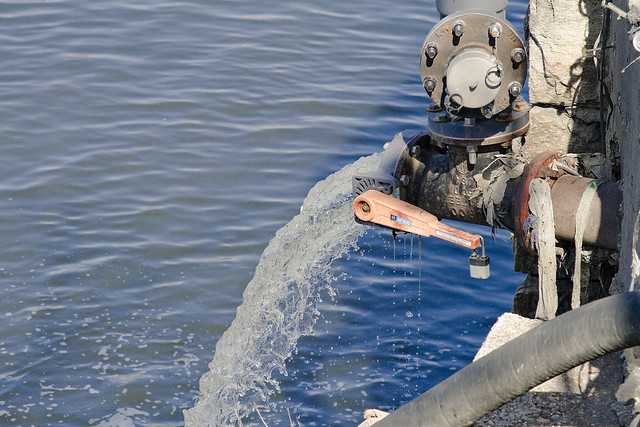
The internationalists and potentates whose congress calls itself the so called United Nations would have you observe “World Water Day” on this date. This cabal of diplomats, intriguers, and acolytes desire you to imagine and contemplate the assertion that at least a sixth of the living human infestation has no reliable access to pure water. From their headquarters in the Shining City of Manhattan- designed by the gallic crypto fascist LeCorbusier- their edict rings out, and we all must take heed of “Agenda 21”. Pictured in the shot above is the largest source of fresh water flowing into the Newtown Creek, some two to three miles from their base.
from wikipedia
World Water Day has been observed on 22 March since 1993 when the United Nations General Assembly declared 22 March as World Day for Water.
This day was first formally proposed in Agenda 21 of the 1992 United Nations Conference on Environment and Development (UNCED) in Rio de Janeiro, Brazil. Observance began in 1993 and has grown significantly ever since; for the general public to show support, it is encouraged for the public to not use their taps throughout the whole day, the day has become a popular Facebook trend.
The UN and its member nations devote this day to implementing UN recommendations and promoting concrete activities within their countries regarding the world’s water resources. Each year, one of various UN agencies involved in water issues takes the lead in promoting and coordinating international activities for World Water Day. Since its inception in 2003, UN-Water has been responsible for selecting the theme, messages and lead UN agency for the World Day for Water.

– photo by Mitch Waxman
Burgeoning, the human infestation continues to intensify upon the skin of the planet, threatening to overwhelm the fragile biosphere with a monoculture of killer apes. Sophistry and numerical manipulation make the case for Agenda 21 to play out, attempting to induce guilt and damned realization into the mainly western minds of the post industrial world, those who are well fed and watered. Your humble narrator plans on not flushing the toilet today, much to the chagrin of both “Our Lady of the Pentacle” and our little dog Zuzu. Additionally, none of us will eat or drink. A fast day will be observed for the suffering multitudes.
from unwater.org
There are 7 billion people to feed on the planet today and another 2 billion are expected to join by 2050. Statistics say that each of us drinks from 2 to 4 litres of water every day, however most of the water we ‘drink’ is embedded in the food we eat: producing 1 kilo of beef for example consumes 15,000 litres of water while 1 kilo of wheat ’drinks up’ 1,500 litres.
When a billion people in the world already live in chronic hunger and water resources are under pressure we cannot pretend the problem is ‘elsewhere’.

– photo by Mitch Waxman
The unfortunate truth, globally, is that much of the fresh water which the human infestation might consume is fouled by sewage. Whether it is agricultural lagoons of animal waste, municipal infrastructure or lack thereof, or outright industrial effluent- this is the true issue which Agenda 21 ignores. If you want to save the multitudes of the developing world- eliminate malaria and a host of other pathogens almost overnight- build sanitary sewers. Of course, we haven’t managed to swing this in New York City let alone sub Saharan Africa, so you might as well despair.
from nycgovparks.org
Social Hour: World Water Day, Thursday, March 22, 2012. 6:30 P.M.–8:00 P.M.
Celebrate World Water Day by learning more about the Croton Reservoir and Central Park’s historic role in supplying New York City with fresh drinking water. Co-presented with the NYC Department of Environmental Protection.
This event is recommended for adults (18 and over) only.
Provided at no cost to you! No advance registration. More details, including rain plans and directions, are on the Central Park Conservancy calendar.
shocking moan

– photo by Mitch Waxman
Amongst the shocking grotesques of Brooklyn’s DUKBO, or Down Under the Kosciuzscko Bridge Onramp, one such as myself finds confirmation of all those things I wish I didn’t know. Following my nose, as it were, an odiferous cloud drew me to this particular corner seeking to investigate whether some cauldron of ichor might have been overturned or to discover whatever it might be that could produce such a miasmic stink.

– photo by Mitch Waxman
A pile of industrial site runoff ran lugubriously toward the sewers, obeying gravity. The effluent carried with it some odd and somewhat fibrous substance. The smell intensified as I neared the fence line, and the runoff was clearly organic, shimmering beneath the thermonuclear eye of god itself with a greasy iridescence.

– photo by Mitch Waxman
Close inspection revealed the presence of avian feathers in the runoff, betraying the origin of the brownish gray liquid. This was clearly chicken feces, running in a rivulet toward the oil stained streets which adjoin and parallel the gargantuan thoroughfare known as the Brooklyn Queens Expressway that is carried by the pendulous Kosciuzscko Bridge.

– photo by Mitch Waxman
The variegated texture exhibited by the pavement is coincidental, and due to the habits of local concrete contractors who cleanse their machinery on the street, dumping what washes from their trucks wherever it may fall. There are large sections of this neighborhood whose sidewalks and streets exhibit the appearance of volcanic flow, where tons of waste concrete cured while seeking those self same drains which a feather laden stream of poultry feces was attempting to enter on this day.
Choked with cement, the sewers become the center of a fetid lagoon, but such sights are common in DUKBO.

– photo by Mitch Waxman
The operation which plies its trade at this corner is a poultry merchant, one which trucks the hapless birds to this warehouse. My understanding is that they are involved in the wholesale section of the business, supplying neighborhood Halal abattoirs, “Pollo Vivo” dealers, and certain Asiatic Restaurants which are scattered around Brooklyn and Queens with fresh stock. Unlike the native born’s habit of purchasing a familiar and largely inoffensive carcass- a plucked, butchered, and often steamed or bleached cadaver- on sale at chain supermarkets and “traditional” Yankee butcher shops- many newer immigrants in the area prefer to inspect their food animals while still alive.
Prosaic, the practice is regarded as barbaric by area wags who prefer to maintain some insulation from the bloody business of supplying industrial quantities of animal protein to an ever growing human infestation.

– photo by Mitch Waxman
Urban sophisticates tend to overlook these sort of details, forgetting that every “organic” or “factory farm” chicken may not have been a healthy bird before it was roughly extinguished. Recent immigration from the queer foreign courts of Asia and other more southernly latitudes has carried with it a certain skepticism about such matters. Inspection of eye, beak, and feet is paramount in certain circles- especially when it concerns the food laid out for children.
They have no trust in the USDA, it’s curious marks and unintelligible grading system for food quality- all of which were codified by bureaucrats.

– photo by Mitch Waxman
Of course, what stretch of the imagination could conjure for them the image of that prize bird stacked in crates ten deep just 3 blocks from the Newtown Creek, imprisoned in those exhaust clouds which bubble and froth invisibly down from the BQE? Could they understand that this is a neighborhood of scrap yards, garbage depots, oil tank farms, and former home to oil refineries, bone boilers, and chemical refineries? Can anyone imagine what these birds are breathing in?
A question often asked of your humble narrator these days concerns the status of those who might engage in subsistence fishing on the Newtown Creek, and the consequences of consuming such a catch.

– photo by Mitch Waxman
The question which is offered as an answer in itself is “do you have any idea how much of the food you buy as “organic” moves through the shadowed warehouses and poison atmospherics of the Newtown Creek?” and “what makes you think you’re any different than those fishermen”?
Seldom do I receive an answer, for when faced with considering such realities about their own food supply, even the clear eyed and prosaic will reveal themselves to be chicken shit.


 The Newtown Pentacle