Posts Tagged ‘ny harbor’
Working Harbor September Sunset tour 3
Today’s fun is a chunk of H.P. Lovecraft’s The Call of Cthulhu, with photos I shot at the Working Harbor Committee September 15th Sunset tour. For the whole story, at wikisource.org– click here.
All text, of course, is by Lovecraft-

– photo by Mitch Waxman
…I suppose that only a single mountain-top, the hideous monolith-crowned citadel whereon great Cthulhu was buried, actually emerged from the waters. When I think of the extent of all that may be brooding down there I almost wish to kill myself forthwith. Johansen and his men were awed by the cosmic majesty of this dripping Babylon of elder daemons, and must have guessed without guidance that it was nothing of this or of any sane planet. Awe at the unbelievable size of the greenish stone blocks, at the dizzying height of the great carven monolith, and at the stupefying identity of the colossal statues and bas-reliefs with the queer image found in the shrine on the Alert, is poignantly visible in every line of the mate’s frightened description.

– photo by Mitch Waxman
Without knowing what futurism is like, Johansen achieved something very close to it when he spoke of the city; for instead of describing any definite structure or building, he dwells only on broad impressions of vast angles and stone surfaces—surfaces too great to belong to anything right or proper for this earth, and impious with horrible images and hieroglyphs. I mention his talk about angles because it suggests something Wilcox had told me of his awful dreams. He said that the geometry of the dream-place he saw was abnormal, non-Euclidean, and loathsomely redolent of spheres and dimensions apart from ours. Now an unlettered seaman felt the same thing whilst gazing at the terrible reality.

– photo by Mitch Waxman
Johansen and his men landed at a sloping mud-bank on this monstrous Acropolis, and clambered slipperily up over titan oozy blocks which could have been no mortal staircase. The very sun of heaven seemed distorted when viewed through the polarising miasma welling out from this sea-soaked perversion, and twisted menace and suspense lurked leeringly in those crazily elusive angles of carven rock where a second glance showed concavity after the first showed convexity.

– photo by Mitch Waxman
Something very like fright had come over all the explorers before anything more definite than rock and ooze and weed was seen. Each would have fled had he not feared the scorn of the others, and it was only half-heartedly that they searched—vainly, as it proved—for some portable souvenir to bear away.
It was Rodriguez the Portuguese who climbed up the foot of the monolith and shouted of what he had found. The rest followed him, and looked curiously at the immense carved door with the now familiar squid-dragon bas-relief. It was, Johansen said, like a great barn-door; and they all felt that it was a door because of the ornate lintel, threshold, and jambs around it, though they could not decide whether it lay flat like a trap-door or slantwise like an outside cellar-door. As Wilcox would have said, the geometry of the place was all wrong. One could not be sure that the sea and the ground were horizontal, hence the relative position of everything else seemed phantasmally variable.

– photo by Mitch Waxman
Briden pushed at the stone in several places without result. Then Donovan felt over it delicately around the edge, pressing each point separately as he went. He climbed interminably along the grotesque stone moulding—that is, one would call it climbing if the thing was not after all horizontal—and the men wondered how any door in the universe could be so vast. Then, very softly and slowly, the acre-great lintel began to give inward at the top; and they saw that it was balanced.
Donovan slid or somehow propelled himself down or along the jamb and rejoined his fellows, and everyone watched the queer recession of the monstrously carven portal. In this phantasy of prismatic distortion it moved anomalously in a diagonal way, so that all the rules of matter and perspective seemed upset.

– photo by Mitch Waxman
The aperture was black with a darkness almost material. That tenebrousness was indeed a positive quality; for it obscured such parts of the inner walls as ought to have been revealed, and actually burst forth like smoke from its aeon-long imprisonment, visibly darkening the sun as it slunk away into the shrunken and gibbous sky on flapping membraneous wings. The odour rising from the newly opened depths was intolerable, and at length the quick-eared Hawkins thought he heard a nasty, slopping sound down there. Everyone listened, and everyone was listening still when It lumbered slobberingly into sight and gropingly squeezed Its gelatinous green immensity through the black doorway into the tainted outside air of that poison city of madness.
Poor Johansen’s handwriting almost gave out when he wrote of this. Of the six men who never reached the ship, he thinks two perished of pure fright in that accursed instant. The Thing cannot be described—there is no language for such abysms of shrieking and immemorial lunacy, such eldritch contradictions of all matter, force, and cosmic order. A mountain walked or stumbled. God! What wonder that across the earth a great architect went mad, and poor Wilcox raved with fever in that telepathic instant? The Thing of the idols, the green, sticky spawn of the stars, had awaked to claim his own. The stars were right again, and what an age-old cult had failed to do by design, a band of innocent sailors had done by accident. After vigintillions of years great Cthulhu was loose again, and ravening for delight.
Flushing Creek 2

– photo by Mitch Waxman
A new friend, whose family could trace ancestry back to the colonial settlers of Flushing, was searching for the spot where her forebears had settled on the Flushing Creek (or river, depending on who you ask). Armed with serious historian muscle, and having hired an experienced mariner to shepherd the journey, She mentioned to a mutual colleague that there was room for one more on the ship, and proffered that He join her party. Busy with professional obligation, this colleague of ours suggested your humble narrator ride along, which is how I ended up leaving the strict borders of the Newtown Pentacle and found myself on Flushing Creek.
from wikipedia
The current site of the airport was originally used by the Gala Amusement Park, owned by the Steinway family. It was razed and transformed in 1929 into a 105-acre private flying field. The airport was originally named Glenn H. Curtiss Airport after the pioneer Long Island aviator, and later called North Beach Airport.
The initiative to develop the airport for commercial flights began with a verbal outburst by New York mayor Fiorello La Guardia (in office from 1934 to 1945) upon the arrival of his TWA flight at Newark — the only commercial airport serving the New York City region at the time — as his ticket said “New York”. He demanded to be taken to New York, and ordered the plane to be flown to Brooklyn’s Floyd Bennett Field, giving an impromptu press conference to reporters along the way. At that time, he urged New Yorkers to support a new airport within their city.

– photo by Mitch Waxman
Factual inconsistencies and wild conjectural fantasies aside, one of the stated goals of this project is documentarian in nature (in the notion that someone in the future will be looking for photos of “Queens in the Past”), and the vantages of the northern Queens shoreline are largely blockaded and hidden from land. I leapt at the opportunity. The security apparatus and extensive fencing of (starting at the east river) an electrical power plant, a sewage treatment plant, prison complex, and airport enforce a cordon (and appropriately so) of the shoreline from the landward side- at least.
note:
Your humble narrator takes a lot of heat from the Urban Explorer types for the “Do Not Trespass” mantra here at Newtown Pentacle. Its my firm belief that – like a vampire- you have to be invited in before you can really do your work. The nervous thrills experienced in penetrating an abandoned factory or condemned hospital or active rail trackbed are outweighed by both the physical and legal dangers to yourself, and exhibit a real lack of empathy toward the poor bastards at NYFD who will have to figure out a safe way to rescue you. I’ve described the attention paid me by radio patrol car police officers as I squat down on the Hunters Point Avenue Bridge trying to get a picture of pollen settling into sticky waters at the Dutch Kills, and been chased for blocks by a hysterical Greek woman screaming “terrorist” at me around Ditmars. I roll under a flag of “if you can see it in a public place, you can take a picture of it, as long as you don’t imply some editorial meaning to it that wasn’t there” and “ask”. I do take a lot of pictures I don’t run, though, and often slightly obscure locations if the subject is so wildly and criminally vulnerable that I had time to set up a tripod and shoot dozens of photos.
And… I never show anyone the images, of all the dead things.
from nytimes.com, an article from 1895
A number of Long Islanders have been quietly considering for some time the feasibility of cutting a ship canal from Newtown Creek to Flushing Bay, and have now reached the conclusion that the work should be done.

Best – photo by Mitch Waxman
The aura of Flushing Creek, as viewed from the water, might best be described as “Dickensian”. The modern steel highways, sweeping in elegant curves over the storied waters, produce tenebrous shadows pregnant with sinister implication. What horrors may have transpired here, under sodium light, fills your humble narrator with wonder. Heavy industry, like this concrete company, seems to dominate this part of Flushing Creek. It all feels somewhat atavist, yet, these are the sort of “mills” that built New York City.
from osc.state.ny.us
Flushing, named for the Dutch village of Vlissingen, was the first permanent settlement in Queens, and was founded in 1645. In 1657, the town fathers issued the “Flushing Remonstrance,” which defied Governor Peter Stuyvesant’s demand that the town expel Quakers, Jews, and other religious groups. Flushing was the first town in the Western hemisphere to guarantee religious freedom for its residents.
The Flushing Railroad, which later became part of the Long Island Rail Road, opened in 1854, as urbanizing influences gradually penetrated the more rural portions of Queens. Urbanization accelerated in the early 20th century, when the Queensborough Bridge opened in 1909 and the subway system was extended to Flushing in 1928. In the 1930s, a former ash dump on the west side of the Flushing River became the site of the 1939 World’s Fair and, later, the third-largest park in New York City—Flushing Meadows Corona Park.
The park hosted the 1964 World’s Fair.

– photo by Mitch Waxman
Built by Robert Moses to house the 1939 Worlds Fair, Flushing Meadows Corona Park cuts the Flushing Creek from its original flow. From 1946 to 1951, the United Nations General Assembly was held at the New York City Pavilion, said Pavilion is now the Queens Museum of Art. Said Museum houses the Panorama of the City of New York, and the United Nations meet in a house that Rockefeller and Le Corbusier built over in Manhattan.
Here’s the scoop of Nelson Rockefeller and LeCorbusier from a Newtown Pentacle posting of June 23, Adventures upon the East River 3
LeCorbusier is responsible- ideologically and in some cases literally- for the ring of poverty surrounding Paris, the council housing of London, the housing complexes of Chicago, and of course- New York’s rather disastrous experience with “the projects”. He was the Ayn Rand of architecture.
here’s what he wanted to do in Paris, from wikipedia:
Theoretical urban schemes continued to occupy Le Corbusier. He exhibited his Plan Voisin, sponsored by another famous automobile manufacturer, in 1925. In it, he proposed to bulldoze most of central Paris, north of the Seine, and replace it with his sixty-story cruciform towers from the Contemporary City, placed in an orthogonal street grid and park-like green space. His scheme was met with only criticism and scorn from French politicians and industrialists, although they were favourable to the ideas of Taylorism and Fordism underlying Le Corbusier designs. Nonetheless, it did provoke discussion concerning how to deal with the cramped, dirty conditions that enveloped much of the city.
here’s what his politics were, also from wikipedia:
Le Corbusier moved increasingly to the far right of French politics in the 1930s. He associated with Georges Valois and Hubert Lagardelle and briefly edited the syndicalist journal Prélude. In 1934, he lectured on architecture in Rome by invitation of Benito Mussolini. He sought out a position in urban planning in the Vichy regime and received an appointment on a committee studying urbanism. He drew up plans for the redesign of Algiers in which he criticised the perceived differences in living standards between Europeans and Africans in the city, describing a situation in which “the ‘civilised’ live like rats in holes” yet “the ‘barbarians’ live in solitude, in well-being.”[10] These and plans for the redesign of other cities were ultimately ignored. After this defeat, Le Corbusier largely eschewed politics.
Until he designed the United Nations Secretariat, a 39 story building and complex located in Turtle bay, Manhattan. This part of Manhattan is not part of the sovereign territory of the United States, incidentally, its legally international territory and not subject to the laws of New York City or the USA unless the U.N. says so. Here’s the proviso:
United Nations, Pub. L. No. 80-357, 61 Stat. 756 (1947): “Except as otherwise provided in this agreement or in the General Convention, the federal, state and local courts of the United States shall have jurisdiction over acts done and transactions taking place in the headquarters district as provided in applicable federal, state and local laws.”
Interesting note:
The land that the complex sits on was purchased from William Zeckendorf (a mid 20th century real estate baron) in a deal brokered by the Chase Manhattan Bank. Chase, of course, was the instrument of future New York Governor and United States Vice President Nelson Rockefeller. Grandson of John D. Rockefeller, and inheritor (with his brothers) of the Standard Oil fortune. The Rockefellers had already offered some of their own land-the house that Standard Oil built- and Rockefeller family castle,in Westchester, for use as the potential seat of a world government- but it was “too far away” for the diplomats. So, he had his father- John D. Rockefeller Jr. buy Turtle Bay and donate the land to the city for the UN.
The area called Turtle Bay was where the Draft Riots of 1863 started, and it was a neighborhood of tenements, butchers, slaughterhouses, and dangerous organized crime controlled docks which handled the traffic coming to and from Long Island City via rail and barge. The United Nations building was completed in 1950.
1950 is also when the decline of the economic infrastructure of North Brooklyn and Western Queens, especially the area around the Newtown Creek in Queens and Red Hook in Brooklyn, began in earnest. Connected? Maybe.
from time.com
“What do you want to go to Flushing Meadow for, honey?” a Manhattan taxi driver asked a TIME researcher last week. “I’m going to the United Nations,” she said. “Well,” he said with a wink, “that used to be quite a lovers’ lane in my day.”
Flushing River 1

– photo by Mitch Waxman
Just outside of the Newtown Pentacle’s north-eastern extant at LaGuardia Airport, beyond the feral Brother Islands and the caustic shores of Rikers Island, is found Flushing Bay.
Following the waters as they flow beneath the Whitestone Expressway, one will realize they are upon the Flushing River (or creek, depending on your source, but it’s actually a salt marsh). Like the nearby Newtown Creek, Flushing Creek is a heavily industrialized waterway with a long history of epic pollution and municipal abuse.
from wikipedia
The town of Flushing was first settled in 1645 under charter of the Dutch West India Company and was named after the port of Vlissingen, in the southwestern Netherlands. It is said that the name Vlissingen means “salt meadow,” given as a nod to the tidal waters of Flushing Meadows. As the English version of the name of the Dutch town is “Flushing”, the same English version was used by the town’s English-speaking inhabitants. During his presidency, George Washington arrived to Flushing by ferry across. The first road crossing, a drawbridge at Northern Boulevard, was built in the early 19th century.

– photo by Mitch Waxman
A vast morass of clinging mud and knife edged grass, Salt Marshes are nevertheless exemplars of biological activity. The stinking mud, bubbling with sulfur and methane, digests organic filth surrendered to it by ocean wave, and provides purchase for tenacious carpets of grasses. This tough vegetable armoring of the shoreline allows more accretion of mud, and in this lilliput of the waves, hordes of multitudinous and loathsomely tentacled carnivores hunt those which are squirming and soft bodied, which form colonies or don shells in self defense. Above the fray, the lords of life and death in this environment truly are the vertebrates, especially those which fly.
from wikipedia
By the 1850s, a second crossing, Strong’s Causeway was built near the present-day Long Island Expressway, extending Corona Avenue towards Flushing. This crossing was located near the confluence of Horse Brook and Flushing Creek. In the mid-19th Century, the growing city of Brooklyn acquired the land around the creek and gave it for use to the Brooklyn Ash Removal Company, which turned the salt marshes into landfill. The pollution was chronicled by F. Scott Fitzgerald in The Great Gatsby, where Nick Carraway observed the “valley of ashes” on his train ride between Manhattan and Long Island.

– photo by Mitch Waxman
Quiet tides and low rates of erosion allow mile after mile of boggy wetland to feed off the nutrient rich salt water, which becomes increasingly brackish as it mixes with fresh water flowing off and through the upland. In the case of the modern Flushing Creek, that fresh water is a combination of industrial runoff and cso’s (combined sewer outfall), along with whatever rain water manages to drip off the highways bridging it.
from wikipedia
In 1936, Robert Moses proposed closing the ash landfill and transforming it into a park through its use as a World’s Fair site. With the exception of the Willets Point triangle, the landfill was leveled, the creek bed was straightened, and the southern part of the creek was deepened to form the Meadow and Willow lakes. At its northern section, a tidal gate bridge was built to keep the East River tide from flooding into the park. By then, Horse Brook was long gone, covered by the future Long Island Expressway. Ireland Creek was also filled in for use as parkland to prevent flooding in the surrounding neighborhoods. Dammed and reduced in size, the creek became navigable only up to Roosevelt Avenue. Barges still docked on the river, bringing sand and gravel. At its southern end, the Jamaica subway yard reduced some of the flow coming from the headwaters.

– photo by Mitch Waxman
Of course, such modern interpretations of what was- until “just yesterday”- considered wasteland, would have been rejected by our progress minded antecedents. An elegant cocktail of petroleum distillates, industrial waste, and municipal sewage were freely combined and dumped directly into the water here for centuries.
When the highway pilings were driven, the fate of Flushing Creek was sealed for half a century, and the community that had symptomatically formed around and because of the waterway lost access to it.
Forgotten-NY, which of course has been everywhere, did a great and in-depth piece on the Flushing Creek (or River, depending)– check it out here.
from wikipedia
Citi Field is a stadium located in Flushing Meadows–Corona Park in the New York City borough of Queens. Completed in 2009, it is the home baseball park of Major League Baseball’s New York Mets. Citi Field was built as a replacement for the adjacent Shea Stadium, which was constructed in 1964 next to the site of the 1964-1965 World’s Fair. Citi Field was designed by Populous (formerly HOK Sport), and is named after Citigroup, a financial services company based in New York that purchased the naming rights. The $850 million baseball park is being funded by the sale of New York City municipal bonds which are to be repaid by the Mets plus interest. The payments will offset property taxes for the lifetime of the park.
Working Harbor September Sunset tour 2
Today’s post- a little post Halloween fun- a chunk of H.P. Lovecraft’s Shadow over Innsmouth, with photos I shot at the Working Harbor Committee September 15th Sunset tour. For the whole story, at wikisource.org– click here. For a slideshow of the entire photo set, (which includes a couple of other cool things) click here.
All text, of course, is by H.P. Lovecraft.

– photo by Mitch Waxman
During the winter of 1927-28 officials of the Federal government made a strange and secret investigation of certain conditions in the ancient Massachusetts seaport of Innsmouth. The public first learned of it in February, when a vast series of raids and arrests occurred, followed by the deliberate burning and dynamiting – under suitable precautions – of an enormous number of crumbling, worm-eaten, and supposedly empty houses along the abandoned waterfront. Uninquiring souls let this occurrence pass as one of the major clashes in a spasmodic war on liquor.

– photo by Mitch Waxman
Keener news-followers, however, wondered at the prodigious number of arrests, the abnormally large force of men used in making them, and the secrecy surrounding the disposal of the prisoners. No trials, or even definite charges were reported; nor were any of the captives seen thereafter in the regular gaols of the nation. There were vague statements about disease and concentration camps, and later about dispersal in various naval and military prisons, but nothing positive ever developed. Innsmouth itself was left almost depopulated, and it is even now only beginning to show signs of a sluggishly revived existence.

– photo by Mitch Waxman
Complaints from many liberal organizations were met with long confidential discussions, and representatives were taken on trips to certain camps and prisons. As a result, these societies became surprisingly passive and reticent. Newspaper men were harder to manage, but seemed largely to cooperate with the government in the end. Only one paper – a tabloid always discounted because of its wild policy – mentioned the deep diving submarine that discharged torpedoes downward in the marine abyss just beyond Devil Reef. That item, gathered by chance in a haunt of sailors, seemed indeed rather far-fetched; since the low, black reef lay a full mile and a half out from Innsmouth Harbour.

– photo by Mitch Waxman
People around the country and in the nearby towns muttered a great deal among themselves, but said very little to the outer world. They had talked about dying and half-deserted Innsmouth for nearly a century, and nothing new could be wilder or more hideous than what they had whispered and hinted at years before. Many things had taught them secretiveness, and there was no need to exert pressure on them. Besides, they really knew little; for wide salt marshes, desolate and unpeopled, kept neighbors off from Innsmouth on the landward side.

– photo by Mitch Waxman
But at last I am going to defy the ban on speech about this thing. Results, I am certain, are so thorough that no public harm save a shock of repulsion could ever accrue from a hinting of what was found by those horrified men at Innsmouth. Besides, what was found might possibly have more than one explanation. I do not know just how much of the whole tale has been told even to me, and I have many reasons for not wishing to probe deeper. For my contact with this affair has been closer than that of any other layman, and I have carried away impressions which are yet to drive me to drastic measures.

– photo by Mitch Waxman
It was I who fled frantically out of Innsmouth in the early morning hours of July 16, 1927, and whose frightened appeals for government inquiry and action brought on the whole reported episode. I was willing enough to stay mute while the affair was fresh and uncertain; but now that it is an old story, with public interest and curiosity gone, I have an odd craving to whisper about those few frightful hours in that ill-rumored and evilly-shadowed seaport of death and blasphemous abnormality. The mere telling helps me to restore confidence in my own faculties; to reassure myself that I was not the first to succumb to a contagious nightmare hallucination. It helps me, too, in making up my mind regarding a certain terrible step which lies ahead of me.
Working Harbor September Sunset tour 1
Today’s Halloween week fun is a large chunk of H.P. Lovecraft’s Horror at Red Hook, with photos I shot at the Working Harbor Committee September 15th Sunset tour. For the whole story, at Dagonbytes.com– click here.
All text, of course is by Lovecraft, hyperlinks inserted by Newtown Pentacle.

– photo by Mitch Waxman
Not many weeks ago, on a street corner in the village of Pascoag, Rhode Island, a tall, heavily built, and wholesome-looking pedestrian furnished much speculation by a singular lapse of behaviour. He had, it appears, been descending the hill by the road from Chepachet; and encountering the compact section, had turned to his left into the main thoroughfare where several modest business blocks convey a touch of the urban. At this point, without visible provocation, he committed his astonishing lapse; staring queerly for a second at the tallest of the buildings before him, and then, with a series of terrified, hysterical shrieks, breaking into a frantic run which ended in a stumble and fall at the next crossing. Picked up and dusted off by ready hands, he was found to be conscious, organically unhurt, and evidently cured of his sudden nervous attack. He muttered some shamefaced explanations involving a strain he had undergone, and with downcast glance turned back up the Chepachet road, trudging out of sight without once looking behind him. It was a strange incident to befall so large, robust, normal-featured, and capable-looking a man, and the strangeness was not lessened by the remarks of a bystander who had recognised him as the boarder of a well-known dairyman on the outskirts of Chepachet.

– photo by Mitch Waxman
He was, it developed, a New York police detective named Thomas F. Malone, now on a long leave of absence under medical treatment after some disproportionately arduous work on a gruesome local case which accident had made dramatic. There had been a collapse of several old brick buildings during a raid in which he had shared, and something about the wholesale loss of life, both of prisoners and of his companions, had peculiarly appalled him. As a result, he had acquired an acute and anomalous horror of any buildings even remotely suggesting the ones which had fallen in, so that in the end mental specialists forbade him the sight of such things for an indefinite period. A police surgeon with relatives in Chepachet had put forward that quaint hamlet of wooden colonial houses as an ideal spot for the psychological convalescence; and thither the sufferer had gone, promising never to venture among the brick-lined streets of larger villages till duly advised by the Woonsocket specialist with whom he was put in touch. This walk to Pascoag for magazines had been a mistake, and the patient had paid in fright, bruises, and humiliation for his disobedience.

– photo by Mitch Waxman
So much the gossips of Chepachet and Pascoag knew; and so much, also, the most learned specialists believed. But Malone had at first told the specialists much more, ceasing only when he saw that utter incredulity was his portion. Thereafter he held his peace, protesting not at all when it was generally agreed that the collapse of certain squalid brick houses in the Red Hook section of Brooklyn, and the consequent death of many brave officers, had unseated his nervous equilibrium. He had worked too hard, all said, it trying to clean up those nests of disorder and violence; certain features were shocking enough, in all conscience, and the unexpected tragedy was the last straw. This was a simple explanation which everyone could understand, and because Malone was not a simple person he perceived that he had better let it suffice. To hint to unimaginative people of a horror beyond all human conception – a horror of houses and blocks and cities leprous and cancerous with evil dragged from elder worlds – would be merely to invite a padded cell instead of a restful rustication, and Malone was a man of sense despite his mysticism. He had the Celt’s far vision of weird and hidden things, but the logician’s quick eye for the outwardly unconvincing; an amalgam which had led him far afield in the forty-two years of his life, and set him in strange places for a Dublin University man born in a Georgian villa near Phoenix Park.

– photo by Mitch Waxman
And now, as he reviewed the things he had seen and felt and apprehended, Malone was content to keep unshared the secret of what could reduce a dauntless fighter to a quivering neurotic; what could make old brick slums and seas of dark, subtle faces a thing of nightmare and eldritch portent. It would not be the first time his sensations had been forced to bide uninterpreted – for was not his very act of plunging into the polyglot abyss of New York’s underworld a freak beyond sensible explanation? What could he tell the prosaic of the antique witcheries and grotesque marvels discernible to sensitive eyes amidst the poison cauldron where all the varied dregs of unwholesome ages mix their venom and perpetuate their obscene terrors? He had seen the hellish green flame of secret wonder in this blatant, evasive welter of outward greed and inward blasphemy, and had smiled gently when all the New-Yorkers he knew scoffed at his experiment in police work. They had been very witty and cynical, deriding his fantastic pursuit of unknowable mysteries and assuring him that in these days New York held nothing but cheapness and vulgarity. One of them had wagered him a heavy sum that he could not – despite many poignant things to his credit in the Dublin Review – even write a truly interesting story of New York low life; and now, looking back, he perceived that cosmic irony had justified the prophet’s words while secretly confuting their flippant meaning. The horror, as glimpsed at last, could not make a story – for like the book cited by Poe’s Germany authority, ‘es lässt sich nicht lesen – it does not permit itself to be read.’
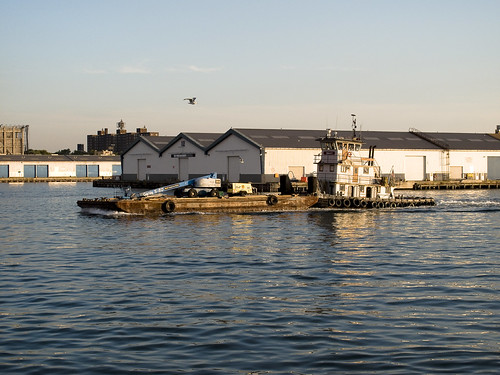
– photo by Mitch Waxman
To Malone the sense of latent mystery in existence was always present. In youth he had felt the hidden beauty and ecstasy of things, and had been a poet; but poverty and sorrow and exile had turned his gaze in darker directions, and he had thrilled at the imputations of evil in the world around. Daily life had fur him come to be a phantasmagoria of macabre shadow-studies; now glittering and leering with concealed rottenness as in Beardsley’s best manner, now hinting terrors behind the commonest shapes and objects as in the subtler and less obvious work of Gustave Doré. He would often regard it as merciful that most persons of high Intelligence jeer at the inmost mysteries; for, he argued, if superior minds were ever placed in fullest contact with the secrets preserved by ancient and lowly cults, the resultant abnormalities would soon not only wreck the world, but threaten the very integrity of the universe. All this reflection was no doubt morbid, but keen logic and a deep sense of humour ably offset it. Malone was satisfied to let his notions remain as half-spied and forbidden visions to be lightly played with; and hysteria came only when duty flung him into a hell of revelation too sudden and insidious to escape.

– photo by Mitch Waxman
He had for some time been detailed to the Butler Street station in Brooklyn when the Red Hook matter came to his notice. Red Hook is a maze of hybrid squalor near the ancient waterfront opposite Governor’s Island, with dirty highways climbing the hill from the wharves to that higher ground where the decayed lengths of Clinton and Court Streets lead off toward the Borough Hall. Its houses are mostly of brick, dating from the first quarter to the middle of the nineteenth century, and some of the obscurer alleys and byways have that alluring antique flavour which conventional reading leads us to call ‘Dickensian’. The population is a hopeless tangle and enigma; Syrian, Spanish, Italian, and Negro elements impinging upon one another, and fragments of Scandinavian and American belts lying not far distant. It is a babel of sound and filth, and sends out strange cries to answer the lapping oily waves at its grimy piers and the monstrous organ litanies of the harbour whistles. Here long ago a brighter picture dwelt, with clear-eyed mariners on the lower streets and homes of taste and substance where the larger houses line the hill. One can trace the relics of this former happiness in the trim shapes of the buildings, the occasional graceful churches, and the evidences of original art and background in bits of detail here and there – a worn flight of steps, a battered doorway, a wormy pair of decorative columns or pilasters, or a fragment of once green space with bent and rusted iron railing. The houses are generally in solid blocks, and now and then a many-windowed cupola arises to tell of days when the households of captains and ship-owners watched the sea.


 The Newtown Pentacle