Posts Tagged ‘weirdness’
Tales of Calvary 9- A Pale Enthusiast

– photo by Mitch Waxman
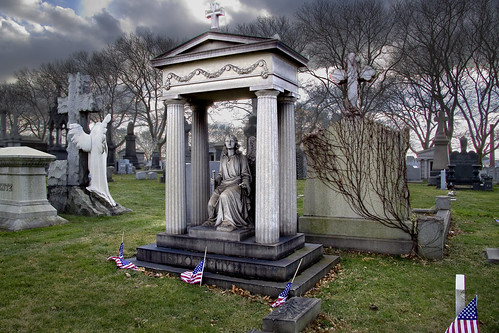
Amateurish and lazy explorations of Calvary Cemetery and the Greater Newtown Pentacle, with associated blog postings foisted upon an unsuspecting public and amplified by a never ending barrage of self promoting debasements of all that is true, have revealed many strange things to your humble narrator, and by extension- to you my gentle lords and ladies of Newtown. Today, the Doherty monument in First Calvary gets its turn. There is nothing “odd” about the monument, in fact the reason I call attention to the thing is the supernal beauty of its working. This is one uncanny bit of carving, and unfortunately these photos do not do it justice (still adjusting to the new camera).
Art school faculty, turtlenecked and smoking french cigarettes, would probably describe it as “Sophia, goddess of wisdom- in the form of a christian angel, sitting within a Roman structure, crowned by a cross- representing an agglutination of civilized democratic-christian progress advancing since the time of the Greeks and the Roman Republic and ultimately manifested as The United States. The angel casts her eye skyward, vigilant, with a sword in her hand. A pacific and expectant expression suggests the nearness of the second coming and resurrection of the dead.”
Such imperious and hyperbolic thinking was very much in vogue in the years between 1900 and the first World War.

– photo by Mitch Waxman
Eugene Doherty and his wife Mary J. Doherty are buried here. Their headstones have bas reliefs of palm fronds draped across them. The little flags are planted at the graves of military veterans in New York Cemeteries on national holidays to honor their service. I found no evidence of Doherty serving in the military, but that probably just means I didn’t know where to look.
After all- I’m just some ‘effed up lunatic who spends his spare time scuttling around trash dumps, toxic waste sites, and cemeteries who gets his kicks bad mouthing the past- Right?
– photo by Mitch Waxman
Mr. Doherty, it seems, was a man of some reknown. He was a leading member of the Irish community on both sides of the Newtown Creek, and stood shoulder to shoulder in prestige alongside Battle-Ax Gleason in the eyes of his countrymen.
A manufacturer of rubber, Doherty specialized in the sort of material demanded by “turn of the 20th century” Dentists for the manufacture of dentures. His heavily advertised (see sample at bottom) Samson Rubber was a standard component for the manufacture of false teeth. The factory, incorporated as Eugene Doherty Rubber Works, Inc., was located at 110 and 112 Kent Avenue which is in Greenpoint (or Williamsburg, depending on whether or not you’re trying to hard sell a building).
rubber, from wikipedia
The major commercial source of natural rubber latex is the Para rubber tree (Hevea brasiliensis), a member of the spurge family, Euphorbiaceae. This is largely because it responds to wounding by producing more latex.
Other plants containing latex include Gutta-Percha (Palaquium gutta),[1] rubber fig (Ficus elastica), Panama rubber tree (Castilla elastica), spurges (Euphorbia spp.), lettuce, common dandelion (Taraxacum officinale), Russian dandelion (Taraxacum kok-saghyz), Scorzonera (tau-saghyz), and Guayule (Parthenium argentatum). Although these have not been major sources of rubber, Germany attempted to use some of these during World War II when it was cut off from rubber supplies. These attempts were later supplanted by the development of synthetic rubbers. To distinguish the tree-obtained version of natural rubber from the synthetic version, the term gum rubber is sometimes used.
A neat image of the the Doherty Rubber Works building late in its heyday (1920) can be found at trainweb.org, if you can believe anything I say, and they have a great description of the whole scene in context here. I warn you though, you’re going to learn about the Brooklyn Eastern District Terminal!
Also, in a completely unrelated coincidence, NAG is located at 110 Kent in modernity. Here’s the place on a google map, click “streetview” to compare to the 1920 shot above

– photo by Mitch Waxman
Eugene Doherty died in 1906, his wife Mary in 1914. Luckily for Mary, the denture business was a lucrative one, and her years of mourning were spent in material comfort. At her death, she bequeathed the staggering sum of $621,148 to her heirs.
$621,148 in 1914, mind you, and federal income tax had just become a reality in 1913. That’s at least $10,000,000 in modern coine.

– photo by Mitch Waxman
Life sized, if you’re a 5 foot tall woman, the statue itself is disarming and has weathered existence in the corrosive atmospheric miasmas extant about the nearby Newtown Creek for 94 years, only losing a thumb. The colour, oddly, doesn’t stain sanctified Calvary. Xanthian skill representative of true artistry went into the shaping of this stone, but I haven’t been able to find the name of the sculptor in public record.
If you see it, stand close and look into its eyes, then leave when the chills begin. Whatever you do, don’t look back over your shoulder at it afterwards, lest an adjusted hand hold on the sword, or the impression that the angle of its head has shifted might be seen. Remain an observer- in Calvary- ever the pale enthusiast- ever an Outsider.
Hey, you never know what you’re going to find at Calvary Cemetery.
Also, just as a note- today, January 13th, is Clark Ashton Smith’s birthday, and St. Knut’s Day as well.
Eugene Doherty Rubber Inc. - Late 19th/Early 20th century Advertising
Tales of Calvary 7

– photo by Mitch Waxman
I just can’t sit on this one anymore. After a spree of “all cemetery” postings in November and December, I decided to take a step back from the grave, but I just can’t stop myself…
Promises would be offered to you, lords and ladies of Newtown, not to spend too much time amongst the dead in these first days of the new year, but I’d probably break them.
Paper fades, buildings fall, but Calvary is eternal and undying. Dripping in its centuried silence and nitre choked glory, the emerald desolations of Calvary Cemetery offer a pastoral transit between tumultuous neighborhoods in the Newtown Pentacle, and that weird old man in the filthy black raincoat you might glimpse as you drive by is often your humble narrator.

– photo by Mitch Waxman
On this particular day, a sunny Saturday (Thanksgiving weekend in 2009), I wasn’t transiting Calvary.
I had come here with a definite purpose, searching for the grave of a man who died in the early 30’s rumored to have been involved with the illegal smuggling of strange statuettes into the United States in the 1920’s from some impossibly remote pacific island. This man, a Massachusetts merchant named Gilman, was killed in a freak nocturnal accident, apparently by a bale of paper which had fallen out of some warehouse window along the Newtown Creek. His oddly deformed body was found by workmen the next morning, and the Coroner pronounced the death accidental. The victim was buried in Calvary’s public section as an act of charity, and under the assumption that Gilman was an Irish name. His belongings and personal valuables, made from some queer kind of gold sculpted into wild and heretical forms, were collected by a schooner captain whose three masted ship appeared unbidden at the Penny Bridge docks one night during an unnaturally thick fog. The Captain, a Massachusetts trader named Marsh, paid for a custom and eccentric grave marker to be erected for this Gilman fellow somewhere in Calvary. It remains elusive, but I shall find it- I found Al Smith!
As is often the case, my befuddled and inept investigations were swept wildly off course by a highly suggestible and credulous nature which makes me vulnerable to wild flights of shivering cowardice and shameful paranoia. Such timidity does not suit one who stands and stares into whatever abyss happens to be before him, and what I saw chilled me with its wild possibilities. It was Thanksgiving weekend, and Calvary was as quiet as… well… a tomb.

– photo by Mitch Waxman
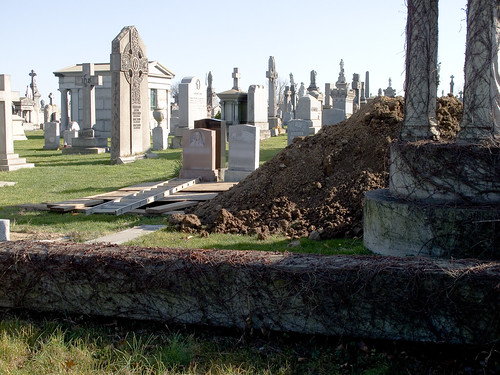
As seen in the above shots, the overgrown monument with its vine covered cupola intrigued and drew my attention. In accordance with usual methods, the object was photographed from many angles, and my path led me widdershins around it. As mentioned in the last paragraph, thanksgiving weekend had evinced a general evacuation of the area surrounding that bulkheaded duct of urban horror called the Newtown Creek, and like their counterparts in the spires of Manhattan it would seem that the workers of Calvary got off early on the previous Wednesday. Just dropped their shovels, as it were.
That’s when I saw it, said “oh. oh… no… just keep walking… don’t take any pictures of…”. Unfortunately, my finger was already depressing the button on my camera. I had lost all control, and still can’t stop myself from posting about it weeks later… I’m all ‘effed up.
– photo by Mitch Waxman
In the interest of full disclosure, the names on the two grave markers are obscured as they were modern burials. If a grave is at least older than me, I feel fine about publishing a photo or talking about who it holds. If it’s an early 1900’s burial- fair game. (note: a cool thing happened recently- a sepulchral portrait, randomly chosen and published in the Mt. Zion series of postings, resulted in a certain Pentacle reader seeing his grandmother’s face for the first time) These interments, however, date from the early 1990’s and later. The context of this post demands some discretion, and censoring the names of the deceased whose graves are seen is definitely the right thing to do.
Now on to something you don’t normally see… and I am cognizant that the presentation of the following is vulgar and in very bad taste. I just can’t stop myself… Its like some alien thing is controlling me…

– photo by Mitch Waxman
There is a limited amount of time that one can tolerate solitary exposure to Calvary Cemetery, as the marble crown of Laurel Hill is a sort of psychic Chernobyl. It preys upon you- this place- in subtle ways, and comes at you in a manner not unlike the gradual stupefaction brought on by liquor. On New Year’s Eve, someone offered me three plots here for free, and withdrew the offer when I explained what a gravesite in Old Calvary is actually worth. Coincidence? hmmm… The place has noticed me, and it is trying to draw me further in…
Like ionizing radiation, whose damage to healthy living flesh is calculated by a multiplex of intensity and duration, whatever it is that lurks in the aether of Calvary is invisible, insidious, and real. Looking into an open grave like this, in this place, carries the comparable psychic risks of unshielded exposure to the thermonuclear eye of god itself.

– photo by Mitch Waxman
What I can’t do, is use my favorite catch phrase. The “who can guess…” one. Horrors too horrible for the graves holding lurk into the abyss, and loathsomeness waits below, but…
That’s what I was thinking as I passed out, again, in a dead faint. Luckily I fell backwards.
Like a great hand

– photo by Mitch Waxman
Came across this dire tableau the other night (December 16th to be exact) here in the oft perplexing grid of Astoria’s streets. At the corner of 44th and Broadway, it seemed that some great hand had reached down and jerked a car skyward, violently.
from wikipedia
Astoria is a neighborhood in the northwestern corner of the borough of Queens in New York City. Located in Community Board 1, Astoria is bounded by the East River and is adjacent to three other Queens neighborhoods: Long Island City, Sunnyside (bordering at Northern Boulevard), and Woodside (bordering at 50th Street). Astoria Heights, more commonly referred to as “Upper Ditmars,” borders Astoria on the northeast, at Hazen Street.

– photo by Mitch Waxman
The eternal entrepreneur who owns the bodega establishment on the corner informs me- as his fruitstand and delicatessen has a full video surveillance coverage of the corner- that a “black car” or “car service” driver was parked in the spot when a delivery truck rounded the corner at many times the speed limit.
Remember, Remember- the 21st of December

Pour me a drink and I’ll tell you some lies – photo by Mitch Waxman
An axial tilt of loathsome memories, shifting identities, and unrealized vengeance torments your humble narrator and makes him thankful that December 21st is, indeed, the shortest day of the year. The long nocturne of the Solstice, however, is no cause for celebration here in the Newtown Pentacle.
Solstice indicates that the Famine Months of January and February are upon us. The ancient Hellenes would enact the barbarous Lenaia bacchanal on solstice, and the Maenads would feast upon human flesh. It was also the central night of a week long Babylonian festival called Zagmuk, a celebration of divine Marduk’s victory over the darkness called the Anunnaki and their champion- the chaos dragon Tiamat. In modernity, in the nation of Mali, the Amma Cult of the atavist Dogon will sing and offer boiled millet at the conical altar of their high god.
from dailyworldbuzz.com
Today is the Celebration of Winter Solstice Traditions – Monday, December 21, 2009 marks the Winter Solstice traditions, and this is the announcement of the official start of the winter in the Northern Hemisphere. Winter Solstice is also known as Yule.
More precisely, winter solstice will take place at 12:47 pm EST (1747 GMT) on Dec. 21. It is a date that will also mark the shortest day and longest night.
Winter solstice falls every year around Dec. 21. It is because of the earth’s axial tilt, which is farthest away from the sun at its maximum of 23° 26′. At this time of the year, the sun is closer to the horizon, thus giving out least amount of daylight therefore shortening the day and lengthening the night.
But there is a bright side to it. Starting Tuesday, the days will start getting longer, leading to summer solstice, which in 2010 will fall on June 21. At that time, the day will be the longest with the daytime lasting for about 15 hours compared to 9 hours on Monday.

Long Island City is ready for an undead invasion, so are parts of Greenpoint – photo by Mitch Waxman
Tonight- Cernunnos- the Horned God of the Wiccans, who the Arabs call Dhu’l Qarnayn, will be reborn after being ritually slain on October 31st.
December 21st is a special day in history, signs and portents abound.
Disraeli and Stalin were born in 1879 and 1804 respectively, Pierre and Marie Curie identified radium in 1898, Elvis had his famous meeting with Nixon in 1970, Ireland finally won its independence from a large and aggressive neighbor in 1948 and Snow White and the Seven Dwarves premiered in 1937. Oh… and then there was Apollo 8.
from wikipedia
Apollo 8 was the first human spaceflight mission to achieve a velocity sufficient to allow escape from the gravitational field of planet Earth; the first to be captured by and escape from the gravitational field of another celestial body; and the first crewed voyage to return to planet Earth from another celestial body – Earth’s Moon.

shot on June 21st 2009 – Summer Solstice – photo by Mitch Waxman
Do not be surprised if you see oddly costumed people beating out unfamiliar melodies on drums today as you make your way around the great metropolitan city. Gatherings of initiates are sure to form, and wild orgiastic dancing will ensue.
Can you be sure, were you to find yourself caught up in some modern celebration in Long Island City or Greenpoint, that you weren’t in the company of flesh eating Maenads? Or that you hadn’t become one yourself? Your humble narrator, lords and ladies of Newtown, will be casting one eager eye at that rivulet of arrested misery called the Newtown Creek- in particular.
from souledout.org
At certain ancient cairns in Ireland the sun only reaches deep inside on the winter solstice, only on that one day is the inner chamber lit … like the celestial body of male Sun impregnating the Mother Earth with rays of light.
At the winter solstice the sun reaches its southernmost position in the northern hemisphere perspective (**), and begins to move northward as it enters into the cardinal, earth sign Capricorn. Through the ages, the period when the sun moves northward again ~ from the winter solstice to the summer solstice ~ has been regarded as a festival season. In many lands and civilizations the winter solstice season has been associated with the coming of a Sun-God to save the world ~ bringing light and fruitfulness to the earth, and bringing hope to humanity.

Gabled roof of netherlandish design, windows glowing with a strange colour, Astoria Church – photo by Mitch Waxman
Of course, this whole rumination on the Solstice takes place against the dominant culture’s winter holiday season. For the better part of a month, ritual feasting and familial gift giving consumes the modern mind. This period of the year, beginning with “Thanksgiving”, culminates in Advent/Yule/Christmas and ends with celebration of a calendar cycling.
1,096 days ago, I was in a hospital bed, and hadn’t yet experienced the pale ecstasies found in the glass strewn alleys and loamy graveyards of the Newtown Pentacle. 26,309 hours ago…
The darkest day, the longest night- my hour of the wolf is an interval of brutal introspections- here at Pentacle HQ in the ice choked heart of Astoria.
Note: Please say a quiet devotion for the ever patient and long suffering “Our lady of the Pentacle” today… she’s going to have to put up with and listen to this kind of maudlin revisionist crap all day…
from wikipedia
In many countries Advent was long marked by diverse popular observances, some of which still survive. In England, especially in the northern counties, there was a custom (now extinct) for poor women to carry around the “Advent images”, two dolls dressed to represent Jesus and the Blessed Virgin Mary. A halfpenny coin was expected from every one to whom these were exhibited and bad luck was thought to menace the household not visited by the doll-bearers before Christmas Eve at the latest.
In Normandy, farmers employed children under twelve to run through the fields and orchards armed with torches, setting fire to bundles of straw, and thus it is believed driving out such vermin as are likely to damage the crops. In Italy, among other Advent celebrations, is the entry into Rome in the last days of Advent of the Calabrian pifferari, or bagpipe players, who play before the shrines of Mary, the mother of Jesus, the Italian tradition being that the shepherds played these pipes when they came to the manger at Bethlehem to pay homage to the infant Jesus. It is the second most important tradition behind Easter for Roman Catholics.
In recent times the commonest observance of Advent outside church circles has been the keeping of an advent calendar or advent candle, with one door being opened in the calendar, or one section of the candle being burned, on each day in December leading up to Christmas Eve.
and just as a note: December 21 is also the anniversary of the Pilgrims landing on Plymouth Rock and getting the whole “America thing” started.
Mt Zion 5- Sunken Houses of Sleep

– photo by Mitch Waxman
Steeling myself for the inevitable humiliating encounter with those oddly menacing children who seemed to be waiting for my reemergence on Maurice Avenue, I moved down the hill from the 58th street side of the burial grounds.
Older than my years, vast psychological inadequacies and shameful physical “episodes” render your humble narrator a helpless emotional cripple. Even the thought of direct confrontation with that which may exist around the Newtown Creek- or because of it- is enough to make me lightheaded and coat my skin in cold sweat. Staying out of sight, I broke into a dogtrot instead of my usual scuttle, and continued along the central artery of Mount Zion Cemetery. On the hill is the DSNY’s gargantuan Queens West Garage complex and an accompanying garbage incinerator.

– photo by Mitch Waxman
The counterpoint of a Jewish Cemetery next door to an industrial incinerator is obvious and exhibits poor municipal siting, conversely this is probably an ideal location for such industry. Western Queens is the backbone of New York City, from a metropolitan industrial complex’s point of view.
Airports, railroad yards, maritime facilities, petrochemical storage and processing, illegal and legal dumping, sewer plants, waste and recycling facilities, cemeteries. The borders of the Newtown Pentacle’s left ventricle are festooned with heavy industry and the toll taken on the health of both land and population is manifest. A vast national agglutination of technologies and a sprawl of transportation arteries stretching across the continent are all centered on Manhattan- which is powered, fed, and flushed by that which may be found around a shimmering ribbon of abnormality called the Newtown Creek.
from jhom.com
The lion motif was common in the ancient Middle Eastern civilizations as a battling, fighting and attacking force. In the Bible, the lion is portrayed as both capable of destroying and punishing, and of saving and protecting. In ancient Jewish art we find the lions in this protective role, guarding the Holy Ark or at the entrances to the chapel, as in the sculpture of the ancient synagogues at Sardis (in Asia Minor), Horazin and Bar’am (in Palestine), and in many mosaics dating from the early Byzantine period.

– photo by Mitch Waxman
But that’s the “why” of how these people came to be buried in America, of all places.
They weren’t coming to be free (that’s Roosevelt talking), most of them, except to be free of poverty and warfare.
In 1894, when Mrs. Chasnov, (pictured below) was born, the last Tsar of Russia took his throne succeeding his father Tsar Alexander 3. Anarchists were tossing bombs in European capitals, and in New York City- the “Robert Moses” of the 19th century, Andrew Haswell Green, formed the American Scenic and Historic Preservation Society.
In 1894, the last known antichrist was only 5 years old, and lived near Linz.
from wikipedia
The stele, as they are called in an archaeological context, is one of the oldest forms of funerary art. Originally, a tombstone was the stone lid of a stone coffin, or the coffin itself, and a gravestone was the stone slab that was laid over a grave. Now all three terms are also used for markers placed at the head of the grave. Originally graves in the 1700s also contained footstones to demarcate the foot end of the grave. Footstones were rarely carved with more than the deceased’s initials and year of death, and many cemeteries and churchyards have removed them to make cutting the grass easier. Note however that in many UK cemeteries the principal, and indeed only, marker is placed at the foot of the grave.

– photo by Mitch Waxman
This is the generation that “it” happened to.
Not these people, of course, who were safe in America- but their cousins and parents and friends who had stayed back in ancient Europe. They saw the Great War play out, displacing millions, and thought that at last the eternal struggles between Hapsburgh and Austrian and Turk and Frenchman and Russian had sorted themselves out.
It wasn’t just Jews, or Irish, or Italians- even the Roma came to America to find work. And the skills possessed by the Cunning Folk were older than the narrow streets of Rome, or the impenetrable complexity of the New York of its time- London, or even the lost city of pillared Irem in the pathless deserts of Arabia.
from nytimes.com
Maspeth is named for the Mespat Indians, who originally settled near what is now Mount Zion Cemetery, on the neighborhood’s edge. In 1642, the first formal colony was established in the area, though conflicts with Indians caused settlers to flee east into what is now Elmhurst.
Mount Olivet Cemetery boasts a much-cherished Manhattan view, and Nathanael West, who wrote “Miss Lonelyhearts” and “The Day of the Locust,” is buried at Mount Zion.

– photo by Mitch Waxman
In Europe, hatred of the Hebrew race has some understandable historical underpinnings. The Moorish and Turk governments employed Jews as officials and clerks, often assigning them as tax collectors to the serf and freeman villages of their conquests. After a period of time, when the islamic tide had been pushed back by Russian, German, Pole, and especially the Wallachian and Hungarian states, the Jews were left behind.
When Peter the Great settled Jews in the so-called “Pale”, it was meant to be a punishment for the Szhlactas and Boyars (Barons and Dukes) who had opposed him. Ultimately, anti-semitism is a political thema which took root and transformed into something cultural.
Hatred of the Roma, though, is something else entirely.
from junipercivic.com
In the vicinity of Mount Zion and lower Calvary cemeteries were swamps. Frogs, polywogs, goldfish were plentiful among the tall cattails and were sport for young boys. Punks were plentiful among the cattails, the plump brown ones were cut down, dried in the sun and when lit gave off an aromatic scent that was not only pleasing to the smell, but was said to keep away mosquitoes which were a nuisance.

– photo by Mitch Waxman
Lingering at the suggestively open door of a tomb, trying to ignore the singsong chant of those menacing children, your humble narrator began to once again feel light headed.
also from junipercivic.com
A short distance away along Maurice Avenue, was a Gypsy Camp. A core group of gypsies lived there permanently and others came from far and wide to visit. Colorfully dressed in gypsy regalia, they danced, sang, and partied, cooking suckling pigs on spits over roaring fires and living in ramshackle huts and tents. For them a carefree existence, but I must admit, for the local lads and lassies a somewhat frightening scene and we watched from afar. When a member of the tribe died, the wake was most often held in Vogel’s Funeral Parlor which was located on Grand Avenue opposite the main entrance to Mount Olivet Cemetery. Gypsies from all around the country would come to pay their respects, especially if the deceased was a member of the Royal family.

– photo by Mitch Waxman
Metal working, particularly copper smithing, that’s what the Ludar- or as the modern Croats and Bosnians call them- the Rudari- were famed for and that’s most likely how they ended up in Maspeth. That and their skill in training animals.
Ever wonder why the annual tradition of the Circus trains coming to LIC and Maspeth, with its spectacle of Elephants marching through the Midtown Tunnel, started? The Rudari were animal trainers, as well as being copper workers. The metal shaping work was an inheritance- Rudar means miner- which is what this tribe of Roma was forced to do during their enslavement to the princes of Europe. After their suffrage, they became trainers of bears, monkeys, and horses for circuses.
All this continued in America.
Incidentally, in Romania, the Rudari were known as the Ursari. The royal potentate that ruled over them was the Voivode of the Wallachian Throne, seated high in the Carpathian Mountains, and in the 15th century- that throne was occupied by Vlad Tepes.
Dracula, as known in the west, and the gypsies mentioned in Stoker’s book were the Ursari, or Rudari.
from wikipedia
Following the immigration waves of the 19th century, Maspeth was home to a shanty town of Boyash (Ludar) Gypsies between 1925 and 1939, though this was eventually bulldozed.

– photo by Mitch Waxman
Just what kind of place is this Newtown Pentacle, anyway?
That’s the last thing I thought, another “very bad idea”, before I passed out again in another dead faint.
The Ludar, or “Romanian Gypsies,” also immigrated to the United States during the great immigration from southern and eastern Europe between 1880 and 1914. Most of the Ludar came from northwestern Bosnia. Upon their arrival in the United States they specialized as animal trainers and showpeople, and indeed passenger manifests show bears and monkeys as a major part of their baggage. Most of de Wendler-Funaro’s photographs of this group were taken in Maspeth, a section of the borough of Queens in New York City, where the Ludar created a “village” of homemade shacks that existed from about 1925 to 1939, when it was razed. A similar settlement stood in the Chicago suburbs during the same period.


 The Newtown Pentacle