Posts Tagged ‘weirdness’
Things you learn from being a ghoul

St. Michael’s Cemetery- photo by Mitch Waxman
As has been mentioned in the past, your humble narrator suffers from a serious health condition, which necessitates regular physical exercise be performed as a curative. These long walks around the Newtown Pentacle, prescriptive in their origins, have made me curious about the things I encounter. Notwithstanding the industrial wonders of Newtown Creek or that clockwork malevolence of marching progress evidenced in Long Island City, desire arises in my heart for quiet… peace… and the company of some semblance of nature.
Here in northwestern Queens, the closest thing to a sylvan glade available to the public for peaceful perambulation are graveyards.

St. Michael’s Cemetery- photo by Mitch Waxman
Despite my great affection for the viridian devastation of Calvary Cemetery, it is quite a long walk from ruby lipped Astoria to the blighted hillocks of Blissville, and in these days of approaching winter- the sun’s journey ends in late afternoon. Calvary will consume you, if you stray too far from the light, and the wise visit it early in the day.
A mere half mile from Newtown Pentacle HQ, however, can be found St. Michael’s. 88 acres of manicured grounds, St. Michael’s is an island of calm in the middle of Astoria. Unlike Calvary, St. Michael’s is a nonsectarian burial ground, and exhibits the legendary diversity of populations for which Queens is renowned worldwide within its loamy depths.
(we’ll be exploring St. Michael’s more thoroughly in future posts, but for now…)
Recently, on one of my ghoulish walks around the place, I encountered strange fruit.
from St. Michael’s
St. Michael’s Cemetery is situated in the borough of Queens in New York City. Established in 1852, St. Michael’s is one of the oldest religious, nonprofit cemeteries in the New York City metropolitan area which is open to people of all faiths. It is owned and operated by St. Michael’s Church, an Episcopal congregation located on the Upper West Side of Manhattan.
The original property for St. Michael’s Cemetery was purchased in 1852 by the Rev. Thomas McClure Peters and occupied seven acres. Over the years St. Michael’s gradually acquired additional land to its present size of approximately eighty-eight acres. Because it was Dr. Peters intention to provide a final dignified resting place for the poor who could not otherwise afford it, areas within the cemetery were assigned to other free churches and institutions of New York City. These areas are still held for the institutions they were assigned. As a service to its diverse constituency, St. Michael’s continues to this day provide burial space for individuals and families from all classes, religions and ethnicities. St. Michael’s reflects the demographic and historical trends of New York City. Walking through the older sections of the cemetery, you will find burials representing the 19th and early 20th century immigrants.
In the late 1980’s St. Michael’s began building community mausoleums in order to more efficiently utilize the remaining unoccupied space and offer attractive, affordable final resting places. Currently, we are planning a new mausoleum complex at 49th Street and Grand Central Parkway Service Road.

St. Michael’s Cemetery- photo by Mitch Waxman
About the size of an orange, or large apple, the ruggose skin of the fruit had a sickly yellow-green coloration. Abundant, the fallen spores were obviously in season. Ignorant of the specificities of arborial lore, nocturnal researches of North American cultivars suggested that this sort of ovum was typical of an Osage Orange- Maclura pomifera to those in the know.
from wikipedia
Osage-orange, Horse-apple, Bois D’Arc, or Bodark (Maclura pomifera) is a small deciduous tree or large shrub, typically growing to 8–15 metres (26–49 ft) tall. It is dioeceous, with male and female flowers on different plants. The fruit, a multiple fruit, is roughly spherical, but bumpy, and 7–15 cm in diameter, and it is filled with a sticky white latex sap. In fall, its color turns a bright yellow-green and it has a faint odor similar to that of oranges.
Maclura is closely related to the genus Cudrania, and hybrids between the two genera have been produced. In fact, some botanists recognize a more broadly defined Maclura that includes species previously included in Cudrania and other genera of Moraceae.
Osajin and Pomiferin are flavonoid pigments present in the wood and fruit, comprising about 10% of the fruit’s dry weight. The plant also contains the flavonol morin.
Recent research suggests that elemol, another component extractable from the fruit, shows promise as a mosquito repellent with similar activity to DEET in contact and residual repellency.

St. Michael’s Cemetery, Maclura pomifera, or Osage Orange fruit – photo by Mitch Waxman
An important plant to the native american cultures, the Osage Orange tree produces wood which is dense and fibrous, ideal for the body of a Bow and it is one of the highest rated “fuel woods“. Resistant to insect and fungus, Osage wood is also prized for use in fenceposts. It grows in the form of a dense thorned thicket surrounding the central trunk, and produces the “orange” which is largely passed over by mammalian scavengers like Squirrels and Raccoons. Prized by Horses and Mules (horse apples), the original range of the tree was confined to the southwest, but its value as a hedge plant and naturally replenishing cattle fence was instrumental in it being planted all over North America.
from horticulture and home pest news
The Osage-orange is native to a small area in eastern Texas, southeastern Oklahoma, and southwestern Arkansas. This region was also the home of the Osage Indians, hence the common name of Osage-orange. White settlers moving into the region found that the Osage-orange possessed several admirable qualities. It is a tough and durable tree, transplants easily, and tolerates poor soils, extreme heat, and strong winds. It also has no serious insect or disease problems. During the mid-nineteenth century, it was widely planted by midwest farmers, including those in southern Iowa, as a living fence. When pruned into a hedge, it provided an impenetrable barrier to livestock. The widespread planting of Osage-orange stopped with the introduction of barbed wire. Many of the original hedges have since been destroyed or died. However, some of the original trees can still be found in fence rows in southern Iowa. Trees have also become naturalized in pastures and ravines in southern areas of the state.
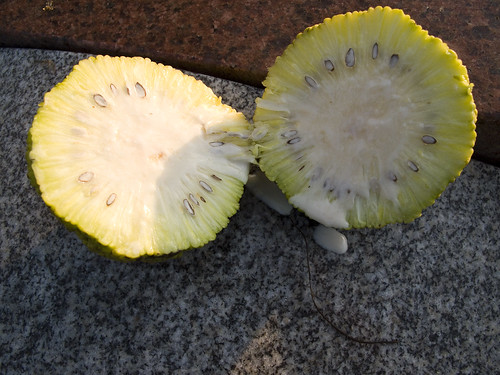
St. Michael’s Cemetery, Maclura pomifera, or Osage Orange fruit – photo by Mitch Waxman
Like all fruiting plants, an animal conspirator is required to complete the life cycle of the Osage Orange, expanding its range via the digestive processes of a ranging forager. Ever efficient, nature would not waste its time producing an energy rich fruit that attracts no living animal to it. Theories abound as to the identity of this partner organism, and an extinct equine is one of the evolutionary vectors theorized to have played this role for the Osage (thought likely due to the browsing preferences of modern Horse and Mule), but an intriguing notion is put forth by Connie Barlow of Harvard’s Arnold Arboretum who offers the theory that the anachronistic fruit of the Osage Orange’s partner animal was in fact a long extinct North American Elephant- the Mammoth.
Practicers of the left handed path of forbidden knowledge prize Osage wood for usage in wands, believing it to be useful when invoking mysterious spirits emanating from the bowels of the earth- those never human elemental intelligences, and the spirit animal guides associated with Native American Shamanic beliefs.
Osage-Orange is a native tree coming from a relatively small area in eastern Oklahoma, portions of Missouri, Texas and Arkansas. While used for centuries by native Americans in its original area for war clubs and bows, it was the first tree Lewis and Clark sent back east from St. Louis in 1804. Yet, with that modest beginning, the Osage-Orange probably has been planted in greater numbers throughout the United States in the 19th and early 20th century than almost any other tree species in North America. Because of its value as a natural hedgerow fence, it made agricultural settlement of the prairies possible, it then led directly to the invention of barbed wire in 1874, and then provided most of the posts for the wire that fenced the West. It is still considered the best wood for making archer’s bows. The Osage-Orange is one of America’s more interesting natives. It has at least two Internet web sites dedicated to keeping Osage-Orange enthusiasts informed (see www.osageorange.com and www.hedgeapple.com).
Happy Thanksgiving.
Tales of Calvary 5- Shade and Stillness

– photo by Mitch Waxman
In the past, the desolating loneliness and isolation which define my internal dialogue have been described to you simply – I’m all ‘effed up.
Shunned by those considered normal, my human– all too human- nature forces visceral desires for companionship. Lacking fellowship amongst the the living, one instinctively reaches out for those things which are no longer- or have never been- alive. That odd man in the filthy black raincoat that you might glimpse as you drive past the graveyard, scuttling along taking pictures of sewers and odd boxes in the Cemetery Belt- might very well be your humble narrator.
I was at Calvary Cemetery, intent on investigating the puzzling knots I had observed, beneath a hilltop tree- fed by some morbid nutrition, when I came across the Sweeney monument.
The Association for Gravestone Studies makes available this pdf file of a 19th century monumental bronze catalog, incidentally, as well as this discussion of “White Bronze“.

– photo by Mitch Waxman
Unlike the celebrated O’Brien clan, whose final destination is found closer to the apex of Calvary’s hills, the Sweeneys are shadowed by time. Social standing and class status drove the generations buried up here to seek a favorable and expensive bit of real estate, away from the common rabble and poor being laid into marshy trenches at the shallow of the hill in their thousands, and to lie for eternity with “their own kind”.
The princes of the City, and their courts, lie in Calvary Cemetery– not far from worm scarred timbers whose titan bulk restricts an elixir of extinction known as the fabled Newtown Creek from mingling with the blessed soils of Calvary. Unguessable springs of subterrene putrefaction percolating with horrors beyond the grave’s holding flow still beneath the streets of Newtown- vestigial streams and waterways that are imprisoned in masonry and brick tunnels. Directly mixing, in hideous congress, the liquefied effluvia of the long dead found in the hydrologic column of Calvary with the exotic chemistries of Newtown Creek? Who can guess would result?
Whoever the Sweeneys were, their family plot is located in a fairly exclusive area of the 19th century’s ex-population, and pretty close to the top of a hill. What’s odd here, and remarkable, is the enigmatic knots of this token affixed to the Sweeney monument- a trinket which had obviously weathered more than one change of season.
Unknowable implications are suggested by the urgency of this arcane reference found in the New York State Cemetery Law.

– photo by Mitch Waxman
Symbolic gifts to the dead and the placement of totemic representations at graves are expected behaviors, when confronted with the brutal truth of mortality, from individuals who experience the death of a family or peer group member. Every cemetery in the area, the sheer acreage of which -in this case- can be observed from space, has posted regulations on appropriate and allowed markers and monuments. Certain obtuse expressions of grief are disallowed due to the necessary maintenance and landscaping of the grounds, and good taste is enforced.
Another odd set of provisions is found in the Penal Law section of the aforementioned codification of New York’s cemeteries.

– photo by Mitch Waxman
Noticing that that the oddly complex knotting of the cord implied commonality with the nearby red and blue knotted cords, I decided to have a closer look. There was a second color of cordage in the knots, a dirty and weathered yellow which was only present in one spot. The pendulum which the arrangement supported was either cheap electroplated metal or some sort of ruggose plastic. It was a sort of cartouche, an amulet shaped in a manner commonly recognized as a heart, suspended by a twisted tendon of oddly knotted string.

– photo by Mitch Waxman
Suspicious that this might be something other than innocent, and knowing the predilection of certain groups for the usage of bodily liquids in their rites, your humble narrator used a trusty all in one Leatherman brand tool to examine it further. It is important, when walking in the hallowed grounds of Calvary, to try not to touch anything lest something touch you back. Things found there, if they can catch the smell of you, might follow you home and demand to be fed.
Of course, I mean the hundreds of feral cats which stalk Calvary’s hills, and it is best that they stay here where it is always safe for them. Neighborhood gossips- their odd comment phrased with a raised eyebrow and knowing squint- hoarsely whisper the opine: In Calvary Cemetery, no man may kill a cat…
Also from New York State, a manual for the new treasurer, a business plan and model to follow for the mortuary industry’s promise of “Perpetual Care”.
More on “The White Lady of Astoria”

– photo by Mitch Waxman
Our Halloween posting, describing spectral phenomena experienced by residents on my old block – 44th street between Broadway and 34th avenue, which lies nestled amongst the lowland hillocks of Astoria, has drawn a reply from the Greater Astoria Historical Society.
from astorialic.org
The Greater Astoria Historical Society, chartered in 1985, is a non-profit organization supported by the Long Island City community. We are dedicated to preserving our past and using it to promote our community’s future. The Society hosts field trips, walking tours, slide presentations, and guest lectures to schools and the public. Regular meetings are usually held the first Monday of the month at 7:00 PM in Quinn’s Gallery, 35-20 Broadway, Long Island City.

– photo by Mitch Waxman
The Greater Astoria Historical Society (located on the 4th floor of the Quinn building here in Astoria)– in addition to hosting multitudinous walking tours of the area and producing a schedule of lectures and scholarly exhibitions focusing on the culture, community, and history of northwestern Queens- serves as a vouchsafe location for rare documents and publications which discuss their area of study. Additionally, GAHS preserves several historic artifacts, some of which were saved literally, from the wrecking ball due to direct intervention.
I am fairly certain that the Dee translation of a certain book, missing page 751- of course, is hidden away somewhere in their vaults.
From their towering vantage point- an eagle’s nest which affords an overview of the entire city- these ascended masters share hard won knowledge generously with initiates, even ones as unworthy as your humble narrator.
from wikipedia
The holdings of the Greater Astoria Historical Society, on loan and owned, include a collection of rare and unusual items available for public perusal. The GAHS maintains a Library/Research Center that contains over 10,000 items, including books and publications on local history, a photographic record of the community, and neighborhood ephemera and memorabilia. The GAHS holdings include dozens of antiquarian atlases and thousands of historic maps of Queens, New York and surrounding areas from the now defunct Belcher Hyde map company among others. The holdings also include an almost complete run (or the morgue file) of the Long Island Star Journal, “a daily paper that informed the community about local and world news until it folded in 1968. A banner across the Star-Journal masthead reminded readers that the newspaper’s name came from the merger of the Long Island Daily Star (1876) and the North Shore Daily Journal–The Flushing Journal (1841).”

– photo by Mitch Waxman
The missive received from the GAHS Lamasery, which came in prompt response to the “White Lady of Astoria” posting on the morning of Hallowmas, has been delayed in reaching the readers of this- your Newtown Pentacle- due to the burden of developing hundreds of photos from the 2009 New York City Marathon and the startling revelations brought forward on research about a certain grave I found in Calvary Cemetery (more on that next week).

– photo by Mitch Waxman
My initial instincts, based on badly scanned and somewhat inaccurate historical maps of the area found around the web, were to postulate about the nearby Moore Jackson colonial era cemetery which is hidden in weedy obscurity a few blocks away. Here’s a google map of the scene today.

From the "Annals of Newtown, 1852" courtesy of Pefagan's great site- pefagan.com
Misreading one of these maps, I placed a colonial era farmhouse inaccurately, and began building a case in my notebook for the White Lady being a phantasmic echo of Mrs. Jackson (as in Jackson avenue). This is a bad habit of mine, connecting dots, and I’m trying to avoid it- so while attending a couple of GAHS events in October, I mentioned my ghost story to officers of the Society. Notice that at the center of the map, where the “S.A. Halsey Late Whitfield’s” script is found- just below that (I believe) is the corner of modern 44th street and Newtown Road.

– photo by Mitch Waxman
I have met a few individuals, since I began wandering the Newtown Pentacle, who are authentic experts on those subjects which we explore together at this page. Esoteric history buffs and antiquarian enthusiasts abound in the community, yet certain individuals (you know who you are) stand head and shoulders above the rest. The encyclopedic knowledge and generous nature of these irascible hierophants has given my poor ramblings a grounding, and helped me to grasp at a secret history, hidden all around us. I call these folks, ascended masters all, “The Rabbi’s”.
Amongst this group of “rabbi’s”, if the subject is Astoria, the folks you’ll want to speak to are Bob Singleton and Richard Melnick of the Greater Astoria Historical Society.

– photo by Mitch Waxman
Here, in its entirety, is their message- used with permission-
I know of no story from that area’s history that would relate to this. It was marshy pasture and undeveloped until about 100 years ago. Northern Blvd. was basically a causeway built through a swamp. The Sunnyside Yards was the head of a millpond dammed at Queens Plaza.
No stories with the Gosman etc. families that owned it, and TNT Auto is the only location of something historic: the old Sunnyside Hotel that gave Sunnyside its name.
However, at 43-44 and 31st Ave-Newtown Road is the approx. location of the infamous Hallet Family massacre where two slaves killed both parents and all their kids in the first capital crime of Queens (ca. 1705 or so). Slaughtered them as they wanted their farm. Both slaves (She was Black and He was Indian) were subject to horrible executions (burning at the stake, I believe) in Flushing.
The area of Newtown Road (original wagon road to their grandfather Hallet farm made about 1652) was always considered haunted in the 19th century. I can personally attest to feeling uneasy as I walked along it at night, particularly the area where the apartment building with courtyard to the south of the street around 45th St.
Wonder if the ‘White Woman’ was the wife who fled and tried to run thorugh the swamp to the nearest homes which would have been along Middleberg Ave on the other side of today’s Sunnyside Yards. Your location would have been the approx. place of the millpond that might have stopped her or been imperfectly frozen.
What was the period of her attire?
P.S. ‘East Astoria’ is historically the area north of Astoria Blvd about 40th St or so. The area that you live in was historically called ‘The German Settlement’.

44th and Newtown Road looking toward Broadway and my former apartment, nearly at the spot mentioned by GAHS above – photo by Mitch Waxman
Astoria Raccoons

– photo by Mitch Waxman
Raccoons in Astoria. 44th street, corner of 31st avenue. There were 4 of them, sighted on the night before Halloween (well, technically Halloween, as it was after midnight).
Here’s something else I worry about.
The White Lady of Astoria, a ghost story

– photo by Mitch Waxman
44th street between Broadway and 34th avenue exhibits a well planted block of row houses, most of which are nearing their centennials. Our Lady of the Pentacle and myself, having been forced out of our Manhattan apartment by the rapacious real estate developments that had overtaken our former neighborhood, moved here around six years ago. We have since relocated, to a Matthews Model Flat a couple of blocks away, but maintain friendly relations with our former neighbors and are a constant presence on the block.
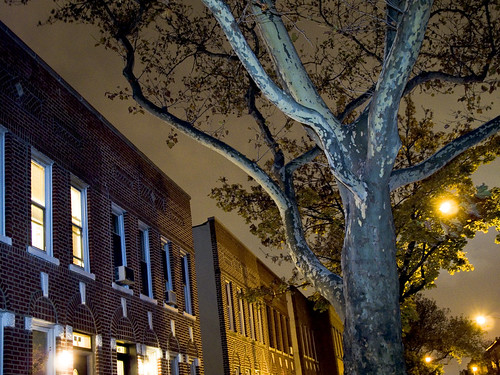
– photo by Mitch Waxman
This section of Astoria, technically East Astoria, abuts Northern Blvd. and forms the border with both Woodside and Sunnyside. A bedroom community, an odd mix of “lifers” (neighborhood stalwarts who were born, and will die, in the same house they live in today) and “city people” (new residents, like myself). Croatians, Serbs, Italians, Bangla, and Brazilians form the largest ethnic groups today.

– photo by Mitch Waxman
Charming, but in a state of deleterious repair, the house we rented our rooms from is owned by a disagreeable hibernian matron whose family took possession of the place in the mid 1960’s. It survives today as an “investment property”, whose street facing wall is unfortunately being undermined by a feral tree growing in the front yard. The roots of the autochthonous vegetation have actually forced open the cement foundations of the structure, and its pinioned trunk is jacking the wall up and away from the roof. Consequently, flooding in both second floor apartments and the basement are routine during weather events, and the weeping of the ceiling was what led us to find other accommodations.

– photo by Mitch Waxman
Over the happy months and years that we lived here, many relationships were forged in the close quartered milieu that describes life in doe-eyed Astoria. Always a collector and connoisseur of intelligence on the unusual and occult, a question that I have put forward to many people is “Have you ever seen a Ghost?”. Oddly enough, the answers on my old block, particularly on the eastern side of the street, were “yes”.

– photo by Mitch Waxman
Characteristic of older buildings built on marshy soils, typical of western Queens, audible manifestations attributed to “settling” are common on the block. Floor joists groan, walls bulge under decades of plastering, and a staccato of steel whistles accompanies the arrival of heating. Often awake at those times of night which might be described as an hour of the wolf, your humble narrator often sensed odd silences and formed unadmitted intuitions. Paranoid, promised and prone to wild fantasy and allegorical dissection, my perception of the world is askew- and I am prone to “fill in the blanks” in order to create a comforting mythological blanket to wrap myself in.

– photo by Mitch Waxman
My former neighbor, a sensitive “lifer”, when confronted with “Have you ever seen a Ghost?” related that there was an apparition on the entire block. A lady in white who moved from house to house. He continued on, saying that his mother, himself- and his tenants- had experienced apparitions. Indeed, the subject was well known amongst the generations of children that had grown up here, and that the phantom was called “The White Lady”. The following text is used with permission, and comes from that stalwart friend…
My mother’s story is this:
When my brother and I were very small, around 2 and 5 or 3 and 6 respectively, we both had high fevers and were sleeping in my mother’s bed. My mother said she heard someone walk down our hallway, and she assumed it was my father, as he worked late into the night. She then says she smelled very sweet perfume, and felt someone sit down on the edge of the bed (she was sitting with us, watching over us).
She never saw anybody, but rather felt a presence. She said she knew it was the presence of a ‘lady’—with the resonance of the word being someone higher in society, graceful and composed. The presence let it be known to her–how I dont know– that she was there for a good reason; that she was there because she was worried about my brother and I, and would watch over us and protect us. My mother added that she thought the ‘lady’ was the wife of the person who owned the land way before our house was built, but Im not sure if that was heresay she might have picked up on in future years.

– photo by Mitch Waxman
My tenant’s story:
My tenant stopped and asked me one day in front of the house. He asked me if we had a ghost living there, and before I told him, I asked him what he meant. He said he dreamt about a ‘lady’. I asked him to describe her, and he said her hair was done up in an old fashioned bun, she was older, her hair was white, and she wore a dress that was cinched around the neck, the way they wore in earlier years.
He also said that he had once peered outside the backyard window, and saw someone looking up at him intently. He said that it was a spirit guide.
My tenant has told me he is sensitive to phenomenon. He even described meeting a woman and immediately ‘knowing’ that the woman was pregnant. He in fact asked her, and she said yes.

– photo by Mitch Waxman
The old building we lived in was in a constant state of flux, with tenants moving in and out on yearly leases. The apartment unit directly below us was vacant a few days when a former tenant and her boyfriend rented it. Bright and logical, the vivacious vicar’s daughter who leased the rooms had drawn her man away from his suburban homeland to the creole urbanity of Astoria. Affable, her intended was a man of science, and recently licensed to operate as a Doctor. Down to earth, head on his shoulders, likes to jog.
After a few days living in the apartment, he approached me, and confided an experience to me.
The following text is used with permission, and comes from him…
My ghostly experience, front bedroom 1st floor.
Well, it was the first night staying in that apartment. I spent the day helping my girlfriend move the rest of her stuff in. And put a large mirror up at the foot of the bed facing north (toward broadway).
So anyway, somehow I awoke between 2 and 3am (at least I feel like I was awake), and saw a kind of a dark shadowy figure move/walk from one side of the room toward the foot of the bed staring at me. Seemed like an older women or a deadly looking middle-aged women with long hair past shoulders staring me down as she crept toward the foot of the bed. She lowered down slowly as if she was going to go under the bed but went out of sight at my feet. Almost instantly I felt my feet tingle and begin to shake like I was shivering and then both legs entirely.
I tried to kick my legs to make it stop but it only made it worse as my legs were basically shaking out of control and woosh it went up my trunk to my neck and my whole body was shaking and my head flexed backward hard into the pillow. I called out for my girlfriend, but my face muscles were very tight – “help… help… me…” which felt like I was wide awake- I know I was.
I began to also feel a pull toward the bottom the bed and toward the wall that the mirror was on. And as soon as it felt like it was going to throw my body off the bed or across the room or through into the mirror, whoosh it left down through my body and out my feet and was standing at the foot of the bed staring at me smiling/kind of laughing at me, and turned toward the mirror and walked through.
That’s it, I was wide awake for 2 hours trying to contemplate if that really happened or what. Nothing like that has ever happend before or since.
The only other thing that happened was a couple of weeks later- a glass picure frame seemed to jump off the wall and shattered on the ground in the middle of the night at 3 or 4 am. The same day I put a 2nd mirror up in that bedroom.

– photo by Mitch Waxman
Postscript- P.S.

– photo by Mitch Waxman
So, remember the roots of that tree, the one that’s busting up the cement floor in the basement? One day, while shining a light under the concrete slab it had lifted, I saw something weird reflecting in the light in the rotting cement. Using a branch, I worked the glinting object free of the concrete matrix which had hidden it for a century.
It was a piece of jewelry wrought from coarse, industrial metals, and it’s circumference and weight was approximately the size of a United States silver dollar. This is it.

– photo by Mitch Waxman


 The Newtown Pentacle