Archive for the ‘Astoria’ Category
Remember, Remember- the 21st of December

Pour me a drink and I’ll tell you some lies – photo by Mitch Waxman
An axial tilt of loathsome memories, shifting identities, and unrealized vengeance torments your humble narrator and makes him thankful that December 21st is, indeed, the shortest day of the year. The long nocturne of the Solstice, however, is no cause for celebration here in the Newtown Pentacle.
Solstice indicates that the Famine Months of January and February are upon us. The ancient Hellenes would enact the barbarous Lenaia bacchanal on solstice, and the Maenads would feast upon human flesh. It was also the central night of a week long Babylonian festival called Zagmuk, a celebration of divine Marduk’s victory over the darkness called the Anunnaki and their champion- the chaos dragon Tiamat. In modernity, in the nation of Mali, the Amma Cult of the atavist Dogon will sing and offer boiled millet at the conical altar of their high god.
from dailyworldbuzz.com
Today is the Celebration of Winter Solstice Traditions – Monday, December 21, 2009 marks the Winter Solstice traditions, and this is the announcement of the official start of the winter in the Northern Hemisphere. Winter Solstice is also known as Yule.
More precisely, winter solstice will take place at 12:47 pm EST (1747 GMT) on Dec. 21. It is a date that will also mark the shortest day and longest night.
Winter solstice falls every year around Dec. 21. It is because of the earth’s axial tilt, which is farthest away from the sun at its maximum of 23° 26′. At this time of the year, the sun is closer to the horizon, thus giving out least amount of daylight therefore shortening the day and lengthening the night.
But there is a bright side to it. Starting Tuesday, the days will start getting longer, leading to summer solstice, which in 2010 will fall on June 21. At that time, the day will be the longest with the daytime lasting for about 15 hours compared to 9 hours on Monday.

Long Island City is ready for an undead invasion, so are parts of Greenpoint – photo by Mitch Waxman
Tonight- Cernunnos- the Horned God of the Wiccans, who the Arabs call Dhu’l Qarnayn, will be reborn after being ritually slain on October 31st.
December 21st is a special day in history, signs and portents abound.
Disraeli and Stalin were born in 1879 and 1804 respectively, Pierre and Marie Curie identified radium in 1898, Elvis had his famous meeting with Nixon in 1970, Ireland finally won its independence from a large and aggressive neighbor in 1948 and Snow White and the Seven Dwarves premiered in 1937. Oh… and then there was Apollo 8.
from wikipedia
Apollo 8 was the first human spaceflight mission to achieve a velocity sufficient to allow escape from the gravitational field of planet Earth; the first to be captured by and escape from the gravitational field of another celestial body; and the first crewed voyage to return to planet Earth from another celestial body – Earth’s Moon.

shot on June 21st 2009 – Summer Solstice – photo by Mitch Waxman
Do not be surprised if you see oddly costumed people beating out unfamiliar melodies on drums today as you make your way around the great metropolitan city. Gatherings of initiates are sure to form, and wild orgiastic dancing will ensue.
Can you be sure, were you to find yourself caught up in some modern celebration in Long Island City or Greenpoint, that you weren’t in the company of flesh eating Maenads? Or that you hadn’t become one yourself? Your humble narrator, lords and ladies of Newtown, will be casting one eager eye at that rivulet of arrested misery called the Newtown Creek- in particular.
from souledout.org
At certain ancient cairns in Ireland the sun only reaches deep inside on the winter solstice, only on that one day is the inner chamber lit … like the celestial body of male Sun impregnating the Mother Earth with rays of light.
At the winter solstice the sun reaches its southernmost position in the northern hemisphere perspective (**), and begins to move northward as it enters into the cardinal, earth sign Capricorn. Through the ages, the period when the sun moves northward again ~ from the winter solstice to the summer solstice ~ has been regarded as a festival season. In many lands and civilizations the winter solstice season has been associated with the coming of a Sun-God to save the world ~ bringing light and fruitfulness to the earth, and bringing hope to humanity.

Gabled roof of netherlandish design, windows glowing with a strange colour, Astoria Church – photo by Mitch Waxman
Of course, this whole rumination on the Solstice takes place against the dominant culture’s winter holiday season. For the better part of a month, ritual feasting and familial gift giving consumes the modern mind. This period of the year, beginning with “Thanksgiving”, culminates in Advent/Yule/Christmas and ends with celebration of a calendar cycling.
1,096 days ago, I was in a hospital bed, and hadn’t yet experienced the pale ecstasies found in the glass strewn alleys and loamy graveyards of the Newtown Pentacle. 26,309 hours ago…
The darkest day, the longest night- my hour of the wolf is an interval of brutal introspections- here at Pentacle HQ in the ice choked heart of Astoria.
Note: Please say a quiet devotion for the ever patient and long suffering “Our lady of the Pentacle” today… she’s going to have to put up with and listen to this kind of maudlin revisionist crap all day…
from wikipedia
In many countries Advent was long marked by diverse popular observances, some of which still survive. In England, especially in the northern counties, there was a custom (now extinct) for poor women to carry around the “Advent images”, two dolls dressed to represent Jesus and the Blessed Virgin Mary. A halfpenny coin was expected from every one to whom these were exhibited and bad luck was thought to menace the household not visited by the doll-bearers before Christmas Eve at the latest.
In Normandy, farmers employed children under twelve to run through the fields and orchards armed with torches, setting fire to bundles of straw, and thus it is believed driving out such vermin as are likely to damage the crops. In Italy, among other Advent celebrations, is the entry into Rome in the last days of Advent of the Calabrian pifferari, or bagpipe players, who play before the shrines of Mary, the mother of Jesus, the Italian tradition being that the shepherds played these pipes when they came to the manger at Bethlehem to pay homage to the infant Jesus. It is the second most important tradition behind Easter for Roman Catholics.
In recent times the commonest observance of Advent outside church circles has been the keeping of an advent calendar or advent candle, with one door being opened in the calendar, or one section of the candle being burned, on each day in December leading up to Christmas Eve.
and just as a note: December 21 is also the anniversary of the Pilgrims landing on Plymouth Rock and getting the whole “America thing” started.
A sound like municipal dentistry

– photo by Mitch Waxman
P.S. 70, an elementary school on 42nd street here in Astoria, is receiving a facelift, general maintenance, and repairs to its roof. Building inspectors have recommended a series of minor repairs to the structure, and 2009 being a local election year, all the project works are being worked on in tandem concurrence.
So as not to disturb classes during the day, all the work is being done after dark, beginning at 4PM and ending at 11PM- as observed. Omnipresent is its sound, as is my kvetching about it.

– photo by Mitch Waxman
Undoubtedly- the availability of Federal Stimulus monies hurried the normally glacial pace of city services in initiating the project, but the work is vulnerable to weather events- especially high winds- and performing it in winter will prolong the ordeal.
On most nights, the sound of masonry drills and other high speed equipment broadcast along the rooftops, manifesting an inescapable staccato of high pitched grinding which reminds me of childhood trips to a certain Percocet addled dentist that my family insisted on using.

– photo by Mitch Waxman
The sound penetrates through the walls of my nonagenarian Matthews Model Flat, causing no end of discomfort to Zuzu, my little dog. Of course- the needs of the many outweigh the needs of the few, or the one, as Spock said (or will say), and at least the work stops at 11.
from schools.nyc.gov
The Lt Joseph Petrosino School serves 1,139 students from pre kindergarten through 5th grades. Hispanic children make up 44% of the student body, 33% are White, almost 22% are Asians and the remaining 2% are Black. More than two-thirds of this year’s students are English language learners, an 18% increase from last year for this group. Most newly enrolled second language students have arrived from Bangladesh, Pakistan and Mexico.
There are self-contained English as second language classes at kindergarten, and ingrades 1, 3 and 4, with two in the 2nd grade. In addition, there is one Spanish bilingual class, in both kindergarten and 1st grade. Approximately 9% of enrolled students are special education students, with 4% of these in self-contained classes in grades 2 and 5. The remaining 5% of special education students are in collaborative team teaching classrooms in kindergarten and 1st grades, or are in general education classes and receive support from resource room specialists.
There are top classes in grades 1 through 5.Classes are housed in the main building, a mini school and two transportable units, which are all adjacent. School attendance is 94.6%, which is 2.5% above that of similar schools and 1.8% above City schools. This is a Title 1 school with almost 82% of the students being eligible, slightly less than similar schools but almost 10% above the City school average.
Astoria is bizarre
As I stared into the vast abyssal plain of my soul last night, contemplating exactly what’s wrong with me- and what motivation I might have for spending all my time hanging out in and photographing cemeteries lately- a sudden peal of cheerful music rose from the hidden backyards of these Matthews Model Flats here in moon kissed Astoria.
It drew me out, onto the fire escape. Then I came back in for my camera. Sorry for the shaky video, but this was so weird.
The whirring and buzzing sound in the second video is a guy on the next block working on his house.
Things you learn from being a ghoul

St. Michael’s Cemetery- photo by Mitch Waxman
As has been mentioned in the past, your humble narrator suffers from a serious health condition, which necessitates regular physical exercise be performed as a curative. These long walks around the Newtown Pentacle, prescriptive in their origins, have made me curious about the things I encounter. Notwithstanding the industrial wonders of Newtown Creek or that clockwork malevolence of marching progress evidenced in Long Island City, desire arises in my heart for quiet… peace… and the company of some semblance of nature.
Here in northwestern Queens, the closest thing to a sylvan glade available to the public for peaceful perambulation are graveyards.

St. Michael’s Cemetery- photo by Mitch Waxman
Despite my great affection for the viridian devastation of Calvary Cemetery, it is quite a long walk from ruby lipped Astoria to the blighted hillocks of Blissville, and in these days of approaching winter- the sun’s journey ends in late afternoon. Calvary will consume you, if you stray too far from the light, and the wise visit it early in the day.
A mere half mile from Newtown Pentacle HQ, however, can be found St. Michael’s. 88 acres of manicured grounds, St. Michael’s is an island of calm in the middle of Astoria. Unlike Calvary, St. Michael’s is a nonsectarian burial ground, and exhibits the legendary diversity of populations for which Queens is renowned worldwide within its loamy depths.
(we’ll be exploring St. Michael’s more thoroughly in future posts, but for now…)
Recently, on one of my ghoulish walks around the place, I encountered strange fruit.
from St. Michael’s
St. Michael’s Cemetery is situated in the borough of Queens in New York City. Established in 1852, St. Michael’s is one of the oldest religious, nonprofit cemeteries in the New York City metropolitan area which is open to people of all faiths. It is owned and operated by St. Michael’s Church, an Episcopal congregation located on the Upper West Side of Manhattan.
The original property for St. Michael’s Cemetery was purchased in 1852 by the Rev. Thomas McClure Peters and occupied seven acres. Over the years St. Michael’s gradually acquired additional land to its present size of approximately eighty-eight acres. Because it was Dr. Peters intention to provide a final dignified resting place for the poor who could not otherwise afford it, areas within the cemetery were assigned to other free churches and institutions of New York City. These areas are still held for the institutions they were assigned. As a service to its diverse constituency, St. Michael’s continues to this day provide burial space for individuals and families from all classes, religions and ethnicities. St. Michael’s reflects the demographic and historical trends of New York City. Walking through the older sections of the cemetery, you will find burials representing the 19th and early 20th century immigrants.
In the late 1980’s St. Michael’s began building community mausoleums in order to more efficiently utilize the remaining unoccupied space and offer attractive, affordable final resting places. Currently, we are planning a new mausoleum complex at 49th Street and Grand Central Parkway Service Road.

St. Michael’s Cemetery- photo by Mitch Waxman
About the size of an orange, or large apple, the ruggose skin of the fruit had a sickly yellow-green coloration. Abundant, the fallen spores were obviously in season. Ignorant of the specificities of arborial lore, nocturnal researches of North American cultivars suggested that this sort of ovum was typical of an Osage Orange- Maclura pomifera to those in the know.
from wikipedia
Osage-orange, Horse-apple, Bois D’Arc, or Bodark (Maclura pomifera) is a small deciduous tree or large shrub, typically growing to 8–15 metres (26–49 ft) tall. It is dioeceous, with male and female flowers on different plants. The fruit, a multiple fruit, is roughly spherical, but bumpy, and 7–15 cm in diameter, and it is filled with a sticky white latex sap. In fall, its color turns a bright yellow-green and it has a faint odor similar to that of oranges.
Maclura is closely related to the genus Cudrania, and hybrids between the two genera have been produced. In fact, some botanists recognize a more broadly defined Maclura that includes species previously included in Cudrania and other genera of Moraceae.
Osajin and Pomiferin are flavonoid pigments present in the wood and fruit, comprising about 10% of the fruit’s dry weight. The plant also contains the flavonol morin.
Recent research suggests that elemol, another component extractable from the fruit, shows promise as a mosquito repellent with similar activity to DEET in contact and residual repellency.

St. Michael’s Cemetery, Maclura pomifera, or Osage Orange fruit – photo by Mitch Waxman
An important plant to the native american cultures, the Osage Orange tree produces wood which is dense and fibrous, ideal for the body of a Bow and it is one of the highest rated “fuel woods“. Resistant to insect and fungus, Osage wood is also prized for use in fenceposts. It grows in the form of a dense thorned thicket surrounding the central trunk, and produces the “orange” which is largely passed over by mammalian scavengers like Squirrels and Raccoons. Prized by Horses and Mules (horse apples), the original range of the tree was confined to the southwest, but its value as a hedge plant and naturally replenishing cattle fence was instrumental in it being planted all over North America.
from horticulture and home pest news
The Osage-orange is native to a small area in eastern Texas, southeastern Oklahoma, and southwestern Arkansas. This region was also the home of the Osage Indians, hence the common name of Osage-orange. White settlers moving into the region found that the Osage-orange possessed several admirable qualities. It is a tough and durable tree, transplants easily, and tolerates poor soils, extreme heat, and strong winds. It also has no serious insect or disease problems. During the mid-nineteenth century, it was widely planted by midwest farmers, including those in southern Iowa, as a living fence. When pruned into a hedge, it provided an impenetrable barrier to livestock. The widespread planting of Osage-orange stopped with the introduction of barbed wire. Many of the original hedges have since been destroyed or died. However, some of the original trees can still be found in fence rows in southern Iowa. Trees have also become naturalized in pastures and ravines in southern areas of the state.
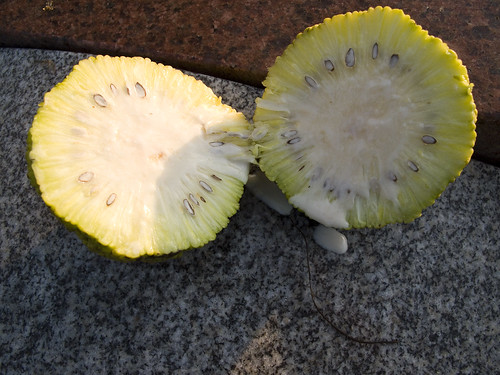
St. Michael’s Cemetery, Maclura pomifera, or Osage Orange fruit – photo by Mitch Waxman
Like all fruiting plants, an animal conspirator is required to complete the life cycle of the Osage Orange, expanding its range via the digestive processes of a ranging forager. Ever efficient, nature would not waste its time producing an energy rich fruit that attracts no living animal to it. Theories abound as to the identity of this partner organism, and an extinct equine is one of the evolutionary vectors theorized to have played this role for the Osage (thought likely due to the browsing preferences of modern Horse and Mule), but an intriguing notion is put forth by Connie Barlow of Harvard’s Arnold Arboretum who offers the theory that the anachronistic fruit of the Osage Orange’s partner animal was in fact a long extinct North American Elephant- the Mammoth.
Practicers of the left handed path of forbidden knowledge prize Osage wood for usage in wands, believing it to be useful when invoking mysterious spirits emanating from the bowels of the earth- those never human elemental intelligences, and the spirit animal guides associated with Native American Shamanic beliefs.
Osage-Orange is a native tree coming from a relatively small area in eastern Oklahoma, portions of Missouri, Texas and Arkansas. While used for centuries by native Americans in its original area for war clubs and bows, it was the first tree Lewis and Clark sent back east from St. Louis in 1804. Yet, with that modest beginning, the Osage-Orange probably has been planted in greater numbers throughout the United States in the 19th and early 20th century than almost any other tree species in North America. Because of its value as a natural hedgerow fence, it made agricultural settlement of the prairies possible, it then led directly to the invention of barbed wire in 1874, and then provided most of the posts for the wire that fenced the West. It is still considered the best wood for making archer’s bows. The Osage-Orange is one of America’s more interesting natives. It has at least two Internet web sites dedicated to keeping Osage-Orange enthusiasts informed (see www.osageorange.com and www.hedgeapple.com).
Happy Thanksgiving.
misty water colored memories… but with blood

Long Island City, mouth of Newtown Creek, Greenpoint stitched panorama – photo by Mitch Waxman
Note- I’ve got a turmoil in me right now.
Your humble narrator is pissed off, and this ape is standing at the edge of his personal forest, hurling invective at an unfamiliar thing hanging in the sky called Moon. Rambling ahead, with a few reminisces of New York in “the good old days”.
The disturbing incongruity of modern skyscrapers in the Newtown Pentacle’s panoramic skies, whether commercial spire or residential tower, is horrifying to the residents of victorian relicts such as Long Island City and Greenpoint. All along the rotting infrastructure of the malodorous Newtown Creek, nearly the geographic center of the City of Greater New York, the arrival of a pregnant moment is apparent.
“A river of federal money will wash out the Newtown Creek, and all the poisons in the mud will be hatched out, or so say the G-Men” is my take on the EPA superfund listing of the Creek for now.
I still haven’t parsed everything, that was said in the November 5, 2009 Newtown Creek Alliance meeting at St. Cecilia’s. I made an audio recording of the presentation, and will be listening to it again. Its just that the EPA… the feds… gaining absolute control over a 4 long by half mile wide chunk of New York City for as long as 50 years… that’s 12.5 presidential administrations. 12.5 administrations ago was FDR’s first term.
Speaking of FDR, did you know that his second term Vice President- Henry A. Wallace (responsible for the very successful transformation of dustbowl era agri-businesses from rural homestead into their somewhat modern form) was a well known and public occultist?

Looking east from Newtown Creek Wastewater Treatment Plant catwalk stitched panorama – photo by Mitch Waxman
The New York that my father knew, the one built up in the late 30’s, 40’s, and 50’s, is the one that began crumbling in the 70’s and came crashing down during the 1980’s. Contrary to what you may have read, the Reagan years were not a very nice time, and a soggy malaise hung over both the great city and the nation that exists because of it. Disillusioned by the failures of utopian city planners and those shambolic ideologies which were popularized by academic and journalist alike, the population of New York turned on each other in those days.
Here’s a few of my “new york stories”- I was there, I saw them.

Looking southwest from Queensboro Bridge stitched panorama – photo by Mitch Waxman
A tragedy of Russian scale and tone, “good old days” New York saw violent encounters between strangers became commonplace in a city always on the edge. Back then (late 80’s, early 90’s)- Williamsburg was a blasted out brick lot, blighted, and an island of extreme poverty.

West from Pulaski Bridge facing Manhattan, stitched panorama – photo by Mitch Waxman
Naked hookers plied their trade in Williamsburg on Bedford and Grand, while just beyond- a Motorcycle Club’s shanty was lit by oil drums filled with castaway lumber and litter. The Lower East Side (then known as Alphabet city) was where you spent your time, then, or way uptown above 96th street on the west side- and both neighborhoods had borderlines and “DMZ” areas.
The City belonged to the rats, and you either fought them or ran away. Cowardice was considered an intelligent option back then, just run away- don’t try to fight “them”.

East on Newtown Creek, Kosciuszko Bridge stitched panorama – photo by Mitch Waxman
Once, I saw a businessman 2 blocks north of Grand Central Station on Park Avenue, wearing an expensive vested suit which was the fashion at the time. He walked between two cars, dropped his suit pants, and defecated in the street. You used to pee wherever you wanted to, as well, “back in the day”.
You could smoke tobacco, in designated areas, within New York City hospital wards. There was a magical danish called the Bearclaw, which has since gone extinct in New York City, best quaffed with bitter black coffee. The last Bearclaw I had was in the “New York New York” casino in Las Vegas.

Skillman Avenue, Sunnyside Railyard fence line – photo by Mitch Waxman
Once, I saw a homeless guy junkie- during the early AIDS years- get hit by a cab. His head shot forward toward the asphalt in a parabolic arc with his knees acting as a fulcrum, shattering his face and killing him. This happened on 21st street and 3rd, down the block from the Police Academy. They left him there for 2-3 hours waiting for the morgue to show up because nobody wanted to get AIDS blood on themselves. The bulls set up traffic cones around him.

Sunnyside, Barnett Avenue looking west stitched panorama – photo by Mitch Waxman
That New York City- the one that was a national disaster long before it became the scene of a national disaster, a lamentable metropolis of blood, hate, and too much damn noise- is being built over and carted away. But this is the way of things, here.
Those farms and mills obliterated by rapacious rail barons and their quest to build Sunnyside Yards, do you know who the Payntars were, or their story?

Queensbridge Park, looking west toward Manhattan stitched panorama – photo by Mitch Waxman
The mansions of Ravenswood, gothic palaces built for the ultra rich who made their fortunes on Newtown Creek and in Long Island City, were casually eradicated to make way for mill and dock, and later bridge and housing project. Do you know the story of the Terracotta House?

From George Washington Bridge looking south on upper Manhattan and New Jersey stitched panorama – photo by Mitch Waxman
Once, back in ’93, on 99th and Broadway- some guy was talking on a pay phone in the middle of the night, during an ice storm. You know the kind- the sort of weather that coats every surface in a half inch of clear, slick ice. Urban misery, but quite beautiful.

Astoria 31st Avenue stormy sky stitched panorama- photo by Mitch Waxman
Unfortunately for this fellow on the phone, someone shot him a few times and he must have slumped forward with the phone in his hand. I walked by on my way to the 2 train the next morning and the wind had pushed him backwards, his frozen hand around the receiver and his corpse was swaying stiffly in the february wind. There were bloodcicles.

Long Island City, Hunters Point, mouth of Newtown Creek, Greenpoint stitched panorama – photo by Mitch Waxman
For more on this lost and forgotten civilization, buy an early Ramones album and play it very loud.


 The Newtown Pentacle