Archive for the ‘Manhattan’ Category
Apple Juice, OHNY 2009
Caveat- What I know about electrical engineering wouldn’t produce enough charge to power an LED. Also, some of the information I’m passing on is sourced back to Open House New York flyers distributed at the event (just for proper attribution), handed out and written by Robert W. Lobenstein– General Superintendent of NYC Transit titled “A Walk Through History”. If I get something wrong, please contact me and we’ll make any appropriate corrections.

This isn’t actually the MTA Substation site- its around a block away and a completely different structure. Its just such good typography…- photo by Mitch Waxman
MTA Substations transmogrify high voltage Alternating Current charges, which flows from a central generator or powerhouse, into the 625 volts Direct Current electrifying the “third rail” which the fleets of Subway cars feed upon to gain their motive action- and fuel the various devices and systems found onboard a modern train (or rapid transit, to be accurate. The term train generally refers to a self actuating mechanism with a mobile locomotive powerplant – or engine- driving the action).
from ohny.org
MTA Substation
225 W 53rd St/ Broadway , New York
neighborhood: Midtown
opendialogue Sat 11 am, 1 pm tours with Robert Lobentstein, General Superintendent Power of Operations of NYC MTA Transit.
Maximum people: 25 per tour
building date: 1901, opened 1904
architect: Heins & LaFarge
other architects/consultants: William Barclay Parsons, McKim, Mead & White

– photo by Mitch Waxman
In the same year that Aleister Crowley wrote his “Book of the Law“, and the General Slocum carried away 1,021 souls at Hells Gate, and Robert Oppenheimer was born- the NYC Subway opened its doors for business (your humble narrator is used to passing the buck on certain subjects- the NYFD for instance- there are REAL experts out there who know far more than me. In the Subway story business, these folks are the tops).
In 1904, the nascent transit system was powered by a vast dynamo mill constructed on west 59th street between 11th and 12th avenues which fed AC current to eight substations (later combinations of IRT below and above shifted the nomen of the units in this group to the “teens”. One became eleven, eight became eighteen) which includes this site.
This is Substation 13.
the Gothamist blog was also here, and they got a great series of photos- lots of stuff I missed or just bungled the shot. Click here for a look.

– photo by Mitch Waxman
Here at Substation 13, “giant red buttons which must never be pushed” abound. A sinister and pervasive electronic hum, the sound of nearby modern solid state rectfier equipment busily converting a pulsating flow of gigajoules uncounted, permeates the dark and dusty building. The old substation rotary works went offline in 1999.
from timeout.com
MTA Substation
What it is: One of the MTA’s original power stations, tucked beneath a midtown street.
Why go? Opened in 1904, this is one of eight original IRT substations that served the subway system (for some perspective, there are now 215). View modern generators, as well as historic rotary converters, the subway’s earliest power source.

– photo by Mitch Waxman
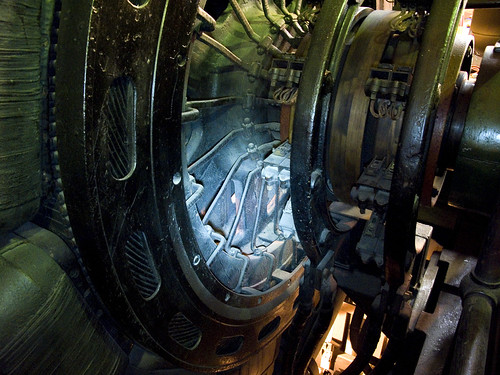
Specialized and redundant armatures of steel are required to support the weight of each of these 50 ton rotary converters, and to withstand the stresses induced by their operation, although the actual truss that supports them is made from hardwoods. Grounded plating is incorporated into the brick and cement clad structure of the substation, vouchsafing neighboring buildings against electrical manifestations and stray voltage.
from joeclipart.com
It opened in 1904, the same year as the first subway. The mayor, governor and, apocryphally, Thomas Edison and Nikola Tesla, among other dignitaries, arrived at the substation-warming party in horse-drawn buggies.
Old #13 has operated continuously since and today powers the 1 line, which old-timers still call the IRT. Although it houses sinister-looking modern equipment, the substation serves as a de facto museum because it contains original machinery, the centerpiece of which is the Westinghouse 1,500 kilowatt rotary converter. Incredibly, this 50-ton wheel didn’t go offline until 1999.

– photo by Mitch Waxman
The converter devices themselves were a constant point of photographic interest for me, the sort of “big” technology that a comic book supervillain might decorate his lair with. On one wall, an animation cel from a Popeye cartoon showed the post Spinach effect of multiple converters spinning within the distaff sailor’s bicep muscle.
from nycsubway.org
Because suitable real estate was difficult to find in the built-up downtown areas, contractor McDonald suggested that some of the sub-stations be placed underground. In February 1901 he requested the aid of the Rapid Transit Commission in acquiring the right to excavate under public lands at City Hall Park, Union Square, and Longacre (Times) Square. McDonald’s contract made him responsible for the purchase of all lands for power facilities and he hoped to cut down his expenses by using city rather than private property. After consulting its lawyers, the Board decided that it lacked authority to grant this request. McDonald had to build his sub-stations above ground.
It was desirable to have the distribution distance to the subway as short as possible after conversion to direct current at the sub-stations. In the downtown areas McDonald obtained sites no more than one-half block from the route. In the far less crowded up-town locations, the Simpson Street and the Hillside Avenue sub-stations were nearly adjacent to the track.
Two adjoining city lots, each 25×100 feet had to be purchased to house sub-station equipment. The resulting 50 foot width allowed installation of eight to ten rotary converters with their sets of transformers. In Sub-station #13 on West 53rd Street, foundations were laid for ten rotaries; the remaining seven were built to receive eight rotaries.
Foundations for eight to ten rotary converters was a provision for the future. The original 1901 Westinghouse contract called for only 26, 1,500-kilowatt rotary converters, or four to five per sub-station. In 1909 Westinghouse responded to a second call, this time for 3,000-kilowatt units. In the plans for the 1916-1918 general system expansion, additional contracts to both Westinghouse and General Electric provided 4,000-kilowatt rotaries, some of which replaced the older 1,500-kilowatt machines. During expansion, [page 330] Sub-station 11 at Park Place was demolished, and its replacement, a half block from the original site was equipped with 4,000-kilowatt units. In 1923 additional 4,000-kilowatt General Electric and Westinghouse units were installed.
The remaining seven of the original eight IRT sub-stations are still standing. Number 19 on West 132nd Street is no longer in use and its equipment has been removed. The others still operate daily [in 1978] with equipment from the earliest installations. [The last of the rotary converter equipment has since been retired.]
– photo by Mitch Waxman
Notoriously, your humble narrator is almost always “a day late and dollar short”, and the fabled “caving rig” lighting setup I’ve been working on for nearly a year was still incomplete when the OHNY event happened. I was lucky enough to be carrying a powerful LED electric torch by happenstance, which allowed some of these exposures sufficient quality for publication at Newtown Pentacle. Quite dark, Substation 13 awaits a creative application of lighting- perhaps the good folks at Strobist can gain access to the site sometime in the future and construct an application of proper illumination.
also from nycsubway.org
Each rotary converter stood in its own hard-wood frame. The frame was not bolted to the Portland cement foundations; the rotary weight was expected to hold the unit in place. The rotaries were the heaviest equipment of the sub-station. Two hand-operated cranes, at the front of each sub-station on the main floor, were provided for the rotary installation and service.

– photo by Mitch Waxman
Vast banks of machinery, replete with switches and glassed in gauges, line the walls of Substation 13. I’ve avoided posting photos of the more modern equipment, for a variety of reasons- mainly its not as cool looking, and the light was so bad I couldn’t get a non blurry shot.
from wikipedia
When the first subway opened between 1904 and 1908, one of the main service patterns was the West Side Branch, running from Lower Manhattan to Van Cortlandt Park via what is now the IRT Lexington Avenue Line, 42nd Street Shuttle, and IRT Broadway – Seventh Avenue Line. Both local and express trains were operated, with express trains using the express tracks south of 96th Street. Express trains ran through to Atlantic Avenue in Brooklyn during rush hours, while other express trains and all local trains turned around at City Hall or South Ferry.

– photo by Mitch Waxman
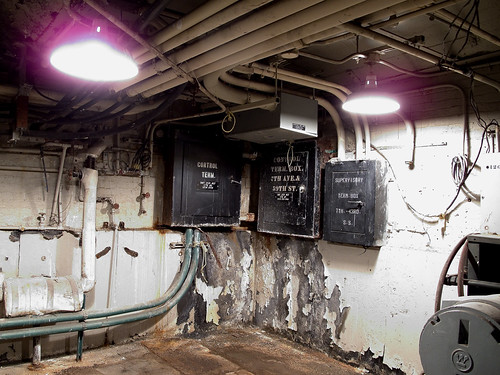
A labyrinth of access tunnels and manholes marks the lower level of Substation 13, whose mouldering brick and disintegrating concrete speaks to the infiltration and regular egress of flood waters. Apertures in the roof of the subterranean level look up into the rotary converters, and the walls are lined with empty sockets which once allowed electrical conduits to snake through the masonry.
from mta.info
New York City’s first official subway system opened in Manhattan on October 27, 1904. The Interborough Rapid Transit Company (IRT) operated the 9.1-mile long subway line that consisted of 28 stations from City Hall to 145th Street and Broadway.

– photo by Mitch Waxman
The art practiced by those engineers of the MTA who serve the modern system has -over the years- witnessed installation of 215 solid state converters, which are largely sited in deep underground vaults and inaccessible side tunnels hidden below the streets of New York City. Consolidated Edison– an electrical trust given stewardship over the metropolitan power grid- also used to maintain multitudinous converter substations for its commercial customers, but these too have been abandoned in favor of the more reliable and less labor intensive solid state rectifiers of the type now used by MTA. This room in particular, was original equipment, and was referred to as “the Manhole” where the Direct Current lines from the generator exited the soil and entered Substation 13. The atmosphere literally pulsed with latency.
from wikipedia
Electro Magnetic Fields (EMF) measurements are measurements of the magnetic or electric field taken with particular sensors or probes. These probes can be generally considered as antennas although with different characteristics. In fact probes should not perturb the electromagnetic field and must prevent coupling and reflection as much possible in order to obtain a precise measure. EMF measurements are nowadays becoming important and wide spread in different sectors to assess environmental and human exposure to non-ionizing radiation in many contexts.
– photo by Mitch Waxman
MTA has sold off many of its relict and offline substation buildings, which have been cross purposed by the modern world to “the needs of the now”. A lumber warehouse, a Chinese noodle factory, an auto repair shop, even a movie theatre- are amongst the modern vocations enjoyed by some of these solidly built structures.
from google books,
a little Congressional Office of Technology Assessment reporting on the effect on Human Physiological Parameters of exposure to high energy power lines (from the New York State Power Line Project).

– photo by Mitch Waxman
Purveyors of the paranormal- who are undergoing a period of intense public interest in recent years due to the influence of several popular television series and a prevailing political fashion that interprets world events through a supernatural lensing of fin de siècle prophecy – speak about arrangements of electrical equipment and their concurrent electromagnetic field fluctuations as creating an environment which alters human perception. If this theory holds water, I would imagine the men and women who worked here might have some stories to share- and probably a union beef against the City.
but seriously…
here’s a map from nycsubway.org of the system in 1904 when it opened. The crane above was one of many hand operated technologies that allowed the early system to come together. Workers would lift the 50 ton converters for maintenance and repairs using it.

– photo by Mitch Waxman
New York Open House is a yearly event wherein the architectural and civil engineering treasures of New York City that are normally off limits to the general public are exhibited by their stewards. For more info, and to sign up for notifications of next year’s event- proceed to OHNY.org.
Chinatown Lion Dance

– photo by Mitch Waxman
An admission- Chinatown scares the hell out of me. Its not an anti chinese thing, its the crowds and urban density. Naturally timid, emotionally stiff, and physically cowardish- the close contact and intimate quarters of these older parts of New York City amplify my natural inclinations and compel flight from such circumstances for want of those open skies and long urban horizons found across the river in the Newtown Pentacle.
Forced by obligation, however, to conquer my timorous nature and attend a meeting of Manhattan Bridge Parade Marshals (I’ll talk about that in a later post) in Chinatown- I came across this Lion Dance on Elizabeth Street.
from chinatown-online
New York City’s Chinatown, the largest Chinatown in the United States—and the site of the largest concentration of Chinese in the western hemisphere—is located on the lower east side of Manhattan. Its two square miles are loosely bounded by Kenmore and Delancey streets on the north, East and Worth streets on the south, Allen street on the east, and Broadway on the west. With a population estimated between 70,000 and 150,000, Chinatown is the favored destination point for Chinese immigrants, though in recent years the neighborhood has also become home to Dominicans, Puerto Ricans, Burmese, Vietnamese, and Filipinos among others.
Chinese traders and sailors began trickling into the United States in the mid eighteenth century; while this population was largely transient, small numbers stayed in New York and married. Beginning in the mid nineteenth century, Chinese arrived in significant numbers, lured to the Pacific coast of the United States by the stories of “Gold Mountain” — California — during the gold rush of the 1840s and 1850s and brought by labor brokers to build the Central Pacific Railroad. Most arrived expecting to spend a few years working, thus earning enough money to return to China, build a house and marry.
As the gold mines began yielding less and the railroad neared completion, the broad availability of cheap and willing Chinese labor in such industries as cigar-rolling and textiles became a source of tension for white laborers, who thought that the Chinese were coming to take their jobs and threaten their livelihoods. Mob violence and rampant discrimination in the west drove the Chinese east into larger cities, where job opportunities were more open and they could more easily blend into the already diverse population. By 1880, the burgeoning enclave in the Five Points slums on the south east side of New York was home to between 200 and 1,100 Chinese. A few members of a group of Chinese illegally smuggled into New Jersey in the late 1870s to work in a hand laundry soon made the move to New York, sparking an explosion of Chinese hand laundries.

– photo by Mitch Waxman
One of my companions, whose origins are found in the oceanic far east, claimed that the lion dance was being performed by what would most probably be an “ethnic society”. I am fairly ignorant about these deeper facets of Chinese Society, and will accept many apocryphal stories as fact- but in this case the source is a trusted observer with a long history of rectitude.
from wikipedia
The traditional borders of Chinatown are:
Canal Street in the North (bordering Little Italy)
The Bowery in the East (bordering the Lower East Side)
Worth Street in the South
Baxter Street in the West

– photo by Mitch Waxman
A dense crowd congealed around me as I neared the scene, which set me off into one of my specious moods. Reeling from the unfamiliar melodies of the percussionists interspersed with the crowd, your humble narrator managed to gain a clear vantage. Confetti rained.
also from wikipedia
The housing stock of Chinatown is still mostly composed of cramped tenement buildings, some of which are over 100 years old. It is still common in such buildings to have bathrooms in the hallways, to be shared among multiple apartments. A federally subsidized housing project, named Confucius Plaza, was completed on the corner of Bowery and Division streets in 1976. This 44-story residential tower block gave much needed new housing stock to thousands of residents. The building also housed a new public grade school, P.S. 124 (or Yung Wing Elementary). Since new housing is normally non-existent in Chinatown, many apartments in the building were acquired by wealthy individuals through under-the-table dealings, even though the building was built as affordable housing.

– photo by Mitch Waxman
It is not an uncommon experience in New York City to stumble upon ancient rites being enacted beneath neon signs and satellite dishes. Back during the summer, I witnessed and photographed a parade that looked like a Roman mural come to life in the DUTBO neighborhood of Astoria.
another from wikipedia
Chinese lion dances can be broadly categorised into two styles, Northern (北獅) and Southern (南獅). Northern dance was used as entertainment for the imperial court. The northern lion is usually red, orange, and yellow (sometimes with green fur for the female lion), shaggy in appearance, with a golden head. The northern dance is acrobatic and is mainly performed as entertainment. Sometimes, they perform dangerous stunts.
Southern dance is more symbolic. It is usually performed as a ceremony to exorcise evil spirits and to summon luck and fortune. The southern lion exhibits a wide variety of colour and has a distinctive head with large eyes, a mirror on the forehead, and a single horn at center of the head.
The Lion dance is often confused with the Chinese Dragon Dance, which features a team of around ten or more dancers. The Lion Dance usually consists of two people.

– photo by Mitch Waxman
The Lion costumes represent a significant material investment, if the prices at this website are typical for the genre. There’s a video at youtube which kind of conveys the feeling of being in this sort of crowd, albeit the far larger commotion and anarchic mood of that film was captured during the raucous Chinese New Year celebrations.

– photo by Mitch Waxman
From my superficial research on the Lion Dance, discernment of a competitive sort of sport has emerged, some kind of a gymnastic exhibition with elaborate scoring based on presentation and performance. For instance, were one to have found oneself in Guangzhou on February 9th, a plethora of Lion Dancers converged on the Guangzhou Lion Dance Contest and Gala for Lantern festival.
from chinatownology.com, which has a pretty cool page with video
During a lion dance performance, 2 performers co operate to “become” a lion. The Lion’s body consists of a lion head with movable ears, eye lids and mouth and a highly decorated body. The performers wear a t-shirt with the lion dance association’s logo and a special pair of pants designed to look like lion’s feet and in matching color and design with the lion’s body.
One of the performers takes the front position and assumes the front body of the lion. He controls the lion’s eye lids, ears and the mouth while his legs moves represent the front legs of a lion. The second performer arches forward to form the back of the lion, controls its tail and his legs represents the hind legs of the lion.
Lion dance performances are often accompanied by drum and gong players so that whenever there is a lion dance performances, the drum and gongs help to “inform” everyone around the area drawing crowds. The lion dance can occur with one or a group of lions and sometimes together with a Dragon Dance.
At the end of each performance, the Lion may leave a display of orange petals for audience to decipher the lucky numbers from the formation. Pastries such as prosperity cakes 发糕 are also used as props because of its auspicious symbolism.
Manhattan Bridge Centennial Photos
The whole set is up at flickr, here’s a few selects. I’ll be writing this up properly in a few days, but posts are going to still be a little sparse this week, and I don’t want to leave y’all hanging.

– photo by Mitch Waxman

– photo by Mitch Waxman

– photo by Mitch Waxman


– photo by Mitch Waxman
DUMBO… or missing my Dad
A little personal history this time, folks, bear with me, I’m particularly eff’ed up in September.

This tug, the Dorothy J, is pushing a barge of shredded autos, most likely coming from the Newtown Creek, down the East River. Manhattan Bridge in background. – photo by Mitch Waxman
I grew up in a solidly working class neighborhood in Brooklyn, first in Flatbush and later- to my utter disbelief- a place called Futurama which was either in Canarsie or Flatlands or Old Mill Basin depending on who you asked. When I was a kid, me and my friend Joey Miller- who was from a family of Sheepshead Bay sailors- would climb the fenceline at a kosher chicken processing plant and pee on the snapping guard dogs- dobermans- kept there during working hours. My friends and I would wander the glass strewn streets in the 1980’s, looking for dud firecrackers to harvest black powder from, which would later be used to fuel our plastic model reenactments of 2nd world war battles- played out in the sandlots around the Paerdegat Basin.
All the 1970’s and 80’s Brooklyn stuff which has been famously dramatized by Hollywood- the blackouts, the Yankees, racial conflict, the fellas, the graffiti trains, and crack, the Son of Sam– this was where I grew up. This is the “do or die” years, not the happily dancing borough of modernity. Back then, Williamsburg was the worst neighborhood in Brooklyn. I always wanted to be “an artist” someday, and live in Manhattan, which was VERY far from Brooklyn back then.

Manhattan Bridge with Manhattan in background. – photo by Mitch Waxman
My Dad grew up in a solidly working class neighborhood in depression era Brooklyn, in Borough Park, and Maimonides Hospital sprawls atop the site of the ancestral seat. “Jewish” is the way the old man would describe his childhood, and he always got shy when queried for details of his life before the Air Force. He would just say “we got drunk and did stupid things”, or allude to all night card games played on fire escapes in a time ” when you could leave your door unlocked, during the war”. After finishing a vocational program at Automotive High School in the mid 50’s- he was drafted into a paratrooper division of the Air Force and became a parachute packing specialist in Newfoundland for the Strategic Air Command, where he claimed to have been “the best fisherman on the entire base”. The old man always got a misty look on his face when discussing this period of his life. After the service, He moved back to Brooklyn. Eventually – he met Mumsies, and they melted into the huge population of secular Jews living in Brooklyn during the 1960’s. She forced him to learn how to drive, he always said, and he bought a Chrysler. Dad liked Chrysler automobiles, as he believed them to have the strongest air conditioners, although he would never shell out for a decent radio.

Manhattan Bridge with Brooklyn in background. – photo by Mitch Waxman
A self employed house painter in business with his elder brother, my old man was up early and home after dark. I came along in 67, and my early childhood was filled with car trips to amusement parks and familial relations as far away as Washington D.C. Dad always made it a point of hitting this museum, or that iconic attraction, often taking a gaggle of cousins with us. Corpulent, pale, and with a permanently sweaty band of hair plastered to my forehead– the son he was devoted to was an ungrateful worm lost in a comic book reality dreaming of a day when his real life would begin- over in “the city”. Morose and self absorbed, often churlish and always foolish, my father’s only son was and is a heaving wreck barely worthy of the food he eats. The old man never wavered, even when his painting business failed in the early 70’s, and he was forced into the humiliating experience of searching for work during the weakest hour of the American Century.
Incidentally- the old man was STRONG, and that’s from an adult perspective. The kind of deep core strength you get from working with your hands, climbing ladders while carrying 9 or 10 buckets of housepaint, packing parachutes. I once saw him pick up a two by four and snap it in half just using his wrists, he would push nails into walls with his thumb, lift fully loaded -1960’s era- refrigerators with one arm. Strong. He never used that strength on me, though, which was atypical parenting in my old neighborhood. He was more subtle, and wore a pinky ring, which he would just flick onto the very crown of my head. I can still feel it today.
Bonk! It’s me not good at talk, why.

Manhattan Bridge with Brooklyn in background. – photo by Mitch Waxman
Dad actually got kind of lucky, in he long run, when he took a job that didn’t pay well- but had “benefits”. Back then, health insurance was a perk for non-union employees, and employers offered it competitively in order to attract the best and brightest. The old man, who was really starting to put on weight by this point (He was around age 40-45- by 50 he was experiencing severe and routine attacks of angina pectoralis), got a job with the New York Foundling Hospital, which was located for many years opposite the FBI Building on Third avenue in Manhattan’s upper east side. Eventually, both institutions moved downtown, with the Catholic Archdioscese run hospital taking up residence on 6th avenue.
Dad began to drive to work, as his Doctors had advised him that the daily ascent of subway stairs was an unreasonable risk for him to assume given his heart condition. His son, by this point, was 18 and starting college at the School of Visual Arts a few blocks away. A miserable wretch and profligate still, his son would not be able to pay Manhattan rents and had opted to continue sucking at the familial teat during this time. So was born young Mitch and father Barry’s morning drives to the City.

Manhattan Bridge with Brooklyn in background. – photo by Mitch Waxman
By this time, the Chrysler had given way to the worst American car of the 1980’s- an ’83 Buick Century– which had a AM radio. He actually told the dealer that he specifically didn’t want an AM/FM- which was standard!
Howard Stern was still on WNBC, but the old man insisted on listening to 1010 WINS (a friend from college, Leslie Martelli, was interning at the station and this made the infinite news loop- so common today- bearable). Traffic was always terrible, but like all Brooklynites, we had secret shortcuts and discerned “light sequences” along thoroughfares (we’d go exactly 22 mph down eastern parkway and catch every green light from…). I’d be babbling on, in my morning caffeine fueled ecstasies, about the hidden green flames of revelation which I’d discovered at art school- or thrilling him with a story about some college party- when he’d stop me and tell me not to argue with my mother, nor let anyone take advantage of me (you’re too trusting, don’t trust people you just meet), and to think about the future so “I don’t end up like him”. Then he’d BONK me with that damn ring.
We always used the Manhattan Bridge when I drove, the Battery Tunnel when he did. I wanted to make the journey end quickly, he wanted to hang out with his weirdo kid a little bit longer.

DUMBO – photo by Mitch Waxman
Eventually, to my shame, I let my parents move out to …Staten Island… after the old man got his gold watch and retired. His weirdo kid had sort of done OK, and was living in Manhattan with a wife. I did manage to convince my parents not to take an apartment (literally) across the street from Fresh Kills, which they were looking at in January. “I don’t smell a thing, you’re crazy” my mother argued. They were living in an apartment complex near the Verrazano Bridge for about a year when he was diagnosed with Pancreas Cancer.
The operation to remove it, while successful, started a decline in his health and mood that ultimately destroyed him. Recovery and further treatment- chemotherapy and radiation- was the beginning of a drawn out process that eventually ended due to two new tumors that turned up in his liver. My mom called me home from a trip to Vermont, taken against her advice, saying that the old man was dying.
After completing the epic journey from shadowed Vermont to …Staten Island… in record time, and in reckless defiance of the speed limits of several counties, we avoided the late night construction traffic along the BQE by using Manhattan’s FDR drive, we crossed the East River using the Manhattan Bridge to egress through Bay Ridge to the Verrazano. Our Lady of the Pentacle and I arrived around his sickbed just as he opened his eyes, saw his weirdo son, grabbed his hand- and died. It was the day before Yom Kippur, which seems appropriate somehow.
My Dad was a simple guy who never had his story told, and that’s a shame. His name was Barry.
Over in Manhattan, one evening in June

Chrysler Building – photo by Mitch Waxman
Manhattan just isn’t fun anymore, so I tend to avoid the island of my youthful aspirations and instead spend my time in the boroughs, which are authentic and still very real. However, a dear friend and professional colleague had planned an event in the city, so I crossed the River of Sound and braved a threatening rainstorm. The shot above is from before the rain swept through, shot on the way to the party.
The turbulent skies of New York have supplied its citizens with phantasmagoric light shows at sunset this summer.
In late June, while attending the aforementioned social function in the shining Metropolis, a quick glance out a window drew me to the street. Apologizing to my stout hibernian host, whose wife- a wholesome and vivacious descendant of the celtic population of Woodside- was the object and celebrated focus of the catered party, I grabbed my handy camera and ran down to the storm littered streets of midtown Manhattan. Something unique and noteworthy was happening in the skies.

Chrysler Building – photo by Mitch Waxman
The wake of the rainstorm had promulgated a fairly rare meteorological phenomena called Mammatus clouds. Combined with the westerly underlighting of the petrochemical haze that lends New York City the spectacular sunsets commented on by its citizenry, a remarkable backdrop was provided for the celebrated Chrysler Building.
from wikipedia
Mammatus, also known as mammatocumulus, meaning “Mammary cloud” or “Breast cloud” is a meteorological term applied to a cellular pattern of pouches hanging underneath the base of a cloud. The name “mammatus” is derived from the Latin mamma (udder or breast), due to the clouds’ characteristic shape, as some believe there is a resemblance between the shape of these clouds and the breast of a woman.

Chrysler Building – photo by Mitch Waxman
There was a lot of buzz about the sky that night. Check out cloudfanatic for other people’s shots of the phenomena.
Also, June 26 is the anniversary of the signing of United Nations Charter in 1945, and the Feast day for the Syriac Orthodox Church’s (or Monophysite) Saint, Mar Abhai.

Chrysler Building – photo by Mitch Waxman


 The Newtown Pentacle