Archive for the ‘Queens Plaza’ Category
Taxi town

– photo by Mitch Waxman
When the intrepid shutterbug wanders around the back streets and hidden lanes of Long Island City (in particular) and North Western Queens (in general), the sheer number of Taxis observed is astounding. In the post WW2 period many, many Taxi garages and dispatchers relocated their fleet garages (mainly from the west side of Manhattan, whose rising real estate valuations priced such large footprint business out of the borough) in the area due to its proximity to Manhattan and the easy (free) egress offered to the business districts of the shining City by the Queensboro Bridge. Also, the land was cheap, by New York standards.
note:
The inexpensive nature of the land in Long Island City during the last half of the 20th century presents an inexplicable paradox given the paradise that LIC – south of the bridge- is reported to have been during the 1970’s and 80’s by comment threads at LIQCity.
I just can’t let this one go, by the way. A general excoriation of this blog and me personally has been detailed in the comment thread there by a few dedicated trolls who have focused on half a sentence in a 1,000 word post that was part of a 3,000 word sum up editorial at the end of the year.
When confronted to back up a statement, I supplied primary source material and was then told “don’t believe what you read”. So far, they’ve made intonations and accusations about my sexual preferences, called me amateur, lazy, gullible, self promoting, on drugs, like a spoiled 2 year old, an untalented liar, having written a “disgraceful and distasteful article complete with racist undertones”, making false claims about having lived in NYC all my life, and one anonymous poster has suggested “Think about it. A few years ago it was an Italian neighborhood. It’s okay to use that locution, right? Well, not for nothin’, but only idiots would try to get away with anything around here”. To my ears, that is the epitome of racist undertone- suggesting that stereotypical organized crime elements kept LIC safe and are exactly the sort of thing that they are all so upset about. I respond here, as comments at Newtown Pentacle are moderated and require you to sign your name, and I don’t participate in acrimonious flame wars.
Notice that at no point do they supply anything besides anonymous anecdotes in argument. The difference between these “anon” posters and myself is that I sign my name to things that I write, and can back up what I say. I fully expect to be connected to global terror and accused of being a sexual predator before the weekend is over. Also, the notion that I would use the tragic death of a car service driver to “promote myself” is anathema and personally offensive. I take my battles outside, to the street, where it counts. Coward.
from nyc.gov
What is the New York City Taxi & Limousine Commission?
The New York City Taxi and Limousine Commission (TLC), created in 1971, is the agency responsible for licensing and regulating New York City’s medallion (yellow) taxicabs, for-hire vehicles (community-based liveries and black cars), commuter vans, paratransit vehicles (ambulettes) and certain luxury limousines. The Commission’s Board consists of nine members, eight of whom are unsalaried Commissioners. The salaried Chair/Commissioner presides over regularly scheduled public Commission meetings, and is the head of the agency, which maintains a staff of approximately 400 TLC employees assigned to various divisions and bureaus. The Hon. Matthew W. Daus was named as Mayor Rudolph W. Giuliani’s designee to the Chair of the TLC in June 2001 and was unanimously confirmed by the New York City Council on August 22, 2001. He was then reappointed by Mayor Bloomberg in July 2003 and was again unanimously confirmed by the New York City Council on July 23, 2003.
The TLC licenses and regulates over 50,000 vehicles and approximately 100,000 drivers, performs safety and emissions inspections of the more than 13,000 medallion taxicabs three times each year, and holds numerous hearings for violations of City and TLC rules and regulations, making it the most active taxi and limousine licensing regulatory agency in the United States.To find out more about the TLC, or to review the agency’s procedures, rules and regulations and programs, you may review the constantly updated information available throughout this web site, or you may call the TLC’s Customer Service Hotline at 311.

– photo by Mitch Waxman
Omnipresent, the New York City Yellow cab is available for hire and will take you just about anywhere. A point is made, by your humble narrator, to converse with Cab drivers. Often, the conversation will involve their native country – which is what I’m really interested in- or their “immigrant story”. Eye opening, some of the stories I’ve been told about life in the far and middle east have changed my perceptions and corrected certain misconceptions acquired through ignorance and cultural prejudices. Ultimately, the one thing all cab drivers seem to have in common is a shared hatred of the Van Wyck.
from nyc.gov
The Following Vehicles are Currently in Use as New York City Taxicabs
- 2009-Ford Crown Victoria Stretch
- 2009-Chevrolet Malibu Hybrid
- 2009-Saturn Aura Hybrid
- 2009-Chevrolet Malibu Hybrid
- 2009-Volkswagen Jetta Clean Diesel Sedan
- 2009-Lexus RX400h
- 2009-Toyota Camry Hybrid
- 2009-Toyota Prius-48 mpg city
- 2009-Toyota Highlander Hybrid (4WD)
- 2009-Saturn Vue Greenline
- 2009-Nissan Altima Hybrid
- 2009-Ford Escape Hybrid (2WD)
- 2009-Mercury Mariner Hybrid (AWD)
- 2010-Ford Crown Victoria Stretch
- 2010-Volkswagen Jetta Clean Diesel Sedan
- 2010-Lexus RX450h
- 2010-Lexus HS250h
- 2010-Toyota Camry Hybrid
- 2010-Toyota Prius-48 mpg city
- 2010-Toyota Highlander Hybrid
- 2010-Nissan Altima Hybrid
- 2010-Ford Escape Hybrid (2WD)
- 2010-Ford Fusion Hybrid
- 2010-Mercury Milan Hybrid
- 2010-Mercury Mariner Hybrid (AWD)
The following are the approved for use as Wheelchair Accessible Taxicabs:
- 2007-Eclipse Mobility Dodge Caravan
- 2007-Eldorado National Mobility Chevrolet Uplander
- 2007-2008 Autovan Toyota Sienna
- 2007-2008 Freedom Motors Toyota Sienna Kneelvan
- 2008-2009 Freedom Motors Toyota Sienna Kneelvan
Additional vehicle models come on the market from time to time that may comply with TLC rules. Any questions about a vehicle model not listed above, or about any vehicle retirement issue, should be referred to TLC hack site at (718) 267-4501.

– photo by Mitch Waxman
Because of the presence of the fleet garages, one will observe hundreds of smashed and destroyed vehicles which have been towed home for repair. Self employed on the whole, the shift drivers of New York’s Taxi fleets must maintain and pay for their own health insurance. When they are sick or injured and can’t work, they don’t get paid. I’ve often wondered why the city doesn’t offer a buy-in to the generous and inexpensive (due to the size of “the plan”) health insurance plan enjoyed by other employees of the City, to help these defacto city workers afford coverage. During the transit strike a few years ago, the municipality depended heavily on these folks, it would only be fair to thank them somehow. Taxi drivers, however, are a maligned and oft abused group.
from yellowcabnyc.com
For the city’s cabbies, the quest for a bathroom is no potty joke.
Finding bladder relief is a daily dilemma for the city’s 44,000 cabbies, who typically work 12 hour shifts and cruise miles away from their garages. And the hunt for a toilet is getting harder as new bike lanes and MUNI meters make it harder to jump out without getting ticketed.

– photo by Mitch Waxman (note: this was a film shoot in progress, down in LIC)
Cab drivers are victimized by anybody who feels like it. During the last quarter of the 20th century, it became an increasingly dangerous job. Casual racism and derogatory comments are suffered by drivers, as well as robbery and theft of services. Drivers often say that the reason they don’t want to go to some outlying area of the city is fear of the passenger exiting the vehicle with the meter still running. Also, as a cab at the middle and end of its shift is carrying a decent amount of cash, they are prime targets for robbery. The city also preys upon the yellow cabs, with NYPD ticket blitz tactics and an ever shifting mosaic of rules and regulations.
from nyc.gov
Are drivers required to know how to get to any destination in New York City?
Drivers are required to know the streets of Manhattan as well as major destinations in the other boroughs. Additionally, all New York City Taxi and Limousine Commission licensed taxi drivers must have a map available to them when on duty. If they do not, they are in violation of TLC rules and regulations. In addition, as per TLC rules, they are required to know the “lay of the land”, that is, have extensive knowledge of the NYC area. Taxi drivers are not permitted to refuse service, because they do not know how to reach a destination. They must consult their 5-borough map to identify the best route to any destination within the 5 boroughs.

– photo by Mitch Waxman
Like all New Yorkers, I count on yellow cabs being available as soon as I step off the curb and stick my hand out. A preference for mass transit is enjoyed here at Newtown Pentacle HQ, but every now and then when time is short and the vagaries of the MTA cannot be counted on, a Taxi is the way to go. As mentioned above, I make it a point to chat with willing drivers, and have learned many interesting things about the modern taxi industry, which contrasts with the experiences of an uncle who owned and drove a Checker cab in NYC for 30 years (retiring in the mid 70’s). Once, a modern driver shared his “drivers manual” with me, which was fascinating.
from wikipedia
The first taxicab company in New York was the New York Taxicab Company, which in 1907 imported 600 gasoline-powered cars from France. The cars were painted red and green. Within a decade several more companies opened business and taxicabs began to proliferate. The fare was 50 cents a mile, a rate only affordable to the relatively wealthy. Previous taxis, including the one that killed Henry Bliss in 1899, were electric.
By the 1920s, industrialists recognized the potential of the taxicab market. Automobile manufacturers like General Motors and the Ford Motor Company began operating fleets. The most successful manufacturer, however, was the Checkered Cab Manufacturing Company. Founded by Morris Markin, Checker Cabs produced the large yellow and black taxis that became one of the most recognizable symbols of mid-20th century urban life. For many years Checker cabs were the most popular taxis in New York City.

– photo by Mitch Waxman
The drivers manual, and this was back in the 1990’s so it’s a bit of a hazy memory, had a table towards the back of the book which described flat fees and regulations for a New York City Taxi to charge when a passenger wants to go to a locale wildly outside of the NY area. At least back then, a cab (which had the right of refusal for such exo-destinations) could be hailed, and the driver told “I need to go to Kansas City”. The driver could only be expected to drive a certain number of hours per day, would have to provided with accommodations and meals, and would be expecting quite a bit more than the usual buck or two tip. A longtime fantasy of mine has been to take a trip to San Francisco in an NYC yellow cab with a documentary film crew- the fare of said trip, back in the ’90’s, would have been (as I said hazy memory, I might be flubbing this number) around $3,800 + fuel, hotels, meals, and tip.
from pubadvocate.nyc.gov
On-duty New York City taxis, or yellow cabs, must take passengers to any destination within the five boroughs, Westchester County, Nassau County and Newark Airport. Unless traffic is tied up or the passenger requests otherwise, the driver is required to take the shortest route. To complain about a cab or cabbie, or find out about lost items, call the Taxi and Limousine Commission. Because there are over 40,000 licensed taxi drivers and over 11,000 licensed taxi cabs, try to have the following information ready: the driver’s name and license number and the taxi medallion number. In addition to yellow cabs, for-hire vehicles (FHVs) carry passengers around town. FHVs, commonly used in all five boroughs, serve passengers by prior arrangement and cannot stop for a hailing customer. FHVs come in three styles and price ranges: car services, black cars, and limousines. The NYC diamond decal on the windshield of licensed FHVs distinguishes them from unlicensed gypsy cabs. Write to the Taxi and Limousine Commission at the above address with complaints about FHVs. Your letter should include the license plate number, the name of the dispatch company, the date and time of the incident, and a brief description of the incident. Allegations of overcharging will be addressed immediately, other complaints less rapidly, and incidents that involve the police will take longer.
Monday through Friday, 8 am to 4 pm
Taxi and Limousine Commission
40 Rector Street, 5th Floor (212) NYC-TAXI (692-8294)

note: the above photo is “highly processed” and is a composited shot of something like six individual photos “photshopped” together. Just in the name of full disclosure, as I wouldn’t want to be accused of being a “liar” – photo by Mitch Waxman
from wikipedia
By the mid-1980s and into the 1990s the demographic changes among cabbies began to accelerate as new waves of immigrants arrived in New York. Today, according to the 2000 U.S. Census, of the 62,000 cabbies in New York 82 percent are foreign born: 23 percent are from the Caribbean (the Dominican Republic and Haiti), and 30 percent from South Asia (India, and Pakistan).
Some drivers became puzzled about why the TLC isn’t scrutinized for profiling the demographic make-up of cab permit holders, while drivers are scrutinized for superficial evaluation, mis-characterized as racism.
The production of the famous Checker Cab had stopped and although there were still many in operation, the Chevrolet Caprice and Ford Crown Victoria became the industry top choices. Large frame, rear-wheel drive, former police cruisers, available at auctions provide a steady supply of used, well-maintained cars for cab fleets nationwide.
The working conditions of cabbies have changed as crime in New York has plummeted, while the cost of medallions has increased. Fewer cabbies own their taxicabs than in previous times. The TLC bureaucracy involved makes single-cab and small-fleet operations less attractive.
Why I love NYC Marathon day

– photo by Mitch Waxman
I make it a point of walking the borderlines between contestant and spectator when the NYC Marathon comes hurtling through Long Island City. The big show always delivers easy photos of runners and acolyte crowd, but for me, the NYC Marathon offers something else. An untrammeled and traffic free opportunity to explore Queens Plaza without the suspicious attentions of the NYPD focusing upon me as a potential anarchist or possible adherent to some fifth columnist group’s philosophies.
for 2008 marathon coverage- and discussion of the physical culture movement, click here.

– photo by Mitch Waxman
Normally impossible angles and vantage points- forbidden by either those security regulations so rigorously enforced by the NYPD or that unyielding flow of traffic entering Queens from Manhattan via the Queensboro Bridge- are available during the Marathon due to the wholesale diversion of traffic away from the event.
for 2009 ING NYC marathon coverage, click here. If you’re looking for photos of the runners as they hurtled through LIC, click here for the entire set of photos at flickr.

– photo by Mitch Waxman
Incongruously empty of their reason for existence, the utilitarian patience of Queens Plaza’s cement clad steel roadways is tried only by the sound of thousands of runners, a cheering crowd, and a complex of actively running elevated subway tracks. The comparative silence offered to your harried narrator during such moments is nepenthe.

– photo by Mitch Waxman
I’ve been lucky in the last few months. The occasion of the Queensboro Bridge Centennial, with its associated parade and historical community events, allowed unprecedented access to the structure- associated onramps– and approaches, and the rich historical vistas normally rendered unreachable by the dangers of oncoming and uncountable waves of vehicular traffic.

– photo by Mitch Waxman
Work has already begun on the renovation of Queens Plaza into a form more to the liking of the oligarch masters of New York, hidden in their Manhattan towers, but what fate will befall the past?
Look to ancient Millstones for prognostications about the future, and commentary on the regard shown the past by those self same urban masters. Forgotten-NY‘s Kevin Walsh, in the syndication feed of his Huffington Post column, has written a great history of the Queens Plaza Millstones- click here.
Queenscrap has been all over the controversy. So has the NY Daily News. Your humble narrator was allowed to video a community meeting on the subject, and it can be viewed here.

– photo by Mitch Waxman
Accompanying the municipal re-rendering of the Plaza will be the construction of multiple tower buildings- condominium apartments and hotel complexes, as well as the opening of a Long Island Railroad and MTA Subway crossover station at Skillman Avenue. Progress has been girdled by the recent financial crisis, but this is hardly the first cycle of boom and hopeless bust that Queens Plaza has weathered.

– photo by Mitch Waxman
Wonder what it might look like in another 100 years, when the archaic elevated subway tracks are rusted away and replaced, in a time when vehicular traffic as we know it will be considered quaint. Wonder if you’ll still be able to see the sky in Long Island City in just 10 years, and whether or not America’s great cities will be anything other than amusement parks and tourist attractions in 50.
Proof and Postulates

Elevated Subway Tracks leaving Queens Plaza, with Queensborough offramp in background- from 23rd street, LIC – photo by Mitch Waxman
One day in August of 2009, a time when the rainy and cool weather that had typified the early summer was finally ended, and under the burning thermonuclear gaze of god itself – which once again stared down upon the Newtown Pentacle unoccluded- I decided to take a little walk down to LIC.
Given the star born waves of heat observed as they shimmered up from the pavement- on my journey from splendor filled Astoria- I opted to navigate down 23rd street and take advantage of the shade as provided by an elevated track tenanted by the 7 line subway, which springs about the area and hurtles noisomely overhead.

Citibank Megalith from 23rd street, LIC – photo by Mitch Waxman
This street is “behind the curtain” down in Long Island City, and I refer to it in my notes as “the fedora district”. The latter nomenclature is purely my own whimsy, as it looks just like a relict set piece from some 1930’s movie, and in that cinematic era- men wore hats (fedoras in particular). 23rd street is festooned, appropriately, with security cameras and other devices whose function it is to vouchsafe both the subway tracks and… the megalith… from the attentions of anarchists, vandals, and foreign elements who have all sworn expiation and vengeance upon the multinational financial institution residing in the megalith, whose activities they will describe as being some sort of rapacious pillaging of the developing world.
The megalith with its dark lord- a blood drinking juggernaut thing that does not think… or breathe… but which stares down, in the manner of a predator, upon the world of men- with its unblinking and flame shrouded eye– will be discussed in later posts.
I would rather direct you to Heidi Neilson’s “LIC sundial” project, which has caught my fancy and which I believe to be quite a clever bit of thinking.

Warehouse Operation 23rd street – photo by Mitch Waxman
An industrial stretch, 23rd street is home to many warehouse and small factory operations. A theater group maintains a space nearby, and there are multiple Taxi depots along its length, taking advantage of its proximity to the “back door” onramps of the Queensboro bridge which leverage a drivers trip into Manhattan down to mere minutes. Silvercup studios is nearby, as well as a few vocational schools which are operated by local trade unions. Its a fairly deserted area from a pedestrian vantage, but considerable amounts of vehicular traffic are often observed. Not too long ago, these buildings housed elephantine examples of industry. In modernity, they have been divided up for the industrial mice who formerly scurried about on the streets and habitated back alleys.

23rd street, Project Firebox 7838 – photo by Mitch Waxman
Glimpses of the megalopolis beyond the river can be had along 23rd street, but I’ve always found it to be a difficult exposure to pull off. Perhaps, someday, as I develop technical acumen and acquire more sophisticated equipment… but my shortcomings are often the result of my own nature. Drawn to the esoteric and bizarre, since the first postings here at Newtown Pentacle- a common gnomen and meme espoused by your humble narrator has been “who can guess, what it is, that may be hidden down there?”.
Also, in detail choked and exasperatingly phrased paragraphs, you’ve been subjected to the haunting revelation that the ground in New York is “not actually the ground”, but the roof of a vast structure which is anywhere between 15 and 30 feet from the actual surface.

Construction site at confluence of 23rd street, 45th road, and Jackson Avenue – at the 45th rd. Courthouse stop on the 7 elevated subway station – photo by Mitch Waxman
This is one of the ancient places. Along Jackson Avenue, a block from the rail- less than a mile from Newtown Creek- a couple of blocks from the courthouse- 4 blocks from the Queensboro bridge.

Construction site at confluence of 23rd street, 45th road, and Jackson Avenue – at the 45th rd. Courthouse stop on the 7 elevated subway station – photo by Mitch Waxman
Hazy, and somewhat enigmatic- the facts of this project seem to stem from two municipal endeavors. One is a track replacement being conducted by the MTA for the elevated subway, the other is some sort of combined sewer replacement and sidewalk widening project being shepherded by the Queens Borough President’s office and the DOB. For my purposes though, this project serves as a cutaway diagram for the underworld of Long Island City.

Construction site at confluence of 23rd street, 45th road, and Jackson Avenue – at the 45th rd. Courthouse stop on the 7 elevated subway station – photo by Mitch Waxman
Several large building projects are underway in nearby Queens Plaza, and the second avenue subway extension combined with the East Side Access LIRR project are furiously moving forward. If all goes according to plan, a new LIRR station will be sited at the Skillman Avenue/Queens Boulevard intersection at the Sunnyside Railyard. The large hotels that have been springing up in Dutch Kills and Queens Plaza are symptomatic anticipations of the future presence of tens of thousands of commuters and tourists in the area. Unfortunately, all of these projects face Manhattan and ignore that rust choked loam of the good earth here in Queens.
The picture below, I think, is the best illustration of one of those central postulates which governs the logic by which the Newtown Pentacle operates- once more- Who can guess, what it is, that may be hidden down there? Click the photo to go to flickr, and click the all sizes button, to zoom into the image and explore the underworld.

Construction site at confluence of 23rd street, 45th road, and Jackson Avenue – at the 45th rd. Courthouse stop on the 7 elevated subway station – photo by Mitch Waxman
Anecdote-
I used to live in Manhattan. A building I resided in was the Whitehall Hotel, where once the NY Giants maintained rooms close to the legendary Polo Grounds. One of my many college jobs was as a third shift doorman at this place, which secured a generous arrangement with the owner on leasing an apartment there years later, and on one occasion I was asked to go find the superintendant of the building who was down in one of the sub-basements. Now, the oil room resovoir in this place was (1980’s) a noxious brick pit with an open surface, loosely covered with ill fitting and rusty hinged iron plates. Said petroleum, when hatches had been thrown back, collected a varied assortment of vermin which had been trapped in the sticky fuel. Forming a sort of upper west side Labrea Tar Pit, there were several chambers below it- allowing egress to oil valves, pumps, and ancient sewer connections. This was 5 flights down below the lobby.
Slime dripping timbers were visible in the lowest level, which the Super – an affable southerner, navy man, and former pugilist named Cappy (who had come to New York in the 1950’s as part of that well commented-upon 20th century migration enacted by African American southerners to the cities of the industrialized north) – said the visible timbers were but a section of those piles that had been driven down during construction of the enormous structure in the early part of the century. In his syrupy and pleasant patois, Cappy told me to put my head close to the wood and listen, and to my astonishment, the sound of tidal action could be heard. Cappy reported this as being the sound of the nearby Hudson, and mentioned that a river or stream ran under Broadway to this day. This Broadway water was no small nuisance for him, causing flooding during snowmelt and storms.
NYC Marathon, 2008
When advised by medical practitioners that I should run, I admonish them. I am from Brooklyn, and without someone or indeed- something- chasing me, I walk at my own pace. Thus, I am fascinated by the NYC marathon, which crosses the ancient heart of the Newtown Pentacle on its course. All of the coverage you see of this event is usually manhattan centric, but it actually rolls through some interesting places.

Pulaski Bridge, NYC Marathon 2009, corner of Jackson ave. and 49th ave. – photo by Mitch Waxman
The Pulaski Bridge is the 13.1 mile point in the New York Marathon, for which it is closed to vehicular traffic annually. Runners exit Greenpoint, speed over the Newtown Creek, and head for the Queensboro bridge. They spend 2.5 miles in Queens.
From wikipedia
The New York City Marathon (ING New York City Marathon for sponsorship reasons) is a major annual marathon (42.195 km (26.219 mi) whose course runs through all five boroughs of New York City. It is one of the largest marathons in the world, with 37,850 finishers in 2006. Along with the Boston Marathon and Chicago Marathon, it is among the pre-eminent long-distance annual running events in the United States and is one of the World Marathon Majors.

Down Under the Queensboro Bridge Onramp- DUQBO- during the 2007 NYC marathon. – photo by Mitch Waxman
When they hit Queensboro, relief for the 2.5 miles of pain that the runners remember as Long Island CIty becomes intellectually closer, and most of the runners redouble their determination and effort. There is a significant Police Dept. muster, in DUQBO, including auxiliary and cadet officers. The cops are involved, from their point of view, in a 25 mile long rerouting of vehicular and pedestrian traffic across multiple municipal and jurisdictional districts. Rerouting the millions of vehicles denied easy access to Manhattan, ensuring that FDNY can move ambulance and fire units seamlessly around the event, mustering and deploying the hundreds of traffic officers- as well as dozens of specialized units ranging from Equestrian to Aviation… This is no marathon, this is a military operation.
Come to think of, so was the story which inspired all future marathons, and lent them its name- in Greece.
from wikipedia
The Battle of Marathon (Greek: Μάχη τοῡ Μαραθῶνος, Māche tou Marathōnos) took place in 490 BC during the first Persian invasion of Greece. It was fought between the citizens of Athens, aided by Plataea, and a Persian force commanded by Datis and Artaphernes. It was the culmination of the first attempt by Persia, under King Darius I, to subjugate Greece. The first Persian invasion was a response to Greek involvement in the Ionian Revolt, when Athens and Eretria had sent a force to support the cities of Ionia in their attempt to overthrow Persian rule. The Athenians and Eretrians had succeeded in capturing and burning Sardis, but was then forced to retreat with heavy losses. In response to this raid, the Persian king Darius I swore to have revenge on Athens and Eretria.
Once the Ionian revolt was finally crushed by the Persian victory at the Battle of Lade, Darius began to plan to subjugate Greece. In 490 BC, he sent a naval task force under Datis and Artaphernes across the Aegean, to subjugate the Cyclades, and then to make punitive attacks on Athens and Eretria. Reaching Euboea in mid-summer after a successful campaign in the Aegean, the Persians proceeded to besiege and capture Eretria. The Persian force then sailed for Attica, landing in the bay near the town of Marathon. The Athenians, joined by a small force from Plataea, marched to Marathon, and succeeded in blocking the two exits from the plain of Marathon. Stalemate ensued for five days, before the Athenians (for reasons that are not completely clear) decided to attack the Persians. Despite the numerical advantage of the Persians, the hoplites proved devastatingly effective against the more lightly armed Persian infantry, routing the wings before turning in on the centre of the Persian line.
The defeat at Marathon marked the end of the first Persian invasion of Greece, and the Persian force retreated to Asia. Darius then began raising a huge new army with which he meant to completely subjugate Greece; however, in 486 BC, his Egyptian subjects revolted, indefinitely postponing any Greek expedition. After Darius died, his son Xerxes I re-started the preparations for a second invasion of Greece, which finally began in 480 BC.
And, yeah, I know- the “in greece” link is the Battle of Thermopylae, and is highly stylized.

Queens Plaza – photo by Mitch Waxman
The interesting part of the marathon, to my eye, is what’s happening around it. Queens Plaza devoid of vehicular traffic, for instance. But NYC has been making great effort and spending big money on Physical Education and Culture since the early days of Progressivism.
from nycgovparks.com (this goes to a really cool page, click this link)
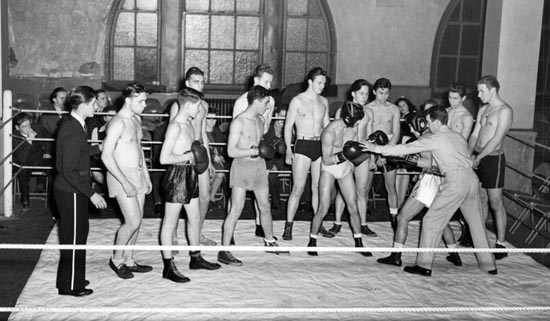
Recreation in Parks
Since the ancient Greeks (or even earlier) there has been a strong link between physical health and general wellbeing. For nearly 100 years, the Parks Department has been at the forefront in supporting a healthy city and putting the “recreation” in “Parks & Recreation.” From the early bathhouses to the anti–obesity programs of today, the Parks Department’s focus on active recreation has supported the goal of a healthy citizenry and positive social and moral conduct…

Near Queens Plaza – photo by Mitch Waxman
Volunteers and well wishers, of both corporate and individual stripe, line the streets. This is actually a dangerous place to be, as at any moment, 200 pounds of human meat may accidentally run into you. Accordingly, NYPD aggressively enforces a margin of safety between runners and crowd, as is their stated mandate and mission- protect and serve.
from wikipedia
The physical culture movement of the 1800s owed its origins to several cultural trends.
As a result of the Industrial Revolution, there arose a perception that members of the middle classes were suffering from various “diseases of affluence” that were partially attributed to their increasingly sedentary lifestyles. In consequence, numerous exercise systems were developed, typically drawing from a range of traditional folk games, dances and sports, military training and medical calisthenics. Many of these systems drew inspiration from the classical Greek and Roman models of athletic training and were organized according to more-or-less scientific methods.
Physical culture programs were promoted through the education system, particularly at military academies, as well as via public and private gymnasiums.
Increasing levels of literacy, the increasing democratization of printing and the relative affluence of the middle classes spurred the growth of a genre of magazines and books detailing these systems of physical culture. Mass production techniques also allowed the manufacture and commercial sale of various items of exercise equipment. During the early and mid-1800s, these printed works and items of apparatus generally addressed exercise as a form of remedial physical therapy.
Certain items of equipment and types of exercise were common to several different physical culture systems, including exercises with Indian clubs, medicine balls, wooden or iron wands and dumbbells. Combat sports such as fencing, boxing and wrestling were also widely practiced in physical culture schools, and were touted as forms of physical culture in their own right.
By the later 19th century, the ethos of physical culture had expanded to include exercise as recreation, education, as preparation for competitive sport and as an adjunct to various political, social, moral and religious causes. The Muscular Christianity movement is an example of the latter approach, advocating a fusion of energetic Christian activism and rigorous physical culture training.

NYC Marathon – photo by Mitch Waxman
A neverending stream of humanity, emblazoned with signage and logotypes, course past. Many are in the final stage of enacting some personal and tragic journey, or running to memorialize the name of a lost loved one, or to celebrate some event. Many have charitable contributions tied to the miles and miles of pavement they cross. Most just run for the human challenge presented by the concrete realities of New York City. At least that’s what the messages were in a series of Nike and Footlocker ads that I worked on for a major metropolitan ad agency just a few years ago.
Like I said at the beginning of this post, I walk (scuttle, actually). These people are nuts.
from wikipedia
The terms to jog and jogging as referring to a form of exercise, originated in England in the mid seventeenth century. This usage became common throughout the British Empire and in his 1884 novel My Run Home the Australian author Rolf Boldrewood wrote “your bedroom curtains were still drawn as I passed on my morning jog”.
In the United States jogging was also called “roadwork” when athletes in training, such as boxers, customarily ran several miles each day as part of their conditioning. In New Zealand during the 1960s or 1970s the word “roadwork” was mostly supplanted by the word “jogging”, promoted by coach Arthur Lydiard, who is crediting with popularizing jogging. The idea of jogging as an organised activity was mooted in a sports page article in the New Zealand Herald in February 1962, which told of a group of former athletes and fitness enthusiasts who would meet once a week to run for “fitness and sociability”.

NYC Marathon – photo by Mitch Waxman
As they progress, cheering crowds villify the thought of surrender, admonish fatigue, and buoy the athletes to further exertion.
from nycmarathon.org
Around the world, the word “marathon” evokes images of New York City. Before the New York race began, marathons were modest events run by a few athletes and followed by a few fans interested in the limits of human endurance. New York Road Runners and marathon co-founder Fred Lebow changed that. Today many marathons are huge media events that take over entire cities around the globe. None is as prominent as the ING New York City Marathon, but all city marathons are modeled on it. Modern marathoning owes its start — and its world-class status — to New York.
The first New York City Marathon, though, was a humble affair. In 1970, 127 runners paid the $1 entry fee to NYRR to participate in a 26.2-mile race that looped several times within Central Park. Fifty-five runners crossed the finish line

NYC Marathon, Dead by Choice band – photo by Mitch Waxman
All along the route, bands were assembled and were allowed to play both amplified music and drums- normally a violation of the city’s strictly enforced Cabaret Law. Entertainers, street performers, and representatives of the local Ethnic Societies all had their spots staked out early.
from nycmarathon.org
Music
More than 100 live bands stationed at regular intervals along the course will motivate and entertain participants and spectators alike. A special stage at Columbus Circle sponsored by Continental Airlines will provide inspiration for the final .2 mile, and there will be live entertainment at the finish line as well.

NYC Marathon, accordion man – photo by Mitch Waxman
Long Island City’s longtime residents always seem to have a good natured chuckle when one of these “City” events rolls through. This gentleman and his wife set up chairs, and he was playing the “toura loura loura” brand of music on his accordion to the runners. He also played an instrumental version of “eleanor rigby“, which was both ironic and funny.
The winners of the 2008 marathon were-
the male champion Brazilian Marílson Gomes dos Santos, who ran the course in 2 hours, 8 minutes and 43 seconds-
and British Paula Radcliffe won the female prize for her 2 hour, 23 minute, and 56 second run.

NYC Marathon – photo by Mitch Waxman
In 2008, the New York City Marathon was only thought to have killed two. Reports were later revised to three.
from wikipedia
The 2008 marathon events were marred by the deaths of three marathon participants:
Carlos Jose Gomes, 58, of Brazil fell unconscious shortly after completing the race in 4:12:15. An autopsy revealed that he had a pre-existing heart condition and died of a heart attack.
Joseph Marotta, 66, of Staten Island, N.Y. succumbed to a heart attack hours after he completed his fourth New York City Marathon. He walked the course in 9:16:46.[
An unidentified 41-year-old man who collapsed at the marathon died on 15 November.

NYC Marathon – photo by Mitch Waxman
The official website for the Marathon is found here. They are currently gearing up for the annual incarnation of the event- scheduled for November 1st, All-Saints Day 2009.
The way other cultures will be celebrating the day are ingenious, and varied. Incidentally, Nov 1st is also called Samhain, by some, but I would be surprised at any bonfires lit in the Newtown Pentacle.
from wikipedia
In Portugal and Spain, ofrendas (offerings) are made on this day. In Spain, the play Don Juan Tenorio is traditionally performed. In Mexico, All Saints coincides with the celebration of “Día de los Inocentes” (Day of the Innocents), the first day of the Day of the Dead(Dia de los Muertos) celebration, honoring deceased children and infants.
In Austria, Belgium, France, Hungary, Italy, Malta, Portugal and Spain people bring flowers to the graves of dead relatives.
In Poland, the Czech Republic, Sweden, Finland, Slovenia, Slovakia, Lithuania, Croatia, Austria, Romania, Moldova, Hungary and Catholic parts of Germany, the tradition is to light candles and visit the graves of deceased relatives.
In the Philippines, this day, called “Undas”, “Todos los Santos” (literally “All Saints”), and sometimes “Araw ng mga Namayapa” (approximately “Day of the deceased”) is observed as All Souls’ Day. This day and the one before and one after it is spent visiting the graves of deceased relatives, where prayers and flowers are offered, candles are lit and the graves themselves are cleaned, repaired and repainted.
In English-speaking countries, the festival is traditionally celebrated with the hymn “For All the Saints” by William Walsham How. The most familiar tune for this hymn is Sine Nomine by Ralph Vaughan Williams.

NYC Marathon – photo by Mitch Waxman
November 1st is, incidentally, also the anniversary of the abdication of the last Ottoman Sultan in 1922- Mehmed VI, which was the end of a 25 century struggle between east and west that truly began at The Battle of Marathon. It’s also World Vegan Day.
For the whole marathon series in a slideshow click here. I was down there shooting between 12 and 2, if you’re one of the runners, contact me for access to full resolution shots.

NYC Marathon – photo by Mitch Waxman
Wow, Forgotten Queens Plaza
Just read an awesome forgotten-ny page walking through Queens Plaza and environs. Check it out here.


 The Newtown Pentacle