Archive for the ‘St. Michael's Cemetery’ Category
pale garden
 |
 |
 |
|||
| The first posting in this series was “City of Marble and Beryl“, from the 7th of April in 2010. | 1 | The second posting in this series was “effulgent valleys“, from the 7th of May in 2010. | 1 | The third posting in this series was “Strange Prayers “, from the 7th of June in 2010. | |
June 27, 2010

– photo by Mitch Waxman
There are more shots in the following series up at my flickr page, if you care to view a few more of them. On the 27th of June, the day after a full moon, I found a white candle in front of the seeming altar. A few other incidentals were scattered about.

– photo by Mitch Waxman
Two cigars were in place, both had been lit at some point, but not smoked.

– photo by Mitch Waxman
There was a curious residue in the grass, which looked to me like candle wax or some other sort of resinous substance.
July 26, 2010

– photo by Mitch Waxman
The 26th of July was a full moon, and I showed up the day of… just to see if any preparatory elements had appeared for the night’s ceremony. There were charred bits of grain and burned bone in the spot where the candle wax or resin was last month.

– photo by Mitch Waxman
The white candle was smashed, probably by groundskeepers during routine mowing. I actually ran into a groundskeeper on this trip, an amiable but suspicious man who volunteered “I see all kinds shit up around here, bottles- knives- whatnot” when I queried him about the spot.
August 26, 2010

– photo by Mitch Waxman
The full moon was on the 24th in August, and obligation kept me from St. Michael’s until the 26th. Luckily, whoever is working this ritual site is fastidious, whereas the groundskeeping crew were concentrating on other more… modern… sections of the cemetery.

– photo by Mitch Waxman
This time around, there was a pan of what looked like peanuts (a kind of nuts at least), beans, and some sort of grain floating about in a frothy bath of water. There was intense rain just the day before, and the water very well might have been a natural accumulation.

– photo by Mitch Waxman
This time around, the candle was green, and nestled close to the altar.

– photo by Mitch Waxman
Melted white wax was also apparent.

– photo by Mitch Waxman
Additionally, there was a broken egg in the grass.
September 23, 2010

– photo by Mitch Waxman
Almost disappointed that “my man” didn’t show up on the moon of September 23rd, a humble narrator instead decided to think about the history of the place and the set of assumptions I’ve been operating under in recording this macabre series of scenes.

– photo by Mitch Waxman
First, the things I know for certain. The frequency of events at this location have been dropping off, after a flurry of activity at the start of the holy year at Easter. The site is set up along the meridian points of a compass, and it seems to have been following a lunar calendar since the early summer.

– photo by Mitch Waxman
Meridian points.

– photo by Mitch Waxman
South

– photo by Mitch Waxman
East

– photo by Mitch Waxman
West

– photo by Mitch Waxman
North and approximately 100-150 yards away.

– photo by Mitch Waxman
North and approximately 175 yards away. Bingo.

– photo by Mitch Waxman
Clockwork.

– photo by Mitch Waxman
A plate of great price, north of the new site.

– photo by Mitch Waxman
An odd necklace just south.

– photo by Mitch Waxman
Can this be a medicine bag?

– photo by Mitch Waxman
Just East was this torn apart bird. My first instinct was that this was a kill by one of the many felines which patrol the cemetery,

– photo by Mitch Waxman
But this isn’t how cats kill, and the bird’s sundered remains were all present and the tell tale signs of carnivorous consumption were absent.
pounding on the rocks
– photo by Mitch Waxman
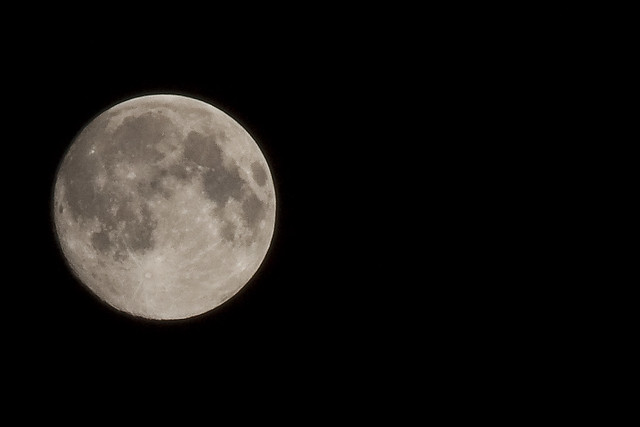
In accordance with habits cultivated, your humble narrator spent the lunar maximum visiting the vast garden cemetery complexes which adorn the Greater Newtown Pentacle during the waning of October. Surveys of these necropolitan complexes often reveal surprise and delight, and figure prominently in the rambling narrative which regular readers of this journal have grown accustomed to. Extant clues to the deep history of our communities can often be found carved into the nitre dripping monuments and grave markers which adorn and define the cemetery belt.
St. Michael’s Cemetery is found in Astoria, a charming victorian affair which has a surprisingly diverse roll call of interments.
from St. Michael’s
St. Michael’s Cemetery is situated in the borough of Queens in New York City. Established in 1852, St. Michael’s is one of the oldest religious, nonprofit cemeteries in the New York City metropolitan area which is open to people of all faiths. It is owned and operated by St. Michael’s Church, an Episcopal congregation located on the Upper West Side of Manhattan.
The original property for St. Michael’s Cemetery was purchased in 1852 by the Rev. Thomas McClure Peters and occupied seven acres. Over the years St. Michael’s gradually acquired additional land to its present size of approximately eighty-eight acres. Because it was Dr. Peters intention to provide a final dignified resting place for the poor who could not otherwise afford it, areas within the cemetery were assigned to other free churches and institutions of New York City. These areas are still held for the institutions they were assigned. As a service to its diverse constituency, St. Michael’s continues to this day provide burial space for individuals and families from all classes, religions and ethnicities. St. Michael’s reflects the demographic and historical trends of New York City. Walking through the older sections of the cemetery, you will find burials representing the 19th and early 20th century immigrants.

– photo by Mitch Waxman
Not so far from Newtown Pentacle HQ that it can’t be reasonably accessed, traversed, and returned from in a timely interval, my frequent strolls through the place are always intriguing. At 88 acres, it’s not the monster that the Olivette/Lutheran or Calvary/Zion objectives represent, and my proximity to it offers me the closest thing to true parkland in this section of Astoria (which does not have two enormous steel bridges spanning it). September and October of 2010, of course, were remarkable for the severe weather that swept across Queens (including an actual Tornado), and the toll taken on the ancient arboretum cemeteries during those days of angry skies is apparent to even casual notice.
from wikipedia
Cemetery authorities face a number of tensions in regard to the management of cemeteries.
One issue relates to cost. Traditionally a single payment is made at the time of burial, but the cemetery authority incurs expenses in cemetery maintenance over many decades. Many cemetery authorities find that their accumulated funds are not sufficient for the costs of long-term maintenance. This shortfall in funds for maintenance results in three main options: charge much higher prices for new burials, obtain some other kind of public subsidy, or neglect maintenance. For cemeteries without space for new burials, the options are even more limited. Public attitudes towards subsidies are highly variable. People with family buried in local cemeteries are usually quite concerned about neglect of cemetery maintenance and will usually argue in favour of public subsidy of local cemetery maintenance, whereas other people without connection to the area often argue that public spending comes from their taxes and therefore should be spent on the living in the district rather than being “wasted” on the dead.
Another issue relates to limited amount of land. In many larger towns and cities, the older cemeteries which were initially considered to be large often run out of space for new burials and there is no vacant adjacent land available to extend the cemetery or even land in the same general area to create new cemeteries. New cemeteries are generally established on the periphery of towns and cities, where large tracts of land are still available. However, people often wish to be buried in the same cemetery as other relatives, creating pressure to find more space in existing cemeteries and are not interested in being buried in new cemeteries with which there is no sense of connection to their family.
A third issue is the maintenance of monuments and headstones, which are generally the responsibility of families, but often become neglected over time. Decay and damage through vandalism or cemetery maintenance practices can render monuments and headstones either unsafe or at least unsightly. On the other hand, some families do not forget the grave but constantly visit, leaving behind flowers, plants, and other decorative items that create their own maintenance problem.

– photo by Mitch Waxman
The Osage Oranges, Maclura Pomifera if you might, have dropped onto the ground in accordance with their nature. A detailed posting on St. Michael’s atavist vegetation was offered nearly one year ago- “Things you learn from being a Ghoul“- which discusses the fruit, my discovery and identification of it, and various empirical theories about the enigmatic and quite prehistoric cultivar. I am keen on acquisition of an Osage wood staff, and fashioning a camera monopod from it, but “one must never remove anything from a graveyard” is one of the commandments etched into my iron road and I shall obey my maxim.
from wikipedia
The trees acquired the name bois d’arc, or “bow-wood”, from early French settlers who observed the wood being used for war clubs and bow-making by Native Americans. Meriwether Lewis was told that the people of the Osage Nation “esteem the wood of this tree for the making of their bows, that they travel many hundred miles in quest of it.” Many modern bowyers assert the wood of the Osage-orange is superior even to English Yew for this purpose, though this opinion is by no means unanimous. The trees are also known as “bodark” or “bodarc” trees, most likely originating from a corruption of “bois d’arc.” The Comanches also used this wood for their bows. It was popular with them because it is strong, flexible and durable. This tree was common along river bottoms of the Comanchería.

– photo by Mitch Waxman
A shame, for the Osage Oranges are actually highly prized as natural pesticides, and sell at a per piece price at major online auction sites. Offered at 6 for $5, such a harvest might find a hearty welcome here at NPHQ, which is underfunded and is a place where belts continue to be tightened and teabags used thrice.
Any reading this missive interested in alleviating the wicked poverty which approaches a humble narrator might wish to purchase the first Newtown Pentacle book– Newtown Creek, for the Vulgarly Curious– which can ordered by clicking this link. It’s available as a nicely bound paper book which will be shipped out to your choice of address, or in a downloadable ebook format (which is HIGHLY discounted)– I would add.
from wikipedia
Osage-orange, Horse-apple, Bois D’Arc, or Bodark (Maclura pomifera) is a small deciduous tree or large shrub, typically growing to 8–15 metres (26–49 ft) tall. It is dioeceous, with male and female flowers on different plants. The fruit, a multiple fruit, is roughly spherical, but bumpy, and 7–15 cm in diameter, and it is filled with a sticky white latex sap. In fall, its color turns a bright yellow-green and it has a faint odor similar to that of oranges.
Maclura is closely related to the genus Cudrania, and hybrids between the two genera have been produced. In fact, some botanists recognize a more broadly defined Maclura that includes species previously included in Cudrania and other genera of Moraceae.
Osajin and Pomiferin are flavonoid pigments present in the wood and fruit, comprising about 10% of the fruit’s dry weight. The plant also contains the flavonol morin.
Recent research suggests that elemol, another component extractable from the fruit, shows promise as a mosquito repellent with similar activity to DEET in contact and residual repellency.

– photo by Mitch Waxman
But… Mitch… -you ask- St. Michael’s? Wasn’t that the place with the weird ritual site that you posted about in “City of Marble and Beryl“, “Effulgent Valleys“, and “Strange Prayers” a few months back? What the heck, man, you just kind of dropped the whole thing after promising to keep us posted on it?
Actually, I’ve been making it a point to be in St. Michael’s after the full moon since then, but you’re just going to have to wait till tomorrow for all that…
from wikipedia
Magical rituals are the precisely defined actions (including speech) used to work magic. Bronisław Malinowski describes ritual language as possessing a high “coefficient of weirdness,” by which he means that the language used in ritual is archaic and out of the ordinary, which helps foster the proper mindset to believe in the ritual. S. J. Tambiah notes, however, that even if the power of the ritual is said to reside in the words, “the words only become effective if uttered in a very special context of other action.” These other actions typically consist of gestures, possibly performed with special objects at a particular place or time. Object, location, and performer may require purification beforehand. This caveat draws a parallel to the felicity conditions J. L. Austin requires of performative utterances. By “performativity” Austin means that the ritual act itself achieves the stated goal. For example, a wedding ceremony can be understood as a ritual, and only by properly performing the ritual does the marriage occur. Émile Durkheim stresses the importance of rituals as a tool to achieve “collective effervescence,” which serves to help unify society. Psychologists, on the other hand, describe rituals in comparison to obsessive-compulsive rituals, noting that attentional focus falls on the lower level representation of simple gestures. This results in goal demotion, as the ritual places more emphasis on performing the ritual just right than on the connection between the ritual and the goal. However, the purpose of ritual is to act as a focus and the effect will vary depending on the individual.
strange prayers

– photo by Mitch Waxman
For the first post on this curious altar- “City of Marble and Beryl”, in Astoria’s St. Michael’s Cemetery – click here
For the second post on this curious altar- “Effulgent Valleys“, in Astoria’s St. Michael’s Cemetery – click here
for a link to a google map, showing the location as recorded by GPS, click here
As the moon waxes to full, anticipation has found a home in the heart of your humble narrator, for the ritual site in St. Michael’s beckons. These shots are from May 28, 2010, one day after the full moon- which is referred to as the “hare’s moon” by antiquarians and occultists alike.
As is usual, the photographs are “forensic in nature”, and reveal the scene exactly as found and in situ, and nothing was manipulated or even touched.
from wikipedia
It is traditional to assign special names to each full moon of the year, although the rule for determining which name will be assigned has changed over time (e.g., the blue moon). An ancient method of assigning names is based upon seasons and quarters of the year. For instance, the Egg Moon (the full moon before Easter) would be the first moon after March 21, and the Lenten Moon would be the last moon on or before March 21. Modern practice, however, is to assign the traditional names based on the Gregorian calendar month in which the full moon falls. This method frequently results in the same name as the older method would, and is far more convenient to use.
The following table gives the traditional English names for each month’s full moon, the names given by Algonquian peoples in the northern and eastern United States, other common names, and Hindu and Sinhala names.[9] Note that purnima or pornima is Sanskrit for full moon, which has also become the Malay word for full moon purnama. Full moon days are sacred according to Buddhist tradition and called Poya in Sinhala, the dominant language of the Buddhist majority of Sri Lanka.

– photo by Mitch Waxman
The big question, of course, is “how are the folks who are working this ritual site getting in?”. St. Michael’s is quite secure, surrounded by corporate office parks and highways and locked tight behind stout fences. Well, not so stout, as a little exploration of the border fences showed several apertures and obvious breaches. I guess if someone wants to, they’re going to get in.
from wikipedia
The monthly cycle of the moon, in contrast to the annual cycle of the sun’s path, has been implicitly linked to women’s menstrual cycles by many cultures, as evident in the links between the words for menstruation and for moon in many resultant languages. Many of the most well-known mythologies feature female lunar deities, such as the Greek goddesses Selene and Phoebe and their Olympian successor Artemis, their Roman equivalents Luna and Diana, Isis of the Egyptians, or the Thracian Bendis. These cultures also almost invariably featured a male Sun god.
Male lunar gods are also frequent, such as Nanna or Sin of the Mesopotamians, Mani of the Germanic tribes, the Japanese god Tsukuyomi, Rahko of Finns and Tecciztecatl of the Aztecs. These cultures usually featured female Sun goddesses.
The bull was lunar in Mesopotamia (its horns representing the crescent). See Bull (mythology) and compare Hubal. In the Hellenistic-Roman rites of Mithras, the bull is prominent, with astral significance, but with no explicit connection to the moon.
Also of significance is that many ancient pagan religions and societies are orientated chronologically by the Moon as opposed to the sun. One common example is Hinduism in which the word Chandra means Moon and has religious significance particularly during the Hindu festival Karwa-Chouth.
The moon is also worshipped in witchcraft, both in its modern form, and in Medieval times, for example, in the cult of Madonna Oriente.

– photo by Mitch Waxman
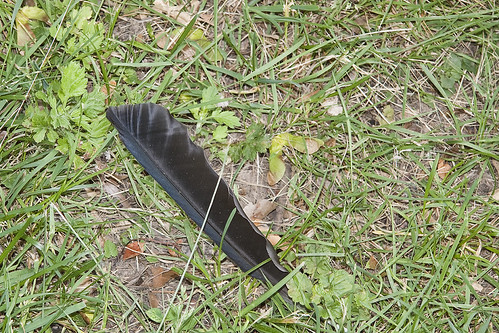
This time around, the feathers scattered around were black, and completed rather than shredded. The quills were also still attached.
from wikipedia
Madonna Oriente or Signora Oriente (Lady of the East), also known as La Signora del Gioco (The Lady of the Game), are names of an alleged religious figure, as described by two Italian women who were executed by the Inquisition in 1390 as witches.
The story which they are reported to have told is an elaborate and fantastical tale of occult religious rituals practised at the houses of wealthy individuals in Milan, Italy, where a woman known as the Madonna Oriente, possibly regarded as a goddess by her followers, performed magical acts such as the resurrection of slaughtered animals.
The two women, Sibilla Zanni and Pierina de’ Bugatis, were brought before the Inquisition first in 1384, and with their story apparently dismissed as fantasy, were sentenced only to minor penance. When they were investigated again in 1390, however, they were charged with consorting with the Devil, condemned, and executed.
While there is no evidence that the organized group described by the women actually existed, their testimonies are remarkably similar to those of several other groups in Italy and greater Europe, such as the followers of Richella and ‘the wise Sibillia’ in 15th century Northern Italy, the Benandanti of 16th and 17th century Northern Italy, the Armiers of the Pyrenees, the Romanian Căluşari, Livonian werewolves, Dalmatian kresniki, Hungarian táltos and Caucasian burkudzauta.
– photo by Mitch Waxman
The last batch of feathers observed were white, and suggested plucking. These were large and dark in color. I shot off the camera flash on the above shot, in the hope that certain ornithological enthusiasts known to be Newtown Pentacle readers might hazard an attempt at classification.
from wikipedia
The pregnancy of Coatlicue, the maternal Earth deity, made her other children embarrassed, including her oldest daughter, Coyolxauhqui. As she swept the temple, a few hummingbird feathers fell into her bosom. Coatlicue’s fetus, Huitzilopochtli, sprang from her womb in full war armor and killed Coyolxauhqui, along with her 400 brothers and sisters. He cut off her limbs, then tossed her head into the sky where it became the moon, so that his mother would be comforted in seeing her daughter in the sky every night.

– photo by Mitch Waxman
The main ritual focal remains the same, but candles and offerings have been altered from previous months. The candles are red and purple, and there are two cigars.
from wikipedia
Moon magic is the belief that working rituals at the time of different phases of the moon can bring about physical or psychological change or transformation. These rituals have historically occurred on or around the full moon and to a lesser extent the new moon. Such practices are common amongst adherents of neopagan and witchcraft systems such as Wicca. Witches in Greek and Roman literature, particularly those from Thessaly, were regularly accused of “drawing down the moon” by use of a magic spell. The trick serves to demonstrate their powers (Virgil Eclogues 8.69), to perform a love spell (Suetonius Tiberius 1.8.21) or to extract a magical juice from the moon (Apuleius Metamorphoses 1.3.1). These beliefs would seem to be consistent with many other cultures traditions, for instance; casting of the i ching is often done during the full moon’s apex.

– photo by Mitch Waxman
One cigar is approximately in the same position as the last one was, on April 30th.
this link from wikipedia actually refers to Santeria, which is not what I think we’re seeing here, but the spirit of it is correct
“The colonial period from the standpoint of African slaves may be defined as a time of perseverance. Their world quickly changed. Tribal kings and families, politicians, business and community leaders all were enslaved in a foreign region of the world. Religious leaders, their descendants, and the faithful, were now slaves. Colonial laws criminalize their religion. They were forced to become baptized and worship a god their ancestors had not known who was surrounded by a pantheon of saints. The early concerns during this period seem to indicate a need for individual survival under harsh plantation conditions. A sense of hope was sustaining the internal essence of what today is called Santería, a misnomer for the indigenous religion of the Lukumi people of Nigeria.
“In the heart of their homeland, they had a complex political and social order. They were a sedentary hoe farming cultural group with specialized labor. Their religion based on the worship of nature was renamed and documented by their masters. Santería, a pejorative term that characterizes deviant Catholic forms of worshiping saints, has become a common name for the religion. The term santero(a) is used to describe a priest or priestess replacing the traditional term Olorisha as an extension of the deities. The orishas became known as the saints in image of the Catholic pantheon.” (Ernesto Pichardo, CLBA, Santería in Contemporary Cuba: The individual life and condition of the priesthood)
As mentioned, in order to preserve their authentic ancestral and traditional beliefs, the Lukumi people had no choice but to disguise their orishas as Catholic saints. When the Roman Catholic slave owners observed Africans celebrating a Saint’s Day, they were generally unaware that the slaves were actually worshiping their sacred orishas. In Cuba today, the terms “saint” and “orisha” are sometimes used interchangeably.

– photo by Mitch Waxman
The second was inserted into the “Gran Poder” red candle.
from wikipedia
A classic Quimbanda ritual, called a trabalho, consists of several parts: a motive, dedication to a spirit, a marginal location, the metal or clay (earthy) material, an alcoholic drink, scent, and food (usually a peppered flour-palm oil mixture, sometimes called miamiami). An example of a trabalho is as follows:
Trabalho 1: ” A work of great force, under the protection of [Exu] Tranca Ruas das Almas (Block-Streets-of-the-Souls), to eliminate an enemy. “
- Go to a crossroads of Exu on a Monday or Friday near midnight, if possible in the company of a member of the opposite sex;
- greet Ogum with a bottle of light beer, a white or red candle, and a lighted cigar;
- greet Exu Sir Block-Streets-of-the-Souls by opening seven bottles of rum (cachaga) in the form of a circle, lighting seven red and black candles, and offering seven cigars;
- put inside a vase (alguidar) and mix the following: manioc flour (farinha da mesa), palm oil (azeitede-dendd), and peppers;
- put on the ground in the middle of the circle the name of the person whom one wishes to hurt, and, using a knife, stab this with violence, asking Exu to attend to one’s request.”
Depending on the purpose of the ritual, aspects of the trabalho will change. For instance, if one desires to seek justice from Exu they will use white candles, rum and a written request. Therefore, certain colors denote different motives in a ritual: white symbolizing an honest and justice-bound motive and red and black representing an aggressive and illicit motive. Other rituals substitute the harsh or spicy smell of cigars for the sweet smell of carnations, thus symbolizing the transformation between harming and helping rituals. Likewise, rituals involving female spirits (Pomba Giras) are less aggressive in their performance. A trabalho to obtain a woman is as follows:
Trabalho 7: “to obtain a woman. “
On a Monday or Friday night, go to a female crossroads (T-shaped rather than plus-shaped) and greet Pomba Gira by pouring a little rum, ” or better yet, champagne or anisette (aniz)”;
- place two pieces of cloth (pano) on the ground, one red and the other black, and on top of this put five or seven red roses in the shape of a horseshoe;
- fill a cup of good quality with champagne or aniz;
- put the name of the desired person in the cup or in the middle of the horseshoe;
- sing a ponto (song) and thank Pomba Gira.

– photo by Mitch Waxman
The purple candle had melted out, its wax incorporating into the loam.

– photo by Mitch Waxman
On the other side of the hill, flies were buzzing about this tumbled stone. There seemed to be some kind of carbonized “stuff” on it, almost a greasy smear of ash.
Crimes typically associated with ritual violence include: trespassing, vandalism, church desecration, theft, graffiti, arson, extortion, suicide, kidnapping, ritual abuse, animal sacrifice, and ritual murder. Trespassing related to ritualistic crime usually involves persons entering private areas such as woods, barns, and abandoned buildings for the purpose of having an isolated place to worship. Since most occult theologies are nature based, rituals are frequently held outdoors and altars are often constructed of natural elements. Vandalism most often associated with occult crime includes cemetery and church desecration. The most common types of cemetery desecration attributed to occult groups are digging up graves, grave robbing, and tampering with human corpses or skeletons. This is frequently motivated by religious beliefs that require human bones to fulfill specific rituals. Church desecration frequently includes destroying Bibles, urinating and defecating on holy objects and furniture, tearing crucifixes off walls, and destroying rosaries and crucifixes. It is important to note that the motivations behind such vandalism can also be attributed to hate crimes. Thefts from Christian churches, Jewish synagogues, hospitals, morgues, medical schools, and funeral homes are often linked with ritual violence. Items that are most often taken include cadavers, skeletal remains, blood, and religious artifacts that are considered sacred: crucifixes, communion wafers, wine, chalices, and so on. Frequent motivations for these thefts are that particular groups require actual holy artifacts or human organs, bones, and the like for their rituals.

– photo by Mitch Waxman
The material on its surface was vegetable in nature, but it was stuck to something whose adhesive qualities were strong enough to resist strong breezes and attract a number of largish black and green flies.
from nypost.com
Two of Queens’ largest parks are hotbeds for animal sacrifices, according to park rangers and advocates.
Longtime Parks Department ranger Joe Puleo told The Post that killing animals for ritualistic reasons in the city is widespread, but that Forest Park and Highland Park are the most common locations.
Perpetrators of the outlawed act are rarely busted because they perform their bloody rituals in the dead of night, and the two parks no longer have 24-hour patrols due to budget cuts.
“They are never caught, because they are careful, and they never do it during the day. They do it at night when no one is around,” Puleo said.

– photo by Mitch Waxman
Lords and Ladies of Newtown, there is a hidden cult at work amongst you, amongst the moon shadowed tomb legions of Astoria.
effulgent valleys

– photo by Mitch Waxman
I went over to St. Michael’s Cemetery again last week to see if there were any developments on the ritual site which Our Lady of the Pentacle and I found a few weeks ago. A hypothesis of mine that this ritual site is being “worked” on a lunar schedule seems to be bearing fruit.
For the first post on this curious altar- “City of Marble and Beryl“, in Astoria’s St. Michael’s Cemetery- click here
for a link to a google map, showing the location as recorded by GPS, click here

– photo by Mitch Waxman
Intriguing are the differences between the last set of offerings, ritual devices, and this grouping, although the setting remains the same. Also, to be absolutely clear- this is not staged in any way, and represents exactly what I observed in situ.

– photo by Mitch Waxman
The brownish cylinder appeared to be a cigar, and the white candle’s wick was blacked but the wax was nearly pristine.

– photo by Mitch Waxman
A set of bleached bones seemed to have been arranged in some non random pattern.

– photo by Mitch Waxman
There were also holes punched in the dirt, which could just be the action of wildlife of course, but the soil of the graveyard was depressed inward without the characteristic mound of surface tailings left behind by those that burrow. It appeared that something had been stuck into the soil.

– photo by Mitch Waxman
Also, amongst the bones, were coins.

– photo by Mitch Waxman
To the north was a glass with a white candle inside of it, approximately 25 feet away.

– photo by Mitch Waxman
The candle’s glass was broken, if that means anything.
– photo by Mitch Waxman
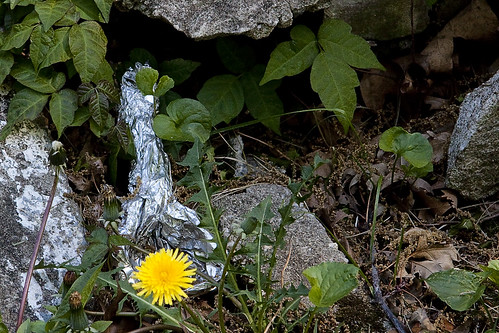
On the west face, this ladle shaped molding of aluminum foil was extant.

– photo by Mitch Waxman
Here’s the whole scene, the center stone seems to be the main altar- it’s where the cigar, bones, and coins as well as the unconsumed candle were observed. The ladle was to the west, on the downward slope, and candle in the glass to the north at the right of the shot.

– photo by Mitch Waxman
The line of monuments in this section are very old, and many of the legends on the stones are faded away, here in St. Michael’s St. George section.
City of Marble and Beryl

– photo by Mitch Waxman
Note: One of those things that your humble narrator is guilty of is a tendency, when confronted with something alien or unknown, to “fill in the blanks” via an inexact mixing of logical supposition and impressionist reasoning. The opposite of exactitude, this can result in wild ideas and false assumptions being presented and accepted as fact. I would love to tell you which cultic group these artifacts belong to- but the fact is that I just don’t know. Certain assumptions can be hazarded, based on cursory resemblance and observed phenomena, but they will be guesses. Don’t assume my interpretation of things is correct.
Witness, then, what I observed in St. Michael’s Cemetery on the Saturday before Easter- April 3rd, 2010- right about here.

– photo by Mitch Waxman
In St. Michael’s, there is a hill which faces East and whose tombstones are very old. The graves are in a state of disrepair, and the stones are found to be in a ruined state. This is no fault of the Cemetery, which maintains its grounds in a meticulous fashion, instead it is merely time and weather which have worked their havoc on the monuments. Perambulating through the grounds on Saturday with Our Lady of the Pentacle, we found this scene.

– photo by Mitch Waxman
A variety of Afro-Cuban syncretic faiths use similar iconography, but the one which most of the english speaking community is passingly familiar with is called Santeria (aka Regla de Ocha, La Regla Lucumi, or Lukumi). This appeared to be Santeria to me at first- because of the particular color scheme of the candles (red white and blue) and the co-mingling of coinage and sacrificial bones. But the Santeria folks generally do their thing indoors, in a ritual space consecrated and blessed by their own padrinos, just like the Catholics. Graveyards are usually avoided for rituals as they are negative places.

– photo by Mitch Waxman
My observation has been that the local latino populations in Astoria tend to be South rather than Central American, and the geographic heritage of Santeria is Caribbean and Central American. Afro-Cuban religion sprang up amongst the African Slaves brought to the New World to work the sugar and tobacco fields who were forced to adopt Roman Catholicism. Voodoo in Haiti and Louisiana, Hoodoo in the American South- all products of the French empire- with Santeria, Obeah, and Palo progeny of the Spanish.
The other great Catholic nation that held huge numbers of west africans as livestock was Portugal, and it did so in Brazil- where Umbanda, Candomblé, Macumba, and Quimbanda originate. Brazil is in South America, of course, and there are tremendous populations of Brazilians living nearby St. Michael’s in surrounding Astoria. This is some of that logical supposition I warned you about…

– photo by Mitch Waxman
Folk magic sites like this raise the ire of Eurasian morals, as ritual animal sacrifice is kept out of sight in our modern communities, and commoditized as Kosher or Halal or Organic meat. Blood sacrifice and submission to cultural norms, from circumcision to ear piercings to the elaborate face paint called “cosmetics”, are part of our daily lives. This sort of visceral aftereffect of some unfortunate avian’s end, however, is disturbing. No less though, than a crucifixion or any other blood ritual.

– photo by Mitch Waxman
One of the many ridiculous totems tucked away in my jacket pocket is a small magnetic compass. When I began these long walks around what I would someday call the Newtown Pentacle, it served me well, and today it revealed that this ritual space was lined up exactly on the cardinal points of my trusty little friend.
The scattering of bottles, bones, coins, and candles sits east of the stone which is aligned north south in the long dimension, and its anterior face is west facing. This will become increasingly important.

– photo by Mitch Waxman
This little package and knife are north east of the monument which I’ll be referring to as an altar. I did not open it, of course, it is against Newtown Pentacle policy to actually touch any of the odd things I come across, like the Pulaski Bridge, with bare skin. This whole neighborhood could use a good scrub, if you ask me.

– photo by Mitch Waxman
As always, if you click any of these images- a new window will open up its Flickr Page. Clicking the “all sizes” button found there will take you to progressively larger incarnations- all the way up to “actual pixels”. Check these out, I’ve spent some time trying to figure out what’s inside of the package. Do any of you sharp eyed Ladies and Lords of Newtown out there wish to hazard a guess? Use the “leave a comment” link.

– photo by Mitch Waxman
Seeing the blade and little kidney shaped package gave the whole scene a somewhat sinister air, and that’s when I remembered to check what else might be found on the cardinal meridians of the compass.

– photo by Mitch Waxman
The western facing of the altar sits at the pinnacle of a muddy ridge, which bears much subsidence. The underpinnings of the stone, and declination of the hill itself, fall away rapidly. These candles were observed.

– photo by Mitch Waxman
Nothing special about one of them, the other was unusual. Both red.

– photo by Mitch Waxman
The west facing side of the scene, from the bottom of the little hill. Note the tumbled and disorganized state of the masonry. North is to your left, south to the right.

– photo by Mitch Waxman
Moving north, a white candle .

– photo by Mitch Waxman
Back on top of the hill, directly east of the white candle above, and north of the main altar.

– photo by Mitch Waxman
A green and a pink candle on a dish of “some quality”.

– photo by Mitch Waxman
West of altar, a tumbled monument, with odd etchings on it. Can this be some sort of language?

– photo by Mitch Waxman
South of altar, west side of hill, a plastic bottle with some sort of red/brown liquid in it.

– photo by Mitch Waxman
Notice that the ground is depressed here, as if something very heavy- like a tombstone- had been moved recently.

– photo by Mitch Waxman
Just at the other end of the divot was this foil wrapped bottle which looked like it had been in the ground for a long time. Notice how the moss grows right up to it.

– photo by Mitch Waxman
Top of hill, south side, looking north across site. There are feathers scattered around the grass, mainly just north of the altar. Click here for a flickr page which shows some detail of the feathers.

– photo by Mitch Waxman
There was also this upside down cross.


 The Newtown Pentacle