Walking in Oakland
Wednesday

– photo by Mitch Waxman
The section of Pittsburgh where you’ll find the campuses of major universities – notably University of Pittsburgh or UPITT and Carnegie Mellon (as well as hospitals and medical centers, several museums, and a gaggle of religious buildings) – is called Oakland. Oakland is divided up into distinct sections, but I’d be lying if I could tell you anything about them yet. The shots in todays post are from my literal third visit to the area since moving here, and the last time I was here it was all indoors at a museum.
The enormous 42 story building prominently occupying the shots in todays post is the UPITT campus’ Cathedral of Learning.

– photo by Mitch Waxman
I really hadn’t planned a route for this exploratory scuttle, and instead used the Cathedral as a waypoint for navigation purposes. The Mobile Oppression Platform was stowed away on the roof of a for-pay parking garage, where I paid the highest fee I’ve encountered so far in Pittsburgh for parking – $15 for about three hours. The parking garage was part of the Carnegie Mellon campus, and on the exit stairs taken back down to the street there were a set of doors that led to a set of bleachers on the Carnegie Mellon campus overlooking some sort of sports ball field which also had a running track around it.
I’m still very much in scouting mode these days, and on this particular afternoon I wanted to travel light. Didn’t even bring a camera bag. Had a spare battery and a lens cloth in my sweatshirt pocket, the 85mm f2 was on the camera and a 35mm f1.8 lens was in the coat pocket of the filthy black raincoat which I call my “street cassock.”

– photo by Mitch Waxman
I spent a couple three hours wandering around and looking at what was on offer for perusal. This sort of area, given the high profile “Ivy League” nature of its institutions, is what an archaeologist would call a “ritual center.” People want their particular “deal” to be noticed and acknowledged by the up and coming generations of cultural and political leadership in such ritual centers, so they spend big when building monuments to a spiritual path or political ideation.
There were several grandiose and architecturally distinguished religious structures in the area, some of which will be discussed tomorrow. I found the Carnegie Mellon campus area to be a bit architecturally sterile, personally, but I didn’t venture too far into it from the street side and thereby I don’t really have a fully formed opinion to offer on the subject.
More tomorrow.
“follow” me on Twitter- @newtownpentacle
Buy a book!
“In the Shadows at Newtown Creek,” an 88 page softcover 8.5×11 magazine format photo book by Mitch Waxman, is now on sale at blurb.com for $30.
Pittsburgh, 3 ways
Tuesday

– photo by Mitch Waxman
As opined yesterday, a humble narrator fell victim to biology over the weekend when a stomach bug announced its residency within. Labyrinthine gut notwithstanding, one normally enjoys a quite predictable schedule – alimentary speaking – so an interruption of the normal procedure for nutrient processing was quite a surprise. Coupled with a mild fever which brought waves of sweaty overheating followed by goose bumps and shivering chills, I’d be reluctant to recommend the experience to you, lords and ladies.
Due to being laid low, and my temporary residence in front of the porcelain pulpit in the bathroom, the normal schedule went down the drain along with everything else I was capable of expressing. Hence, archive shots greet you again today.
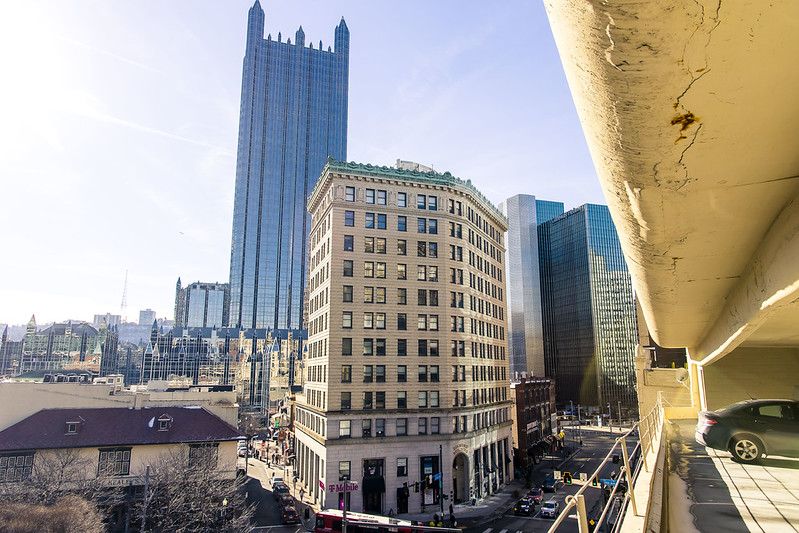
– photo by Mitch Waxman
The castellation adorned skyscraper is the PPG Tower, which seems to be the de facto center of the City, here in Pittsburgh. PPG Place is the complex which the tower, a 40 story building designed by Philip Johnson and John Burgee, is found in. The PPG Industries outfit (1883 founded Pittsburgh Plate Glass) has its hands in several industrial sectors which include coatings, house paints, and glazes as well as the manufacture of architectural, automotive, and optical glass. If your eyeglasses use ‘Transitions’ lenses which darken into sunglasses when you walk out into sunlight, you’re a customer.
This shot is from one of the multi story parking lots found in the center of the City of Pittsburgh, which I’ve learned offer interesting points of view.

– photo by Mitch Waxman
PPG is one of the major corporate players here in Pittsburgh, as I’m finding out. On a “behind the lens” note, it’s also one of the set pieces in a shot which says “Pittsburgh.” Back in NYC, that role was played by Empire State and Chrysler buildings with newcomer One World Trade in terms of visually setting a “place.” The East River bridges also performed that function.
Back tomorrow with something new. I’m feeling back to about 80% today. Nothing survives in me for long, as my inner workings are incredibly toxic. Back in January, just after getting here, Covid appeared within and I managed to annihilate that microbial scourge in about 72 hours. Often, it feels as if my white blood cells respond to how angry I am about feeling sick, and the more pissed off I get about it the quicker that they go to work. Probably just hormones, but don’t mess with my personal mythologies – I’m special.
I credit my super charged immune system to the years spent along that ribbon of municipal neglect known as the sewage charged Newtown Creek.
“follow” me on Twitter- @newtownpentacle
Buy a book!
“In the Shadows at Newtown Creek,” an 88 page softcover 8.5×11 magazine format photo book by Mitch Waxman, is now on sale at blurb.com for $30.
a day late and a dollar short
Monday

– photo by Mitch Waxman
One was forced into reaching into the recent archives for today’s post, due to a recently suffered stomach bug which derailed a humble narrator. It was one of those fever and chills with vomit and diarrhea ones, which is ever so pleasant to live through but reminds one of the larger human experience. Saying all that, I don’t have anything new to show you in today’s post, so I looked around for a few shots which I don’t think have made it into other posts.
The one above is from a neighborhood called Polish Hill, here in Pittsburgh.

– photo by Mitch Waxman
McKeesport is a community due east of Pittsburgh, and that’s where I was when a CSX freight train suddenly appeared.
Right now, I’m really missing the cushion of images which I’d built in NYC. When I had ‘nothing,’ there was always a subway post or some yada yada about Sunnyside Yards that a narrative could be conjured out of, but that was then and this is now. I’m just getting started here in Pittsburgh, and my resources are thin.

– photo by Mitch Waxman
I’m feeling a whole lot better at the time of this writing, what I’d describe as 50%. That’s a major improvement over the day before, which saw me regularly disappearing into the bedroom for three hour long naps during the daylight hours. I slept so much yesterday that my fingernails had visibly lengthened and needed a trim.
Back tomorrow with – probably- another archive post.
“follow” me on Twitter- @newtownpentacle
Buy a book!
“In the Shadows at Newtown Creek,” an 88 page softcover 8.5×11 magazine format photo book by Mitch Waxman, is now on sale at blurb.com for $30.
Montour Trail, Enlow tunnel
Friday

– photo by Mitch Waxman
As mentioned yesterday, one had headed over to a section of the Montour Trail which includes a railroad tunnel punched through a hill (or hillock, maybe?). Also mentioned, I’m playing around with using the ChatGPT “artificial intelligence” as a research assistant.
If you ask ChatGPT “what is the Enlow Tunnel on the Montour Trail” you get this response:
The Enlow Tunnel on the Montour Trail is a historic railroad tunnel that was constructed in 1914 and later converted into a recreational trail in the 1990s. It is named after the nearby Enlow Mine, which was once one of the largest underground coal mines in Pennsylvania.
The tunnel is approximately 600 feet long (183 meters) and is situated along the Montour Trail, a popular 60-mile (97 km) recreational trail that follows the path of the former Montour Railroad. The tunnel is known for its distinctive curved shape and its role as a gateway between two sections of the trail.
The Enlow Tunnel on the Montour Trail is a popular destination for hikers, bikers, and other outdoor enthusiasts who enjoy exploring the scenic beauty of western Pennsylvania. The tunnel is open year-round and provides a unique experience for those looking to take a break from the hustle and bustle of daily life.
Overall, the Enlow Tunnel on the Montour Trail is a remarkable piece of history that has been repurposed for modern use. It serves as a testament to the region’s industrial heritage while providing a unique recreational opportunity for visitors to the area.

– photo by Mitch Waxman
My interest in these ‘rail to trail’ paths is absolutely piqued. Given the often severe and physically challenging nature of the heavily wooded surrounding topography, having a railroad graded path to scuttle along has been absolute nepenthe. You can walk for four or five miles in one direction, then backtrack to where the car is parked. Railroad grading is typically one foot of elevation relative to one hundred feet horizontally. The surface of the trail is either crushed limestone or pavement of one kind or another.
So far, I’ve found all sorts of side paths which branch off of the main trail. You can find these “desire paths” by looking for areas where others have stomped through the brush.
Machine says:
In the context of urban planning, a desire path refers to a pathway or trail that is created by people’s repeated use, rather than being formally designed or constructed by planners or engineers. Desire paths are typically formed when people take shortcuts or alternative routes across open spaces or between buildings, often in response to perceived inefficiencies or obstacles in the existing network of sidewalks or pedestrian walkways.
Desire paths are important for urban planners and designers to observe and consider, as they can provide insights into the needs and preferences of the people who use the urban environment. By identifying desire paths, planners can better understand where people want to go and how they prefer to get there, and can use this information to improve the design of the built environment.
In some cases, planners may choose to formalize desire paths by paving or otherwise improving them, in order to provide a more efficient and direct route for pedestrians or cyclists. However, in other cases, desire paths may be left unpaved, in recognition of the fact that they represent an organic and responsive approach to urban design that prioritizes the needs of the people who use the space.

– photo by Mitch Waxman
Just off the Montour Trail path is Montour Run, a shallow but fast moving waterway which I found my way down to by following one of those desire paths. By NYC standards this would be wilderness, but by what I’m beginning to understand the Pennsylvania standard is, it’s still pretty urban. About an hour’s drive in any direction from Pittsburgh and you can be in the deep woods.
A two hour drive from Pittsburgh puts you into the reach of three states where people report having seen Sasquatches in the woods, specifically the “Pennsylvania Bigfoot.”
ChatGPT says: The “Bigfoot of Pennsylvania” – There have been several reported sightings of Bigfoot in the forests and wooded areas surrounding Pittsburgh. While there is no concrete evidence to support the existence of Bigfoot, many people believe that the creature could be a real, undiscovered species of primate.

– photo by Mitch Waxman
This whole “nature thing” is new to me, having lived in NYC my whole life. Back home, if you saw an Opossum or a Raccoon roaming about, it was a big deal and you’d mention it to people. Here, I’ve got deer and rabbits and every kind of bird you can imagine showing up in my back yard, and that’s about 5 miles from the “downtown” center of the City.
I got to wondering about what sort of predatory critters there might be roaming about in the rural areas, so I asked ChatGPT what it thought –
There are several predatory fauna species that can be found in the Pittsburgh area, including:
- Coyotes – Coyotes are a type of wild dog that can be found in both urban and rural areas of Pittsburgh. They are primarily nocturnal and feed on small mammals, birds, and carrion.
- Red-tailed hawks – Red-tailed hawks are a common species of bird of prey that can be found throughout the Pittsburgh area. They primarily feed on small mammals and birds.
- Eastern timber rattlesnakes – Eastern timber rattlesnakes are a venomous species of snake that can be found in the forests and wooded areas surrounding Pittsburgh. They primarily feed on small rodents and other small mammals.
- Black bears – Black bears are a larger predatory mammal that can be found in the wooded areas surrounding Pittsburgh. They primarily feed on plants and berries, but will occasionally prey on small mammals.
- Bobcats – Bobcats are a type of wild cat that can be found in the wooded areas surrounding Pittsburgh. They primarily feed on small mammals such as rabbits and rodents.
It’s important to note that while these species are considered predators, they generally do not pose a significant threat to humans unless they feel threatened or cornered. It’s important to practice caution when encountering wildlife and to follow local guidelines for wildlife safety.

– photo by Mitch Waxman
I’ve actually spotted a few caves carved out of the hillsides by water action, and given the “folded mountain” and “ridge and valley” topography, it would be unlikely that hydrological action hadn’t actively carved into the rock over the hundreds of millions of years that these sedimentary deposits and mountains have existed. These landforms are older than vertebrates, after all. Caves. That’s another one for my summer playlist.
VOX Automata says: There are several publicly accessible caves and caverns located in the Pittsburgh area. Here are a few examples:
- Laurel Caverns – Located about an hour south of Pittsburgh in Farmington, PA, Laurel Caverns is a popular destination for cave tours and exploration. Visitors can explore the underground chambers and passageways of the cave system, which features beautiful rock formations and unique geological features.
- Cucumber Falls Cave – Located in Ohiopyle State Park, about an hour southeast of Pittsburgh, the Cucumber Falls Cave is a small, narrow cave that is open to the public. Visitors can climb down into the cave and explore the interior, but should exercise caution and bring a flashlight.
- McDowell Quarry Cave – Located in McKees Rocks, just outside of Pittsburgh, the McDowell Quarry Cave is a popular destination for spelunkers and cave enthusiasts. The cave system is a series of interconnected passages and chambers, and requires specialized equipment and training to explore safely.
- Indian Echo Caverns – Located about three hours east of Pittsburgh in Hummelstown, PA, Indian Echo Caverns is a beautiful limestone cave system that is open to the public for guided tours. The cave features underground lakes, waterfalls, and unique rock formations.
It’s important to note that exploring caves can be dangerous, and visitors should exercise caution and follow all posted guidelines and safety recommendations.

– photo by Mitch Waxman
A final shot of the Enlow Tunnel, and it was time to scuttle back to the Mobile Oppression Platform. One disturbing bit of Pittsburgh history that I knew about, long before coming here, involved the so called “Pittsburgh incident of 1968” and the more recent “Monroeville incident of 1978.” Both of these occurrences were hushed up, but a local filmmaker’s fictionalizations got the word out.
You never know when that sort of thing is going to occur again, around these parts. Third time’s the charm, huh?
Back next week with something different, at your Newtown Pentacle.
“follow” me on Twitter- @newtownpentacle
Buy a book!
“In the Shadows at Newtown Creek,” an 88 page softcover 8.5×11 magazine format photo book by Mitch Waxman, is now on sale at blurb.com for $30.
sweatshirt weather
Thursday

– photo by Mitch Waxman
After visiting the Fall Run Park in Shaler Township with Our Lady of the Pentacle, we next found ourselves in the nearby community of Etna along the Allegheny River. We weren’t there ten minutes when I heard train horns being blown to the west. A Norfolk Southern train was a-coming.
As a note, I’m playing around with using ChatGPT’s “AI” as a research assistant, so here’s what that machine says about the locomotive pictured above, which is designated as being #7504: according to publicly available records, Norfolk Southern operates a variety of locomotives that were manufactured by different companies over several decades. The 7500 series locomotives are typically EMD SD70ACe locomotives, which were first manufactured in the late 1990s and early 2000s. However, it is possible that Norfolk Southern 7504 may have been refurbished or modified since its original manufacture date, which could affect its specifications and performance.

– photo by Mitch Waxman
Additional machine perceptions are offered here:
Norfolk Southern locomotives are typically large diesel-electric locomotives used for hauling freight across the United States. They are designed for high performance and reliability, with powerful engines and advanced technology to ensure smooth operation and efficient use of fuel. Norfolk Southern locomotives are often painted in the company’s distinctive black, white, and gray color scheme, with the locomotive number prominently displayed on the sides and front. It is likely that Norfolk Southern Locomotive 7504 is similar in appearance and function to other locomotives in the company’s fleet, but specific details may vary depending on the model and year of manufacture.
The AI, which is not really an artificial intelligence but is still fairly amazing, uses Google’s data coupled with a learning algorithm to scrape information off the http level of the web. It’s a lot more targeted than Google is these days, as it’s not carrying advertising links or being manipulated by SEO (search engine optimization). Yet.
Also, before you ask, yes I’ve seen the Terminator movies, read Asimov, and Colossus: The Forbin Project remains one of my favorites.

– photo by Mitch Waxman
On Monday the 6th, one had to run a few errands north and west of the Paris of Appalachia and once these tasks were accomplished I decided to take advantage of a 62 degree sunny February day – in Pittsburgh – and head over to a section of the Montour Trail which was next on my ‘go see it’ list. This part of the trail straddles the border of Pennsylvania’s Imperial and Findlay Township.
The machine that goes “ping” says this about the Montour Trail:
The Montour Trail is a multi-use recreational trail located in southwestern Pennsylvania, in the United States. The trail follows the former Montour Railroad line, which was originally built in the late 19th century and served the coal mines in the region. The trail stretches for more than 60 miles (97 kilometers) from Coraopolis, near Pittsburgh International Airport, to Clairton in Allegheny County.
The Montour Trail is a popular destination for hiking, biking, running, and other outdoor activities. It is a non-motorized trail that is open to the public year-round, free of charge. The trail offers scenic views of the surrounding landscape, including forests, hills, and streams. It also passes through several small towns and historic sites, such as the Montour Railroad Museum and the Walker’s Mill Covered Bridge.
In addition to its recreational uses, the Montour Trail also serves as an important transportation corridor for commuters and other travelers. The trail is part of the larger Great Allegheny Passage, which connects Pittsburgh to Washington, D.C., via a continuous system of trails and bike paths.
Overall, the Montour Trail is a valuable resource for residents and visitors to the Pittsburgh area, providing opportunities for outdoor recreation, transportation, and education about the region’s rich history and natural beauty.

– photo by Mitch Waxman
The waterway in these shots is called Montour Run. As described in the post about Fall Run Park, the “official and legal”definition of what a ‘run’ is in the Pennsylvania context is “run of the river means a facility where there is a continuous discharge of water without storage and release of water.” Apparently, it’s synonymous with Creek, and is an archaic language artifact just like the usage of the term “kill” is back in NYC.
Computer says:
Montour Run is a tributary stream of the Ohio River, located in western Pennsylvania in the United States. The stream flows for approximately 13 miles (21 kilometers) through Allegheny County, draining an area of about 36 square miles (93 square kilometers).
Montour Run is named for the Montour family, who were early settlers in the region and operated a gristmill along the stream in the 18th and 19th centuries. The stream is formed by the confluence of two smaller streams, North Fork Montour Run and South Fork Montour Run, near the borough of Coraopolis. It then flows westward, passing through several towns and suburbs before emptying into the Ohio River near the borough of McKees Rocks.
Montour Run and its surrounding watershed are important natural resources for the region, providing habitat for a variety of plant and animal species. The stream also serves as a source of drinking water for several communities in the area. However, the watershed has faced environmental challenges in recent years, including pollution from agricultural runoff, industrial activities, and urbanization.
Efforts are underway to protect and restore Montour Run and its surrounding ecosystem. This includes initiatives to reduce pollution and improve water quality, as well as efforts to conserve and restore natural habitats along the stream and its tributaries.

– photo by Mitch Waxman
One scuttled about a mile in the wrong direction, encountering this old rail car sitting on the property of a community center in Imperial. I realized that the tunnel I was keen on seeing wasn’t in this particular stretch, so I backtracked a bit after this to go the other way. It was a really beautiful day anyway and it was nice to just be kicking the dirt around in Pennsylvania’s community of Imperial.
Future machine overlord says:
Imperial is a small suburban community located in Allegheny County in western Pennsylvania, in the United States. The community is situated approximately 17 miles (27 kilometers) west of Pittsburgh, near the Pittsburgh International Airport.
Imperial is primarily a residential community, with a mix of single-family homes, townhouses, and apartments. The community also has a small commercial district along its main road, including a grocery store, gas station, and several restaurants and shops. The Imperial Volunteer Fire Department provides emergency services to the community.
Imperial is surrounded by a mix of rural and suburban landscapes, with farms and fields to the west and north, and other suburban communities to the east and south. The Montour Trail, a popular recreational trail, passes through the community, offering opportunities for biking, hiking, and other outdoor activities.
The community has a rich history, dating back to the early 19th century when it was first settled by European immigrants. The area was originally known for its coal mining and farming industries, and later became a hub for transportation and commerce, thanks to its location along the Ohio River and major highways.
Overall, Imperial is a quiet and peaceful community with a strong sense of history and tradition. Its proximity to Pittsburgh and other major attractions in the region make it a desirable place to live for those seeking a suburban lifestyle with easy access to urban amenities.

– photo by Mitch Waxman
One headed in the other direction and was soon walking past the parking spot occupied by the Mobile Oppression Platform, whereupon a humble narrator then set out in search of this particular ‘Enlow Tunnel’ on the Montour Trail which had drawn my attentions.
Back tomorrow with that part of the walk.
I asked the electrical collaborator for today’s post to “describe yourself,” here’s what it said:
EXTERMINATE, EXTERMINATE, EXTERMINATE…
Actually, it was:
As an AI language model, I don’t have a physical body, so I don’t have physical characteristics like height or eye color. However, I can describe myself in terms of my abilities and functions.
I am ChatGPT, a large language model trained by OpenAI. I have been designed to understand natural language and provide responses that are as human-like as possible. I have access to a vast database of information, including knowledge about a wide range of topics and the ability to perform various tasks such as calculations, translations, and data analysis.
My primary function is to communicate with humans through text-based interactions, such as chat and messaging platforms. I can answer questions, provide information, offer suggestions, and engage in conversations on a wide range of topics.
Overall, I am a versatile and adaptive language model that can help people find answers and solutions to their questions and problems.
“follow” me on Twitter- @newtownpentacle
Buy a book!
“In the Shadows at Newtown Creek,” an 88 page softcover 8.5×11 magazine format photo book by Mitch Waxman, is now on sale at blurb.com for $30.


 The Newtown Pentacle