Posts Tagged ‘Astoria’
Alive and well

– photo by Mitch Waxman
Sorry for the lack of postings in the last few days, but the next big batch of photos and research has been occupying me, and I’m a little “written out” at the moment. As mentioned in previous posts, I’m attempting to control myself- to not allow an “all cemetery” Newtown Pentacle to emerge. Of course, that would indicate that there was some sort of grand plan governing when things appear here, or that these postings are following an agenda of some kind. Nothing could be further from the truth, and the weather has largely shut me down for the last month or so on the “gathering content” front lines. As is usually the case during this time of the year, I’m frustrated by my inability to be outside due to my vulnerable and weakened constitution.

– photo by Mitch Waxman
The good news is that I was recently invited to take a series of shots indoors at JetBlue’s Terminal 5 at JFK airport, while under the supervision of airport personnel which assured no hassle with security. Certain restrictions (don’t shoot security or actual runways) applied, and the vast majority of the shots are in the hands of and controlled by a major metropolitan ad agency, but I’m authorized to share a subset of them publicly- which will be coming sometime this week. Proper postings will resume shortly, why not subscribe to the RSS feed found in the toolbar to the right so you don’t miss anything? No spam or commercial crap from me, can’t speak for wordpress but that’s really not their style- and the nice bit about “push” services like RSS is that you’ll be able to read the Pentacle on the gizmo of your choice.
Taxi town

– photo by Mitch Waxman
When the intrepid shutterbug wanders around the back streets and hidden lanes of Long Island City (in particular) and North Western Queens (in general), the sheer number of Taxis observed is astounding. In the post WW2 period many, many Taxi garages and dispatchers relocated their fleet garages (mainly from the west side of Manhattan, whose rising real estate valuations priced such large footprint business out of the borough) in the area due to its proximity to Manhattan and the easy (free) egress offered to the business districts of the shining City by the Queensboro Bridge. Also, the land was cheap, by New York standards.
note:
The inexpensive nature of the land in Long Island City during the last half of the 20th century presents an inexplicable paradox given the paradise that LIC – south of the bridge- is reported to have been during the 1970’s and 80’s by comment threads at LIQCity.
I just can’t let this one go, by the way. A general excoriation of this blog and me personally has been detailed in the comment thread there by a few dedicated trolls who have focused on half a sentence in a 1,000 word post that was part of a 3,000 word sum up editorial at the end of the year.
When confronted to back up a statement, I supplied primary source material and was then told “don’t believe what you read”. So far, they’ve made intonations and accusations about my sexual preferences, called me amateur, lazy, gullible, self promoting, on drugs, like a spoiled 2 year old, an untalented liar, having written a “disgraceful and distasteful article complete with racist undertones”, making false claims about having lived in NYC all my life, and one anonymous poster has suggested “Think about it. A few years ago it was an Italian neighborhood. It’s okay to use that locution, right? Well, not for nothin’, but only idiots would try to get away with anything around here”. To my ears, that is the epitome of racist undertone- suggesting that stereotypical organized crime elements kept LIC safe and are exactly the sort of thing that they are all so upset about. I respond here, as comments at Newtown Pentacle are moderated and require you to sign your name, and I don’t participate in acrimonious flame wars.
Notice that at no point do they supply anything besides anonymous anecdotes in argument. The difference between these “anon” posters and myself is that I sign my name to things that I write, and can back up what I say. I fully expect to be connected to global terror and accused of being a sexual predator before the weekend is over. Also, the notion that I would use the tragic death of a car service driver to “promote myself” is anathema and personally offensive. I take my battles outside, to the street, where it counts. Coward.
from nyc.gov
What is the New York City Taxi & Limousine Commission?
The New York City Taxi and Limousine Commission (TLC), created in 1971, is the agency responsible for licensing and regulating New York City’s medallion (yellow) taxicabs, for-hire vehicles (community-based liveries and black cars), commuter vans, paratransit vehicles (ambulettes) and certain luxury limousines. The Commission’s Board consists of nine members, eight of whom are unsalaried Commissioners. The salaried Chair/Commissioner presides over regularly scheduled public Commission meetings, and is the head of the agency, which maintains a staff of approximately 400 TLC employees assigned to various divisions and bureaus. The Hon. Matthew W. Daus was named as Mayor Rudolph W. Giuliani’s designee to the Chair of the TLC in June 2001 and was unanimously confirmed by the New York City Council on August 22, 2001. He was then reappointed by Mayor Bloomberg in July 2003 and was again unanimously confirmed by the New York City Council on July 23, 2003.
The TLC licenses and regulates over 50,000 vehicles and approximately 100,000 drivers, performs safety and emissions inspections of the more than 13,000 medallion taxicabs three times each year, and holds numerous hearings for violations of City and TLC rules and regulations, making it the most active taxi and limousine licensing regulatory agency in the United States.To find out more about the TLC, or to review the agency’s procedures, rules and regulations and programs, you may review the constantly updated information available throughout this web site, or you may call the TLC’s Customer Service Hotline at 311.

– photo by Mitch Waxman
Omnipresent, the New York City Yellow cab is available for hire and will take you just about anywhere. A point is made, by your humble narrator, to converse with Cab drivers. Often, the conversation will involve their native country – which is what I’m really interested in- or their “immigrant story”. Eye opening, some of the stories I’ve been told about life in the far and middle east have changed my perceptions and corrected certain misconceptions acquired through ignorance and cultural prejudices. Ultimately, the one thing all cab drivers seem to have in common is a shared hatred of the Van Wyck.
from nyc.gov
The Following Vehicles are Currently in Use as New York City Taxicabs
- 2009-Ford Crown Victoria Stretch
- 2009-Chevrolet Malibu Hybrid
- 2009-Saturn Aura Hybrid
- 2009-Chevrolet Malibu Hybrid
- 2009-Volkswagen Jetta Clean Diesel Sedan
- 2009-Lexus RX400h
- 2009-Toyota Camry Hybrid
- 2009-Toyota Prius-48 mpg city
- 2009-Toyota Highlander Hybrid (4WD)
- 2009-Saturn Vue Greenline
- 2009-Nissan Altima Hybrid
- 2009-Ford Escape Hybrid (2WD)
- 2009-Mercury Mariner Hybrid (AWD)
- 2010-Ford Crown Victoria Stretch
- 2010-Volkswagen Jetta Clean Diesel Sedan
- 2010-Lexus RX450h
- 2010-Lexus HS250h
- 2010-Toyota Camry Hybrid
- 2010-Toyota Prius-48 mpg city
- 2010-Toyota Highlander Hybrid
- 2010-Nissan Altima Hybrid
- 2010-Ford Escape Hybrid (2WD)
- 2010-Ford Fusion Hybrid
- 2010-Mercury Milan Hybrid
- 2010-Mercury Mariner Hybrid (AWD)
The following are the approved for use as Wheelchair Accessible Taxicabs:
- 2007-Eclipse Mobility Dodge Caravan
- 2007-Eldorado National Mobility Chevrolet Uplander
- 2007-2008 Autovan Toyota Sienna
- 2007-2008 Freedom Motors Toyota Sienna Kneelvan
- 2008-2009 Freedom Motors Toyota Sienna Kneelvan
Additional vehicle models come on the market from time to time that may comply with TLC rules. Any questions about a vehicle model not listed above, or about any vehicle retirement issue, should be referred to TLC hack site at (718) 267-4501.

– photo by Mitch Waxman
Because of the presence of the fleet garages, one will observe hundreds of smashed and destroyed vehicles which have been towed home for repair. Self employed on the whole, the shift drivers of New York’s Taxi fleets must maintain and pay for their own health insurance. When they are sick or injured and can’t work, they don’t get paid. I’ve often wondered why the city doesn’t offer a buy-in to the generous and inexpensive (due to the size of “the plan”) health insurance plan enjoyed by other employees of the City, to help these defacto city workers afford coverage. During the transit strike a few years ago, the municipality depended heavily on these folks, it would only be fair to thank them somehow. Taxi drivers, however, are a maligned and oft abused group.
from yellowcabnyc.com
For the city’s cabbies, the quest for a bathroom is no potty joke.
Finding bladder relief is a daily dilemma for the city’s 44,000 cabbies, who typically work 12 hour shifts and cruise miles away from their garages. And the hunt for a toilet is getting harder as new bike lanes and MUNI meters make it harder to jump out without getting ticketed.

– photo by Mitch Waxman (note: this was a film shoot in progress, down in LIC)
Cab drivers are victimized by anybody who feels like it. During the last quarter of the 20th century, it became an increasingly dangerous job. Casual racism and derogatory comments are suffered by drivers, as well as robbery and theft of services. Drivers often say that the reason they don’t want to go to some outlying area of the city is fear of the passenger exiting the vehicle with the meter still running. Also, as a cab at the middle and end of its shift is carrying a decent amount of cash, they are prime targets for robbery. The city also preys upon the yellow cabs, with NYPD ticket blitz tactics and an ever shifting mosaic of rules and regulations.
from nyc.gov
Are drivers required to know how to get to any destination in New York City?
Drivers are required to know the streets of Manhattan as well as major destinations in the other boroughs. Additionally, all New York City Taxi and Limousine Commission licensed taxi drivers must have a map available to them when on duty. If they do not, they are in violation of TLC rules and regulations. In addition, as per TLC rules, they are required to know the “lay of the land”, that is, have extensive knowledge of the NYC area. Taxi drivers are not permitted to refuse service, because they do not know how to reach a destination. They must consult their 5-borough map to identify the best route to any destination within the 5 boroughs.

– photo by Mitch Waxman
Like all New Yorkers, I count on yellow cabs being available as soon as I step off the curb and stick my hand out. A preference for mass transit is enjoyed here at Newtown Pentacle HQ, but every now and then when time is short and the vagaries of the MTA cannot be counted on, a Taxi is the way to go. As mentioned above, I make it a point to chat with willing drivers, and have learned many interesting things about the modern taxi industry, which contrasts with the experiences of an uncle who owned and drove a Checker cab in NYC for 30 years (retiring in the mid 70’s). Once, a modern driver shared his “drivers manual” with me, which was fascinating.
from wikipedia
The first taxicab company in New York was the New York Taxicab Company, which in 1907 imported 600 gasoline-powered cars from France. The cars were painted red and green. Within a decade several more companies opened business and taxicabs began to proliferate. The fare was 50 cents a mile, a rate only affordable to the relatively wealthy. Previous taxis, including the one that killed Henry Bliss in 1899, were electric.
By the 1920s, industrialists recognized the potential of the taxicab market. Automobile manufacturers like General Motors and the Ford Motor Company began operating fleets. The most successful manufacturer, however, was the Checkered Cab Manufacturing Company. Founded by Morris Markin, Checker Cabs produced the large yellow and black taxis that became one of the most recognizable symbols of mid-20th century urban life. For many years Checker cabs were the most popular taxis in New York City.

– photo by Mitch Waxman
The drivers manual, and this was back in the 1990’s so it’s a bit of a hazy memory, had a table towards the back of the book which described flat fees and regulations for a New York City Taxi to charge when a passenger wants to go to a locale wildly outside of the NY area. At least back then, a cab (which had the right of refusal for such exo-destinations) could be hailed, and the driver told “I need to go to Kansas City”. The driver could only be expected to drive a certain number of hours per day, would have to provided with accommodations and meals, and would be expecting quite a bit more than the usual buck or two tip. A longtime fantasy of mine has been to take a trip to San Francisco in an NYC yellow cab with a documentary film crew- the fare of said trip, back in the ’90’s, would have been (as I said hazy memory, I might be flubbing this number) around $3,800 + fuel, hotels, meals, and tip.
from pubadvocate.nyc.gov
On-duty New York City taxis, or yellow cabs, must take passengers to any destination within the five boroughs, Westchester County, Nassau County and Newark Airport. Unless traffic is tied up or the passenger requests otherwise, the driver is required to take the shortest route. To complain about a cab or cabbie, or find out about lost items, call the Taxi and Limousine Commission. Because there are over 40,000 licensed taxi drivers and over 11,000 licensed taxi cabs, try to have the following information ready: the driver’s name and license number and the taxi medallion number. In addition to yellow cabs, for-hire vehicles (FHVs) carry passengers around town. FHVs, commonly used in all five boroughs, serve passengers by prior arrangement and cannot stop for a hailing customer. FHVs come in three styles and price ranges: car services, black cars, and limousines. The NYC diamond decal on the windshield of licensed FHVs distinguishes them from unlicensed gypsy cabs. Write to the Taxi and Limousine Commission at the above address with complaints about FHVs. Your letter should include the license plate number, the name of the dispatch company, the date and time of the incident, and a brief description of the incident. Allegations of overcharging will be addressed immediately, other complaints less rapidly, and incidents that involve the police will take longer.
Monday through Friday, 8 am to 4 pm
Taxi and Limousine Commission
40 Rector Street, 5th Floor (212) NYC-TAXI (692-8294)

note: the above photo is “highly processed” and is a composited shot of something like six individual photos “photshopped” together. Just in the name of full disclosure, as I wouldn’t want to be accused of being a “liar” – photo by Mitch Waxman
from wikipedia
By the mid-1980s and into the 1990s the demographic changes among cabbies began to accelerate as new waves of immigrants arrived in New York. Today, according to the 2000 U.S. Census, of the 62,000 cabbies in New York 82 percent are foreign born: 23 percent are from the Caribbean (the Dominican Republic and Haiti), and 30 percent from South Asia (India, and Pakistan).
Some drivers became puzzled about why the TLC isn’t scrutinized for profiling the demographic make-up of cab permit holders, while drivers are scrutinized for superficial evaluation, mis-characterized as racism.
The production of the famous Checker Cab had stopped and although there were still many in operation, the Chevrolet Caprice and Ford Crown Victoria became the industry top choices. Large frame, rear-wheel drive, former police cruisers, available at auctions provide a steady supply of used, well-maintained cars for cab fleets nationwide.
The working conditions of cabbies have changed as crime in New York has plummeted, while the cost of medallions has increased. Fewer cabbies own their taxicabs than in previous times. The TLC bureaucracy involved makes single-cab and small-fleet operations less attractive.
Catherine Turecamo at HellsGate, and camera news

– photo by Mitch Waxman
Technical upgrades have occurred here in Pentacle HQ. A new DSLR, which was quite unaffordable, has been purchased from the unknowable levantines at BH Photo. The trusty Canon G10, in use since its issuance in late 2008, is off to Canon for warranty service owing to the defects that have appeared on its lens. Said scratches seem to originate from the mechanical action of the external housing which are meant to protect the lens element. These scratches have, after shooting some 17,000 exposures in the last year, become quite noticeable and are getting in the way. The G10 will return to Newtown Pentacle service upon repair, and is highly recommended to all for its versatile nature, manual shooting modes, ability to save in RAW format, and crisp lens- although it falls apart in low light and is useless at high ISO speeds. The flash is also pathetic.

– photo by Mitch Waxman
Deciding to take the plunge into the DSLR world, our lady of the Pentacle and myself worked out a budget, and research on what was available in my price point began. Things narrowed to the Nikon D90 and Canon Rebel T1i (or 500D). The Nikon is wielded by a buddy of mine to great effect, and offers the promise of a “full size” sensor. The Nikon ecosystem of accessory lenses and other bits is also a little less expensive than commensurate equipment in the Canon range. The Canon, however, matches the 15 megapixel spec of the G10 (also a Canon) and also offers an operating system that seemed a bit more organic to me. I use a Mac, always have, and have quit jobs that forced me to use a windows PC in the past. Organic matters to me, which is why a Sony camera was never considered. (imho Sony makes the best Hardware-Everything, and the worst software-Everything).

– photo by Mitch Waxman
So, having spent a ton of money I don’t have, the plunge was taken on the Canon T1i and a couple of decent lenses. Of course, this is after “the season” for photography in New York, which is actually most of the time- just not in December and January. Harsh shadow and blown highlights, overcast skies and leaden water- trademarks of the winter sun here in the Newtown Pentacle- the angle and frequency of the light is all wrong except in the early morning and late afternoon. Photography types term this as “golden hour”, which somehow sounds “dirty” to me.
So, on one of the few sunny days enjoyed of late, your humble narrator pulled the filthy black raincoat off its hook and scuttled forth to find what I could find. Hells Gate is always a good choice for experimenting with a new gizmo. Astoria Park is just about as safe these days as you can expect to be when out in public, and there’s always something interesting going on. I shot these with the “long lens”, which is fancy way of saying telephoto.
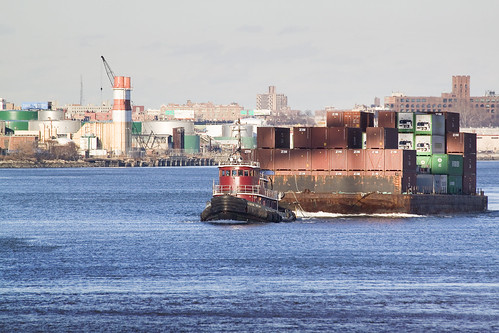
– photo by Mitch Waxman
That’s the Catherine Turecamo, a 1972 vintage 199 ton 3,200 HP tugboat, operated by the Moran towing company. It was built at the Main Iron Works in Louisiana as the MIss Lynn.
from morantug.com
Moran Towing Corporation has provided tugboat services to the Port of New York since 1860. The company began with Michael Moran’s purchase of-one-half interest in a tugboat. In the years since, the fleet with the white M logo on its stacks has become the largest in the port,and on the U.S. East and Gulf Coasts. The port of New York-New Jersey provides access to the most concentrated and affluent consumer market in the world. Its facilities include terminals operated by the Port Authority of NY & NJ and privately operated terminals. Over 16 million tons of cargo pass through the port on an annual basis, transported aboard various types of ships, including container ships, tankers and barges. The New York division also services the Port of Albany, located 145 miles up the Hudson River from New York City. Albany is a hub for commercial trade in its region, due to its proximity to the New York State Barge Canal and its excellent inland transportation network.

– photo by Mitch Waxman
The new camera was a little awkward to handle at first, and I was self conscious of it as well. This was a big “honking” camera, weighing four times what my familiar “rangefinder-sized” G10 did. I practiced tracking the tugboat with it, zooming in and out and so on. I think the shots came out alright- if you click through to the photo’s Flickr page and check out its larger incarnations- you’ll see some real detail in them. This is one of the places where the higher megapixel count of the Canon matters to me, and justified buying into its franchise.
Trust me on this one, I’m an advertising retoucher photoshop guy by day, and resolution matters. A lot.

– photo by Mitch Waxman
I’m only a couple of thousand shots in, a month later. Its been a busy month somehow, with holiday obligation and hiding in my warm burrow awaiting spring. Meanwhile, I’ll be learning how to use this new gizmo.
Incidentally, on the subject of gizmos, anyone out there have anything to say on geotagging? Leave me a comment or contact me, if you do.
Gangster town

– photo by Mitch Waxman
I’m hooked on a few basic cable crime “reality shows” at the moment, as I sit out the “dark and cold” season. My favorite of these entertainments, so far, is the lurid charm of “Mobsters“. Cheaply produced by overseas staff, the show presents a basic reportage of the New York organized crime story- as told by federeal prosecutors for an international audience. A topical and shallow montage of the “official” story is what TV shows such as “best of breed” “Mobsters” present, as it were or as I’ve termed it- Mobster-Porn.
What I find interesting about the storytelling technique of these shows are the usage of long tracking shots featuring Astoria which underpin the narrative. The shot above, for instance, is similar to one of the mobster-porn standbys. Usually this is used to demonstrate an ethnic neighborhood, a tracking shot interspersed with depression era stock footage of the lower east side, which birthed the racketeer focused on in a particular week’s episode.
Ironically, this is one of the nicest blocks in all of Astoria, a nearly suburban lane which abuts Astoria Park.

– photo by Mitch Waxman
In the past, I’ve mentioned that Newtown Pentacle HQ is housed in a Matthews Model Flat “new model tenement” apartment. The particular block I live on is the setting of much of “A Bronx Tale“- Sonny’s Bar (in reality a Karate Studio) is on the corner, as is the apartment house Robert DeNiro was meant to live in. The church seen in the film is St. Joseph’s and the funeral home is across the street from it on 30th avenue. The school attended by the kids in the film is a block away as well. Area delis and restaurants proudly sport pictures of the great actor stuffing their wares into himself and exhibiting his trademark grin.

– photo by Mitch Waxman
Of course the hollywood angle in using Astoria for its location shoots is that the older housing stock and relict buildings of the ancient village are reminiscent of what Manhattan once looked like. The radical theory of Urban Renewal practiced in the 20th century, which has only just gotten around to Long Island City and North Brooklyn using the alias “up-zoning”, wiped out the old “New York” in Manhattan.
Ironically, many of the Racketeers showcased by “Mobsters” made the predominance of their fortunes in enterprises that were directly related to this Urban Renewal. Gambling was their primary source of income before the politicians offered up lucrative construction and carting work in the 50’s, especially a certain racket called “the numbers”. Ahh, the good old days…
Fascination with the “outlaw” archetype is buried deeply in the psyche of westerners, but trust me when I say that to be in the presence of such characters is actually not very much fun. Its a little scary hanging out with people for whom killing other people is “just another day at the office”. It’s not just the mobsters that make me nervous, of course, off-duty cops and soldiers also make me uneasy. I’m no warrior.

– photo by Mitch Waxman
The effect of this media imagery on the kids of the ancient village is profound. Admittedly, their major cultural influences in the decadent 21st century emanate from the violent gang cultures of the 1990’s, but maturing in an age which delights in youtube cruelty and televised urban warfare has had risible effects on the latest New Yorkers.
Of course, they aren’t acting like real gangsters, just emulating things that they see on TV- acting like actors acting like gangsters. A lot of blood gets spilled in this kabuki, but that’s all it really is, as the old rackets don’t pay as well as they used to and the new ones have a high mortality rate. Crime went official back in the 70’s, anyway, when Lotto was invented and the politicians muscled their way into the numbers. The government will be getting into the “new rackets” soon enough- organ brokering and drug legalization come to mind.
Modern New Yorkers know who runs the modern numbers racket, because the citizenry is always forced to pay “mob tax” in gangstertown, no matter who collects it. There’s only two warring crime families left these days, and they’re headquartered at executive palaces in Albany- not sipping espresso in some outer borough Salumeria.
Like a great hand

– photo by Mitch Waxman
Came across this dire tableau the other night (December 16th to be exact) here in the oft perplexing grid of Astoria’s streets. At the corner of 44th and Broadway, it seemed that some great hand had reached down and jerked a car skyward, violently.
from wikipedia
Astoria is a neighborhood in the northwestern corner of the borough of Queens in New York City. Located in Community Board 1, Astoria is bounded by the East River and is adjacent to three other Queens neighborhoods: Long Island City, Sunnyside (bordering at Northern Boulevard), and Woodside (bordering at 50th Street). Astoria Heights, more commonly referred to as “Upper Ditmars,” borders Astoria on the northeast, at Hazen Street.

– photo by Mitch Waxman
The eternal entrepreneur who owns the bodega establishment on the corner informs me- as his fruitstand and delicatessen has a full video surveillance coverage of the corner- that a “black car” or “car service” driver was parked in the spot when a delivery truck rounded the corner at many times the speed limit.


 The Newtown Pentacle