Posts Tagged ‘Calvary Cemetery’
distant ravine

– photo by Mitch Waxman
The final product of my “Grand Walk” which was found on my camera card, which was populated by these puzzling images of centuried statuary lost amongst First Calvary’s emerald devastations.
The figure is life sized, according and conforming to the proportions and stature of the malnourished 19th century. In our modern era of gigantic milk, beef, and grain fed humans, when 6 feet of height is not an uncommon attainment for Italians, Irish, and Chinese alike (all 3 notoriously short statured groups according to historical anecdote), she seems to be a young girl- but this delicate figure conforms to statistical adult height records of 19th century immigrant New York.
We often forget, when discussing fashionable dining trends (locavore or vegan, organic or farm raised- bleh) that the primary goal of our forebears wasn’t ultimately financial acquisition, but was instead a guarantee of basic nutrition.

– photo by Mitch Waxman
Pithy commentary about the fallacies of a modern world, corporatized and commercialized, notwithstanding- attention is called to the plastic baubles which the monument has been adorned with. Such commemorate decoration is commonly observed at area cemeteries, although the rules and bylaws of these institutions publish severe limitations on acceptable grave ornamentation. Unless taste and or propriety are offended, the management seems to allow these minor decorative touches to subsist for a time, after which the activities of groundskeeping and upkeep sweep the place clean.
Behind a fence or near a seldom used entranceway at any of these urban polyandrions, once can easily locate a dumpster containing a polyglot of rotting flowers in cheap vases, joss paper idols, and a cacophony of sentimental or religious trinkets which lie glittering amidst the debris.

– photo by Mitch Waxman
The trinket itself is pedestrian, a childish and injection molded representation of grapes on the vine. What sets me to wonder, and more than wonder, is that undeniable resemblance to the color of the purple bloom worn by the apostate Hibernian and his bizarre companions whose threatening aspect hurled me into a panicked state and meandering escape route through the ancient sections of New York City.
I’ve been queried via private email about this person by several people. Unfortunately, as mentioned in the last posting, I can only remember bits and pieces- but the flower in his lapel matched the color of these plastic beads exactly- of that I can be sure.
What does it mean? I cannot tell you, as it would be madness to attempt the connection of dots between a seemingly random series of events.

– photo by Mitch Waxman
Did your humble narrator, stricken by terror induced delirium, randomly stumble along deeply buried trolley tracks past storefront mystics on Delancey Street and over the Williamsburg Bridge into the heart of 19th century Williamsburg?
It was in the piecing together of these seemingly random shots, in their proper order, that the various historical tidbits began to present themselves, and the journey across the Newtown Creek and through Maspeth led into places which I had never suspected- such as the story of Case’s Crew (the apostate Friends shunned by most, but welcomed here).
Local historical authorities reacted in a bizarre and hostile manner when queried about this group of apostate Friends, I would add. The impression of this exchange puzzled me, but for some, knowledge is meant to be suppressed and zealously hidden away in a vault rather than disseminated freely.

– photo by Mitch Waxman
Often, as I pack up my ridiculous “field kit” and leave the house for one of my “walks” about the vast human hive, I will joke that “I feel like Queens wants me to see something today, probably “that way”- as I gesture in some random direction to Our Lady of the Pentacle or my little dog Zuzu.
Our lady smiles and says “bless”, while Zuzu usually turns around to see what I’m pointing at.
I’ve learned it’s just best to listen to Queens, as it suffers beneath the load it bears for the rest of the City, and simply attempt to understand its terrible story. If some decide to stand in my way, or otherwise obstruct me, they will know what it means to burn away into ignominy and learn the meaning of the words inexorable, irresistible, and merciless.
The story, it’s parable, and the answers to the future offered by this ancient place are too important.

– photo by Mitch Waxman
This “Grand Walk” ended at Greenpoint Avenue, apparently, or at least that’s when the pictures stopped.
The final shot was of the Long Island Expressway from First Calvary, an elevated roadway which hurtles as high as 106 feet above Borden Avenue and that liquid malignity which fills the banks of Dutch Kills. Borden Avenue, of course, is a counterpart to Grand Street in Brooklyn- another ferry to trolley road corridor which has been forgotten and obliterated by modernity.
Ultimately, all roads do indeed seem to lead to Calvary, here in the Newtown Pentacle.
from Documents of the Senate of the State of New York, Volume 5, 18dd, courtesy google books
The road is a double track line laid in the center of Borden avenue, from Vernon to Bradley avenues, and thence a single track along Bradley avenue to Green Point avenue and entrance to Calvary cemetery.
At Vernon avenue a junction is made, and tracks used of the Steinway and Hunter’s Point railroad, along Borden avenue to the Thirty-fourth street ferry slips fronting on East river. A piece of track is laid from Borden avenue along Front street to Third street, a portion of which is used for storing cars, and there is a short side track at the cemetery terminal.
The total length of road now owned and operated from Vernon to Green Point avenues is about one and two-fifths miles, and the portion of the Steinway railroad operated jointly is about one-fifth of a mile, making a total length of road owned, leased and operated by the Long Island City and Calvary Cemetery Railroad Company one and three fifths miles.
Borden avenue is paved with block stone as far south as the drawbridge over the Dutch Kills canal; the remainder of the track is laid upon and along the center of an ordinary earth roadway.
The superstructure is laid with fiat iron street rails where the street is paved, and also along Bradley avenue a distance of onefifth mile.
The general construction of the superstructure is not as permanent in character and condition of maintenance as generally found on surface roads. Ties are widely spaced, and flat rail not thoroughly secured to longitudinal timbers, and the line and surface imperfect. South of the draw-bridge, upon the earth road-bed, the track is laid with light T rails, secured at ends with fish plate, many of which are omitted, causing the ends to form an uneven vertical joint.
From the crossing of the Long Island railroad to Bradley avenue, Borden avenue is a roadway raised up about eight feet above the low flat lands bordering the Dutch Kill and Newton creek, and the portion of the avenue south of the canal is being raised each year, requiring a corresponding raise of superstructure, which may account in part for the imperfect condition of that portion of the tracks; no serious inconvenience can bo experienced, however, as the cars have good, easy springs, and they ride the rail fairly well; yet a thoroughly Constructed, lined and surfaced superstructure would add to the comfort of passengers, and insure greater speed at less outlay of power.
At Calvary cemetery no separate waiting-room is provided, those in hotels being used. At the northerly terminal the covered way and waiting-rooms of the ferry are conveniently near, and afford protection in inclement weather.
paramount desire

– photo by Mitch Waxman
The final series of images which were discovered on my camera card, product of a trance like “Grand Walk” which carried me through an ancient corridor of the megalopolis, corroborated my theory that indeed- all roads always have and always will lead to Calvary.
Calvary Cemetery hosts the hoary remnants of an ancient clan of Anglo Saxons called the Alsops, who are buried in a family plot maintained as separate and distinct from the necropolis which surrounds it. Protestant land, officially, the earliest grave found here is meant to be the one housing the sire of the line- that of Thomas Wandell, but if there was ever a marker it is long vanished.
There are several members and generations of the Alsop family interred here, alongside their unnamed and oft unmentioned African slaves in this hidden corner of the Newtown Pentacle.
The oldest stone extant is that of Richard Alsop, a crumbling example of the carvers art which dates to 1718.
from The Eastern District of Brooklyn By Eugene L. Armbruster, courtesy google books
The Alsop farm, on the Queens County shore of the Newtown Creek, was the grave of Thomas Wandell, the former owner of the farm, who died in 1691. A large part of the farm became the site of Calvary Cemetery, but the Alsop family burial ground, by a reservation to the family, still remains Protestant ground.

– photo by Mitch Waxman
Alsop was quite a fellow by all reports, a very public man who acted as judicial magistrate and executor of inheritances for the simple farmers of Newtown. One of his descendants, John Alsop of Connecticut and Long Island, was a delegate to the Constitutional Conventions which initiated the “American experiment” in the 1770’s and 80’s.
The last of the Alsop line in Newtown – also named Richard Alsop- died without heirs, and a vast plantation estate that stretched along the then vernal Newtown Creek was offered up for sale.
It found interested buyers in a group of Irishmen hailing from Mulberry Street, across the river in New York, who worked for a large firm headquartered in Rome.
from Publication Fund series By New-York Historical Society, courtesy google books
Thomas Wandell, Maspeth Kills. “The last will and Testament of Thomas Wandell of Maspeth Kills in the bounds and limits of Newtown upon Long Island; being subject to sudden sickness and knowing the certainty of death.” Leaves all estate, except the following legacies, to his wife Audry Wandell, and makes her his sole executrix.
I leave to my cousin Richard Alsop, the piece of salt meadow that lieth within his fence, that incompasseth his dwelling house.
Also 2 steers and a case of pistols already in his possession.

– photo by Mitch Waxman
Long has your humble narrator desired to look upon the monument of “he who must not be named” and the long journey which carried me here actually began when I was contacted via “electronic mail” by a stranger who claimed to possess first hand information- an actual burial plot address here at Calvary.
He described himself as belonging to a faction of the “Ancient Order of Hibernians” which had splintered away from the mainstream group in 1921 over a silly doctrinal dispute. His forebears had stored away a copy of the burial and business records of Calvary Cemetery, a singular item since the original documents possessed by the Church were immolated in an outwardly suspicious fire.
Insisting that our meeting be privately attended yet in a public place is what led me to St. Patrick’s Old Cathedral in the first place, a seemingly natural location given the circumstances, and one that might provide certain literary symmetries if the story was later told.
As is habitual for one like myself, an attempt was made at an early arrival, and when my appointee arrived- he was not alone nor was he unobserved.
from Historical records and studies, Volume 1 By United States. Catholic Historical Society, courtesy google books
In the meeting of trustees, Sept. 19, 1845, it was announced that the Alsop Farm, consisting of about 115 acres, in Newtown Township, Long Island, had been secured for a cemetery. The deeds are dated Oct. 29, 1845. On July 31, 1848, at a special meeting of the board, it was resolved that “the cemetery at Newtown Creek, recently consecrated in part, should be called Calvary, and placed at the disposal of the public; that after August 2d the 11th Street burial-ground, as well as the free vault at 50th Street, should be permanently closed.”
Calvary Cemetery began to be used August 4, 1848. The first interment was that of Esther Ennis. Sections 1, 2, 3, 4, and 5 had been previously blessed. No record is preserved, however, of the ceremony.
Formerly, as is well known, every farm had its ” wood-lot” for fuel. The Alsop Farm had reserved 11 acres for this purpose, and the wood-lot has remained undisturbed to the present time. About 30 acres, lying in low ground near the water, were sold many years ago. The remaining 73 95-100 acres of the original Alsop Farm were devoted to and are still used for cemetery purposes.

– photo by Mitch Waxman
It was the sight of his companions that shocked me into flight, as reported in the first post of this series, and I will confess to experiencing a sort of racism that has nothing to do with national origin or ethnicity having been kindled in me. Rather than ethnographic it was something ancestral and instinctual, a genetic memory of some other specie of intelligent ape which our wholesome ancestors saw fit to exterminate in some long ago savannah.
I’m not altogether sure that these 2 companions of his were members of the “human race” itself, you see – with rounded jowls and underdeveloped chins they appeared to have a snout rather than a face- and what hung hairily beneath their wrists are better described as paws rather than hands. Their clothing was unseasonable and several years behind current fashions- flannel jackets and watch caps worn on a warm summer afternoon. The Anti Hibernian I was meant to meet did most of the talking in low whispers, and hoarse grunts were the only responses the two man shaped creatures offered in return which I could make out.
The exact moment which brought on this latest surrender to “one of my states”, triggering a multiple hour flight which carried me across half of New York City in a foot blistering haze, happened when I was peeking out from behind one of the columns at St. Patrick’s Old Cathedral in the manner of some mouse who has just noticed the presence of predators.
also from Historical records and studies, Volume 1 By United States. Catholic Historical Society, courtesy google books
At present there are over five miles of flag walks in Calvary. The cost of the headstones, monuments, etc., is roughly estimated as exceeding $6,000,000. A force of about 150 men is constantly occupied in attending to the burials, adapting and preparing the grounds for future use. A characteristic feature of Calvary, as of all Catholic cemeteries in contradistinction to large burial corporations formed with a view to personal profit, is the provision made for the benefit of the poor and destitute. According to the direction of the ritual and the spirit of Christian charity, the needy are interred as a work of mercy. In fact, more than one tenth of all the burials are gratuitous.
The entire number of interments since the opening of the cemetery in August, 1848, to January, 1898, is 644,761.

– photo by Mitch Waxman
Bits of it, like words on the tip of your tongue, are available to me as fragmented images lensed through the curious distortions of a migraine headache….
- A metallic cylinder of some kind, the thickness of a young child’s index finger, passing between the man who contacted me and his conspirators.
- The oddly green color and outmoded cut and style of the sports jacket worn by the man I was meeting, gaudily ornamented with a purple blossom of unknown breed which emitted a sickly lemon like smell
- The odd juxtaposition of muddy workman boots worn under suit pants seemingly chosen to match the flower.
- The horrible countenance and bestial appearance of his companions, augmented by the jiggling folds produced where their jowled necks became occluded beneath shirt collar.
from the Friends’ intelligencer, Volume 35, courtesy google books
The early history of Friends in Newtown and Maspeth Kills is marred by the irregularities of the Ranters, who claimed to be Friends, and intruded on their meetings.
Such was Thomas Case, who (1674) was forbidden by the Court to entertain the wife of William “Smith. His wife, Mary Case, was fined £5 for interrupting Rev. William Leveridge, while preaching, by saying to him: “Come down, thou whited wall that feedest thyself and starvest the people.” Samuel Scudder sent a long, scandalous letter to Mr. Leveridge.
The Court put Case and Scudder under bonds not “to seduce and disturb the people.”

– photo by Mitch Waxman
But this was not the least, for the event which set off my spell is also contained in one of these glimmer images…
I noticed that all three bore that unmistakable colour often commented on around the Newtown Creek, an iridescent hue which is neither black nor white nor any recognizable color of the wholesome earth, rather it is something alien- like a colour out of space.
When one observes this colour, especially within the elite corridors and behind the mirrored shield wall of the Shining City of Manhattan itself, it is obvious that something from the tainted Creeklands is nearby.
from The annals of Newtown, in Queens County, New York, containing its history from its first settlement, together with many interesting facts concerning the adjacent towns, courtesy openlibrary.org
Mr. Wandell, according to reminiscence in the Alsop family, had been a major in Cromwell’s army ; but, having some dispute with the protector, was obliged to flee for safety, first to Holland, and thence to America.
But some doubt of this may be justly entertained; because Mr. Wandell was living at Mespat Kills in 1648, which was prior to the execution of King Charles, and when Cromwell enjoyed but a subordinate command in the parliamentary army. Mr. Wandell m. the widow of Wm. Herrick, whose plantation on Newtown Creek, (originally patented to Richard Brutnell,) he bought in 1659, afterwards adding to it fifty acres, for which Richard Colefax had obtained a patent in 1652.
On this property, since composing the Alsop farm, Mr. Wandell resided.
He was selected, in 1665, as one of the jury for the trial of Ralph Hall and his wife for witchcraft, (the only trial for witchery in this colony,) and shared the honor of acquitting the accused. Some years later, he made a voyage to England, returning by way of Barbadoes, and, it is supposed, brought with him from England his sister’s son, Richard Alsop, who, about this time, came to America, and was adopted by Mr. Wandell as his heir, he having no issue. He d. in 1691, and was interred on the hill occupied by the Alsop cemetery.
Many years after his death, the silver plate of his cofiin was discovered, in digging a new grave.

– photo by Mitch Waxman
That malign and impossible intelligence which cannot possibly exist in the crown of this “Sapphire Megalith of the Long Island“, a thing which neither thinks nor breathes but instead hungers, gazing down on the folly of knowing the past and chuckling deeply (it does laugh, I am told). Protected and coddled by its mercenary army of human acolytes, it must wonder “what profit can there be in these pursuits?”.
And in the deep past- hidden behind the orthodoxy of 20th century historians- are found hidden references to Hannah Alsop (widow of Richard) having hosted meetings of so called “Friends” (Quakers in modernity) on the Alsop plantation. A nameless cult of some kind, these apostates are remembered only by their presence along Newtown Creek, troublemaking further east on Long Island, and by the colloquial name of “Case’s Crew”.
from Potter’s American Monthly, Volume 1, courtesy google books
There had scarce been any profession of the christian religion among the people of that town. They had scarcely any notion of religion but Quakerism. The Quakers had formerly a meeting there; but many of them became followers of Tho’s. Case, and were called ‘Case’s Crew,’ who set up a new sort of Quakerism, and among other vile principles, condemned marriage and said it was of the Devil, perverting that text of Scripture. ‘The children of the resurrection neither marry nor are given in marriage,’ and they said ‘they were the children of the resurrection.
‘ This mad sort of Quakerism held that ‘they were come already to the resurrection and had their vile bodies already changed.'”
suitable apparatus
– photo by Mitch Waxman
As the redolent cargo of my camera card revealed- this “Grand Walk”, a panic induced marathon which carried your humble narrator across the East River from St. Patrick’s Old Cathedral in Manhattan into Williamsburg and up Grand Street to Maspeth and the baroque intrigues of the Newtown Creek– wound down into it’s final steps on Laurel Hill Blvd.
Examining the images recorded on my camera, photos which I don’t remember taking, the ineluctable feeling that something was missing from the modern scene was inescapable.
from wikipedia
Nichols, along with his son Charles W. Nichols, helped organize the merger of 12 companies in 1899 to create General Chemical. Under his leadership, the company grew its asset base and increased its earnings threefold, making Nichols a force in America’s fledgling chemical industry. His vision of a bigger, better chemical company took off when he teamed up with investor Eugene Meyer in 1920. Nichols and Meyer combined five smaller chemical companies to create the Allied Chemical & Dye Corporation, which later became Allied Chemical Corp., and eventually became part of AlliedSignal, the forerunner of Honeywell’s specialty materials business. Both men have buildings named after them at Honeywell’s headquarters in Morristown, New Jersey. His original plant along the Newtown Creek in Queens is infamous for its legacy of pollution. Nichols is rumored to have once emptied vats of excess sulfuric acid into the creek rather than sell it cheaply to a businessman he had no respect for.

– photo by Mitch Waxman
Nichols Chemical, from which the legendary Phelps Dodge Laurel Hill plant would someday sprout, would have been found along the Newtown Creek nearby the thrice damned Kosciuszko Bridge – which is itself doomed and consigned to the stuff of future reminiscence. At it’s apex, this industrial site employed 17,500 people and squatted along some 36 square acres of the Creeklands.
The tallest chimneys in the United States (at the time) stabbed at the sky from here, painting the Newtown sky with poison effluvium whose pH content was sufficient to cause marble and granite to melt like ice cream left to the merciless gaze of the burning thermonuclear eye of god itself.

– photo by Mitch Waxman
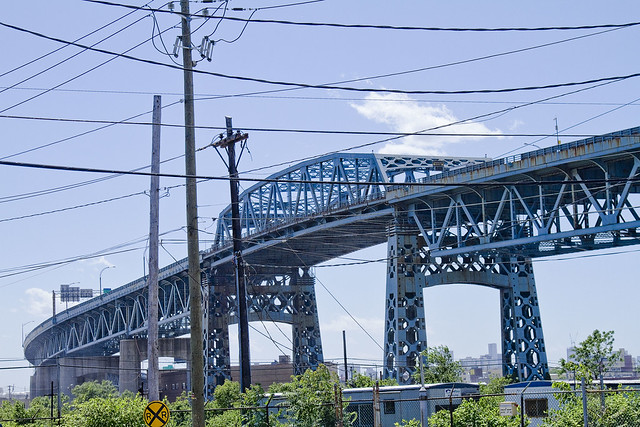
The Kosciuszko Bridge is slated for demolition and replacement in a few short years of course, and this scene will irrevocably alter when a modern structure is put in place. The high flying bridge was built large to accommodate the sort of ocean going craft which were common in the 1930’s- cargo and passenger vessels with enormous smokestacks that would have been serviced and outfitted by other corporations just up the Creek.
Additionally, the war department held certain intentions and reserved the option to sequester battleships in Newtown Creek, with the intentions of protecting the vital industrial center from a safe inlet, were an invasion of North America attempted by hostile European adversaries via New York Harbor.
When a manufacturing establishment decides to increase its output fivefold; when it decides to tear down its present buildings and put up new ones; and when it owns valuable waterfront which is marketable at a high price, that concern considers carefully the question whether it will remain in its present location or move to some other. Now our friends above mentioned would doubtless at once aver that, if this concern was a New York concern and found itself in this situation, there could be but one answer—”To Jersey for us”— or to some other place near land’s end where land can be purchased for a song, where government regulations are unknown and where, in addition, the manufacturer would find himself surrounded by a great and aching void.
But all these prophesies are as wormwood and the pessimists are confounded. Over In the wilds of Queens there Is a place—look it up on the map—called Laurel Hill.
Laurel Hill is not a place of beauty. The undulating hills in them neighborhood are covered with cemeteries, rocks, and ugly houses and through the midst of it all (lows the far-famed Newtown Creek, covered at all times during the day and night with busy water craft. But Laurel Hill is one of the most important manufacturing districts in Greater New York and Newtown Creek is one of the foremost commercial arteries in or about NewYork City.

– photo by Mitch Waxman
One of the aphorisms which has emerged in my studies of Newtown Creek and the surrounding communities is this: “all roads lead to Calvary“.
Whether it be ancient ferry lines which fed the street car roads, or the occluded pathways of the aboriginal Mespaetche and Decadent Dutch, all the roads of western Queens and North Brooklyn point inevitably to this spot. Semi conscious during this “Grand Walk”, your humble narrator nevertheless found himself at the corner of Laurel Hill Blvd. and Review Avenue once again, standing before the great and sacred Polyandrion of the Roman Catholic church in New York City.
Perhaps the foremost industry at Laurel Hill is the Nichols Copper Company. To this factory each year come by boat and by rail thousands of tons of copper, some of it in the raw state— the ore—and much of it already in bars ready for the final refining. The copper is refined here and put into a variety of forms and shapes ready for the market. The raw material comes in from the Lake Superior region, from Mexico, and even from more distant South America. The finished product goes to manufacturers in all parts of the world. The annual value of this product is over $60,000,000, and there are between seventeen hundred and eighteen hundred men engaged in converting the raw copper into the refined product which has made this factory famous tne world over.
In this factory, located within Greater New York, there is three times as much copper refined as in any other factory in the United States.

– photo by Mitch Waxman
Here lies Tammany, the Dead Rabbits, and a good percentage of those colorful characters who populated the “Bloody Sixth Ward” of the Five Points in 19th century New York. Here lies the Newsboy Governor, the “Original Gangster“, and the rightful heirs to the throne of Ireland rest within the ground consecrated by the legendary prelate called “Dagger John” alongside the “Fighting 69th” and “the 21” and the “Abbot“. Here is the secretive cruciform shaped repository which contains the remains of thousands of priests and nuns, in a catacomb which lies some 50 feet below the Almirall Chapel.
Additionally, here might be found the grave of a man who died in 1718, lying with both his descendants and his african slaves in the only Protestant burial ground entirely contained by a Catholic cemetery in North America.
And from above, that thing in the Sapphire Megalith which neither thinks nor breathes but instead hungers, watches.
from Illustrated history of the borough of Queens, New York City, 1908, courtesy google books
The Alsop family was also among the early settlers. Richard Alsop, the first of the name to locate here, came at the request of his uncle, one Thomas Wandell, who was said to have left England because he had become involved in a quarrel with Oliver Cromwell, though this report is doubtful, for it is known that Wandell was living at Mespat Kills in 1648, or before Charles I was put to death. He had secured a considerable tract of land by patents and purchase which he left to his nephew, Richard Alsop. The family he founded became extinct in 1837 when the last of the name died without issue.
athwart the desert

– photo by Mitch Waxman
Many things find a piquant and interested perch in my thoughts.
Autocthonic, these wonderings are often based on observations of a block or two of grandiose structures which seem out of place in modern context, Greenpoint Avenue between Manhattan Ave. and the East River is just one.
There is a distinct and obviously missing element which once defined its “reason for being”, and like many of the other occlusions which abound along the coastline of North Brooklyn and Western Queens- the answer is presented by First Calvary Cemetery.
from the “DIGEST OF SPECIAL STATUTES By THE CITY OF NEW YORK” courtesy google books
1865: This act incorporates the Green Point and Calvary Railroad Company, and authorizes the construction of a railroad, to be operated by horse power only, from at or near the Green Point and Tenth street ferry, at the foot of Green Point avenue, in the city of Brooklyn, thence along Green Point avenue to Green Point avenue plank road, across the bridge over Newtown creek; thence easterly along said road to the easterly side of Calvary cemetery at or near the point where the, said road intersects the main road leading from Calvary cemetery to Hunter’s Point; thence to Central avenue; thence along Central avenue and Commercial street to Franklin avenue, to Freeman street, to Washington street, to the place of beginning.

– photo by Mitch Waxman
It’s no accident that Almiralls chapel is clearly visible from the paramount of Greenpoint Avenue at Manhattan Avenue.
It’s a latecomer to the scene of course, having been built in the early years of the 20th century, but in 1865 when the Streetcar Line described above was mandated there were 1,000 interments a day going on at Calvary. Some portion of those were the graves which were being uprooted over in Manhattan of course, when cemeteries there were outlawed by the Rural Cemetery Act of 1848, but the majority of the dead coming to Queens were from a sausage grinder called the Five Points and the Tenth Street Ferry was how you got from points A to B for the funerals.
from “A history of the city of Brooklyn By Henry Reed Stiles” courtesy google books
The Green-point Ferries are from the foot of Green-Point Avenue, Brooklyn, E. D., to the foot of East Tenth and East Twenty-Third streets, New York. The first named route was established in 1852 (lease dated 1850), by the efforts of Mr. Neziah Bliss, of Green-Point; and was soon transferred to Mr. Shepard Knapp, being now held by G. Lee Knapp. The Twenty-Third street route was established in 1857, and held by St. Patrick’s Cathedral, per G. Lee Knapp. Rent of the Tenth street ferry, $1,300, and of the Twenty-Third street, $600 per annum, both expiring in 1874.

– photo by Mitch Waxman
It’s not the facts of the Ferry or Streetcar that make me curious, of course.
What I’ve been wondering about lately is how the ethnic neighborhoods in the boroughs came to be. Everybody started in Manhattan on the Lower East Side, yet the Jews of Bayard Street and the Italians of Mulberry found a path to Williamsburg and Greenpoint (Tenth Street Ferry?), while the Catholic Germans found their way to Ridgewood and Astoria (86th Street Ferry?). The Irish were everywhere, but made colonies of Woodside and Rockaway.
What natural synergies drew large populations of ethnic brethren to these neighborhoods?
Work was certainly a factor (garment and stone industries in the industrial mills of Newtown Creek and Williamsburg, etc.), but I’m wondering if it wasn’t the lost Ferry and Streetcar connections which allowed and encouraged these ethnic populations to agglutinate.
from “The Sun’s guide to New York” in 1892 courtesy google books
Tenth Street Ferry Branch (color cream): Runs from foot Chambers St., cor. West (ferry to Pavonia Ave., Jersey City and Erie R. R. Depot), through West to Charlton, to Prince, to Bowery, to Pitt St., to Ave. C, to foot E. 10th St. (Tenth St. Ferry to Greenpoint Ave., Brooklyn), returning by E. 10th St., to Ave. D, to E. llth St., to Ave. C, to E. 3d St., to 1st Ave., to Houston St., to West, to Chambers, cor. West.
Ladder 128

– photo by Mitch Waxman
The Newtown Pentacle mailbox alert bleeped at me the other day, indicating that the local elected’s were planning a rally to save Blissville’s own Ladder 128 from extinction. Double booked, I feared that I might miss this event in the heart of things, but thanks to an offer of a ride from one of these very elected’s to the event, I made it there from my beloved Astoria just as the ceremony was beginning.
from jimmyvanbramer.com
On Friday, May 27th City Council Member Jimmy Van Bramer held a rally with City Council Fire & Criminal Justice Chair Elizabeth Crowley, the Uniformed Firefighters Association and the Uniformed Fire Officers Association against the proposed closure of Ladder 128 in Long Island City. For over a century, Ladder 128 has been serving the City of New York in emergency situations, including playing an integral role in the rescue efforts during the terror attacks of Sept. 11, 2001. Ladder 128 serves the communities of Blissville, Long Island City, Sunnyside, Woodside and Greenpoint, Brooklyn.
According to a recent report, closing Ladder 128 would result in nearly 7 min response times, well above the National Fire Protection Association’s (NFPA) four minute benchmark. According to NFPA studies, the increased response times lead to greater casualties and expanded property damage in emergencies.

– photo by Mitch Waxman
Mr. Van Bramer of the NYC City council was the leader of the event, and acted as master of ceremony. Despite the terrific and sudden onset of summer heat on Friday the 27th, and proximity to the holiday weekend, a surprising multitude had gathered.
also from jimmyvanbramer.com
“In an emergency, every second saves lives,” said Council Member Jimmy Van Bramer. “Allowing response times to skyrocket is simply unacceptable. The Mayor must reconsider this dangerous proposal. As the population continues to grow in the area, this is not the time to cut services that protect our residents. I will continue to fight to keep Ladder 128 open for the safety of our local residents.”

– photo by Mitch Waxman
The trick, in my opinion, to understanding the function which the various fire companies serve the city is that while every unit has the same basic skill set, through practice and districting- specialties are either called for or evolve through day to day experiences.
The fire companies around Newtown Creek traditionally have some expertise in chemical and petroleum blazes, are experienced in warehouse and high rise situations, and are trained to handle everything from train derailments to fuel barge explosions. Given the immolations which typify the history of the area, this is logical and appropriate.
also from jimmyvanbramer.com
“Closing Ladder 128 will lengthen response times, potentially putting residents’ lives in danger. With this area experiencing a population boom, now is not the time to be making dangerous cuts to emergency services,” said Congresswoman Nydia M. Velázquez.

– photo by Mitch Waxman
Elizabeth Crowley of the NYC City Council spoke next. I’m led to understand that fire house closures are a personal and signature issue for her, which explained the clear ire she expressed at the Mayor’s proposal to shutter Ladder 128. It is not clear to me how the other companies in firehouse E 259 will be affected by the loss of Ladder 128, and whether or not they are similarly endangered.
In other words, I’m not sure if it’s just the unit or the entire firehouse which is on the block.
also from jimmyvanbramer.com
Out of the twenty fire companies slated for closure, the loss of Ladder 128 create the second longest average response time. The Fire Department released a report that estimates that arrival times for first responders will likely increase by more than a minute, from five minutes 31 seconds to six minutes 44 seconds, if Ladder 128 were to close.

– photo by Mitch Waxman
I’m not entirely sure where the concept of Queens having an infinite capacity to cut municipal services arose in Manhattan, but we really are at the breaking point. Our hospitals, the few we have left, are suffering from overcrowding and lack of funds. The cops are overwhelmed protecting the vital infrastructure which distinguishes western Queens, and barely have the manpower to accomplish basic law and order. The FDNY is already contending with shrinking budgets and expanded responsibilities, coupled with new populations contributing to a population density the likes of which the area has never known.
from council.nyc.gov
As we approach the 10th anniversary of the attacks on 9/11, our FDNY remains as busy, strong and heroic as ever before- and the City needs to be there for them now just as they have been and always are there for us. On May 6, 2011, Mayor Bloomberg announced the Fiscal Year 2012 Executive Budget to include the closure of 20 fire companies. The Mayor’s proposal to drastically cut our FDNY services is dangerous, costly and a serious threat to public safety. Once again we need to come together as a community to fight these cuts and let the Mayor know we need our fire protection. Please contact my office to get involved 212.788.7381.

– photo by Mitch Waxman
Several of the speakers pointed out the relatively low savings offered to the budget by threatening the 20 fire companies which Ladder 128 shares the threat of closure with. Some offered that there seems to be plenty of money to rename bridges and create bike paths available to the Manhattan elites. Whether that was rhetoric or actual, it certainly pleased the crowd of angry constituents who had gathered with them.
from nyc.gov, on February 4th, 2010
FDNY TO CELEBRATE THE 100TH ANNIVERSARY OF LADDER
COMPANY 128
Fire Commissioner Salvatore J. Cassano will join the officers and members of Ladder Company 128 in their quarters at 33-51 Greenpoint Ave. in Long Island City, Queens at 11 a.m. Friday, as they celebrate 100 years of dedicated service to the community.
Several veterans of Ladder 128 have become Chiefs at FDNY, including Assistant Chief Joseph Pfeifer, who is Chief of the FDNY’s Counterterrorism and Preparedness Center, and Deputy Chief Robert Strong of Division 11. Ladder 128 played important roles battling the Chiclet factory fire of 1976, a 10-alarm fire on the Brooklyn waterfront in 2006, and during the Sept. 11, 2001 attacks. Last week, members of the company received a unit citation from FDNY for a February 2009 incident in which they rescued a man who was dragged and pinned by a tractor trailer after it was struck by a locomotive at Review Avenue and Laurel Hill Boulevard in Queens. Ladder 128, which shares quarters with Engine 259, had their firehouse renovated just last year.

– photo by Mitch Waxman
The congresswoman was angry, and left no doubt as to her position on the matter.
also from jimmyvanbramer.com
“In a fire, seconds count. If we lose Ladder Company 128, the extra seven minutes it may take for another company to come to the neighborhood could be the difference between life and death. Let’s hope city officials take another look at closing Ladder 128. I know these are tough times, but our firehouses are the last places we should look to for budget cuts,” said Congresswoman Carolyn Maloney.

– photo by Mitch Waxman
As always, my thoughts drift toward that sister of the stygian known as the brain blasting Newtown Creek. The notion of removing fire protection from anywhere within a 5 mile radius of this place is actually insane. The industrial base that surrounds it’s banks represents petroleum, chemical, warehousing. Every art of the industrial world- from power generation to sewage handling- is accomplished nearby.
Less than a mile from here is a home heating oil depot which stores and distributes an incalculable amount of fuel.
The firehouse, at 33-51 Greenpoint Ave. in Blissville, is one of four in Queens and 20 throughout the borough that have been targeted for closure by Mayor Michael Bloomberg due to budget cuts. Ladder 128, nicknamed “tombstone territory” for its proximity to Calvary Cemetery across the street, celebrated its centennial last year. It services the neighborhoods of Blissville, Long Island City, Sunnyside, Woodside and Greenpoint in Brooklyn.

– photo by Mitch Waxman
In the late 19th and early 20th centuries, a series of hellish immolations happened nearby. Once, the Greenpoint Avenue Bridge actually burned down. On the Brooklyn side, at the Locust Hill Refinery, oil tanks were shooting up into the air like rockets. Literal tidal waves of burning oil washed over the Creek and incinerated two FIREBOATS.
from wikipedia.org
Catherine T. Nolan (born March 12, 1958) is a member of the New York State Assembly representing the 37th Assembly District, which includes the Queens neighborhoods of Sunnyside, Ridgewood, Astoria, Woodside, Long Island City, Maspeth, Queensbridge, Ravenswood, Dutch Kills and Blissville.
Nolan has lived in her district for most of her life and graduated from the St. Aloysius R.C. School and Grover Cleveland High School. She received a B.A. degree (cum laude) in political science from New York University.
She was first elected to the Assembly in 1984. Nolan is a member of the Democratic leadership in the Assembly and has served as Chair of both the Labor and Banking Committee during her career. Although no longer on the Labor Committee, she has continued to push legislation which protects workers rights in New York State.
In January 2006, Nolan was appointed as Chair of the Assembly Standing Committee on Education. She is also a member of the highly influential Rules and Ways & Means Committee.
She ran uncontested in the 2008 general election and won the 2010 general election with 84 percent of the vote.
Nolan resides in Ridgewood with her husband, Gerard Marsicano, and son Nicholas.

– photo by Mitch Waxman
Senator Michael Gianaris spoke next. He’s the elected who gave me the ride incidentally, and you have him to thank for me getting to this event in time to record it for your Newtown Pentacle. There some kind of blogging rule out there which says you have to acknowledge this sort of thing to eliminate conflicts of interest or something, otherwise you’re bad..
also from jimmyvanbramer.com
“Closing Ladder 128 would lengthen response times and harm the safety of western Queens residents,” Senator Michael Gianaris said. “Western Queens continues to grow and is in need of more fire protection services, not less. The Mayor must reconsider and keep Ladder 128 open.”
“In a fire or emergency, every second counts. That’s why our neighborhood firehouses, like Ladder 128, and the brave men and women of the New York City Fire Department are essential to the safety of our communities,” said Congressman Joe Crowley. “While budget cuts are necessary right now, there cannot be a compromise when it comes to providing lifesaving services. I urge the City to reconsider these closures.”

– photo by Mitch Waxman
The Senator coincidentally suggested one of my pet issues in his statement.
I interpreted concurrence with my notion that while the future of Queens has been written to include vast new populations inhabiting former industrial areas, there seems to be very little thought given to the municipal infrastructure which will be required to maintain those agglutinations of citizenry. Development in Queens once followed the installation of sewers and train lines, rather than just being dropped into whatever open space that could be found. The hospitals and schools, fire houses and police stations, electrical and sewerage systems in western Queens are already inadequate- and don’t even mention the archaic subway stations.
from nysenate.gov
Michael Gianaris, was elected to the State Senate with over 81% of the vote and is the first Greek-American to be elected to office from New York City and has served his community and his state with unique effectiveness.
Senator Gianaris was elected to the State Assembly in 2000.
In the Assembly, Mike recognized the dysfunction of state government and has emerged as a leader on government reform issues. Mike has sponsored numerous measures to improve the efficiency and transparency of state government, including a proposal to reform the legislative redistricting process that the New York Times has called “the real key to reform” in Albany.
Most recently, when state government was brought to a screeching halt, it was Mike Gianaris who found the solution to end the stalemate. By recommending that the Governor appoint a Lieutenant Governor, Mike was able to end the logjam and and get the State Senate working again on behalf of New Yorkers.
Additionally, among his many accomplishments in the legislature, Mike authored important public safety measures, including the state’s first major anti-terror law after September 11th. His Energy Security Act, which has become a national model, enhances security at our State’s power plants and transmission centers. His Airline Passenger Bill of Rights, now in the process of becoming a federal law, ensures that travelers are treated with respect and dignity while on commercial airplanes.
Mike is also a fighter to protect our environment, particularly in the effort to reshape New York’s energy policy. He wrote the Clean Energy Law that encourages the private sector to utilize modern technologies to dramatically reduce pollution while increasing productivity. Mike also held Con Ed accountable when its blackouts hurt local businesses and families in our community. Thanks to Mike’s efforts, the energy behemoth was forced to pay restitution to those affected by its mistakes.
Born in Astoria, Queens to Nicholas and Magdalene Gianaris, Mike is a graduate of the New York City public school system. He attended Public School 84, Junior High School 141 and Long Island City High School before graduating from Fordham University, Summa Cum Laude with a Bachelors Degree in Economics and Political Science. He went on to receive his law degree from Harvard Law School.

– photo by Mitch Waxman
Next up was Stephen J. Cassidy of the Uniformed Firefighters Association of the FDNY. This guy is some kind of speaker, I tell you. He’s a “union” guy, and speaks in a fashion which is blunt, emotional, and pointed.
Hearing him speak is what going to an old fashioned tent revival meeting must have been like.
from wikipedia
Stephen Cassidy is the President of the Uniformed Firefighters Association of Fire Department of New York firefighters.
Cassidy is a vocal critic of former New York City mayor Rudy Giuliani’s record of response to the September 11, 2001 terrorist attacks.
He charges that Giuliani’s reputation of a hero or as “America’s Mayor” is an undeserved myth. He has key appearances in the International Association of Fire Fighters’ video, Rudy Giuliani: Urban Legend, released on July 11, 2007 to fire departments across the U.S. The DVD rebroadcasts images of the collapsing Twin Towers. The video outlines New York firefighters’ complaints against Giuliani. In the video, Cassidy said, “The things that we needed to do our jobs even better, we didn’t have, because of his administration.” He added, “On the heroic memory of 343 dead firefighters, he wants to run for president of the United States. It’s a disgrace.” Many other present and former IAFF leaders and firefighters from New York City appear in the video. He faulted the 9/11 Commission for its treatment of Giuliani, “The 9/11 Commission gave Rudy Giuliani a pass, not asking him tough questions about what he knew, when he knew it or why he failed to provide respirators to firefighters and other first responders.” He said that the lack of respirators led to exposure of first responders to fatal or otherwise serious pathogens.
He has criticized the reduction of the number of firehouses in Brooklyn while up to 60,000 units of housing are planned for waterfront areas of Brooklyn.
In 2007, he sided with the Fire Department and the city of New York in a Federal lawsuit initiated by the Vulcan Society of black firefighters, which charged that the written entrance exams had disparate impact on minority candidates.

– photo by Mitch Waxman
You don’t hear this sort of oration much in the public sphere, although it was once ubiquitous. Combative, inflected with urban accent and patois, rife with gestural poses and dismissive facial expressions. This isn’t a lawyer talking, this is a working guy.
from ufanyc.org
The objectives of the Uniformed Firefighters Association (UFA) are to:
- Protect the rights of UFA members
- Obtain better and safer working conditions
- Secure adequate remuneration
- Obtain the equitable resolution of grievances
- Cultivate fellowship among its members
- Foster the finest traditions of American citizenship

– photo by Mitch Waxman
Next up was Captain Al Hagan of the Uniformed Fire Officers Association (UFOA), for which he serves as President.
…But it is very frightening that that the mayor of New York has announced the closing of 20 fire companies in the city and I am concerned that the impact on the security of our citizens—particularly in the event of another terrorist attack-would be devastating. The whole world knows that the Fire Department is one of the cornerstones of homeland security here in New York City.

– photo by Mitch Waxman
Capt. Hagan, similarly a union man, brought the old time thunder to the podium.
from wikipedia
Uniformed Fire Officers Association (UFOA) is a union for lieutenants, captains, battalion chiefs, deputy chiefs, medical officers and supervising fire marshals in the Fire Department of New York. Captain Alexander Hagan is the current president of the UFOA. Battalion Chief Jack McDonnell preceded Capt. Hagan. Peter Gorman was president from 1999-2007.

– photo by Mitch Waxman
Next up was Bill de Blasio… and I must get this out of my system… who must be the largest man in the City of New York. When you stand next to the public advocate, and I am average height, it feels like you’re in third grade.
If we lived in medieval times, the public advocate would be King just based on virtue of his stature.
Holy moley, this guy is gigantic.
…glad I got that off my chest…
from pubadvocate.nyc.gov
On November 3rd, 2009, Bill de Blasio was elected New York City’s third Public Advocate. For the prior eight years, de Blasio served in the New York City Council where he fought to make City Hall more responsive and accountable to New Yorkers.
Bill de Blasio began his work in New York City government as an aide to Mayor David Dinkins. During the Clinton Administration, de Blasio was appointed Regional Director for the U.S. Department of Housing and Urban Development, where he served under former Secretary Andrew Cuomo. In 1999, de Blasio was elected to the School Board for District 15 in Brooklyn. In 2000, he managed Hillary Rodham Clinton’s successful campaign for U.S. Senate. The following year, de Blasio was elected to the New York City Council where he represented District 39 in Brooklyn for eight years.

– photo by Mitch Waxman
All kidding aside, the Public Advocate threw his protestations to the Mayor’s plan to close Ladder 128 and 19 other firehouses into the ring.
from pubadvocate.nyc.gov
“The list of fire company cutbacks shows what the Mayor’s budget really means for the safety of New Yorkers and their families. In my own neighborhood, Engine Company 220, which is a block from my house, now faces an estimated 30-second jump in response time. As Fire Commissioner Cassano has acknowledged, higher response times mean greater risks for New Yorkers. I will fight to keep every one of these fire companies open so that no family is put in harm’s way.”

– photo by Mitch Waxman
Newtown Pentacle HQ, I would reveal in accordance with some set of ethical blogging rules, lies deep within the districts of several of these powers and potentates. So does the Newtown Creek, and just in case my viewpoints and biases might be viewed as representing any groups or organizations which I belong to or am affiliated with, this is just me rattling on and does not attempt the former.
My wife sleeps in the area affected by this closing, and I’m pissed off about it as a citizen.
from qgazette.com
Known affectionately as “Tombstone Territory” due to the surrounding graveyard, Ladder Co. 128 was originally founded on Feb. 7, 1910 as Hook and Ladder Co. 78 on Greenpoint Ave in the town of Blissville. The name was changed to Hook & Ladder 128 on Jan. 1, 1913.

– photo by Mitch Waxman
Of course, as the E259 Firehouse is directly across the street from Calvary Cemetery, which longtime readers of this- your Newtown Pentacle- know I have a certain interest in, there’s a little more to the story of the place than just modern politics. Check out this report from the archives at nytimes.com on this firehouse, when it housed Long Island City F.D. Engine No. 2 during the reign of Battleax Gleason.
additionally, here’s a little nugget from Municipal journal and engineer, Volume 26, courtesy google books

– photo by Mitch Waxman
The insignia nickname for this unit, of course, is tombstone territory. Here’s their patch.
from fdnytrucks.com


– photo by Mitch Waxman
There are a series of rallies and marches planned, and I’ve heard rumors of a gargantuan protest meant to occur on June 3rd. Please check the websites of the various elected officials pictured or mentioned in this post for more news. As well, the web sites of the 2 unions bear watching.
Normal Newtown Pentacle policy on such matters is “it’s not good, it’s not bad, it just is”, however closing fire companies is definitively a very bad idea indeed.
from nypost.com
Chief of Department Edward Kilduff called the centennial a tremendous milestone for the firehouse, nicknamed “tombstone territory” thanks to its location across from Calvary Cemetery, one of the largest and oldest burial grounds in the country.
“This is one of the most diverse areas in the city,” Kilduff said. “You have everything here from high-rises to tunnels to rail yards. The commercial buildings are extreme challenges for anybody. A place like this really represents the heart and soul in the Fire Department.”


 The Newtown Pentacle