Posts Tagged ‘cemetery’
restless lichens

– photo by Mitch Waxman
A sharp eyed reader and fellow haunter of the tombs tipped me on to this, something I never noticed on 58th street, a sidewalk deprived viaduct that runs between two cemeteries- New Calvary and Mt. Zion.
Mount Zion Cemetery encompasses an area of 78 acres. This cemetery is located in Maspeth, Queens near the Manhattan Border. When this cemetery was first established the surrounding area was considered to be rural. There was an ongoing need for burial spaces to accommodate the explosion of the immigrant population in not only Queens, but also the nearby neighborhoods of Manhattan and Brooklyn. Mount Zion Cemetery has more than 210,000 burials on its 78 acres making it one of the more interesting burial grounds.

– photo by Mitch Waxman
Nitre dripping, the walls of Zion are composed of conventional mortar and stone for much of their length, protecting its centuries of interments with a stout but rusty fence.
from wikipedia
Masonry is the building of structures from individual units laid in and bound together by mortar; the term masonry can also refer to the units themselves. The common materials of masonry construction are brick, stone such as marble, granite, travertine, limestone; concrete block, glass block, and tile. Masonry is generally a highly durable form of construction. However, the materials used, the quality of the mortar and workmanship, and the pattern in which the units are assembled can strongly affect the durability of the overall masonry construction.

– photo by Mitch Waxman
As one nears Laurel Hill Blvd. and the stature of the masonry wall shrinks back to a human scale, a curious heterogeneousness in its composition is noticed. Suddenly granite and “finishing marble” is noticed.
from wikipedia
Sculpture
White marble was prized for its use in sculptures since classical times. This preference has to do with the softness and relative isotropy and homogeneity, and a relative resistance to shattering. Also, the low index of refraction of calcite allows light to penetrate several millimeters into the stone before being scattered out, resulting in the characteristic “waxy” look which gives “life” to marble sculptures of the human body.
Construction marble
Construction marble is a stone which is composed of calcite, dolomite or serpentine which is capable of taking a polish. More generally in construction, specifically the dimension stone trade, the term “marble” is used for any crystalline calcitic rock (and some non-calcitic rocks) useful as building stone. For example, Tennessee marble is really a dense granular fossiliferous gray to pink to maroon Ordovician limestone that geologists call the Holston Formation.

– photo by Mitch Waxman
Proceeding up the block, certain familiar shapes become recognizable in the wall, and a cold dread is realized. Tombstones. They used tombstones to make this part of the wall.
from wikipedia
The stele (plural stelae), as they are called in an archaeological context, is one of the oldest forms of funerary art. Originally, a tombstone was the stone lid of a stone coffin, or the coffin itself, and a gravestone was the stone slab that was laid over a grave. Now all three terms are also used for markers placed at the head of the grave. Originally graves in the 1700s also contained footstones to demarcate the foot end of the grave. Footstones were rarely carved with more than the deceased’s initials and year of death, and many cemeteries and churchyards have removed them to make cutting the grass easier. Note however that in many UK cemeteries the principal, and indeed only, marker is placed at the foot of the grave.
Graves and any related memorials are a focus for mourning and remembrance. The names of relatives are often added to a gravestone over the years, so that one marker may chronicle the passing of an entire family spread over decades. Since gravestones and a plot in a cemetery or churchyard cost money, they are also a symbol of wealth or prominence in a community. Some gravestones were even commissioned and erected to their own memory by people who were still living, as a testament to their wealth and status. In a Christian context, the very wealthy often erected elaborate memorials within churches rather than having simply external gravestones.

– photo by Mitch Waxman
Section markers and footpath monuments are used, as well as grave markers whose screed faces inward. Oh what treasures may be entrusted to the grave’s holding that only some future archaeologist will know?
from sciencedaily.com
“Until now we have relied on evidence from medieval rubbish – including food remains, pottery and other finds – to build up a picture of medieval life in the city. This group of burials represents the first opportunity to examine the medieval population itself, in terms of life expectancy, stature and health.
“Evidence of some communal burials and high infant mortality also indicate evidence of infection and disease.
“The skeletons are very well preserved – some were in coffins and others weren’t and were placed in shrouds. We were expecting there to be some 300 skeletons- but the scale of this discovery is stunning.”
The site dates from between the 12th century and the mid 1500s and is part of the medieval church of St Peter’s – one of two parish churches in the city which disappeared in the late medieval period.
effulgent valleys

– photo by Mitch Waxman
I went over to St. Michael’s Cemetery again last week to see if there were any developments on the ritual site which Our Lady of the Pentacle and I found a few weeks ago. A hypothesis of mine that this ritual site is being “worked” on a lunar schedule seems to be bearing fruit.
For the first post on this curious altar- “City of Marble and Beryl“, in Astoria’s St. Michael’s Cemetery- click here
for a link to a google map, showing the location as recorded by GPS, click here

– photo by Mitch Waxman
Intriguing are the differences between the last set of offerings, ritual devices, and this grouping, although the setting remains the same. Also, to be absolutely clear- this is not staged in any way, and represents exactly what I observed in situ.

– photo by Mitch Waxman
The brownish cylinder appeared to be a cigar, and the white candle’s wick was blacked but the wax was nearly pristine.

– photo by Mitch Waxman
A set of bleached bones seemed to have been arranged in some non random pattern.

– photo by Mitch Waxman
There were also holes punched in the dirt, which could just be the action of wildlife of course, but the soil of the graveyard was depressed inward without the characteristic mound of surface tailings left behind by those that burrow. It appeared that something had been stuck into the soil.

– photo by Mitch Waxman
Also, amongst the bones, were coins.

– photo by Mitch Waxman
To the north was a glass with a white candle inside of it, approximately 25 feet away.

– photo by Mitch Waxman
The candle’s glass was broken, if that means anything.
– photo by Mitch Waxman
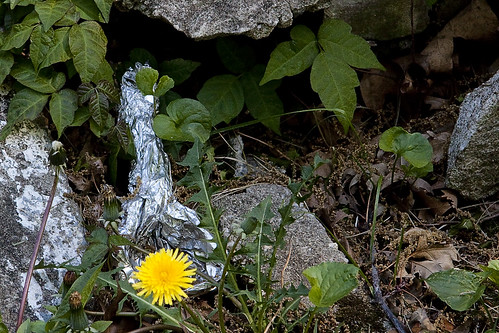
On the west face, this ladle shaped molding of aluminum foil was extant.

– photo by Mitch Waxman
Here’s the whole scene, the center stone seems to be the main altar- it’s where the cigar, bones, and coins as well as the unconsumed candle were observed. The ladle was to the west, on the downward slope, and candle in the glass to the north at the right of the shot.

– photo by Mitch Waxman
The line of monuments in this section are very old, and many of the legends on the stones are faded away, here in St. Michael’s St. George section.
Searching for Gilman

– photo by Mitch Waxman
For several months I have been searching Calvary Cemetery in a non systematic manner for 2 particular locations. Thwarted time and again by false leads and incorrect addressing, both sites have remained elusive. One grave is the final resting place of Tess Gardella– the actress who portrayed Aunt Jemima- and the other is that of an enigma from the early 20th century whose name was Gilman.
from wikipedia
Aunt Jemima is a trademark for pancake flour, syrup, and other breakfast foods currently owned by the Quaker Oats Company. The trademark dates to 1893, although Aunt Jemima pancake mix debuted in 1889. The Quaker Oats Company first registered the Aunt Jemima trademark in April, 1937.
The name “Jemima” is biblical in origin. Jemima is the King James Version’s rendering of the feminine Hebrew name יְמִימָה (Yəmīmā), the first of Job’s daughters born to him at the end of his namesake book of the Bible.
The term “Aunt Jemima” is sometimes used colloquially as a female version of the derogatory label “Uncle Tom”. In this context, the slang term “Aunt Jemima” falls within the “Mammy archetype”, and refers to a friendly black woman who is perceived as obsequiously servile or acting in, or protective of, the interests of whites. The 1950s television show Beulah came under fire for depicting a “mammy”-like black maid and cook who was somewhat reminiscent of Aunt Jemima. Today, the terms “Beulah” and “Aunt Jemima” are regarded as more or less interchangeable as terms of disparagement in popular discourse.

– photo by Mitch Waxman
Somewhere in the viridian depths of Calvary Cemetery lies an unremarked merchant from Massachusetts, who died in an accident along the delirious Newtown Creek in 1931. No obituary I can find discusses him, and Gilman slid unnoticed into the hallowed loam of Calvary’s charitable sections. His anonymity came to an end when, according to neighborhood sources and contemporary diarists, a relict 3 masted schooner arrived at the Penny Bridge docks and ordered an eccentric monument be erected on Gilman’s resting place. The captain of that black ship, a leathery bastard named Marsh, collected Gilman’s belongings and sailed via Newtown Creek to the East River, turning North toward Hell Gate- ultimately disappearing into the mists of Long Island Sound heading for New England.
from noaa.gov
Click here for : Hell Gate and Its Approaches
This nautical chart depicts Hell Gate, a narrow channel on the East River, at the confluence of the Harlem River, which connects Long Island Sound with New York Harbor. The chart shows Hell Gate in 1851, which is the year that the U.S. Army began blasting ledges and rocks within Hell Gate to ensure safe passage through the channel.

– photo by Mitch Waxman
Rumors that this man was the same Gilman mentioned by members of the Boston Police Department in 1920, in connection with investigations into a string of sensational murders and for connections to a certain group of anarchists thought to be operating within the city. The Back Bay area of Boston, of course, is associated with the illustrious architect Arthur Delevan Gilman– but there doesn’t seem to be any involvement with Calvary’s mysterious Gilman other than a tangential coincidence of names.
from wikipedia
The Back Bay neighborhood was created when a parcel of land was created by filling the tidewater flats of the Charles River. This massive project was begun in 1857. The fill to reclaim the bay from the water was obtained from Needham, Massachusetts. The firm of Goss and Munson, railroad contractors, built 6 miles (9.7 km) of railroad from Needham, and their 35-car trains made 16 trips a day to the Back Bay. The filling of present-day Back Bay was completed by 1882; filling reached the existing mainland at Kenmore Square in 1890, and finished in the Fens in 1900. The project was the largest of a number of land reclamation projects, beginning in 1820, which, over the course of time, more than doubled the size of the original Boston peninsula. It is frequently observed that this would have been impossible under modern environmental laws.
Back Bay’s development was planned by architect Arthur Gilman with Gridley James Fox Bryant. Strict regulations produced a uniform and well-integrated architecture, consisting mostly of dignified three- and four-story residential (or once-residential) brownstones.

– photo by Mitch Waxman
Both saint and sinner alike can be found in the emerald devastations of First Calvary- governors, mayors, and priests share in the loam with common laborer and notorious gangster. There are multitudes here, vast tomb legions awaiting only the advent of their messiah to rise and walk the earth. Gilman is amongst the many, lost in the crowd. I will find him, and the notable monument raised in his honor- it is just a matter of time.
from wikipedia
While the Christian doctrine of resurrection conforms to Jewish belief, there is, however, a minority point of view, held by certain Jewish mystics and others,[who?] which asserts that those Jewish beliefs are in contradiction with the resurrection as taught by Isaiah (Isaiah 8:16 and 26:19) and Daniel (12:1 and 13) in which the resurrection was understood as being a doctrine of physical ‘Rebirth’.
Jesus appears to have been in general agreement with the position held by the Pharisees, as illustrated by his response to a question regarding marriage at the resurrection (Matthew 22:23-32, Mark 12:18-27 and Luke 20:27-40).
Most Christian churches continue to uphold the belief that there will be a general resurrection of the dead at “the end of time”, as described Paul when he said, “…he hath appointed a day, in the which he will judge the world…” (Acts 17:31 KJV) and “…there shall be a resurrection of the dead, both of the just and unjust.” (Acts 24:15 KJV).
Many of the early Church Fathers cited the Old Testament examples listed in the Judaism section above as either foreshadowing Jesus’s resurrection, or foreshadowing or prophesying a future resurrection of all the dead.

– photo by Mitch Waxman
Gilman, I have no first name or exact date of interment- which intensifies the difficulty in locating him- was supposedly a dealer in far eastern art. What his purpose was in coming to the Newtown Pentacle remains shadowed. Veiled references to the illegal importation of statuettes from the south Pacific, and distribution of these items to radical theosophists and heretic Masons in the Greenpoint and Maspeth neighborhoods can be gleaned from antiquarian sources but nothing definite enough for the consideration of the Lords and Ladies of Newtown has emerged. The statuettes it is said, are the product of the lost Saudeleur culture from Nan Madol found on fabled Pohnpei, and an item of particular interest to certain occultists.
from wikipedia
Nan Madol was the ceremonial and political seat of the Saudeleur dynasty, which united Pohnpei’s estimated 25,000 people. Set apart on the main island of Pohnpei, it was a scene of human activity as early as the first or second century AD. By the 8th or 9th century islet construction had started, but the distinctive megalithic architecture was probably not begun until perhaps the 12th or early 13th century.
Little can be verified about the megalithic construction. Pohnpeian tradition claims that the builders of the Lelu complex on Kosrae (likewise composed of huge stone buildings) migrated to Pohnpei, where they used their skills and experience to build the even more impressive Nan Madol complex. However, this is unlikely because radiocarbon dates have placed the construction of Nan Madol prior to that of Lelu. Like Lelu, one major purpose of constructing a separate city was to insulate the nobility from the common people.
A local story holds that when Nan Madol was being built a powerful magician living in the well inhabited region on the northwest of the island was solicited, and that his help was a major factor in completing the buildings. In particular, he was responsible for supplying the huge stone “logs” used in much of Nan Madol by “flying” them from their source to the construction site.
…Supposedly there was an escape tunnel beginning at the center of Nan Madol and boring down through the reef to exit into the ocean. Scuba divers continue to look for this “secret” route, but so far a complete tunnel has yet to be discovered.

– photo by Mitch Waxman
Gilman is meant to have been killed in a curious accident on the Queens bank of Newtown Creek in Blissville, when a bail of paper fell from a second story warehouse window along the negligent shoreline of the Newtown Creek. Crushed, the peculiar condition of his body was remarked on by several hardened Detectives used to such sights. Speculations that he had been previously deformed by Polio or some other childhood disease were made, but before our era of “antigenic vaccination as public policy” was enacted, monstrous alterations of the human form by disease organisms were a common sight. Disfigurements caused by Smallpox and Leprosy or the ravages of Tertiary Syphilis are seldom observed by we happy few that enjoy the luxury of western modernity.
from wikipedia
Tertiary syphilis usually occurs 1–10 years after the initial infection, however in some cases it can take up to 50 years. This stage is characterized by the formation of gummas, which are soft, tumor-like balls of inflammation known as granulomas. The granulomas are chronic and represent an inability of the immune system to completely clear the organism. They may appear almost anywhere in the body including in the skeleton. The gummas produce a chronic inflammatory state in the body with mass effects upon the local anatomy. Other characteristics of untreated tertiary syphilis include neuropathic joint disease, which is a degeneration of joint surfaces resulting from loss of sensation and fine position sense (proprioception). The more severe manifestations include neurosyphilis and cardiovascular syphilis. In a study of untreated syphilis, 10% of patients developed cardiovascular syphilis, 16% had gumma formation and 7% had neurosyphilis.
Neurological complications at this stage can be diverse. In some patients manifestations include generalized paresis of the insane, which results in personality changes, changes in emotional affect, hyperactive reflexes and Argyll-Robertson pupil. This is a diagnostic sign in which the small and irregular pupils constrict in response to focusing the eyes, but not to light. Tabes dorsalis, also known as locomotor ataxia, a disorder of the spinal cord, often results in a characteristic shuffling gait.

– photo by Mitch Waxman
Somewhere, amongst those who eternal lie, is Gilman. The disturbing detail that troubled the Detectives who investigated the reports of his death, the one that made for saloon conversation and idle speculation by neighborhood wags, was the fact that this deceased dealer in illicit eastern art had six fingers on both hands and that these polydactyl appendages were webbed all the way to the nail beds. Not much could be said about Gilman’s face, for the rodent population of Newtown Creek had discovered him long before the Police did.
Additionally, his shorter than normal legs also bore long healed scars that suggested some intense surgical experience- participation in the Civil War was speculated on by area Police, when Gilman would have been a young man. Amongst his few possessions was a watercolor postcard of some southern Plantation labeled as “Carfax Plantation, James River, Virginia”, which was quite out of place in the pockets of a Massachusetts trader who died alone during the middle of the night along Newtown Creek. Further speculations held out the possibility that Gilman hailed from a degenerate or illegitimate offshoot of the famed Gilman family of Exeter, New Hampshire.
Where and who is he? Where is Gilman?
from wikipedia
Winthrop Sargent Gilman (1808-1884) was head of the banking house of Gilman, Son & Co. in New York City. He was born in Marietta, Ohio to merchant Benjamin Ives Gilman and Hannah (Robbins) Gilman. Benjamin Ives Gilman, born in 1766, was a native of Exeter, New Hampshire, where his ancestors were among the most prominent early settlers and where he graduated in the first class of the Phillips Exeter Academy.
In 1837 Winthrop Sargent Gilman let the abolitionist Elijah Parish Lovejoy hide his printing press in one of Gilman’s warehouses in Alton, Illinois. In the ensuing riot the angry mob burned Gilman’s warehouse to the ground and killed Lovejoy. Following the Alton riots, Gilman moved to New York City and entered the family banking business.
He was married to Abia Swift Lippincott Gilman, who in 1900 narrowly escaped burning to death from a gasoline torch in front of the Charles Scribner mansion at 12 East Thirty-eighth Street.
Winthrop Gilman had an abiding interest in science and built a private observatory at his home ‘Fern Lodge’ at the Palisades, New York, where he frequently observed meteors.
City of Marble and Beryl

– photo by Mitch Waxman
Note: One of those things that your humble narrator is guilty of is a tendency, when confronted with something alien or unknown, to “fill in the blanks” via an inexact mixing of logical supposition and impressionist reasoning. The opposite of exactitude, this can result in wild ideas and false assumptions being presented and accepted as fact. I would love to tell you which cultic group these artifacts belong to- but the fact is that I just don’t know. Certain assumptions can be hazarded, based on cursory resemblance and observed phenomena, but they will be guesses. Don’t assume my interpretation of things is correct.
Witness, then, what I observed in St. Michael’s Cemetery on the Saturday before Easter- April 3rd, 2010- right about here.

– photo by Mitch Waxman
In St. Michael’s, there is a hill which faces East and whose tombstones are very old. The graves are in a state of disrepair, and the stones are found to be in a ruined state. This is no fault of the Cemetery, which maintains its grounds in a meticulous fashion, instead it is merely time and weather which have worked their havoc on the monuments. Perambulating through the grounds on Saturday with Our Lady of the Pentacle, we found this scene.

– photo by Mitch Waxman
A variety of Afro-Cuban syncretic faiths use similar iconography, but the one which most of the english speaking community is passingly familiar with is called Santeria (aka Regla de Ocha, La Regla Lucumi, or Lukumi). This appeared to be Santeria to me at first- because of the particular color scheme of the candles (red white and blue) and the co-mingling of coinage and sacrificial bones. But the Santeria folks generally do their thing indoors, in a ritual space consecrated and blessed by their own padrinos, just like the Catholics. Graveyards are usually avoided for rituals as they are negative places.

– photo by Mitch Waxman
My observation has been that the local latino populations in Astoria tend to be South rather than Central American, and the geographic heritage of Santeria is Caribbean and Central American. Afro-Cuban religion sprang up amongst the African Slaves brought to the New World to work the sugar and tobacco fields who were forced to adopt Roman Catholicism. Voodoo in Haiti and Louisiana, Hoodoo in the American South- all products of the French empire- with Santeria, Obeah, and Palo progeny of the Spanish.
The other great Catholic nation that held huge numbers of west africans as livestock was Portugal, and it did so in Brazil- where Umbanda, Candomblé, Macumba, and Quimbanda originate. Brazil is in South America, of course, and there are tremendous populations of Brazilians living nearby St. Michael’s in surrounding Astoria. This is some of that logical supposition I warned you about…

– photo by Mitch Waxman
Folk magic sites like this raise the ire of Eurasian morals, as ritual animal sacrifice is kept out of sight in our modern communities, and commoditized as Kosher or Halal or Organic meat. Blood sacrifice and submission to cultural norms, from circumcision to ear piercings to the elaborate face paint called “cosmetics”, are part of our daily lives. This sort of visceral aftereffect of some unfortunate avian’s end, however, is disturbing. No less though, than a crucifixion or any other blood ritual.

– photo by Mitch Waxman
One of the many ridiculous totems tucked away in my jacket pocket is a small magnetic compass. When I began these long walks around what I would someday call the Newtown Pentacle, it served me well, and today it revealed that this ritual space was lined up exactly on the cardinal points of my trusty little friend.
The scattering of bottles, bones, coins, and candles sits east of the stone which is aligned north south in the long dimension, and its anterior face is west facing. This will become increasingly important.
– photo by Mitch Waxman
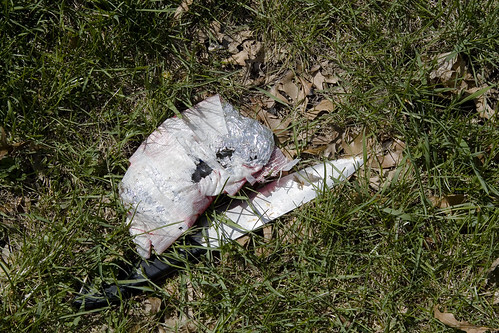
This little package and knife are north east of the monument which I’ll be referring to as an altar. I did not open it, of course, it is against Newtown Pentacle policy to actually touch any of the odd things I come across, like the Pulaski Bridge, with bare skin. This whole neighborhood could use a good scrub, if you ask me.

– photo by Mitch Waxman
As always, if you click any of these images- a new window will open up its Flickr Page. Clicking the “all sizes” button found there will take you to progressively larger incarnations- all the way up to “actual pixels”. Check these out, I’ve spent some time trying to figure out what’s inside of the package. Do any of you sharp eyed Ladies and Lords of Newtown out there wish to hazard a guess? Use the “leave a comment” link.

– photo by Mitch Waxman
Seeing the blade and little kidney shaped package gave the whole scene a somewhat sinister air, and that’s when I remembered to check what else might be found on the cardinal meridians of the compass.

– photo by Mitch Waxman
The western facing of the altar sits at the pinnacle of a muddy ridge, which bears much subsidence. The underpinnings of the stone, and declination of the hill itself, fall away rapidly. These candles were observed.

– photo by Mitch Waxman
Nothing special about one of them, the other was unusual. Both red.

– photo by Mitch Waxman
The west facing side of the scene, from the bottom of the little hill. Note the tumbled and disorganized state of the masonry. North is to your left, south to the right.

– photo by Mitch Waxman
Moving north, a white candle .

– photo by Mitch Waxman
Back on top of the hill, directly east of the white candle above, and north of the main altar.

– photo by Mitch Waxman
A green and a pink candle on a dish of “some quality”.

– photo by Mitch Waxman
West of altar, a tumbled monument, with odd etchings on it. Can this be some sort of language?

– photo by Mitch Waxman
South of altar, west side of hill, a plastic bottle with some sort of red/brown liquid in it.

– photo by Mitch Waxman
Notice that the ground is depressed here, as if something very heavy- like a tombstone- had been moved recently.

– photo by Mitch Waxman
Just at the other end of the divot was this foil wrapped bottle which looked like it had been in the ground for a long time. Notice how the moss grows right up to it.

– photo by Mitch Waxman
Top of hill, south side, looking north across site. There are feathers scattered around the grass, mainly just north of the altar. Click here for a flickr page which shows some detail of the feathers.

– photo by Mitch Waxman
There was also this upside down cross.
Update on the Calvary Knots

– photo by Mitch Waxman
The first thing I would say is that the name on the card does not match those on the monument. The second would be to ask you to read through this posting- Tales of Calvary 4- Triskadekaphobic Paranoia from November of 2009 which describes this odd arrangement in some detail. In the comments thread at that post, please take note of a former Calvary employee’s possible explanation of what is going on here. Third, here’s the latest addition to the knots, a mass card which has appeared just at the outset of spring.

– photo by Mitch Waxman
Despite the intervening brutalities of a New York winter, the knotted cords and stick persisted in their intended places, as evinced above. Realize, of course, that the equinoxes mark special dates on the magickal calendar and cultic activity is ripe at the quarters of the solar and lunar cycle- both Passover and Easter fall near the equinox, for example. At these times of year, if you seek- ye shall find.

– photo by Mitch Waxman
I’m not certain, however, what significance a mass card carries. Not being an adherent of the Roman Catholic religion, I’ve nevertheless purchased them when friends and associates have suffered a loss, and offered them up to grieving families. My assumption has always been that they represent some sort special devotion or ceremony which will be performed by the priestly caste, but I remain ignorant of their purpose. As mentioned above, however, the names on the monument do not match the one on the mass card.
I’m keeping an eye on this “tree fed by a morbid nutrition” here at the ossified heart of the Newtown Pentacle in Calvary Cemetery.
And don’t miss tomorrow’s post, which discusses additional weirdness found at St. Michael’s Cemetery just this past weekend.


 The Newtown Pentacle