Posts Tagged ‘New York City’
Burgundy Crow

– photo by Mitch Waxman
Wandering along the border between Ridgewood, Brooklyn, and Maspeth one afternoon- heading for one of the demoniac terminus points of the Newtown Creek’s tributaries found on Metropolitan Avenue, I realized that I was very much on the wrong side of the tracks.
from wikipedia
The majority of the neighborhood covers a large hill, more than likely part of the glacial moraine that created Long Island, which starts at Metropolitan Avenue, rises steeply for about two blocks, then slopes down gently. A good example of just how steep the hill is can be found at Our Lady of the Miraculous Medal Parish. The Front Entrance of the Church, which is at street level on 60th Place, is almost level with the second floor of the Parish school right next door.
Major streets in Ridgewood include Forest Avenue, Fresh Pond Road, Myrtle Avenue, and Metropolitan (“Metro”) Avenue. All of these streets are narrow two-lane roads (with parking lanes), and the high volume on these streets can cause traffic tie-ups during rush hour. The intersection of Fresh Pond and Metropolitan is especially notorious for being a bottleneck. The main shopping areas are on Myrtle Avenue and Fresh Pond Road. Other, smaller shopping strips are located on Metropolitan Avenue, Forest Avenue, and Seneca Avenue.

– photo by Mitch Waxman
Shabby and poorly kept, these industrial neighborhood scenes observed in this angle between neighborhoods bred paranoia in your humble narrator, who is always given to musings and imaginings.
The people who work here, and even worse- those who live in the shadowed alcoves between buildings and along the rail culverts- would care little for the gentle ways and informed manner of one like myself. There are people, and other entities, which enjoy things around these parts exactly as they are.
from wikipedia
The area known today as Maspeth was chartered by Dutch and English settlers in the mid-17th century. The Dutch had purchased land in the area known today as Queens in 1635, and within a few years began chartering towns. In 1642 they settled Maspat, under a charter granted to Rev. Francis Doughty. Maspat became the first European settlement in Queens. The settlement was leveled the following year in an attack by Native Indians, and the surviving settlers returned to Manhattan. It wasn’t until nine years later, in 1652, that settlers ventured back to the area, settling an area slightly inland from the previous Maspat location. This new area was called Middleburg, and eventually developed into what is now the town of Elmhurst, bordering Maspeth. Following the immigration waves of the 19th century, Maspeth was home to a shanty town of Boyash (Ludar) Gypsies between 1925 and 1939, though this was eventually bulldozed.
The name “Maspeth” is derived from the name of Mespeatches Indians, one of the 13 main Indian tribes that inhabited Long Island. It is translated to mean “at the bad waterplace” relating to the many stagnant swamps that existed in the area.

– photo by Mitch Waxman
My wanderings have brought me into contact with the high minded, the educated, and the entitled. From their offices in Manhattan, they spin a tale of “brownfield remediation” and “environmental reclamation” about the creek lands. They believe in policy, and regulation, and the force of law. Many have never walked these streets, and to quote a professor from a certain Manhattan university who was the institutions expert on this place- “ewww, it smells”.
She said this directly before one of her assistants, who wore sandals to Newtown Creek, stepped into a pile of animal droppings.
They also know nothing about the Crows.
from wikipedia
The scrap industry contributed $65 billion in 2006 and is one of the few contributing positively to the U.S. balance of trade, exporting $15.7 billion in scrap commodities in 2006. This imbalance of trade has resulted in rising scrap prices during 2007 and 2008 within the United States. Scrap recycling also helps reduce greenhouse gas emissions and conserves energy and natural resources. For example, scrap recycling diverts 145,000,000 short tons (129,464,286 long tons; 131,541,787 t) of materials away from landfills. Recycled scrap is a raw material feedstock for 2 out of 3 pounds of steel made in the U.S., for 60% of the metals and alloys produced in the U.S., for more than 50% of the U.S. paper industry’s needs, and for 33% of U.S. aluminum. Recycled scrap helps keep air and water cleaner by removing potentially hazardous materials and keeping them out of landfills.

– photo by Mitch Waxman
This Crow, who we will refer to as “Burgundy Crow” or “BC”, was visiting a scrap yard with his load of cast off mattresses. I have witnessed, although I was to cowardly to use my camera to record it, such men burning the bedding in Greenpoint to free the steel coil springs from the fabric- and I have seen the end product being sold as scrap. “Red Crow” was mentioned in a Newtown Pentacle posting a while back, as was “Blue Crow“.
This is not the sort of industry that the people who run Manhattan believe to exist, and represent an underground cash based economy of subsistence labor which most would prefer not to mention at cocktail parties. It wouldn’t matter to them anyway, as the Crows currently do not deal or compete in speculative Real Estate- which is all that Western Queens represents to them.
from a recent Queenstribune report
A recent achievement is a new grant program that will use financial incentives to spur the cleanup and redevelopment of contaminated lands known as brownfields. More than $9 million in City funds will be available over the next several years to fund environmental planning, investigation and cleanup.
“As our population continues to grow, turning contaminated land into usable space will allow us to develop new housing, create more open space, and spur new job growth,” Bloomberg said. “By awarding grants to those committed to cleaning up and developing brownfield sites, we can start revitalizations that may not otherwise have occurred, and that will bring real benefits to local neighborhoods.”
remembered spires

It was 3,287 days, or 78,885 hours ago, from 9:03 am this morning, that the second plane hit.
You have blinked your eyes approximately 71,002,179 times since then.
2010 Great North River Tugboat Race
– photos by Mitch Waxman
Sunday the 5th of September saw the Hudson River boiling with Tugboats, and your humble narrator was onboard the stout Launch 5 (a former NYPD patrol boat- aka the Patrolman Walburger- whose sturdy crew generously hosted me) shooting photos. Check out the flickr slideshow above (which can also be accessed here) and the race results below.
The Race results as released by the Working Harbor Committee:
18th Annual Great North River Tugboat Race & Competition – 5 September 2010 Working Harbor Committee
SHIP, Company – TIME- HP – CLASS – FINISH IN CLASS
- Maurania III – McAllister Towing – 5:09 – 4,000- A 1
- Cornell – Lehigh Maritime – 5:15 – 1,800 – A 2 (tie)
- Meagan Ann – Donjon Marine – 5:15 – 2,000 – A 2 (tie)
- Cheyenne – Donjon Marine – 5:25 – 1,800 – A 3
- Atlantic Salver – Donjon Marine – 5:55 – 7,200 – A 4
- Catherine Miller – Miller’s Launch – 6:23 – 1,200 – B 1
- Susan Miller – Miller’s Launch – 6:36 – 1,500 – B 2
- Sea Wolf – Sea Wolf Marine – 6:49 – 1,400 – B 3
- Mary H – Bren Transportation – 6:52 – 900 – B 4
- Vulcan – Derrick Marine – 6:56 – 500 – C 1
- W. O. Decker – Seaport Museum – 7:31 – 285 – C 2
- The Bronx – Robert & Lucy Apuzzo – 7:40 – 220 – C 3
- Shawn Miller – Miller’s Launch – 8:29 – 600 – C 4
- Lt. Michael Murphy – Scott Koen – 8:39 – 180 – C 5
Line Throw-
- Cheyenne 15 seconds
- Maurania III 16 seconds
- Susan Miller 18 seconds
Best Looking Tug- Mary H
Best Vintage Tug- Vulcan (1958)
Little Toot- The Bronx
Best Dressed- Meagan Ann (Pirates)
Best Tattoo- Meagan Ann (Multiple nautical tattoos)
Best Mascot- Maurania III (Chihuahua Maddie McAllister, wearing McAllister hat and
carried by small children)
Team Spirit (tie)- Miller’s Launch (3), Donjon Marine (3)
One of the big K-Sea boats arrived too late to compete.
Winners – Spinach Eating Contest
- Adult: Manny Rebelo (of tug Cornell)
- Child: Roland McAllister
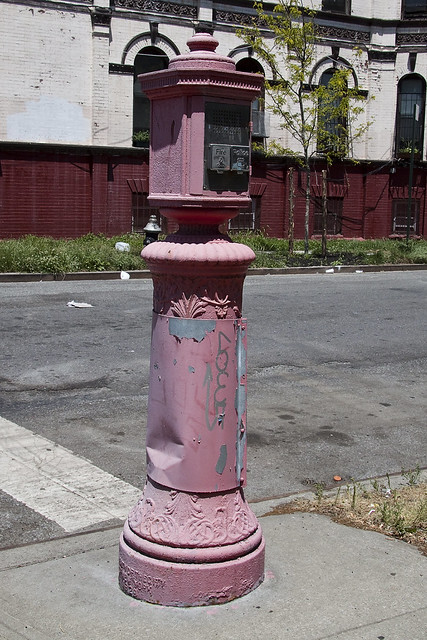
Project Firebox 12
– photo by Mitch Waxman
Following Forgotten-NY’s Kevin Walsh around Bushwick one day, this very old firebox was observed.
It exhibited a couple of unique features, which even the great explorer and expert of these urban climes found puzzling. We shot photos, and moved on in search of certain locations rumored to have survived in the area unscathed by modernity, remnants of the German Brewers which once typified the population of this ancient section of Brooklyn.

– photo by Mitch Waxman
Several days later, the normally steady and wholesome measure of Mr. Walsh’s correspondence took on a feverish tone when he reported that the network of antiquarians and recluse scholars with which he maintains communication had delivered to him a detailed description of the enigmatic firebox, with it’s embossed “H.P. TEL” on the crown and dated base.

– photo by Mitch Waxman
It seems that when the fire system, pipe and pump wise, was first laid down in the early 20th century, technological infancy limited the number of streets that could be served by high pressure lines. Reserved for high rises, factories, and high density tenement blocks- the high pressure water common today was only available in certain areas. However, should the need arise, a fire chief carried a key that would access one of these “H.P. TEL” fireboxes which would send a command back to the firehouse to throw open the valves that would pressurize the lines flowing through its district.
The TEL stands for telegraph, apparently, and the whole scheme ceased to be necessary sometime in the 1950’s.
uncanny light

– photo by Mitch Waxman
Disillusioned, desolate, and diseased– the endless byways of the Newtown Pentacle beckon- calling out to me- the barren, the confused, the discarded.
Always, it seems, an Outsider must keep to the shadows. This is best.
Paranoid, absent minded, and an unreliable physical coward– the feckless quisling who serves as your humble narrator once more offers devotions and attention to a great pattern etched beneath the cement, marching across its sunlit reality like some obsequious pilgrim. Certain realities have been made abundantly clear over the vernal months, confirming specific fears and betraying closely held beliefs. A stalking horse walks my lands.
While lost in the above soliloquy one afternoon, I was walking from Astoria to South Street Seaport‘s Pier 17, when I found this scene in Long Island City.

– photo by Mitch Waxman
Another crew of workmen were observed standing in a similar pit on the other side of the street- 23rd street, if you’re curious. My assumption was that they were feeding this copper tubing from one side of the street to the other, for some purpose of which I cannot hazard a guess. Perhaps the acolytes of that which does not think, or breathe, yet hungers; that thing which is rumored to exist in the crown of the nearby Citibank Megalith– desired to have a constant connection to the Court Square diner’s coffee station.
Who can guess, all there is… that might be down there?


