Posts Tagged ‘photowalk’
Project Firebox 16

– photo by Mitch Waxman
Too seldom consulted and seldom admired, this notable exception to municipal prejudice on Review Avenue provides succor and aid to the long strip of industrial and warehouse buildings which typify the severe declination that leads one to the Newtown Creek, and acts as a watchman over the titan walls of Calvary Cemetery.
note: apologies for missing yesterday and for the non tangential nature of this post, but I’m a little busy with something at the moment. I’ll be back on the stick within a day or so.
Project Firebox 15

– photo by Mitch Waxman
The seldom trammeled but often traversed intersection of Skillman Avenue, 43rd Avenue, and 32nd Place alongside the titan Sunnyside Yard is home to this wounded veteran. Here’s a google maps “street view” shot of it in happier times.
A cursory examination of the nycfire.net forums has at last revealed a discussion of the prevailing logic governing the odd numbering system which codifies the alarm boxes, and discusses why you’ll often see the base and stump of an alarm box left in place years after the actual alarm has been removed. Check it out here.
gentle manner

Combined Sewer Outfall BB-013, from the Pulaski Bridge – photo by Mitch Waxman
To begin- I warn you- this post will most likely “gross you out”.
In 1674, Boyle said: “I have often suspected, that there may be in the Air some yet more latent Qualities or Powers differing enough from all these, and principally due to the Substantial Parts or Ingredients, whereof it consists. For this is not as many imagine a simple and elementary body, but a confused aggregate of ‘effluviums’ from such differing bodies, that, though they all agree in constituting by their minuteness and various motions one great mass of fluid matter, yet perhaps there is scarce a more heterogeneous body in the world”.
When the pithy observation was recorded, “effluviums” were the central notion behind the miasmatic theory of disease.

CSO Outfall NC-077, Maspeth Creek, discharges 288.7M gallons per year into English Kills – photo by Mitch Waxman
The viewpoint of the learned classes in prior ages held that when certain noxious vapors produced by a mingling of soil with that standing water typically found about marsh, swamp, and sewer- then mixed with the cool night air- form so called miasmas (which is an ancient greek for pollution, I’m told).

CSO Outfall NC-077, Maspeth Creek, Tier 2 outfall – photo by Mitch Waxman
These miasmas- or “epidemic influences”- were believed to be the cause of Cholera and Typhus– and all the other plagues which would one day scythe through the crowded 18th and 19th century cities of the Industrial Revolution.
Vitruvius, in the 1st century BCE, said: “For when the morning breezes blow toward the town at sunrise, if they bring with them mist from marshes and, mingled with the mist, the poisonous breath of creatures of the marshes to be wafted into the bodies of the inhabitants, they will make the site unhealthy.”

CSO Outfall NC-077, Maspeth Creek, Ranked 25 out of over 400 in terms of volume – photo by Mitch Waxman
The air produced by, in, and around a sewer is typically an aerosol of whatever liquid solution might be floating through it. Hydroden sulfide, carbon dioxide, methane, ammonia and a host of other constituent compounds mingle and form what is generically known as “Sewer Gas”. Typically, this gas has the sulfurous smell commonly associated with rotten eggs. Otherwise lacking and poor, the average human’s sense of smell can discern this odor when its concentration in the surrounding air is minor- which speaks to an evolutionary quirk.
Obviously- our ancestors who could not detect this aerosol, or miasma, died off while while those who could detect them passed on these sensitivities on to future generations.

CSO Outfall BB-026, Dutch Kills – photo by Mitch Waxman
If you suffer from Obsessive Compulsive Disorder, this would probably be a good time to stop reading this post, incidentally. Things are about to get ugly.
As an example- When a toilet is flushed, and there is scientific evidence to back this, a plume of microscopic droplets- an aerosol– erupts from the water. These droplets carry microbes and virus particles, which then settle on surfaces around the commode facilitating the “surface to hand to mouth” vector of infection. Modern plumbing does its best to minimize this bioaerosol in the house, but routine antimicrobial maintenance with bleach and other chemicals is necessary to sterilize the potential infections which might otherwise occur.
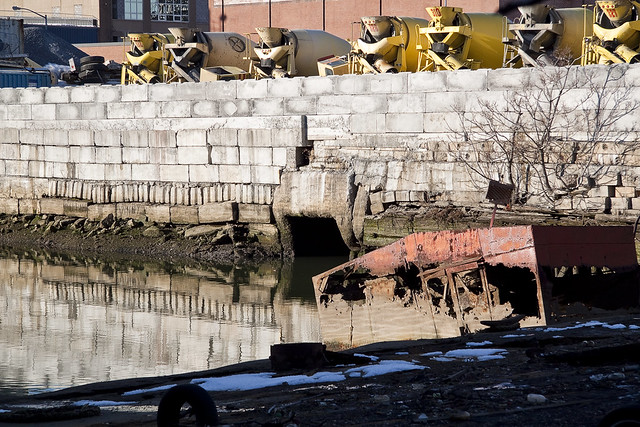
CSO Outfall BB-026, Dutch Kills – photo by Mitch Waxman
Of course, these cleaning chemicals- along with non neutralized microbes- end up in the wastewater flow, and make their way into the sewers… just like the petroleum products, volatile organic chemicals, and everything else that the human hive produces… where they swirl about beneath the streets and follow gravity to low lying areas. A properly designed system intercepts these waters, but in the case of a “CSO”, a lot of the poison makes it into the mud.

CSO Outfall BB-026, Dutch Kills – photo by Mitch Waxman
A classic example of a bacterium whose spread is defined by such aerosol dissemination is Legionella, but heavy metals and other contaminants may also find a pathway into the human body via such aerosols (let’s just call it vapor or fog). Additionally, fibers of toxic manmade substances- Asbestos for instance- are left behind during evaporation. Such deposits are then picked up on the wind, as are the dusty remains of the putrescent particulates which escape treatment by wastewater industries like the Newtown Creek Wastewater Treatment plant in Greenpoint or the Bowery Bay facility in Astoria.
During heavy rain events, some untreated sewage reaches the rivers, but a large percentage of it- the lion’s share- oozes out from the bulkheads of that assassination of joy called the Newtown Creek.

CSO Outfall NCB-632 – photo by Mitch Waxman
The Newtown Creek and its tributaries are indeed waterways, but no one ever discusses this plume of disease and contamination in the air. Fingers are pointed at certain chimneys and infamous underground lakes of petroleum and chemicals, heated discussions of when it might be safe to kayak or swim in the water are offered by interested parties, and odd admissions that there are some who actually fish in and consume the catch from these waters (which according to the EPA, are offering this catch for sale in area restaurants) both shock and titillate area wags- but what about the miasmas?

CSO Outfall NCB-632 – photo by Mitch Waxman
The sewer system of New York City is a composite beast, marrying together the municipal infrastructure of multiple communities into a single system. The cities of Brooklyn, Queens, and Manhattan (the historically agrarian and until modernity- lightly populated – Bronx has almost always been ruled over by Manhattan) each had their own standard, staring elevation, and set of regulations governing the sewers.
This NYTimes.com article from 2008 discusses recent attempts to consolidate and digitize the municipal record, and make sense out of the byzantine network of pipes which underlie the city.

CSO Outfall NCB-632 – photo by Mitch Waxman
Who can guess, all there is, that might be buried down there?
Who can speculate, all there is, which might be wafting out from these deep channels of filth and what strange aerosols are carried upon the gentle breeze- here in the Newtown Pentacle?
Scenes from a Snowpocalypse
– photos by Mitch Waxman
The recent and much commented on Blizzard of December 28, 2010- which we in the frozen zone of Astoria refer to as “The Snowpocalypse”- produced many memorable moments around the ancient village. Made especially clear was that the internet, designed to withstand a nuclear attack, has become vulnerable to seasonal weather in the hands of corporate stewards such as Time Warner Cable.
Here’s a few photos of the experience, and notice the Daily News Truck- which was stuck in the middle of 44th street from 4:30 AM to 11PM and was finally towed out by a block long hydraulic chain. The auto in the second to last shot zipped up the block- the wrong way- and got stuck into the very spot that the truck was in. Some of these shots are unforgivably grainy, as they were captured at extremely high iso speeds.
Incidentally, the iPhone shot of the truck being towed finally out is here.
H.P. Lovecraft’s “The Festival”

– photo by Mitch Waxman
text quoted from H.P. Lovecraft’s “The Festival”, courtesy wikisource, where you can read the whole story
I was far from home, and the spell of the eastern sea was upon me. In the twilight I heard it pounding on the rocks, and I knew it lay just over the hill where the twisting willows writhed against the clearing sky and the first stars of evening. And because my fathers had called me to the old town beyond, I pushed on through the shallow, new-fallen snow along the road that soared lonely up to where Aldebaran twinkled among the trees; on toward the very ancient town I had never seen but often dreamed of.

– photo by Mitch Waxman
It was the Yuletide, that men call Christmas though they know in their hearts it is older than Bethlehem and Babylon, older than Memphis and mankind. It was the Yuletide, and I had come at last to the ancient sea town where my people had dwelt and kept festival in the elder time when festival was forbidden; where also they had commanded their sons to keep festival once every century, that the memory of primal secrets might not be forgotten. Mine were an old people, and were old even when this land was settled three hundred years before. And they were strange, because they had come as dark furtive folk from opiate southern gardens of orchids, and spoken another tongue before they learnt the tongue of the blue-eyed fishers. And now they were scattered, and shared only the rituals of mysteries that none living could understand. I was the only one who came back that night to the old fishing town as legend bade, for only the poor and the lonely remember.

– photo by Mitch Waxman
Then beyond the hill’s crest I saw Kingsport outspread frostily in the gloaming; snowy Kingsport with its ancient vanes and steeples, ridgepoles and chimney-pots, wharves and small bridges, willow-trees and graveyards; endless labyrinths of steep, narrow, crooked streets, and dizzy church-crowned central peak that time durst not touch; ceaseless mazes of colonial houses piled and scattered at all angles and levels like a child’s disordered blocks; antiquity hovering on grey wings over winter-whitened gables and gambrel roofs; fanlights and small-paned windows one by one gleaming out in the cold dusk to join Orion and the archaic stars. And against the rotting wharves the sea pounded; the secretive, immemorial sea out of which the people had come in the elder time.

– photo by Mitch Waxman
Beside the road at its crest a still higher summit rose, bleak and windswept, and I saw that it was a burying-ground where black gravestones stuck ghoulishly through the snow like the decayed fingernails of a gigantic corpse. The printless road was very lonely, and sometimes I thought I heard a distant horrible creaking as of a gibbet in the wind. They had hanged four kinsmen of mine for witchcraft in 1692, but I did not know just where.

– photo by Mitch Waxman
As the road wound down the seaward slope I listened for the merry sounds of a village at evening, but did not hear them. Then I thought of the season, and felt that these old Puritan folk might well have Christmas customs strange to me, and full of silent hearthside prayer. So after that I did not listen for merriment or look for wayfarers, kept on down past the hushed lighted farmhouses and shadowy stone walls to where the signs of ancient shops and sea taverns creaked in the salt breeze, and the grotesque knockers of pillared doorways glistened along deserted unpaved lanes in the light of little, curtained windows.


