Posts Tagged ‘Triborough Bridge’
Catherine Turecamo at HellsGate, and camera news

– photo by Mitch Waxman
Technical upgrades have occurred here in Pentacle HQ. A new DSLR, which was quite unaffordable, has been purchased from the unknowable levantines at BH Photo. The trusty Canon G10, in use since its issuance in late 2008, is off to Canon for warranty service owing to the defects that have appeared on its lens. Said scratches seem to originate from the mechanical action of the external housing which are meant to protect the lens element. These scratches have, after shooting some 17,000 exposures in the last year, become quite noticeable and are getting in the way. The G10 will return to Newtown Pentacle service upon repair, and is highly recommended to all for its versatile nature, manual shooting modes, ability to save in RAW format, and crisp lens- although it falls apart in low light and is useless at high ISO speeds. The flash is also pathetic.

– photo by Mitch Waxman
Deciding to take the plunge into the DSLR world, our lady of the Pentacle and myself worked out a budget, and research on what was available in my price point began. Things narrowed to the Nikon D90 and Canon Rebel T1i (or 500D). The Nikon is wielded by a buddy of mine to great effect, and offers the promise of a “full size” sensor. The Nikon ecosystem of accessory lenses and other bits is also a little less expensive than commensurate equipment in the Canon range. The Canon, however, matches the 15 megapixel spec of the G10 (also a Canon) and also offers an operating system that seemed a bit more organic to me. I use a Mac, always have, and have quit jobs that forced me to use a windows PC in the past. Organic matters to me, which is why a Sony camera was never considered. (imho Sony makes the best Hardware-Everything, and the worst software-Everything).

– photo by Mitch Waxman
So, having spent a ton of money I don’t have, the plunge was taken on the Canon T1i and a couple of decent lenses. Of course, this is after “the season” for photography in New York, which is actually most of the time- just not in December and January. Harsh shadow and blown highlights, overcast skies and leaden water- trademarks of the winter sun here in the Newtown Pentacle- the angle and frequency of the light is all wrong except in the early morning and late afternoon. Photography types term this as “golden hour”, which somehow sounds “dirty” to me.
So, on one of the few sunny days enjoyed of late, your humble narrator pulled the filthy black raincoat off its hook and scuttled forth to find what I could find. Hells Gate is always a good choice for experimenting with a new gizmo. Astoria Park is just about as safe these days as you can expect to be when out in public, and there’s always something interesting going on. I shot these with the “long lens”, which is fancy way of saying telephoto.
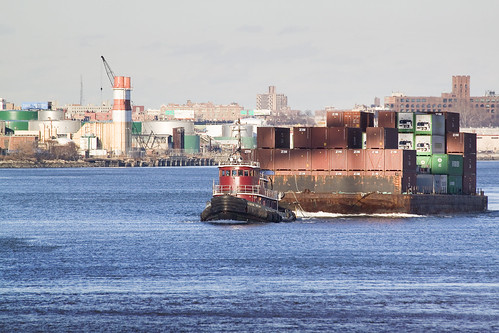
– photo by Mitch Waxman
That’s the Catherine Turecamo, a 1972 vintage 199 ton 3,200 HP tugboat, operated by the Moran towing company. It was built at the Main Iron Works in Louisiana as the MIss Lynn.
from morantug.com
Moran Towing Corporation has provided tugboat services to the Port of New York since 1860. The company began with Michael Moran’s purchase of-one-half interest in a tugboat. In the years since, the fleet with the white M logo on its stacks has become the largest in the port,and on the U.S. East and Gulf Coasts. The port of New York-New Jersey provides access to the most concentrated and affluent consumer market in the world. Its facilities include terminals operated by the Port Authority of NY & NJ and privately operated terminals. Over 16 million tons of cargo pass through the port on an annual basis, transported aboard various types of ships, including container ships, tankers and barges. The New York division also services the Port of Albany, located 145 miles up the Hudson River from New York City. Albany is a hub for commercial trade in its region, due to its proximity to the New York State Barge Canal and its excellent inland transportation network.

– photo by Mitch Waxman
The new camera was a little awkward to handle at first, and I was self conscious of it as well. This was a big “honking” camera, weighing four times what my familiar “rangefinder-sized” G10 did. I practiced tracking the tugboat with it, zooming in and out and so on. I think the shots came out alright- if you click through to the photo’s Flickr page and check out its larger incarnations- you’ll see some real detail in them. This is one of the places where the higher megapixel count of the Canon matters to me, and justified buying into its franchise.
Trust me on this one, I’m an advertising retoucher photoshop guy by day, and resolution matters. A lot.

– photo by Mitch Waxman
I’m only a couple of thousand shots in, a month later. Its been a busy month somehow, with holiday obligation and hiding in my warm burrow awaiting spring. Meanwhile, I’ll be learning how to use this new gizmo.
Incidentally, on the subject of gizmos, anyone out there have anything to say on geotagging? Leave me a comment or contact me, if you do.
Tugboat transit at Hells Gate

– photo by Mitch Waxman
Hanging out at Astoria Park, waiting for the Greater Astoria Historical Society‘s “Haunted East River” tour to start, what did I spy crossing under mighty Triborough?
The John Reinauer tugboat- that’s what- moving a fuel barge north on the East River, through the bright passage at Hells Gate.
from wikipedia
Liquid cargo barges are barges that transport petrochemicals, such as styrene, benzene and methanol; liquid fertilizer, including anhydrous ammonia; refined products, including gasoline, diesel and jet fuel; black oil products, such as asphalt, No. 6 fuel oil and coker fuel; and pressurized products, such as butane, propane and butadiene, which are transported on the waterways from producers to end users.

– photo by Mitch Waxman
The John Reinauer was built at Main Ironworks in 1969, and was christened the Esso Crystal River. (Esso, is of course, the brand name for Standard Oil -S.-O- Esso, later Exxon) The now Exxon Crystal River went to Reinauer Transportation in 1993. A 2,600 horsepower, 86 foot long steel hulled towing vessel, the J.R. is 27 feet wide and has a draw of 9 feet.
Check out the company’s J.R. page for photos of the ship in its various incarnations here.
from wikipedia
The terms “Tonnage” and “Ton” have different meanings and are often confused. Tonnage is a measure of the size or cargo capacity of a ship. The term derives from the taxation paid on tuns of wine, and was later used in reference to the weight of a ship’s cargo; however, in modern maritime usage, “tonnage” specifically refers to a calculation of the volume or cargo volume of a ship. The term is still sometimes incorrectly used to refer to the weight of a loaded or empty vessel.
Measurement of tonnage can be less than straightforward, not least because it is used to assess fees on commercial shipping.

– photo by Mitch Waxman
Like many other tugboats, the John Reinauer participated in the evacuation of Lower Manhattan necessitated by the September 11 attacks.
(The John J. Harvey Fireboat, which was discussed in some detail in 2 prior posts- here… and here, similarly served the city that day).
from wikipedia
Immediately after the first attack, the captains and crews of a large number of local boats steamed into the attack zone to assist in evacuation and provide supplies and water.Water became urgently needed after the Towers’ collapse severed downtown water mains. The size of the dust and debris cloud following the collapse of the Twin Towers was such that it necessitated that many of these trips were navigated by radar alone. Estimates of the number of people evacuated by water from Lower Manhattan that day in the eight hour period following the attacks range from 500,000 to 1,000,000. As many as 2,000 injured people in the attacks were reportedly evacuated by this means through there were no reported injuries resulting from the evacuation itself.
Sludge Boats, baby, Sludge Boats

M/V Red Hook DEP Sludge Vessel – photo by Mitch Waxman
After processing at a water treatment facilities, which the City of New York’s DEP manages 14 of (including the vast Temple of Cloacina called the Newtown Creek Wastewater Treatment Plant), the concentrated sludge distillate produced by municipal sewage plants requires “dewatering” – it must be reduced into a semi solid called “cake”. Not every one of the 14 wastewater treatment plants has a dewatering facility, so the sludge needs to get from point A to point B via a the fleet of Sludge Vessels.
Pictured above is the sludge dock in Greenpoint, with the M/V Red Hook at dock, at the mouth of the Newtown Creek. Flowing from that aforementioned temple of “the Venus of the Sewers” to a gigantic holding tank via mechanical means, it is then pumped out to the dock and the waiting sludge boat.
from nyc.gov
Preliminary treatment
Several stories underground, wastewater flows into the plants from sewers connected to New York City’s homes and businesses. The incoming wastewater, called influent, passes through screens consisting of upright bars, spaced one to three inches apart. These bars remove large pieces of trash including rags, sticks, newspaper, soft drink cans, bottles, plastic cups and other similar items. This protects the main sewage pumps and other equipment. The garbage is transported to landfills. The main sewage pumps then lift the wastewater from the screening chamber to the surface level of the plant.
Primary treatment
Next, the wastewater enters primary settling tanks, also called sedimentation tanks, for one to two hours. The flow of the water is slowed, allowing heavier solids to settle to the bottom of the tank and the lighter materials to float. At the end of the process, the floatable trash, such as grease and small plastic material, rises and is skimmed from the top of the tanks surface.
The settled solids, called primary sludge, are then pumped through cyclone degritters — devices that use centrifugal force to separate out sand, grit (such as coffee grinds) and gravel. This grit is removed, washed and taken to landfills.
The degritted primary sludge is pumped to the plant’s sludge handling facilities for further processing. The partially treated wastewater from the primary setting tanks then flows to the secondary treatment system.

M/V North River DEP Sludge Vessel – photo by Mitch Waxman
The 1.3 billion gallon a day flow of New York City’s sewage should be defined as a third river. That’s 1,300,000,000 gallons a day or 474,500,000,000 gallons of night soil a year. 1.3 billion is the population of China.
Pictured above is the DEP Sludge Vessel M/V North River, a veteran, she was launched at Maryland Shipbuilding in 1974. Just under 324 foot long, North River can carry 102,000 cubic feet of evil juice and weighs in at 2,557 gross tons.
from nyc.gov
Secondary treatment
Secondary treatment is called the activated sludge process. This is because air and “seed” sludge from the plant treatment process are added to the wastewater to break it down further. Air pumped into large aeration tanks mixes the wastewater and sludge that stimulates the growth of oxygen-using bacteria and other tiny organisms that are naturally present in the sewage. These beneficial microorganisms consume most of the remaining organic materials that are polluting the water and this produces heavier particles that will settle later in the treatment process.Wastewater passes through these bubbling tanks in three to six hours.
The aerated wastewater then flows to the final settling tanks which are similar to the primary settling tanks. Here the heavy particles and other solids settle to the bottom as secondary sludge. Some of this sludge is re-circulated back to the aeration tanks as “seed” to stimulate the activated sludge process. The returned sludge contains millions of microorganisms that help maintain the right mix of bacteria and air in the tank and contribute to the removal of as many pollutants as possible.
The remaining secondary sludge is removed from the settling tanks and added to the primary sludge for further processing in the sludge handling facilities.Wastewater passes through the settling tanks in two to three hours and then flows to a disinfection tank.
Disinfection
Even after primary and secondary treatment, diseasecausing organisms may remain in the treated wastewater. To disinfect and kill harmful organisms, the wastewater spends a minimum of 15-20 minutes in chlorine-contact tanks mixing with sodium hypochlorite, the same chemical found in common household bleach. The treated wastewater, or effluent, is then released into local waterways. Disinfection is an essential step because it protects the health of people who use local beaches and enjoy other recreational activities on or near the water.

M/V Newtown Creek DEP Sludge Vessel – photo by Mitch Waxman
Identical in dimension and capacity to the North River, the 1967 vintage DEP Sludge Vessel M/V Newtown Creek passed under mighty Triborough and crossed Hells Gate. M/V Newtown Creek was laid down by the Wiley Manufacturing Co. Back in the days of ocean dumping, these ships were amongst a small fleet of tugs, barges, and older sludge boats that would “do the deed“.
from nyc.gov
Sludge treatment
The following are typical stages of the sludge treatment process.
Thickening
The sludge produced by primary and secondary treatment is approximately 99% water and must be concentrated to enable its further processing. Thickening tanks allow the sludge to collect, settle and separate from the water for up to 24 hours. The water is then sent back to the head of the plant or to the aeration tanks for additional treatment.
Digestion
After thickening, the sludge is further treated to make it safer for the environment. The sludge is placed in oxygenfree tanks, called digesters, and heated to at least 95 degrees Fahrenheit for between 15 to 20 days. This stimulates the growth of anaerobic bacteria, which consume organic material in the sludge. Unlike the bacteria in the aeration tanks, these bacteria thrive in an oxygen-free or “anaerobic” environment. The digestion process stabilizes the thickened sludge by converting much of the material into water, carbon dioxide and methane gas. The black sludge that remains after digestion has the consistency of pea soup and has little odor. This is called digested sludge.
Methane gas is often used as an energy source at the City’s wastewater treatment plants. The gas may be used in engines to produce electricity or directly drive plant equipment. Gas is also used in boilers to provide heat for digestion and plant-wide buildings. Currently, DEP and the New York Power Authority (NYPA) have jointly installed fuel cells at four of the City’s water pollution control plants; 26th Ward, Red Hook, Oakwood Beach and Hunts Point. Fuel cells convert the methane gas and carbon dioxide into heat and electricity that is then used to operate the plants. This technology contributes to New York City’s efforts to enhance clean air operations at its facilities. There is a significant reduction in air emissions as a result of using fuel cells.
Digester sludge is pumped from sludge storage tanks to a dewatering facility. At some treatment plants, where there are no dewatering facilities on site, the sludge is transported for processing through a pipeline or by a sludge boat to a plant that has a dewatering facility.

M/V Newtown Creek DEP Sludge Vessel, close-up – photo by Mitch Waxman
Once requiring a crew of as many of 20, the City now runs these ships with a mere 6. Semiautomated, M/V Newtown Creek and North River are nevertheless more than twice the size of the original model Sludge Vessels like the Owl’s Head.
from nyc.gov
Dewatering reduces the liquid volume of sludge by about 90%. New York City operates dewatering facilities at eight of its 14 treatment plants. At these facilities, digested sludge is sent through large centrifuges that operate like the spin cycle of a washing machine. The force from the very fast spinning of the centrifuges separates most of the water from the solids in the sludge, creating a substance knows as biosolids. The water drawn from the spinning process is then returned to the head of the plant for reprocessing. Adding a substance called organic polymer improves the consistency of the “cake”, resulting in a firmer, more manageable product. The biosolids cake is approximately 25 to 27 percent solid material.


 The Newtown Pentacle