Posts Tagged ‘weirdness’
…this one’s for the birds

– photo by Mitch Waxman
Washington, whose actual birthday is on February 22, would have avoided shopping on this holiday- I would think.
Have no doubt that the American Augustus had significant material aspirations and enjoyed a lifestyle that could only be maintained by a subjugate army of slaves, but I’d like to believe that he would be resistant to having his birthday celebrated with a crass and consumerist bacchanal.
I like to think he’d be embarrassed, but as I’m a non-slaver, it’s difficult for me to imagine the mindset of the “founding fathers”.
from wikipedia
Titled Washington’s Birthday, the federal holiday was originally implemented by the United States Congress in 1880 for government offices in the District of Columbia (20 Stat. 277) and expanded in 1885 to include all federal offices (23 Stat. 516). As the first federal holiday to honor an American citizen, the holiday was celebrated on Washington’s actual birthday, February 22. On 1 January 1971, the federal holiday was shifted to the third Monday in February by the Uniform Monday Holiday Act. This date places it between February 15 and 21, which makes the name “Washington’s Birthday” a misnomer, since it never lands on Washington’s actual birthday, February 22. A draft of the Uniform Holidays Bill of 1968 would have renamed the holiday to Presidents’ Day to honor the birthdays of both Washington and Lincoln, but this proposal failed in committee and the bill as voted on and signed into law on 28 June 1968, kept the name Washington’s Birthday.

– photo by Mitch Waxman
February 15th is also Susan B. Anthony‘s birthday, who is at least as important to our republic as its founder. If Washington was indeed Augustus, Anthony was Trajan. Speaking of pagan times, incidentally, today is the third day of Lupercalia – a Roman spring cleaning ritual that is also known as Februa. The particular deity of this ancient rite is Februus– an Etruscan god of malaria- although its the ritual that lends its name to the calendrical month, not the god.
Closer to home, February 15th is also the birthday of a man who sired one of Astoria’s most important families– Heinrich Engelhard Steinweg.
from wikipedia
Because of the unstable political climate in Germany, Steinweg decided to leave the country. He emigrated from Braunschweig to New York City in 1851 with four of his sons, but before leaving he gave the company to his son, Theodor Steinweg. Once in New York, he anglicized his name to Henry E. Steinway, and he and his sons worked for other piano companies until they could establish their own production under the name of Steinway & Sons in 1853.
The overstrung scale in a square piano earned the Steinway Piano first prize at the New York Industrial Fair of 1855.[3] In 1862 they gained the first prize in London in competition with the most eminent makers in Europe; and this victory was followed in 1867 by a similar success at the Universal exposition in Paris. According to Franz Liszt, Anton Rubinstein, and other high authorities, the Steinways have done more to advance the durability, action, and tone-quality of their instruments than any other makers of Europe or America.
He and his wife, Juliane, had seven children: Albert Steinway, Charles H. Steinway, Christian Friedrich Theodor Steinweg, Doretta Steinway, Henry Steinway, Jr., Wilhelmina Steinway and William Steinway.
Crows of Queens

Red Crow van spotted – photo by Mitch Waxman
Returning from a trip to Third Calvary Cemetery the other day (searching for Gilman) to my Astoria, I came across this red van with a disturbingly heterogeneous collection of mattresses affixed to it. This red van is a familiar sight around the neighborhood, personal conveyance of a Crow. For clarity and codification lords and ladies, this gentleman shall be referred to as “Red Crow”, here at your Newtown Pentacle.

Red Crow appears – photo by Mitch Waxman
Crows is a nickname given to the refuse and metal collectors who harvest valuable metals from everyday garbage, as assigned to them here in the old village of Astoria. Some are individuals, others are multi man operations, and a variety of vehicles are purposed to the task. If its not nailed down, and copper-steel-iron or gold can be harvested, a Crow will fly in and scoop it up. Furniture and bicycles are highly prized.

Red Crow goes back for more – photo by Mitch Waxman
Usually an hour or two ahead of the Sanitation trucks, the Crows may be observed on DSNY “bulk pickup days”, cruising the streets with the wary aspect of a Police Detective hunting a criminal. Most are specialists, collecting a specific kind of refuse. Almost all of them are metal collectors, no doubt selling the found materials by the pound down at the Newtown Creek.
This is a surmise, incidentally, filling in the dots as it were- as I cannot prove what I’m asserting- i.e. I can’t show you a photo of some lump of metal in Astoria, grabbed by a Crow, and then the same lump transacted for in Greenpoint. I have observed the beginning (this post) and the product of such scavenging at metal dealers in Brooklyn, however.

Red Crow reappears – photo by Mitch Waxman
One of the rules of dumpster diving in the City of Greater New York dictates that mattresses are not a desirable item and are in fact avoided like lepers. If its on the street, there’s either an infestation or somebody died on it, and Bedbugs can jump like Fleas. Essentially valueless as a manufactured good, the general custom is for the merchant that sold and delivered your bedding is to remove and dispose of the old mattress- often at no cost. Nobody really wants a used mattress. What, then, would motivate this incongruously well dressed Crow into such an odd pursuit?

Red Crow hitches – photo by Mitch Waxman
Steel springs, the coil structure within the bedding, are highly prized items for recycling. The reason that its not economical for a commercial enterprise to do so is the cost of removing the deeply embedded metal from its surrounding padding and removal of the metals using electromagnetics. Mattress merchants factor the cost of this process into every new bed sold, by statute in some places.

Red Crow adjusts – photo by Mitch Waxman
Not conforming to OSHA or environmental guidelines, the Crows have a developed a far simpler system to separate the wheat from the chaff. They call it fire.

Red Crow ties – photo by Mitch Waxman
Somewhere, whether it be in the backyard of an isolated house in Flushing or an empty lot along the Newtown Creek in Greenpoint or East Williamsburg, the steel springs will be freed and the charred padding discarded. Elsewhere, plastic insulation will be melted off copper wire and tires will be melted open to reveal their internal steel belting. The Crows will clean up after themselves and no one will be the wiser for the extra tax free bucks that they pick up off the streets.

Red Crow done – photo by Mitch Waxman
This is recycling, manifest, incidentally. A crude layman version of it, but the way that things actually work, one of those “Green Jobs of the Future” the politicians keep going on about.

Red Crow drivers side door doesn’t want to open, uses passenger door – photo by Mitch Waxman
I bring this Crow to your attention simply because the history of our times will be culled from sources that promote an oligarchal viewpoint, and the story that will be told is that of the princes and potentates who stare down at the world from skyscraper windows. Phenomena like these “Crows of Queens” will escape the notice and mention of the future, leaving behind virtually no documentation that they ever existed, like the omnipresent “shmata” men of Manhattan’s Lower East Side a mere 100 years ago.

Red Crow resumes hunt – photo by Mitch Waxman
Revisionist by nature, the urge to focus a historical lens on the machinations of the rich and powerful is strong, and desire to know and emulate the successful is a strong desire. The story of the bosses is not all that’s going on these days.
You have to appreciate this fellow, he looks mid-50’s to me, and here he is in 25 degree weather scavenging the streets and struggling to tie down his load. The rest of us just walked by and saw a pile of junk, he saw opportunity, and was willing to go that extra step and do the job. Know what I see, when I look at these Crows of Queens?

Red Crow, notice PBA stickers and window washer duct tape repair – photo by Mitch Waxman
I see that which made America great, and will do so again.
Shoosh… Be Very Quiet… I’m hunting rabbits…

– photo by Mitch Waxman
Hunting for the elusive gravesite of a man called Gilman, one frigid afternoon spent within the 365 acres of First Calvary Cemetery proved the existence here of a race of burrowing things- mud caked groundlings with glowing red eyes.
Somewhere, nearby I would suspect, is a subterranean warren kept warm by the swarming masses of their hairless and blind progeny. Squirming, these sweaty holes dug into the frozen graveyard force the adults to brave the bright dangers of the surface world to forage.
from wikipedia:
The lagomorphs are the members of the taxonomic order Lagomorpha, of which there are two families, the Leporidae (hares and rabbits), and the Ochotonidae (pikas). The name of the order is derived from the Greek lagos (λαγος, “hare”) and morphē (μορφή, “form”).
Though these mammals can resemble rodents (order Rodentia), and were classified as a superfamily in that order until the early twentieth century, they have since been considered a separate order. For a time it was common to consider the lagomorphs only distant relatives of the rodents, to whom they merely bore a superficial resemblance.
The earliest fossil lagomorphs, such as Eurymylus, come from eastern Asia, and date to the late Paleocene or early Eocene. The leporids first appear in the late Eocene, and rapidly spread throughout the northern hemisphere; they show a trend towards increasingly long hind limbs as the modern leaping gait developed. The pikas appear somewhat later, in the Oligocene of eastern Asia.

– photo by Mitch Waxman
Prey by nature, the foragers are fast and smart and alert. The gods of the sky, the claws of the stealth demons, the brutal agonies of the dog- all are found on the surface. Designed to eat the ruggose fibers of grass and seed, quickly and as much as possible in one go, they are swift and nervous. Fed on the morbid nutrition offered up by the loam of Calvary Cemetery, the glowing red eyes of these burrowers scan constantly for danger.
from wikipedia:
The rabbit lives in many areas around the world. Rabbits live in groups, and the best known species, the European rabbit lives in underground burrows, or rabbit holes. A group of burrows is called a warren. Meadows, woods, forests, thickets, and grasslands are areas in which rabbits live. They also inhabit deserts and wetlands. More than half the world’s rabbit population resides in North America. They also live in Europe, India, Sumatra, Japan, and parts of Africa. The European rabbit has been introduced to many places around the world.

– photo by Mitch Waxman
Merely a part of some vast ecosystem occluded by the marble and sorrow, these burrowers are prized game for the higher mammals and avian predators which frequent the bulkheaded shorelines of the Newtown Creek. It is difficult, with modern eyes, to imagine the world of the unspoiled Creek.
Once, this was part of a rich swampy marshland, and abundant game and wildlife drew sportsmen from the great cities of Brooklyn and Manhattan for hunting and fishing to the rural extants of the Newtown Creek. Nearby, aboriginal tribes of Lenape (the Maspeatche) made their camps near Mt. Zion cemetery and when the europeans came- great hunting lodges and hotels were erected along its banks to service the tourist trade from the two island cities. That was before the industries, before the Rural Cemeteries Act, and before the 800 pound gorilla came to town.
from wikipedia:
Jugged Hare (known as civet de lièvre in France), is a whole hare, cut into pieces, marinated and cooked with red wine and juniper berries in a tall jug that stands in a pan of water. It traditionally is served with the hare’s blood (or the blood is added right at the very end of the cooking process) and Port wine.
Jugged Hare is described in the influential 18th century cookbook, The Art of Cookery by Hannah Glasse, with a recipe titled, “A Jugged Hare,” that begins, “Cut it into little pieces, lard them here and there….” The recipe goes on to describe cooking the pieces of hare in water in a jug that it set within a bath of boiling water to cook for three hours. Beginning in the nineteenth century, Glasse has been widely credited with having started the recipe with the words “First, catch your hare,” as in this citation. This attribution is apocryphal.

– photo by Mitch Waxman
Your humble narrator appreciates the irony that New York City’s nature preserves are entirely accidental. The nearby Ridgewood Reservoir, an eidelon of municipal malfeasance and neglect, has transformed into a significant bird sanctuary and houses a teeming ecosystem ranging from rodent to raptor. The cemeteries of Queens similarly house a niche ecology, providing a refuge for ghoulish reprobates and rabbit alike. Some effort has been made at finding a scientific sampling of biota at these locations, but if it exists, my meager skills at the art of detection have been unable to uncover such data.
for a third person perspective on how my encounter with this manifest avatar of the Lepus specie went, please click here- its pretty much the way that the whole thing “went down”.
Tales of Calvary 10- The Hatch

– photo by Mitch Waxman
Your humble narrator, amongst other failings, has a certain preference for the grandiose statuary of the late 19th and early 20th century at First Calvary Cemetery here in Queens. Baroque expressions such as these appeal to the comic book fan in me, looking for all the world like a Jack Kirby or Jim Steranko rendering. One half expects a concrete angel to… well, I stray…
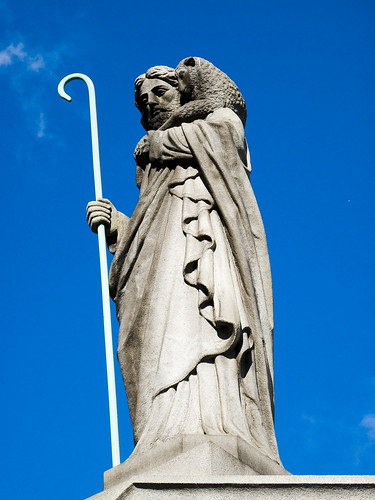
– photo by Mitch Waxman
The southern section of First Calvary, found atop the cyclopean masonry observed on Review Avenue, offers glimpses of the Newtown Creek and panoramic views of industrial Brooklyn. Framing the open horizon of marshy western Queens and the forges of Brooklyn is the Kosciuszko Bridge, heroically carrying a vehicular river called the Brooklyn Queens Expressway over the infamous cataract. The elevation of these walls is actually quite high, an arcing and non euclidean structure which must be 2 to 3 stories at its apogee.
Am I overestimating? Check out this shot from the “street level” declination, aimed at the downward slope from halfway down Review Ave.–
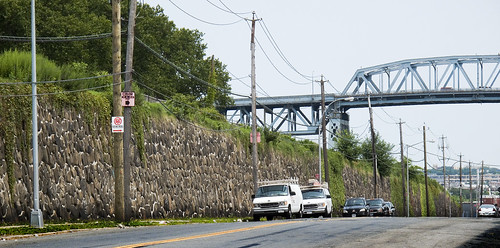
And the shots below are from the other side of it, the topside of the wall.

– photo by Mitch Waxman
You won’t find the grandiose tombs or obsequious monuments to the famous on this side of First Calvary. This is where the “regular people” are buried- in their multitudes- in neatly defined rows of plots. The northwestern sections of Calvary, where the main gates are, and the northeastern- along Laurel Hill Blvd.- (both “High Ground”) are where you can find the princes of the 19th century city. Here, along Review Avenue, is where the middle and working class rest.

– photo by Mitch Waxman
My reasons for coming to this section must remain hidden, for now, suffice to say that I am still hunting for the grave of a man named Gilman (see “Tales of Calvary 7” for more speculation on this mysterious merchant from Massachusetts). Enjoying the relative quiet, I noticed one of the concrete pillboxes which I’ve also alluded to in earlier posts. These structures are all over Calvary, are often padlocked, and have aroused no small amount of curiosity in your humble narrator.

– photo by Mitch Waxman
Several conjectures -an access point to buried family mausoleums, a storage unit for groundskeepers, some sort of equipment shed- have assailed me as I observed these structures with their heavy iron lids and stout cement construction. An avid devotee of the macabre, I’ve often wondered aloud about just what is is that may be down there.

– photo by Mitch Waxman
This particular structure, as you can see, had been left unlocked. In fact, its heavy lid was just resting on the cement and its hinges had long ago stopped functioning.

– photo by Mitch Waxman
Nudging the lid back a few inches, a better than six foot drop was observed, which put its bottom some 4 feet below the surface as observed in the shot above. I activated the camera flash and illuminated quite a bit of airborne dust when the camera performed its intended action. As you can see, there were two modern shopping carts and part of a lamp down there. Puzzling- not for being trash, but… for… why, how, when, etc. You’d expect shovels or spades, but shopping carts and a lamp?

– photo by Mitch Waxman
Were I still the youthful and robust physical specimen I once was, I might have more to say about this, as I would have entered the yawning mystery for a closer look. However, as an aged physical coward and feckless quisling given to emotional stupor and irrational panic, the miasmal odor of the open hatch drove me backwards and I nearly passed into one of my episodes. Fighting off a faint, I labored to close the heavy lid and made for the Penny Bridge gates found on Laurel Hill Blvd. to escape the implications of that smell, which reminded me of an aquarium in need of filtration.
What can it be, that might be down there?
Thawing Thursday linkage
Lovecraftia-
Well, it seems that the Deep Ones have been spotted in Antarctica by the Japanese. They dare much, these Deep Ones, for the city of the Old Ones– infested with Shoggoths– still awaits rediscovery atop the Earth’s forbidden peaks at the austral pole. Has to be, because Lovecraft was actually right about a lot of things- although his racial politics were distasteful even by the standard of his times.
- photo from Pinktentacle.com

The Ningen, ladies and lords, and the glory that is pinktentacle.com.
The Occult-
Check out the story of an Orthodox Jewish exorcism, which is part of an ongoing Dibuk Possession at failedmessiah.com
Politics-
Check out Geoff Dyer’s comparisons of the British and American mindset at nytimes.com
Discredited, but worth a look-
Miss Murray’s Witch Cult in Western Europe
Tragedy in Haiti
Looks like a 100,000 may have died in the Earthquake on Tuesday. 48 tons of emergency supplies and 2,000 Marines are onboard speedy ships coming to help dig out, set up field hospitals, and facilitate law and order. An air craft carrier and multiple support vessels are enroute as well. The Coast Guard just arrived to set up communications and air traffic control. It is time to live up to our national mythology, and damn the cost of it. Count on the national government to find a way to focus the charitable urges of the nation- a flood of donations and canned food drives- with shipping arranged by some friendly corporation. The Mexicans are a rather large presence in the region as well, and don’t be surprised if even Cuba shows up to help.
And- America must resist the urge to “fix” Haiti during reconstruction in any way except to leave behind a staggering amount of useful stuff. Our national will has tried to “fix” Haiti several times before and it hasn’t worked out very well for anyone concerned. Haitians are clever, just broke. They can do a lot more with a cord of lumber and a set of tools than they can with a paper grocery bag full of cash, and there’s enough unsold raw material sitting around in American warehouses and factory docks to build a stairway to the moon out of PVC pipes and drywall.
This is the head of the snake, of course, and a vast conveyor belt of aid is being loaded up all over the East Coast. America is coming, and this is when we are at our national best- when our friends are in trouble. The Eagles are coming.
note: Growing up in Brooklyn, I knew A LOT of Haitian families, and my heart goes out for the people of Port Au Prince. There are so many Haitians in Brooklyn, by the way, that this may as well have happened to New York. God speed, good luck, hold on for a couple of days and stay warm- the Cavalry is just on the other side of the hill… hopefully.
For Google’s listing of organizations working on Haiti relief efforts, click here.


 The Newtown Pentacle