Archive for September 2009
Leave the 27th of September open, if you’re an Astorian

St. Joseph’s Church 30th avenue bet 44 and 45 streets, Astoria – photo by Mitch Waxman
Founded in 1878 by German Catholics, St. Josephs is clad in the yellow Kreischer brick so typical of this part of Astoria. A massive complex, the church also maintains a school and (or, used to maintain) domestic residences for both Priests and Nuns. On the 27th of September, at 1 in the afternoon, they will enacting the procession of San Pio. This is not dissimilar to the Orsogna Society Parade I was lucky enough to catch last month, but on a grander scale. In past years, I observed Catholic offices as high as Deacon represented and in attendance at this marching of the Saint’s statue. This parade will kick off a sequence of celebratory events at St. Joseph’s- which I’ll be covering in some detail- as it’s around the corner from my house.
from wikipedia
St. Pio of Pietrelcina (May 25, 1887 – September 23, 1968), also known as Saint Padre Pio, was a Capuchin priest from Italy who is venerated as a saint in the Roman Catholic Church. He was born Francesco Forgione, and given the name Pio when he joined the Capuchins; he was popularly known as Padre Pio after his ordination to the priesthood. He became famous for his stigmata.

St. Joseph’s Church parade- 2006, Astoria – photo by Mitch Waxman
Here’s a short Queens Tribune report on the 2006 event. Pio was renowned as an exorcist and stigmatic, which is kind of interesting all on its own. More to come…
Proof and Postulates

Elevated Subway Tracks leaving Queens Plaza, with Queensborough offramp in background- from 23rd street, LIC – photo by Mitch Waxman
One day in August of 2009, a time when the rainy and cool weather that had typified the early summer was finally ended, and under the burning thermonuclear gaze of god itself – which once again stared down upon the Newtown Pentacle unoccluded- I decided to take a little walk down to LIC.
Given the star born waves of heat observed as they shimmered up from the pavement- on my journey from splendor filled Astoria- I opted to navigate down 23rd street and take advantage of the shade as provided by an elevated track tenanted by the 7 line subway, which springs about the area and hurtles noisomely overhead.

Citibank Megalith from 23rd street, LIC – photo by Mitch Waxman
This street is “behind the curtain” down in Long Island City, and I refer to it in my notes as “the fedora district”. The latter nomenclature is purely my own whimsy, as it looks just like a relict set piece from some 1930’s movie, and in that cinematic era- men wore hats (fedoras in particular). 23rd street is festooned, appropriately, with security cameras and other devices whose function it is to vouchsafe both the subway tracks and… the megalith… from the attentions of anarchists, vandals, and foreign elements who have all sworn expiation and vengeance upon the multinational financial institution residing in the megalith, whose activities they will describe as being some sort of rapacious pillaging of the developing world.
The megalith with its dark lord- a blood drinking juggernaut thing that does not think… or breathe… but which stares down, in the manner of a predator, upon the world of men- with its unblinking and flame shrouded eye– will be discussed in later posts.
I would rather direct you to Heidi Neilson’s “LIC sundial” project, which has caught my fancy and which I believe to be quite a clever bit of thinking.

Warehouse Operation 23rd street – photo by Mitch Waxman
An industrial stretch, 23rd street is home to many warehouse and small factory operations. A theater group maintains a space nearby, and there are multiple Taxi depots along its length, taking advantage of its proximity to the “back door” onramps of the Queensboro bridge which leverage a drivers trip into Manhattan down to mere minutes. Silvercup studios is nearby, as well as a few vocational schools which are operated by local trade unions. Its a fairly deserted area from a pedestrian vantage, but considerable amounts of vehicular traffic are often observed. Not too long ago, these buildings housed elephantine examples of industry. In modernity, they have been divided up for the industrial mice who formerly scurried about on the streets and habitated back alleys.

23rd street, Project Firebox 7838 – photo by Mitch Waxman
Glimpses of the megalopolis beyond the river can be had along 23rd street, but I’ve always found it to be a difficult exposure to pull off. Perhaps, someday, as I develop technical acumen and acquire more sophisticated equipment… but my shortcomings are often the result of my own nature. Drawn to the esoteric and bizarre, since the first postings here at Newtown Pentacle- a common gnomen and meme espoused by your humble narrator has been “who can guess, what it is, that may be hidden down there?”.
Also, in detail choked and exasperatingly phrased paragraphs, you’ve been subjected to the haunting revelation that the ground in New York is “not actually the ground”, but the roof of a vast structure which is anywhere between 15 and 30 feet from the actual surface.

Construction site at confluence of 23rd street, 45th road, and Jackson Avenue – at the 45th rd. Courthouse stop on the 7 elevated subway station – photo by Mitch Waxman
This is one of the ancient places. Along Jackson Avenue, a block from the rail- less than a mile from Newtown Creek- a couple of blocks from the courthouse- 4 blocks from the Queensboro bridge.

Construction site at confluence of 23rd street, 45th road, and Jackson Avenue – at the 45th rd. Courthouse stop on the 7 elevated subway station – photo by Mitch Waxman
Hazy, and somewhat enigmatic- the facts of this project seem to stem from two municipal endeavors. One is a track replacement being conducted by the MTA for the elevated subway, the other is some sort of combined sewer replacement and sidewalk widening project being shepherded by the Queens Borough President’s office and the DOB. For my purposes though, this project serves as a cutaway diagram for the underworld of Long Island City.

Construction site at confluence of 23rd street, 45th road, and Jackson Avenue – at the 45th rd. Courthouse stop on the 7 elevated subway station – photo by Mitch Waxman
Several large building projects are underway in nearby Queens Plaza, and the second avenue subway extension combined with the East Side Access LIRR project are furiously moving forward. If all goes according to plan, a new LIRR station will be sited at the Skillman Avenue/Queens Boulevard intersection at the Sunnyside Railyard. The large hotels that have been springing up in Dutch Kills and Queens Plaza are symptomatic anticipations of the future presence of tens of thousands of commuters and tourists in the area. Unfortunately, all of these projects face Manhattan and ignore that rust choked loam of the good earth here in Queens.
The picture below, I think, is the best illustration of one of those central postulates which governs the logic by which the Newtown Pentacle operates- once more- Who can guess, what it is, that may be hidden down there? Click the photo to go to flickr, and click the all sizes button, to zoom into the image and explore the underworld.

Construction site at confluence of 23rd street, 45th road, and Jackson Avenue – at the 45th rd. Courthouse stop on the 7 elevated subway station – photo by Mitch Waxman
Anecdote-
I used to live in Manhattan. A building I resided in was the Whitehall Hotel, where once the NY Giants maintained rooms close to the legendary Polo Grounds. One of my many college jobs was as a third shift doorman at this place, which secured a generous arrangement with the owner on leasing an apartment there years later, and on one occasion I was asked to go find the superintendant of the building who was down in one of the sub-basements. Now, the oil room resovoir in this place was (1980’s) a noxious brick pit with an open surface, loosely covered with ill fitting and rusty hinged iron plates. Said petroleum, when hatches had been thrown back, collected a varied assortment of vermin which had been trapped in the sticky fuel. Forming a sort of upper west side Labrea Tar Pit, there were several chambers below it- allowing egress to oil valves, pumps, and ancient sewer connections. This was 5 flights down below the lobby.
Slime dripping timbers were visible in the lowest level, which the Super – an affable southerner, navy man, and former pugilist named Cappy (who had come to New York in the 1950’s as part of that well commented-upon 20th century migration enacted by African American southerners to the cities of the industrialized north) – said the visible timbers were but a section of those piles that had been driven down during construction of the enormous structure in the early part of the century. In his syrupy and pleasant patois, Cappy told me to put my head close to the wood and listen, and to my astonishment, the sound of tidal action could be heard. Cappy reported this as being the sound of the nearby Hudson, and mentioned that a river or stream ran under Broadway to this day. This Broadway water was no small nuisance for him, causing flooding during snowmelt and storms.
DUMBO… or missing my Dad
A little personal history this time, folks, bear with me, I’m particularly eff’ed up in September.

This tug, the Dorothy J, is pushing a barge of shredded autos, most likely coming from the Newtown Creek, down the East River. Manhattan Bridge in background. – photo by Mitch Waxman
I grew up in a solidly working class neighborhood in Brooklyn, first in Flatbush and later- to my utter disbelief- a place called Futurama which was either in Canarsie or Flatlands or Old Mill Basin depending on who you asked. When I was a kid, me and my friend Joey Miller- who was from a family of Sheepshead Bay sailors- would climb the fenceline at a kosher chicken processing plant and pee on the snapping guard dogs- dobermans- kept there during working hours. My friends and I would wander the glass strewn streets in the 1980’s, looking for dud firecrackers to harvest black powder from, which would later be used to fuel our plastic model reenactments of 2nd world war battles- played out in the sandlots around the Paerdegat Basin.
All the 1970’s and 80’s Brooklyn stuff which has been famously dramatized by Hollywood- the blackouts, the Yankees, racial conflict, the fellas, the graffiti trains, and crack, the Son of Sam– this was where I grew up. This is the “do or die” years, not the happily dancing borough of modernity. Back then, Williamsburg was the worst neighborhood in Brooklyn. I always wanted to be “an artist” someday, and live in Manhattan, which was VERY far from Brooklyn back then.

Manhattan Bridge with Manhattan in background. – photo by Mitch Waxman
My Dad grew up in a solidly working class neighborhood in depression era Brooklyn, in Borough Park, and Maimonides Hospital sprawls atop the site of the ancestral seat. “Jewish” is the way the old man would describe his childhood, and he always got shy when queried for details of his life before the Air Force. He would just say “we got drunk and did stupid things”, or allude to all night card games played on fire escapes in a time ” when you could leave your door unlocked, during the war”. After finishing a vocational program at Automotive High School in the mid 50’s- he was drafted into a paratrooper division of the Air Force and became a parachute packing specialist in Newfoundland for the Strategic Air Command, where he claimed to have been “the best fisherman on the entire base”. The old man always got a misty look on his face when discussing this period of his life. After the service, He moved back to Brooklyn. Eventually – he met Mumsies, and they melted into the huge population of secular Jews living in Brooklyn during the 1960’s. She forced him to learn how to drive, he always said, and he bought a Chrysler. Dad liked Chrysler automobiles, as he believed them to have the strongest air conditioners, although he would never shell out for a decent radio.

Manhattan Bridge with Brooklyn in background. – photo by Mitch Waxman
A self employed house painter in business with his elder brother, my old man was up early and home after dark. I came along in 67, and my early childhood was filled with car trips to amusement parks and familial relations as far away as Washington D.C. Dad always made it a point of hitting this museum, or that iconic attraction, often taking a gaggle of cousins with us. Corpulent, pale, and with a permanently sweaty band of hair plastered to my forehead– the son he was devoted to was an ungrateful worm lost in a comic book reality dreaming of a day when his real life would begin- over in “the city”. Morose and self absorbed, often churlish and always foolish, my father’s only son was and is a heaving wreck barely worthy of the food he eats. The old man never wavered, even when his painting business failed in the early 70’s, and he was forced into the humiliating experience of searching for work during the weakest hour of the American Century.
Incidentally- the old man was STRONG, and that’s from an adult perspective. The kind of deep core strength you get from working with your hands, climbing ladders while carrying 9 or 10 buckets of housepaint, packing parachutes. I once saw him pick up a two by four and snap it in half just using his wrists, he would push nails into walls with his thumb, lift fully loaded -1960’s era- refrigerators with one arm. Strong. He never used that strength on me, though, which was atypical parenting in my old neighborhood. He was more subtle, and wore a pinky ring, which he would just flick onto the very crown of my head. I can still feel it today.
Bonk! It’s me not good at talk, why.

Manhattan Bridge with Brooklyn in background. – photo by Mitch Waxman
Dad actually got kind of lucky, in he long run, when he took a job that didn’t pay well- but had “benefits”. Back then, health insurance was a perk for non-union employees, and employers offered it competitively in order to attract the best and brightest. The old man, who was really starting to put on weight by this point (He was around age 40-45- by 50 he was experiencing severe and routine attacks of angina pectoralis), got a job with the New York Foundling Hospital, which was located for many years opposite the FBI Building on Third avenue in Manhattan’s upper east side. Eventually, both institutions moved downtown, with the Catholic Archdioscese run hospital taking up residence on 6th avenue.
Dad began to drive to work, as his Doctors had advised him that the daily ascent of subway stairs was an unreasonable risk for him to assume given his heart condition. His son, by this point, was 18 and starting college at the School of Visual Arts a few blocks away. A miserable wretch and profligate still, his son would not be able to pay Manhattan rents and had opted to continue sucking at the familial teat during this time. So was born young Mitch and father Barry’s morning drives to the City.

Manhattan Bridge with Brooklyn in background. – photo by Mitch Waxman
By this time, the Chrysler had given way to the worst American car of the 1980’s- an ’83 Buick Century– which had a AM radio. He actually told the dealer that he specifically didn’t want an AM/FM- which was standard!
Howard Stern was still on WNBC, but the old man insisted on listening to 1010 WINS (a friend from college, Leslie Martelli, was interning at the station and this made the infinite news loop- so common today- bearable). Traffic was always terrible, but like all Brooklynites, we had secret shortcuts and discerned “light sequences” along thoroughfares (we’d go exactly 22 mph down eastern parkway and catch every green light from…). I’d be babbling on, in my morning caffeine fueled ecstasies, about the hidden green flames of revelation which I’d discovered at art school- or thrilling him with a story about some college party- when he’d stop me and tell me not to argue with my mother, nor let anyone take advantage of me (you’re too trusting, don’t trust people you just meet), and to think about the future so “I don’t end up like him”. Then he’d BONK me with that damn ring.
We always used the Manhattan Bridge when I drove, the Battery Tunnel when he did. I wanted to make the journey end quickly, he wanted to hang out with his weirdo kid a little bit longer.

DUMBO – photo by Mitch Waxman
Eventually, to my shame, I let my parents move out to …Staten Island… after the old man got his gold watch and retired. His weirdo kid had sort of done OK, and was living in Manhattan with a wife. I did manage to convince my parents not to take an apartment (literally) across the street from Fresh Kills, which they were looking at in January. “I don’t smell a thing, you’re crazy” my mother argued. They were living in an apartment complex near the Verrazano Bridge for about a year when he was diagnosed with Pancreas Cancer.
The operation to remove it, while successful, started a decline in his health and mood that ultimately destroyed him. Recovery and further treatment- chemotherapy and radiation- was the beginning of a drawn out process that eventually ended due to two new tumors that turned up in his liver. My mom called me home from a trip to Vermont, taken against her advice, saying that the old man was dying.
After completing the epic journey from shadowed Vermont to …Staten Island… in record time, and in reckless defiance of the speed limits of several counties, we avoided the late night construction traffic along the BQE by using Manhattan’s FDR drive, we crossed the East River using the Manhattan Bridge to egress through Bay Ridge to the Verrazano. Our Lady of the Pentacle and I arrived around his sickbed just as he opened his eyes, saw his weirdo son, grabbed his hand- and died. It was the day before Yom Kippur, which seems appropriate somehow.
My Dad was a simple guy who never had his story told, and that’s a shame. His name was Barry.
Calvary Mystery Box

Calvary Cemetery at 48th street – photo by Mitch Waxman
As one proceeds up the glacier carved hillocks that define northwestern Queens- climbing away from the terrors of Laurel Hill and leaving the malefic secrets of Maspeth and the Newtown Creek behind, the intrepid pedestrian will pass under and above an arcade of highways and find second Calvary.
Old Calvary is the original cemetery- second, third, and fourth Calvary are the metastasized and sprawling additions to the venerable original- and a significant portion of the Cemetery Belt.

Calvary Cemetery at 48th street – photo by Mitch Waxman
Calvary Cemetery is the organizational name for the vast funerary complex, and the vast majority of it sits well above street grade- with the graves set 6-7 feet or more above eye level along its fencelines. In lonely moments of reflection, I will remark to myself- one such as myself is always alone, even when in the company of friends and familial relations– about my proximity to the mouldering corpses sequestered in festering splendors beyond the cement retaining wall. Fantastic visions appear to me, of rotting hands reaching through the cracked and pitted concrete, and pulling me into their sepulchral world. I’ve often believed this will be my fate, to ride the night winds with an army of ghouls, and know the splendors of Persephone in her palace of mists- as part of her gaunt legion. I’m all ‘effed up.
While lost in my self aggrandizement, I noticed this box.

Calvary Mystery Box on 48th street – photo by Mitch Waxman
I should mention that- “in the field”– the label on this box was misread by your humble narrator, and my error filled me with fancies. I read it as “Catholic Protection Rectifier”, with the secondary label admonishing that this box must remain padlocked at all times. I wondered aloud- does it contain some emergency supply of Eucharist or Holy Water for usage by a squad of the Jesuit Emergency Services Unit (the JESU) which stands ready to be dispatched to combat an outbreak of Vampirism – or even an appearance by flesh eating mobs of the Living Dead? I am a fool, of course, and should read things more carefully.

Calvary Mystery Box on 48th street – photo by Mitch Waxman
The enigmatic steel box contains a Cathodic Protection Rectifier.
Apparently- Cathodic Protection is an electrical technology widely used in pipelines, buried metallic structures, and in maritime situations to guard against corrosion. Operating on the theory that by supplying a specific electrical frequency to a metallic structure, even one clad in masonry or immersed in sea water, an ionic charge imparted by the current will not allow oxygen to bind into the affected alloy at a molecular level. Its the reverse of electroplating, essentially, to my ignorant and amateur vantage point of observation. I’m not much of anything, but I’m especially not an engineer. Cathodic Protection Rectifiers are news to me, I thought it a Catholic Protection Rectifier after all.
This unit was manufactured by Corrpro Canada Inc.
from wikipedia
Cathodic protection (CP) is a technique to control the corrosion of a metal surface by making it work as a cathode of an electrochemical cell. This is achieved by placing in contact with the metal to be protected another more easily corroded metal to act as the anode of the electrochemical cell. Cathodic protection systems are most commonly used to protect steel, water or fuel pipelines and storage tanks, steel pier piles, ships, offshore oil platforms and onshore oil well casings.
Cathodic protection can be, in some cases, an effective method of preventing stress corrosion cracking.
Queens being Queens, of course- the device is installed next to a bus shelter and along a public sidewalk, contravening the operating instructions found in this pdf.
Possible recipient candidates for the devices to be working on are innumerable on this locus of piplines, sewers, highway bridges, and overpasses. Most likely its accumen is applied to the decaying fences of the cemetery itself, or to the concrete foundations of the roadway it adjoins. There is also the outside possibility that there is something forbidden– deep below Second Calvary- that has been imprisoned for a century or more in some vault of steel, which cannot be allowed egress to the gentle and ignorant surface of our modern Newtown Pentacle.
I will continue to hold onto it as a Catholic Protection Rectifier, and believe that the Jesuit Emergency Services Unit stands at the ready to defend Queens against those hidden threats of the supranormal night which only fools, guileless children, and the very old believe in. There is nothing on the roof but graffiti, I must remind myself.
As always, if something I’ve posted here is inaccurate, or you can expand on the topic, please post a comment or contact me here.
a Grand Journey in DUGSBO

Grand Street – North East – photo by Mitch Waxman
Gaze upon the coils of the dragon and despair.
Scuttling like some Kafkaesque cliche’– away from those tremulous revelations manifested just up the street in DUMABO– at the Metropolitan Avenue Bridge over the English Kills- around soiled patches of broken pavement and across a sandy substrate of glittering and powderized glass- between towering fencelines whose attendant armies of guardian birds voicing their mocking cry of “Ia, IA” or “tekeli-li” – the Grand Street Bridge is suddenly risen above the Newtown Creek’s miasmic banks- and your humble narrator falls unabashedly to the tainted ground before it. This is a standing stone, an ancient artifact, and like the Greenpoint Avenue Bridge– an urban talisman of those days when the Tiger came to the Newtown Pentacle.
from nyc.gov
Grand Street is a two-lane local City street in Queens and Kings Counties. Grand Street runs northeast and extends from the Brooklyn Queens Expressway in Brooklyn to Queens Boulevard in Queens. The road is known as Grand Street west of the bridge and Grand Avenue east of the bridge. The bridge is located between Gardner Avenue in Brooklyn and 47th Street in Queens. The Grand Street Bridge is a 69.2m long swing type bridge with a steel truss superstructure. The general appearance of the bridge remains the same as when it was opened in 1903. The bridge provides a channel with a horizontal clearance of 17.7m and a vertical clearance, in the closed position, of 3.0m at MHW and 4.6m at MLW. The bridge structure carries a two-lane two-way vehicular roadway with sidewalks on either side. The roadway width on the bridge is 6.0m and the sidewalks are 1.8m wide. The height restriction is 4.1m. The approach roadways are wider than the bridge roadway. For example, the width of Grand Avenue at the east approach to the bridge (near 47th Street) is 15.11m.
The first bridge on this site, opened in 1875, quickly became dilapidated due to improper maintenance. Its replacement, opened in 1890, was declared by the War Department in 1898 to be “an obstruction to navigation.” Following a thorough study, a plan was adopted in 1899 to improve the bridge and its approaches. The current bridge was opened on February 5, 1903 at a cost of $174,937.
from nyc.gov
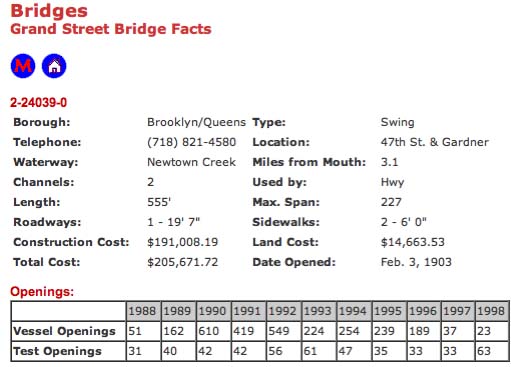

Grand Street – North East – photo by Mitch Waxman
This dragon is a hungry consumer of life, and a dangerous crossing for pedestrian, bicyclist, and vehicles. The approaches are wider than the roadbeds on the crossing, accidents are frequent occurrences, and I’ve known people that have been horrifically injured here. The walkway is roughly hewn.
A NYTimes.com article from 1895 discusses the necessity of building this bridge, at the urging of the War Dept. of the United States.

Grand Street – North – photo by Mitch Waxman
This bridge and the area surrounding it have sucked its victims into that blackened and iridescent ichor lining the malodorous basins that these disease choked waters of the Newtown Creek swirl about in. Shudder at the fate of a priest, who ran afoul of those things which may lurk here even still.
“…victim was a tall, heavily built man, who, from papers found in his pockets, is supposed to be the Rev. Leonard Syczek, a Polish priest of the Roman Catholic Church.”- in this NYTimes.com article from 1896.

Grand Street – North – photo by Mitch Waxman
Despite the unfriendly and barren environment, poisoned with an exotic blending of the chemist’s art, a surprising variety of tenacious life persists here. Many fish and marine invertebrates find themselves trapped in the Newtown Creek due to tidal actions on the East River (which adjoins the Creek at Hunter’s Point). The anoxic condition of the water drowns these unfortunate creatures, and the sewage born bacteria prospering into the waterway soon ruins the meat even for scavengers.
Indignities have been heaped upon the Newtown Creek for centuries. Check out this NYTimes.com article from 1896, which sounds eerily like something you might read in one of their modern articles on the place.

Grand Street Bridge – Span, down – photo by Mitch Waxman
Life here, unless it is very bold– or driven to desperation by hunger- remains well hidden in daylight. Testifying to the presence of nocturnal predation, early morning observations reveal bloody patches of fur and feather, and characteristic drag marks etched in the sooty dust that typifies the area. Skeletons of rats abound, collected in middens revealed only by roadwork or the effects of construction projects.
A particular family of cat, whose ancestry has painted them calico- with a predominately white coat, pink nose, and golden eyes- is often observed along the Newtown Creek. What advantage such partial albinism would lend- from a darwinian perspective- can only hint at unguessable implications about an unknowable subterrene world which exists in the untold layers of civilization that the ignorant modern city is built upon. There still may be vaults down there, cellars erected in the time of the Dutch decadence, which have been sealed up since before the Civil War- an eternal night, encased in a slithering and blind world of dripping stone arches.
from wikipedia
A swing bridge is a movable bridge that has as its primary structural support a vertical locating pin and support ring at or near to its center, about which the turning span can then pivot horizontally as shown in the animated illustration below. Small swing bridges as found over canals may be pivoted only at one end, opening as would a gate, but require substantial underground structure to support the pivot.
In its closed position, a swing bridge carrying a road over a river or canal, for example, allows road traffic to cross. When a water vessel needs to pass the bridge, road traffic is stopped (usually by traffic signals and barriers), and then motors rotate the bridge approximately 90 degrees horizontally about its pivot point.

Grand Street Bridge – Span, down – photo by Mitch Waxman
As is well known by those who have sought the esoteric lore of past generations, the race of Cats will be-and have always been- the guardians over Mankind upon this Earth. Their moonlight parades, which enforce and magnify the domination of mankind over those hordes of vermin which attempt the destruction and consumption of our every industry are dreamlike to some, and a nightmare to others.
Good arguments have been made that the agricultural revolution could not have happened without the presence of Cats living amongst mankind and their efforts at stemming the rodent and insect tide. No agricultural revolution, there’s no Kings– nor Queens. Thereby, Brooklyn and Queens ultimately owe their existence to Cats. It is my fervent hope that someday, in the lands and waterways of Newtown, that no man shall kill a Cat.
Some technical data on the Grand Street Bridge, from city-data.com
Structure Number: 224039, Location: OVER NEWTOWN CREEK (Lat: 40.716500, Lng: -73.922672), Route carried “on” structure: City street , Year Built: 1901, Year Reconstructed: 1973, Status: Open, Structure Length: 7.01m (23.00ft), Average Daily Traffic: 9,154 (year 2005), Truck Traffic: 6%, Average Future Daily Traffic: 12,816 (year 2025), Design Load: HS 20, Features Intersected: NEWTOWN CREEK, Facility Carried by Structure: GRAND STREET
Minimum Vertical Clearance: 4.41m (14.47ft), Kilometerpoint: 0.000, Lanes on structure: 2, Owner: City or Municipal Highway Agency, Approaching Roadway Width: 15.2m (49.9ft), Navigation Control: Yes ( Vertical Clearance: 2.7m (8.9ft), Horizontal Clearance: 27.7m (90.9ft)), Material/Design: Steel, Design/Construction: Movable – Swing, Number Of Spans In Main Unit: 2, Length of Maximum Span: 34.4m (112.9ft), Curb or Sidewalk Widths: Left: 1.7m (5.6ft), Right: 1.7m (5.6ft), Curb-To-Curb Width: 5.9m (19.4ft), Out-to-Out Width: 6.8m (22.3ft)
Condition: Deck: Satisfactory, Superstructure: Fair, Substructure: Satisfactory, Channel: Good, Operating Rating: 37.2 metric tons, Method Used To Determine Operating Rating: Load Factor (LF), Inventory Rating: 25.4 metric tons, Method Used To Determine Inventory Rating: Load Factor (LF), Structural Evaluation: Somewhat better than minimum adequacy, Deck Geometry: High priority of replacement, Waterway Adequacy: Somewhat better than minimum adequacy, Approach Roadway Alignment: Somewhat better than minimum adequacy, Length Of Structure Improvement: 7.01m (23.00ft), Designated Inspection Frequency: Every 24 months, Critical Feature Inspection Frequency: Every 24 months, Underwater Inspection Frequency: Every 60 months, Inspection Date: September 2007, Critical Feature Inspection Date: September 2007, Underwater Inspection Date: September 2007, Bridge Improvement Cost: $1,268,000, Roadway Improvement Cost: $758,000, Total Project Cost: $2,026,000 ( Estimate for 2007), Deck Structure Type: Open Grating

Grand Street Bridge- North East – photo by Mitch Waxman
From Brooklyn, looking to Queens. At some uncommented spot in the middle of the bridge, reality alters, and Grand Street transmogrifies into that ancient lane called Grand Avenue. Rolling through centuried Maspeth, and after an interruption at Queens Blvd., Grand Avenue becomes Broadway and continues on through ruby lipped Astoria on its way to the East River and past the horrors of Hallet’s Cove. This pathway has been in use, in one form or another, since the first Europeans- and they learned it from the Mespat.
I’ve mentioned this article before, but here’s another NYTimes.com article, from 1894, which talks about the consumption of even more human life here at the Grand Street Bridge- “…told a story which, if true, shows that that section of the city is a dangerous place at night and throws light on a number of mysterious things that have recently occurred in that vicinity.”

Grand Street Bridge – Span, down – photo by Mitch Waxman
The bed of the creek in the area worked over was variable below the plane of 18 feet mean low water; near the bar it was composed of sand, or sand and clay mixed, but as the bridge was approached it grew harder like hardpan, and had large bowlders embedded in it. The range of the tides in the creek is about 4£ feet, but the bed of the creek has no natural slope. The creek is the receptacle for all the refuse from the sewers, factories, and slaughter-houses of the east of Brooklyn; constant deposits are therefore forming in it, especially at the upper end, from these causes and from the caving in of the unprotected banks, which consist of marsh mud. To remedy this difficulty, annual dredging will be needed until the banks are protected by bulkheads throughout their whole length. The commerce of the creek is so large that this improvement should be pushed at least 3 mile.s up from the mouth as soon as possible, so that vessels drawing 20 to 23 feet may pass in and out of the creek with full cargoes at or near low water.

Grand Street Bridge – Span, down – photo by Mitch Waxman
The building of this bridge was a Tammany project, check out this City Club book describing Mayor Low’s Administration in New York at Google Books.
On August 7th, 1900, Commissioner Shea signed a contract for the building of a draw bridge to replace an old bridge over Newtown Creek, at Grand Street, between Brooklyn and Queens. The engineers’ preliminary estimate of the cost was $173,379-90, and the final estimate $166,819.69. The old bridge was closed to traffic on August 27th, 1900, and the new bridge was to be completed by October 2ist, 1901, or in three hundred working days.
Although the traffic over Newtown Creek is very great, and the new bridge was urgently needed, the bridge was not opened to traffic until December 26th, 1902, or in four hundred and thirty-six working days, and was accepted by the city on February 5th, 1903. The total cost was 8172,323.43, including a bill for $5,503.74 for extra work, which was finally allowed in April, 1903. The contractor presented a bill for twice that amount, but Commissioner Lindenthal settled for the sum mentioned as the amount of the legitimate claim against the city.
The causes of this long delay under Mr. Shea’s administration are given in a detailed report handed in to Commissioner Lindenthal by Edward De Voe Tompkins on July 9th, 1902. From the time the bridge was started and until March roth, 1902, Mr. Tompkins was assistant engineer under the orders of a superior, also an assistant engineer. On that date Commissioner Lindenthal placed Mr. Tompkins in charge of the construction of the bridge. Mr. Tompkins gives the causes of delay as follows :—
On August 13th, 1900, the contractor was ordered to begin work. In September, 1900, the contractor removed “the old bridge in a very ” slow, objectionable and ridiculous way. When the engineer remonstrated he was answered with profanity. The contractor refused to ” furnish the engineer with necessary supplies, assistance, rowboat, etc. ” The contractor instead of devoting all his efforts to the construction ” of the bridge, used the site of the work for fitting out two derrick ‘ boats, and building two pile driver leaders and placing same on scows ” to be used on other contracts.
” The department’s original contract drawings of masonry were ” full of errors and practically worthless. This caused considerable ” delay and complications, the contractor being also to blame.”

Grand Street Bridge- Span, South East – photo by Mitch Waxman
The bridge that the 1903 model replaced was built by the King Bridge Company.
from kingbridgeco.com (they have an image of an extinct Newtown Creek crossing, the Manhattan Avenue Bridge, by the by)
As early as 1874, the King Bridge Company was selected to build the Grand Street Bridge in Eastern Brooklyn across Newtown Creek. This was a drawbridge built for $18,200 and was in service for fifteen years but suffered from poor maintenance. The company bid on its replacement in 1888 but lost out to a local contractor. However, the company did display one of its New York moveable bridges in its catalogues of the 1880s. This was a 168-foot wrought iron high-truss swing bridge on Manhattan Avenue in the Greenport section of Brooklyn. This bridge also has long since disappeared.

Grand Street Bridge- Span, North – photo by Mitch Waxman
from “Queens Borough, New York City, 1910-1920; the borough of homes and industry, a descriptive and illustrated book setting forth its wonderful growth and development in commerce, industry and homes during the past ten years … a prediction of even greater growth during the next ten years … and a statement of its many advantages, attractions and possibilities as a section wherein to live, to work and to succeed” at Archive.org
Some further idea of the immense commerce of this waterway can be obtained from the figures compiled by the Department of Plant and Structures of New York City, which show that during the year 1918, 59,389 boats passed through the Vernon Avenue Bridge, 56,735 passed through the Greenpoint Avenue Bridge, 27,000 through the Meeker Street Bridge and 5,007 through the Grand Street Bridge.
Steamers schooners and unrigged vessels are the principal freight carriers. Their drafts range from 5^ to 20 feet; 2 to 19 feet; 2 to 18 feet respectively. Some steamers of still larger draft lighter in their cargoes.
Among the larger plants on the Queens shore of Newtown Creek are the National Sugar Refining Company, Nichols Copper Company, National Enameling and Stamping Company, General Chemical Company, Standard Oil Refineries. American Agricultural Chemical Company, and the Wrigley Chewing Gum Company.

Grand Street Bridge- Span, Bridge House – photo by Mitch Waxman
1882- James McFADDEN, of 312 Maujer street, while working in REYNOLD’s coal yard, near Grand street bridge, was caught between a coal cart and some lumber yesterday afternoon, causing a lacerated wound of left thigh. He was attended by Assistant Surgeon CURRAN and taken to St. Catharine’s Hospital.
also in 1882- Lack Of Humanity
A Coroner’s Jury Censures Street Car Passengers and Exonerates the Driver At an inquest held yesterday afternoon by Coroner PARKER on the body of Henry SCHUMACKER, the jury brought in the following verdict:
“We find that the said Henry SCHUMACKER came to his death on the 18th inst from shock due to fracture of the left leg caused by being run over by a car of the Grand Street & Newtown Railroad Company on Wednesday, November 16. And we, the jury, are of the opinion that he fell or was thrown out accidentally from his wagon and exonerate the driver of the car from all blame, but severely censure three passengers who were on the front platform of the car for lack of common humanity displayed on that occasion, and we recommend that lights be placed on Grand Street Bridge for the protection of the public.”
The “lack of humanity” was displayed by the passengers refusing to assist the injured man.

Grand Street Bridge- Span, North, Newtown Creek – photo by Mitch Waxman
Looking north and west, the vast panorama of the western side of the Newtown Creek with its Manhattan Skyline backdrop. One of the few places near ground level that you can see this sort of vista.
Newtown Pentacle has visited this spot, briefly, in the past- in “That’s Just Grand“, much of who’s content is expanded upon in this post.

Grand Street Bridge- Span, South, Newtown Creek – photo by Mitch Waxman
from a 2002 NYTimes.com article which discusses the history and future of this structure
“The city’s Department of Transportation has made what seems like a small request concerning this forsaken three-mile-long waterway separating Queens from Brooklyn. It wants to turn the Grand Street swing bridge, one of the dozen that cross the creek, into a fixed structure.”

Grand Street Bridge- Span, South from Newtown Creek – photo by Mitch Waxman
check out an 1899 NYTimes.com article which describes the area that the Grand Street Bridge was built into as “White’s Dock”.

Grand Street Bridge- Span, Up – photo by Mitch Waxman
from fultonhistory.com
Check out a scan of the Brooklyn Daily Eagle in 1899 for an editorial take on what was really going on with the whole “condemned by the war dept. thing”.
note:
If institutional memory was not absent from modern statecraft, we would say- the 1890’s- of course there was bad press about anything having to do with Brooklyn. The consolidated City was just 1 year old, Tammany was vying for control of not just NY State– but reaching for the Congress in Washington as well. There was a power struggle between Manhattan and Brooklyn for patronage and control over the limitless budget pooled from the taxes of Greater New York.

Grand Street Bridge- Span, down, Newtown Creek – photo by Mitch Waxman
All about the site of the Grand Street Bridge, this crippled dragon found along the lamentable Newtown Creek, history seems to be tenanted by violent and deadly events. Newtownicans seem drawn to this stage during moments of crisis-
as is evidenced in this brutal NYTimes.com article from 1885.
And in this one from 1894.

Grand Street Bridge- Span, Up – photo by Mitch Waxman
A little Newtown texture from HISTORY OF QUEENS COUNTY with illustrations, Portraits & Sketches of Prominent Families and Individuals. New York: W.W. Munsell & Co.; 1882. pp. 329-408. at bklyn-genealogy-info.com
The Alsop Family.- Among the early settlers of New town were the Alsop family. Writers on English sur names inform us that this family derives its name from the village of Alsop, in Derbyshire. Richard Alsop, the progenitor of the Newtown family, was induced to locate here by his uncle, Thomas Wandell. Mr. Wandell, according to reminiscences in the Alsop family, had been a major in Cromwell’s army; but, having some dispute with the “protector,” was obliged to flee for safety, first to Holland and thence to America. Some doubts of this may he entertained, for Mr. Wandell was living at Mespat Kills in 1648, which was prior to the execution of King Charles, and when Cromwell enjoyed but a subordinate command in the parliamentary army. Mr. Wandell married the widow of William Herrick, whose plantation on Newtown Creek he bought in 1659. This was originally patented to Richard Brutnell. To this he afterward added fifty acres for which Richard Colfax had obtained a patent in 1652. On this property, since composing the Alsop farm, Mr. Wandell resided.
He was one of the jury in 1665 for the trial of Ralph Hall and his wife for witchcraft (the only trial for witchery in this colony), and shared the honor of acquitting the accused. Some years later he visited England, and it is supposed that on his return he brought with him his sister’s son, Richard Alsop, whom he made his heir. Mr. Wandell died in 1691 and was buried on the hill occupied by the Alsop cemetery. Many years later the silver plate of his coffin was discovered in digging a new grave.

Grand Street Bridge- Span, West – photo by Mitch Waxman
A little more Newtown texture from HISTORY OF QUEENS COUNTY with illustrations, Portraits & Sketches of Prominent Families and Individuals. New York: W.W. Munsell & Co.; 1882. pp. 329-408. at bklyn-genealogy-info.com
Newtown in the winter of 1778 presented an unusually animated appearance. General Washington was expected to make an attack upon New York, and for the better preservation and safety of the shipping Sir Henry Clinton ordered all vessels not in the service of the government to be removed to Newtown Creek. A large number of British troops were also barracked here. There were the seventeenth regiment of light dragoons, the Maryland loyalists, the royal Highlanders, commanded by Lieutenant Colonel Thomas Sterling, who had seen long and arduous service in America during the French and Indian war; the royal artillery, with their cannon and horses; and the thirty-third regiment, Lord Cornwallis. During this period the farmers were subjected to many severe burdens. They were required to furnish from year to year, for the use of the army, the greater portion of their hay, straw, rye, corn, oats and provisions, under pain of being imprisoned and having their crops confiscated. The commissary weighed or measured the produce, and then rendered payment according to the prices fixed by the king’s commissioners. If the seller demanded more it was at the risk of losing the whole. The private soldiers were billeted in the houses of the Whig families. The family was generally allowed one fireplace.
Robberies were frequent, and Newtown became a prey to depredation, alarm and cruelty. The civil courts were suspended, and martial law prevailed through seven long years. It was a happy day for Newtown when news arrived that Great Britain had virtually acknowledged our independence, and when her patriotic sons were permitted to return from a tedious exile.

Grand Street Bridge- Span, South – photo by Mitch Waxman
One last bit of Newtown texture from HISTORY OF QUEENS COUNTY with illustrations, Portraits & Sketches of Prominent Families and Individuals. New York: W.W. Munsell & Co.; 1882. pp. 329-408. at bklyn-genealogy-info.com
The fertility of the Newtown lands early attracted the attention of colonists, among the first of whom was Hans Hansen, who obtained a plantation of some 400 acres at the head of Newtown Creek. Richard Brutnell, a native of Bradford, England, was at the entrance of the creek, and on the opposite side was found the plantation of Tymen Jansen, who had been a ship carpenter in the employ of the West India Company. These were the only occupants at the time Mr. Doughty with his friends came to take possession of his grant. He made preparations to begin a settlement, and in less than a year a number of families were comfortably settled here. Mr. Doughty officiated as pastor, and affairs were tending prosperously when the breaking out of a war with the Indians gave a sudden and fatal check to the settlement. This war had been brought about upon a frivolous pretense of injuries received from the natives, resulting in a horrid butchery of some sleeping indians. Inflamed to the utmost, they with fire-brand and scalping-knife desolated the country around New Amsterdam, devoting property to destruction and the inhabitants to a cruel death. The savages broke in upon the settlement at Mespat and some of the settlers fell victims to their fury.
The remainder sought safety in flight, while the flame was applied to their dwellings, which with their contents were reduced to ashes. At length a peace was concluded. Thereupon some of the settlers returned to their ruined habitations. As a better day seemed dawning, several residents without the lines of the Mespat patent took occasion to secure government title for their lands. July 3d 1643 Burger Joris, Richard Brutnell, and Tymen Jansen took out their “ground briefs” or deeds.

Grand Street Bridge- Span, detail, Queens side – photo by Mitch Waxman
a 1908 map of the neighborhood from digitalgallery.nypl.org


Grand Street Bridge- Span, North and West – photo by Mitch Waxman
from wikipedia
Grand Street is a street in Williamsburg, Brooklyn, New York City, United States. The Grand Street (BMT Canarsie Line) subway station serves the corner of Grand Street and Bushwick Avenue. Crossing English Kills into Queens, Grand Street becomes Grand Avenue, continuing through Maspeth where it is a main shopping street, to Elmhurst. Its northern end is at Queens Boulevard. Broadway continues the thoroughfare north and west.
History
In the 19th century, before the construction of the Williamsburg Bridge, the Grand Street Ferry connected Grand Street, Brooklyn to Grand Street, Manhattan. The Grand Street Line was a streetcar line along the road.
As always, if something I’ve posted here is inaccurate, or you can expand on the topic, please post a comment or contact me here.


 The Newtown Pentacle