Archive for November 2009
Tales of Calvary 2- Veterans Day

-photo by Mitch Waxman
21 Roman Catholic Union soldiers are interred amongst the 365 acres of first Calvary Cemetery in Queens, nearby the cuprous waters of the much maligned Newtown Creek.
The wars of the 20th century, terrible in scope and vulgar in effect, cause us to overlook these men who vouchsafed the American Republic in the 19th century as we focus in on the veterans of the second thirty years war which modernity myopically calls World Wars One and Two. Woodrow Wilson proclaimed a federal holiday called Armistice Day in 1919, celebrating the anniversary of the legal end of the first World War in 1918. Congress agreed, seven years later, and then took six years to pass an act which made Armistice day an official United States federal holiday celebrated on November 11 annually.
Ed Rees, a populist Representative from the state of Kansas during the post World War 2 era, spearheaded a successful campaign in 1953 to have “Armistice Day” reclassified as “All Veterans Day” so as to include the veterans of WW2, and the ongoing conflicts fought by our “permanent government” on the world stage.
from nycgovparks.com
On April 28, 1863, the City of New York purchased the land for this park from the Trustees of St. Patrick’s Cathedral and granted Parks jurisdiction over it. The land transaction charter stated that Parks would use the land as a burial ground for soldiers who fought for the Union during the Civil War (1861-65) and died in New York hospitals. Parks is responsible for the maintenance of the Civil War monument, the statuary, and the surrounding vegetation. Twenty-one Roman Catholic Civil War Union soldiers are buried here. The last burial took place in 1909…
The monument features bronze sculptures by Daniel Draddy, fabricated by Maurice J. Power, and was dedicated in 1866. Mayor John T. Hoffman (1866-68) and the Board of Aldermen donated it to the City of New York. The 50-foot granite obelisk, which stands on a 40 x 40 foot plot, originally had a cannon at each corner, and a bronze eagle once perched on a granite pedestal at each corner of the plot. The column is surmounted by a bronze figure representing peace. Four life-size figures of Civil War soldiers stand on the pedestals. In 1929, for $13,950, the monument was given a new fence, and its bronze and granite details replaced or restored. The granite column is decorated with bronze garlands and ornamental flags.

-photo by Mitch Waxman
Many of the combatant nations observe November 11th as Armistice Day, or Remembrance Day.
It is hard for we moderns to conceive of the psychological pathologies of the post Victorian era, as our “end of the world scenario” is played out as either an expanding cloud of nuclear fire, or some “romeroesque” dystopia populated by hordes of disease maddened and resource starved ghouls- either way- it involves the apocalyptic ascendance of one of the “ism’s”.
Have no doubts though, that the world which created Calvary ended in an apocalypse, and our modern world was built upon the ashes of the Fin de Siècle.
from wikipedia
In many parts of the world people take a two-minute moment of silence at 11:00 a.m. as a sign of respect for the roughly 20 million people who died in the war, as suggested by Edward George Honey in a letter to a British newspaper although Wellesley Tudor Pole established two ceremonial periods of remembrance based on events in 1917.

-photo by Mitch Waxman
The soils of Calvary, a vast cocktail of loathsome and ghoulish ichor, contain many Civil War dead- as well as citizen soldiers from every conflict since. Forgotten and long neglected, the obelisk and its attendant bronzes are in a tremulous condition, etched at by a century of pervasive industrial pollution arising from Newtown Creek, and the greater city beyond.
from a newtown pentacle post, from july 31 of 2009, titled “Up and through Calvary”
Daniel Draddy was an irish speaker from County Cork, and the son of John Draddy- a stonecarver and prolific author in the Irish language who hailed from a family on Quaker Road. In context, they came from what modernity would describe as “an oppressed religious underclass involved in an ethnic and cultural war with an aggressive and powerful neighbor willing and and able to actively engage in state sponsored genocide and ethnic cleansing“ but which they would have called the Irish Potato Famine.
Daniel maintained his marble studios on 23rd street in Manhattan, near the east river. Known as a cultured and gracious host, he was beloved by the Tammany men. Contemporaries describe him as a first class carver, mechanic, historian, and he had the ability to write in the Irish language “druidically”.
Resemblance of the monuments to the tombs of ancient Egypt is no accident. The men who built this were Free and Accepted Masons.
This is masonic iconography, with its obelisk splitting the solar wisdom into the four cardinal directions and the four deities of the spaces found between standing watch at intersecting 45 degree vectors. Such falderol was quite in vogue after the Civil War, look at the Capitol Dome or Supreme Court building in Washington D.C. for similar thematic elements.
Don’t forget- Draddy was a stonecutter, from a family of stonecutters. That made him a Free and Accepted Mason, who’s existential threat was the subject of much Catholic liturgy. The Masons, especially after their successes in the Lowlands and North America in the 17th and 18th centuries, were considered a dangerous fifth column in the power structure of Europe. In the United States, the origins of the mythology surrounding them was beginning to form. In the 19th century men like Draddy would have been considered as subscribing to an “ism”, and its odd to find such iconography in a Catholic cemetery. The Church bore a special antipathy toward the Masons in this period of time, and even today they officially shun members.

-photo by Mitch Waxman
The statues here at Calvary’s Soldiers Monument seem to have been the original castings of a much reproduced statuary design. Placed here in 1866, they predate the identical statues found at Green-Wood Cemetery, and exact issuance of the mold has been confirmed in New England, North Carolina, and all over New York State. As early as 1875, fumes from a nearby Ammonia Factory at Newtown Creek were graving pitted marks into them.
Check out this amazing nytimes.com report of the ceremonies held, at this very spot- on Memorial Day, June 1, 1875.
In accordance with a resolution to celebrate the ceremony of decorating the graves of their dead comrades with more impressiveness than had attended that event in the past, John A. Rawlius Post, No. 80, with the members of the veteran corps of the old Sixty-ninth Regiment, Meagher’s Irish Brigade, Corcoran’s Irish Legion…
Observation, Speculation, and musing- the thinking out loud section
During the Civil War, the United States Union organized its troops by State, City, and town- hence the “XXth New York Regiment” or the “XXrd Illinois”. What this meant, in a meat grinder conflict like the Civil War with its high casualties, was that an entire neighborhood or town could lose ALL of its sons in a single battle.
The long economic decline of upstate New York, New England- especially Massachusetts- began soon after the Civil War partly because of this depopulation- and a generation of widows it created (the decline of “green energy” powered cotton cloth production in area textile mills is a major factor as well). The population important to politicians ceased being the rural mill town or agrarian producer and shifted to the newly crowded urban centers. In “the country”, a fascination with Spiritualism took hold while “the cities” set about building concrete cathedrals.
Radical politics, moralist movements, and fringe religion ruled in a depopulated countryside. The worn out land of the family farm wound inexorably toward a dust bowl, and there was no way to keep your sons and daughters from moving to “The City” and its possibilities. Stricken by endemic poverty, disease, ethnic violence, and starvation, the reality of “the good old days” before the Fin de Siècle is something that just doesn’t jibe with “you could leave your doors unlocked when you went to sleep, back then” that my grandfather used to proclaim.
The next generation of women that came along, who saw their widowed mothers and aunts running businesses and farms and participating in government– they were the Suffragettes.
Tales of Calvary

– photo by Mitch Waxman
Hallowmas, or All Saints Day, is coincident with the running of the NYC Marathon’s tumult laden course. The secular spectacular merely whets the appetite of your humble narrator for the open skies and sacred vantages found along those unhallowed backwaters of an urban catastrophe called the Newtown Creek. Calvary Cemetery– dripping in centuried glory- sits incongruously in an industrial moonscape stained with a queer and iridescent colour. It’s marble obelisks and acid rain etched markers landmark it as a necropolis of some forgotten civilization.
Today, I determined to ignore the psychic effects of the graveyard, which are both palpable and remarkable. Resolving to climb to the highest point on this Hill of Laurels, my aim was to discover whose grave would occupy such a socially prominent spot. Secretly, I hoped to discover some celebrity or famous mobster’s resting place. Instead I found the O’Brien’s.

– photo by Mitch Waxman
Let me mention, before I begin this vulgar display of information gathering and dissemination, that this was hard won knowledge. If anyone has additional info they’d like to share, please contact me.
The difficulties one encounters when using modern search services to inventory a common personal or place name, especially ones that might overlap a mediacentric figure or location whose modern incarnation has obliterated all other definitions, are numerous. In the case of one William O’Brien, a VERY common name, narrowing things down is a daunting task. O’Brien died in New York City, apparently, as He’s buried in Calvary. O’Brien is an odd spelling of a common hibernian nomen, and indicates a certain direction to look toward. Still, finding an Irishman who died in 1846 New York wouldn’t be easy. I kept looking, slavishly.
Who was William O’Brien?

– photo by Mitch Waxman
I went down the list of names, searched with quotations, ampersands, and “or”s. Tacked on the “died xx, xxxx”. Nothing. “Disappeared from history”, thought your humble narrator, “Balderdash!”.
A couple of leads on the O’Brien patriarch William seemed to point to a career in finance and politics, but the O’Brien in those stories was some kind of Irish nobility, and that just couldn’t be right. These people were buried at the top of the hill in Calvary, but there’s no way that an Irish noble was going to be buried in Queens. My searching did turn up a potential address for the O’Brien clan, in Manhattan at 19 Washington Square North, via this link to an obituary page for Robert, from 1902 at nytimes.com. Concurrence found.

– photo by Mitch Waxman
from nyc-architecture.com
By the time Abbott photographed the venerable houses at the northwest corner of the Square, Old New York’s foothold was slipping. Although not built until 1952, an apartment house was planned in 1929 for the Rhinelander properties, east of nos. 21-26, and shortly after Abbott’s photograph, nos. 7-13 were gutted and renovated as apartments. The photograph documented the beauty of the old facades but also revealed incipient change. Nos. 22 and 23 (center) were shuttered with “for sale” signs affixed to them. At the west end of the block (left) was the 16-story Richmond Hill Apartments. The leaves of a tree in Washington Square Park, softly framing the left and top edges of the photograph, give a romantic air to this otherwise sharp-focused view of fading elegance.

– photo by Mitch Waxman
When searching for the combined term William O’Brien and Robert Pardow, this 1901 pdf at the Library of Congress turned up. William O’Brien Pardow? Who was Robert Pardow, and again- who was William O’Brien?
William O’Brien Pardow was the key to this conundrum… and away we go…
from nytimes.com
THOUSAND MOURN FOR FATHER PARDOW; Women and Children Weep During Funeral Services for the Noted Jesuit Priest. ALL SEVERELY SIMPLE Poverty and Humility, to Which the Order Is Pledged, the Keynote — Four Bishops Present.
When Archbishop Farley began the low mass for the repose of the soul of Father William O’Brien Pardow in the Church of St. Ignatius Loyola, in East Eighty-fourth Street, yesterday, every seat in the edifice was filled, the aisles were crowded, and thousands stood for hours outside the church to see the coffin bearing the beloved rector of the Jesuit Church borne to the hearse…

– photo by Mitch Waxman
The name Pardow is an anglicized version of a family name that indicates both a Norman heritage, and long service to the French as part of the Irish Brigades. The original family name is reported as either “De Par Dieu” or “De La Pore”. The first Robert Pardow arrived in New York City in 1772 with his wife and six children. Her name was Elizabeth Seaton, and the family business they started would be the first Catholic newspaper published in the City, called the Truth Teller. He had two sons, Gregory and Robert. Both studied with the Jesuits in England. Gregory became a member of the Society of Jesus, and Robert returned to New York’s social elites and died in 1882.
Robert was married to Augusta O’Brien, daughter of William O’Brien. And, it was “that William O’Brien”, as it turns out. The kings of Ireland, it seems, lie in Queens.

– photo by Mitch Waxman
This is actually where everything goes off on a crazy train.
The O’Briens of County Clare are a troublesome lot, given to displays of heaven shaking martial prowess, if the mood suits them.
Legendary foemen of the English Crown, they have gathered unto themselves vast power and influence which continues to the present day. The hereditary title of the Chief of the Name is “the O’Brien, Marquess of Thomond and Baron Inchiquin”. They’re also the direct descendents and heirs of Brian Boru, the semi legendary King of Ireland.

– photo by Mitch Waxman
William O’Brien, 2nd Marquess of Thomond and the Baron Inchiquin, forfeited his title and came to New York around 1800 for political reasons. He started a banking house, supposedly located at no. 58 Wall Street (modern no. 33), with his brother John. He married Eliza(beth) and had an undetermined number of children. Augusta was his eldest daughter, and the family story follows her union with a young and recently returned to New York Robert Pardow- on its unyielding journey toward the emerald devastation of Calvary Cemetery, here alongside the noisome Newtown Creek.
from wikipedia
In 1847, faced with cholera epidemics and a shortage of burial grounds in Manhattan, the New York State Legislature passed the Rural Cemetery Act authorizing nonprofit corporations to operate commercial cemeteries. Old St. Patrick’s Cathedral trustees had purchased land in Maspeth in 1846, and the first burial in Calvary Cemetery there was in 1848. By 1852 there were 50 burials a day, half of them the Irish poor under seven years of age. By the 1990s there were nearly 3 million burials in Calvary Cemetery, the cemetery was also used for the film The Godfather for the funeral of Don Corleone.

– photo by Mitch Waxman
The Pardow’s had two boys and three girls- William, Robert, Julia, Pauline, and Augusta.
The matriarch of the clan, Eliza, survived her husband William by 36 years and died in 1882. She even survived her daughter Augusta, who died in 1870.
Click here for a description of Eliza’s funeral in 1882 at the NYTimes. The Mass was led by her grandson- William O’Brien Pardow, S.J.- now a firebrand Jesuit orator- and was attended by one archbishop, 2 bishops, and Mayor Grace– amongst others.
from wikipedia
Opposing the famous Tammany Hall, Grace was elected as the first Irish American Catholic mayor of New York City in 1880. He conducted a reform administration attacking police scandals, patronage and organized vice; reduced the tax rate and broke up the Louisiana Lottery. Defeated the following year, he was re-elected in 1884 on an Independent ticket but lost again the following year. During his second term, Grace received the Statue of Liberty as a gift from France.
– photo by Mitch Waxman
Of the five children, 4 joined the Roman Catholic clergy, and all attained high office in their various devotions. Robert and William joined the Jesuits, sisters Pauline and Augusta (junior) joined the Society of the Sacred Heart. Both sisters became Mother Superiors, and William became an ecclesiastic rock star in the days of the Third Great Awakening. His sister Julia remained “in the world”.
That Julia had children, or that this branch of the O’Brien clan persists, I cannot confirm.
As a note, their uncle- Gregory Pardow– who had become a Jesuit whilst his brother Robert was courting Augusta O’Brien- was the founding Rector of the first Catholic Church in Newark N.J. – St. John’s.
from wikipedia
The number of Roman Catholics in Continental United States increased almost overnight with the Louisiana Purchase in 1803, the Adams-Onís Treaty (purchasing Florida) in 1819, and in 1847 with the incorporation of the northern territories of Mexico into the United States (Mexican Cession) at the end of the Mexican American War. Catholics formed the majority in these continental areas and had been there for centuries. Most were descendants of the original settlers, dating back to the 16th and 17th centuries, benefiting in the Southwest, for example, from the livestock industry introduced by Jesuit priest Eusebio Kino in 1687. However, U.S. Catholics increased most dramatically and significantly in the latter half of the 19th century and the early 20th century due to a massive influx of European immigrants from Ireland, Italy, Germany (especially the south and west), Austria-Hungary, and the Russian Empire (largely Poles). Substantial numbers of Catholics also came from French Canada during the mid-19th century and settled in New England. Although these ethnic groups tended to live and worship apart initially, over time they intermarried so that, in modern times, many Catholics are descended from more than one ethnicity.

– photo by Mitch Waxman
The grandson of a great man, William O’Brien Pardow distinguished himself in his vocations. He offered spiritual retreats to clergy and commoner alike, and attendants often remarked on the priest’s incisive intuition and razor sharp rhetorical skills which made him the center and arbiter of conversation. He made the rounds of polite society, and often spoke at parlour meetings of the social elite. Many of the references I found about him were on Society pages, located a blurb or two below discussion of Mrs. Vanderbilt’s latest scandals or gossip about the scandalous meetings of Dutch Cotillion Societies.
Quoting freely from the 1879 edition of a Justine Bayard Cutting Ward biography of William O’Brien Pardow, grandson of William O’Brien found at archive.org
“The lives of men are written,” said Father Pardow, “their biographies press down the shelves of our libraries, yet when you have read the biography of the greatest of men, what do you know of the man himself? You know what this, that, or the other man thinks about him, but you know nothing of the real life of that man, nothing of his interior life which the eyes of God alone can penetrate. About that life you know absolutely nothing.”

– photo by Mitch Waxman
Pardow had an interesting mind, and focused on education in many of his sermons. He preached an eleventh commandment “Thou shalt learn to read and write” as the cure for society’s ills.
Again, quoting freely from the 1879 edition of a Justine Bayard Cutting Ward biography of William O’Brien Pardow, grandson of William O’Brien found at archive.org
William Pardow came of a race of warriors, the O Briens of County Clare. Many an ancestor had fought and died for a principle, and from Brian Boru, the warrior king, down through the centuries, the military tradition keeps recurring in almost every generation. Among the officers of the Irish Regiments in the French army we find the names of many an O Brien, bearing the proud titles of Marquis of Thomond, Earls of Inchiquin, and Barons Burren. When in 1800, William O Brien sought the New World, he did so as the result of an unselfish struggle for a principle. Pure patriotism had led him to identify himself with the cause of the United Irishmen; as a result he for feited his title of Inchiquin, sold his property, and set sail for New York. There he established a successful banking house, but though the ocean lay between him and his beloved country, he never wavered in his loyalty to his own people and their cause, and it is characteristic of the man that when, many years later, he was offered the agency of the Bank of England, the loyal Irishman would have none of it.

– photo by Mitch Waxman
The family business was finance- and as I’ve mentioned earlier in this post- references to no. 58 Wall Street as the address for it, which- I am told- would correspond to the modern numbering n0.33. That would put it on or near the site of the modern New York Stock exchange. If anyone reading this has any information on the O’Brien banking operation that they can share, please contact me, as it’s a missing piece of this particular pie.
And again, quoting freely from the 1879 edition of a Justine Bayard Cutting Ward biography of William O’Brien Pardow, grandson of William O’Brien found at archive.org
Many a man or woman is defeated by ease who would have flashed forth under persecution with the heroism of the martyr. In the more complex struggle against the imperceptible encroachment of a lax moral code, Augusta Pardow stood firm. She brought up her children with almost military discipline, grounding them firmly in the nobler qualities which such training brings out, courage, obedience, and devotion to a cause outside of self. She needed no punishments, it would appear, to enforce her will, for her children realized from the first the principle of authority and its source. It was a point of honor to obey.

– photo by Mitch Waxman
The world of the O’Brien’s was sketched out by novelist and next door neighbor Henry James, check out ephemeralnewyork’s post on James here.
And one last time- quoting freely from the 1879 edition of a Justine Bayard Cutting Ward biography of William O’Brien Pardow, grandson of William O’Brien found at archive.org
The framework of his active life may be outlined with a stroke of the pen. It has but slight signif icance. The scene of his early experience and early mistakes was the Church of St. Francis Xavier, where he was appointed on his return from Europe. In 1884 he was made socius, or secretary to the provincial; in 1888, instructor of tertians at Frederick, Maryland; in 1891, rector of St. Francis Xavier s College in New York City; in 1893 he was appointed provincial of the Maryland- New York Province and held the position until 1897, when he was attached to Gonzaga College in Washington as professor of philosophy and preacher in the church, going from there to St. Ignatius Church in New York. In 1903 he was once more appointed instructor of the tertians, this time at St. Andrew-on-Hudson near Poughkeepsie. In July, 1906, he was elected delegate from the province to the general congregation at Rome, which met to elect a new General for the Company of Jesus. While in Rome, he fell ill, but recovered sufficiently to take his place in the congress. Upon his return to the United States a few months later, he was attached to the Church of the Gesu in Philadelphia; in the autumn of 1907, was made rector of the Church of St. Ignatius in New York City, where a little over a year later he died.

– photo by Mitch Waxman
Hey, you never know what you’re going to find out here, at Calvary Cemetery.
Who can guess all there might be, buried down there, in that poison loam which is the heart of the Newtown Pentacle?
More on “The White Lady of Astoria”

– photo by Mitch Waxman
Our Halloween posting, describing spectral phenomena experienced by residents on my old block – 44th street between Broadway and 34th avenue, which lies nestled amongst the lowland hillocks of Astoria, has drawn a reply from the Greater Astoria Historical Society.
from astorialic.org
The Greater Astoria Historical Society, chartered in 1985, is a non-profit organization supported by the Long Island City community. We are dedicated to preserving our past and using it to promote our community’s future. The Society hosts field trips, walking tours, slide presentations, and guest lectures to schools and the public. Regular meetings are usually held the first Monday of the month at 7:00 PM in Quinn’s Gallery, 35-20 Broadway, Long Island City.

– photo by Mitch Waxman
The Greater Astoria Historical Society (located on the 4th floor of the Quinn building here in Astoria)– in addition to hosting multitudinous walking tours of the area and producing a schedule of lectures and scholarly exhibitions focusing on the culture, community, and history of northwestern Queens- serves as a vouchsafe location for rare documents and publications which discuss their area of study. Additionally, GAHS preserves several historic artifacts, some of which were saved literally, from the wrecking ball due to direct intervention.
I am fairly certain that the Dee translation of a certain book, missing page 751- of course, is hidden away somewhere in their vaults.
From their towering vantage point- an eagle’s nest which affords an overview of the entire city- these ascended masters share hard won knowledge generously with initiates, even ones as unworthy as your humble narrator.
from wikipedia
The holdings of the Greater Astoria Historical Society, on loan and owned, include a collection of rare and unusual items available for public perusal. The GAHS maintains a Library/Research Center that contains over 10,000 items, including books and publications on local history, a photographic record of the community, and neighborhood ephemera and memorabilia. The GAHS holdings include dozens of antiquarian atlases and thousands of historic maps of Queens, New York and surrounding areas from the now defunct Belcher Hyde map company among others. The holdings also include an almost complete run (or the morgue file) of the Long Island Star Journal, “a daily paper that informed the community about local and world news until it folded in 1968. A banner across the Star-Journal masthead reminded readers that the newspaper’s name came from the merger of the Long Island Daily Star (1876) and the North Shore Daily Journal–The Flushing Journal (1841).”

– photo by Mitch Waxman
The missive received from the GAHS Lamasery, which came in prompt response to the “White Lady of Astoria” posting on the morning of Hallowmas, has been delayed in reaching the readers of this- your Newtown Pentacle- due to the burden of developing hundreds of photos from the 2009 New York City Marathon and the startling revelations brought forward on research about a certain grave I found in Calvary Cemetery (more on that next week).

– photo by Mitch Waxman
My initial instincts, based on badly scanned and somewhat inaccurate historical maps of the area found around the web, were to postulate about the nearby Moore Jackson colonial era cemetery which is hidden in weedy obscurity a few blocks away. Here’s a google map of the scene today.

From the "Annals of Newtown, 1852" courtesy of Pefagan's great site- pefagan.com
Misreading one of these maps, I placed a colonial era farmhouse inaccurately, and began building a case in my notebook for the White Lady being a phantasmic echo of Mrs. Jackson (as in Jackson avenue). This is a bad habit of mine, connecting dots, and I’m trying to avoid it- so while attending a couple of GAHS events in October, I mentioned my ghost story to officers of the Society. Notice that at the center of the map, where the “S.A. Halsey Late Whitfield’s” script is found- just below that (I believe) is the corner of modern 44th street and Newtown Road.

– photo by Mitch Waxman
I have met a few individuals, since I began wandering the Newtown Pentacle, who are authentic experts on those subjects which we explore together at this page. Esoteric history buffs and antiquarian enthusiasts abound in the community, yet certain individuals (you know who you are) stand head and shoulders above the rest. The encyclopedic knowledge and generous nature of these irascible hierophants has given my poor ramblings a grounding, and helped me to grasp at a secret history, hidden all around us. I call these folks, ascended masters all, “The Rabbi’s”.
Amongst this group of “rabbi’s”, if the subject is Astoria, the folks you’ll want to speak to are Bob Singleton and Richard Melnick of the Greater Astoria Historical Society.

– photo by Mitch Waxman
Here, in its entirety, is their message- used with permission-
I know of no story from that area’s history that would relate to this. It was marshy pasture and undeveloped until about 100 years ago. Northern Blvd. was basically a causeway built through a swamp. The Sunnyside Yards was the head of a millpond dammed at Queens Plaza.
No stories with the Gosman etc. families that owned it, and TNT Auto is the only location of something historic: the old Sunnyside Hotel that gave Sunnyside its name.
However, at 43-44 and 31st Ave-Newtown Road is the approx. location of the infamous Hallet Family massacre where two slaves killed both parents and all their kids in the first capital crime of Queens (ca. 1705 or so). Slaughtered them as they wanted their farm. Both slaves (She was Black and He was Indian) were subject to horrible executions (burning at the stake, I believe) in Flushing.
The area of Newtown Road (original wagon road to their grandfather Hallet farm made about 1652) was always considered haunted in the 19th century. I can personally attest to feeling uneasy as I walked along it at night, particularly the area where the apartment building with courtyard to the south of the street around 45th St.
Wonder if the ‘White Woman’ was the wife who fled and tried to run thorugh the swamp to the nearest homes which would have been along Middleberg Ave on the other side of today’s Sunnyside Yards. Your location would have been the approx. place of the millpond that might have stopped her or been imperfectly frozen.
What was the period of her attire?
P.S. ‘East Astoria’ is historically the area north of Astoria Blvd about 40th St or so. The area that you live in was historically called ‘The German Settlement’.

44th and Newtown Road looking toward Broadway and my former apartment, nearly at the spot mentioned by GAHS above – photo by Mitch Waxman
Working Harbor September Sunset tour 2
Today’s post- a little post Halloween fun- a chunk of H.P. Lovecraft’s Shadow over Innsmouth, with photos I shot at the Working Harbor Committee September 15th Sunset tour. For the whole story, at wikisource.org– click here. For a slideshow of the entire photo set, (which includes a couple of other cool things) click here.
All text, of course, is by H.P. Lovecraft.

– photo by Mitch Waxman
During the winter of 1927-28 officials of the Federal government made a strange and secret investigation of certain conditions in the ancient Massachusetts seaport of Innsmouth. The public first learned of it in February, when a vast series of raids and arrests occurred, followed by the deliberate burning and dynamiting – under suitable precautions – of an enormous number of crumbling, worm-eaten, and supposedly empty houses along the abandoned waterfront. Uninquiring souls let this occurrence pass as one of the major clashes in a spasmodic war on liquor.

– photo by Mitch Waxman
Keener news-followers, however, wondered at the prodigious number of arrests, the abnormally large force of men used in making them, and the secrecy surrounding the disposal of the prisoners. No trials, or even definite charges were reported; nor were any of the captives seen thereafter in the regular gaols of the nation. There were vague statements about disease and concentration camps, and later about dispersal in various naval and military prisons, but nothing positive ever developed. Innsmouth itself was left almost depopulated, and it is even now only beginning to show signs of a sluggishly revived existence.

– photo by Mitch Waxman
Complaints from many liberal organizations were met with long confidential discussions, and representatives were taken on trips to certain camps and prisons. As a result, these societies became surprisingly passive and reticent. Newspaper men were harder to manage, but seemed largely to cooperate with the government in the end. Only one paper – a tabloid always discounted because of its wild policy – mentioned the deep diving submarine that discharged torpedoes downward in the marine abyss just beyond Devil Reef. That item, gathered by chance in a haunt of sailors, seemed indeed rather far-fetched; since the low, black reef lay a full mile and a half out from Innsmouth Harbour.

– photo by Mitch Waxman
People around the country and in the nearby towns muttered a great deal among themselves, but said very little to the outer world. They had talked about dying and half-deserted Innsmouth for nearly a century, and nothing new could be wilder or more hideous than what they had whispered and hinted at years before. Many things had taught them secretiveness, and there was no need to exert pressure on them. Besides, they really knew little; for wide salt marshes, desolate and unpeopled, kept neighbors off from Innsmouth on the landward side.

– photo by Mitch Waxman
But at last I am going to defy the ban on speech about this thing. Results, I am certain, are so thorough that no public harm save a shock of repulsion could ever accrue from a hinting of what was found by those horrified men at Innsmouth. Besides, what was found might possibly have more than one explanation. I do not know just how much of the whole tale has been told even to me, and I have many reasons for not wishing to probe deeper. For my contact with this affair has been closer than that of any other layman, and I have carried away impressions which are yet to drive me to drastic measures.

– photo by Mitch Waxman
It was I who fled frantically out of Innsmouth in the early morning hours of July 16, 1927, and whose frightened appeals for government inquiry and action brought on the whole reported episode. I was willing enough to stay mute while the affair was fresh and uncertain; but now that it is an old story, with public interest and curiosity gone, I have an odd craving to whisper about those few frightful hours in that ill-rumored and evilly-shadowed seaport of death and blasphemous abnormality. The mere telling helps me to restore confidence in my own faculties; to reassure myself that I was not the first to succumb to a contagious nightmare hallucination. It helps me, too, in making up my mind regarding a certain terrible step which lies ahead of me.
Massive NYC 2009 Marathon Photo set

– photo by Mitch Waxman
The 2009 NYC Marathon came hurtling through Long Island City just this past Sunday, which was November the First- which is also the celebrated anniversary of the abdication of the last Sultan of the House of Osman, and World Vegan Day. A fairly detailed posting about the 2008 Marathon which has lots of history on the race and running, as well as discussion of the Physical Culture movement, can be accessed here.

– photo by Mitch Waxman
Arriving early, a conspiritor and I nonchalantly greeted the small army of affable NYPD personnel, and mounted the Pulaski Bridge. At around 9am, the disabled competitors came barreling through. I can’t really think of what to call these devices. Wheelchair just doesn’t do technology like this justice. Affably, the NYPD then asked us to clear off the bridge.

– photo by Mitch Waxman
I followed the course as the Marathon runners blasted along. For me, the real show is always the sideline, but I shot a lot of pictures of the competitors between 9 and 12:30 in Long Island City.
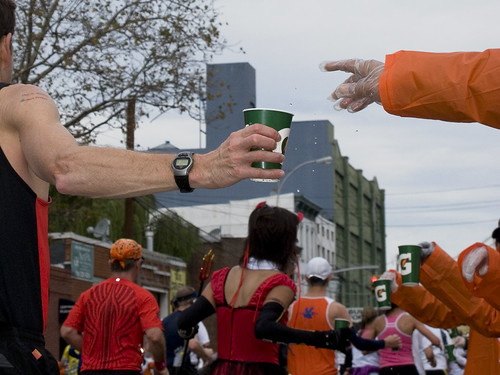
– photo by Mitch Waxman
If you’re a 2009 NYC marathon runner, looking for photos you might be in, click here to reach a huge set at flickr with the full range of shots.

– photo by Mitch Waxman
All along the route, bands were playing. This kid with the Tuba was in a school band that just finished playing “Play that funky music, white boy”.

– photo by Mitch Waxman
Hard rock bands also lined the route- these iconic minstrels were staked out directly across the street from the Citibank Megalith. The runners, toward the ever shadowed cobbles of sin pitted Queens Plaza, were Manhattan bound.

– photo by Mitch Waxman


 The Newtown Pentacle