Archive for March 2010
running in place

– photo by Mitch Waxman
Maritime pursuits call out to your humble narrator this 18th of March, and the mysteries of Barren Island and the greater Jamaica Bay await. Just a short post today, before I head down to the docks.
This whole “mom is sick again” business is going as well as it can, but has set me off in a tail spin of guilty self recrimination and brutal self examination. A quick walk around Cavalry yesterday helped to clear my head a bit, but I’m all ‘effed up, and even my little dog Zuzu is worried about me at the moment. Tendencies toward maudlin and tiresome self loathing render me a real “ray of sunshine” at moments like this, but from such psychic manure often bloom new and interesting ideas. In the meantime, I’m just snapping photos.

– photo by Mitch Waxman
Some good news is apparent-
One of my photos ended up on the Roosevelt Island community newspaper’s front page. Click here for the latest Main Street Wire
Also, a Newtown Pentacle reader who once worked at Cavalry Cemetery offers some insight on the mysterious knotted cords I observed back around Halloween. I have another update, in the works, observed there yesterday- more on that next week.
Creek Week, which was truncated by “newsworthy” and “strike while the iron is hot” postings about public ceremonies and parades, will continue- I promise.
Bacchanal

Astoria Back Yard – photo by Mitch Waxman
The Romans had a name for March 16th and 17th, specifically for tonight and all day tomorrow, and it was the Bacchanlia. A central holiday for the cult of a fertility and wine god called Bacchus, who was a latin interpretation of the greek Dionysos, the Bacchanal (which was originally a gathering of women, but was made co-ed in 188 BC) would take place on the Aventine Hill. Shackles of conventional morality and licentiousness would be thrown off and vast celebrations of oinoculture would be enacted.
from wikipedia
In the rites, men were said to have shrieked out prophecies in an altered state of consciousness with frenzied bodily convulsions. Women, dressed as Bacchantes, with hair dishevelled, would run down to the Tiber with burning torches, plunge them into the water, and take them out again. Their flames would not diminish as they were made of sulphur mixed with lime.
The rites gradually turned into sexual orgies, particularly among the men, and men who refused to take part were sacrificed. It is said these men were fastened to a machine and taken to hidden caves, where it was claimed they were kidnapped by the gods.
The festivities were reported to Postumius who persuaded the Roman Senate to authorize a full investigation. In 186 BC, the Senate passed a strict law (the Senatus consultum de Bacchanalibus) prohibiting the Bacchanalia except under specific circumstances which required the approval of the Senate. Violators were to be executed.required the approval of the Senate. Violators were to be executed.

Lexington Avenue, Manhattan – photo by Mitch Waxman
Just as our modern Republic seeks favorable comparison with the ancient titans of Rome, so too did the Romans see themselves as the inheritors of the advanced cultures that preceded them in dominance over the Mediterranean world, and which they conquered in the most brutal manner imaginable. The Bacchanal was a conservative Italian version of the wild Dionysian Mysteries and the Greek Bacchanal.
from wikipedia
If the Dionysus Cult first came to Greece with the importation of wine, as seems likely, then it probably first emerged around 6000 BC in one of two places, either in the Zagros Mountains, the borderlands of Mesopotamia and Persia, both with their own rich wine culture since then (arriving in Europe via Asia Minor), or from the ancient wild vines on the mountain slopes of Libya / North Africa. North Africa was the source of early Egyptian wine from around 2500 BC, and home of many an ecstatic rite involving animal possession—notably the goat and panther men of the Aissaoua Sufi cult of Morocco (though it is also possible that this was of later origin and influenced by Dionysian cults itself). Whatever the case it appears Minoan Crete was the next link in the chain of transmission, importing wine from the Egyptians, Thracians and Phoenicians and exporting it to its own colonies, such as Greece. Thus it was in Minoan Crete (c. 3000 to 1000 BC) that the basic Mysteries probably took form—certainly the name Dionysus exists nowhere else other than here and Greece.

Ia, Santorini – photo by Mitch Waxman
Even the Greeks, or “Hellenes” as they would have and do call themselves (Greek is bad latin, a derogatory term meaning short legged- Graeki). When the christians gained power and influence in the latter days of the Roman Empire, Hellenes was the term used for heathen or pagan, and so it fell out of usage.
The Hellenes themselves were late comers to the mediterranean milieu, conquering a civilization which modernity refers to as the Mycenae (which had supplanted the still earlier Minoan) some 10,000 years ago. This culture, which is believed to have traded with Pharonic Egypt and Phonecia (also modern terms), fell to ruin after the explosion of the Santorini (Thera) volcano ca. 1600 BC left them defenseless. The Bacchanal, however, was already an annual tradition by then.
from wikipedia
Cultic rites associated with worship of the Greek god of wine, Dionysus (or Bacchus in Roman mythology), were allegedly characterized by maniacal dancing to the sound of loud music and crashing cymbals, in which the revellers, called Bacchantes, whirled, screamed, became drunk and incited one another to greater and greater ecstasy. The goal was to achieve a state of enthusiasm in which the celebrants’ souls were temporarily freed from their earthly bodies and were able to commune with Bacchus/Dionysus and gain a glimpse of and a preparation for what they would someday experience in eternity. The rite climaxed in a performance of frenzied feats of strength and madness, such as uprooting trees, tearing a bull (the symbol of Dionysus) apart with their bare hands, an act called sparagmos, and eating its flesh raw, an act called omophagia. This latter rite was a sacrament akin to communion in which the participants assumed the strength and character of the god by symbolically eating the raw flesh and drinking the blood of his symbolic incarnation. Having symbolically eaten his body and drunk his blood, the celebrants became possessed by Dionysus.

Kalives, Crete – photo by Mitch Waxman
Crete, which is the true cradle of the western tradition, was an important cultic center for Dionysus- but the Cretans are known and commented on historically for their parties. Come and spend a night out in Astoria, you’ll see what I mean.
from wikipedia
The idea of a mystery religion consisted essentially of a series of initiations which benefited the individual or their society in some way. Initially associated with the passage from childhood to adulthood and maturity, they later became seen as what we might call an evolutionary rite. And it was in the form of a Mystery Religion that the Dionysus Cult was first channeled in a more civilized way, probably first in Minoan Crete.
The notion behind the Dionysian Mysteries seems to have been not only of the affirmation of the primeval bestial side of mankind, but also its mastery and integration into a civilized psychology and social culture. Given the dual role of Ariadne as the Mistress of the Minoan Labyrinth and consort of Dionysus, some have seen the Minotaur story as also partly deriving from the idea of the mastery of mankind’s animal nature, though this remains controversial. The self mastery achieved in this way was not one of domination as in similar cults, most famously preserved in contemporary culture as George and the Dragon, and perhaps the original Minotaur myth, but one of acceptance and integration. Thus while the Mysteries did much to lighten the darker aspects of the cult they often failed to reassure its perhaps excessively civilized critics and continued to be regarded by many as dangerously liberative (particularly given its egalitarian tendencies as well).

Astoria Maenads – photo by Mitch Waxman
Fascinating, the way that some traditions just will not die out. St. Patrick’s day is tomorrow, and when you raise a glass to some wee lass in a pub, or go to some drunken revel at a friends apartment, think of the Maenads and realize that you are enacting the bacchanal- and carrying out a tradition that extends back through time. Watch out for the ladies, though, they have a tendency to go a little wild on this sort of holiday, even the prim and proper ones.
from wikipedia
Carry A. Nation (November 25, 1846 – June 9, 1911) was a member of the temperance movement, which opposed alcohol in pre-Prohibition America. She is particularly noted for promoting her viewpoint through vandalism. On many occasions Nation would enter an alcohol-serving establishment and attack the bar with a hatchet. She has been the topic of numerous books, articles and even a 1966 opera by Douglas Moore, first performed at the University of Kansas.
Nation was a large woman, almost 6 feet (180 cm) tall and weighed 175 pounds (79 kg) and of a somewhat stern countenance. She described herself as “a bulldog running along at the feet of Jesus, barking at what He doesn’t like”, and claimed a divine ordination to promote temperance by smashing up bars.

Ides

– photo by Mitch Waxman
He died alone, squirming in agony, surrounded by strangers. His last friend and only true colleague had recently used a colt handgun to commit suicide, and the only woman he ever loved had left him years ago. Instead he lay there alone in the charity ward- dying in anonymity and pain as his parents had. An orphan raised by matron aunts who indulged and spoiled the strange child who came to them in their dotage- they left him unprepared for adulthood. He retreated into his letters, wrote his stories, and never knew he would live on in the dreams of the sensitive and artistic forever more.
Just 14 months previous to his death, the newspapers detailed the lurid crimes of Albert Fish- the Gray Man, the Werewolf of Wysteria, the Brooklyn Vampire, The Boogeyman– who was executed at SingSing. The good old days, indeed.
“In relating the circumstances which have led to my confinement within this refuge for the demented, I am aware that my present position will create a natural doubt of the authenticity of my narrative. It is an unfortunate fact that the bulk of humanity is too limited in its mental vision to weigh with patience and intelligence those isolated phenomena, seen and felt only by a psychologically sensitive few, which lie outside its common experience. Men of broader intellect know that there is no sharp distinction betwixt the real and the unreal; that all things appear as they do only by virtue of the delicate individual physical and mental media through which we are made conscious of them; but the prosaic materialism of the majority condemns as madness the flashes of super-sight which penetrate the common veil of obvious empiricism.”

– photo by Mitch Waxman
Severely malnourished due to privation and poverty, cancer of the intestine was the diagnosis when he finally checked himself in to the hospital, for the pain had become unbearable. Some money had been found by cousins to bury him in a family plot, but there was no memorial to him on the stone, just his name. He lay with the parents who had disappeared into mental hospitals. Rumors and postmortem analysis of medical records support the theory of tertiary syphilis as the cause of their ruination- but for the son, though, it was failure and loneliness.
In the year same month that he was born, a genius painter– who also suffered from the madness induced by syphilis- shot himself in the chest.
“Our modern worship of empty ideals is ludicrous. What does the condition of the rabble matter? All we need do is to keep it as quiet as we can. What is more important, is to perpetuate those things of beauty which are of real value because involving actual sense-impressions rather than vapid theories. “Equality” is a joke — but a great abbey or cathedral, covered with moss, is a poignant reality. If it is for us to safeguard and preserve the conditions which produce great abbeys, and palaces, and picturesque walled town, and vivid sky-lines of steeples and domes, and luxurious tapestries, and fascinating books, paintings and statuary, and colossal organs and noble music, and dramatic deeds on embattled fields — these are all there is of life: take them away and we have nothing which a man of taste or spirit would care to live for. Take them away and our poets have nothing to sing — our dreamers have nothing to dream about. The blood of a million men is well shed in producing one glorious legend which thrills posterity and it is not at all important why it was shed.”

– photo by Mitch Waxman
For a time, he lived in New York, and took a wife. They lived in Brooklyn, and like any writer of the early 20th century, he spent a great deal of his time in Greenwich Village. The settings of several of his stories are still extant within the Shining City. Xenophobic and racially charged viewpoints, which are actually quite liberal by the standards of early 20th century America, dog his reputation to this day. However, the company he kept while in New York was a cross section of ethnicity. His wife was Jewish, after all, and his friends were shocked when they learned of his racial politics.
The New York he knew was a seething cauldron of crime and hatred, with all the tribes of man battling for their slice of the American Pie. For a bourgeois anglophile from New England, this was his first taste of fear, and when he picked up the newspapers they spoke of a sensational englishman who had proclaimed himself “the Great Beast”. This english wizard had just moved from Greenwich VIllage to Palermo to set up the “Abbey of Thelema“, after having performed a secret rite on Esopus island (in the Hudson RIver) and receiving the revelation “Do what thou wilt shall be the whole of the law”.
“I have dwelt ever in realms apart from the visible world; spending my youth and adolescence in ancient and little-known books, and in roaming the fields and groves of the region near my ancestral home. I do not think that what I read in these books or saw in these fields and groves was exactly what other boys read and saw there; but of this I must say little, since detailed speech would but confirm those cruel slanders upon my intellect which I sometimes overhear from the whispers of the stealthy attendants around me. It is sufficient for me to relate events without analysing causes.”

– photo by Mitch Waxman
The existential and celestial nature of the abyssal future mankind, as elucidated by the frenchman Camus, would soon be facing as the second World War slouched toward the use of atomic weaponry would not have surprised him . Long ago, in his house, quaint iterations of the macabre had been put aside for something grander. He looked past our world, into cosmic gulfs of infinity whose utter vastness filled him with dread.
That there are some things to which even madness and death are preferable to, and culturally childlike monstrosities like ghosts and vampires and messiahs should be shelved as quaint relics. He foresaw a world in which men would be regarded as ants, and the gods care not if you worship them or not, and all the faiths of men are mere superstition.
He put forward the belief that if mankind as a whole was to discover our true importance in the universe it would trigger a new dark age. He warned that the cosmic revelations would teach men new ways to fight, and eat, and enjoy themselves- while at the center of it all, cosmic evil would slaver with delight as mankind destroyed itself.
“Life is a hideous thing, and from the background behind what we know of it peer daemoniacal hints of truth which make it sometimes a thousandfold more hideous. Science, already oppressive with its shocking revelations, will perhaps be the ultimate exterminator of our human species — if separate species we be — for its reserve of unguessed horrors could never be borne by mortal brains if loosed upon the world.”

– photo by Mitch Waxman
Howard Philips Lovecraft died in Providence on the Ides of March, of instestinal cancer, in 1937.

from wikipedia
In 1932, Lovecraft wrote in a letter to Robert E. Howard: “All I say is that I think it is damned unlikely that anything like a central cosmic will, a spirit world, or an eternal survival of personality exist. They are the most preposterous and unjustified of all the guesses which can be made about the universe, and I am not enough of a hair-splitter to pretend that I don’t regard them as arrant and negligible moonshine. In theory I am an agnostic, but pending the appearance of radical evidence I must be classed, practically and provisionally, as an atheist.
Kill Van Kull walk 2
for part one, click here

– photo by Mitch Waxman
The Kill Van Kull is an industrial waterway which provides a border between Staten Island and New Jersey, as well as serving the role of a maritime route between the Port of Newark and the greater body of water called New York Harbor or the New York Harbor Estuary- depending on your priorities. The New Jersey side of the Kill Van Kull is lined with modern docks and industrial facilities. The Staten Island side seems to have abandoned its industrial role, with storm shattered pilings and relict rail tracks found lining its banks.
from wikipedia
New York Harbor lies at the confluence of three major bodies of water. The harbor opens onto the New York Bight (Atlantic Ocean) to the southeast and the Long Island Sound to the northeast. Both of these are essentially marine bodies with both tides and saltwater, but the Sound compared to the Atlantic is about 20-30% less saline (as an estuary), and the tide is about 3 hours later with as much as 70% more variation. The Hudson River adds a fresher, non-tidal inflow from the north, although the tide and brackishness extend well up river.

– photo by Mitch Waxman
Critters abound along this cement clad shore, and large flocks of coastal and ocean fowl may be observed. My ignorance of the natural world is an ongoing handicap (why can’t I know everything about anything? … human… all too… human…) so I cannot describe the taxonomy of these birds. Perhaps a helpful Newtown Pentacle reader with ornithological knowledge can assist in identifying the specie observed above. I can tell you that they were apparent in great numbers, during the early days of March.
UPDATE: Sharp eyed reader Christina informs me that these are Brant Geese.
from army.mil
The U.S. Army Corps of Engineers New York District recently shared its plans to improve the New York – New Jersey Harbor Estuary with members of Congress and other key decision-makers. Representatives of more than 20 organizations joined the District commander aboard the USACE vessel Hayward tour of the estuary and the Hudson River.
“It’s the 400th anniversary of Henry Hudson’s historic exploration up this great river,” said Col. John R. Boulé II, New York District commander, addressing the group from the bow of the Hayward. “Our view must be very different from his. Years of industrialization have considerably degraded this part of the Hudson.”
The Corps plans to help turn back the hands of time on the estuary. The event to celebrated the unveiling of an innovative, comprehensive restoration plan created in collaboration with partners, and with a focus on restoring the estuary. This will create a healthier environment for fish and wildlife, and also provide the public cleaner waters, healthier fisheries, increased flood protection, recreational opportunities, and a boost to the region’s economy.
“The primary goal of the New York-New Jersey Harbor Estuary Comprehensive Restoration Plan is to develop a mosaic of habitats that provides maximum ecological and societal benefits to the region,” said Lisa Baron, project manager and marine biologist with the New York District.
A diverse group of USACE technical experts and consultants developed the plan as part of the Hudson Raritan Estuary Ecosystem Restoration Study sponsored by the Port Authority of New York and New Jersey. The plan was prepared in collaboration with the New York-New Jersey Harbor Estuary Program and more than 60 partnering organizations, including federal, state and local agencies, non-governmental organizations and regional stakeholders. The overall plan is unique in that these agencies are presently combining their funds and forces to reduce redundancy, become more efficient and save taxpayers a considerable amount of money. The plan will serve as a master guide and framework for restoration efforts throughout the estuary.
The plan involves many partners because the estuary spans 1,600 square miles across New York and New Jersey. An estuary is the area where the fresh waters of a river meet the salt water of the sea. The New York-New Jersey Harbor Estuary includes rivers, wetlands, coastline and open waters, and is located within a complex ecological system and a metropolitan region with a population of 20 million people. The plan’s boundary covers a large region of the estuary, which is a 25-mile radius around the Statue of Liberty National Monument.
“To perform restoration work in the estuary, the plan divides the estuary into eight regional areas associated with specific watersheds,” said Peter Weppler, chief of the New York District’s Coastal Ecosystem Section. He is a biologist with an extensive background in ecological investigations.
The plan includes 11 priority targets for restoration, recognized as Target Ecosystem Characteristics that include methods to restore and create habitats, ensure these habitats live in harmony and with the surrounding urban infrastructure, and to ensure the estuary is safe and accessible to the millions of estuary residents and visitors.

– photo by Mitch Waxman
The big show on the Kill Van Kull, of course, are the Tugboats transiting between the lower Harbor and the Port of Newark. Tugboats, for those of you unfamiliar with the role they are engineered to perform, act as precision guides that pilot and nudge ocean going vessels through the relatively shallow and tight quarters found in coastal waters. Powered by engines many times more powerful than required for vessels of their size and tonnage, Tugs are also designed with specially stiffened and overly robust frames which allow them to manipulate the elephantine ships that they shepherd to safe harbor. Pictured above is the Jill Reinauer. For an interesting window on the life of a tugboat crew and the hazards they face in New York Harbor, check out this post at piersystem.com.
from tuginformation.weebly.com
Built for Interstate Oil Transport by Main Iron Works of Houma, La in 1967 (hull #183) as the tug Ranger. She measures 91’(ft) long, with a 9’(ft) draft and 26’(ft) wide rating at 2,000 horsepower.
At the time Interstate Oil Transport had two fleets. Their Northeast Fleet “Green Fleet” that operated in Philadelphia, Pennsylvania. And a Southern Fleet “White fleet” which operated out of Tampa, Florida. The Ranger was assigned to the “Green Fleet.” However, many changes came to Interstate Oil, a company called Southern National Resources (also known for a time as SONAT Marine) purchased Interstate Oil Transport. SONAT eventually sold out to Maritrans Operating Partners LLP.
In 1998, Maritrans’s northeast fleet was thinned. Many of the vessels where acquired by K-Sea Transportation Partners. Reinauer Transportation acquired three vessels, the Ranger was one of the three vessels. She was renamed the Jill Reinauer the others vessels Reinauer acquired where the Interstate Transporter (Kristy-Ann Reinauer), and the Delaware (Curtis Reinauer). In 2005, the Jill Reinauer was re-powered with MTU engines and fitted with canted windows in her main wheelhouse to reduce glare in the wheelhouse, and was fitted with an upper wheelhouse as well, this work was done at Reinauer’s yard in Staten Island, New York.

– photo by Mitch Waxman
A sudden flurry of activity on the Kill Van Kull began when the Charles D. McAllister sped by, after having passed beneath the elegant Bayonne Bridge (designed by Omar Othman under the guidance of Gustav Lindenthal, who designed the Hells Gate Bridge spanning the East River nearby storied Astoria). For a different perspective on the Kill Van Kull and lots of information on the Chemical Coast of New Jersey, Bayonne Bridge, and Port of Newark- check out the Newtown Pentacle postings from June of 2009 here, and here.
also from tuginformation.weebly.com
Built in 1967 as the Esso Bayou State by Jacksonville Shipyard of Jacksonville, FLA. Rated at 1,800 horsepower she is driven by two Caterpillar 12-D398 Turbo main engines, with Lufkin reduction gears with a ratio of 7.14:1 She is a twin screw tug, fitted kort nozzles and flanking rudders. She is outfitted with two fire monitors that produce 1,500 Gallons Per Minute. She has a fuel capacity of 26,670 gallons, 628 gallons of Lube Oil and 3,480 gallons of potable water.
She was later renamed the Exxon Bayou State, and when Exxon became Sea River Maritime, her name was altered to S/R Bayou State. When Sea River sold off their assets she was acquired by McAllister Towing and Transportation she was renamed the Charles D. McAllister and is currently assigned to McAllister’s New York, New York fleet.

– photo by Mitch Waxman
Moran towing’s Cape Cod shot past at what seemed to be it full 4,200 HP throttle, undoubtedly in an urgent rush. Note the lesson in physics illustrated by the waveforms around the speeding tug. The warping of the water’s surface illustrate the principles of displacement, surface tension, and offer visible waveforms for study.
from tugboatenthusiastsociety.org
Tugs are “displacement” hull vessels, the hull is designed so water flows around it, there is no consideration for having the vessel “plane”. Because of this the hull form is limited to a maximum speed when running “free” that is about 1.5 times the square root of the waterline length. As the tug approaches this speed when running “free” it is perched between the bow wave and the stern wave. Since the hull cannot plane, application of additional power when approaching maximum hull speed only results in a larger bow wave, with the tug “squatting” further into the trough.

– photo by Mitch Waxman
The Amy C McAllister was next on the parade, and it seemed to also be in quite a hurry. Something was approaching, something big.
also from tuginformation.weebly.com
Built in 1975, she was formerly named the Jane A. Bouchard. She is fitted with two EMD 16-645-E2 main engines for a rating of 4,000 horsepower turning two Falk reduction gears at a ratio of 4.708:1. She is also fitted kort nozzles, and flanking rudders with a Smatco single drum towing winch outfitted with 2,200′ (ft) of 2 ¼” (in) towing wire. When she was acquired by McAllister Towing and Transportation she was renamed the Amy C. McAllister.
She is currently assigned to McAllister’s New York, New York Fleet.

– photo by Mitch Waxman
Turns out that “something big” was the Eagle Beaumont, a gargantuan fuel ship which was flagged in far off Singapore. Sources reveal that the Eagle Beaumont is an “aframax tanker“, was built at the Korean Samsung Heavy Industries Yard in 1996, has a maximum DWT of 99,448, and is a double hulled vessel classified as “1A1 Tanker for Oil ESP E0 LCS-SI” with a worth of some $52 million.
from aet-tankers.com
AET’s double-hulled VLCC fleet is managed from London and is mostly engaged in the Atlantic trades, as well as longer haul trips to the US West Coast. There are currently 11 vessels in this fleet with an average age of less than five years. Growing VLCC capability is a priority and we are on target to achieve a 25-strong fleet within the next five years.
The fleet of aframax vessels forms the core of AET’s crude oil activities. All double-hulled and with an average age of around 9 years, these workhorses of the tanker industry transport crude oil in Europe, Asia and the Americas. This fleet and its global footprint will continue to grow, to provide increased connectivity between geographic regions and between our VLCC operations and our lightering activities.
AET vessels are employed for customers on long-term period charters, shorter voyage charters or on extended contracts of affreightment (COAs). The dedicated chartering teams in London, Singapore, Gurgaon and Houston work alongside our customers to ensure we deliver the best possible solutions.

– photo by Mitch Waxman
The two tugs maneuvering the Eagle Beaumont in the narrow space of the Kill Van Kull are the aforementioned Amy C. McAllister and a second McAllister tug which escapes my identification due to the shadows cast by the titanic fuel tanker. My suspicions point to the Charles B. McAllister, but the wheel house exhibits minor differences from the shot above, so I’m probably wrong. At any rate, they performed a rotation of the tanker using sturdy cables and precision coordination of effort.
from wikipedia
Tankers used for liquid fuels are classified according to their capacity.
In 1954 Shell Oil developed the average freight rate assessment (AFRA) system which classifies tankers of different sizes. To make it an independent instrument, Shell consulted the London Tanker Brokers’ Panel (LTBP). At first, they divided the groups as General Purpose for tankers under 25,000 tons deadweight (DWT); Medium Range for ships between 25,000 and 45,000 DWT and Large Range for the then-enormous ships that were larger than 45,000 DWT. The ships became larger during the 1970s, and the list was extended, where the tons are long tons:
- 10,000–24,999 DWT: General Purpose tanker
- 25,000–44,999 DWT: Medium Range tanker
- 45,000–79,999 DWT: Large Range 1 (LR1)
- 80,000–159,999 DWT: Large Range 2 (LR2)
- 160,000–319,999 DWT: Very Large Crude Carrier (VLCC)
- 320,000–549,999 DWT: Ultra Large Crude Carrier (ULCC)

– photo by Mitch Waxman
From the direction of the Port of Newark, a behemoth container ship suddenly appeared. Notice how high it’s riding in the water, signifying that its pessimistically half empty. A Liberian flagged 231 meter long by 32 meter wide ocean going vessel, it was built in the year 2000, and is capable of moving at 21.1 knots. Another product of the Samsung Heavy Industries yard in Korea, it’s the Santa Carolina.
from wikipedia
Samsung Heavy Industries or SHI (Korean: 삼성중공업, Hanja: 三星重工業) is the second-largest shipbuilder in the world and one of the “Big Three” shipbuilders of South Korea. A core subsidiary of the Samsung Group, South Korea’s and the world’s largest conglomerate, SHI’s main focus is on shipbuilding, offshore floaters, digital devices for ships, and construction and engineering concerns.
SHI operates manufacturing facilities at home and abroad, including ship block fabrication factories in Ningbo and Rongcheng, China. The Geoje Shipyard in particular, SHI’s largest shipyard in South Korea, boasts the highest dock turnover rate in the world. The largest of the three docks, Dock No. 3, is 640 meters long, 97.5 meters wide, and 13 meters deep. Mostly ultra-large ships are built at this dock, having the world’s highest production efficiency with yearly dock turnover rate of 10 and the launch of 30 ships per year.[2]
SHI specializes in the building of high added-value and special purpose vessels, including LNG carriers, off-shore related vessels, oil drilling ships, FPSO/FSO’s, ultra Large container ships and Arctic shuttle tankers. In recent times SHI has concentrated on LNG tankers and drillships, for which it is the market leader.

– photo by Mitch Waxman
The Laura K. Moran tug appeared, and took up its position to guide the Santa Carolina through the narrow hazards faced by the Santa Carolina passing by the Eagle Beaumont. Realize that a ship of this size is incapable of stopping on a dime, and the dynamics of such massive objects suggest vast kinetic energy transfers should they accidentally come in contact with other objects. An interesting point of language, interesting to your humble narrator at least, in the correct usage of the words allision and collision. An Allision is used when a moving object strikes a fixed object- i.e. when a ship strikes a pier or shoreline feature. A Collision is when two moving objects meet. The job of the Tugboat Captain is to avoid either.
from boatinglaw.com
When one thinks of admiralty law the archetypical fact pattern that comes to many people’s minds is a collision or allision (vessel contact with a fixed object). There are many well ingrained legal concepts and rules, some of which are unlike anything found in land based law.
First, when there has been a collision or allision the vessel herself may be sued as if she were a person. This is an “in rem” action and the complaint is against the vessel her tackle her engines and appurtenances.
Second, under general maritime law, each vessel must pay in proportion to the amount that it was at fault. This rule stands in stark contrast to state law in a those states, including Maryland, where plaintiffs who bear any fault can be barred from all recovery.
Third, there are several judicial presumptions of fault that all vessel operators should bear in mind. A vessel creating wake is presumed at fault for damage caused by wave wash. A vessel in violation of any safety statute which could have prevented the casualty is presumed at fault. A vessel that is drifting or dragging anchor is presumed at fault. A vessel that allides with a fixed object (unless it is submerged) is presumed at fault.
Fourth, there are several sources of fault in addition to the judicial presumptions including, statutory violations, local rules, unseaworthiness of your vessel and custom. If you violate a custom you may well find yourself liable for the casualty. A prime example of a custom is the Point Bend Custom on the Mississippi River. Since the current flows fastest on the outside of a bend and slower under a point of land, all downbound traffic travels around the outside of a bend while upriver traffic takes advantage of reduced current by traveling from point of land to point of land. This creates a situation in which large vessels must weave through each other’s paths.

– photo by Mitch Waxman
In fact, the two ships were quite a distance from each other, but in nautical terms, this is a tight squeeze for the vagaries of displacement and current are somewhat unpredictable. The Tug crews that inhabit New York Harbor carry a knowledge passed from father to son and captain to deckmate, and represent millions of hours of applied labor and hard won familiarity with the liquid thoroughfare of the Kill Van Kull. No room for error is to be found as they nudge and pull, and mistakes can be deadly to crew and environment alike. The Kill Van Kull is only a thousand feet wide, after all.
from shipsnostalgia.com
Errors in judgment by the navigators aboard two tanker ships carrying volatile cargos resulted in a collision, explosion and fire that consumed both tankers, two attending tugs and left 37 sailors dead and more than 20 injured in New York harbor on June 16, 1966.
The fiery accident remains counted even today as among the deadliest shipwrecks in the history of New York Harbor.
The tankers, the British MV Alva Cape was entering the harbor with a cargo of naphtha and was struck amidships on the starboard side by the outgoing American tanker Texaco Massachusetts. The raging explosion and fire that resulted from the crash destroyed not only the tankers but the tugs Latin America and Esso Vermont.
Thirty-four sailors perished during this first explosive event on July 3. Nineteen of them perished on the Alva Cape, eight on the Esso Vermont, three on the Texaco Massachusetts and three on the tug Latin America. The U.S. Navy, Coast Guard and New York City fire boats worked together to battle the flames and rescue as many sailors as possible from the burning vessels in a place with the ominous name of Kill Van Kull Channel.
The blaze was finally extinguished, but the Alva Cape was not finished as a human death trap. Three more men were killed in yet another explosion while they were aboard the burned out wreck, attempting to unload what remained of its deadly cargo. This happened just 12 days later, bringing the death toll from the accident to 37.

– photo by Mitch Waxman
Along the Staten Island coastline, an abandoned rail line is observed. Forgotten-NY has rolled through here, and as always, wrote the book on Cornelius Vanderbilt’s SIRT.
check out the words of the Master- click here

– photo by Mitch Waxman
Inheritances of the industrial revolution such as these rusted tracks litter the North Shore of Staten Island. The lovely homes and tree lined streets nearby are sited, unfortunately, amongst the toxic inheritances of the heroic age of the mills and factories which defined the area- which cause your humble narrator to muse on analogies to Maspeth and Greenpoint, found along the route of the malefic Newtown Creek as it gurgles along the currently undefended border of Brooklyn and Queens.
from wikipedia
Much of the North Shore is industrialized, which when paired with the fumes being exuded from New Jersey factories, helps to give Staten Island the worst smog in New York City. According to the New York State Department of Health, deaths from lung cancer are 48% higher on Staten Island than in the city as a whole. The poorest air quality being on the North Shore of the island. Within the North Shore’s approximately 5.2 square mile area, there has been around 21 different sites that the Environmental Protection Agency or residents have identified as contaminated. All of them sit within 70 feet of homes and apartment buildings, and residents believe that many violate state environmental regulations.
While the famed Fresh Kills Landfill much further South on the island has received large media coverage for its harmful effects, eventually leading to its closing in 2001, the numerous problems on the North Shore have gone ignored. The demographics of those who live around the former landfill differ quite drastically from those who live on the island’s North Shore, leading some to point the finger at racism and classism as answers to why so many North Shore sites remain contaminated.

– photo by Mitch Waxman
The Santa Carolina threaded through the Kill Van Kull without incident, as do most of the hundreds of large ships that pass through it daily. The redoubtable Army Corps of Engineers is involved in a multi year project to deepen the Kill so as to accommodate even larger trans oceanic shipping and ensure that the Port of Newark remains a primary destination for all the world’s traders and merchants.
from wikipedia
Planned and built during the 1950s by the Port Authority, it is the largest container port in the eastern United States and the third largest in the country. Container goods typically arrive on container ships through the Narrows and the Kill Van Kull before entering Newark Bay, a shallow body of water which is dredged to accommodate the larger ships (some ships enter Newark Bay via the Arthur Kill). The port facility consists of two main dredged slips and multiple loading cranes. Metal containers are stacked in large arrays visible from the New Jersey Turnpike before being loaded onto rail cars and trucks. The building of the port facility antiquated most of the waterfront port facilities in New York Harbor, leading to a steep decline in such areas as Manhattan, Hoboken, and Brooklyn. The automated nature of the facility requires far fewer workers and does not require the opening of containers before onward shipping.
Today, the major Port operators at Port Newark-Elizabeth include Maher terminals, APM terminal (A. P. Moller-Maersk), and PNCT (Port Newark Container terminal).
Other significant seaport terminals under the auspices of the Port Authority of New York and New Jersey include: Global Marine Terminal in Jersey City, NJ; NYCT (New York Container Terminal) in Staten Island, NY; and Red Hook Container Terminal at the Brooklyn Marine Terminal in Brooklyn, NY.

– photo by Mitch Waxman
I wonder if this duck knows that menacing “menage a mallard” that I saw at Dutch Kills a few weeks ago? Couldn’t be the same suspicious quacker, could it?
from wikipedia
The Kill Van Kull is a tidal strait approximately 3 miles (4.8 km) long and 1,000 feet (305 m) wide separating Staten Island and Bayonne, New Jersey, USA. The name kill comes from the Middle Dutch word kille, meaning “riverbed” or “water channel.”
Kill Van Kull connects Newark Bay with Upper New York Bay. The Robbins Reef Light marks the eastern end. Historically it has been one of the most important channels for the commerce of the region, providing a passage for marine traffic between Manhattan and the industrial towns of New Jersey. Since the final third of the 20th century, it has provided the principal access for ocean-going container ships to Port Newark-Elizabeth Marine Terminal, the busiest port facility in the eastern United States and the principal marine terminal for New York Harbor.
Kill Van Kull walk 1

– photo by Mitch Waxman
A legendarily squalid and desolate abode of pirates, gangsters, and irresolute opportunists- the docks of Manhattan- have been recast by modernity as “the financial district”- and simply referred to as “wall street”. The end of the line, the Staten Island Ferry docks at South Ferry and offers a free maritime connection between the far flung Staten Island and Manhattan across New York Harbor. The boat leaves every half hour, like clockwork (and the fleet is orange).
from wikipedia
The origin of the name South Ferry is probably one of the more misunderstood trivia, even to New Yorkers accustomed to using it in a geographical sense. One would suppose that it is so called because it is at the southern tip of Manhattan, and it hosts ferries. In actuality, it was the name of the South Ferry, one of several ferries between what were then the separate cities of New York and Brooklyn. The “Old Ferry”, which later was renamed the “Fulton Ferry”, crossed between Manhattan and Brooklyn from streets that in each city would eventually be renamed “Fulton Street” after the ferry company. The “New Ferry” crossed further east, between Catherine Street in Manhattan, and Main Street in Brooklyn.
As the City of Brooklyn grew, the area south of Atlantic Avenue (known as “South Brooklyn”) began to become built-up, but lacked easy access to the ferry terminals in the northern parts of the city of Brooklyn. Thus, a new ferry was established in 1836 to take passengers directly to Atlantic Avenue and the southern parts of the City of Brooklyn, and so was called the “South Ferry”. The ferry connected to the foot of Atlantic Avenue in Brooklyn and the Brooklyn and Jamaica Railroad (later part of the Long Island Rail Road) through the Cobble Hill Tunnel. In addition, South Ferry was the name of the Brooklyn landing and ferry house of the aforementioned ferry.

– photo by Mitch Waxman
Another great opportunity to take photos of the shining city is offered by this short trip, and one must pick a spot soon after boarding or the masses of camera wielding citizenry will cheat you out from an unoccluded vantage point. Staten Island is a rapidly growing part of New York City, a hilly district of quiet and well planted streets that frame envious homes on one shore, and highways lined with medium density apartment houses and condominiums on the other which are served by a never ending series of strip malls and the occasional “big box” store. The older sections of the community are of maritime heritage, largely, and clustered around the Kill Van Kull.
from wikipedia
In the 1700s ferry service between Staten Island and the city of New York (then occupying only the southern tip of Manhattan) was conducted by private individuals with “periaugers”, shallow-draft, two-masted sailboats used for local traffic in New York harbor. In the early 1800s, Vice President (and former New York governor) Daniel D. Tompkins secured a charter for the Richmond Turnpike Company, as part of his efforts to develop the village of Tompkinsville; though intended to build a highway across Staten Island, the company also received the right to run a ferry to New York. The Richmond Turnpike Company is the direct ancestor of the current municipal ferry.
In 1817 the Richmond Turnpike Company began to run the first motorized ferry between New York and Staten Island, the steam-powered Nautilus. It was commanded by Captain John De Forest, the brother-in-law of a young man named Cornelius Vanderbilt. In 1838 Vanderbilt, who had grown wealthy in the steamboat business in New York waters, bought control of the company. Except for a brief period in the 1850s, he would remain the dominant figure in the ferry until the Civil War, when he sold it to the Staten Island Railway, led by his brother Jacob Vanderbilt. (Three of the Staten Island ferries were requisitioned by the United States Army for service in the war, but none ever returned to New York harbor.)
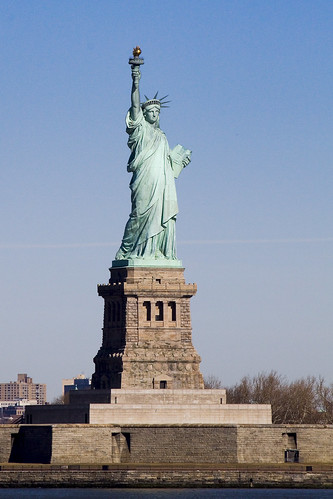
– photo by Mitch Waxman
Just after passing Liberty Island, an abundance of industrial terminals and petroleum mills are apparent. A dizzying display of technology may be observed as the Ferry makes its way from Manhattan to Staten Island, and the lighting conditions demand a morning trip for photographic opportunities to be realized. You don’t have to be up fiendishly early, these shots for instance, were from a ferry ride that left Manhattan at 9:30 AM.
from nyc.gov
The Staten Island Ferry has been a municipal service since 1905, and currently carries over 21 million passengers annually on a 5.2-mile run between the St. George Terminal in Staten Island and the Whitehall Terminal in lower Manhattan. Service is provided 24 hours a day, 365 days a year. The Staten Island Ferry is the most reliable form of mass transit, with an on-time performance of over 96 percent.
A typical weekday schedule involves the use of five boats to transport approximately 65,000 passengers daily (110 daily trips). A four-boat (15 minute headway) rush hour schedule is maintained. During the day, between rush hours, boats are regularly fueled and maintenance work is performed. Terminals are cleaned around the clock and routine terminal maintenance is performed on the day shift. On weekends, three boats are used (64 trips each weekend day). Over 33,000 trips are made annually. Ferry terminal supervisors, assigned around the clock at both Whitehall and St. George, are responsible for ensuring that the ferry operates according to its published schedule (pdf) or (html).

– photo by Mitch Waxman
That’s the Vane Bros. Choptank, a very modern tug built by Thoma-Sea, a shipbuilder which operates out of the Lockport shipyard in Houma, LA. Vane Bros. and its plans for an ultra modern fleet was featured in a 2007 feature at professionalmariner.com.
from vanebrothers.com
The tug Choptank is the fifth in a line of Patapsco-class tugs. Like her sister tugs, she was designed by Frank Basile of Entech & Associates, and built by the Thoma-Sea Boat Builders in Houma, Louisiana. She joined the fleet in January 2007, and was subsequently named one of the “17 top new tugs of 2007” by American Tugboat Review, an annual publication of Professional Mariner.
The Choptank is 95’ long, 34’ abeam, and 15’ deep. Her gross tonnage is 99 tons. She is powered by two CAT 3516, 2100 horsepower engines with Kort nozzles, and maintains running speeds of better than 12 knots. Featuring a model bow and square stern, her fuel capacity is approximately 90,000 gallons. Potable water capacity is approximately 9,000 gallons. With accommodations for seven crew members, the Choptank is dedicated to 50-class tank barges on the coastwide trade.

– photo by Mitch Waxman
I love this boat, the Tug Ellen McAllister. A familiar sight in New York Harbor, it’s actually the same age as I am. I mentioned this ship in a posting about last June’s Working Harbor Committee “Sunset Cruise”.
The tug Ellen McAllister was originally built for the U.S. Navy, as the Piqua, at the Marinette Marine Shipyards in Wisconsin in July of 1967. The Piqua’s anchorage for many years was at Holy Loch, Scotland. It spent most of its naval career providing tug services for the 1st naval district and the Atlantic Fleet. It was sold under its current name in 2001 to McAllister Towing.
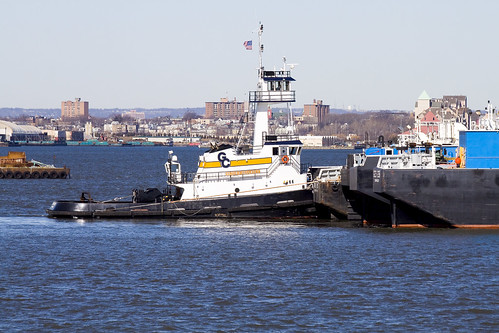
– photo by Mitch Waxman
Over there, that’s the Peter F. Gallatly, another Thoma-Sea built ship. A 1,200 HP, 327 GT tugboat, it went into service in December of 2008.
PETER F. GELLATLY
Official #: 1212432
- Year Built: December, 2008
- Dimensions: 100’L x 34’B x 15’D (Molded)
- Gross Tons: 327 tons
- Net Tons: 98 tons
- Draft Loaded: 13.6 Feet
- Speed Light: 11 Knots
- Classifications: Endorsement for Oceans, Coastwise Trade, ABS Load Line
- Eye Level: Lower Pilot House (23 Feet)
- Upper Pilot House (40 Feet)
- Capacities:
- Fuel Oil 85,900 Gallons
- Lube Oil 662 Gallons
- Hydraulic Oil 496 Gallons
- Gear Oil 662 Gallons
- Potable Water 8,816 Gallons
- Ballast Water 10,621 Gallons
- Dirty Bilge 1,263 Gallons
- Dirty Lube Oil 1,306 Gallons
- Grey/Brown Water 3,898 Gallons (ZERO (0) Discharge Compliant)
- Horse Power: 4,200 Continuous
- Main Engines: (2) 3516 CAT @ 1600 RPM Tier 2 Compliant
- Reduction Gears: (2) Reintjes WAF 11 37 7.087:1 Reduction with Shaft Brakes
- Propellers: (2) Rolls-Royce Stainless Steel (4) Blades GWAN 104″ x 77″
- Pitch ABS Open Wheel
- Shafts: 9 1/2″ Diameter
- Generators: (2) John Deere 6068T 99KW 120/208V Tier 2 Complaint
- Towing Winch: (1) Intercon DD200 Double Drum with Level Winder and Capsan
- 2,200′ x 2 ¼” Galv. Cable
- 1,000′ x 1 3/4″ Galv. Cable
- John Deere Engine, Torque Converter Tier 2 Complaint
- Towing Arch: 8″ x Sch. 120 with (2) Bronze Bushed Sheaves
- Air Compressors: (2) Quincy 325 Operating @ 150 PSI with 160 Gallon Receiver
- C02 System: Herbert Hiller

– photo by Mitch Waxman
Just as the Ferry was maneuvering into its dock at St. George Terminal on Staten Island, Ellen McAllister was good enough to move into an egregious spot. This tugboat, of course, was the Division A winner of the 17th Annual Running of the Great North River Tugboat Race & Competition in 2009 and its Captain, Kirk Watts, won the contest for “Best Tattoo”. I was on a circleline observer boat at the event, and photos from the race can be found in this set at flickr.
from tuginformation.weebly.com
McAllister Towing is one of the oldest and largest marine towing and transportation companies in the United States. They operate a fleet of more than seventy tugboats and twelve barges along the East Coast from Portland, Maine to San Juan, Puerto Rico.
Although their corporate headquarters are located in New York City they operates in the ports of: Portland Maine, Staten Island New York, Philadelphia, Pennsylvania; Baltimore, Maryland; Hampton Roads, Virginia; Wilmington North Carolina, Georgetown, and Charleston, South Carolina as well as Jacksonville, and Port Everglades, Florida; including San Juan Puerto Rico. McAllister engages in ship docking, general harbor towing, coastal towing and bulk transportation.
Captain James McAllister started the first McAllister enterprise shortly after he arrived from Cushendall, County Antrim, Ireland . Together with his brothers and in-laws, McAllister formed the Greenpoint Lighterage Company. They augmented the lighterage business with towing, with the acquisition of their first steam tug, the R.W. Burke, in the 1880’s, while the Brooklyn Bridge was still being built. In the early twentieth century there was a period of innovation and expansion. Captain James was one of the first to convert a sail lighter into a bulk oil carrier, for the transport of oil around New York Harbor. The company also became known nationally for its salvage work, which extended from the West Indies, along the Atlantic Coast as far north as Maine.
In 1909, the company acquired the Starin Fleet of steamboat excursion vessels, forming the McAllister Steamboat Company, which was then among the largest excursion boat operators in New York, with regular runs to the Statue of Liberty, Bear Mountain, Coney Island, and Long Island. After the death of Captain James in 1916, his four sons assumed control of the company. The new partnership consisted of James, John E., Charles D. and William H., the second generation of McAllisters.


 The Newtown Pentacle