Archive for March 2010
chugging along…

– photo by Mitch Waxman
An unholy and untrammeled period of exertions, which have left your humble narrator a hollow eyed wreck in the last few days, are nearly complete. A short missive this morning, as I am off to the shores of “sub jersey”, or Staten Island as the rest of you might describe it, to meet with my aged mother’s physicians. The poor woman’s health collapsed several years ago, and on doctor’s orders, we moved her into a nursing home. Luckily, dementia has shielded her from the depersonalization and horror of institutionalization- her constructed reality is filled with deceased loved ones and the belief that she is going home “tomorrow”.

– photo by Mitch Waxman
Unfortunately for my Mom, and even worse for the facility she resides in, she has developed a bed sore of some severity which has forced me to turn my attentions to Staten Island. A pressure ulcer, which is to be expected in patients suffering from her portfolio of illness but is nevertheless representative of neglectful failure for her caregivers, developed to Stage 4 (which I won’t even link to wikipedia to explain, as it’s that hideous). An open wound the size of softball, it is on her back and advanced enough to have required surgical debridement last week. An investigation into “how this advanced so quickly”, and “when, who, what, and how often” was initiated at my insistence by the administration of the Nursing Home, the findings of which are the point of my trip to… “sub jersey” today.
Something wicked this way comes… if you see a filthy black raincoat tattering down Victory Blvd. today… beware the coming of the Ides. Know that a storm is arrived, venom will be spat, and the dragon loosed.
Delayed by obligation, the next installment of “Creek Week” is on the stove and simmering, expect it tomorrow…
the shadow over sunnyside

– photo by Mitch Waxman
First Canto,
Lords and Ladies of Newtown-
Homosexuality is a non issue to me. This is partly because I’m not gay, and therefore I don’t suffer the oppression, discrimination, and second class status afforded this slice of the american pie by so called political conservatives. Most people hate me for reasons having nothing to do with sexual preference, but when the subject is brought up by my blue collar buddies- a standard response I offer is “what the hell do you care what somebody else does in the bedroom?”. The antics some of my heterosexual friends get up to would curl your hair, I tell you, but this is a society based on choice and self determination and anyone can follow whatever dream may intrigue them.
from thekelticdreams.com
The Keltic Dreams Irish Dancers, are a group of 33 children ages 7-12 from Public School 59, PS 59 in the Bronx, NY. The school is situated in a low Socio Economic area in the Bronx and has a 95% poverty rate. The students are all African American and Hispanic and have no background in Irish culture. Hired by the Department of Education, I, Caroline Duggan, moved to New York over 4 years ago and began teaching music in the school. I had no intention of staying more than one year in the school but fell in love with the children’s drive to become professional. After being constantly asked by the children why I spoke funny I told them that I was from Ireland. The fascination began with questions about the Irish lifestyle, leprechauns and Irish dance. They questioned me about a huge photo of Riverdance I had hanging in the classroom . I showed the children a few steps and was truly amazed by how quick they grasped even the most complicated steps. They were fascinated with the Riverdance video from Radio City, which I still show them on a regular basis. Especially how the show incorporated different cultures into Irish dancing. With this idea in mind and with the amazing support of the principal and school, I began an Irish dancing program after school twice a week. The group The Keltic Dreams was born and have since had their own one hour show on The Plaza at Lincoln Center, in the Bronx Botanical Garden for Bronx week , St Barnabas Nursing Home, on the Band shell at Central Park, at Lehman College in the Bronx and in The Manhattan Mall at Herald Square NYC. They were the sole performers at the St Patrick’s Day Parade in Queens for Mayor Bloomberg and afterwards all the students marched in the parade joined by their parents. The Irish dance program has encouraged huge parental involvement, bringing the whole community together!!!! Much to my surprise some of the children had never been to Manhattan before they performed in these shows!!

– photo by Mitch Waxman
The St. Pat’s for All parade in Sunnyside, Queens, however, was organized as a response to the banning of homosexual marchers in the St. Patrick’s Day Parade in Manhattan 10 years ago. My take on this, based on an outsider’s view of the Roman Catholic Church- is that although exclusionary politics rub me the wrong way, church policy is that Catholicism is not a buffet. You eat the meal they serve or dine elsewhere, there are no substitutions allowed on their menu.
Saying that, “what the hell do you care what somebody else does in the bedroom?” once again escapes my lips and I remind you that I’m neither gay nor catholic. I grew up in an ethnic culture that encourages the wearing of funny little hats, having Saturday’s off, and the mass consumption of cake. As always, I remain an Outsider.
Shunning homosexuals from public view or acknowledgment – is bigotry in my opinion – and the power elite of New York City’s political class seems to agree with me on this one. One finds an alternative to such rudeness at this all inclusive event.
At this parade, you don’t even have to be Irish.
from wikipedia
John Chun Liu (simplified Chinese: 刘醇逸; traditional Chinese: 劉醇逸; pinyin: Liú Chúnyì, born January 8, 1967 in Taiwan) is a New York City elected official, currently serving as New York City Comptroller. Liu previously served on the New York City Council representing District 20. He was elected to the City Council in 2001 to represent northeast Queens (Flushing, Queensboro Hill, Mitchell Linden, Murray Hill, Holly, Kissena Park, Harding Heights, Auburndale, part of Whitestone) and was re-elected in 2003 and 2005.
Liu entered the New York City Comptroller election in 2009 and won the race on November 3, 2009, becoming the first Asian American to be elected to a city-wide office in New York City. He was succeeded in the City Council by pharmacist Republican Peter Koo. Koo, along with Democrat Margaret Chin, a Council member from Manhattan, comprise the Asian-American delegation of the Council.

– photo by Mitch Waxman
Events like this are a photographer’s dream, a time when the politicos let their guards down for a few minutes, and they seem to conduct a lot of business at the sidelines. The politician smile mask, which is every bit as menacing and shallow as a shark’s grin, drops away and you see the actual face of the people who run our government. To wit, witness the Mayor in a contemplative moment, and his assumption of the public face he normally shows us when Carolyn Maloney greets him, and then his “big show” face used for working the crowd. This is part of the art they practice, the methodology of navigating the “endless sea”- as a 15th century Italian Poet might have described politics.
from wikipedia
Elizabeth Crowley (born November 27, 1977, Queens, New York) is a member of the New York City Council and a Democratic Party politician in New York.
Crowley was elected in November 2008, defeating the incumbent Republican, Anthony Como. She was sworn in January 2009 to represent the Queens neighborhoods of Glendale, Richmond Hill, Ridgewood, Maspeth, Middle Village and Woodhaven.
Crowley is the first Democrat and first woman to represent the 30th Council District. She was born and raised in Middle Village and now resides with her family in Glendale, Queens. She has two sons, Dennis and Owen. Crowley graduated magna cum laude with a Bachelors degree in Restoration/Preservation from the Fashion Institute of Technology (SUNY). She has a Masters degree in City and Regional Planning from the Pratt Institute Graduate School of Architecture.

– photo by Mitch Waxman
An admission I must make is that I love taking pictures of Michael Bloomberg. Absolutely no gap seems to exist between his thoughts and the facial postures exhibited, which is of course what his public persona is designed to intone. If it seems that I’m describing stagecraft and thespian performance, I am. Like all great actors, the elite who have clawed their way to the dangerous summit of political life in New York City must go to where a receptive audience can be found, and for politicians- places where their constituents can see them supporting favored causes. The LGT community is an important voting bloc, and those who do not take them seriously will suffer the consequences- and appropriately so.
from wikipedia
Carolyn B. Maloney (born February 19, 1946) is a New York Democrat who has served in the United States House of Representatives as the Congresswoman for New York’s 14th congressional district since 1993. This district, popularly known as the “silk stocking district”, includes most of Manhattan’s East Side; Astoria and Long Island City in Queens; and Roosevelt Island.

– photo by Mitch Waxman
Social conservatives- a term which is actually a bit of a misnomer as it refers to a series of radical ideologies which advocate the overthrow of current social mores and policies in favor of something that would have nauseated Ronald Reagan, infuriated Nixon (who was an evil genius), and that even Ayn Rand might find severe- have a right to their opinion, also known as conscience. The Constitution of the United States acknowledges and protects this right- it does not GRANT this inalienable and irrevocable human right– as asserted by the so called “right wing”, it bows before it. This notion is something that evolved out of the religious wars of 16th and 17th century Europe, producing “the enlightenment“, Freemasonry, and representative democracy by the 18th and 19th centuries.
“Conservatism” can serve traditionally left wing causes as well, with do gooder progressives regulating what you eat and drink and inhale in the name of knowing what’s good for you – I term this “the left hand of fascism”- but that’s a story for another day.
from wikipedia
Christine Callaghan Quinn (born July 25, 1966) is a Democratic politician and the current Speaker of the New York City Council, which is among the most powerful positions in city government after the Mayor. The office of speaker was established in 1990 as a result of the revision of the City Charter.The third person to hold this office, Quinn is the first female and first openly gay speaker.
In 2007, the New York Post named Quinn the third-most powerful woman in New York, after Hillary Rodham Clinton and Diane Sawyer.She was rated one of the “Forty Under Forty” by Gotham Magazine.
Second Canto,
Lords and Ladies of Newtown-

– photo by Mitch Waxman
Early in the parade, I encountered a community affairs officer of the NYPD I had met during the Manhattan Bridge Centennial planning meetings, and after I reminded him of our amiable conversations- he shepherded me into the “press box”. Feeling haughty, as I was shoulder to shoulder with the Daily News, NY1, and CBS News personnel, I scanned around from my vantage and did my thing.
As long time readers of this Newtown Pentacle know, “my thing” is to look for what doesn’t fit or belong in a scene, and find out everything I can about it. That’s when I noticed the gentleman in the shot above, who seemed to be aghast at the unfolding tableau. In the middle of a happy and raucous crowd, he was radiating sorrow.
from wikipedia
A lone wolf is a wolf that lives by itself rather than with others as part of a pack. Lone wolves are typically old specimens driven from their pack or young adults in search of new territory. Instead of openly challenging the leadership of the pack leaders, most young wolves between the ages of 1 and 4 years leave their family in order to search for a pack of their own. Some wolves will simply remain lone wolves; as such, lone wolves are usually stronger, more aggressive and far more dangerous than the average wolf that is a member of a pack. They have difficulty hunting, as wolves’ favorite prey are large ungulates, and it is nearly impossible for a wolf to bring one down by itself (hunting on their own can be done, as lone wolves are naturally stronger and some specialize in hunting moose on their own). Instead, they will hunt smaller animals and scavenge. Sometimes, a lone wolf will find another lone wolf of the opposite sex, and the two will start a new pack.

– photo by Mitch Waxman
Soon, his dour and expressionless countenance found company in the form of protesters waving signs. Ugly sentiment on such placards is commonplace at public events centering around LGT communities and these were rather tame by the standards of such protest. Once again- not commenting on right or wrong, just what “is”.
Noticing that the protesters were all carrying similar signs, however, made me realize that this might be a coordinated effort by a small group to manufacture the appearance that the surrounding community disapproves of the event and disseminate this false impression via the news media.
The news media ignored them… but your humble narrator… scuttles forward
LO, BEHOLD, AND TREMBLE
for the Newtown Pentacle is back in session…
Third Canto,
Lords and Ladies of Newtown-

– photo by Mitch Waxman
Were it not so, but there is a shadow which fell on the sylvan lanes of Sunnyside this last weekend, a malevolent force which seeks to hurl down the hard fought progress of mankind and return us to serfdom. An organization whose roots reach into the sandy amazonian soil of Brazil, and has spread to all points on the globe.
A true conspiracy, the apostate organization whose identity is displayed on these unhandsomely designed placards reads “The American TFP – America Needs Fatima”.

– photo by Mitch Waxman
Scuttling ahead of the parade, and I really must compliment NYPD on their gentle touch in keeping me ahead of the pack as I walked backwards up Skillman Avenue, I kept on noticing sullen faces with leaden eyes scanning the scene.
People who didn’t fit.
The first warm day after a torturous period of winter storms and blasting wind, families and dogs and marching bands promulgated a general feeling of relaxed enjoyment along the route. The parade felt like a safety valve, blowing off the high pressures of a very cold and dark winter in the megalopolis, but there were those who felt other things.

– photo by Mitch Waxman
The American TFP (Tradition, Family, Property) is a Catholic Lay organization which is the United States arm of the international TFP. Banned from Brazil by diocesan edict, outlawed in France as a cult organization, the TFP was founded by Prof. Plinio Corrêa de Oliveira. A very interesting group of people, the American TFP and America Needs Fatima can be contacted here:
American TFP P.O. Box 341 Hanover, PA 17331
Phone – (888) 317-5571 or (717) 225-7147 FAX – (717) 225-7382
and at their web site,
At this site, which is a tremendous and expensive feat of web engineering, you can expose yourself to the totality of their views. I recommend “Dispelling Myths about the Crusades“, “Virgin is not a dirty word“, and the credo of their group which is Prof. de Oliveira’s Revolution and Counter Revolution.
quoting from Revolution and Counter Revolution:
This terrible enemy has a name: It is called the Revolution.
Its profound cause is an explosion of pride and sensuality that has inspired, not one system, but, rather, a whole chain of ideological systems. Their wide acceptance gave rise to the three great revolutions in the history of the West: the Pseudo-Reformation, the French Revolution, and Communism.
Pride leads to hatred of all superiority and, thus, to the affirmation that inequality is an evil in itself at all levels, principally at the metaphysical and religious ones. This is the egalitarian aspect of the Revolution.
Sensuality, per se, tends to sweep aside all barriers. It does not accept restraints and leads to revolt against all authority and law, divine or human, ecclesiastical or civil. This is the liberal aspect of the Revolution.
Both aspects, which in the final analysis have a metaphysical character, seem contradictory on many occasions. But they are reconciled in the Marxist utopia of an anarchic paradise where a highly evolved mankind, “emancipated” from religion, would live in utmost order without political authority in total freedom. This, however, would not give rise to any inequality.
The Pseudo-Reformation was a first revolution. It implanted, in varying degrees, the spirit of doubt, religious liberalism, and ecclesiastical egalitarianism in the different sects it produced.
The French Revolution came next. It was the triumph of egalitarianism in two fields: the religious field in the form of atheism, speciously labeled as secularism; and the political field through the false maxim that all inequality is an injustice, all authority a danger, and freedom the supreme good.
and from wikipedia
Plinio Corrêa de Oliveira (São Paulo, December 13, 1908 — October 3, 1995) was a Brazilian intellectual, politician and Catholic activist.
His mother, Lucilia Corrêa de Oliveira, was a devout Roman Catholic. He was educated by Jesuits. In 1928 he joined the Marian Congregations of São Paulo and soon became a leader of that organization, often giving speeches. In 1933 he helped organize the Catholic Electoral League and was elected to the nation’s Constitutional Convention. As the youngest congressman in Brazil’s history he was part of the “Catholic bloc”.
He assumed the chair of Modern and Contemporary History at the Pontifical Catholic University of São Paulo. He was also the first president of the São Paulo Archdiocesan Board of Catholic Action.
From 1935 to 1947 he served as director of the Catholic weekly Legionário. In 1951 he began his direction of the monthly paper Catolicismo. From 1968 to 1990 he wrote a column for the Folha de São Paulo, the city’s largest daily newspaper. He opposed communism and Catholic leftism in Latin America, believing instead in the breeding of a ruling elite to run society.
An admirer of Thomas Aquinas, he was the author of 15 books and over 2,500 essays and articles. His works include: In Defense of Catholic Action, Revolution and Counter-Revolution, The Church and the Communist State: The Impossible Coexistence, Nobility and Analogous Traditional Elites in the Allocutions of Pius XII, and many others.
To put his ideas into action, he founded the Brazilian Society for the Defense of Tradition, Family and Property (TFP) in 1960 and served as president of its national council until his death in 1995. His treatise Revolution and Counter-Revolution inspired the founding of autonomous TFPs groups in nearly 20 countries worldwide.

– photo by Mitch Waxman
Come into my house, and make the Lords and Ladies of Newtown uncomfortable on the first nice day in 2010? You get what you get, folks. The storm approaching you is the light of day, and something wicked this way comes… its called Truth.
from nationmaster.com
TFP’s worldview is based on Corrêa de Oliveira’s 1959 study Revolution and Counter-Revolution. According to the aims laid out in this book, TFP strives to reverse what it sees as the immoral processes that have undermined Christian civilization since the 14th century, the “Revolution” of the study’s title. TFP promotes the values of Christianity, and opposes liberal and egalitarian ideas, policies, and trends in both society as a whole and in the Catholic Church. Thus, in addition to supporting official Catholic teaching on matters like abortion, same-sex marriage, and the like, the group distinguishes itself by also being monarchist and feudalist in its political tendencies and advocating a return to rule by “aristocracies” and “elites,” such as the titled, landed nobility of the Middle Ages, as witnessed by one of Corrêa de Oliveira’s most available works, Nobility & Analogous Traditional Elites in the Allocutions of Pius XII (in this book, Corrêa de Oliveira rejects the “preferential option for the poor” idea that has become the core of modern Catholic social teaching, and argues for a “preferential option for the nobility”). Ardently anti-Communist, the group’s Catholic identity did not prevent it from excoriating the Pope over his perceived softness on Communism (Corrêa de Oliveira, The Church and the Communist State: The Impossible Coexistence)…
…The group’s activities, notably its pro-life marches, have won it the admiration of many conservative Catholics.On the other hand, most other Catholics, including conservative ones, consider the group an embarrassment, and allege that it advocates a return to Medieval society by advocating values that are, paradoxically, incompatible with Christianity. Recent pronouncements on their website that the Indian Ocean Tsunami was sent by God the day after Christmas as a punishment for the sinfulness of vacationers and the rest of the world, have added to this controversy.

– photo by Mitch Waxman
democraticunderground.com presented a fully realized reporting of this organization here.
Amongst other revelations found in the posting are: the story of Carmina Salcido, TFP’s banning or condemnation by the governments of Venezuela (1985’s version), Chile, and France. The Church’s response to them is similar- take for example this bulletin from the Archdiocese of Miami from 2007, this study of them by the University of Durban (written DURING apartheid, I would add), and this lovely exchange at catholicforum.fisheaters.com’s message board in which the current director of the American TFP- Robert Ritchie- offers his views to an anxious public.
from wikipedia
The American TFP’s worldview is based on Corrêa de Oliveira’s 1959 study, Revolution and Counter-Revolution. According to the aims laid out in this book, TFP acts to oppose the anti-Christian process that has undermined Christian civilization since the 14th century, the “Revolution” of the study’s title. This “Revolution” has three phases which progressively undermine the Church and social order:
The Protestant “Pseudo-Reformation” and its rejection of religious authority and inequality, in particular the Pope.
The “Enlightenment” and the French Revolution and its rejection of temporal authority, in particular the King and nobility.
The Communist Revolution and its rejection of economic inequality.
The final phases that follow (now taking place) seek to eradicate the Church and Christian civilization while applying more radical egalitarianism and implementing neo-paganism.
The American TFP promotes the values of Christianity, and opposes liberal and egalitarian ideas, policies, and trends in both society as a whole and in the Catholic Church. In addition to supporting all official Catholic teaching, the group also argues for the need for authentic elites in society that raise, above all, the moral tone of general society, as witnessed by Corrêa de Oliveira’s Nobility & Analogous Traditional Elites in the Allocutions of Pius XII. In this book, Corrêa de Oliveira seeks to balance the notion of “preferential option for the poor” idea in some modern liberal Catholic social thinking, with support for the natural elite that exists in all societies, according to the teaching of Pius XII, that they may become the obligated class working for the good of society (Noblesse Oblige).
If the Revolution is disorder, the Counter-Revolution is the restoration of order. And by order we understand the peace of Christ in the reign of Christ. That is, Christian civilization, austere and hierarchical, fundamentally sacral, anti-egalitarian and anti-liberal.

– photo by Mitch Waxman
And yet, most of the people along this parade route in Sunnyside would agree to defend the right these people have to express this odd stance in public without fear of state retribution. It would be nice if the same courtesy was afforded in return…
St. Pat’s day for all Parade
Another gargantuan set of photos can be found at flickr, this time from the St. Pat’s Day for all parade in Sunnyside on March 7, 2010. Here’s a few shots for now, as I’m in a bit of a hurry this morning, but we’ve got to talk about the protesters later on- VERRRY Interesting…

Malachy McCourt and Daniel Dromm – photo by Mitch Waxman

Brendan Fay and John Liu – photo by Mitch Waxman

Irish Traditional Dance – photo by Mitch Waxman

Joseph Crowley – photo by Mitch Waxman

Christine Quinn and Michael R. Bloomberg – photo by Mitch Waxman

Just how tall is Bill de Blasio, anyway? – photo by Mitch Waxman

Christine Quinn and Moppet – photo by Mitch Waxman

A great dog – photo by Mitch Waxman
Protester – photo by Mitch Waxman
I’ll be talking about these folks in some depth in a post this evening, which you will not want to miss (come into my house, from a Brazilian right wing cult, and think that the Newtown Pentacle won’t notice- HA). In the meanwhile, the entire photoset is up at flickr, and can be accessed by clicking here.
Lots of politicians and dignitaries, and if you attended, I swept the crowd a few times. Here’s a link to the whole shebang in a slideshow.
exhausted
Phew. Busy couple of days… sorry for the lack of contact. Creek week is extending into next week as well, but check out what I did on Friday the 5th.
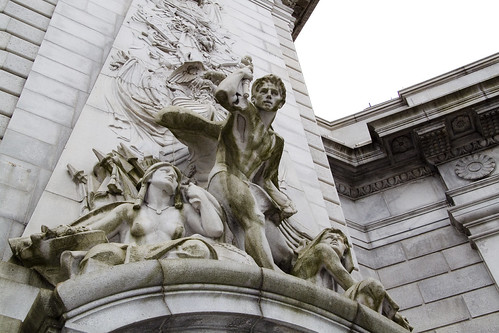
– photo by Mitch Waxman
On Friday, I attended a ceremony which placed a time capsule in the Manhattan Bridge, then walked from Chinatown to Astoria, developed a LOT of photos, slept 4 hours.
Saturday- woke up, took a ride on the Staten Island Ferry, then walked part of the Kill Van Kull shoreline , visited my sick mom in the hospital, and came back to Astoria.
Tomorrow is the “St. Pat’s Day for All” parade in Sunnyside- which promises to be enjoyable AND photogenic- if you’re around the neighborhood- don’t miss it.
Now, here’s a few shots from the Manhattan Bridge event.

DOT Commissioner Janette Sadik-Khan – photo by Mitch Waxman
from nyc.gov
Janette Sadik-Khan serves as the Commissioner of the New York City Department of Transportation since her appointment by Mayor Michael R. Bloomberg in April of 2007. She manages 4,500 skilled employees with wide ranging expertise from engineering to construction finance, to marine navigation, and is responsible for 6,000 miles of streets and highways, nearly 800 bridges, 1.3 million street signs, 300,000 streetlights and 12,000 signalized intersections, as well as the Staten Island Ferry, the nation’s busiest commuter ferry service carrying over 19 million passengers annually.
Since her appointment, Sadik-Khan has implemented an ambitious program to improve safety, mobility and sustainability throughout New York City, and ensure a state of good repair on all the Department’s roads and bridges. In April 2008 the Agency published its Strategic Plan, Sustainable Streets. Projects highlighted in that plan include the first Select Bus routes for NYC, the NYC Plaza Program, the creation of Broadway Boulevard in midtown Manhattan, the addition of 200 miles of on-street bike lanes, car-free summer streets and weekend pedestrian walks.

“Gridlock Sam” Schwartz – photo by Mitch Waxman
from gridlocksam.com
From 1982-86, Sam Schwartz served an extremely successful term as New York City’s Traffic Commissioner before going on to serve the next four years as the New York City Department of Transportation’s Chief Engineer/First Deputy Commissioner.
After nearly twenty years with the New York City Department of Transportation, Mr. Schwartz moved from public service in 1990 to join Hayden-Wegman Consulting Engineers, Inc. as Senior Vice President in charge of transportation engineering, infrastructure, quality control and planning.
In the summer of 1995, The Sam Schwartz Engineering opened its doors with a staff of two. Since that time, the company has grown to include over sixty diverse professionals. Today, under Sam’s direction, The Sam Schwartz Engineering produces some of the finest work in civil engineering, planning, and urban design.

Henry Perahia, Deputy Commissioner Chief Bridge Officer DOT – photo by Mitch Waxman
from nyc.gov
In 1998 Mr. Perahia was promoted to Chief Engineer of the Department. In 1999, he was given the added responsibilities of Chief Bridge Officer. As Chief Engineer, he serves as the Department’s representative on all engineering issues, including review of all major Department projects, response to engineering emergencies, and advising the Commissioner on all engineering issues. As Chief Bridge Officer, he is responsible for the planning and administration of all aspects of design, construction and maintenance of approximately 750 City-owned bridges, tunnels, and culverts, with an annual capital program of approximately $500 million and an annual expense budget of approximately $56 million.
The Division of Bridges is responsible for maintaining the structural integrity of all City owned bridges and tunnels. It undertakes the design and construction of all rehabilitation and reconstruction work, including in-house design, engineering support, engineering review, and quality assurance. It inspects the City’s bridges to identify hazardous or potentially hazardous.

A few of the items that were placed in the Time Capsule – photo by Mitch Waxman

The assembled crowd of dignitaries, DOT workers, and invited well wishers – photo by Mitch Waxman

The time capsule was sealed up within the ornate arches of the Bridge – photo by Mitch Waxman

Specifically, right about here (this is inside the arch) – photo by Mitch Waxman

How could I not have a look around? I mean, how often are you inside the Manhattan Bridge, after all? – photo by Mitch Waxman

A window? – photo by Mitch Waxman

Here’s the view from said window – photo by Mitch Waxman
for the complete set of photos at flickr- click here
the hillside thickets
CREEK WEEK continues…
- For the first installment, from the mouth of the Newtown Creek at the East River to the Pulaski Bridge, click here. For more on just the Pulaski Bridge, click here.
- For the second installment, which turns off the main course of the Newtown Creek and follows the Dutch Kills tributary to Long Island City’s Degnon Terminal, click here.

– photo by Mitch Waxman (from the Queens Museum of Art’s “Panorama of the City of New York”)
As the Newtown Creek follows its atavist path across the (currently) undefended border of Brooklyn and Queens, the second drawbridge encountered along its length is the J.J. Byrne Memorial Bridge, aka the Greenpoint Avenue Bridge, which provides a connection between Queen’s Blissville and Brooklyn’s Greenpoint.
A detailed posting on this bridge and its immediate environs was presented in August of 2009, which can accessed by clicking here.
from the DOT website:
The Greenpoint Avenue Bridge is a double-leaf trunnion bascule, with 21.3m wide leaves. This bridge is a steel girder structure with a filled grid deck. The bridge provides a channel with a horizontal clearance of 45.4m and in the closed position a vertical clearance of 7.9m at MHW and 9.4m at MLW. The bridge structure carries a four-lane two-way vehicular roadway with a 1.2m striped median and sidewalks on either side. The roadway width is 8.6m and the sidewalks are 4.0m and 3.7m for the north and south sidewalk respectively. The approach roadways are narrower than the bridge roadway. The west approach and east approach roadways are 17.1m (including 1.4m center median) and 11.9m respectively.

– photo by Mitch Waxman
A significant petrochemical industrial footprint is observed at the 1.3 mile mark of the Newtown Creek, and the bridge marks that point at which even the current generation of shambolic urban planners throw up their hands and surrender. This is where the heavy manufacturing stage of the industrial revolution was enacted and invented, and the story preserved in the anaerobic soils of this area will be the joy of future archaeologists. Nearby the Queens onramp, Silvercup studios maintains a large film and television production campus, but this is mainly a region defined by recycling yards, warehouses, truck depots, and a sewer plant interspersed with century old petrochemical franchises. There are a few homes nearby, in both Brooklyn and Queens, but this is not a residential area. This is where the “sweaty, smelly, and dirty work” is done.
the nytimes has an article available from 1919, describing a spectacular and auspicious conflagration at Standard Oil.

– photo by Mitch Waxman
The Brooklyn shore of the Creek hosts an enormous yard of fuel tanks, while the Queens side is lined with rail and light industrial buildings. Review and Railroad Avenue’s follow the Newtown Creek in Queens, which intersect with Laurel hill Blvd. less than a mile away. Appropriately high security along the volatile shoreline of Brooklyn renders exploration of it a somewhat futile endeavor, with high walls and armed guards securing and enclosing privatized corporate streets. A stroll down from Kingsland ave., through Grandparents ave., to Norman ave., Bridgewater St., and Stewart avenues will reveal visual egress to the Newtown Creek in only two places, both of which are well staffed and monitored by private security. A trucking center, the streets and sidewalks here are also quite degraded, and in this part of Brooklyn- Guard Dogs are deployed in great numbers. Go to Queens, instead.
There is more than 400 years of rich, if often troubled, history on Newtown Creek. Dutch explorers first surveyed the creek in 1613-14 and acquired it from the local Mespat tribe. The Dutch and English used the creek for agriculture and fledgling industrial commerce, making it the oldest continuous industrial area in the nation. The country’s first kerosene refinery (1854) and first modern oil refinery (1867) brought jobs and infrastructure. By the end of the 19th century, Rockefeller’s Standard Oil, which began as Astral Oil Co. in 1880, had over 100 distilleries on both sides of Newtown Creek, and each refinery’s average effluent of discharge per week was 30,000 gallons, most spewing into the creek. By the 1920s and 30s, the Creek was a major shipping hub and was widened, deepened, and bulkheaded to accommodate bigger barges, destroying all its fresh water sources. Newtown Creek became home to such businesses as sugar refineries, hide tanning plants, canneries, and copper wiring plants.
Up until the latter part of the 20th Century, industries along the creek had free reign over the disposal of unwanted byproducts. With little-to-no government regulation or knowledge of impacts on human health and the environment, it made business sense to pollute the creek. The legacy of this history today is a 17 million gallon underground oil spill caused by Standard Oil’s progeny companies—7 million gallons more than the Exxon Valdez spill in 1989, copper contamination of the Phelps Dodge superfund site, bubbling from the creek bed in the English Kill reach due to increases of hydrogen sulfide and a lack of dissolved oxygen, and creekbeds coated with of old tires, car frames, seats and loose paper. Nearly the entire creek had the sheen and smell of petroleum, with the bed and banks slicked black.

– photo by Mitch Waxman
The Queens shoreline boasts a geologic feature called Laurel Hill. High ground, as it were. A lot of time is spent on the Queens side, scuttling around in a filthy black raincoat, by your humble narrator. Of late, I’ve been curtailing my presence in the area, for fear of environmental exposure’s cumulative effects. Breathing this air, while walking the blistered concrete of its lengths, cannot be beneficent for the mammalian constitution.
Beginning at Borden Avenue near the Dutch Kills, which is roughly a mile from where the ferry docks of 19th century Hunter Point could be found, Review Avenue only goes to one place. Literally, it was the avenue that funeral reviews- elaborate parades of mourners replete with musicians and baroque carriages- would use to travel to Calvary Cemetery. A posting from July of 2009, Walking Widdershins to Calvary, explored Review Avenue and the surrounding area in some small depth. Industrial footprints are observed on the Creek side, and very active rail tracks still carry freight along the shoreline.
here’s a link to city-data.com, which details the sort of businesses and structures, and their worth, which are found along Review Avenue

– photo by Mitch Waxman
Relict factories and abandoned lots for many years, the structures along the Queens side are either being torn down or renovated to modern usage. Dirty industries like recycling and septic tank maintenance firms are seen hard at work, and a thriving light industrial facility exists, however, these businesses are predicated on the use of Trucks and ignore the reason for their original construction- which is access to the water. Not that long ago, industrial shipping along Newtown Creek outstripped traffic on the Mississippi River.
from bklyn-genealogy-info.com’s History of Queens County
The boundary line of Long Island City, “beginning at a point formed by the intersection of the easterly boundary line of the city and county of New York with the centerline of Newtown Creek,” runs “thence easterly along the center line of said Newtown Creek to the westerly side of the Penny Bridge (so – called); thence northerly along the westerly side of the Bushwick and Newtown turnpike to the road on the southerly side of Calvary Cemetery, known as the road to Dutch Kills; thence along the center of said last named road to the southerly and westerly side of Calvary Cemetery as far as the boundaries of said cemetery extend; thence northerly along the said cemetery to the center of the road leading to Green Point along the northerly side of said cemetery; thence easterly along said last mentioned road to the intersection of the same with the road leading from Calvary Cemetery to Astoria; thence northerly and north- easterly along the center of said road, Dutch Kills road, Woodside avenue, Bowery Bay road, to the easterly boundary line of land formerly of Isaac Rapelye, on the northerly side of said Bowery Bay road; thence along the line of said Rapelye land to the Bowery Bay; thence along Bowery Bay and the sound to the northerly boundary line of the town of Newtown; thence northwesterly and southwesterly along said boundary line to the easterly boundary line of the city and county of New York; thence southwesterly along said last mentioned boundary line to the place of beginning.”
The new city was divided into five wards, described as follows:
- First Ward (Hunter’s Point)– “All that portion of the city lying between the center of Newtown Creek on the south, the westerly boundary line of Long Island City on the west, the center of Nott avenue and Boundary street on the north and the center of Dutch Kills Creek on the east.”
- Second Ward (Blissville).- “Beginning at the junction of Newtown and Dutch Kills Creek, running thence easterly along the center of said Dutch Kills Creek to Boundary street; thence along the center of Boundary street to Jackson avenue; thence easterly along the center of said Jackson avenue to the easterly line of Long Island City; thence southerly along said boundary line to the southerly boundary line of said city and at the center of Newtown Creek; thence westerly along the southerly boundary line of said city to the place of beginning.”
- Third Ward (Ravenswood).– “Beginning at a point on the westerly boundary of Long Island City, at its intersection with the center line of Nott avenue when extended on its present course to the said westerly boundary line of Long Island City; running thence northerly along said boundary line to its intersection with the center line of Sunswick Creek; running thence easterly and southerly along the center of said creek to the center of Pearce avenue; thence easterly along the center of said Pearce avenue to the center of First avenue; thence southerly along the center of said First avenue to the center of Webster avenue; thence easterly along the center of Webster avenue to the center of Jackson avenue; thence southwesterly along the center of Jackson avenue and Nott avenue to the point or place of beginning.”
- Fourth Ward (Astoria).– “Beginning at a point in the westerly boundary line of Long Island City, at its intersection with the center line of Sunswick Creek, running thence northerly along said westerly boundary line to its intersection with the center line of Franklin street, when extended on its present course to the said westerly boundary line; thence easterly along the center of Franklin Street to the intersection of Flushing avenue; thence easterly along the center of said Flushing avenue to the easterly boundary line of said city at the center line of the Bowery Bay road; thence southerly along the said easterly boundary line to the center of Jackson avenue; thence southwesterly along the center of said Jackson avenue to the center of Webster avenue; thence westerly along said Webster avenue to the center of First avenue; thence northerly along the center of First avenue to the center of Pearce avenue thence westerly along the center of Pearce avenue to the center of said Sunswick Creek; thence northerly and westerly along the center of said creek to the point of beginning.”
- Fifth Ward (Bowery Bay).– “All that portion of the city lying between the northerly boundary line of Long Island City on the north, the easterly boundary line of said city on the east, the westerly boundary line of the same on the west, and the Fourth ward on the south, together with all the islands opposite thereto and comprehended in the town of Newtown.”
- The islands belonging to Long Island City are known as North Brother, South Brother and Berrien’s.

– photo by Mitch Waxman
The bulkheaded docks found here, this one in particular, once allowed funeral ferries from Manhattan to dock near the Penny Bridge (a structure which allowed egress from Brooklyn). A LIRR passenger station, also called Penny Bridge, was nearby. Mourners would gather on these docks and weave through the crowds entering the main gate of Calvary Cemetery, after having completed the journey from Manhattan. Nearby, in Maspeth, Hunters Point, and along Review and Greenpoint Avenue- hospitality industries sprang up in the form of inns, hotels, and saloons. Hunters Point also offered illegal gambling (and during prohibition in the 1920’s, booze), but that was for the trip home. When the Five Points gangsters held a funeral out here, extra police from Hunters Point would be on duty to prevent a drunken riot from breaking out, here- in Blissville.
from wikipedia
Blissville is a neighborhood in the New York City borough of Queens. It is part of Long Island City. It is bordered by Calvary Cemetery to the east; the Long Island Expressway to the North; Newtown Creek to the South and Dutch Kills (a tributary of Newtown Creek) to the West. Blissville was named after Neziah Bliss, who owned most of the land in the 1830s and 1840s. Bliss built the first version of what was known for many years as the Blissville Bridge, a drawbridge over Newtown Creek, connecting Greenpoint, Brooklyn and Blissville. It was replaced in the 20th century by the J. J. Byrne Memorial Bridge, also called the Greenpoint Avenue Bridge), located slightly upstream.
Blissville existed as a small village until 1870 when it was incorporated with the villages of Astoria, Ravenswood, Hunters Point, Dutch Kills, Middletown, Sunnyside and Bowery Bay into Long Island City.

– photo by Mitch Waxman
Calvary Cemetery, of course, is not the only entity which has defined this area- just the largest and longest lasting. Nearby, the Phelps Dodge corporation maintained a copper refinery, and an early chemical factory was located here. Colorants and dyes were also a specialty of the locale. Review Avenue is remarkable for a cyclopean splendor at Calvary, the towering masonry structures which girdle and contain the borders of the necropolis.
from queenslibrary.org
A history of the Laurel Hill Chemical works from the beginning in 1852, from the Phelps Dodge Corporation Laurel Hill Plant Records, 1893-1983.
The following is a chronology of Phelps Dodge Corporation’s Laurel Hill Plant starting with William Henry Nichols, the man who co-founded the original chemical plant, G.H. Nichols and Company at the site in 1872; continuing to when it was purchased by Phelps Dodge Corporation in 1930; and ending in 2000 when all the structures were finally demolished.
Chronology
- 1852 William Henry Nichols was born to George Henry and Sara Elizabeth (Harris) Nichols in Brooklyn, New York, January 9, 1852.
- 1870 William Henry Nichols and his friend Charles W. Walter started making acids.
- 1872 To expand their acid production to sulfphurc acid and support their entrepreneurial needs William H. Nichols and Charles W. Walter, with the financial backing of William’s father George Henry Nichols, formed the G. H. Nichols and Company. The new company so named, because not only did George Henry provide the majority of the capital, but also the two men were too young to incorporate a company in New York State. During the year the company began purchasing land and building buildings in the Laurel Hill (now Maspeth) neighborhood of Queens, New York on Newtown Creek. Not only did the site offer good fishing, it afforded convenient water and rail transportation to move their raw and finished material.
- 1870s-1880s Their sulphuric acid, produced from brimstone, was stronger than the industry standard upsetting their competition but greatly increasing their market share.

– photo by Mitch Waxman
Calvary Cemetery, as longtime readers of this Newtown Pentacle are all too aware, is a special place which I’ve spent a lot of time exploring. Past postings on Calvary include:
- Up and Through Calvary
- Calvary Mystery Box
- Calvary Cemetery Walk
- Tales of Calvary 1 – The O’Briens
- Tales of Calvary 2 – Veterans Day
- Tales of Calvary 3 – Rumors and stories
- Tales of Calvary 4 – Triskadekaphobic Paranoia
- Tales of Calvary 5 – Shade and Stillness
- Tales of Calvary 6 – The Empire State Building and the Newsboy Governor.
- Tales of Calvary 7
- Tales of Calvary 8– the Abbot
- Tales of Calvary 9– A Pale Enthusiast
- Tales of Calvary 10– The Hatch
- Tales of Calvary 11– Keegan and Locust Hill

– photo by Mitch Waxman
This shot is from one of those two vantage points in Brooklyn, mentioned above, showing the bend taken by the Newtown Creek and the Shining City of Manhattan beyond. The construction work observable on the right side of the image is the self same bulkhead where the ferries from Manhattan docked that was pictured above. Everything in Brooklyn and Queens looks toward Manhattan, but as always, I have to scuttle off in a different direction and to the beat of my own drummer. Turn widdershins on your heels, Lords and Ladies, and gaze eastward toward the besotted and behemoth corpse lands of the Kosciuszko Bridge.
from wikipedia
The Kosciuszko Bridge is a truss bridge that spans Newtown Creek between the New York City boroughs of Brooklyn and Queens, connecting Greenpoint, Brooklyn and Penny Bridge, Queens. It is a part of Interstate 278, which is also locally known as the Brooklyn-Queens Expressway. The bridge opened in 1939, replacing the Penny Bridge from Meeker Avenue in Brooklyn to Review Avenue and Laurel Hill Boulevard, and is the only bridge over Newtown Creek that is not a drawbridge. It was named in honor of Tadeusz Kościuszko, a Polish volunteer who was a General in the American Revolutionary War. Two of the bridge towers are surmounted with eagles, one is the Polish eagle, and the other the American eagle.

– photo by Mitch Waxman
The heart of darkness, where the slime and filth that agglutinate along the bed of the Newtown Creek defeat navigable intentions of oarsman and sailor alike, begins beyond the Kosciuszko Bridge. Untrammeled and seldom travelled pathways, a moonscape of cement dissolution awaits…
…but that’s going to be in another installment of Creek Week, here at your Newtown Pentacle.

– photo by Mitch Waxman (from the Queens Museum of Art’s “Panorama of the City of New York”)
On a side note, a ripple of revulsion and shock greeted the antiquarian and environmentalist communities that operate along the Newtown Creek recently, when a Dolphin was spotted near the Pulaski Bridge by members of the Harbor School- as reported by Gothamist.com


 The Newtown Pentacle