Archive for May 2010
The Hermetic Hungarian responds

Down under the Hell Gate Bridge Onramp- DUHGBO – photo by Mitch Waxman
A recent posting- Hungry Ghosts– detailed the lengthy and pedantic debate over the merits of Film vs. Digital photography enjoyed by myself and that erudite Manhattanite known to long time readers of this Newtown Pentacle as the Hermetic Hungarian.
The Hungarian responds:
32. Not 22. Two times 16. And they are all great. Ain’t gonna scan ’em. Projected ’em from my 2-1/4″ slide projector. Dee-lish.
And it’s not that I dislike digital, it’s that there is no digital equivalent of black & white. A photo-chemical process which leaves traces of its origins throughout the process. Palimpsests. Ghosts.
I’m probably gonna get a G-11 or used G-10 (it was the stupid human interface that put me off the S-90, not to mention Adobe’s brain-dead policies) to fool with while I wait for version 2 of Leica’s digital M-9 to come out. Upon which I will then be able to attach all but two of my 14 Leica lenses. (To be fair, one of my lenses can only go on my vintage 1948 Leica IIIf due to the extreme distance the rear element projects into the body. It would kill a modern body with a built-in meter).
–Légmentesen Magyar AKA “HH”

Review Ave. trucking – photo by Mitch Waxman
Back on track tomorrow, with a proper posting, did you realize we’re in the midst of the Lemuralia?
effulgent valleys

– photo by Mitch Waxman
I went over to St. Michael’s Cemetery again last week to see if there were any developments on the ritual site which Our Lady of the Pentacle and I found a few weeks ago. A hypothesis of mine that this ritual site is being “worked” on a lunar schedule seems to be bearing fruit.
For the first post on this curious altar- “City of Marble and Beryl“, in Astoria’s St. Michael’s Cemetery- click here
for a link to a google map, showing the location as recorded by GPS, click here

– photo by Mitch Waxman
Intriguing are the differences between the last set of offerings, ritual devices, and this grouping, although the setting remains the same. Also, to be absolutely clear- this is not staged in any way, and represents exactly what I observed in situ.

– photo by Mitch Waxman
The brownish cylinder appeared to be a cigar, and the white candle’s wick was blacked but the wax was nearly pristine.

– photo by Mitch Waxman
A set of bleached bones seemed to have been arranged in some non random pattern.

– photo by Mitch Waxman
There were also holes punched in the dirt, which could just be the action of wildlife of course, but the soil of the graveyard was depressed inward without the characteristic mound of surface tailings left behind by those that burrow. It appeared that something had been stuck into the soil.

– photo by Mitch Waxman
Also, amongst the bones, were coins.

– photo by Mitch Waxman
To the north was a glass with a white candle inside of it, approximately 25 feet away.

– photo by Mitch Waxman
The candle’s glass was broken, if that means anything.
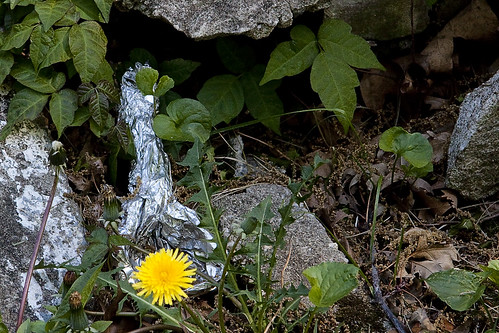
– photo by Mitch Waxman
On the west face, this ladle shaped molding of aluminum foil was extant.

– photo by Mitch Waxman
Here’s the whole scene, the center stone seems to be the main altar- it’s where the cigar, bones, and coins as well as the unconsumed candle were observed. The ladle was to the west, on the downward slope, and candle in the glass to the north at the right of the shot.

– photo by Mitch Waxman
The line of monuments in this section are very old, and many of the legends on the stones are faded away, here in St. Michael’s St. George section.
Circumnavigation 4

– photo by Mitch Waxman
After sliding past the Williamsburg Bridge, the Circle Line narrator began to talk about Queensboro (he called it 59th street bridge- grrrr) and didn’t mention the Newtown Creek. Tourists wouldn’t want to hear about that story, I guess. One thing that really annoyed your humble narrator were the constant references to pop culture icons like the Seinfeld sitcom and the Spiderman movies. Realization that that’s what tourists have as touchstones for NYC is obviated, but still… blurring the line between fantasy and reality is a real issue in the modern world.
from wikipedia
George Louis Costanza is a fictional character in the American television sitcom Seinfeld (1989–1998), played by Jason Alexander. He has variously been described as a “short, stocky, slow-witted, bald man” (by Elaine Benes and Costanza himself), “Lord of the Idiots” (by Costanza himself), and as “the greatest sitcom character of all time”. He is friends with Jerry Seinfeld, Cosmo Kramer, and Elaine Benes. George appears in every episode except for “The Pen” (third season). The character was originally loosely based on Seinfeld co-creator Larry David, but surnamed after Jerry Seinfeld’s real-life New York friend, Mike Costanza.

– photo by Mitch Waxman
The power of cinema and television to present a cogent and absorbing telling of historical events is actually a dangerous thing. Again, I realize that the tourists aboard the Circle Line aren’t looking for hardcore history, but there’s a lot to say about the Queensboro bridge that doesn’t involve the Green Goblin or George Costanza. History is made not by accurate or cogent catalogs of events, but by distribution. The reason we know about Aristotle or Voltaire is that MANY copies of their work were made, distributed across a wide area, and were quoted by others. This means that distaff copies of their work survived the fires and floods. This means that to future eyes, the surviving copies of Spiderman and Goodfellas might be all they have.
Which makes me wonder if Pliny the Younger might have been the Dean Koontz of his time.
from wikipedia
As they watch over May in the hospital, Mary Jane tells Peter she has a crush on Spider-Man, and Peter expresses his own feelings for her. Harry catches them holding hands and tells his father about their love for each other. Now knowing that Spider-Man has feelings for Mary Jane, the Goblin lures him to the top of the Queensboro Bridge by taking Mary Jane and a Roosevelt Island Tramway car full of children hostage, then drops both at the same time. Spider-Man saves them all, but the Goblin takes him to an abandoned building for a fight. Spider-man eventually defeats and unmasks the Goblin, and Norman dies after asking Peter not to tell Harry that he (Norman) was the Goblin.

– photo by Mitch Waxman
As the boat passed Roosevelt Island, the looming hotel construction sites of Queens Plaza rise behind it. Within a few years, tens of thousands of Queens Plaza and Dutch Kills hotel rooms will be serving the self same tourist trade which is satisfied by attractions like these Circle Line cruises. Perhaps this is what we New Yorkers are destined to become, apes in a steel and glass cage put on display for foreigners as we live out our funny lives. Just like on Seinfeld.
from wikipedia
Tourism in New York City includes nearly 47 million foreign and American tourists each year. Major destinations include the Empire State Building, Ellis Island, Broadway theatre productions, museums such as the Metropolitan Museum of Art, and other tourist attractions including Central Park, Washington Square Park, Rockefeller Center, Times Square, the Bronx Zoo, South Street Seaport, New York Botanical Garden, luxury shopping along Fifth and Madison Avenues, and events such as the Tribeca Film Festival, and free performances in Central Park at Summerstage and Delacorte Theater. The Statue of Liberty is a major tourist attraction and one of the most recognizable icons of the United States. Many New York City ethnic enclaves, such as Jackson Heights, Flushing, and Brighton Beach are major shopping destinations for first and second generation Americans up and down the East Coast.

– photo by Mitch Waxman
Of course, the folks whose lives are a little too funny can be found on Ward’s Island at the psychiatric hospitals that serve the City of Greater New York. I’m never quite sure which building is which in this complex, as your humble narrator is convinced that getting too close to a madhouse would be injurious to his freedoms, but this is either the 509 bed Manhattan Psychiatric Center (I lean toward this) or the maximum security Kirby Forensic Psychiatric Center. The Circle Line narration didn’t mention either.
from soundportraits.org
There seem to be two constants to life on Ward 2-West. One of these is violence. The state considers the staffers who work on the ward to hold the single most dangerous job in New York, with the highest injury rate of any profession. The other constant on the ward is noise. There is nowhere to escape it, although there is one patient who seems to have adapted to it quite well. His name is Peter, and you can always find him at the front of the dayroom, hunched over a table peacefully drawing with yellow plugs stuffed deep into his ears. He is about 50 years old, has curly brown hair and a graying beard, gentle eyes behind thick glasses. Before committing his crime, Peter was a successful commercial artist. Today he’s working on a still life with pastels.

– photo by Mitch Waxman
Amongst the more pleasant realities of the trip was this view of the Hell’s Gate with its two spans- the Triborough Bridge(s) and the Hellgate railroad Bridge. The plane taking off from nearby LaGuardia airport was pure serendipity.
from wikipedia
Hell Gate is a narrow tidal strait in the East River in New York City in the United States. It separates Astoria, Queens from Randall’s Island/Ward’s Island (formerly two separate islands that are now joined by landfill).
It was spanned in 1917 by the New York Connecting Railroad Bridge (now called the Hell Gate Bridge), which connects the Ward’s Island and Queens. The bridge provides a direct rail link between New England and New York City. In 1936 it was spanned by the Triborough Bridge (now called the Robert F. Kennedy Bridge), allowing vehicular traffic to pass between Manhattan, the Bronx, and Queens.

– photo by Mitch Waxman
The Hellgate Bridge has long graded approaches which sprawl out all the way to the Sunnyside Yards on one side and continental North America on the other, providing a freight and rail link between the archipelago of islands which form this City-State of ours. Triborough’s approaches and ramps are almost too numerous for me to count.
from wikipedia
The Robert F. Kennedy Bridge, better known as the Triborough or Triboro Bridge, is a complex of three separate bridges in New York City, United States. Spanning the Harlem River, the Bronx Kill, and the Hell Gate (part of the East River), the bridges connect the boroughs of Manhattan, Queens, and The Bronx via Randall’s Island and Ward’s Island, which are joined by landfill.
Often historically referred to as simply the Triboro, the spans were officially named after Robert F. Kennedy in 2008.

– photo by Mitch Waxman
As the boat motored past Ward’s Island, where the Canadian theatrical provocateur’s called Cirque du Soleil had set up a circus tent, the Amtrak Acela rumbled over the Hellgate tracks. The last part of this trip that I can claim intimacy with until we returned to the Hudson, the Circle Line continued Northward.
Venturing into the “not part of my beat” areas of the City of Greater New York which your humble narrator is least familiar with- specifically the northeast sections of Manhattan and La Bronx, I actually got see a few things I didn’t even suspect…
from wikipedia
Acela Express (often simply Acela) is Amtrak’s high-speed rail service along the Northeast Corridor (NEC) in the Northeast United States between Washington, D.C., and Boston via Baltimore, Philadelphia, and New York. It uses tilting technology which allows the train to travel at higher speeds on the sharply curved NEC without disturbing passengers, by lowering lateral centrifugal forces, based on the concept of banked turns.
Acela Express trains are the only true high-speed trainsets in the United States; the highest speed they attain is 150 mph (240 km/h), though they average less than half of that. Acela has become popular with business travelers and by some reckoning has captured over half of the market share of air or train travelers between Washington and New York. Between New York and Boston the Acela Express has up to a 37% share of the train and air market.
Circumnavigation 3

– photo by Mitch Waxman
Hailing from the Brooklyn neighborhoods of first Flatbush, then Flatlands and Canarsie, my driving into “the City” habits always focused on the red haired step child of the Brooklyn Bridge- the Manhattan Bridge- which was the next great structure that the Circle Line passed.
from wikipedia
The Manhattan Bridge is a suspension bridge that crosses the East River in New York City, connecting Lower Manhattan (at Canal Street) with Brooklyn (at Flatbush Avenue Extension) on Long Island. It was the last of the three suspension bridges built across the lower East River, following the Brooklyn and the Williamsburg bridges. The bridge was opened to traffic on December 31, 1909 and was designed by Leon Moisseiff, who later designed the infamous original Tacoma Narrows Bridge that opened and collapsed in 1940. It has four vehicle lanes on the upper level (split between two roadways). The lower level has three lanes, four subway tracks, a walkway and a bikeway. The upper level, originally used for streetcars, has two lanes in each direction, and the lower level is one-way and has three lanes in peak direction. It once carried New York State Route 27 and later was planned to carry Interstate 478. No tolls are charged for motor vehicles to use the Manhattan Bridge.
The original pedestrian walkway on the south side of the bridge was reopened after forty years in June 2001.[3] It was also used by bicycles until late summer 2004, when a dedicated bicycle path was opened on the north side of the bridge, and again in 2007 while the bike lane was used for truck access during repairs to the lower motor roadway.
Main span: 1,470 ft (448 m)
Length of suspension cables: 3224 ft (983 m)
Total length: 6,855 ft (2,089 m)
The neighborhood near the bridge on the Brooklyn side, once known as Fulton Landing has been gentrified and is called DUMBO, an acronym for Down Under the Manhattan Bridge Overpass.
To celebrate the bridge’s centennial anniversary, a series of events and exhibits were organized by the New York City Bridge Centennial Commission in October 2009. These included a ceremonial parade across the Manhattan Bridge on the morning of October 4th and a fireworks display in the evening. In 2009, the bridge was also designated as a National Historic Civil Engineering Landmark by the American Society of Civil Engineers.

– photo by Mitch Waxman
Your humble narrator was honored to serve as a Bridge Parade Marshall for the aforementioned Centennial Parade, and attended the Landmarking ceremony on March 5th.
Here’s the Newtown Pentacle Posts on the Centennial Parade on October 4th-
Manhattan Bridge Centennial Parade 1
Manhattan Bridge Centennial Parade 2
Manhattan Bridge Centennial Parade 3
Here’s the NP post on the Ceremony in March- Exhausted
And for my personal take on the Manhattan Bridge- DUMBO… or missing my Dad

– photo by Mitch Waxman
Beneath the Bridge, small clots of citizenry were cleaning the shoreline of wind blown refuse and whatever washed up out of the East River over the long and severe winter that New York endured in 2010. It was Earth Day eve, after all.
I wish I could point you to a link about this effort, but the Brooklyn Blogosphere is an impenetrable fortress of noise and self importance which defies even the might of Google. If anybody associated with this effort is reading this, please fill the rest of us in on the particulars.

– photo by Mitch Waxman

– photo by Mitch Waxman
Moving north, ever north, midtown Manhattan’s iconic Chrysler Building rises behind the recently upgraded East River Station cogeneration power plant at 14th street and Ave. D.
The East River Generating Station, one of Consolidated Edison Co. of New York Inc.’s largest and most significant combined-cycle power stations, will be repowered by Slattery Skanska and its subsidiary Gottlieb Skanska.
Located on the east side of Lower Manhattan, the 43,000-sq.-ft. facility produces electricity and steam for homes and businesses throughout New York City. The project was completed May 2004.

– photo by Mitch Waxman
I still owe you, lords and ladies, a proper workup of the Williamsburg bridge. I’m still collecting material research and photography for this posting, so don’t expect it anytime soon. One of my summer projects is “The Grand Walk”, which will start in Manhattan and follow Grand Ave. through Williamsburg and Greenpoint, across the Grand Ave. Bridge into Queens and onto (former Grand Avenue) 30th avenue through Astoria to Hallet’s Cove. An open call for experts on the various phases of the route is being made, by the way, and hopefully I can get a few of you to come along for the first Newtown Pentacle meetup and photowalk at the end of the summer. Bring ID, and a camera.
from wikipedia
Construction on the bridge, the second to cross this river, began in 1896, with Leffert L. Buck as chief engineer, Henry Hornbostel as architect and Holton D. Robinson as assistant engineer, and the bridge opened on December 19, 1903 at a cost of $24,200,000. At the time it was constructed, the Williamsburg Bridge set the record for the longest suspension bridge span on Earth. The record fell in 1924, when the Bear Mountain Bridge was completed.
Circumnavigation 2

– photo by Mitch Waxman
Onboard the Circle Line, as it passed the Lower Manhattan Financial District, I spotted a couple of interesting things. The Meagan Ann tugboat was pulling a barge of shredded autos, which were reduced to their basic components at an industrial location found along that canalized exemplar of municipal neglect called the Newtown Creek, just up the river.
Here’s a shot of that Newtown Creek auto shredding operation which I took last year:

– photo by Mitch Waxman

– photo by Mitch Waxman
Meagan Ann is a twin-engine, 2,250 HP coastal towing tug, built in 1975 and rebuilt in 1988, approximately 81 feet long and formerly known as the Scorpius. It is owned and operated by Donjon Marine towing, Inc.
from donjon.com
Since its incorporation in 1966, Donjon Marine has established and continues to seek long-term client relationships in a world where limited business resources demand a constant balancing of expenditures. Beginning with its foundation in the New York area as a pioneer in marine salvages services, Donjon has grown to become a leader in both conventional and environmental dredging. Our areas of expertise also include recycling, land and marine demolition, pollution control and remediation, heavy lift transport, marine transportation and landfill remediation/site management. Donjon and its affiliates maintain offices, assets and personnel throughout the Northeast, with operations spanning the globe.

– photo by Mitch Waxman
Also witnessed by your humble narrator were regular comings and goings of Helicopter flights from the East River Piers found alongside the Financial District. It’s a Eurocopter AS-350B-2 Ecureuil, based at the West 30th street Heliport and operated by Liberty Helicoptors.
The largest helicopter sightseeing and charter service in the Northeast. Liberty Helicopters is currently the only authorized helicopter sightseeing company in New York City. We began in the charter business on April 22, 1986 and added sightseeing tours of New York City originating from the VIP heliport on September 6th, 1990. At that time, Liberty had begun an aggressive plan selling in both the domestic and international markets. Using our strong customer base afforded us the opportunity to open a second location at the downtown Manhattan heliport in 1995. Liberty Helicopters was not only the first company to operate sightseeing tours from this multi-million dollar facility, but also the first to offer our customers the convenience of two Manhattan locations. On May 1, 2004, we opened a third heliport at the Paulus Hook Pier located in the newly developed area of the Colgate section of Jersey City, N.J. In addition to our “once in a lifetime” helicopter tours, this facility operates both commuter and sightseeing ferry services, making it a very accessible facility to Manhattan.

– photo by Mitch Waxman
Of course, once we reached the grandest structure in the entire megalopolis (if you consider New York City to be composed of individual parts as opposed to being one gigantic system of transit, power, and satellite cities that stretches for hundreds of miles in every direction) your humble narrator forgot all about Sludge boats, Tugs, and aircraft. I’m always amazed at the scale and classical proportions of the Brooklyn Bridge.
from wikipedia
The Brooklyn Bridge is one of the oldest suspension bridges in the United States. Completed in 1883, it connects the New York City boroughs of Manhattan and Brooklyn by spanning the East River. At 5,989 feet (1825 m), it was the longest suspension bridge in the world from its opening until 1903, and the first steel-wire suspension bridge.
Originally referred to as the New York and Brooklyn Bridge, it was dubbed the Brooklyn Bridge in an 1867 letter to the editor of the Brooklyn Daily Eagle, and formally so named by the city government in 1915. Since its opening, it has become an iconic part of the New York skyline. It was designated a National Historic Landmark in 1964.

– photo by Mitch Waxman
If it hasn’t been recommended to you yet, by me or others, I have to sing the praises of “The Great Bridge by David McCullough” which details the design and construction of the Brooklyn Bridge as well as providing a real “slice of life” about 19th century New York City. My preference for audiobooks is satisfied by the version available at apple’s iTunes store, and you could do worse things with your hard earned money than pick up the print edition at amazon.
from wikipedia
Born and raised in Pittsburgh, McCullough attended Yale University, earning a degree in English literature. His first book, The Johnstown Flood, was published in 1968; he has since written seven more on topics such as Harry S. Truman, John Adams, and the Brooklyn Bridge. McCullough has also narrated multiple documentaries, as well as the 2003 film Seabiscuit; he also hosted American Experience for twelve years. Two of McCullough’s books, Truman and John Adams, have been adapted into a TV film and mini-series, respectively, by HBO. McCullough’s next work, about Americans in Paris between the 1830s to the 1930s, is due out in 2010.

– photo by Mitch Waxman
I don’t remember who the quote is attributed to, but the Ken Burns PBS documentary “Brooklyn Bridge” embedded a notion into me a while back that “all of modern heroic New York began with the building of the Brooklyn Bridge”. I tend to agree with this maxim.
from endex.com
After sixty years of political, financial and technical discussions (including a 6 lane tunnel proposal in the 1830’s), John Roebling’s plan was approved, the New York Bridge Company was formed and, in 1869, construction of the bridge finally began.
The bridge was built over 14 years in the face of enormous difficulties. Roebling died as a result of an accident at the outset; a fire in the Brooklyn Caisson smoldered for weeks; Roebling’s son, Washington, who took over as chief engineer, suffered a crippling attack of the bends during the construction of the Manhattan Caisson, and continued to direct operations, sending messages to the site by his wife, Emily. After the towers were built, a cable parted from its anchorage killing two people; there was fraud perpetrated by the cable contractor.
In the end, John Roebling’s prediction that the promenade above the deck will be “of incalculable value in a crowded commercial city” was justified, together with his perhaps most noted statement, claiming that “the great towers…will be ranked as national monuments. …As a work of art, and a successful specimen of advanced bridge engineering, this structure will forever testify to the energy, enterprise, and wealth of that community which shall secure its erection.”
On May 24, 1883, with schools and businesses closed, the Brooklyn Bridge, also referred to as the “Great East River Bridge”, was opened. Scores of people attended this spectacular ribbon cutting event. Over 100 years later, its renowned beauty & stature is still admired by many New Yorkers & tourists alike.

– photo by Mitch Waxman
The shot above is actually from last year (2009), but gives a good sense of the intricate series of roads and onramps that allow Manhattan traffic egress to the bridge.
from pbs.org
- Although he was physically able to leave his apartment, Washington Roebling refused to attend the opening celebration honoring his remarkable achievement.
- The bridge opened to the public on May 24, 1883, at 2:00 p.m. A total of 150,300 people crossed the bridge on opening day. Each person was charged one cent to cross.
- The bridge opened to vehicles on May 24, 1883, at 5:00 p.m. A total of 1,800 vehicles crossed on the first day. Vehicles were charged five cents to cross.
- Today, the Brooklyn Bridge is the second busiest bridge in New York City. One hundred forty-four thousand vehicles cross the bridge every day.


 The Newtown Pentacle