Archive for 2010
Ruby M. at Whale Creek

– photo by Mitch Waxman
Someone recently told me that this, your Newtown Pentacle, was a mere paparazzi rag for infrastructure and heavy industry- which made me laugh out loud.
Then, depressed, disturbed, and frightened by even good natured criticism I retreated into a sulking and jealous rage. All ‘effed up, I threw together my little ensemble of camera bag and headphones and set off for the Newtown Creek. When I got to the Pulaski Bridge, it was open and I realized that I had just missed a Tugboat passing through. ARRGHH!!!
What I did see though, was this flatbed truck carrying what appears to be remnants of a Roosevelt Island Tramway tower in the direction of Greenpoint.
“Could this be some sort of super Crow?” thought your humble narrator…
– photo by Mitch Waxman
Brutally hot, vast misty shelves of humid air blanketed the terrain when the Pulaski reconstituted itself into its roadway configuration via those electrical engines that operate its double bascule mechanism. Tepid, the fetid air flow’s tortuous languor augmented that remarkable and certain odor which distinguishes the Newtown Creek watershed. At the apex of the arc which spans this part of that storied rivulet, this small boat was spied.

– photo by Mitch Waxman
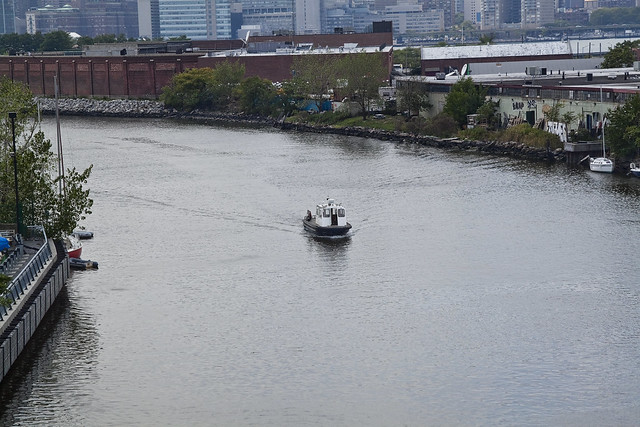
As its markings indicate, this is the Emily Miller. A “Job” or Utility boat, Emily Miller is 31 feet long, 185 HP and based at Pier 7 1/2 in Staten Island at Miller’s Launch.
from millerslaunch.com
Miller’s Launch is a marine service company based on the North Shore of Staten Island, New York. With satellite terminals throughout New York, New Jersey and Connecticut, we have provided first-class service to the marine industry since 1977.

– photo by Mitch Waxman
Nothing special, really, but since I missed the Tug… I decided to take some shots of it passing anyway. For a waterway that was once the busiest on Earth, the relative scarcity of traffic on Newtown Creek these days makes any vessel plying its poison expanse notable.

– photo by Mitch Waxman
My endless wanderings found your humble narrator once more at the Newtown Creek Waste Water Treatment Plant Nature Walk, always an easy egress point for observing the malefic realities of Newtown Creek and one of the few water level access points open to the general public along the great canal. To my wonder and joy, I found the tugboat that I had missed when the Pulaski (and this post) opened.

– photo by Mitch Waxman
The tug is the Ruby M. operated by Dann Towing, but once once known as he Texaco Fire Chief when it was built in 1967 at the Jakobson Shipyard in Oyster Bay. Steel hulled, it is 95 feet long and has a gross tonnage of 197. It was sitting astride Whale Creek, and maneuvering a barge into position. Tugboats are seldom observed at work this close, and certainly -in my limited experience- it is a rare thing to see one in such a nearly static position relative to the camera.
Normally, you have to shoot fast to capture one, as it is hurtling past.
The Newtown Creek Waste Water Treatment Plant, incidentally, sits on the site of one those insane fires which Greenpoint seems to have been quite prone to and distinguished by during the heady days of the industrial revolution. Check out this NYtimes article from 1900 which describes the horror.

– photo by Mitch Waxman
Daring contact with that which might exist in the shallow depths, your humble narrator descended those threatening steps found at the Nature Walk, and was rewarded with this found composition. Unlike most of the photos presented here, its presence is not meant to advance a narrative or illustrate a point- I just think its a neat shot.

– photo by Mitch Waxman
Having little else to do, I hung around for a while to see if the Ruby M. was about to do something interesting. It didn’t, just repositioning itself further up the creek and tying off to a different barge than the one they had just delivered. Emily Miller’s role in the transaction seemed to have been completed as well, as it advanced past the rail bridges spanning the Dutch Kills tributary of the Newtown Creek.
mother of invention

– photo by Mitch Waxman
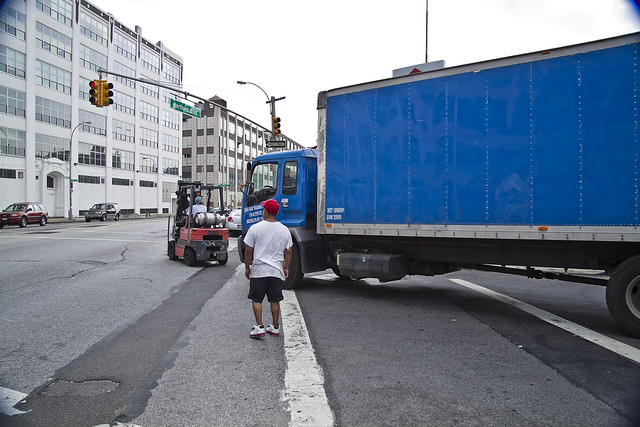
Another recent bit of serendipity experienced during a random walk, this time a bit further down Northern Blvd. and directly across the street from the Standard Motor Products building on 39th street, it seems that the good fellows who operate this largish delivery truck had experienced an unlucky turn when its engine suddenly stranded them. Luckily, they seemed to have a tiny red forklift on board, of a sort which I’ve always heard referred to as a “Bobcat”.
from wikipedia
Forklifts are rated for loads at a specified maximum weight and a specified forward centre of gravity. This information is located on a nameplate provided by the manufacturer, and loads must not exceed these specifications. In many jurisdictions it is illegal to remove or tamper with the nameplate without the permission of the forklift manufacturer.
An important aspect of forklift operation is that most have rear-wheel steering. While this increases maneuverability in tight cornering situations, it differs from a driver’s traditional experience with other wheeled vehicles. While steering, as there is no caster action, it is unnecessary to apply steering force to maintain a constant rate of turn.
Another critical characteristic of the forklift is its instability. The forklift and load must be considered a unit with a continually varying centre of gravity with every movement of the load. A forklift must never negotiate a turn at speed with a raised load, where centrifugal and gravitational forces may combine to cause a disastrous tip-over accident. The forklift are designed with a load limit for the forks which is decreased with fork elevation and undercutting of the load (i.e. load does not butt against the fork “L”). A loading plate for loading reference is usually located on the forklift. A forklift should not be used as a personnel lift without the fitting of specific safety equipment, such as a “cherry picker” or “cage”.

– photo by Mitch Waxman
The inert truck was borrowing its motive power from the smaller and self propelled tool. Its driver clearly seemed embarrassed by all the attention he garnered. Several of us stood on the corners, males all, sporting broad smiles and cheering him on while he waited for a red light to turn. This sort of situation appeals to we men, I don’t know why, but it does.
I was betting on either the inadequate chain just sundering into constituents, or the forklift burning out its transmission before it moved the giant blue vehicle more than a couple of feet.
from wikipedia
A high-tensile chain, also referred to as a transport chain, is a link chain with a high tensile strength used for drawing or securing loads. This type of chain usually consist of broad (thick/heavy) metal, oblong torus-shaped links for high strength. All the links of the chain are usually identical, and on the ends are usually two hooks of the appropriate size and strength to slide easily over one chain link but small enough not let the links slip by. When the ability to grasp the load is required, a slip hook is used.
The chain used for tire chains on tractors and some automobiles for better traction is very similar; usually consisting of the same type of link, especially so for snow chains; however, instead of being a single chain, it is more of a network of interconnected chains with no hooked ends; the size and design of the network depending on the tire it was intended for.

– photo by Mitch Waxman
The signal turned, and that tiny forklift and its driver wouldn’t let anything like the laws of Physics or the limits of engineering stop them from getting the truck moving.
Whom, indeed, says that an ant can’t move a rubber tree plant? Whom?
from wikipedia
They usually range in size 4 to 7 m in length, with smaller or larger sizes existing but being rare in North America. They usually have a garage door-like rear door that rolls up. On some box trucks, the cargo area is accessible from the cab through a small door.
Box trucks are usually used by companies that need to haul appliances or furniture. They are also used as moving trucks which can be rented from companies such as U-Haul or Ryder.
In North America, Ford, Dodge and Chevrolet/GMC have historically been the most common manufacturers of conventional cab/chassis to which various producers (called body builders or upfitters) attach the box that holds cargo. Isuzu, Mitsubishi Fuso and UD/Nissan Diesel have been the most common marketers of cabover-type medium duty cab/chassis used as platforms for box trucks. In North America, these trucks can range from Class 3 to Class 7 (12,500 lb. to 33,000 lb. gross vehicle weight rating, or GVWR).
– photo by Mitch Waxman
The drivers around these parts- borderland and angle between Sunnyside, Astoria, and Dutch Kills- are not exactly a sagacious or patient lot. Normal practice for them is to hit their horns in the quarter second before the traffic light goes from red to green, and to accelerate precipitously in an effort to “beat the lights”. Queens Plaza is nearby, and their probable destination of Manhattan- unlike Queens- is a heavily regulated and well policed thicket of traffic jams. This is their last chance to see the sky.
Well… not for long.
from wikipedia
A gross vehicle weight rating (GVWR) is the maximum allowable total mass of a road vehicle or trailer when loaded – i.e including the weight of the vehicle itself plus fuel, passengers, cargo, and trailer tongue weight.
The difference between gross weight and curb weight is the total passenger and cargo weight capacity of the vehicle. For example, a pickup truck with a curb weight of 4,500 pounds (2,041 kg) might have a cargo capacity of 2,000 pounds (907 kg), meaning it can have a gross weight of 6,500 pounds (2,948 kg) when fully loaded.

– photo by Mitch Waxman
Witness the tenacity and determination of the American workforce- its inchoate improvisations and hazard ridden solutions that keep the machines running no matter what, its complete disregard for official procedure and personal safety -unstoppable, indefatigable, the children of necessity.
from wikipedia
New York State Route 25A (NY 25A) is a New York State highway and the main east–west route for most of the North Shore of Long Island, running from the Queens Midtown Tunnel in the New York City borough of Queens at its western terminus to Calverton in Suffolk County at its eastern end.
Known for its scenic route through decidedly lesser-developed areas such as Brookville, Fort Salonga, Centerport, and the Roslyn Viaduct, 25A begins as 21st Street in Long Island City. As you go farther through 25A, it is then known as Jackson Avenue for a short period and is variously named Northern Boulevard east of Queens Plaza (NY 25), North Hempstead Turnpike, Main Street, Fort Salonga Road, and North Country Road. It merges with NY 25 for approximately 1.5 miles (2.4 km) in Smithtown.
Old School

– photo by Mitch Waxman
Wandering aimlessly, your humble narrator recently encountered this rather badly equipped automobile just off Northern Blvd. The historic cradle of the automobile industry in New York City, this stretch of the great thoroughfare hosts several multi acre car lots, including the famous Major Auto World. This is the corner of 44th street.
from fundinguniverse.com
Bruce Bendell and his brother Harold began operating a Brooklyn carwash and auto repair shop in 1972. Subsequently they and their father sold used cars and leased new cars in Brooklyn before purchasing Major Chevrolet, a Long Island City distributor, in 1985. At this time the dealership was in decline, with only 500 cars and $10 million in annual sales. By 1990 sales had increased tenfold. In 1996 Bendell’s Major Automotive Group was doing about $180 million a year in business. One of New York’s largest auto dealerships, it now consisted of six franchises, including Major Chevrolet/Geo; Major Dodge; and Major Chrysler, Plymouth, Jeep Eagle, in Long Island City, plus, in Woodside–another Queens community–Major Subaru, in addition to Major Fleet and Leasing, the leading supplier of taxis and police cars in New York and also a lessor of trucks.

– photo by Mitch Waxman
I haven’t witnessed a car deconstructed in this manner for many years, perhaps as many as twenty. Once a common sight in the City of Greater New York, before “Giuliani Time“, this car was stripped of wheels and electronics, and the entire act probably took less than five minutes to accomplish- if the professionalism of the thieves guild has held up since the old days.
from wikipedia
Starting in 2005, New York City achieved the lowest crime rate among the ten largest cities in the United States. Since 1991, the city has seen a continuous fifteen-year trend of decreasing crime. Neighborhoods that were once considered dangerous are now much safer. Violent crime in the city has dropped by three quarters in the twelve years ending in 2005 with the murder rate at its lowest then level since 1963 with only 539 murders that year, for a murder rate of 6.58 per 100,000 people, compared to 2,245 murders in 1990. In 2009, the low would be displaced. Among the 182 U.S. cities with populations of more than 100,000, New York City ranked 136th in overall crime.

– photo by Mitch Waxman
I’ve been sort of expecting to see this sort of thing to start up again, and no, it’s not because there are fewer police these days.
Classic right wing thinking, a sort of disastrous chest thumping and braggadocio practiced by the safe and protected, is to proclaim “more cops” as a panacea for any and all of society’s ills. I thought that the right had learned the lesson of this at Waco, and at Ruby Ridge. We don’t need more cops, we just have to offer them better pay, support staff, and on the job training- but I guess that’s latent socialism talking.
Happy Monday.
an article from 1993, nearly twenty years ago, at the nytimes…
Last year, from January through September, 94,724 vehicles were stolen in New York City. That’s about 126,000 cars a year, or 345 a day. New York City leads the U.S. in auto thefts, with 139,977 in 1991, or twice the number reported by the second place finisher, Los Angeles. Despite the number of cases, or perhaps because of it, the police seem uninterested in the average theft.

– photo by Mitch Waxman
The Police clean up the mess after a crime- but they seldom are there when it’s being committed. Even during “Giuliani Time” or the long and notable tenure of the current Commissioner, the combination of a booming job market and mandatory sentencing were the direct causal factors in a reduction of crime here in the Naked City. The spate of 10-15 year sentences handed out so liberally in the 1990’s are coming to an end, and New Yorkers will once again know the true meaning of the word “Scumbag”.
from nyc.gov
If Your Car Does Get Stolen
Report theft to police.
- Obtain form MV78B “License Plate Form” from your local police precinct.
- Notify your insurance company.
- Submit Form MV78B to Department of Motor Vehicle.
- Retain a copy of Department of Motor Vehicle Form as a receipt.
NOTE: False reporting of vehicle theft is a crime and can be punishable by a fine or imprisonment.

– photo by Mitch Waxman
“It’s the economy, stupid”- When your baby is hungry, you do crazy things to put food on the table. The parents of fat, happy babies generally don’t do this to automobiles- or strap dynamite to themselves and blow up buses for that matter. Old school crime like this happens quickly, this car was probably stripped down within minutes, and the fact that a “chop shop” didn’t dissect it for black market body parts also speaks to the greater economy’s relative weakness.
from wikipedia
In his first term as mayor, Giuliani, in conjunction with New York City Police Department Commissioner Bill Bratton, adopted an aggressive enforcement-deterrent strategy based on James Q. Wilson’s “Broken Windows” approach. This involved crackdowns on relatively minor offenses such as graffiti, turnstile jumping, cannabis possession, and aggressive “squeegeemen”, on the theory that this would send a message that order would be maintained. Giuliani and Bratton also instituted CompStat, a comparative statistical approach to mapping crime geographically and in terms of emerging criminal patterns, as well as charting officer performance by quantifying criminal apprehensions. Critics of the system assert that it creates an environment in which police officials are encouraged to underreport or otherwise manipulate crime data.

– photo by Mitch Waxman
We’ve become accustomed to walking about the city, these days, as if we were safe or something. That existential horror did not lurk along the brightly lit path of shambolic corporate fantasies and elaborate real estate schemes, and that a nightmare population of atavist monsters were not returning from exile to walk amongst us, and do what they wilt- which shall become the whole of the law.
Again.
also from the nytimes
A raging crack epidemic in pockets of New York poured people into its jails starting in the late 1980s and early 1990s. The population peaked in 1992, according to correction officials, when the daily average hit 21,449 and the annual intake reached 111,045.
But by the end of the last fiscal year on June 30, 2009, the average daily population had dwindled to 13,362, while the number of inmates admitted that year shrank to 99,939. This year, both figures appear likely to be even lower.
torment of the Brachyura

– photo by Mitch Waxman
Your humble narrator is a carnivore, as mentioned in the past, despite a somewhat advanced state of understanding of the realities of feedlot and abattoir.
Human beings are ultimately predatory apes, and the greasy taste of flesh is prized by most. Displays of comestible items are commonly observed amongst the human hives, but when one is moving through a neighborhood whose residents enjoy exotic fare- like Manhattan’s famous Chinatown in this case – the careful observer might be rewarded with visions of the fanciful or alien.
from wikipedia
Homo Necans: the Anthropology of Ancient Greek Sacrificial Ritual and Myth is a book on ancient Greek religion and mythology by Walter Burkert, which won the Weaver Award for Scholarly Literature, awarded by the Ingersoll Foundation, in 1992. The book’s core thesis is that when paleolithic man became a hunter, in spite of the generally omnivorous orientation of the great apes, lack of a predator instinct was made up for by turning patterns of intra-species aggression against the prey: Homo necans means “man the killer”. Thus, the animal hunted by ancient man automatically acquired aspects of an equal, as if it were of one of the hunter’s relations. In a first attempt at applying ethology to religious history, Burkert confronts the power and effect of tradition in uncovering traces of ancient hunting rituals so motivated in historical animal sacrifice and human sacrifice (by his thesis unified as deriving from the same fundamental principle) in specific historical Greek rituals with relevance to human religious behaviour in general. Burkert admitted that a decisive impulse for the thesis of Homo Necans derived from Konrad Lorenz’ On Aggression (1963).
The thesis set out in the first chapter, “Sacrifice, hunting and funerary rituals”, is an extension of the hunting hypothesis, which states that hunting as a means of obtaining food was a dominant influence on human evolution and cultural development (as opposed to gathering vegetation or scavenging). The guilt incurred in the violence of the hunt was reflected in sacred crimes, which through rituals of cleansing and expiation served to unify communities.

– photo by Mitch Waxman
A carnivorous glutton your humble narrator may be, but empathy and indignation arose in him when confronted with this display.
Sure that this is a time tested and necessary technique intended to display the freshness and nutritional validity of this cast of crustaceans, demanded by clientele, a certain bile nevertheless rises. Western prejudice no doubt colors my point of view, as the same overt revulsion does not rise at the sight of a counter of European butchers meat.
Paradoxical, but to my reasoning, there isn’t a display of crucified and disemboweled cows overhanging the refrigerated section at the supermarket. Vegan friends would disagree, but I guess it depends on your point of view, and “Krabs ain’t Kosher” either.
from wikipedia
Crabs make up 20% of all marine crustaceans caught, farmed, and consumed worldwide, amounting to 1½ million tonnes annually. One species accounts for one fifth of that total: Portunus trituberculatus. Other commercially important taxa include Portunus pelagicus, several species in the genus Chionoecetes, the blue crab (Callinectes sapidus), Charybdis spp., Cancer pagurus, the Dungeness crab (Metacarcinus magister) and Scylla serrata, each of which yields more than 20,000 tonnes annually.

– photo by Mitch Waxman
It really was just the simple fact that the Cast of Crabs in the bushel bucket beneath this macabre marquee were subtly scuttling which disturbed me and drew this comment.
I am also aware, of course, that given the chance- those in the basket would consume those above them with abandon.
from wikipedia
The problem of animal suffering, and animal consciousness in general, arises primarily because animals have no language, leading scientists to argue that it is impossible to know when an animal is suffering. This situation may change as increasing numbers of chimps are taught sign language, although skeptics question whether their use of it portrays real understanding. Singer writes that, following the argument that language is needed to communicate pain, it would often be impossible to know when humans are in pain. All we can do is observe pain behavior, he writes, and make a calculated guess based on it. As Ludwig Wittgenstein argued, if someone is screaming, clutching a part of their body, moaning quietly, or apparently unable to function, especially when followed by an event that we believe would cause pain in ourselves, that is in large measure what it means to be in pain.[98] Singer argues that there is no reason to suppose animal pain behavior would have a different meaning.
symbolism and phantasm

– photo by Mitch Waxman
Another item in my “catch-up” file was when I got to witness the redoubtable employees of Consolidated Edison blowing off some steam at the South Street Seaport back in June.
from wikipedia
SS Normandie was an ocean liner built in Saint-Nazaire, France for the French Line Compagnie Générale Transatlantique. She entered service in 1935 as the largest and fastest passenger ship afloat; she is still the most powerful steam turbo-electric-propelled passenger ship ever built.
Her novel design and lavish interiors led many to consider her the greatest of ocean liners. Despite this, she was not a commercial success and relied partly on government subsidy to operate. During service as the flagship of the CGT, she made 139 transatlantic crossings westbound from her home port of Le Havre to New York and one fewer return. Normandie held the Blue Riband for the fastest transatlantic crossing at several points during her service career, during which the RMS Queen Mary was her chief rival.
During World War II, Normandie was seized by the United States authorities at New York and renamed USS Lafayette. In 1942, the liner caught fire while being converted to a troopship, capsized and sank at the New York Passenger Ship Terminal. Although salvaged at great expense, restoration was deemed too costly and she was scrapped in October 1946.

– photo by Mitch Waxman
A zone of the greater city that I normally avoid like the plague, South Street Seaport is a tourist mecca which also happens to host a museum. Said museum had initiated an event wherein the vast sonics of the legendary SS Normandie would be activated and displayed for the public.
from youtube
and at travelfilmarchive.com there’s this great newsreel clip that tells the Normandie story

– photo by Mitch Waxman
The engineers of ConEd informed me that these pipes and hoses were connected into the high pressure steam lines that underlie lower Manhattan, and were carrying 150 PSI of steam to the Normadie’s whistle.
The NY Times folks were in attendance, apparently, so here’s what the professionals said.

– photo by Mitch Waxman
Knowing the effects that high pressure steam might evince upon the human body, I stepped backwards a few feet, but in reality- if anything went wrong, there would be pieces of me found across the river in Brooklyn.
from wikipedia
The New York Steam Company began providing service in lower Manhattan in 1882. Today, Consolidated Edison operates the largest commercial steam system in the world, now known as Con Edison Steam Operations, providing steam service to nearly 2,000 customers and serving more than 100,000 commercial and residential establishments in Manhattan from the Battery at the southern tip of Manhattan to 96th Street uptown. Roughly 30 billion lbs. (just under 13.64 megatons) of steam flow through the system every year.

– photo by Mitch Waxman
A small crowd of dignitaries gathered, and the ConEd guys gave the go ahead for the Normandie’s phantom to sound its voice.
from wikipedia
Regular cricket matches were held near Fulton Market in 1780 when the British Army based itself in Manhattan during the American Revolution. Robert Fulton became famous for his steamship in 1809 though he did spend time in Paris during the American Revolution.
Fulton Street is named for Robert Fulton, an engineer instrumental in the development of steam ships in the United States. Ferries connected Manhattan across the East River to Fulton Street in Brooklyn.
The street has a Beaux-Arts architectural feel with many buildings dating back to the Gilded Age or shortly thereafter. The early 19th century buildings on the south side of the easternmost block are called Schermerhorn Row and are a Registered Historic Place.
The Fulton Fish Market was located nearby at the South Street Seaport until 2005, when it moved to Hunts Point in The Bronx.

– photo by Mitch Waxman
At this distance, as the scalar waves of sound were reflecting off the building walls and masonry clad street, it sounded for all the world as if the gates of hell had just fallen off their hinges and that demon trumpeters were signaling the impending war of apocalypse.
from wikipedia
A steam whistle is a device used to produce sound with the aid of live steam, which acts as a vibrating system [1] (compare to train horn). The whistle consists of the following main parts, as seen on the drawing: the whistle bell (1), the steam orifice or aperture (2), and the valve (9).
When the lever (10) is pulled, the valve opens and lets the steam escape through the orifice. The steam will alternately compress and rarefy in the bell, creating the sound. The pitch, or tone, is dependent on the length of the bell; and also how far the operator has opened the valve. Some locomotive engineers invented their own style of whistling.


– photo by Mitch Waxman
Your humble narrator has often found himself vulnerable and sensitive to high volumes, and has noted a curious phenomena in the presence of extreme loudness. The visual field narrows, as one’s brain attempts to make sense of the overload of auditory information, which has been remarked upon scientifically by insurance industry specialists who describe a similar effect when one drives an automobile with loud music playing and it’s corollary of higher accident rates.
from straightdope.com
It’s been well documented that jets of high-pressure gas (which is what superheated steam is) can cause injuries even without the added complication of heat. OSHA warns against possible amputation from high-pressure gas and limits air pressure for industrial cleaning to 30 PSI. High-pressure gases can easily penetrate the skin, especially via an existing cut or wound, and potentially lead to gas embolism–bubbles in the bloodstream that can migrate to the heart, lungs, or brain and cause serious trouble. U.S. Army medical reports tell of numerous gas-penetration injuries suffered during training with blank firearm rounds. Just 12 PSI can likely pop your eyeball from its socket. Less than 80 PSI of air from 12 inches away reportedly swelled up a woodworker’s hand “to the size of a grapefruit.” One source reports that high-pressure nitrogen cut into a worker’s leg like a knife, and other references warn that high-pressure gases can cut fingers, toes, and other body parts. Again, I didn’t find an actual case of high-pressure gas cutting anyone in half, but it’s not going out on much of a limb to say it sure would smart.

– photo by Mitch Waxman
Such incidences of altered perception are commonly encountered at festival concerts, and military science is exploring the strategic use of sonics as we speak. Modern Cruise ships are equipped with sonic devices used to deter piracy, and the United States military possesses an inventory of experimental “non lethal” sonics.
from wikipedia
The Long Range Acoustic Device (LRAD) is a crowd-control and hailing device developed by LRAD Corporation.
According to the manufacturer’s specifications, the equipment weighs 45 pounds (20 kg) and can emit sound in a 30° beam (only at high frequency, 2.5 kHz) from a device 83 centimetres (33 in) in diameter. At maximum level, it can emit a warning tone that is 146 dBSPL (1,000 W/m2) at 1 metre. The maximum usable design range extends to 300 metres. At 300 metres, the warning tone (measured) is less than 90 dB.
The Long Range Acoustic Device (LRAD) is a crowd-control and hailing device developed by LRAD Corporation.According to the manufacturer’s specifications, the equipment weighs 45 pounds (20 kg) and can emit sound in a 30° beam (only at high frequency, 2.5 kHz) from a device 83 centimetres (33 in) in diameter. At maximum level, it can emit a warning tone that is 146 dBSPL (1,000 W/m2) at 1 metre. The maximum usable design range extends to 300 metres. At 300 metres, the warning tone (measured) is less than 90 dB.
Note: Friend of the Pentacle, chronicler of the sixth borough. and oddly peaceful guy Will Van Dorp from tugster was standing right next to me when he recorded the following video.
Now, I didn’t ask him if it was OK to link to his video, but I don’t think he’ll mind if y’all just take a peek…


 The Newtown Pentacle