Archive for 2010
unchangeable power

– photo by Mitch Waxman
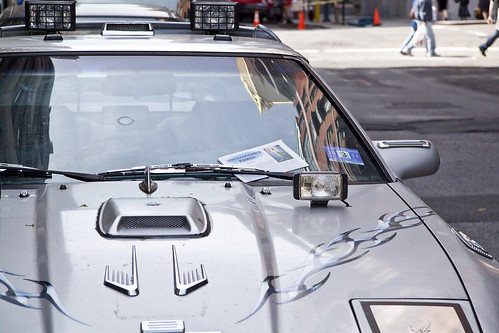
Found this auto on east 24th street, right after leaving a parade of (maybe) Sikhs on Madison Ave on Saturday the 24th. Categorically, this is the world’s coolest car, despite the jersey license plates. Seriously customized, it’s a Toyota of some kind under all the “bling”.
from wikipedia
Toyota has factories in most parts of the world, manufacturing or assembling vehicles for local markets. Toyota has manufacturing or assembly plants in Japan, Australia, India, Sri Lanka, Canada, Indonesia, Poland, South Africa, Turkey, Colombia, the United Kingdom, the United States, UAE, France, Brazil, Portugal, and more recently, Argentina, Czech Republic, Mexico, Malaysia, Thailand, Pakistan, Egypt, China, Vietnam, Venezuela, the Philippines, and Russia.

– photo by Mitch Waxman
The exhaust pipes that adorn it, beneath the doors, are actually a weird combination of duct tape and pipe. The whole vehicle had a sense of “hand” to it, and a certain charm. Your humble narrator, of course, was drawn to the flyer tucked under the drivers side windshield wiper. I just can’t resist a good flyer.
from nylp.com
New York City Administrative Code
Sanitation
§ 16–118
5. No person shall throw, cast or distribute, or cause or permit to be thrown, cast or distributed, any handbill, circular, card, booklet, placard or other advertising matter whatsoever, in or upon any street or public place, or in a front yard or courtyard, or on any stoop, or in the vestibule of any hall in any building, or in a letter box therein; provided that nothing herein contained shall be deemed to prohibit or otherwise regulate the delivery of any such matter by the United States postal service, or prohibit the distribution of sample copies of newspapers regularly sold by the copy or by annual subscription. This section is not intended to prevent the lawful distribution of anything other than commercial and business advertising matter.
6. No swill, brine, offensive animal matter, noxious liquid, or other filthy matter of any kind, shall be allowed by any person to fall upon or run into any street, or public place, or be taken to or put therein.

– photo by Mitch Waxman
Unchangeable Power, it says, and I like to believe that whoever was pamphleteering the neighborhood- locally dominated by a National Guard armory, made it a special point to drop their booklet on this car. They must be attracted to fog lights and soldiers.
from wikipedia
The 69th Regiment Armory located at 68 Lexington Avenue, New York, New York, is a historical building completed in 1906. It still houses the U.S. 69th Infantry Regiment.
The building, which runs from 25th to 26th Streets on the west side of Lexington Avenue, was declared a National Historic Landmark in 1965.
– photo by Mitch Waxman
The pamphlet, which is a screed published by Tony Alamo’s Christian Ministries- a Texas based church- is available online here. Pastor Alamo’s congregation is a familiar one to New Yorkers due to constant printed proselytizing, and the local meeting house is found at the Vincci Hoteles, 16 east 32nd street.
from hotelstravel.com
Vincci Avalon Hotel
Located off Madison Avenue, the Vincci Avalon Hotel incorporates European grandeur, boutique intimacy, and top of the line business amenities. The Avalon is situated three blocks from Penn Station and two blocks from the Empire State Building. Located in Midtown, the hotel is three blocks from Madison Square Garden, half a mile from Jacob Javits Center, three miles from the site of the World Trade Center, and eight miles from LaGuardia Airport.Rates include full buffet complimentary breakfast, morning newspapers, and complimentary access to Boom Fitness. The business center is also freeMore than half of the rooms are non-smoking, and the bathrooms are all marble with brass and chrome fixtures. All rooms have complimentary wifi high-speed Internet access and ihomes of ipods. The guestrooms feature desk chairs designed specifically for comfort and functionality, luxurious bath amenities, Egyptian Cotton linens, velour bathrobes, the Avalon signature body pillows, dual-line phones with voicemail, hairdryers and irons.

– photo by Mitch Waxman
Pastor Alamo is a controversial figure, for those of you not in the know. Check out this 2007 page at the Southern Poverty Law Center’s Hatewatch for more info on him and his group. Nevertheless, this was a very cool car.
from wikipedia
Tony Alamo (born Bernie LaZar Hoffman; September 20, 1934) is an American preacher, singer, entrepreneur, religious evangelist, and convicted child sex offender. He and his late wife Susan are best known as the founders of an organization currently known as Tony Alamo Christian Ministries. The organization is based in and around Fouke and Alma, Arkansas, United States. It has been referred to as a cult. On July 24, 2009 Alamo was convicted in the Federal District Court for the Western District of Arkansas, sitting in Texarkana, Arkansas, on 10 counts of Interstate Transportation of Minors for Illegal Sexual Purposes, Rape, Sexual Assault and Contributing to the Delinquency of Minors. On November 13, 2009, he was sentenced to the maximum punishment of 175 years in prison.
Searching for Gilman

– photo by Mitch Waxman
For several months I have been searching Calvary Cemetery in a non systematic manner for 2 particular locations. Thwarted time and again by false leads and incorrect addressing, both sites have remained elusive. One grave is the final resting place of Tess Gardella– the actress who portrayed Aunt Jemima- and the other is that of an enigma from the early 20th century whose name was Gilman.
from wikipedia
Aunt Jemima is a trademark for pancake flour, syrup, and other breakfast foods currently owned by the Quaker Oats Company. The trademark dates to 1893, although Aunt Jemima pancake mix debuted in 1889. The Quaker Oats Company first registered the Aunt Jemima trademark in April, 1937.
The name “Jemima” is biblical in origin. Jemima is the King James Version’s rendering of the feminine Hebrew name יְמִימָה (Yəmīmā), the first of Job’s daughters born to him at the end of his namesake book of the Bible.
The term “Aunt Jemima” is sometimes used colloquially as a female version of the derogatory label “Uncle Tom”. In this context, the slang term “Aunt Jemima” falls within the “Mammy archetype”, and refers to a friendly black woman who is perceived as obsequiously servile or acting in, or protective of, the interests of whites. The 1950s television show Beulah came under fire for depicting a “mammy”-like black maid and cook who was somewhat reminiscent of Aunt Jemima. Today, the terms “Beulah” and “Aunt Jemima” are regarded as more or less interchangeable as terms of disparagement in popular discourse.

– photo by Mitch Waxman
Somewhere in the viridian depths of Calvary Cemetery lies an unremarked merchant from Massachusetts, who died in an accident along the delirious Newtown Creek in 1931. No obituary I can find discusses him, and Gilman slid unnoticed into the hallowed loam of Calvary’s charitable sections. His anonymity came to an end when, according to neighborhood sources and contemporary diarists, a relict 3 masted schooner arrived at the Penny Bridge docks and ordered an eccentric monument be erected on Gilman’s resting place. The captain of that black ship, a leathery bastard named Marsh, collected Gilman’s belongings and sailed via Newtown Creek to the East River, turning North toward Hell Gate- ultimately disappearing into the mists of Long Island Sound heading for New England.
from noaa.gov
Click here for : Hell Gate and Its Approaches
This nautical chart depicts Hell Gate, a narrow channel on the East River, at the confluence of the Harlem River, which connects Long Island Sound with New York Harbor. The chart shows Hell Gate in 1851, which is the year that the U.S. Army began blasting ledges and rocks within Hell Gate to ensure safe passage through the channel.

– photo by Mitch Waxman
Rumors that this man was the same Gilman mentioned by members of the Boston Police Department in 1920, in connection with investigations into a string of sensational murders and for connections to a certain group of anarchists thought to be operating within the city. The Back Bay area of Boston, of course, is associated with the illustrious architect Arthur Delevan Gilman– but there doesn’t seem to be any involvement with Calvary’s mysterious Gilman other than a tangential coincidence of names.
from wikipedia
The Back Bay neighborhood was created when a parcel of land was created by filling the tidewater flats of the Charles River. This massive project was begun in 1857. The fill to reclaim the bay from the water was obtained from Needham, Massachusetts. The firm of Goss and Munson, railroad contractors, built 6 miles (9.7 km) of railroad from Needham, and their 35-car trains made 16 trips a day to the Back Bay. The filling of present-day Back Bay was completed by 1882; filling reached the existing mainland at Kenmore Square in 1890, and finished in the Fens in 1900. The project was the largest of a number of land reclamation projects, beginning in 1820, which, over the course of time, more than doubled the size of the original Boston peninsula. It is frequently observed that this would have been impossible under modern environmental laws.
Back Bay’s development was planned by architect Arthur Gilman with Gridley James Fox Bryant. Strict regulations produced a uniform and well-integrated architecture, consisting mostly of dignified three- and four-story residential (or once-residential) brownstones.

– photo by Mitch Waxman
Both saint and sinner alike can be found in the emerald devastations of First Calvary- governors, mayors, and priests share in the loam with common laborer and notorious gangster. There are multitudes here, vast tomb legions awaiting only the advent of their messiah to rise and walk the earth. Gilman is amongst the many, lost in the crowd. I will find him, and the notable monument raised in his honor- it is just a matter of time.
from wikipedia
While the Christian doctrine of resurrection conforms to Jewish belief, there is, however, a minority point of view, held by certain Jewish mystics and others,[who?] which asserts that those Jewish beliefs are in contradiction with the resurrection as taught by Isaiah (Isaiah 8:16 and 26:19) and Daniel (12:1 and 13) in which the resurrection was understood as being a doctrine of physical ‘Rebirth’.
Jesus appears to have been in general agreement with the position held by the Pharisees, as illustrated by his response to a question regarding marriage at the resurrection (Matthew 22:23-32, Mark 12:18-27 and Luke 20:27-40).
Most Christian churches continue to uphold the belief that there will be a general resurrection of the dead at “the end of time”, as described Paul when he said, “…he hath appointed a day, in the which he will judge the world…” (Acts 17:31 KJV) and “…there shall be a resurrection of the dead, both of the just and unjust.” (Acts 24:15 KJV).
Many of the early Church Fathers cited the Old Testament examples listed in the Judaism section above as either foreshadowing Jesus’s resurrection, or foreshadowing or prophesying a future resurrection of all the dead.

– photo by Mitch Waxman
Gilman, I have no first name or exact date of interment- which intensifies the difficulty in locating him- was supposedly a dealer in far eastern art. What his purpose was in coming to the Newtown Pentacle remains shadowed. Veiled references to the illegal importation of statuettes from the south Pacific, and distribution of these items to radical theosophists and heretic Masons in the Greenpoint and Maspeth neighborhoods can be gleaned from antiquarian sources but nothing definite enough for the consideration of the Lords and Ladies of Newtown has emerged. The statuettes it is said, are the product of the lost Saudeleur culture from Nan Madol found on fabled Pohnpei, and an item of particular interest to certain occultists.
from wikipedia
Nan Madol was the ceremonial and political seat of the Saudeleur dynasty, which united Pohnpei’s estimated 25,000 people. Set apart on the main island of Pohnpei, it was a scene of human activity as early as the first or second century AD. By the 8th or 9th century islet construction had started, but the distinctive megalithic architecture was probably not begun until perhaps the 12th or early 13th century.
Little can be verified about the megalithic construction. Pohnpeian tradition claims that the builders of the Lelu complex on Kosrae (likewise composed of huge stone buildings) migrated to Pohnpei, where they used their skills and experience to build the even more impressive Nan Madol complex. However, this is unlikely because radiocarbon dates have placed the construction of Nan Madol prior to that of Lelu. Like Lelu, one major purpose of constructing a separate city was to insulate the nobility from the common people.
A local story holds that when Nan Madol was being built a powerful magician living in the well inhabited region on the northwest of the island was solicited, and that his help was a major factor in completing the buildings. In particular, he was responsible for supplying the huge stone “logs” used in much of Nan Madol by “flying” them from their source to the construction site.
…Supposedly there was an escape tunnel beginning at the center of Nan Madol and boring down through the reef to exit into the ocean. Scuba divers continue to look for this “secret” route, but so far a complete tunnel has yet to be discovered.

– photo by Mitch Waxman
Gilman is meant to have been killed in a curious accident on the Queens bank of Newtown Creek in Blissville, when a bail of paper fell from a second story warehouse window along the negligent shoreline of the Newtown Creek. Crushed, the peculiar condition of his body was remarked on by several hardened Detectives used to such sights. Speculations that he had been previously deformed by Polio or some other childhood disease were made, but before our era of “antigenic vaccination as public policy” was enacted, monstrous alterations of the human form by disease organisms were a common sight. Disfigurements caused by Smallpox and Leprosy or the ravages of Tertiary Syphilis are seldom observed by we happy few that enjoy the luxury of western modernity.
from wikipedia
Tertiary syphilis usually occurs 1–10 years after the initial infection, however in some cases it can take up to 50 years. This stage is characterized by the formation of gummas, which are soft, tumor-like balls of inflammation known as granulomas. The granulomas are chronic and represent an inability of the immune system to completely clear the organism. They may appear almost anywhere in the body including in the skeleton. The gummas produce a chronic inflammatory state in the body with mass effects upon the local anatomy. Other characteristics of untreated tertiary syphilis include neuropathic joint disease, which is a degeneration of joint surfaces resulting from loss of sensation and fine position sense (proprioception). The more severe manifestations include neurosyphilis and cardiovascular syphilis. In a study of untreated syphilis, 10% of patients developed cardiovascular syphilis, 16% had gumma formation and 7% had neurosyphilis.
Neurological complications at this stage can be diverse. In some patients manifestations include generalized paresis of the insane, which results in personality changes, changes in emotional affect, hyperactive reflexes and Argyll-Robertson pupil. This is a diagnostic sign in which the small and irregular pupils constrict in response to focusing the eyes, but not to light. Tabes dorsalis, also known as locomotor ataxia, a disorder of the spinal cord, often results in a characteristic shuffling gait.

– photo by Mitch Waxman
Somewhere, amongst those who eternal lie, is Gilman. The disturbing detail that troubled the Detectives who investigated the reports of his death, the one that made for saloon conversation and idle speculation by neighborhood wags, was the fact that this deceased dealer in illicit eastern art had six fingers on both hands and that these polydactyl appendages were webbed all the way to the nail beds. Not much could be said about Gilman’s face, for the rodent population of Newtown Creek had discovered him long before the Police did.
Additionally, his shorter than normal legs also bore long healed scars that suggested some intense surgical experience- participation in the Civil War was speculated on by area Police, when Gilman would have been a young man. Amongst his few possessions was a watercolor postcard of some southern Plantation labeled as “Carfax Plantation, James River, Virginia”, which was quite out of place in the pockets of a Massachusetts trader who died alone during the middle of the night along Newtown Creek. Further speculations held out the possibility that Gilman hailed from a degenerate or illegitimate offshoot of the famed Gilman family of Exeter, New Hampshire.
Where and who is he? Where is Gilman?
from wikipedia
Winthrop Sargent Gilman (1808-1884) was head of the banking house of Gilman, Son & Co. in New York City. He was born in Marietta, Ohio to merchant Benjamin Ives Gilman and Hannah (Robbins) Gilman. Benjamin Ives Gilman, born in 1766, was a native of Exeter, New Hampshire, where his ancestors were among the most prominent early settlers and where he graduated in the first class of the Phillips Exeter Academy.
In 1837 Winthrop Sargent Gilman let the abolitionist Elijah Parish Lovejoy hide his printing press in one of Gilman’s warehouses in Alton, Illinois. In the ensuing riot the angry mob burned Gilman’s warehouse to the ground and killed Lovejoy. Following the Alton riots, Gilman moved to New York City and entered the family banking business.
He was married to Abia Swift Lippincott Gilman, who in 1900 narrowly escaped burning to death from a gasoline torch in front of the Charles Scribner mansion at 12 East Thirty-eighth Street.
Winthrop Gilman had an abiding interest in science and built a private observatory at his home ‘Fern Lodge’ at the Palisades, New York, where he frequently observed meteors.
merry sounds

– photo by Mitch Waxman
Wandering through Manhattan on Saturday the 24th of April, your humble narrator suddenly found himself in a throng of colorfully dressed people. Willfully, I denied myself the opportunity to ask anyone what was going on, and instead preferred total ignorance of the significance of such a gathering.
Why?
Because sometimes it’s important to let New York show you what it wants you to see and not ask too many questions.

– photo by Mitch Waxman
Ethnographic assumptions suggested to me that this crowd most likely had its origins on the mysterious subcontinent of India, based on observable physical features and style of dress. Also, many people were eating what I recognized as Indian food. Further trespass into the unknown would assert that these folks are most likely Sikh’s. Such ideations of national specificity hatch from the particular head wrappings and sheer physical size of the men.

– photo by Mitch Waxman
Crowded, with what seemed to be thousands of children dashing about in panics of joy, there was a cacophony of conversation and color all around me. Spoken in some foreign tongue, foreign to me at least, their language carried a certain lilting and almost musical tone in utterance- which, I noted- were backed up by a seemingly simultaneous stream of information manifested by a secondary language of hand postures. I have noted that Indian people “speak with their hands” in the past, a cherished tradition of all New Yorkers here in the Shining City.

– photo by Mitch Waxman
On 25th street, this enigmatic fellow was intently focused on what seemed to be either religious devotions or preparation of a ceremonial space. The little palace had flowers pinned to it, and seemed to a be a focal point for many of the men to gather and greet each other. On the corner of Madison, the female percentage of the crowd fell off somewhat. That’s when I realized this was a parade of some kind.

– photo by Mitch Waxman
Scuttling to an out of the way spot, your humble narrator wondered if the variegated colors of the garb had any significance, and whether it denoted society or affiliation or caste. Musing about whether or not these might be gang colors in some far away place or time, a magnificent cast of characters then passed by- reminding me of a costumed group of super heroes.

– photo by Mitch Waxman
Sikh’s, if Sikh’s these folks be, are known to exhibit great physical size- which distinguishes them from their more economically built Asian neighbors. This isn’t scientific, just a personal observation- if I see an Indian Guy who’s over 6 foot and well over 200 pounds, I always think “Sikh”. Afghans also are quite stoutly built, but Sikh men are huge.

– photo by Mitch Waxman
Your humble narrator continued his long scuttle back to Queens, where- odds are- many of these people likely dwell. There are several Sikh temples near and in Astoria, and I’ve been trying to work up the courage to visit one. I’m intrigued, but I like churches best from the outside. Always… I must remain outside.

– photo by Mitch Waxman
If anyone can identify this event, or positively assess the identity of the crowd, please share.
Errata Hari

– photo by Mitch Waxman
As often mentioned in posts since the very inception of this, your Newtown Pentacle, when I screw up- whether it be a place name, roadway, or some other variance from reality- I’m counting on being called on it and corrected by you assembled Lords and Ladies of Newtown.
Often, when contacted on such matters- an unnecessarily confrontational tone is offered by the petitioner to your humble narrator. Sometimes, wild accusations of defaming the past or purposely smoothing over inconvenient truths are put forth. Before we discuss the rather lengthy list of errors that I’ve been made aware of regarding the Vanderbilt Mansion postings published earlier this month, allow me to restate and clarify things…

– photo by Mitch Waxman
The pitiable mendicant who calls himself “your humble narrator” is an unlettered amateur, untempered by the crucible of academic review, whose flawed attempt at presenting a cogent overview and glimpse into an often hidden world of relict infrastructure and unseen corners found around the great metropolis is sometimes successful.
There are certain subjects which I refuse to delve too deeply into- famously NYFD history and Rail- for there are amateur experts out there whose depth of knowledge on these topics is staggering. Intelligent discussion of historic Newtown can be had “off the top of my head”, but it’s when I leave “my beat” that I tend to get into trouble.
The Vanderbilt Mansion revealed certain lapses in capabilities, and remind one that I am an expert on nothing except embarrassing myself in public. If I’m wrong about something, please contact me through the comments, so corrections may be offered to your fellow Lords and Ladies.

– photo by Mitch Waxman
Thankfully, Eric Weaver, who served as Horticultural Educator at “Vandyland” from 2004 to 2007 contacted me with a lengthy list of corrections regarding the Vanderbilt Mansion posts and has given me permission to post them here. All the following text (in blue) is from Mr. Weaver.
ERRATA Vanderbilt Mansion 1

– photo by Mitch Waxman
He also flew, having been the first to circumnavigate South America and cross the Andes in a “flying boat.”
He collected fauna not flora.
He didn’t have a fleet, his boats and ships were owned in succession.
His dock was too shallow to accommodate ocean going ships. He moored the Alva at Price’s Bend off of Eaton’s Neck. JP Morgan had to moor his ship there too which gave his son HP Morgan the idea of buying up 500 acres on Eaton’s Neck which is still known as the Morgan Estate.
The Guatemalan church only influenced the design on the Marine Museum.
He wasn’t powerful, just rich.
There was no fleet of vessels and the only collection was at Eagle’s Nest.
ERRATA Vanderbilt Mansion 2

– photo by Mitch Waxman
The Vanderbilt family were farmers, hence the boat to take the vegetables into Manhattan.
Willie K I did not want to compete making money like his father and grandfather, so he decided to spend it. He seemed to compete with his brothers building houses.
Willie K II did not compete building houses. His places are modest compared to his father’s generation.
The planetarium was built by Suffolk County, not the state.
The Marine Museum has not been officially called the Hall of Fish since they put the second story on in the late twenties.
There are some nice totems and artifacts on the second floor.
The ironwork at the door of the second floor of the ‘fish house’ was used to haul up the large objects.
ERRATA Vanderbilt Mansion 3

– photo by Mitch Waxman
Willie K did not own a fleet. Did you visit the ship model room?
The ship Alva that you write about was Willie K I’s ship. Willie K II’s Alva was built in Kiel, Germany in the same shipyard that the U-boat that sunk it was built. (Did I mention that Lindbergh was one of Willie K II’s friends?)
The narrative goes that it takes five generations to make the fortune then squander it.
ERRATA Vanderbilt Mansion 4
– photo by Mitch Waxman
The Breakers was Cornelius V II. GWV was the Biltmore in North Carolina. These were two of the Uncles of Willie K II who competed in building.
Eagle’s Nest is in Centerport on Northport Bay. Maybe the fumes of formaldehyde (since replaced with alcohol) from the second floor overcame you.
Consuelo was forced to wear hoops on her neck to elongate it. Alva locked her in her boudoir for long periods.
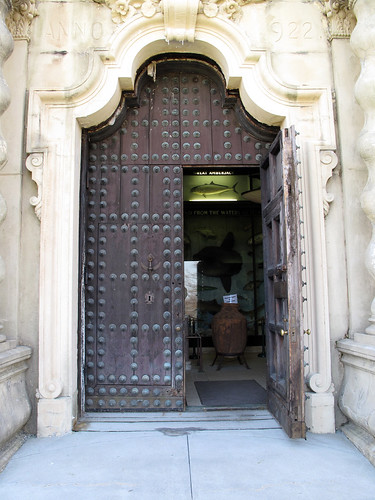
The historic castle doors are ornamental. Security is too lax as golden things get stolen frequently. The curator was offered half a million in cash for one artifact on the second floor of the fish house. There are valuable things there.
The Alva didn’t dock in Northport.
ERRATA Vanderbilt Mansion 5

– photo by Mitch Waxman
The property is NOT owned by the State of New York but Suffolk County. Willie K left an endowment of six million dollars. It was up over twenty in the late nineties. Graft and corruption by the former director brought them back to six mil. The county is loaning them money now to make ends meet. If not, the property reverts back to the family.
The photography policy is no professionals and not in the mansion because they make money on photo shoots, especially wedding pictures.
To get to the beach you need to go to the seaplane hangar.
There have been numerous Newsday articles about the wheelchair access. To make the place totally wheelchair accessible it would no longer be a museum.
Eagle’s Nest being decrepit serves as an indication of what happens to wealth.
Eagle’s Nest was started in 1909 but he kept adding on until the 1930s.
The portcullis is fake and does not move but there are iron bars on all lower windows on most buildings – did I mention Lindbergh?
He had his own wells and a power plant to generate electricity.
Willie K did contribute to science, discovering and naming many new species.
Thanks to Mr. Weaver, who unfortunately doesn’t maintain a web presence that I can send you to check out.
Tombstone Territory

– photo by Mitch Waxman
Just a short posting today, and as you might observe, your humble narrator has been hanging out around cemeteries again. The other day, as I was leaving Calvary via the Greenpoint Avenue Gates, I spotted Ladder 128’s truck (which had apparently just been washed) sparkling in the cascading emanations of the thermonuclear eye of god itself. As I’ve mentioned in the past, the subject of the NYFD and their wonderful equipment reduces me to early childhood. When a fire engine or ladder truck screams past with lights and sirens on, it is a very difficult thing for me not to run after it yelling “Firemen, Firemen!!!”.
from nypost.com
Ladder 128 has played an integral role in the community over the past 100 years, and the stories from within the house were feted as that which makes a life complete by the hundreds who attended Friday’s celebration at the Blissville location. The firehouse covers the areas of Blissville, Long Island City, Sunnyside, Woodside and Greenpoint, Brooklyn.
“Ladder 128 has produced some true strong leaders,” Fire Commissioner Salvatore Cassano said. “%u2026 You’ve responded to some of the toughest fires we’ve had. Members of Ladder 128 have served this city with distinction.”
Chief of Department Edward Kilduff called the centennial a tremendous milestone for the firehouse, nicknamed “tombstone territory” thanks to its location across from Calvary Cemetery, one of the largest and oldest burial grounds in the country.
“This is one of the most diverse areas in the city,” Kilduff said. “You have everything here from high-rises to tunnels to rail yards. The commercial buildings are extreme challenges for anybody. A place like this really represents the heart and soul in the Fire Department.”

– photo by Mitch Waxman
Far away from the carven hillocks of Calvary, along the graven lanes of Broadway in Astoria, that’s Engine 263 and Ladder 163 doing something important that involved the ancient Subway platform at 46th street.

– photo by Mitch Waxman
What I believe is Ladder 136 at the scene of a 5 alarm fire in a Dutch Kills commercial building last year.


 The Newtown Pentacle