Archive for June 2012
needed adjustments

– photo by Mitch Waxman
Recent opportunity found your humble narrator standing upon that painted lady of the archipelago named Manhattan, in front of one the Shining City’s newest accoutrements.
Originally built on the Lower East Side in 1965, the Manhattan Pump House acts as the central concentrating point for the waste water and sewage of a significant slice of the borough (basically everything below 79th street) and the point from which it is pumped to the Newtown Creek Waste Water Treatment Plant in Greenpoint from for processing.
from nyc.gov
Early Manhattan settlers obtained water for domestic purposes from shallow privately-owned wells. In 1677 the first public well was dug in front of the old fort at Bowling Green. In 1776, when the population reached approximately 22,000, a reservoir was constructed on the east side of Broadway between Pearl and White Streets. Water pumped from wells sunk near the Collect Pond, east of the reservoir, and from the pond itself, was distributed through hollow logs laid in the principal streets. In 1800 the Manhattan Company (now The Chase Manhattan Bank, N.A.) sank a well at Reade and Centre Streets, pumped water into reservoir on Chambers Street and distributed it through wooden mains to a portion of the community. In 1830 a tank for fire protection was constructed by the City at 13th Street and Broadway as was filled from a well. The water was distributed through 12-inch cast iron pipes. As the population of the City increased, the well water became polluted and supply was insufficient. The supply was supplemented by cisterns and water drawn from a few springs in upper Manhattan.

– photo by Mitch Waxman
Pictured above is a device which performs a rudimentary process upon the collected liquids, a screening mechanism designed to remove solids from the flow. Remember that what everybody’s friends at the NYC DEP are dealing with is not just that which one might flush down or wash away, but all that might find its way into a roadside sewer grate. Casual littering, when seen from a citywide point of view, creates enormous engineering concerns and generates tons of sewage borne trash.
from wikipedia
The New York City Department of Environmental Protection (NYCDEP) manages the city’s water supply, providing more than 1.1 billion US gallons (4,200,000 m3) of water each day to more than 9 million residents throughout New York State through a complex network of nineteen reservoirs, three controlled lakes and 6,200 miles (10,000 km) of water pipes, tunnels and aqueducts. The DEP is also responsible for managing the city’s combined sewer system, which carries both storm water runoff and sanitary waste, and fourteen wastewater treatment plants located throughout the city. The DEP carries out federal Clean Water Act rules and regulations, handles hazardous materials emergencies and toxic site remediation, oversees asbestos monitoring and removal, enforces the city’s air and noise codes, bills and collects on city water and sewer accounts, and manages citywide water conservation programs.

– photo by Mitch Waxman
Surprisingly, turtles often find themselves swept up in the flow, and the workers at this plant have set up a temporary habitat tank for their reptilian charges to recover from the ordeal of their journey here. After regaining their strength, the turtles are offered a new home in the wild, in an “undisclosed location” body of water owned and operated by the City Parks Department.
from wikipedia
The red-eared slider (Trachemys scripta elegans) is a semiaquatic turtle belonging to the family Emydidae. It is a subspecies of pond slider. It is the most popular pet turtle in the United States and also popular in the rest of the world. It is native only to the southern United States, but has become established in other places because of pet releases and has become an invasive species in many introduced areas, like California, where it outcompetes the native western pond turtle.

– photo by Mitch Waxman
Something which often brings a tinge of warmth to my otherwise calcified and cynical outlook on the world is the way that workmen handle the animals who traverse and inhabit their facilities. These are busy, burly, often brusque men and women that work in dangerous and often unpleasant circumstance who nevertheless show their gentle and kind sides toward the lesser breeds. Whether it be rail yard, factory, or in this case- pump house- these folks always do their best to accommodate and care for strays, injured, or just lost animals.
Laudable, the entire human infestation of New York should take note of such efforts and attempt emulation.
from nyc.gov
Litter that washes down storm drains in the street can easily wind up in local waters and on City beaches. This unsightly pollution, called floatables, can kill birds, turtles and other marine animals that mistake trash – especially plastic – for food. Street litter that goes to the treatment plants must be separated from the wastewater so it won’t damage plant equipment. Litter can also clog storm drains and cause sewer backups and flooding.

– photo by Mitch Waxman
This posting will be a two parter. Tomorrow, we will descend into the very bowels of New York City. Additionally, we will looking into a yawning black maelstrom, which when stared into…
from “Beyond Good and Evil, by Friedrich Nietzche” courtesy authorama.com
He who fights with monsters should be careful lest he thereby become a monster. And if thou gaze long into an abyss, the abyss will also gaze into thee.
Click for details on Mitch Waxman’s
Upcoming walking and boat tours of Newtown Creek, and Staten Island’s Kill Van Kull
June 23rd, 2012- Atlas Obscura Thirteen Steps around Dutch Kills walk (this Saturday)
for June 23rd tickets, click here for the Atlas Obscura ticketing page
June 30th, 2012- Working Harbor Committee Kill Van Kull walk
for June 30th tickets, click here for the Working Harbor Committee ticketing page
July 8th, 2012- Atlas Obscura Walking Tour- The Insalubrious Valley
for July 8th tickets, click here for the Atlas Obscura ticketing page
July 22nd, 2012- Working Harbor Committee Newtown Creek Boat Tour

darkly hidden

– photo by Mitch Waxman
As described in the recent posting “Obscure World“, the location of Conrad Wissel’s notorious “Dead Animal and Night Soil Wharf” has been finally nailed down and confirmed by contmeporaneous maps and photographs. A lot of people ask me where I find my information about the oft occluded history of the Newtown Creek, and are surprised when informed about my methodology.
Basically, it all boils down to this- I’ll notice something hidden in plain sight while wandering around, take photos of it, and start researching when back at HQ. There’s a whole list of mysteries in my “to do” pile, and often the answer to what they were is presented while searching for something else entirely. It’s how the whole “missing Lamp Post of the Queensboro bridge thing” got started. Accordingly, whenever accusations of pursuing some political agenda are leveled at this- your Newtown Pentacle- great amusement ensues.
The utterly forgotten headquarters of the General Electric Vehicle Company of Long Island City, which had been staring me in the face for years, revealed itself in this manner. Easy to miss the third largest factory building in Queens, I guess, even if its painted with bright yellow and green stripes.

– photo by Mitch Waxman
As detailed in the posting “uncommented masonry“, one was merely poking around for some information about the “Blissville Banshee“.
A supernatural phenomena, the Banshee was reported on in 1884 by the NY Times (she was described as red haired, blue eyed, and screaming “Oh Ho” like … well… a banshee), and was an obvious jab at the largely Irish and Catholic population of Blissville by Manhattan’s patrician “Nativists”. Racial or ethnic prejudice is commonly encountered in journalism of that era, and quite unsurprising to those familiar with reportage of the period. In the 1880’s, “politically correct” meant not shooting someone on sight.
What emerged about the structure above, however, was that in 1915- a quarter of the 40,000 or so trucks then plying the streets of New York City were electric (and participated in a rail based battery exchange program). Most of them were manufactured in Long Island City within the building pictured above, by the General Electric Vehicle Company.
This is my favorite sort of posting, a product of serendipity and pure discovery.
Which brings me to the Tammany men, and why there very well might be a horse buried in Calvary Cemetery.

– photo by Mitch Waxman
“The Abbot” from January of 2010, described a chance sighting of a curious obelisk in Queens’s Calvary Cemetery.
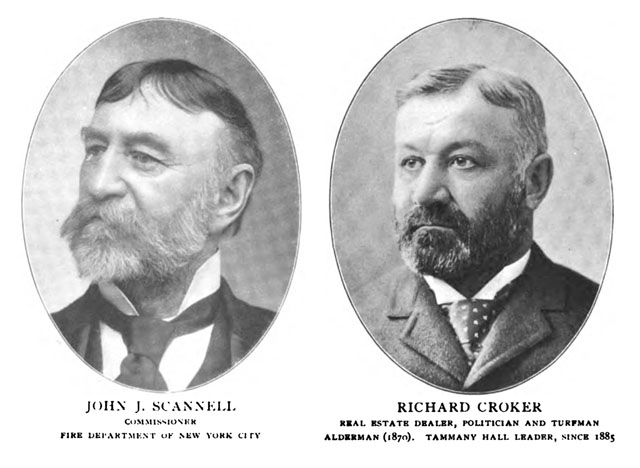
By the time that I was done with this post, I had found the young J.J. Scannell and Richard Croker sitting out a sentence in Manhattan’s “Tombs”. Quite a propitious meeting- in retrospect, one with far reaching consequence.
These two men would rise to the top of Tammany Hall one day, preside over the consolidation of the City of Greater New York from the shadowed world of the “smoke filled room”, and grow filthy rich on a buttery diet of political corruption.
Think Boss Tweed was something? In that case, you’ve never heard of Scannell and Croker.
All this because I enjoy strolling through Calvary in the afternoon while the Dropkick Murphys are playing on my headphones.
incidentally, something recently discovered (see how it works?) were these portraits of Mr.’s Scannell and Croker- found in Moses King’s “Notable New Yorkers of 1896-1899, courtesy google books

– photo by Mitch Waxman
“from some point in space“, another 2010 posting, showcases a shot of Dutch Kills acquired before a press conference which highly placed members of the Newtown Creek Alliance had asked me to represent them at (literally no one else from Queens was available).
My statement was prepared, thankfully, as I was standing next to and was introduced by Congresswoman Carolyn Maloney. Stage fright and hallucination inducing nervousness ruled my mood during the lead up.
To alleviate the anxiety while waiting for the event to begin… and as I happened to be standing in a south facing room within the Degnon Terminal’s former Loose Wiles building… which overlooks the waters of the Dutch Kills tributary of Newtown Creek- a window was soon roughly thrown open and I shot the image above.
As it happens, while attempting to research a group of heretical Quakers operating in the area just before the Revolutionary War, I came across the following image in another one of those “old and out of copyright” municipal journals which have found their way onto the web.

– Photo from 1921’s ”The Newtown Creek industrial district of New York City By Merchants’ Association of New York. Industrial Bureau”, courtesy google books
Cool, huh?
An August 2011 post, called the “the dark moor“, reversed the point of view and showed the view from infinite Brooklyn into Queens from atop the digester eggs of the Newtown Creek Waste Water Treatment Plant.
Click for details on Mitch Waxman’s
Upcoming walking and boat tours of Newtown Creek, and Staten Island’s Kill Van Kull
June 23rd, 2012- Atlas Obscura Thirteen Steps around Dutch Kills walk (this Saturday)
for June 23rd tickets, click here for the Atlas Obscura ticketing page
June 30th, 2012- Working Harbor Committee Kill Van Kull walk
for June 30th tickets, click here for the Working Harbor Committee ticketing page
July 8th, 2012- Atlas Obscura Walking Tour- The Insalubrious Valley
for July 8th tickets, click here for the Atlas Obscura ticketing page
July 22nd, 2012- Working Harbor Committee Newtown Creek Boat Tour
antique bridge

– photo by Mitch Waxman
To be seen by so many diminishes me.
Seeking solace, one such as myself can only find succor and peace in those hinterland angles found between neighborhoods- or boroughs. Neither tick nor tock, Brooklyn nor Queens, the concrete devastations found in these places are nepenthe. Often do I find that my steps have carried me in some inexorable and unconscious fashion to the Grand Street Bridge, spanning the lamentable waters of the Newtown Creek itself.
DUGSBO has been calling to me (Down Under the Grand Street Bridge Onramp) again.
from nyc.gov
The bridge is located between Gardner Avenue in Brooklyn and 47th Street in Queens. The Grand Street Bridge is a 69.2m long swing type bridge with a steel truss superstructure. The general appearance of the bridge remains the same as when it was opened in 1903. The bridge provides a channel with a horizontal clearance of 17.7m and a vertical clearance, in the closed position, of 3.0m at MHW and 4.6m at MLW. The bridge structure carries a two-lane two-way vehicular roadway with sidewalks on either side. The roadway width on the bridge is 6.0m and the sidewalks are 1.8m wide. The height restriction is 4.1m. The approach roadways are wider than the bridge roadway. For example, the width of Grand Avenue at the east approach to the bridge (near 47th Street) is 15.11m.
The first bridge on this site, opened in 1875, quickly became dilapidated due to improper maintenance. Its replacement, opened in 1890, was declared by the War Department in 1898 to be “an obstruction to navigation.” Following a thorough study, a plan was adopted in 1899 to improve the bridge and its approaches. The current bridge was opened on February 5, 1903 at a cost of $174,937.

– photo by Mitch Waxman
This is close to the cartographic end of the actual “Newtown Creek”, although the English Kills tributary slithers forth into Brooklyn and slouches roughly toward Bushwick from this spot. Truncated wetlands, the canalized bulkheads and present shape of the waterway were established by the Army Corps of Engineers in the early 20th century, eradicating any semblance to what the Mespat, Dutch, or English knew the place to look like.
There used to be a nearby island, called Mussel, which the Federal authorities spent no small amount of effort on eradicating from common memory, for instance.
The East Branch, as the water on the eastern side of the Grand Street Bridge is called, continues a short distance and terminates in a complex of sewage infrastructure which underlies Metropolitan Avenue.
from 1920’s Port of New York Annual, courtesy google books
Newtown Creek is a tidal arm of the East River, and forms the boundary between the Boroughs of Brooklyn and Queens, New York City. The mouth of the creek is nearly opposite 34th Street, Manhattan, and 4 miles northeast from the Battery. Its length is about 4 miles, with width varying from 125 to 200 feet.
About 2.75 miles above its mouth it divides into two branches, termed the East Branch and English Kills, or West Branch. About 4,000 feet above the mouth a tributary, Dutch Kills, 4,450 feet long, enters the creek from the east, and almost directly opposite another tributary, Whale Creek, 2,000 feet long, enters it from the west. Maspeth Creek, 3,550 feet long, branches off to the southward 2.25 miles below the mouth of the creek. Mussel Island, included in the existing project for removal, is situated just above the junction of Maspeth Creek with the main stream. The drainage area embraces about 7 square miles, for the most part densely built up along the banks of the creek.
Previous projects.—The original project was adopted by the river and harbor act of June 14, 1880, and was modified and extended by the river and harbor acts of July 5, 1884, and June 3, 1886. A total of $527,530.58 had been expended on the modified project prior to the adoption of the existing project on March 2, 1919.
The amount spent for new work and maintenance can not be separately stated with accuracy, the division in the early years being intermediate. An approximate estimate is that $401,260.51 were applied to new work and $126,270.07 to maintenance.
Existing project.—This provides for a channel 20 feet deep at mean low water in Newtown Creek, including Dutch Kills, Maspeth Creek, and English Kills, and of the following widths: 250 feet wide at the entrance to Newtown Creek, narrowing to 150 feet, and continuing with this width to the Grand Street Bridge on the East Branch, and thence 125 feet wide to Metropolitan Avenue on said branch, including the removal of Mussel Island; 150 feet wide in English Kills, or West Branch, to the Metropolitan Avenue Bridge across said branch, including the easing of bonds; 100 feet wide for a distance of 2,000 feet up Maspeth Creek; and 75 to 100 feet wide for a distance of 2,800 feet up Dutch Kills, with a turning basin at the head, and for the collection and removal of drift. The total length of channel included in the project is about 25,000 feet.

– photo by Mitch Waxman
Traffic, of an automotive sort, courses through and defines this locale. On the Brooklyn side, the neighborhood is called East Williamsburg and on the Queens side it’s an ancient community called Maspeth. There used to a light electric rail running through here and across the bridge, which contemporaneous sources referred to as “a streetcar” (trolley to we moderns), along Grand Street. It allowed for expansion of the great human hive in both directions, which allowed workers to get to and from the dark satanic mills of the industrial age.
Today, there’s a city bus which follows an ancient route of cart and horse, later travelled by streetcar and trolley.
Back during the days of industry, however, the preferred methodology for shipping freight was either rail or barge, not inefficient automotive conveyance.
also from nyc.gov
The highest volume Brooklyn-Queens highway was the Kosciuszko Bridge on the Brooklyn-Queens Expressway, with two-way daily volume of 190,800 vehicles, 32.0% of all traffic on the monitored thoroughfares and 71.4% of Newtown Creek crossings. Belt Parkway (Shore Parkway) was second with 155,600 vehicles per day, 26.1% of the total recorded screenline traffic.

– photo by Mitch Waxman
One of the great shames about the modern era along the Newtown Creek, often remarked upon at this- your Newtown Pentacle, is that so few of the industries based along the water utilize the bulkheaded shorelines lining their properties for their intended purpose.
Instead, the vast majority of stakeholders in the watershed are truck based businesses.
Soot paints the walls, and a bizarre “colour“- not part of any familiar palette or wholesome hue- but instead like something from outer (or perhaps out of) space- stains the vegetation and building stock with a queer sort of iridescence.
from nyc.gov
During the 47 years from 1963 to 2010, daily traffic crossing Newtown Creek increased 66.5%, to 267,100 from 160,400. Volumes increased on all four facilities: Kosciuszko Bridge up 86.7% to 190,800 from 102,200; J.J. Byrne Memorial Bridge up 51.5% to 26,700 from 17,600; Pulaski Bridge up 29.5% to 37,000 from 28,600; Grand Street Bridge up 5.3% to 12,700 from 12,000.

– photo by Mitch Waxman
Overheard murmurs, carelessly spoken in my company by the Manhattan elites, have revealed that -as early as 2004 (see page 75)– plans to replace this centenarian structure were being drawn. Statisticians have compiled numerical data, engineers have produced dire reports, and described the need for a newer, wider, and distinctly static vehicle bridge to be installed on this spot. Heavy trucks, the presence of a nearby MTA bus garage, and an ever increasing number of automobiles are cited as causatives.
Personal experience offers that when a city bus or fully loaded truck speeds across the structure, often far in excess of the posted speed limit, the 1903 vintage swing bridge cavitates, trembles, and vibrates tremendously.
from Mayor Low’s Administration in New York at Google Books.

– photo by Mitch Waxman
Given that which flows, lugubrious and languid, below- the kinetics of the Grand Street Bridge dancing in its casements can be quite disconcerting. It is something which one grows used to, however, despite the sure knowledge that when confronting the water and sediments of this part of the Newtown Creek- a single question crowds out all other thoughts in the minds of vehicle borne transient, pedestrian, or casual visitor alike…
Who can guess, all there is, that might be buried down there?
from Annual report of the State Department of Health of New York. 1896, courtesy google books
_______________________________________________________________________________
Also:
June 23rd, 2012- Atlas Obscura Thirteen Steps around Dutch Kills walk

– photo by Mitch Waxman
The “Obscura Day” Thirteen Steps around Dutch Kills tour proved that the efficacy and charms of the Newtown Creek’s least known tributary, with its myriad points of interest, could cause a large group to overlook my various inadequacies and failings. The folks at Atlas Obscura, which is a fantastic website worthy of your attentions (btw), have asked me to repeat the tour on the 23rd of June- also a Saturday.
for June 23rd tickets, click here for the Atlas Obscura ticketing page
June 30th, 2012- Working Harbor Committee Kill Van Kull walk

– photo by Mitch Waxman
My various interests out on the sixth borough, NY Harbor, have brought me into association with the Working Harbor Committee. A member of the group’s Steering Committee- I also serve as the “official” group photographer, am chairman and principal narrator of their annual Newtown Creek Boat Tour, and occasionally speak on the microphone during other tours (mainly the Brooklyn one). This year, the group has branched out into terrestrial explorations to compliment the intense and extant schedule of boat tours, and I’m going to be leading a Kill Van Kull walking tour that should be a lot of fun.
The Kill Van Kull, or tugboat alley as its known to we harbor rats, is a tidal strait that defines the border of Staten Island and New Jersey. A busy and highly industrialized waterfront, Working Harbor’s popular “Hidden Harbor – Newark Bay” boat tours provide water access to the Kill, but what is it like on the landward side?
Starting at the St. George Staten Island Ferry terminal, join WHC Steering Committee member Mitch Waxman for a walk up the Kill Van Kull via Staten Islands Richmond Terrace. You’ll encounter unrivaled views of the maritime traffic on the Kill itself, as well as the hidden past of the maritime communities which line it’s shores. Surprising and historic neighborhoods, an abandoned railway, and tales of prohibition era bootleggers await.
The tour will start at 11, sharp, and you must be on (at least) the 10:30 AM Staten Island Ferry to meet the group at St. George. Again, plan for transportation changes and unexpected weirdness to be revealed to you at MTA.info.
for June 30th tickets, click here for the Working Harbor Committee ticketing page
July 8th, 2012- Atlas Obscura Walking Tour- The Insalubrious Valley

– photo by Mitch Waxman
Newtown Creek Alliance historian Mitch Waxman will be leading a walk through the industrial heartlands of New York City, exploring the insalubrious valley of the Newtown Creek.
The currently undefended border of Brooklyn and Queens, and the place where the Industrial Revolution actually happened, provides a dramatic and picturesque setting for this exploration. We’ll be visiting two movable bridges, the still standing remains of an early 19th century highway, and a forgotten tributary of the larger waterway. As we walk along the Newtown Creek and explore the “wrong side of the tracks” – you’ll hear tales of the early chemical industry, “Dead Animal and Night Soil Wharfs”, colonial era heretics and witches and the coming of the railroad. The tour concludes at the famed Clinton Diner in Maspeth- where scenes from the Martin Scorcese movie “Goodfellas” were shot. Lunch at Clinton Diner is included with the ticket.
Details/special instructions.
Meetup at the corner of Grand Street and Morgan Avenue in Brooklyn at 11 a.m. on July 8, 2012. The L train serves a station at Bushwick Avenue and Grand Street, and the Q54 and Q59 bus lines stop nearby as well. Check MTA.info as ongoing weekend construction often causes delays and interruptions. Drivers, it would be wise to leave your vehicle in the vicinity of the Clinton Diner in Maspeth, Queens or near the start of the walk at Grand St. and Morgan Avenue (you can pick up the bus to Brooklyn nearby the Clinton Diner).
Be prepared: We’ll be encountering broken pavement, sometimes heavy truck traffic as we move through a virtual urban desert. Dress and pack appropriately for hiking, closed-toe shoes are highly recommended.
Clinton Diner Menu:
- Cheese burger deluxe
- Grilled chicken over garden salad
- Turkey BLT triple decker sandwich with fries
- Spaghetti with tomato sauce or butter
- Greek salad medium
- Greek Salad wrap with French fries
- Can of soda or 16oz bottle of Poland Spring
for July 8th tickets, click here for the Atlas Obscura ticketing page
July 22nd, 2012- Working Harbor Committee Newtown Creek Boat Tour
 |
|
Many people know about the environmental issues facing Newtown Creek, but did you know that the Creek was once the busiest waterway in North America, carrying more industrial tonnage than the entire Mississippi River?
You’ll learn much more when Working Harbor Committee’s maritime historians and harbor experts
put it all in context during a Hidden Harbor Tours: Newtown Creek Exploration.
The heart of industrial New York, Newtown Creek was home port to hundreds of tugboats (one of which is the historic WO Decker). It was also an international destination for oceangoing ships and a vast intermodal shipping and manufacturing hub that employed hundreds of thousands of people. Forming the border of Brooklyn and Queens for nearly three miles, five great cities grew rich along the Newtown Creek’s bulkheads — Greenpoint, Willamsburg, Bushwick, Long Island City and Manhattan itself. The waterway is still a vital part of the harbor and the Working Harbor Committee (WHC) is proud to present this tour as part of the celebration of their tenth anniversary year.
Mitch Waxman, a member of WHC’s steering committee and the group’s official photographer, also serves with the Newtown Creek Alliance as its group Historian. In addition to working on WHC’s boat tours of the Creek, Mitch offers a regular lineup of popular walking tours, and presents a series of well-attended slideshows for political, governmental, antiquarian, historical and school groups. His website — newtownpentacle.com — chronicles his adventures along the Newtown Creek and in the greater Working Harbor.
He was recently profiled in the NY Times Metro section, check out the article here.
Upcoming tour: Hidden Harbor Tours: Newtown Creek Exploration.
On July 22nd, Mitch shares his unique point of view and deep understanding of the past, present and future conditions of the Newtown Creek as the narrator and expedition leader for this years Hidden Harbor Tours: Newtown Creek exploration.
Our NY Water Taxi leaves from South Street Seaport at 11 a.m. (sharp) on a three hour tour of the Newtown Creek. From the East River we’ll move into the Newtown Creek where we’ll explore explore vast amounts of maritime infrastructure, see many movable bridges and discover the very heart of the Hidden Harbor.
Limited seating available, get your tickets today.
 |
|||||||||||||||
|
|||||||||||||||


printless road

– photo by Mitch Waxman
Know my wisdom.
A geologic formation located in the present day beneath the Williamsburg Bridge, called Corlears Hook by cartographers, is where the ship building industry of New York City would have been centered just after the Revolutionary War. Vast yards stretched from here to modern day 23rd street, and enormous piles of wood- white oak, live oak, cedar- would have been observed lining the shore. Everywhere would be plumes of smoke and the ringing sound of hammers and the groaning of strained rope, the smell of tar and pitch would pervade. The yards of Cheeseman, Charles Browne- and others- would shortly form the greatest concentration of ship building to be found anywhere in the newly christened United States.

– photo by Mitch Waxman
A concentration of labor, sailors, and all the ancillary trades of the ship building industry created a huge demand for saloons, bars, hotels, and above all else- brothels. The concentration of prostitutes found nearby the Hook was infamous by the 1830’s, and from Corlears Hook a new and distinctly American slang term for the worlds oldest profession -still in usage today- emerged.
It’s why we call sex workers “Hookers”.

– photo by Mitch Waxman
Always the guardians of decency, the powers that be in Albany demanded that a permanent, incorruptible, and salaried Municipal Police force be sent to clean up and prosecute the situation. Fears of a uniformed militia in the politically unstable atmosphere of the young republic were acknowledged by the decree that these policemen would dress in plain clothes and identify themselves only by a simple badge, fashioned into the shape of a six pointed star.
The badge was made of Copper, and that’s where the slang term, still in use for the gendarme- Cops- comes from.
_______________________________________________________________________________
Also:
June 23rd, 2012- Atlas Obscura Thirteen Steps around Dutch Kills walk
– photo by Mitch Waxman
The “Obscura Day” Thirteen Steps around Dutch Kills tour proved that the efficacy and charms of the Newtown Creek’s least known tributary, with its myriad points of interest, could cause a large group to overlook my various inadequacies and failings. The folks at Atlas Obscura, which is a fantastic website worthy of your attentions (btw), have asked me to repeat the tour on the 23rd of June- also a Saturday.
for June 23rd tickets, click here for the Atlas Obscura ticketing page
June 30th, 2012- Working Harbor Committee Kill Van Kull walk
– photo by Mitch Waxman
My various interests out on the sixth borough, NY Harbor, have brought me into association with the Working Harbor Committee. A member of the group’s Steering Committee- I also serve as the “official” group photographer, am chairman and principal narrator of their annual Newtown Creek Boat Tour, and occasionally speak on the microphone during other tours (mainly the Brooklyn one). This year, the group has branched out into terrestrial explorations to compliment the intense and extant schedule of boat tours, and I’m going to be leading a Kill Van Kull walking tour that should be a lot of fun.
The Kill Van Kull, or tugboat alley as its known to we harbor rats, is a tidal strait that defines the border of Staten Island and New Jersey. A busy and highly industrialized waterfront, Working Harbor’s popular “Hidden Harbor – Newark Bay” boat tours provide water access to the Kill, but what is it like on the landward side?
Starting at the St. George Staten Island Ferry terminal, join WHC Steering Committee member Mitch Waxman for a walk up the Kill Van Kull via Staten Islands Richmond Terrace. You’ll encounter unrivaled views of the maritime traffic on the Kill itself, as well as the hidden past of the maritime communities which line it’s shores. Surprising and historic neighborhoods, an abandoned railway, and tales of prohibition era bootleggers await.
The tour will start at 11, sharp, and you must be on (at least) the 10:30 AM Staten Island Ferry to meet the group at St. George. Again, plan for transportation changes and unexpected weirdness to be revealed to you at MTA.info.
for June 30th tickets, click here for the Working Harbor Committee ticketing page
July 8th, 2012- Atlas Obscura Walking Tour- The Insalubrious Valley
– photo by Mitch Waxman
Newtown Creek Alliance historian Mitch Waxman will be leading a walk through the industrial heartlands of New York City, exploring the insalubrious valley of the Newtown Creek.
The currently undefended border of Brooklyn and Queens, and the place where the Industrial Revolution actually happened, provides a dramatic and picturesque setting for this exploration. We’ll be visiting two movable bridges, the still standing remains of an early 19th century highway, and a forgotten tributary of the larger waterway. As we walk along the Newtown Creek and explore the “wrong side of the tracks” – you’ll hear tales of the early chemical industry, “Dead Animal and Night Soil Wharfs”, colonial era heretics and witches and the coming of the railroad. The tour concludes at the famed Clinton Diner in Maspeth- where scenes from the Martin Scorcese movie “Goodfellas” were shot. Lunch at Clinton Diner is included with the ticket.
Details/special instructions.
Meetup at the corner of Grand Street and Morgan Avenue in Brooklyn at 11 a.m. on July 8, 2012. The L train serves a station at Bushwick Avenue and Grand Street, and the Q54 and Q59 bus lines stop nearby as well. Check MTA.info as ongoing weekend construction often causes delays and interruptions. Drivers, it would be wise to leave your vehicle in the vicinity of the Clinton Diner in Maspeth, Queens or near the start of the walk at Grand St. and Morgan Avenue (you can pick up the bus to Brooklyn nearby the Clinton Diner).
Be prepared: We’ll be encountering broken pavement, sometimes heavy truck traffic as we move through a virtual urban desert. Dress and pack appropriately for hiking, closed-toe shoes are highly recommended.
Clinton Diner Menu:
- Cheese burger deluxe
- Grilled chicken over garden salad
- Turkey BLT triple decker sandwich with fries
- Spaghetti with tomato sauce or butter
- Greek salad medium
- Greek Salad wrap with French fries
- Can of soda or 16oz bottle of Poland Spring
for July 8th tickets, click here for the Atlas Obscura ticketing page
July 22nd, 2012- Working Harbor Committee Newtown Creek Boat Tour
|
|
Many people know about the environmental issues facing Newtown Creek, but did you know that the Creek was once the busiest waterway in North America, carrying more industrial tonnage than the entire Mississippi River?
You’ll learn much more when Working Harbor Committee’s maritime historians and harbor experts
put it all in context during a Hidden Harbor Tours: Newtown Creek Exploration.
The heart of industrial New York, Newtown Creek was home port to hundreds of tugboats (one of which is the historic WO Decker). It was also an international destination for oceangoing ships and a vast intermodal shipping and manufacturing hub that employed hundreds of thousands of people. Forming the border of Brooklyn and Queens for nearly three miles, five great cities grew rich along the Newtown Creek’s bulkheads — Greenpoint, Willamsburg, Bushwick, Long Island City and Manhattan itself. The waterway is still a vital part of the harbor and the Working Harbor Committee (WHC) is proud to present this tour as part of the celebration of their tenth anniversary year.
Mitch Waxman, a member of WHC’s steering committee and the group’s official photographer, also serves with the Newtown Creek Alliance as its group Historian. In addition to working on WHC’s boat tours of the Creek, Mitch offers a regular lineup of popular walking tours, and presents a series of well-attended slideshows for political, governmental, antiquarian, historical and school groups. His website — newtownpentacle.com — chronicles his adventures along the Newtown Creek and in the greater Working Harbor.
He was recently profiled in the NY Times Metro section, check out the article here.
Upcoming tour: Hidden Harbor Tours: Newtown Creek Exploration.
On July 22nd, Mitch shares his unique point of view and deep understanding of the past, present and future conditions of the Newtown Creek as the narrator and expedition leader for this years Hidden Harbor Tours: Newtown Creek exploration.
Our NY Water Taxi leaves from South Street Seaport at 11 a.m. (sharp) on a three hour tour of the Newtown Creek. From the East River we’ll move into the Newtown Creek where we’ll explore explore vast amounts of maritime infrastructure, see many movable bridges and discover the very heart of the Hidden Harbor.
Limited seating available, get your tickets today.
|
|||||||||||||||
|
|||||||||||||||
Announcement: Newtown Creek Boat Tour- July 22, 2012
|
|
Many people know about the environmental issues facing Newtown Creek, but did you know that the Creek was once the busiest waterway in North America, carrying more industrial tonnage than the entire Mississippi River?
You’ll learn much more when Working Harbor Committee’s maritime historians and harbor experts
put it all in context during a Hidden Harbor Tours: Newtown Creek Exploration.
The heart of industrial New York, Newtown Creek was home port to hundreds of tugboats (one of which is the historic WO Decker). It was also an international destination for oceangoing ships and a vast intermodal shipping and manufacturing hub that employed hundreds of thousands of people. Forming the border of Brooklyn and Queens for nearly three miles, five great cities grew rich along the Newtown Creek’s bulkheads — Greenpoint, Willamsburg, Bushwick, Long Island City and Manhattan itself. The waterway is still a vital part of the harbor and the Working Harbor Committee (WHC) is proud to present this tour as part of the celebration of their tenth anniversary year.
Mitch Waxman, a member of WHC’s steering committee and the group’s official photographer, also serves with the Newtown Creek Alliance as its group Historian. In addition to working on WHC’s boat tours of the Creek, Mitch offers a regular lineup of popular walking tours, and presents a series of well-attended slideshows for political, governmental, antiquarian, historical and school groups. His website — newtownpentacle.com — chronicles his adventures along the Newtown Creek and in the greater Working Harbor.
He was recently profiled in the NY Times Metro section, check out the article here.
Upcoming tour: Hidden Harbor Tours: Newtown Creek Exploration.
On July 22nd, Mitch shares his unique point of view and deep understanding of the past, present and future conditions of the Newtown Creek as the narrator and expedition leader for this years Hidden Harbor Tours: Newtown Creek exploration.
Our NY Water Taxi leaves from South Street Seaport at 11 a.m. (sharp) on a three hour tour of the Newtown Creek. From the East River we’ll move into the Newtown Creek where we’ll explore explore vast amounts of maritime infrastructure, see many movable bridges and discover the very heart of the Hidden Harbor.
Limited seating available, get your tickets today.
|
|||||||||||||||
|
|||||||||||||||
_______________________________________________________________________________
Also:
June 23rd, 2012- Atlas Obscura Thirteen Steps around Dutch Kills walk
– photo by Mitch Waxman
The “Obscura Day” Thirteen Steps around Dutch Kills tour proved that the efficacy and charms of the Newtown Creek’s least known tributary, with its myriad points of interest, could cause a large group to overlook my various inadequacies and failings. The folks at Atlas Obscura, which is a fantastic website worthy of your attentions (btw), have asked me to repeat the tour on the 23rd of June- also a Saturday.
for June 23rd tickets, click here for the Atlas Obscura ticketing page
June 30th, 2012- Working Harbor Committee Kill Van Kull walk
– photo by Mitch Waxman
My various interests out on the sixth borough, NY Harbor, have brought me into association with the Working Harbor Committee. A member of the group’s Steering Committee- I also serve as the “official” group photographer, am chairman and principal narrator of their annual Newtown Creek Boat Tour, and occasionally speak on the microphone during other tours (mainly the Brooklyn one). This year, the group has branched out into terrestrial explorations to compliment the intense and extant schedule of boat tours, and I’m going to be leading a Kill Van Kull walking tour that should be a lot of fun.
The Kill Van Kull, or tugboat alley as its known to we harbor rats, is a tidal strait that defines the border of Staten Island and New Jersey. A busy and highly industrialized waterfront, Working Harbor’s popular “Hidden Harbor – Newark Bay” boat tours provide water access to the Kill, but what is it like on the landward side?
Starting at the St. George Staten Island Ferry terminal, join WHC Steering Committee member Mitch Waxman for a walk up the Kill Van Kull via Staten Islands Richmond Terrace. You’ll encounter unrivaled views of the maritime traffic on the Kill itself, as well as the hidden past of the maritime communities which line it’s shores. Surprising and historic neighborhoods, an abandoned railway, and tales of prohibition era bootleggers await.
The tour will start at 11, sharp, and you must be on (at least) the 10:30 AM Staten Island Ferry to meet the group at St. George. Again, plan for transportation changes and unexpected weirdness to be revealed to you at MTA.info.
for June 30th tickets, click here for the Working Harbor Committee ticketing page
July 8th, 2012- Atlas Obscura Walking Tour- The Insalubrious Valley
– photo by Mitch Waxman
Newtown Creek Alliance historian Mitch Waxman will be leading a walk through the industrial heartlands of New York City, exploring the insalubrious valley of the Newtown Creek.
The currently undefended border of Brooklyn and Queens, and the place where the Industrial Revolution actually happened, provides a dramatic and picturesque setting for this exploration. We’ll be visiting two movable bridges, the still standing remains of an early 19th century highway, and a forgotten tributary of the larger waterway. As we walk along the Newtown Creek and explore the “wrong side of the tracks” – you’ll hear tales of the early chemical industry, “Dead Animal and Night Soil Wharfs”, colonial era heretics and witches and the coming of the railroad. The tour concludes at the famed Clinton Diner in Maspeth- where scenes from the Martin Scorcese movie “Goodfellas” were shot. Lunch at Clinton Diner is included with the ticket.
Details/special instructions.
Meetup at the corner of Grand Street and Morgan Avenue in Brooklyn at 11 a.m. on July 8, 2012. The L train serves a station at Bushwick Avenue and Grand Street, and the Q54 and Q59 bus lines stop nearby as well. Check MTA.info as ongoing weekend construction often causes delays and interruptions. Drivers, it would be wise to leave your vehicle in the vicinity of the Clinton Diner in Maspeth, Queens or near the start of the walk at Grand St. and Morgan Avenue (you can pick up the bus to Brooklyn nearby the Clinton Diner).
Be prepared: We’ll be encountering broken pavement, sometimes heavy truck traffic as we move through a virtual urban desert. Dress and pack appropriately for hiking, closed-toe shoes are highly recommended.
Clinton Diner Menu:
- Cheese burger deluxe
- Grilled chicken over garden salad
- Turkey BLT triple decker sandwich with fries
- Spaghetti with tomato sauce or butter
- Greek salad medium
- Greek Salad wrap with French fries
- Can of soda or 16oz bottle of Poland Spring
for July 8th tickets, click here for the Atlas Obscura ticketing page


 The Newtown Pentacle