Archive for 2013
Project Firebox 85
An ongoing catalog of New York’s endangered Fireboxes.

– photo by Mitch Waxman
At the border of Woodside and Astoria, someone has been fancying up the Fireboxes. This specimen is found at 32nd avenue and 51st street, clad in gilt. Non regulation, at least someone other than me has begun to take notice of these municipal guardians, and decided to take ownership over the local street furniture.
Want to see something cool? Summer 2013 Walking Tours-
The Poison Cauldron of the Newtown Creek – TODAY, Saturday, August 24, 2013
Newtown Creek walking tour with Mitch Waxman and Atlas Obscura, tickets now on sale. Walk ups welcome.
An unexpected birthday
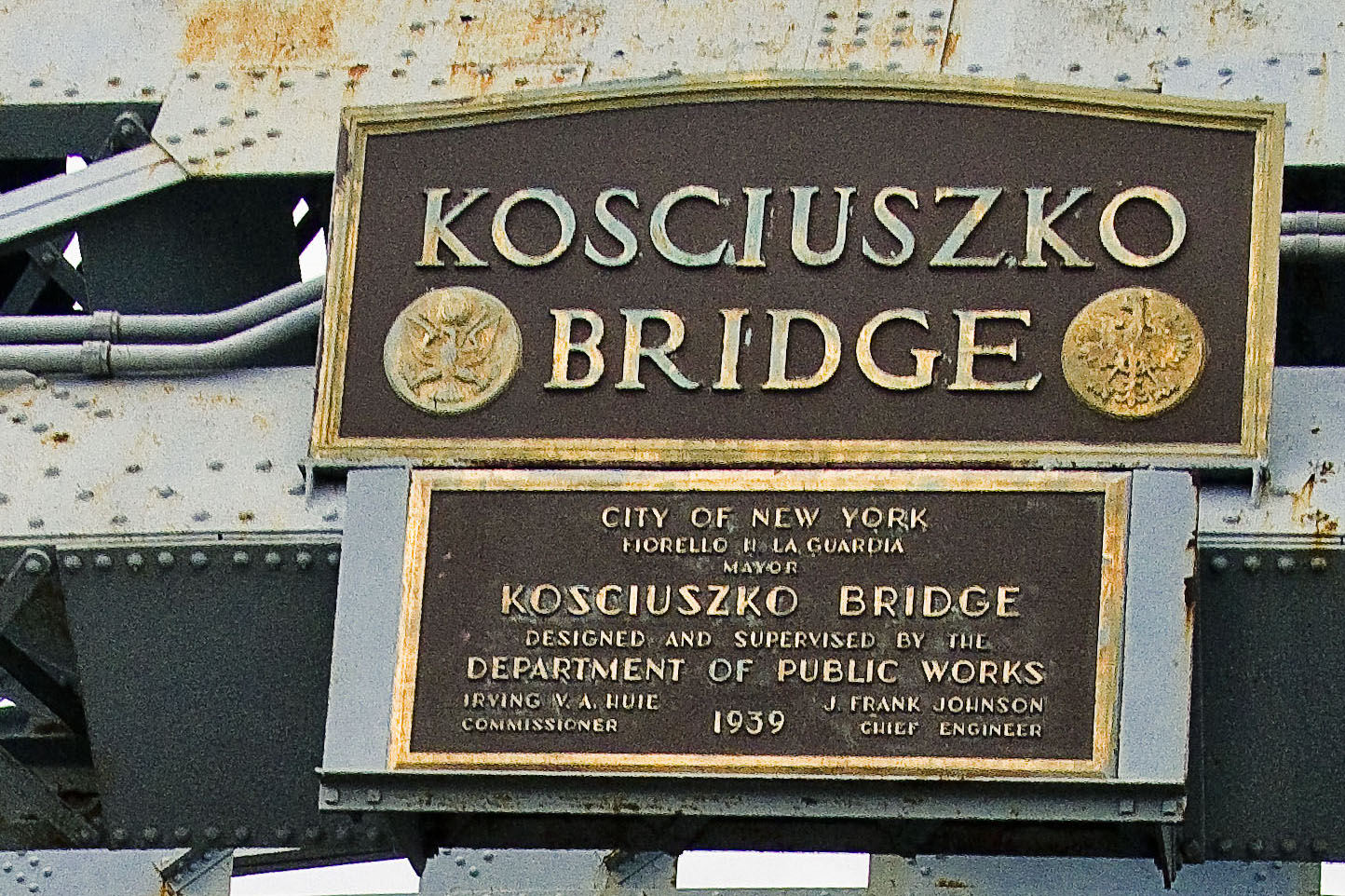
This is a reblog from exactly one year ago, commemorating both the Birthday of the Kosciuszko Bridge and the Night of the Living Dead.
– photo by Mitch Waxman
Oh, the old gray mare, she ain’t what she used to be,
Ain’t what she used to be, ain’t what she used to be.
The old gray mare, she ain’t what she used to be, Many long years ago.
Seventy Four years ago today, the Little Flower cut the ribbon and officially opened the “New Meeker Avenue Bridge” to traffic. The following April in 1940, it was renamed as the Kosciuszko Bridge.
It’s the Night of the Living Dead, by the way. Also, it’s Vulcanalia…
August 23, 1939, image New York City Municipal Archives at nycma.lunaimaging.com

– photo by Arthur J. Foley
According to the Long Island City Star-Journal of August 24th, 1939– the lineup of folks in the shot and action above are described as:
Mayor LaGuardia snips the ribbon which admitted the first autos lo use the lofty new Meeker Avenue Bridge over Newtown Creek in Laurel Hill, at the dedication held yesterday at Laurel Hill Plaza. To the right of the mayor is Acting Borough President John J. Halloran of Queens. To his left is Borough President Raymond V. Ingersoll of Brooklyn. Left of Ingersoll is Frederick J. H. Kracke, who was commissioner of Plant and Structures when that department originated plans for the bridge.

– photo by Mitch Waxman
American Bridge Company and Bethlehem Steel worked on her, along with dozens of other contractors. The Big K was part of what was known as “the Regional Plan”, which also provied the pretext for the erection of the Triborough, Whitestone, Marine Parkway and a slew of other bridges across the archipelago.
July 14, 1939, image New York City Municipal Archives at nycma.lunaimaging.com,

– photo by Arthur J. Foley

– photo by Mitch Waxman
Odds are very good that this is her last birthday (wrong again, Mitch), as the “Fast Track” program announced by the Governor will be kick starting the construction of a “Newer Meeker Avenue Bridge”- or perhaps the “Kosciuszko Two”- by the late spring of 2013. She will be gone by 2017, if one were to believe the schedule currently touted by State officials.
June 29, 1939, image New York City Municipal Archives at nycma.lunaimaging.com,

– photo by Joseph Shelderfer

– photo by Mitch Waxman
The historic shots included in this post all link out to the New York City Municipal Archives site, which has famously begun releasing thousands of historic images of the City online. One of the tricks to using the system, I’ve discovered, is knowing what things used to be called. It’s a “streetcar” versus “trolley” kind of thing. We call the former light rail system by the latter name, while those who dwelled in the past used the former.
June 29, 1939, image New York City Municipal Archives at nycma.lunaimaging.com,

– photo by Joseph Shelderfer

– photo by Mitch Waxman
Very little information is available about the construction and planning of the Kosciuszko, but there’s plenty about the New Meeker Avenue Bridge. The Big K was built for two official reasons- first, to provide a link between the multitudes of infinite Brooklyn and the World Fair Grounds in Flushing (Flushing Meadow Corona Park), and secondly to replace the aging swing bridge that spanned Newtown Creek between Meeker Avenue in Brooklyn and Laurel Hill Blvd. in Queens. Unofficially, Robert Moses really wanted to get the Brooklyn Queens Expressway built and this was as good a place as any to start.
August 14, 1939, image New York City Municipal Archives at nycma.lunaimaging.com,

– photo by Arthur J. Foley

– photo by Mitch Waxman
One does look forward to that day in the latter half of this decade, which I seriously doubt will be anything even close to 2017, when the pedestrian lane of the new bridge will be open for inspection. One of the most frustrating parts of the current bridge is that it once sported such a lane for perambulation, but it has long been closed off- thwarting photographic exploitation of the surreal vantage point that it offers.
How I would love to set up a tripod on the Kosciuszko Bridge…
from nydailynews.com
Construction on a new bridge is now expected to begin in spring 2013 — a year ahead of schedule, thanks to $460 million made available for the job by Gov. Cuomo’s New York Work initiative.
The 73-year-old bridge, which carries the Brooklyn-Queens Expressway over the Newtown Creek, qualified for the money in part because it is on the state’s “deficient bridge” list.
The initial phase of construction will build an eastbound lane next to the existing bridge, according to the state Department of Transportation, the agency overseeing the project. The 1.1-mile bridge is expected to be done in 2017 and will cost about $800 million.
When completed, two new spans with a total of nine vehicle lanes and paths for pedestrians and bikes will replace the original structure.
Here’s a rare historic shot- in color- of the mighty span, from the year it was opened, also courtesy New York Municipal Archives

– photo by New York City Municipal Archives

– photo by Mitch Waxman
And just as a reminder, in the name of public good and an abundance of caution- don’t forget about the whole Night of the Living Dead thing- this could be trouble.
from youtube–
Want to see something cool? Summer 2013 Walking Tours-
The Poison Cauldron of the Newtown Creek – Saturday, August 24, 2013
Newtown Creek walking tour with Mitch Waxman and Atlas Obscura, tickets now on sale.
clumsy modification
I call thee vibrant and diverse, names by which thou shalt be known.

– photo by Mitch Waxman
Bland and homogenous, the rest of New York City must be a wasteland ruled by a monolithic uniculture wherein all speak the same language and subsist on a flavorless protein paste. Woe to the quartet of other boroughs, for Queens has locked up all the color and intrigue, and it is both illegal and immoral to cook with curry or cumin in Staten Island or the Bronx. We got all the peppers out here as well, so enjoy your bland gravies Manhattanites.
I have come to this realization the last time somebody in the City reacted to the unexpected news that I live in Astoria with the ubiquitous “I love Queens, it’s so vibrant and diverse, and I was in Astoria sometime in the 70’s when I had Greek food.”
By the by, the two kids in the shot above had a small table with signage that read “everything, a dollar.”
from wikipedia
Astoria is a middle class and commercial neighborhood with a 154,000 population in the northwestern corner of the New York City borough of Queens. Located in Community Board 1, Astoria is bounded by the East River and is adjacent to three other Queens neighborhoods: Long Island City, Sunnyside (bordering at Northern Boulevard), and Woodside (bordering at 50th Street). Astoria is patrolled by the New York City Police Department’s 114th Precinct.
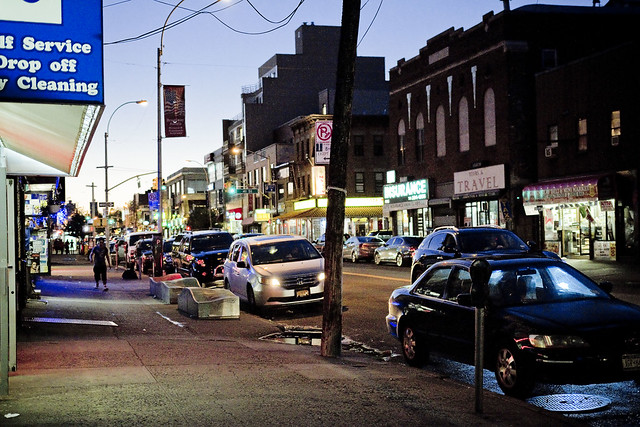
– photo by Mitch Waxman
To begin with, Astoria ain’t all that Greek anymore, they’ve largely moved on and are renting out restaurant space to the highest bidder. The section I live in is equal parts Croatian, Brazilian, Mexican, Ecuadorean, African American, and everybody else is a product of the old 20th century melting pot. The societal engineering that drove my grandparents to speak heavily accented english is gone, and the best way to describe the modern system is to reference the old testament.
This “vibrant and diverse” thing drives me crazy, something that is touted by Manhattan liberals who live in vertical affluence and believe what Time Warner Cables’ NY1 tells them and who haven’t visited Queens since that time in the 70’s they went out for Greek. Get to Queens and talk to somebody who doesn’t look like or agree with you, cliff dwellers.
from airbnb.com
If you’re looking for great Greek food or an exotic microbrew, look no further than Astoria. This northern Queens neighborhood exudes a youthful charm and welcoming attitude. In Astoria, mom-and-pop shops snuggle up to humble townhouses whose residents address one another by name. Strikingly diverse groups of people intermingle with appreciative ease in this laid-back neighborhood’s various culinary destinations and quiet streets.

– photo by Mitch Waxman
Some of our vibrancy is expressed in illegal dumping, the native art form of western Queens. To wit, recently observed is yet another iteration of the single shoe phenomena on Broadway nearby the 46th street stop on the R. I’ve written about this a couple of times, and am not altogether convinced that there isn’t some amputee serial killer at work in the neighborhood. Vibrant diversity, however, would explain the presence of a population of peg legged sociopaths.
from oddshoefinder.com
Welcome to Oddshoefinder.com, a free site that connects people with odd shoes with people who need odd shoes! Many people with feet of different sizes buy one pair of shoes for each shoe size and use only one shoe from each pair, leaving a closet full of unused shoes. The purpose of this site is to help you get those shoes out of your closet and put money into your pocket.
Want to see something cool? Summer 2013 Walking Tours-
The Poison Cauldron of the Newtown Creek – Saturday, August 24, 2013
Newtown Creek walking tour with Mitch Waxman and Atlas Obscura, tickets now on sale.
sweet chariot
Another unexpected encounter with a cool car.

– photo by Mitch Waxman
Perambulating along recently, one found himself at the corner of 31st street and 38th Avenue here at the border of hospitable Dutch Kills and raven haired Astoria. This is one of those posts where I show off my detective skills, as I did not recognize the model of this classic car. It is, and was, a Pontiac.
That’s all I had to go on.
from dmv.ny.gov
A historical vehicle is a vehicle that is more than 25 years old. A vehicle qualifies for a historical registration when it begins the 26th model year. For example, a 1978 model vehicle qualifies for historical registration in 2004.
Some vehicles that are less than 25 years old and have unique characteristics can qualify for a historical registration. The DMV determines if the vehicle has historical, classic or exhibit value.
A vintage vehicle is a historical vehicle and receives a historical registration. The registrant of a vintage vehicle can put vintage plates on the vehicle. Vintage plates are authentic NYS vehicle plates that were issued during the model year of the vehicle. More information about vintage plates appears below.

– photo by Mitch Waxman
The body styling suggests the 1950’s with its swept back fenders, excessive ornamentation of general “look and feel.” There are several body shops and auto detailers in the area between here and Astoria Blvd. and those of us lucky enough to live in Astoria have become blase about seeing manufactured items of enduring quality and esthetic achievement parked on the street, so even a late model Pontiac from the golden age of American auto manufacturing seldom catches the notice of jaded area wags.
from wikipedia
Pontiac was an automobile brand established in 1926 as a companion make for General Motors’ Oakland. Quickly overtaking its parent in popularity, it supplanted the Oakland brand entirely by 1933 and, for most of its life, became a companion make for Chevrolet. Pontiac was sold in the United States, Canada, and Mexico by General Motors (GM). Pontiac was marketed as the performance division of General Motors for many years, specializing in mainstream performance vehicles. Pontiac was relatively more popular in Canada, where for much of its history it was marketed as a low-priced vehicle.

– photo by Mitch Waxman
The major identifiers, there were two, are the star motif on the rear fenders and the shape of the dashboard. The fact that all the controls and indicators were contained in an oval marked this car’s model year, and the stars provided incontrovertible proof that this was a Pontiac Star Chief from 1957.
This car is 56 years old, and is considered to be highly collectible by auto enthusiasts.
from wikipedia
Between 1954 and 1957, the Star Chief was Pontiac’s prestige model; the car was easily identified by its chrome star trim along its sides. When the storyline of I Love Lucy pointed towards a Hollywood setting in the 1954-1955 season, the characters “drove” (in episode 110, “California Here We Come”) to the West Coast in a 1955 Star Chief convertible. In 1954, Pontiac also introduced air conditioning with all the components under the hood, a first for the price range. Seat belts were added as options in 1956.

– photo by Mitch Waxman
Marketed as a sedan (4 doors), there were also coupe and station wagon versions of this model.
A true car fan will decry calling this a sedan and these is no post rising from the body, between the two door windows, to support the hard shell roof. Researching the vehicle, I came across a great site called pontiacsonline, which presents an enormous amount of period advertisements for the model and the one linked to below offers concrete proof that what we’re looking at is a Pontiac Star Chief.
from pontiacsonline.com


– photo by Mitch Waxman
Ultimately, the whole reason that this cool car exists at all is due to the efforts of a fellow named Semon Emil “Bunkie” Knudsen, a mid 20th century auto executive at General Motors. Due to Knudsen’s influence, Pontiac became quite involved with a growing organization which called itself NASCAR, and Pontiacs served the race organization as their pace cars for many years.
from wikipedia
Knudsen began working for General Motors in 1939 with Pontiac Division and rose to management quickly, becoming general manager of the Detroit Diesel Division in 1955, a vice-president of the company and general manager of Pontiac Division in 1956.
When appointed head of Pontiac, he was given the mission to improve sales. At that time Pontiac had a reliable but stuffy image. Knudsen brought in Pete Estes from Oldsmobile as chief engineer and hired John DeLorean away from Packard to be his assistant, with the assignment to create high performance versions of their existing models. The Pontiac Bonneville and the “wide-track Pontiacs” came from this effort. Pontiac became heavily involved in NASCAR racing under Knudsen.
Want to see something cool? Summer 2013 Walking Tours-
The Poison Cauldron of the Newtown Creek – Saturday, August 24, 2013
Newtown Creek walking tour with Mitch Waxman and Atlas Obscura, tickets now on sale.
carven into
Getting back home is what its all about.

– photo by Mitch Waxman
My travels routinely find a humble narrator in far flung corners of the megalopolis which are remote from the north western corner of Queens wherein one dwells. Whatever event has carried me to these impossibly distant locations, it is paramount in my mind that I need to get back home to Queens and Our Lady of the Pentacle and my little dog Zuzu. Often will I find myself, as above, on a Staten Island Ferry looking through the ridiculously long transit tunnel which will provide me with a solution to this problem.
They used to carry cars on these boats, y’know, now this section is just for bicycles.
from nytimes.com
Deckhands said Ms. Bayer, sitting at the wheel of the car at the head of a sleepy line of drivers, appeared to have dozed off as the ferry lumbered across the harbor, just as the sun was turning the sky into a pink and orange patchwork of clouds. But as the ferry approached the terminal on Staten Island and the crew lowered the black metal gate, the deckhands said, Ms. Bayer was apparently jolted awake. The car began rolling, but the John F. Kennedy was not yet in the dock.
”It took off like a rocket,” said Kevin Hennessey, a deckhand. ”It was like something out of the movies.”
The first mate, Mickey Mardikos, said the car screeched ”and she went flying through the gate.”

– photo by Mitch Waxman
With all the track work and repairs occurring on the weekends, it can be a real hassle getting to and from Queens. Ironically, I live not more than a mile from the transit hub which is Queens Plaza, but getting from Lower Manhattan to this spot on a saturday can often entail multiple transfers and “thinking on your feet.” Recently, it took me around a hour and forty five minutes to get from the Staten Island Ferry Whitehall terminal to Astoria, a distance I could have walked in around two and half hours.
Incidentally, the chronology quoted does not incorporate waiting for the train(s) to arrive, nor walking to and from the stations- it’s actual “on the train time.” Adding this time in makes taking the train anti competitive to just hoofing it. The closer you get to Queens, the more barriers and “gotchas” you hit.
from wikipedia
Queens Plaza is a plaza located on Queens Boulevard, between North and South Plaza streets, in Long Island City, Queens. The plaza is overlapped by an elevated railway transit (which was constructed in 1914), with the Queensboro Bridge starting on the western edge. It has a subway stop for the E M R trains at the Queens Plaza station below ground along the eastern edge, and the 7 <7> N Q trains at the Queensboro Plaza station above the west central part of the plaza on elevated tracks.

– photo by Mitch Waxman
Many have commented to me that I should just “accept the things I can’t control” and roll with it. It’s “nobody’s fault” and this necessary series of repairs are just a part of life in the big city.
I always respond, while ruminating on how much I’d rather be at home amongst the rolling hills of almond eyed Astoria, that moving around within Manhattan remains a cakewalk. It’s the connections with Queens that always seem to be problematic. Politicians offer that there is always the East River Ferry, which leaves you off at second street in LIC in the middle of nowhere at Hunters Point and runs on an hourly schedule during the weekend. They then say “Citi Bike” as if it means something.
May I offer that there is no such thing as a weekend in NYC anymore, and that anything which keeps me away from Our Lady of the Pentacle and my little dog ZuZu is sure to draw my ire?
Also, it is H.P. Lovecraft’s birthday today, he would have been 123 years old had he joined with Father Dagon and Mother Hydra in the cyclopean and many-columned street of Y’ha-nthlei, the subaqueous city of the Deep Ones.
from wikipedia
Homesickness frequently occurs when one travels and may be exacerbated by unfamiliar environments or foreign cultural contexts. Homesickness is especially common in youth. Young people may experience a sense of dread, helplessness, or separation anxiety on their first day of school, summer camp, or on a protracted summer vacation away from the family. Many first-year students at boarding schools or universities also experience homesickness. Some new members on military basic training and members on missions or deployments might also experience it.
Want to see something cool? Summer 2013 Walking Tours-
The Poison Cauldron of the Newtown Creek – Saturday, August 24, 2013
Newtown Creek walking tour with Mitch Waxman and Atlas Obscura, tickets now on sale.


 The Newtown Pentacle