Archive for November 2016
maximum diameter
Well, that sucks.

– photo by Mitch Waxman
One is dismayed at the results of yesterday’s election results, and I’m in fact struck dumb by them. I was hoping that the United States wouldn’t succumb to its baser instincts in this election, but I’ve been disappointed before. It always strikes me as odd that working class people across the country continually vote against their own interests – which is what a vote for either one of the major parties ultimately turns out to be.
Saying that, as I’ve opined several thousand times in the last year – the National level stuff is above my pay grade, and that the only thing we can really have any effect on are the local issues.

– photo by Mitch Waxman
I can offer you predictions – based on having lived through several rightist swings in the White House about what the next half decade holds. There will be war, and recession, an unregulated corporatist nirvana, and the very same rural and rust belt people who voted the new administration into power will be the ones most impoverished by its policies.
This is nothing new, of course, and it hasn’t been so since Marius and Sulla.

– photo by Mitch Waxman
The mistake made by the leftists in this election was in the choice of a technocrat candidate who seemed to be awaiting a popular voter enabled coronation to the Presidency – despite being remarkably unpopular. The national level party bosses repudiated, and destroyed, the chances of the populist wing in their own party structure in the name of ensuring this coronation. As the Book of Revelations says – you are neither hot nor cold, you are lukewarm, and I spit you out.
They ran a 20th century campaign in 2016, and lost.

– photo by Mitch Waxman
The rural/urban divide is something I’ve been talking about for a long time, incidentally. I’m of the belief that we are headed for a second Civil War in these United States, one that isn’t based around a North and South divide, but instead one that is based around whether you live in a City or a Town.
Cities are internationalist, towns nationalist.

– photo by Mitch Waxman
Beyond all of that, one is absolutely speechless and sort of terrified. Apoplectic is an appropriate word.

– photo by Mitch Waxman
Thing is, this election came out of NYC.
“follow” me on Twitter- @newtownpentacle
lustrous balustrade
A few odds and ends, in today’s post.

– photo by Mitch Waxman
An ex-Cat, this skeleton was observed in Long Island City up on the Montauk Cutoff tracks about a week ago. There were raccoon tracks surrounding it, which probably explains a lot about where the rest of the cat is. Pretty gross shot, I guess, but there’s a whole lot of existential reality all over LIC when you peek into its shadowed places.

– photo by Mitch Waxman
A renewal of my previously stated opinion that the 7 line is far and away the most photogenic of NYC’s subways is offered. A comparison to Michelle Pfeifer in the movie “Scarface” would be made, but it’s inappropriate.
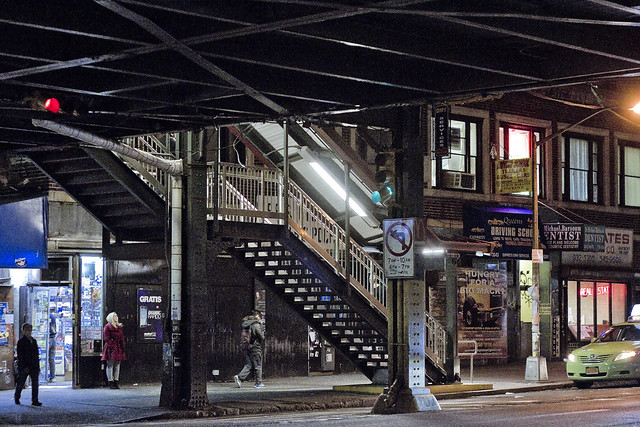
– photo by Mitch Waxman
Finally, did you know that the “King of Shwarma and Falafel” food truck people have opened a brick and mortar storefront on Astoria’s Broadway at 31st street? Practically under the El? I do, which is why I was waiting for Our Lady of the Pentacle on that instersection recently, and I cracked out this noirish shot of the N/Q stairs to pass the time.
Mmm… Shwarma.
“follow” me on Twitter- @newtownpentacle
inhuman squeals
Shots from Halloween 2016, Astoria.

– photo by Mitch Waxman
As stated, my plans for Halloween involved taking up station at the neighborhood pub and waving the camera about at people in costumes while Our Lady of the Pentacle and my pal Death handed out candy. This is sort of an annual tradition for us, and for those of you outside of NYC – hereabouts the trick or treaters don’t ring residential door bells for their candy, instead they go from shop to shop along the “commercial” streets like Broadway here in Astoria, Queens.

– photo by Mitch Waxman
The fellow above should have won some sort of award for his pumpkin themed business suit.

– photo by Mitch Waxman
There were a lot of superheroes about. We counted around five Harley Quinn’s, dozens of Batmen, Jokers, and other comic characters. Supergirl was quite popular this year, I’m happy to report.

– photo by Mitch Waxman
Astoria goes “all in” on Halloween, whether it be just the kid or her mom too.

– photo by Mitch Waxman
That’s my buddy Death.

– photo by Mitch Waxman
Every few minutes, you’d hear bunches of people sighing “awww-wwuuhh.”

– photo by Mitch Waxman
Some kid’s parents let him buy the inflatable dinosaur suit seen above, which is something I would have sold my soul for when I was 6 or 7.

– photo by Mitch Waxman
There were lots of grown ups all done up as well.

– photo by Mitch Waxman
Awww-wwuuhh.

– photo by Mitch Waxman
This kid pretty much won Halloween.

– photo by Mitch Waxman
So did these two.

– photo by Mitch Waxman
When I pointed the camera at this family, Captain America there jumped right in front of the lens. Great thing about Halloween is hamming it up, I guess.
“follow” me on Twitter- @newtownpentacle
haggard and ghastly
Eldridge Street Synagogue, in today’s post.

– photo by Mitch Waxman
As mentioned in yesterday’s post, a humble narrator was invited to a “thank you” event for the Open House NY weekend site hosts (we produced a Newtown Creek Alliance event at the 520 Kingsland Avenue Green Roof this year). The event was set for six o’clock in what is now Manhattan’s Chinatown, at the 1887 vintage Eldridge Street Synagogue, a 19th century institution which had fallen into disrepair during the middle 20th century, but which has been restored and converted over for use as a museum.
from eldridgestreet.org
The Eldridge Street Synagogue opened its doors at 12 Eldridge Street on September 4, 1887, just in time for the Jewish High Holidays. Hundreds of newly arrived immigrants from Russia and Poland gathered here to pray, socialize and build a community. It was the first time in America that Jews of Eastern Europe had built a synagogue from the ground up.
Dozens of Stars of David decorate the Eldridge Street Synagogue’s façade. Here in America, Jews could worship openly and freely. The synagogue was a proud declaration of newly- found religious freedom for the synagogue’s immigrant founders. The synagogue was also emblematic of their economic aspirations. With its soaring 50-foot ceiling and exuberant Moorish-style interior, Eldridge Street provided an inspiring contrast to the crowded tenements, factories and shops of the Lower East Side.
For fifty years, the synagogue flourished. Men and women came in their finery, and mounted policemen patrolled the crowds. The congregation hired world-renowned cantors and in 1918 hired Rabbi Aharon Yudelovitch, the first in a series of famed Talmudists and speakers. Thousands participated in religious services in the building’s heyday, from its opening through the 1920s.

– photo by Mitch Waxman
One such as myself enjoys being in the company of other historically minded folks, it should be mentioned, but I’ve always found the people I meet at these sort of gatherings to be somewhat stuffy types who take themselves quite seriously, and that my particular and inescapable sense of humor is neither appreciated nor expected by them. Accordingly, a minimal amount of time is devoted to “socializing” with the “Manhattan people.”
Instead, I wander around and take photos.
also from eldridgestreet.org
“It was as though the synagogue was held up by strings from heaven,” said Roberta Brandes Gratz, founder of the Museum at Eldridge Street, of her first impression of the synagogue in the early 1980s. Pigeons roosted in the balconies and benches were covered with dust. Gratz and others rallied to save the building. They formed the non-sectarian Eldridge Street Project, pre-cursor to the Museum at Eldridge Street. The synagogue was designated a National Historic Landmark in 1996 and more than $20 million was raised to restore it to its original grandeur.
The Museum completed the Eldridge Street Synagogue restoration in December 2007, the synagogue’s 120th anniversary. The restoration received nearly every major preservation honor, including the prestigious National Trust for Historic Preservation 2008 Preservation Award. The crowning piece of the Museum’s restoration is a magnificent new stained-glass window by artist Kiki Smith and architect Deborah Gans.
Today the Eldridge Street Synagogue is home to the Museum at Eldridge Street, which welcomes people from around the world for tours, school programs, concerts, lectures, festivals and other cultural events. The building also continues to be home to Kahal Adath Jeshurun. This small Orthodox congregation has never missed a Saturday or holiday service in the more than 120 years since the synagogue first opened.

– photo by Mitch Waxman
The overall architectural impression received from visiting the Eldridge Street Synagogue was that a significant Moorish and or Galician influence was evident in its design. I’ve seen ruins of synagogues in Southern Europe, built during the days of the Ottomans, which this structure reminded me of – but nothing of the size nor as ornate as the one on Eldridge Street. That’s America for you, I guess.
from wikipedia
The Eldridge Street Synagogue is one of the first synagogues erected in the United States by Eastern European Jews (Ashkenazis). One of the founders was Rabbi Eliahu the Blessed (Borok), formerly the Head Rabbi of St. Petersburg, Russia. It opened at 12 Eldridge Street in New York’s Lower East Side in 1887 serving Congregation Kahal Adath Jeshurun. The building was designed by the architects Peter and Francis William Herter, (but unrelated to the Herter Brothers cabinet-makers). The brothers subsequently received many commissions in the Lower East Side and incorporated elements from the synagogue, such as the stars of David, in their buildings, mainly tenements. When completed, the synagogue was reviewed in the local press. Writers marveled at the imposing Moorish Revival building, with its 70-foot-high vaulted ceiling, magnificent stained-glass rose windows, elaborate brass fixtures and hand-stenciled walls.

– photo by Mitch Waxman
The Star of David is everywhere you look on the front of the building, an elder sign meant to act as both a ward and an announcement that “we are here.” Chatting with one of my cousins about this location afterwards, I kept on coming back to the sort of “Sheols” which the Waxman clan frequented in Brooklyn. There are three forms of modern Judaism in the United States – Reformed, Conservative, and Orthodox. I grew up in the former variant, and our ritual centers could best be analogized to Christian churches as being plain and unadorned in the manner of Lutheran or Presbyrterian temples. Eldridge Street was an Orthodox center, and they liked to pour it on in the sort of manner for which the Roman Catholic and Greek Orthodox churches are known for. The modern day Orthodox are fundamentalists, and eschew this sort of “glitz.”
from nytimes.com
By 1910, according to the historian Hasia R. Diner, the neighborhood contained half a million Jews; by contrast, Vienna, one of the largest Jewish centers in Europe, had a Jewish population of 175,000, and Chicago, about 100,000. This neighborhood had one of the largest Jewish populations of any city in the world — and surely one of the poorest. Most of the area’s 60-some synagogues were humble gathering places named after the Eastern European towns and shtetls from which their worshipers had fled, resembling the social clubs that develop among many immigrant communities.

– photo by Mitch Waxman
If you know anything about Jewish mysticism, which the Orthodox are well known practitioners of, you’ll spot instances of Kabbalist motif all over Eldridge Street. The Sephiroth and other occult concepts are omnipresent, and really seem to be governing the designs laid down by architects Peter and Francis William Herter.
from njit.edu
This synagogue was built in part to assert the importance of this Orthodox congregation in opposition to the more liberal German Jewish population which bad preceded them. The feeling was that German Jews had become to Americanized and assimilated and had, therefore, given up many of their traditional Jewish practices in favor of the more liberal reform movement. The construction of Eldridge Street Synagogue was a statement on the part of its congregation that one does not need to abandon strict Judaism to su~ in America. The opulence and ornament of the synagogue compare to German Jewish/Reform synagogues of the same period. The architect of the building was the German firm of Herter Brothers, which went on to build numerous Lower East Side tenement buildings. This was not the first synagogue for this congregation, which was housed in earlier buildings prior to raising the capital for the construction of their own building.
Eldridge Street Synagogue is located on the block bounded by Eldridge Street on the west, Canal Street on the north, Allen Street on the east and Division Street on the south. The immediate neighborhood is a sheltered enclave, set off from the surrounding bustle in part by the Manhattan Bridge, which sits just above it. The building fills most of its lot, which is approximately 60 feet wide by 87 feet deep, but is set apart from its neighbors by narrow areaways. This block is part of the densely packed Lower East Side which is a neighborhood known for role as a point of first contact for immigrants throughout the last two centuries, a role that continues to this day.

– photo by Mitch Waxman
Eldridge Street, btw, is named for a soldier named Lieutenant Joseph C. Eldridge of the 13th U.S. Infantry, who died during the war of 1812. Eldridge was butchered by the Ottawa, in a fashion horrific enough that the British actually petitioned that American prisoners taken by the Ottawa be rendered to the King’s army in exchange for a substantial bounty. Chief Blackbird told the British that money meant nothing to his people, and refused.
from warof1812chronicles.blogspot.com
One of the essays in “THE WAR OF 1812: Writings from America’s Second War of Independence” told of “The Death Of Joseph C. Eldridge…,” a lieutenant with the 13th U.S. Infantry, who was ambushed by Chief Blackbird and other Ottawa warriors. The Ottawas, from Michigan, “joined the British army during the siege of Fort George,” and that is the vicinity where was killed. An investigation conducted by Colonel William Claus, of Canada’s Indian Department, ensued at the request of the Fort George commander after it was reported that Eldridge was tortured and killed in captivity.

– photo by Mitch Waxman
The second floor of Eldridge Street Synagogue is where the ladies would have been seated, but since it’s a museum now, I was allowed to go up there and get my shots. That’s a Bimah, in the shot above, incidentally.
from nyc-architecture.com
READER’S PLATFORM (Bimah) — The table upon which the Torah scroll is read. The location, in the center of the sanctuary, follows the older European tradition. The central location is to insure that all can hear the reading of the Torah, and refers to the location of the sacrificial altar in the Temple in Jerusalem. In many American synagogues the bimah is placed in the front of the congregation near the Ark. In Sephardic synagogues the bimah is generally located in the rear.

– photo by Mitch Waxman
Unfortunately, I didn’t bring my tripod with me on this excursion, but I did find a couple of spots where I could rest the camera for a minute. This allowed me to drop the ISO down to 100, and narrow the aperture for a greater depth of field and infinity focus. Next time I come back to Eldridge Street, I’m bringing the tripod.
“follow” me on Twitter- @newtownpentacle
creaking or thumping
The old part of town, in today’s post.

– photo by Mitch Waxman
Recent endeavor, specifically the Open House NY weekend event, resulted in one getting invited to a “site hosts” reception over in lower Manhattan last week. I’ll show you where that took place tomorrow, but as always, half the fun of going anywhere is the trip itself. The event invitation was for six in the evening, but since I didn’t have much else to do that afternoon it was decided to “make a day of it” and go wandering with the camera. After laying out food and water for the dog, I left Astoria and began my meandering path, one which ultimately found me in LIC boarding an East River Ferry bound for Pier 11/Wall Street that deposited me in the financial district. That’s the “House of Moses” flying around the Brooklyn Bidge, right at the corner of Dover and South Street, in the shot above.
My destination was on the east side of Chinatown, a section of Manhattan which offers a series of particularly interesting artifacts dating back to the early 19th century that somehow survived the “urban renewal” and “slum clearance” era of the middle 20th century. You can spot all three historic types of tenements in this neighborhood “pre,” “old,” and “new” law structures. It’s also a bustling section – crowded, messy, and full of different cultures bumping up against each other.
from wikipedia
Originally named East River Drive, FDR Drive was later renamed after Franklin Delano Roosevelt. The roadway was designed by Robert Moses. He faced the difficulties of building a parkway/boulevard combination along the East River while minimizing disruptions to residents. The section from 125th Street to 92nd Street is the original 1934 construction, while sections from 92nd Street down to Battery Park (with the exception of a section from 42nd to 49th streets) were built as a boulevard, an arterial highway running at street level. Future reconstruction designs from 1948 to 1966 converted FDR Drive into the full parkway that is in use today.
The section of highway from 23rd Street to 34th Street was built on wartime rubble dumped by cargo ships returning from Bristol, England, during World War II. The German Luftwaffe bombed Bristol heavily. After delivering war supplies to the British, the ships’ crews loaded rubble onto the ships for ballast, then sailed back to New York, where construction crews made use of it.

– photo by Mitch Waxman
You can take the boy away from his beloved Newtown Creek, but that doesn’t mean he’s not still fascinated by sewers. This non standard drain was spotted just to the southeast of the footings of the Manhattan Bridge. It was maybe 16 inches across, and clearly an artifact of the early city. My moles inside the modern day DEP tell me that the sewers in Chinatown are amongst the worst ones for them to maintain. Partially this is due to the density of the local population and their particular propensity for dumping greasy materials into the street drains, but it’s mainly due to the age of the local system and the limitations of 19th century engineering. I seem to recall that this was shot along Monroe Street, possibly at the corner of Market, but I didn’t jot down where I found it at the time.
Supposedly, there’s a few sewers down in these parts that are lined with lumber rather than concrete. Famously, the DEP was doing repairs on a water main at Beekman Street (and on Chambers) a few years back and they happened on colonial era water pipes that were constructed of hollowed out wooden logs.
from nyc.gov
Log water pipe discoveries are not without precedent. Archaeologists expect to find historical infrastructure such as water and sewer pipes, wells, cisterns and foundations in locations where early New Yorkers lived and worked. In fact, reports of wood water pipe discoveries south of Chambers Street date back at least 100 years. The unique thing about the Beekman Street discovery is that the wood pipes were discovered nearly intact – one pipe is missing its tapered end. What’s even more remarkable is that the pipes were still connected when they were found and form a contiguous section of New York City’s first water distribution infrastructure.

– photo by Mitch Waxman
86 Madison Street caught my eye while I was wandering about. Luckily, it also drew the scholarly attention of a person from the University of Delaware named Zachary J. Violette back in 2012, who produced an interesting dissertation comparing the tenements of NYC and Boston – check it out here.
from sites.udel.edu
Alexander Stake tenement, 86 Madison Street, New York, 1889. Alexander Finkle, architect. A heavily-ornamented New York tenement, this immigrant-built and designed building shows the use of belt courses, pilasters and window support elaboration. The ornate stamped-metal cornice bears the name “Lincoln”, a reference to the president and a typical invocation of power through the use of ornament.

– photo by Mitch Waxman
Given the facade work, the date of its manufacture, and a hundred other little details obvious to those of us who have learned how to “read” the City, the Lincoln building and its neighbors are “Old Law” tenements. As to the demographics of these parts, this neighborhood was predominantly Catholic (German and Irish, mainly) and a little bit Jewish (according to Jakob Riis – “Jewtown,” or the “Ghetto,” or as my grandmother called it – “The Shtetl”) was mainly on the east side of Delancey Street back in 1889 when these tenement buildings went up. The Chinese began to arrive in NYC in great numbers during the 1870’s, but their original “zone” of occupation was closer to Doyers Street, near Chatham Square, on the west side of the Bowery. When the Germans and Irish began to evacuate this area east of Bowery, the Chinese moved in.
from wikipedia
Old Law Tenements are tenements built in New York City after the Tenement House Act of 1879 and before the New York State Tenement House Act (“New Law”) of 1901. The 1879 law required that every inhabitable room have a window opening to plain air, a requirement that was met by including air shafts between adjacent buildings. Old Law Tenements are commonly called “dumbbell tenements” after the shape of the building footprint: the air shaft gives each tenement the narrow-waisted shape of a dumbbell, wide facing the street and backyard, narrowed in between to create the air corridor. They were built in great numbers to accommodate waves of immigrating Europeans. The early 21st century side streets of Manhattan’s Lower East Side are still lined with numerous dumbbell structures.

– photo by Mitch Waxman
My intended destination still awaited me, but I was having a pretty nice time wandering around Chinatown. Hungry, there was a particular meal, available in these parts, which I sought out.
Now, this is one of those stories… When my Dad used to force me to work with him on one of his Saturday jobs – he was a house painter who would pick up extra cash on the weekends – it would often be in Manhattan. We’d stop off at a Chinese bakery on the west side of Chinatown at the corner of Walker and Mulberry to get a box of “pork buns” and a couple of those ultra strong and ultra hot cups of black coffee commonly offered by such establishments. Whenever I eat this particular meal, I always think of the old man.
The “pork buns” are called “Bao” and whereas Chinese bakeries do indeed produce sweet cakes like the more familiar western ones do, they also manufacture incredibly flavorful and savory fare as well. There’s all sorts of variants on these, some are steamed, some filled with custard or dried pork, but a personal preference for the baked ones with the savory roast pork inside is offered. I procured a couple of the baked Roast Pork “Bao” and a cup of that super hot coffee, and then proceeded to sit down on a tenement stoop for a quick dinner before heading off to my eventual destination – which will be described in tomorrow’s post at this – your Newtown Pentacle.
“follow” me on Twitter- @newtownpentacle


 The Newtown Pentacle