Author Archive
Cruelty
Just a short one today. Still burnt out from the weekend’s tug boat races. Check out this video from tugster. I’ve got at least two major posts cooking right now.
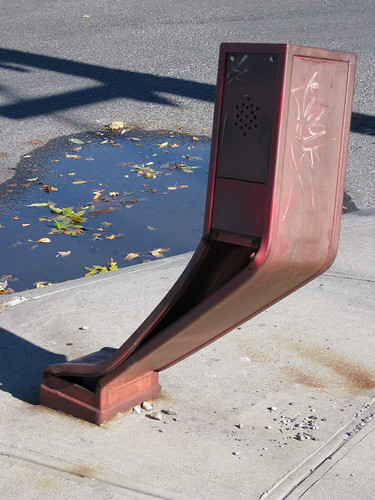
Project Firebox, 3350 – photo by Mitch Waxman
I realize and fully aspire to understand the harried mind of the metropolitan vehicular operator, but often wonder, how does one manage to ignore a 2 meter tall shiny red box until its too late?
The devastation endured by these silent sentinels is but one of the striking dichotomies one encounters when walking the shadows of concrete shrouded and legend haunted Newtown. To the benefit of this heterogeneous collection of guardian devices, which can raise titan armies of Fire and Police Departments at the touch of a button, their abuse must be remarked upon. We, as a community, must find some way to train drivers to notice the near presence of – a 6 foot tall gleaming metallic object with reflective surfaces. Calculation of its relative proximity to their vehicles would surely follow suit.
This is Project Firebox.

Project Firebox, 8778 – photo by Mitch Waxman
This was on Hunters Point Avenue, opposite a mattress factory outlet store. This I understood. Simple kinetics, an impact, and subsidence. Fine.
from wikipedia
Alarm Boxes: The second most common method is by means of F.D.N.Y. alarm boxes in the street and in certain public buildings such as schools and hospitals as well as highways, bridges, etc. These consist of the following primarily two types. The first is mechanical boxes, also commonly called pull-boxes or telegraph boxes in which a spring-wound mechanism alternately opens and closes an electrical circuit thereby rendering a coded number linked to the specific location of the box. Until the advent of the STARFIRE Computer-Assisted Dispatch System (CAD), dispatchers had to physically count the taps from mechanical boxes when they were received in the central offices. Today, a “Box Alarm Readout System” (B.A.R.S.) display handles that aspect of the job. The second type is the “Emergency Reporting System” (E.R.S.) boxes that are equipped with buttons to notify either FDNY or NYPD, allowing either department’s dispatcher to have direct voice communication with a reporting party. E.R.S. boxes began to replace mechanical boxes in many areas of the City beginning in the 1970s.

Project Firebox, 6368 – photo by Mitch Waxman
Down near Newtown Creek, this abandoned car was resting on this firebox for nearly a year, but this is a deserted little cul de sac near a hundred year old train station and the site of a long vanished bridge.
A pretty nice history of FDNY alarm boxes at google books

Project Firebox, 4477 – photo by Mitch Waxman
Where Astoria ends, and Dutch Kills begins, near Northern Blvd. Notice that it’s bent OUT, against the traffic.
Hey, somebody noticed the Newtown Pentacle
Check this out- an Astoria Times profile of Old Mitch and the Newtown Pentacle.
Big Newtown shoutout to reporter Jeremy Walsh.
Maspeth? Laurel Hill? Where am I?

– photo by Mitch Waxman
The angles found between neighborhoods are perilous and enigmatic, here in the Newtown Pentacle. Denigrated and given over to commercial interests, these areas which are neither here nor there- tick nor tock- exist outside of the normal rules that govern the more wholesome and presentable villages that surround them. Just to the south and east lies storied Maspeth, due south is centuried Greenpoint and colonial East Williamsburg, north is venerable Sunnyside and luminant Astoria.
The hill one climbs- the shot above is looking up said hill, and the one below is its counterpoint– was called Laurel in those days when august titans like Neziah Bliss strode the earth with omnipotent confidence in the future. So close to the Newtown Creek’s industrial heartland and Calvary Cemetery, one gains an impression of an undefinable sickness hanging about every malformed plant and pollution streaked brick. Hints of its former glory can be detected by observing an ornate cornice of finely carved masonry, or in proud cast iron logotypes found in rusted pilasters, atavistically claiming a structure for a long bankrupt company or proud individual proprietor.
There is a colour about the place. A queer iridescence, neither black nor white, which is the same sort of colour found in the Newtown Creek. It is not a terrestrial colour, the colour… is like something from outer space.

– photo by Mitch Waxman
43rd street continues its murderous and poorly graded ascent over the sickly hill, its sidewalk and street scribed with automotive fluids and petroleum residues. At the bottom of the hill is where copper was burnt out of its ore matrix using powerful acids for over a century. In previous explorative descriptions of the larger context of this place, I described a pathway around and into Calvary Cemetery and beyond. This exploration intersects with that one, and with another describing the Maspeth Plank Road.
This colour, it pollutes, and it has a smell- something metallic- like the sensation of licking a battery.

– photo by Mitch Waxman
Late, too late, had I set out for my journey through this place. The barking of hungry dogs and the scurrying of small things which, for the sake of my sanity, we’ll call rats- could be heard from behind the gates and within the very walls of the shuttered properties. I realized that, immersed as I was in my historical musings, I was completely alone on this street- there was no traffic. Always nervous and possessed of a weak psychological constitution which makes me prone to paranoid fantasy and physical cowardice, I decided to seek out the safety of companions and quicken my steps.
The effusive colour of the place, stronger now as I ascended Laurel Hill, was playing on my nerves. In my mind, I felt a growing warmth which was puzzlingly dry- and somehow cold as well- a disorienting and very bad idea forming in my mind. The colour.

– photo by Mitch Waxman
Seeking a guidepost, the obsequious spires of Manhattan could be seen rising over Calvary. With the BQE onramp for the Kosciuzko Bridge thrumming- in rythmic sense impacts- as vehicular traffic pulsed over the rough hewn and pitted slabs of masonry from which the road surface of that busy highway carried by the bridge is built, I had a moment of clarity and somewhat regained my senses. The odd colour, it was visibly not present over -or in- Calvary, whose plants and trees sway accordingly to the direction of the wind, not against it. A fever overtook my thoughts and I feared one of my “episodes” was beginning.

– photo by Mitch Waxman
Resting for a moment by a garbage bin whose inner sounds filled me with a malevolent premonition, I noticed that people actually do live here. Lovely, well cared for, and huge houses can be witnessed on 43rd street.
A testament to the character and resiliency of Newtownicans- these holdouts of a time when hard men and ironclad women bit into life with shining teeth, live in the middle of an area reviled and shunned by most. This is at most 2-3,000 feet from either Phelps Dodge and Calvary, and within shooting distance of an industrial waterfront fallen on hard times. Only those who move into the new housing units proposed for Hunters Point will be able to boast of living closer to the bulkheads of the Newtown Creek.
Except for this guy.

– photo by Mitch Waxman
At the summit of the hill, whose attainment by a physical specimen as poor as myself is a breathless experience, a highway cloverleaf cuts 43rd street off at 54th avenue- and the road offers a right hand turn that continues to climb higher. Especially prevalent here, the colour adorns the illegally dumped truck and automobile tires and variegated forms of construction debris that accompany all dead end streets in western Queens. Squamous little bushes adorn the curblines, and potholes mark the asphalt. In those cavities, cobble stones are illuminated by the merciless Newtown sun, revealing an earlier world which our modernity increasingly seems to be a cheaply wrought imitation of.

– photo by Mitch Waxman
Following the erratic and illogically sharp curve of the 54th ave., which matches the arc of the highway that has precedent right of way- and cuts this area off from the surrounding communities- the colour persisted.

– photo by Mitch Waxman

– photo by Mitch Waxman
Be sure to look all around you here. Spectacular views of Manhattan are to the west, and you are standing pretty close to the top of the hill.
At this elevation, we are actually looking right over Long Island CIty and the Newtown Creek which are close to or at sea level.
I have always lived in terror of some seismic event or industrial accident disturbing the vast deposits of the subaqueous Methane Clathrates in the New York Bight. This potential petrochemical replacement for oil is so plentiful in the waters surrounding New York State that many energy companies are exploring methods of economically harvesting it. The Saudi Arabia of these undersea “ice which burns”, incidentally, just happens to be the northeast coast of North America. Were there to be a sudden upwelling of these frozen gases, it would trigger a tsunami wave that would flood New York City’s lowlands in a way that would dwarf… well- it has happened in the past.

– photo by Mitch Waxman
Relict building stock abounds, but remain occupied. I attempted conversation with an area resident found on a different block, a skeletal man in his early 40’s, but noticed that the colour seemed to be dancing around in his eyes and his complexion was wan and jaundiced. I asked him- Is this Maspeth, or Laurel Hill? In a nervous whisper, he informed me that he didn’t know- then glanced over his shoulder into a house- and asked me if I knew that he knew that I know that he knows that I know that he knows I was a cop.

– photo by Mitch Waxman
I said “yes”, and moved along. I’m not a cop.

– photo by Mitch Waxman
Everything I saw here was eaten away at by that damned dry cold hot colour- a queerly iridescent patina so familiar to those inveterate observers of the Newtown Creek and its environs.
Who can guess what this home of former style and antiquarian taste saw- its joyous weddings and births, the tragedy of its funerals and disease. How many families welcomed their sons home from war, or sent their daughters off to college from this place? What heroic immigrant struggle played out between the clapboard walls? And when did this colour begin to manifest itself here, and why?
I cannot believe it just fell from the sky one night.
Whatever happened here, its all gone. Lost to time and dissolution and the tyranny of the silent tomb. Like so much of our Newtown history, these tales will be unremarked and forgotten.

– photo by Mitch Waxman
Still looking for Greenpoint, Williamsburg, Bushwick, Maspeth, Astoria, LIC, Elmhurst, Newtown Ghost Stories- by the way- Halloween is coming. Send anything you’d like to share to me privately through this address. I’ll contact you back and we’ll arrange details, you’re as anonymous as you’d like to be. Developing a multi witness one right now, which folks in the 40’s along 34th avenue and Broadway in Astoria have described. Have you seen “her”?
Long Island City Zen 2 -The Empty Corridor
Know this spot?

50th avenue and 25th street – photo by Mitch Waxman
This is 50th avenue and 25th street, and here’s a google map (I suggest hitting street view and exploring an area via the google service, it’s really helpful to get an idea of what’s “there”). Which, in this case is a whole lot of infrastructure. The elevated LIE allows vehicular traffic to hurtle along on a sloping ascent, reaching as high as 106 feet in some places. The fuligin shadow cast by the steel aqueduct falls on an area of Long Island City I like to call “the empty corridor”.
from wikipedia:
The expressway begins at the Queens-Midtown Tunnel in the Murray Hill section of Manhattan. Upon emerging from the tunnel in Queens, it is formally subdivided by name into three sections: the Queens-Midtown Expressway from the tunnel toll plaza to Queens Boulevard, the Horace Harding Expressway from said intersection to the Nassau County line, and the Long Island Expressway in Nassau and Suffolk Counties, though almost all locals and most signage use “the Long Island Expressway” or “the L.I.E.” to refer the entire length of I-495.[3] A mile after entering Queens, the LIE meets Interstate 278 (The Brooklyn-Queens Expressway) at interchange 16. Not long after Queens Boulevard, the LIE meets the Grand Central Parkway, then immediately after, the Van Wyck Expressway (I-678).

stitch panorama, looking southeast – photo by Mitch Waxman
Its an inaccurate pun, of course, as there are gargantuan municipal (New York City Housing Authority – although their front door is on 49th ave.) warehouses, truck yards, and active masonry mills operating all along the pocket street of 50th avenue. Enclosed on one side by 27th street, which follows the course of the nearby Dutch Kills, 50th is also abruptly severed by first the rear entrance, trackbeds, and associated workhouses of the Long Island City station of the 800 pound gorilla, then by the highway complex that feeds traffic to Manhattan via the Midtown Tunnel. It resumes its course to the river near 11th place, but is aborted in its aim by the Gantry Plaza Queenswest development at Center Blvd.

stitch panorama, looking southwest- photo by Mitch Waxman
The train station was destroyed a few times, especially in 1892, when a conflagration broke out at its coal dock on nearby Newtown Creek. The LIRR lost the dock itself and its stored fuel, part of the coal chute, and the locomotive repair shop. Spontaneous combustion in a cotton storage shed was blamed. Another fire in 1902 (there were lots of huge fires around the area in this time period, oddly enough) consumed the rebuilt station and an adjacent office building. It was rebuilt in 1903, electrified in 1910, and has been completely ignored since. It is the end of the (main) line.
A block to the south is Borden Avenue, to the north is 49th avenue.

east – photo by Mitch Waxman
The spire of St. Raphael’s on Greenpoint Avenue, sentinel church to Old Calvary– can be glimpsed through the steel. That is also where the highway returns to earth before beginning the ascent to the Kosciuszko Bridge spanning the Newtown Creek. That’s 27th street where the fences are. Normally, one can reach Borden Avenue and cross the Dutch Kills via this garbage strewn lane, but the Borden Avenue Bridge is still undergoing emergency repairs.

50th and 27th- photo by Mitch Waxman
I find strange things down here, in this place where cobblestones have never known asphalt. Until just a few months ago, a group of men lived in a broken down car on this corner. They had modern conveniences, electrical power generously supplied by serpentine orange extension cords that ran up and into the bushes by the railroad tracks. I observed them over a couple of years, and then found their car burnt, them missing, and this bird in their place. After a month, even the car was gone.

west – photo by Mitch Waxman
The empty corridor (or as I’ve called it in the past- Down under the LIE- DULIE) makes a sound. A constant droning pitch produced by approximately 84,000 quartets of automobile tires a day drawing across the steel and cement at controlled speeds. The sound of racing engines create doppler waves as their sounds ripple against the warehouse buildings. You are surrounded by this sound, enveloped in its chordal structure. All of New York’s bridges and elevated arteries have a distinctive sound, I have noticed. I have failed in my attempts to record these sounds due to wind, street noise, and inappropriate or amateurish equipment.
The folks who are into this sort of sonic thing are onto some revolutionary ideas, human perception wise. Check out these Hearing Perspective kids, and then stop off at wikipedia to learn the deep secrets of harmonic resonances and the hidden existence of Tuned Mass Dampers, and of the only man who ever truly mastered their manipulation mechanically- Nikola Tesla.

Dutch Kills – photo by Mitch Waxman
The elevated LIE spans over the Dutch Kills on its heading eastward, and the structure continues along Borden Avenue until it passes under Greenpoint avenue and returns to grade. As I mentioned earlier, its primary function is carrying city vehicles from the tunnel out to the Long Island highway system.
from nycroads.com, which has a must read post on the building of the tunnel and the politics surrounding it
No sooner had Moses learned that Mayor LaGuardia was considering establishing an authority to build a $58,000,000 Queens-Midtown Tunnel that he began hinting, none too subtly, that he would like to be on it, if not in charge of it.
In 1936, Mayor Fiorello LaGuardia created the New York City Tunnel Authority to construct a twin-tube tunnel that had been proposed six years earlier between the East Side of Manhattan and Long Island City, Queens. The East River Tunnel, along with the Hudson River (Lincoln) Tunnel then under construction, was to form a continuous route from Long Island to New Jersey.
Citing the deep divisions between New York City Arterial Coordinator Robert Moses and President Franklin D. Roosevelt (who approved the $58 million Public Works Administration loan for the tunnel), LaGuardia specifically left Moses out of the Tunnel Authority by stating in legislation that “an unsalaried state official shall not be eligible” for appointment. LaGuardia sought engineers outside of Moses’ Triborough Bridge Authority, most notably famed tunnel engineer Ole Singstad, to construct the Queens-Midtown Tunnel. Meanwhile, Moses tried to influence upstate politicians to kill the Authority, but was unsuccessful when Governor Herbert Lehman sided with LaGuardia.

Borden avenue- photo by Mitch Waxman
Technically, this is the Queens Midtown Expressway, but this is a subdivision of the larger expressway.
Dutch Kills has balls
Be sure to check out the large images at flickr for insane amounts of detail in these shots.
In some places- every stitch on a baseball.

– photo by Mitch Waxman
I am given to moods, melancholy, and suffer from an abundance of hubris– due to a series of ego related karmic retributions. All ‘effed up, there are days- often sunny ones- when I wake from that dark and torturous dreamland inflicted on me since my wastrel youth– in one of my little moods.
from wikipedia:
The US National Library of Medicine notes that “some people experience a serious mood change when the seasons change. They may sleep too much, have little energy, and crave sweets and starchy foods. They may also feel depressed. Though symptoms can be severe, they usually clear up.” The condition in the summer is often referred to as Reverse Seasonal Affective Disorder, and can also include heightened anxiety.
also from wikipedia:
The name “melancholia” comes from the old medical theory of the four humours: disease or ailment being caused by an imbalance in one or other of the four basic bodily fluids, or humours. Personality types were similarly determined by the dominant humour in a particular person. Melancholia was caused by an excess of black bile; hence the name, which means ‘black bile’ (Ancient Greek μέλας, melas, “black”, + χολή, kholé, “bile”); a person whose constitution tended to have a preponderance of black bile had a melancholic disposition. See also: sanguine, phlegmatic, choleric.
Melancholia was described as a distinct disease with particular mental and physical symptoms in the fifth and fourth centuries BC. Hippocrates, in his Aphorisms, characterized all “fears and despondencies, if they last a long time” as being symptomatic of melancholia.
In the medieval Arab world, the Arab psychologist Ishaq ibn Imran (d. 908), known as “Isaac” in the West, wrote an essay entitled Maqala fi-l-Malikhuliya, in which discovered a type of melancholia: the “cerebral type” or “phrenitis”. He carried out a diagnosis on this mental disorder, describing its varied symptoms. The main clinical features he identified were sudden movement, foolish acts, fear, delusions and hallucinations.[4] In Arabic, he referred to this mood disorder as “malikhuliya”, which Constantine the African translated into Latin as “melancolia”, from which the English term “melancholia” is derived.
Ali ibn Abbas al-Majusi (d. 982) discussed mental illness in his medical encyclopedia, Kitab al-Malaki, which was translated into Latin as Liber pantegni, where he discovered and observed another type of melancholia: clinical lycanthropy, associated with certain personality disorders. He wrote the following on this particular type of melancholia: “Its victim behaves like a rooster and cries like a dog, the patient wanders among the tombs at night, his eyes are dark, his mouth is dry, the patient hardly ever recovers and the disease is hereditary.”
Nasty, and a few seconds out of synchronous function with others, I keep to myself and let hatred boil off of me in bright green sheets. For a few hours or even several sleepless days, there will be a storm in me, and in a tangential and often pedantic manner I will think aloud about existential minutiae to calm my racing thoughts…
…November 15th, 2008, in this case…

Actually Sunnyside yards, but shot on the same day as the other ones- photo by Mitch Waxman
Warm and humid patches of air had permeated the greater New York area for several days, producing the frequent rain and gray fogs which had made the Autumn of 2008 remarkable.
After a severe squall, whose high winds and driving rains obliterated those clouds occluding the Hunter’s Moon during the previous week, and an unusually warm late summer and autumn- a phenomena once referred to as “Indian Summer“- the entirety of the area found itself coated in a grimy patina of storm blown mud and filth- like the garage door which is the photographic subject above and below. There was blown grit on the sidewalk, with wind action the presumed culprit, as the storm picked its pathway through the rain puddles which collect in and garland the broken pavement of the Newtown Pentacle.
from wikipedia:
The DSM-IV-TR, a widely used manual for diagnosing mental disorders, defines Agoraphobia Without a History of Panic Disorder as:
The presence of Agoraphobia related to fear of developing panic-like symptoms (e.g., dizziness or diarrhea):
Anxiety about being in places or situations from which escape might be difficult (or embarrassing) or in which help may not be available in the event of having an unexpected or situationally predisposed Panic Attack or panic-like symptoms. Agoraphobic fears typically involved characteristic clusters of situations that include being outside the home alone; being in a crowd or standing in a line; being on a bridge; and traveling in a bus, train or automobile.
The situations are avoided (e.g., travel is restricted) or else are endured with marked distress or anxiety about having a Panic Attack or panic-like symptoms, or require the presence of a companion.
The anxiety or phobic avoidance is not better accounted for by another mental disorder, such as social phobia (e.g., avoidance limited to social situations because of fear of embarrassment), specific phobia (e.g., avoidance limited to single situation like elevators), Obsessive-Compulsive Disorder (e.g., avoidance of dirt in someone with an obsession about contamination), Post-traumatic stress disorder (e.g., avoidance of stimuli associated with a severe stressor), or Separation anxiety disorder (e.g., avoidance of leaving home or relatives).

– photo by Mitch Waxman
The authorities at several meteorological centers warned that the arrival of winter was but a few days off, and we citizens of the megalopolis should make the best of this pleasant weather while it lasted. Just 72 hours later, the temperature would plummet to a hard freeze, and the bone cracking devastation of a metropolitan winter began in earnest. A beautiful day, I headed for joy defined hinterlands of the Newtown Creek.
Following the sun to Long Island City that Saturday, I crossed the neighborhood of Dutch Kills. Geographically distinct from the tributary of the Newtown Creek for which it is named, Dutch Kills is a mixed use neighborhood which is a dichotmous mix of lovely 19th and early 20th century homes, apartment houses, and churches with heavy industry sited incongruously nearby.

– photo by Mitch Waxman
Crescent St., which has carried traffic from modern day Queens Plaza to the wildly distant Bowery Bay- located on the distant northern shore of elysian Astoria- since the time of the Dutch- is where I found this enigmatic garage door.
It is odd that I am so fascinated by the world of a century ago, for were a creature of my inner weakness and faults were to appear in amongst the super predators that inhabited that Newtown, I would have quickly been sent off to a nearby madhouse. In 1887, Nellie Bly– the unofficial inspiration for Lois Lane– faked madness for the sake of investigating the Women’s Lunatic Asylum on Blackwell’s Island.
Click here for a link to an absolutely free audiobook of Nellie Bly’s Ten Days in a Madhouse, from Librivox.

– photo by Mitch Waxman
I must confess to one of the morbid habits which consumes me, and why I can always be found amongst the lightning crashed trees and storm tossed alleys of Newtown Creek soon after (or sometimes during) a weather event. Out of mercy for the sensibilities of those whose childhood was not spent only in the company of dusty shelves, and they whose actions are not governed by an aesthete’s desire to witness the bizarre and macabre truths of life and death, for the sake of these innocents- I do not show these forbidden photos to anyone. Even the long suffering and effusive Lady of The Pentacle is denied access to these images of broken and shattered life- which I collect after a cleansing storm washes through the Newtown Pentacle.

– photo by Mitch Waxman
Detailed, and sharply focused, the bloody patches of cement and the little piles of flystruck meat are the center of a great ecosystem that somehow survives the moonscape hostility of Long Island City. These swollen and torn animals, which present themselves first via olfactory means- to me- are proof of life’s resiliency and provide great hope in their fecund example. You will never see these images.
Satisfy yourself instead with the amusing spectacle of these imprinted sporting goods, tattoo imprints of the actions of adolescent spirit.
meh…


