Archive for the ‘Astoria’ Category
vainly striving

– photo by Mitch Waxman
Trapped by ice and cold, during that time of the year when the burning thermonuclear eye of god itself shines bright but carries no warmth, your humble narrator is bored-bored-bored. Crippled by vulnerability to cold, I’ve been appeasing myself- during those long hours when sleep is impossible- with long exposures and incessant hand wringing.
Your historical nugget for the day is: This is that time of the year when the ancient colony of Newtown was beset by wolves, and the Sheriff was required to distribute gunshot and powder from his stores to the local gentry- so as the the population of these livestock killing predators around Dutch Kills as well as a nearby swampy area (which would someday be called Queens Plaza) might be reduced.
Wolves.
from wikipedia
Cabin fever is an idiomatic term for a claustrophobic reaction that takes place when a person or group is isolated and/or shut in, in a small space, with nothing to do, for an extended period (as in a simple country vacation cottage during a long rain or snow). Symptoms include restlessness, irritability, irrational frustration with everyday objects, forgetfulness, laughter, excessive sleeping, distrust of anyone they are with, and an urge to go outside even in the rain, snow or dark.

– photo by Mitch Waxman
Making Lemonade from waste fruit is a specialty of mine, however, so the long exposures mentioned above have been of the photographic kind rather than some shocking and lewd behavior.
For the shots above and below, I used my trusty Canon G10 rigged with a specialized mount. A friend here in Astoria found this contraption for me, after I complained about the annoyances of using traditional camera mounts like tripods on the street. A sturdy Croat, he found the device at a hardware store and described it as “a laser level’s magnetic tripod”, which just happens to have a standard .25 inch tripod mounting screw. This thing just kind of “klangs” onto anything magnetic, which opens up a lot of possible places to steady mount the camera- Cars, fire hydrants, fences, signposts- you name it.
You wouldn’t believe how many individual shots it took to achieve the one above, as passing cars or changing traffic signal lights kept on screwing me up.
from wikipedia
Symptoms of SAD may consist of difficulty waking up in the morning, morning sickness, tendency to oversleep as well as to overeat, and especially a craving for carbohydrates, which leads to weight gain. Other symptoms include a lack of energy, difficulty concentrating on completing tasks, and withdrawal from friends, family, and social activities. All of this leads to the depression, pessimistic feelings of hopelessness, and lack of pleasure which characterize a person suffering from this disorder.
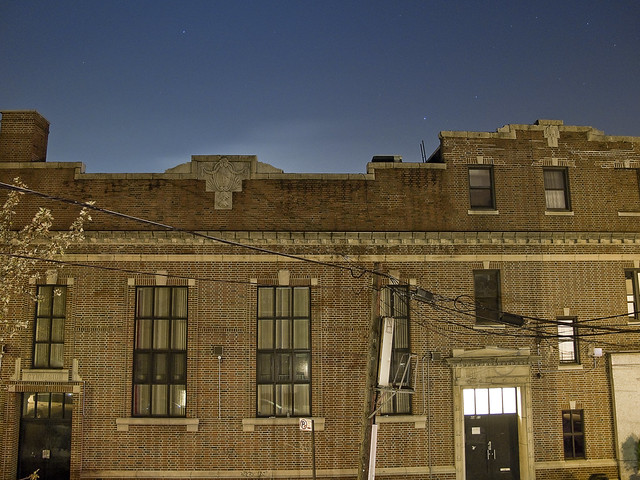
– photo by Mitch Waxman
Problem is that despite its many merits, the G10 is ultimately a point and shoot which Canon has placed certain limits on (specifically the limitation in exposure to 15 seconds), and the magnetic doohickey described above is not stout enough for the weight of a DSLR and lens (which is capable of manual exposure times, supposedly the shutter can be left open for quite some time). Luckily, Astoria offers many opportunities for night photography, despite its omnipresent automotive traffic.
Bored.
from forgotten-ny.com
On June 8, 1875 eight individuals met and organized the Long Island City Turn Verein at Koch’s Hall, N.E. Corner of Broadway and 9th Avenue [today’s 38th St] in Long Island City, N.Y. for the sole purpose of introducing and furthering German Turnerism (which embraces the philosophy of building a “Sound Mind in a Sound Body” fostered by Friedrich Ludwig Jahn in Germany). The society’s purpose was to educate its membership physically and mentally through gymnastic exercises and by encouraging use of the German language.
The present building was constructed in 1928 and sold in the mid-1970s. The society is now based in Nassau County.
Scenes from a Snowpocalypse
– photos by Mitch Waxman
The recent and much commented on Blizzard of December 28, 2010- which we in the frozen zone of Astoria refer to as “The Snowpocalypse”- produced many memorable moments around the ancient village. Made especially clear was that the internet, designed to withstand a nuclear attack, has become vulnerable to seasonal weather in the hands of corporate stewards such as Time Warner Cable.
Here’s a few photos of the experience, and notice the Daily News Truck- which was stuck in the middle of 44th street from 4:30 AM to 11PM and was finally towed out by a block long hydraulic chain. The auto in the second to last shot zipped up the block- the wrong way- and got stuck into the very spot that the truck was in. Some of these shots are unforgivably grainy, as they were captured at extremely high iso speeds.
Incidentally, the iPhone shot of the truck being towed finally out is here.
Message from Council Member Van Bramer
The constituents of Council Member Jimmy Van Bramer received this message yesterday, which is presented here verbatim. Similar sentiment has been expressed to me by area wags and common gentry alike.
Council Member Jimmy Van Bramer — District 26 December 28, 2010
The storm’s aftermath – an update to the community
It is hard to believe that nearly three days after snow started to fall, and two days after it stopped, hundreds if not thousands of streets and roadways have been left untouched and unplowed, endangering the safety and wellbeing of New Yorkers. Never in the history of our great city has such a gross mismanagement of a snow cleanup turned into the disastrous lack of response we see before us today. For the past two days I have trekked through the impassable sidewalks and roadways in my district, witnessing first hand the systemic failure that our Mayor seems to believe is the best job our city can do in a time of emergency. The disconnect between “Hizzoner” and the everyday people that are struggling to get out of their houses, walk down their streets and attempt to get to work to make a living is unbelievable. The people of my district, and indeed all New Yorkers need help and answers and they need them now.
In the past two days my office has received over 150 complaints, emails and phone calls from distraught constituents and senior citizens who cannot walk down their streets, access their vehicles or get to the places and services they need. I am baffled as to how major roadways were left untouched and unplowed nearly 48 hours after a storm hit our city and the photographs that I have personally taken and collected from my constituents capture the chaos Queens has and is currently experiencing in the aftermath of the snowstorm.
Every complaint taken by my office has been documented and filed with the the Mayor’s Office, the Speaker’s office, and the Department of Sanitation to ensure that all levels are notified of the urgency and severity of the issue at hand and to expedite the snow removal. When not on the streets of our neighborhoods, I’ve been on the phone with residents, demanding answers from City agencies, and drawing attention to this debacle in interviews with media. Something has clearly gone wrong and answers will be sought out at a City Council hearing on January 10th, which will address and examine the City’s snow emergency policy and response.
My staff and I are dedicated to getting our community the services it needs and the answers it deserves and will be working around the clock to ensure that every complaint is adequately addressed. As always, please do not hesitate to call my district office, at 718-383-9566 or send us an email at JimmyVanBramer@gmail.com.
I work for you. I’ll never forget that, and I’ll always be grateful for the honor and privilege.
Sincerely,
Jimmy Van Bramer
Council Member, District 26
Web: http://www.jimmyvanbramer.com Email: jimmyvanbramer@gmail.com Twitter: http://twitter.com/jimmyvanbramer
Snowpocalypse
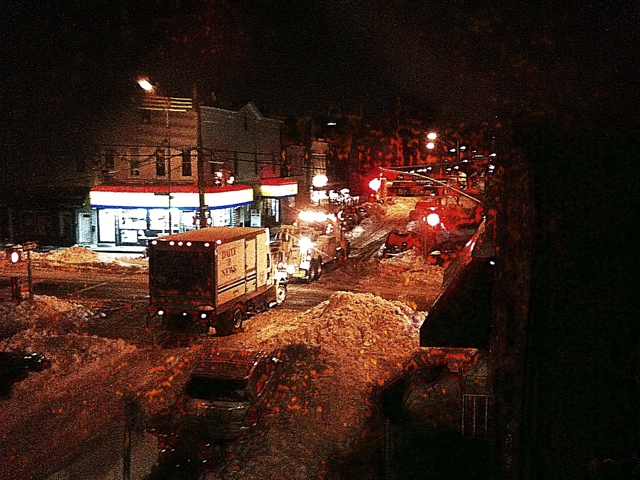
Astoria still suffers from an information blackout, as Time Warner Cable and to a larger extent- the City of New York- have once again forgotten we’re here. Most of our streets are unplowed, despite the fact that the citizenry has abided with law and custom by clearing the sidewalks. Vehicles remain stuck, including an ambulance which was mired down for an astounding 20 hours. The Daily News truck in the shot above came to a halt at 4:30 am yesterday, and the tow truck in the shot had just freed it at 11:00 pm. Shots and posts were all done on my iPhone as the main computer is isolated by Time Warner’s inability to forecast that it might snow during the winter.
We’ve seen many interesting things the last couple of days, as soon as I’m web capable again- I’ll be posting.
dark apertures

– photo by Mitch Waxman
“The daily reminder”:
Please consider purchasing a copy of the first Newtown Pentacle book:
“Newtown Creek for the Vulgarly Curious” – a fully annotated 68 page, full-color journey from the mouth of Newtown Creek at the East River all the way back to the heart of darkness at English Kills, with photos and text by Mitch Waxman.
Lamentable, this dark part of of the solar cycle both frustrates and delights.
Unwelcome, the return of frigid conditions renders my wrecked health tremulous. Unbalanced, my delicate constitution reaches out desperately for amusement and titillation. Tenebrous- the light of December is thin, ephemeral, a cloying charlatan.
I’m all ‘effed up.
from wikipedia
Anxiety is a generalized mood condition that can often occur without an identifiable triggering stimulus. As such, it is distinguished from fear, which is an emotional response to a perceived threat. Additionally, fear is related to the specific behaviors of escape and avoidance, whereas anxiety is related to situations perceived as uncontrollable or unavoidable. An alternative view defines anxiety as “a future-oriented mood state in which one is ready or prepared to attempt to cope with upcoming negative events”, suggesting that it is a distinction between future vs. present dangers which divides anxiety and fear.
Physical effects of anxiety may include heart palpitations, muscle weakness and tension, fatigue, nausea, chest pain, shortness of breath, stomach aches, or headaches. The body prepares to deal with a threat: blood pressure and heart rate are increased, sweating is increased, blood flow to the major muscle groups is increased, and immune and digestive system functions are inhibited (the fight or flight response). External signs of anxiety may include pale skin, sweating, trembling, and pupillary dilation. Someone who has anxiety might also experience it as a sense of dread or panic. Although panic attacks are not experienced by every person who has anxiety, they are a common symptom. Panic attacks usually come without warning, and although the fear is generally irrational, the perception of danger is very real. A person experiencing a panic attack will often feel as if he or she is about to die or pass out.

– photo by Mitch Waxman
Loathsome, the reflection which gazes from every shop window and puddle of urine during my long walks is that of something which can only be superficially referred to as a man.
Filthy and blackened by time, my garb has become tattered and beggarly of late. Financial hardship experienced over a long and sordid lifetime instructs that only the coarse and lasting textiles worn by beasts of burden should be considered for replacements, as they will outlast the fancy caprices of fashion and comfort by virtue of their sheer and stolid composition. These are hard times my friends, and the hard rain has already fallen.
A season of the witch is apparent, Lords and Ladies, and Woody Guthrie would recognize our time immediately as his own.
from wikipedia
Self-Awareness Theory states that when we focus our attention on ourselves, we evaluate and compare our current behavior to our internal standards and values. We become self-conscious as objective evaluators of ourselves. Various emotional states are intensified by self-awareness, and people sometimes try to reduce or escape it through things like television, video games, drugs, etc. However, some people may seek to increase their self-awareness through these outlets. People are more likely to align their behavior with their standards when made self-aware. People will be negatively affected if they don’t live up to their personal standards. Various environmental cues and situations induce awareness of the self, such as mirrors, an audience, or being videotaped or recorded. These cues also increase accuracy of personal memory.

– photo by Mitch Waxman
Lutescent, my skin color produces impressions of some jaundiced ginger candy lightly drizzled over with a thin syrup of sweat, a noted change from the sun baked complexion which was earned during the many maritime adventures of the vernal months that were described at this, your Newtown Pentacle.
A recent observation of myself at 4:30 AM in the bathroom mirror, after having spent a considerable number of hours researching a certain bridge which crosses that malign influence known as the Newtown Creek, was the moment when I realized that I had let my beard grow unchecked for better than 60 days and allowed my external appearance to betray my state of mind. The wild eyed thing staring back at me… reaching out to me as I did the same to him… surely it remains trapped in that pane of mirrored glass.
I went to the barber the next morning, and as Joe of “Joe and Tony’s” dragged a straight razor across my throat and scratched off months of neglect- for the first time in ages- I was able to relax.
from wikipedia
Clinicians assess the physical aspects such as the appearance of a patient, including apparent age, height, weight, and manner of dress and grooming. Colorful or bizarre clothing might suggest mania, while unkempt, dirty clothes might suggest schizophrenia or depression. If the patient appears much older than his or her chronological age this can suggest chronic poor self-care or ill-health. Clothing and accessories of a particular subculture, body modifications, or clothing not typical of the patient’s gender, might give clues to personality. Observations of physical appearance might include the physical features of alcoholism or drug abuse, such as signs of malnutrition, nicotine stains, dental erosion, a rash around the mouth from inhalant abuse, or needle track marks from intravenous drug abuse. Observations can also include any odor which might suggest poor personal hygiene due to extreme self-neglect, or alcohol intoxication. Gelder, Mayou & Geddes (2005) tells us to look out for weight loss. This could signify a depressive disorder, physical illness, anorexia nervosa or chronic anxiety.

– photo by Mitch Waxman
Labefaction of my very self continues unabated, and flavor is absent from all the elixirs of joy.
Sleep, and concurrent dreaming, has plagued me with its insistence and Antaeus like grip. When the oppression of these periods of unconscious hallucinations lift, I force myself from home and wander the streets in the manner and aforementioned garb of a mendicant. Drifting like some cast off ember caught on the wind, I follow the sun but as always- I am relegated to stand in the shadows of this world and its bright places are reserved for others to enjoy. Outside, in the cold and filth is where I belong- not amongst bright and happy faces chortling over shared intimacies and embarrassing overtures.
Inevitability is enjoyed by the sleepy, for in the end, they shall drop off.
from wikipedia
Depersonalization (or depersonalisation) is a malfunction or anomaly of the mechanism by which an individual has self-awareness. It is a feeling of watching oneself act, while having no control over a situation. It can be considered desirable, such as in the use of recreational drugs, but it usually refers to the severe form found in anxiety and, in the most intense cases, panic attacks. Sufferers feel they have changed, and the world has become less real, vague, dreamlike, or lacking in significance. It can be a disturbing experience, since many feel that, indeed, they are living in a “dream”. Depersonalization is a subjective experience of unreality in one’s sense of self, while derealization is unreality of the outside world. Although most authors currently regard depersonalization (self) and derealization (surroundings) as independent constructs, many do not want to separate derealization from depersonalization.Chronic depersonalization refers to depersonalization disorder, which is classified by the DSM-IV as a dissociative disorder. Though depersonalization-derealization feelings can happen to anyone subject to temporary severe anxiety/stress, chronic depersonalization is more related to individuals who have experienced a severe trauma or prolonged stress/anxiety. Depersonalization-derealization is the single most important symptom in the spectrum of dissociative disorders, including Dissociative Identity Disorder and Dissociative Disorder Not Otherwise Specified (DD-NOS). It is also a prominent symptom in some other non-dissociative disorders, such as anxiety disorders, clinical depression, bipolar disorder, borderline personality disorder, obsessive-compulsive disorder, migraine, sleep deprivation, and some types of epilepsy.

– photo by Mitch Waxman
Lexiphanic lickspittle, the lickerish lientery offered today is limaceous, foully libanophorous, and is admittedly… logorrhoea.
The question you may be asking, of course, might be “What exactly does this all have to do with anything, and what’s up with dem boids?”. Simply put, today is the beginning of the Roman festival of Saturnalia, a day of tricks and treats- and described as the “best of days” by the poet Catullus.
Traditionally, it was the day when masters and slaves would trade places. What fun that would be.
from wikipedia
Mad hatter disease describes the symptoms of mercury poisoning, specifically its effect on the nervous system. These include paraesthesias, vision and hearing impairment, slurred speech, anxiety, hallucinations, irritability, depression, lack of coordination, and tremors. The condition was observed among workers in the hat-making industry in the 1800s. Chronic mercury exposure was common in hatters who used a mercury solution during the process of curing animal pelts. Poor ventilation in the workshops of the time resulted in the hatters breathing in the fumes of this highly toxic metal, leading to an accumulation of mercury in the workers’ bodies. Metal toxicity was poorly understood and the broad range of symptoms were also associated with insanity.The phrase mad as a hatter is derived from the condition, and commonly associated with Lewis Carroll’s character the Mad Hatter in Alice’s Adventures in Wonderland. While the character’s eccentricities differ from those suffering from mercury poisoning (the Hatter was likely inspired by Theophilus Carter, a furniture dealer), Lewis Carroll grew up near the town of Stockport, where hatting was the dominant trade.


 The Newtown Pentacle