Archive for the ‘Astoria’ Category
A little experiment…

– photo by Mitch Waxman
As you may have noticed, lords and ladies, your humble narrator has been struggling with deadlines and various other problems for the last couple of months which has resulted in a rather less than daily schedule here at your Newtown Pentacle. Part of the reason that postings have become somewhat sporadic is the enormous amount of research that goes into a 1-3 thousand word posting illustrated with photos. Fear not, long winded exposition is not going out of style around these parts, but I’m going to be experimenting a little bit with the format in the next few weeks- bear with me.
The first thing you’ll notice will be that rather than abbreviate the posting schedule- I’m going to be accelerate it. You very well might want to subscribe to the RSS feed for the next several weeks, as there will be multiple posts per day. There will still be the mega posts, and anything newsworthy will get the “full treatment”, but I’m going to bombard you with shorter postings for a bit.
My reasoning is twofold, first- it’s the time of year when I need to be outside, wandering the Newtown Pentacle itself and photographing its subtle implications. The shorter posts will allow me a little more freedom of movement, as they are simpler to accomplish and the photographic assets are extant- second- well… I’ll tell you that one in a little while…
Let me know what you think… Next post will be in a few hours.
the king in yellow, brick

Matthews Model Flats, Astoria – photo by Mitch Waxman
As mentioned in the past, Newtown Pentacle HQ is embedded within one of the few corner to corner blocks of Matthews Model Flats remaining in Astoria, Queens. This is also one of the postings where I’m thinking out loud, so if your humble narrator is in error, let me know.
Yellow bricks, which once distinguished much of western Queens, compose the street faces of these buildings. This particular stretch of Matthews flats in Astoria is just about a hundred years old (1911), as is a lot of the building stock in what I’ve been told was called “the German Section”- “back in the day”. Model tenements, as they were known, and while walking my little dog Zuzu one morning I began to ponder those bricks. Those yellow bricks.
Everywhere you go, from Ridgewood to Greenpoint, Maspeth and Astoria- you see those bricks.
from an EXCELLENT illustrated history of Brick manufacturing in the New World at brickcollecting.com
The first bricks in the English colonies in North America were probably made in Virginia as early as 1612. New England saw its first brick kiln erected at Salem, Massachusetts in 1629. The Dutch colonists in New Amsterdam imported yellow bricks from Holland, which imparted a Dutch character to the architecture of the city. The excellent quality and abundance of local clays in the colonies made it unnecessary to import bricks from across the Atlantic. Brick-making centers developed in Fort Orange (what is now Albany), New York; near Philadelphia, Pennsylvania; and Burlington and Trenton, New Jersey, as well as along the Raritan River.

Grand 30th avenue, Astoria – photo by Mitch Waxman
One of the real pleasures encountered when working on postings for this, your Newtown Pentacle, are the moments when I suddenly have to research something mundane because I realize that I actually know nothing about the subject. In this case, it’s bricks.
A couple of years ago, I pursued knowledge of industrial Honey production– How, exactly, do all those millions of gallons of honey get to the little bottles in your supermarket? What can the industrial process be, I asked. The answers are pedantic, complex, and suffice to say that China is the world’s Honey superpower and that Honey was arguably the first industrial commodity.
The story of these yellow Kriescher bricks however, has something for everyone.
also from brickcollecting.com
The Manhattan Fire Brick and Enameled Clay Retort Works (as described in New York Illustrated (New York: D.Appleton & Co., 1876) was located on East 15th Street near the East River. Henry Maurer learned the fireclay manufacturing business in his uncle’s firm, Maurer & Weber, and then established his own firm which relocated from New York and Staten Island to Maurer, New Jersey, in 1874
There were several firms in New York City that took advantage of the nearby deposits of fire clay and manufactured both clay retorts and fire bricks. In 1845 Balthazar Kreischer established a fire-brick works in Manhattan, later known as the New York Fire Brick and Clay Retort Works; Kreischer acquired a fire-clay deposit on Staten Island in 1852 and established a works there which eventually replaced the Manhattan factory (his son’s house, the Charles Kreischer House and the workers’ houses for the company, the Kreischerville Worker’s Houses are both designated New York City Landmarks). Joseph K. Brick established the Brooklyn Clay Retort and Fire Brick Works in 1854. The Maurer & Weber Company later known as the Manhattan Fire Brick and Enameled Clay Retort Works, opened in 1863.
In 1868 John Cooper established a business, later known as the Greenpoint Fire Brick and Sewer Pipe Works, at 413-421 Oakland Street, Brooklyn. While there were 350 fire brick manufacturers in the United States in 1895, the New York-New Jersey area remained one of the major fire brick manufacturing centers.
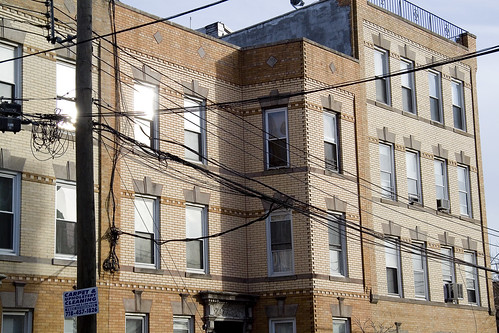
Matthews Houses – photo by Mitch Waxman
19th century businessmen were either merchant princes or robber barons, depending on your point of view. Both are accurate, but suffice to say that communities of labor would cluster around the industrialist, corollary industry would arise to support growing populations around the main mill, and even competitors would often locate in their vicinity to take advantage of locale and the skilled worker population. This is why you find financial, garment, and flower districts in Manhattan and its also why Astoria is visually distinct from the neighborhoods around it.
William Steinway was here, and his interests were larger than just pianos. Steinway was a primal force in digging the first Subway Tunnel from Queens to Manhattan (completed by Michael Degnon, of course), and was a major player in the Queens Trolley business. Wealthy, philanthropic, and well regarded by all reports- Steinway’s Piano mill pulled a population to it. Out on Staten Island, Balthazar Kreischer worked a somewhat coarser but technologically sophisticated operation that made… Bricks.
from boards.ancestry.com
…trying to find the descendants of Balthasar KREISCHER (3.13.1813-8.15.1886) of the Kreischer & Sons Brick Company of Staten Island, and interred in The Green-Wood Cemetery of Brooklyn, New York.
Descendants/Family include his 4 daughters Catherine KREISCHER-WEBER, Fredricka P. KREISCHER, Louisa Albertina KREISCHER-STEINWAY and Caroline L. KREISCHER-ELLIS and his 3 sons: Charles C. KREISCHER, Edward B. KREISCHER and George F. KREISCHER. Some Kreischers settled into Brooklyn.
Louisa Albertina KREISCHER-STEINWAY (d. 6.30.1926) married Albert STEINWAY (b. 6.10.1849- d. 5.14.1877), the youngest son of of Steinway & Sons Piano Mfgr. of Astoria, New York, and had 2 daughters: Henrietta Julia STEINWAY and Ella Frederica STEINWAY. Louisa, Albert and Frederick P. Kreischer are interred in the Steinway mausoleum in Green-Wood Cemetery of Brooklyn, NY.

Maspeth Matthews Houses – photo by Mitch Waxman
Both great men were successful and accepted, rich beyond avarice, and had children. Steinway’s son Albert married Kreischer’s daughter Louisa, connecting the two families in business and standing. Both men also had holdings and interests in the burgeoning railroad business, Kreischer an investor in the Vanderbilt’s Staten Island Railroad and Steinway a rail mogul in Queens. Many of these yellow brick homes, so typical of ancient Queens, lie along the route that trolley tracks once followed.
My supposition is that Kreischer received a family discount for moving his product around on Steinway’s rails, and use of Kreischer Brick in a new project bought some good will from the Steinways- known for their generous nature and political connections in New York, Newtown, and the upstart Long Island City with its scandalous political class.
This is theory, of course, but sounds kind of like the way things worked in 19th century New York when the “old boys” club ruled. Again- theory.
from astorialic.org
“It was reported on the street on Friday that Gleason had sold his railway interests to the Steinway syndicate for $275,000. It has been reported for a long time that the Gleason roads did not pay. The road up Borden Avenue to Calvary Cemetery [in Woodside] was not well patronized. There are not many people who go to Blissville [Sunnyside] unless it is to visit the dead. The Blissville people as a rule do not travel much and when they do they patronize the Greenpoint line in preference to Gleason’s, thus his exchequer has suffered, and again the cars to the cemetery are cold this winter, and the conductors lugubrious on account of the scarcity of pennies and passengers, and a traveler after a survey of one of the cars, is tempted to foot it in preference to riding in an open car, as they had to do on Christmas Day.”

St. Joseph’s RC Church, Grand 30th avenue, Astoria – photo by Mitch Waxman
Louisa’s brother Edward, it seems, met a tragic end.
Check out this page at thecabinet.com, which tells a detailed story of that Kreischer Mansion where Edward lost his life, which describes ghostly phenomena and the violent history experienced by those who have inhabited it since.
Also, don’t miss forgotten-ny’s page on the Steinways and Kreischer’s
The Hermetic Hungarian responds

Down under the Hell Gate Bridge Onramp- DUHGBO – photo by Mitch Waxman
A recent posting- Hungry Ghosts– detailed the lengthy and pedantic debate over the merits of Film vs. Digital photography enjoyed by myself and that erudite Manhattanite known to long time readers of this Newtown Pentacle as the Hermetic Hungarian.
The Hungarian responds:
32. Not 22. Two times 16. And they are all great. Ain’t gonna scan ’em. Projected ’em from my 2-1/4″ slide projector. Dee-lish.
And it’s not that I dislike digital, it’s that there is no digital equivalent of black & white. A photo-chemical process which leaves traces of its origins throughout the process. Palimpsests. Ghosts.
I’m probably gonna get a G-11 or used G-10 (it was the stupid human interface that put me off the S-90, not to mention Adobe’s brain-dead policies) to fool with while I wait for version 2 of Leica’s digital M-9 to come out. Upon which I will then be able to attach all but two of my 14 Leica lenses. (To be fair, one of my lenses can only go on my vintage 1948 Leica IIIf due to the extreme distance the rear element projects into the body. It would kill a modern body with a built-in meter).
–Légmentesen Magyar AKA “HH”

Review Ave. trucking – photo by Mitch Waxman
Back on track tomorrow, with a proper posting, did you realize we’re in the midst of the Lemuralia?
effulgent valleys

– photo by Mitch Waxman
I went over to St. Michael’s Cemetery again last week to see if there were any developments on the ritual site which Our Lady of the Pentacle and I found a few weeks ago. A hypothesis of mine that this ritual site is being “worked” on a lunar schedule seems to be bearing fruit.
For the first post on this curious altar- “City of Marble and Beryl“, in Astoria’s St. Michael’s Cemetery- click here
for a link to a google map, showing the location as recorded by GPS, click here

– photo by Mitch Waxman
Intriguing are the differences between the last set of offerings, ritual devices, and this grouping, although the setting remains the same. Also, to be absolutely clear- this is not staged in any way, and represents exactly what I observed in situ.

– photo by Mitch Waxman
The brownish cylinder appeared to be a cigar, and the white candle’s wick was blacked but the wax was nearly pristine.

– photo by Mitch Waxman
A set of bleached bones seemed to have been arranged in some non random pattern.

– photo by Mitch Waxman
There were also holes punched in the dirt, which could just be the action of wildlife of course, but the soil of the graveyard was depressed inward without the characteristic mound of surface tailings left behind by those that burrow. It appeared that something had been stuck into the soil.

– photo by Mitch Waxman
Also, amongst the bones, were coins.

– photo by Mitch Waxman
To the north was a glass with a white candle inside of it, approximately 25 feet away.

– photo by Mitch Waxman
The candle’s glass was broken, if that means anything.
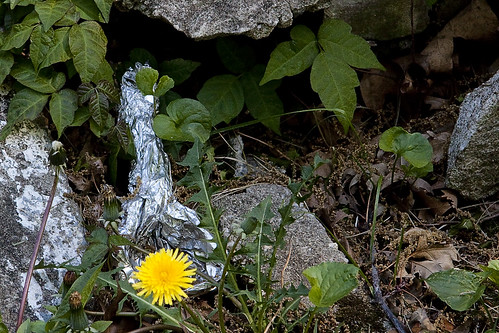
– photo by Mitch Waxman
On the west face, this ladle shaped molding of aluminum foil was extant.

– photo by Mitch Waxman
Here’s the whole scene, the center stone seems to be the main altar- it’s where the cigar, bones, and coins as well as the unconsumed candle were observed. The ladle was to the west, on the downward slope, and candle in the glass to the north at the right of the shot.

– photo by Mitch Waxman
The line of monuments in this section are very old, and many of the legends on the stones are faded away, here in St. Michael’s St. George section.
Circumnavigation 4

– photo by Mitch Waxman
After sliding past the Williamsburg Bridge, the Circle Line narrator began to talk about Queensboro (he called it 59th street bridge- grrrr) and didn’t mention the Newtown Creek. Tourists wouldn’t want to hear about that story, I guess. One thing that really annoyed your humble narrator were the constant references to pop culture icons like the Seinfeld sitcom and the Spiderman movies. Realization that that’s what tourists have as touchstones for NYC is obviated, but still… blurring the line between fantasy and reality is a real issue in the modern world.
from wikipedia
George Louis Costanza is a fictional character in the American television sitcom Seinfeld (1989–1998), played by Jason Alexander. He has variously been described as a “short, stocky, slow-witted, bald man” (by Elaine Benes and Costanza himself), “Lord of the Idiots” (by Costanza himself), and as “the greatest sitcom character of all time”. He is friends with Jerry Seinfeld, Cosmo Kramer, and Elaine Benes. George appears in every episode except for “The Pen” (third season). The character was originally loosely based on Seinfeld co-creator Larry David, but surnamed after Jerry Seinfeld’s real-life New York friend, Mike Costanza.

– photo by Mitch Waxman
The power of cinema and television to present a cogent and absorbing telling of historical events is actually a dangerous thing. Again, I realize that the tourists aboard the Circle Line aren’t looking for hardcore history, but there’s a lot to say about the Queensboro bridge that doesn’t involve the Green Goblin or George Costanza. History is made not by accurate or cogent catalogs of events, but by distribution. The reason we know about Aristotle or Voltaire is that MANY copies of their work were made, distributed across a wide area, and were quoted by others. This means that distaff copies of their work survived the fires and floods. This means that to future eyes, the surviving copies of Spiderman and Goodfellas might be all they have.
Which makes me wonder if Pliny the Younger might have been the Dean Koontz of his time.
from wikipedia
As they watch over May in the hospital, Mary Jane tells Peter she has a crush on Spider-Man, and Peter expresses his own feelings for her. Harry catches them holding hands and tells his father about their love for each other. Now knowing that Spider-Man has feelings for Mary Jane, the Goblin lures him to the top of the Queensboro Bridge by taking Mary Jane and a Roosevelt Island Tramway car full of children hostage, then drops both at the same time. Spider-Man saves them all, but the Goblin takes him to an abandoned building for a fight. Spider-man eventually defeats and unmasks the Goblin, and Norman dies after asking Peter not to tell Harry that he (Norman) was the Goblin.

– photo by Mitch Waxman
As the boat passed Roosevelt Island, the looming hotel construction sites of Queens Plaza rise behind it. Within a few years, tens of thousands of Queens Plaza and Dutch Kills hotel rooms will be serving the self same tourist trade which is satisfied by attractions like these Circle Line cruises. Perhaps this is what we New Yorkers are destined to become, apes in a steel and glass cage put on display for foreigners as we live out our funny lives. Just like on Seinfeld.
from wikipedia
Tourism in New York City includes nearly 47 million foreign and American tourists each year. Major destinations include the Empire State Building, Ellis Island, Broadway theatre productions, museums such as the Metropolitan Museum of Art, and other tourist attractions including Central Park, Washington Square Park, Rockefeller Center, Times Square, the Bronx Zoo, South Street Seaport, New York Botanical Garden, luxury shopping along Fifth and Madison Avenues, and events such as the Tribeca Film Festival, and free performances in Central Park at Summerstage and Delacorte Theater. The Statue of Liberty is a major tourist attraction and one of the most recognizable icons of the United States. Many New York City ethnic enclaves, such as Jackson Heights, Flushing, and Brighton Beach are major shopping destinations for first and second generation Americans up and down the East Coast.

– photo by Mitch Waxman
Of course, the folks whose lives are a little too funny can be found on Ward’s Island at the psychiatric hospitals that serve the City of Greater New York. I’m never quite sure which building is which in this complex, as your humble narrator is convinced that getting too close to a madhouse would be injurious to his freedoms, but this is either the 509 bed Manhattan Psychiatric Center (I lean toward this) or the maximum security Kirby Forensic Psychiatric Center. The Circle Line narration didn’t mention either.
from soundportraits.org
There seem to be two constants to life on Ward 2-West. One of these is violence. The state considers the staffers who work on the ward to hold the single most dangerous job in New York, with the highest injury rate of any profession. The other constant on the ward is noise. There is nowhere to escape it, although there is one patient who seems to have adapted to it quite well. His name is Peter, and you can always find him at the front of the dayroom, hunched over a table peacefully drawing with yellow plugs stuffed deep into his ears. He is about 50 years old, has curly brown hair and a graying beard, gentle eyes behind thick glasses. Before committing his crime, Peter was a successful commercial artist. Today he’s working on a still life with pastels.

– photo by Mitch Waxman
Amongst the more pleasant realities of the trip was this view of the Hell’s Gate with its two spans- the Triborough Bridge(s) and the Hellgate railroad Bridge. The plane taking off from nearby LaGuardia airport was pure serendipity.
from wikipedia
Hell Gate is a narrow tidal strait in the East River in New York City in the United States. It separates Astoria, Queens from Randall’s Island/Ward’s Island (formerly two separate islands that are now joined by landfill).
It was spanned in 1917 by the New York Connecting Railroad Bridge (now called the Hell Gate Bridge), which connects the Ward’s Island and Queens. The bridge provides a direct rail link between New England and New York City. In 1936 it was spanned by the Triborough Bridge (now called the Robert F. Kennedy Bridge), allowing vehicular traffic to pass between Manhattan, the Bronx, and Queens.

– photo by Mitch Waxman
The Hellgate Bridge has long graded approaches which sprawl out all the way to the Sunnyside Yards on one side and continental North America on the other, providing a freight and rail link between the archipelago of islands which form this City-State of ours. Triborough’s approaches and ramps are almost too numerous for me to count.
from wikipedia
The Robert F. Kennedy Bridge, better known as the Triborough or Triboro Bridge, is a complex of three separate bridges in New York City, United States. Spanning the Harlem River, the Bronx Kill, and the Hell Gate (part of the East River), the bridges connect the boroughs of Manhattan, Queens, and The Bronx via Randall’s Island and Ward’s Island, which are joined by landfill.
Often historically referred to as simply the Triboro, the spans were officially named after Robert F. Kennedy in 2008.

– photo by Mitch Waxman
As the boat motored past Ward’s Island, where the Canadian theatrical provocateur’s called Cirque du Soleil had set up a circus tent, the Amtrak Acela rumbled over the Hellgate tracks. The last part of this trip that I can claim intimacy with until we returned to the Hudson, the Circle Line continued Northward.
Venturing into the “not part of my beat” areas of the City of Greater New York which your humble narrator is least familiar with- specifically the northeast sections of Manhattan and La Bronx, I actually got see a few things I didn’t even suspect…
from wikipedia
Acela Express (often simply Acela) is Amtrak’s high-speed rail service along the Northeast Corridor (NEC) in the Northeast United States between Washington, D.C., and Boston via Baltimore, Philadelphia, and New York. It uses tilting technology which allows the train to travel at higher speeds on the sharply curved NEC without disturbing passengers, by lowering lateral centrifugal forces, based on the concept of banked turns.
Acela Express trains are the only true high-speed trainsets in the United States; the highest speed they attain is 150 mph (240 km/h), though they average less than half of that. Acela has become popular with business travelers and by some reckoning has captured over half of the market share of air or train travelers between Washington and New York. Between New York and Boston the Acela Express has up to a 37% share of the train and air market.


 The Newtown Pentacle