Archive for the ‘Astoria’ Category
unknown respondent
Sludge Boats, baby, Sludge Boats.

– photo by Mitch Waxman
These shots are actually from the height of that shoulder injury period last month, and represent a desperate desire one acted upon to “shake it off” by indulging in a bit of exercise. The weather was less than cooperative from a light point of view, and the affected limb was less than pleased at the rest of my body moving around, so I decided that since I was in the “hell of pain” I’d simply head over to Hells Gate and indulge the horror.

– photo by Mitch Waxman
Luckily for my diversion starved and somewhat depressed state of mind, the MV Red Hook was observed while debarking from the Wards Island dewatering facility across the river. Wards Island is the end point for the sewage sludge process, which is operated by the NYC DEP. Centrifugal machines are fed the material, which has the consistency of syrup or warm honey at the end of the thickening process at the various neighborhood sewer plants, which is carried here by the DEP’s fleet of “Honey” or Sludge boats. The dewatered material is compressed into “cakes” and sold for use as fertilizer on non food crops such as cotton and Christmas Trees.

– photo by Mitch Waxman
MV Red Hook is one of NYC’s older generation of Sludge Boats, although it’s the newest of its type – having come online in 2012. The newer class of Sludge Boats has been discussed here at Newtown Pentacle before.
from NYC.gov
The Red Hook sludge vessel was built over a three-year period in Brownsville, Texas by Keppel AmFELS. Once completed, it took seven days to make its way to New York City, arriving on November 19, 2008. The vessel has recently completed post-delivery dry-dock inspections and adjustments at the Brooklyn Navy Yard and is ready for service. Each six-person crew consists of a captain, chief engineer, assistant engineer, mate and two mariners. Crews work a 40-hour week divided into 14, 13, and 13 hour shifts. The Red Hook is slightly over 350 feet long, about 53 feet wide, with a depth of slightly over 21 feet. It has eight storage tanks with 150,000 cubic foot capacity equivalent to 1.2 million gallons. The Red Hook weighs over 2,098 long tons and is designed to travel at 12.75 knots or approximately 15 miles per hour. On a typical week, each vessel makes 14 round trips and visits eight wastewater treatment plants.

– photo by Mitch Waxman
All of the DEP’s honey boats will find themselves heading to or from Wards Island periodically, after making their rounds at one of the City’s 14 sewer plants. Hells Gate is a great place to spot them, and Shore Road along Astoria Park is a great place to observe Hells Gate.

– photo by Mitch Waxman
There are many who would agree with me, in my assertion that the view from Shore Road rocks.
“follow” me on Twitter- @newtownpentacle
bustling contact
If you see something, say something.

– photo by Mitch Waxman
This is LIC’s 41st street, between Northern Blvd. and 36th avenue, west side. The two shopping carts you’re looking at in the shot above have remained, unmolested, in this spot for more than a year. I know this because I walk past them on an almost daily basis. Not long ago, it occurred to me how long it is that they’ve been chained to this DOT owned sign post pole, and just how unusual that is. The City normally clips the chains of things attached to their property, and at the very least a Sanitation Inspector has been down this block at least once every couple of weeks.
At first glance, these carts belong to one of the many bottle and can collectors who work area streets for deposit returns. On second glance, however…
This is “weirdness” cart number one. (The numbers assigned are simply in the order of discovery and have no other meaning)

– photo by Mitch Waxman
The carts are stoutly secured to the pole, with a galvanized chain and a heavy commercial grade padlock. By commercial, I mean the sort of case hardened unit you see securing the steel gates of shops. Locks like these will run you anywhere from $10-30 – depending on make, model, and quantity. I’ve never bought a length of chain, so I couldn’t comment on the price of that. Shopping carts in Astoria are in the $20-30 range. That means that between lock and cart, you’ve got $50-100 bucks chained to this pole, and it has been for more than a year.

– photo by Mitch Waxman
On top of the carts is a piece of beverage tray plastic, wired securely to the top of the things. The black bags in the carts are “3 mil contractor” bags, and if you probe them with your finger – there are no bottles or cans inside. Instead, you’d feel about an inch of foam and behind it a hard shelled case of some kind.
It’s odd, but there’s a lot of odd things you’ll find in Queens.

– photo by Mitch Waxman
Steinway Street at the northeast corner of 36th avenue is where you’ll find another one of these assemblages. Same thing as the one on 41st – tightly folded up contractor bags perfectly filling the entire cart’s volume with a layer of foam and a hard shell hidden within.
This is “weirdness” cart number two.

– photo by Mitch Waxman
Beverage tray is secured to the cart, with wire that is tightly twisted in a manner suggesting the use of pliers.

– photo by Mitch Waxman
Stout chain, expensive padlock.
It’s odd, I tell you, odd.

– photo by Mitch Waxman
This is “weirdness” cart number three.
36th avenue, south side, at 38th street is where you’ll find it.

– photo by Mitch Waxman
Around the corner, at 38th street’s east side, at 36th avenue. Foam, hard case within, contractor bags tightly wrapped. You’ll notice some blue material showing through, which was actually TYVEK – the same plastic fabric that construction tarps and COSTCO bags are made of. Can’t say if this stuff was in all of these carts, but… odd.
This is “weirdness” cart number four.

– photo by Mitch Waxman
Beverage tray wired securely to the cart, twisted tightly.

– photo by Mitch Waxman
Expensive lock and galvanized chain.

– photo by Mitch Waxman
This is “weirdness” cart number five.
36th avenue, north side, at 37th street. This one has a wire grill attached to the top, but it too is wire tied to the cart. Again, finger probing of the black bag revealed not bottles or cans, but instead the now familiar foam padding around a hard case like interior.

– photo by Mitch Waxman
This is “weirdness” cart number six.
37th street, east side, at 36th avenue. The arrangements of these carts became increasingly regular. Always at the same relationship to a corner, chained to the first sign pole on the block.
It is increasingly odd.

– photo by Mitch Waxman
The beverage trays were securely tied off, the foam and hard interior shell present, and so were the heavy chains and expensive padlocks.

– photo by Mitch Waxman
36th street, east side, at 36th avenue.
While photographing this one, I got a “hey, whatcha taking pictchas of” comment from a fellow leaving his house. We chatted for a moment and he said this cart had been in this spot for more than a year.

– photo by Mitch Waxman
Most of these carts were arrayed along 36th avenue, I should mention. I should also mention the abundance of subway tunnels which are directly below. I continued my little survey, but the carts were not found anywhere beyond 35th street. I decided to head down towards Northern Blvd.
This is “weirdness” cart number seven.

– photo by Mitch Waxman
This is “weirdness” cart number eight.
35th street, west side, between 37th avenue and Northern Blvd. This one was a little bit different, lacking a beverage tray on the top, but in all other aspects it was the identical setup with a padded case of some kind and the heavy chain with expensive padlock.

– photo by Mitch Waxman
Wandering back towards HQ, on Northern Boulevard, north east corner, at 42nd street. Same setup, with beverage trays and so on.
This is “weirdness” cart number nine.

– photo by Mitch Waxman
These carts on Northern at 42nd had a bit of garbage stuffed into them, but anything you leave on the street in Queens will soon turn into a trash can.

– photo by Mitch Waxman
35th avenue, south side, at 43rd street. Again, same setup. There were a couple of empty carts sitting alongside the two chained up ones.
This is “weirdness” cart number ten.

– photo by Mitch Waxman
The whole affair was being held together with the now familiar wire tie offs.
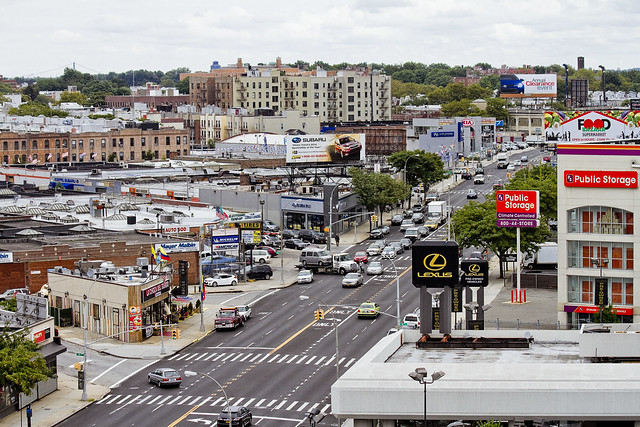
– photo by Mitch Waxman
What’s going on here – along this stretch of Northern Boulevard, 36th, and 35th avenues, between 43rd and 36th streets? These ten cart installations hide whatever is inside those foam lined cases from discovery or inspection using skillfull camouflage. They look like just another bit of the sort of street ephemera you don’t notice – the bicycle wheel chained to a fence, a shopping bag stuck in a tree, a lamp post or firebox. At first glance you think “yeah, some bottle guy chains his cart here.”
Or – There’s a bottle and can collector – hereabouts – who uses high end padlocks, steel chains, layers of water tight contractor bags, TYVEK, foam, and a hard shell case that perfectly fits into a shopping cart to protect his ten caches of bottle deposit returns which are kept only in areas which are over subway tunnels.
Speculation is a silly thing to engage in.

– photo by Mitch Waxman
As you’re reading this post, I’m also sending it over to the 114th precinct for the boys in blue to consider. It’s probably nothing extraordinary, but I don’t like the locations or heterogeneity of these carts, given that they are all sitting on top of subway tunnels and are found at busy intersections which carry thousands of vehicles every day. I’d love to cut into one of these carts and find out what’s inside, but I’m a photographer not a cutter. It’s probably nothing, and the cops will proably just waste their time if they do look into it, but…
This cart business isn’t just odd, it’s downright weird, and my “spidey sense” is tingling for some reason.
“follow” me on Twitter- @newtownpentacle
itemized exceptions
I just can’t stop.

– photo by Mitch Waxman
More of the macro shots with which I’ve been passing the cold weather down time, in today’s post. First up is a bit of Swiss Chard. Chard (Beta vulgaris subsp. vulgaris) is actually part of the beetroot subspecies of the Amaranthaceae family. I’m planning on cooking the non photographed portions of it up with garlic, red onion, olive oil, and a bit of a poblano pepper thrown in to make it interesting. That’s likely the first time I’ve ever shared a recipe at this, your Newtown Pentacle, btw.

– photo by Mitch Waxman
It was a bit challenging to pose this leafy thing, given the manner in which its leaves buckle up and curl. The now standard under flash arrangement was used to reveal some of the internal structures of the thing.

– photo by Mitch Waxman
All sorts of Lovecraftian stuff was flying through my head while I was shooting these, it should be mentioned, but then again – I was standing in a darkened and quite chilly room in which bright lights were flashing every eight to fifteen seconds. The thing about strobes is that even if you close your eyes, the light will penetrate the lids.

– photo by Mitch Waxman
I mentioned pareidola in my last post of macro shots, and a humble narrator is experiencing it heavily in the shot above. It’s the nature of the human mind to try and find recognizable faces and other familiar shapes in entirely random patterns, or at least it’s the nature of the slowly rotting ball of snot found between my ears and behind my eyes.

– photo by Mitch Waxman
This is a bit of that plum I was showing you in the last macro shot, with a blast of light traveling up and through the flesh of the fruit. The slice was probably about a quarter inch thick, and I set my flash gun to half power.

– photo by Mitch Waxman
The snow pea pod pictured above required full power on the flash gun. The waxy skin of the legume provided a bit of refraction as well, which was unexpected. A legume, the snow pea (Pisum sativum var. saccharatum) is also known to the french talkers as a “mangetout.” That means “eat all.” I know it’s supposed to be “two peas in a pod” but three just worked better.

– photo by Mitch Waxman
The fuzzy Kiwi fruit, (Actinidia deliciosa aka mangüeyo), is seen in the shot above and is the national fruit of China. Once known as the Chinese Gooseberry, the vine escaped China in 1847 via the actions of British horticulturalists. A girls school principal began planting the vine in New Zealand in the early 20th century, and the fruit soon became synonymous with the country, although it wasn’t called Kiwifruit until 1959.

– photo by Mitch Waxman
Oddly enough, the world’s largest producer of Kiwifruit is actually Italy, and the specifics of the most common commercially available variant of this cultivar – called the Hayward – are that the world produces some 1,412,351 tonnes of it annually with Italy and New Zealand leading the pack. It seems that since the two nations are in different hemispheres, they don’t actually compete with each other due to seasonal variability.
Who knew?
“follow” me on Twitter- @newtownpentacle
cubits wide
More macro comestibles, in today’s post.

– photo by Mitch Waxman
As described in a couple of posts from last week (this, and that), a humble narrator is making productive use of the hermitage forced upon him by the cold weather by experimentation with macro lens photography. The subject matter for this pursuit has almost exclusively been food based, and in the case of what you see in today’s post – it’s a true fruit and a drupe, not berries which are commonly referred to as fruit like banana or citrus.
The circumstance of the shots utilizes a jury rigged lighting set up which includes the usage of a powerful flash placed behind the subject, which allows for some of the internal structure of the food stuffs to be revealed. It’s all somewhat complicated.

– photo by Mitch Waxman
First up on the stage are apples, specifically two of them, and I’ll be damned if I can tell you exactly which one of the 7,500 breeds of the thing they are – they’re red apples which I bought at the bodega across the street from my house is all I can tell you. The nice thing about this sort of project is that in addition to providing for an interesting technical challenge which produces somewhat intriguing results, it also results in a series of tasty and healthy snacks for a narrator to enjoy when the work is done.

– photo by Mitch Waxman
Apples and humans have been together a long time. Literal interpreters of certain holy texts will tell you that the fruit of the tree of knowledge of good and evil consumed by Adam and Eve was an apple, but that’s largely because of a translation era. There’s also the Nordic tradition of the Golden Apples of Idunn, which supplied Odin, Loki, and the rest of that crew with immortality. Heracles had twelve labors, and acquiring the golden apples found at the Garden of the Hesperides was one.

– photo by Mitch Waxman
Malus domestica is the botanical classification for all 7,500 kinds of domesticated apple, which have been bred out from a wild ancestor native to Kazakhstan, Kyrgyzstan, Tajikistan, and Xinjiang that is called Malus sieversii. It’s believed that the original cultivation of apples as a crop began in China’s Tian Shan mountains in prehistoric times. Apples are produced by a deciduous tree which is part of the same botanical family that produces Roses and Plums, amongst other useful things.

– photo by Mitch Waxman
It seems that China is the world’s apple superpower, producing roughly half of the worldwide annual 80 million ton harvest of the fruit. Apples are nearly twice as genetically complex as human beings, and unlike humans, if you store them under the right conditions you can count on them staying fresh for months. The Granny Smith and Fuji variants can be kept viable in storage for nearly a year under tightly controlled circumstance.

– photo by Mitch Waxman
Apples were brought to the Americas by European colonists in the 17th century, and the first orchard on the continent was in Boston. The schoolboy mythology version of American history claims that Johnny Appleseed distributed cultivars of Apples to far flung homesteads. The reality was that John Chapman was a Swedenborgian missionary, who maintained a far flung apple tree nurseries business, who would just show up on your property and try to convert you to the “New Church.” He would distribute individual sections of the bible to people he visited, operating a one chapter at a time library service for pioneers. Chapman would also try to talk the farmers he met into partnering with him on an apple nursery planted on their property.
The esoteric side of Swedenborgian thought opined that if if you could create a society that operated in the manner of an orchard, it would be producing better citizen and parishioner fruit than you could by letting them grow wild. Later adherents of the philosophy would popularize and institutionalize into education a tenet of their faith, and if you attended Kindergarten then you’ve experienced it.
Swedenborgian Kindergarden – American Child Orchard.

– photo by Mitch Waxman
The shot above looks right down where the stem of the fruit connected to the branch. My “under” flash was set to maximum power and “throw” to illuminate the otherwise lightfast skin and flesh of the fruit. I’ve received a couple of comments about the prior posts that there’s a “Georgia O’Keefe” sort of sexual vibe going on with some of these shots, btw.

– photo by Mitch Waxman
Technically speaking, these are the sex organs of a life form, so… probably not far off. I’ve always been interested in the visual similarity of various animal body parts to analogous organs found in the plant world. My opinion on the subject has always been that evolution is a somewhat lazy beast, and that certain anatomical configurations were figured out very early in the game and have been widely transmitted as the various clades diverged from each other. Someday, science will describe certain shapes and structures as being distinctly terrestrial – presuming we have something else to compare earthly life to in a clinical setting.
Either that, or it’s the same mechanism of the human brain which renders a passing cloud as either a winged dragon or a unicorn and sees recognizable shapes in otherwise random patterns, which is called pareidolia.

– photo by Mitch Waxman
As mentioned above, Plums also belong to the Rosales or Rose family, just like apples. A taxonomist will argue about the number of plum species there are, but the presumption is that there are something like 20-40 individual variants. Commercially available plums are a different story, with most of the Plums we eat originate from either the European plum (Prunus domestica) or the Japanese plum (Prunus salicina).
– photo by Mitch Waxman
Plums aren’t fruits, unlike apples, instead they’re drupes. They’ve been domesticated by humans since Neolithic times. If you spot a stand of Prunus domestica in the woods of the Caucasian Montains of Eastern Europe, you’ve got a good candidate spot for archaeologists and paleontologists to poke at.

– photo by Mitch Waxman
One of the things I’m trying to do with these macro experiments is to find a way to do an “x-ray view.” This requires a bit of “studio-fu.” The shot above is the same basic setup as the one below, with the difference between them being that in the one above, I left a lamp on that flooded the lens facing section of the plum with light. This reveals surface details and true color.

– photo by Mitch Waxman
In the “x-ray view” above, the lamp was turned off after about a second. When the big flash underneath the Plum went off, all that light went traveling straight up through the thing, revealing all the internal structure. Haven’t quite perfected this procedure yet, but intriguing – ain’t it?

– photo by Mitch Waxman
The shots above and below are long exposures, coupled with that flash traveling up through the Plum to reveal the internal structure of the skin.

– photo by Mitch Waxman
The one above is my favorite of the plum series, mainly because you see both exterior and interior of the thing simultaneously. I had to jump through a few digital hoops developing these things, incidentally, as my improvised lighting and flash set up hopelessly confused the camera.
I’ll be doing more of this kind of thing periodically, as I’m having a lot of fun, and eating a lot of fruit.
“follow” me on Twitter- @newtownpentacle
conducive circumstance
Macro shots, berries, and my life’s savings – in today’s post.

– photo by Mitch Waxman
On Monday of this week, a series of table shots were offered, depicting various food stuffs and comestibles which were photographed under a “macro” table shot setup. This sort of setup is kind of technical, involves all sorts of measurements and secondary equipment like lights and flashes. I won’t bore you with all the details, but suffice to say it allows a somewhat magnified version of reality to be captured. It should be mentioned that my macro setup is by no means a professional one, rather it’s cobbled together from various bits of kit I already own. A proper macro lens is a wonderful bit of optical engineering, and expensive.
On my kitchen counter, there’s a bag of garlic which has been there since the first week of January, and some of the cloves have sprouted – as you’ll notice in the shot above. Garlic is native to Central Asia, is officially known as Allium sativum, and is a species of the onion genus – Allium. It’s one of mankind’s oldest cultivars, and is evidenced as far back as 7,000 years in the historic record. Most of the world’s garlic is produced in China, which is probably why you don’t hear many vampire stories with a Han twist.

– photo by Mitch Waxman
A taproot, the Carrot is another ancient vegetable, especially so for the one pictured above which withered away in the back of my refrigerator. The word “Carrot” suddenly manifested in the English language around 1530, orignating from the Middle French “carotte,” which comes from the Late Latin carōta, which borrowed the word from the Greek καρωτόν or “karōton.” Daucas Carota is the scientific name for the wild Carrot, and there are many, many variants of it found throughout Iran. Wild Carrot variants were grown in Europe as early as 2,000 BCE, but most modern folks wouldn’t recognize those purple colored vegetables as carrots. The modern yellow and orange cultivar “Daucas Carota Sativum” comes from Afghanistan, and found its way into Europe via the Moors back in the 8th century CE.
Suffice to say, the specimen above found its way into the compost bucket shortly after the shot above was captured.

– photo by Mitch Waxman
All citrus trees belong to a single genus – Citrus – and are almost entirely interfertile, with farmers reproducing them via grafting. A single superspecies – grapefruits, lemons, limes, oranges, and various other types and hybrids are all one “thing.” The fruit of a citrus tree is a hesperidium, which is modified berry and is covered by a rind which is actually a rugged and thickened ovary wall. According to various sources – the word “orange” comes from the Sanskrit word for “orange tree” (नारङ्ग nāraṅga). The Sanskrit word reached European languages through Persian نارنگ (nārang) and its Arabic derivative نارنج (nāranj). The first recorded use of the word Orange in English was in 1512.
The Navel Orange, as pictured above, is a mutant variant which emerged in Brazil sometime between 1810 and 1820. The navel part is actually a conjoined twin.

– photo by Mitch Waxman
Lemons are thought to have originated in either Northern India, Burma, or Southern China. The plant made its way to Europe and the Romans in the 1st century CE, but it was the Arabs who embraced them in cuisine and widely planted them. Columbus brought lemon seeds along with him to the Americas back in 1493, but it wasn’t until 1747 that Lemons began to be widely planted and cultivated by Europeans – due to a Scot Doctor named James Lind – who discovered that lemon juice could help sailors in the British Royal Navy avoid coming down with Scurvy.
The word “lemon” is thought to be of Arabic origin – “laymūn or līmūn” – which came to the European tongues via the Old French “limon,” and then the Italian “limone.” An older Persian term for it is “līmūn,” which is a generic term for citrus fruit, and there’s also the Sanskrit root word “nimbū.”

– photo by Mitch Waxman
Limes are actually prehistoric cultivars, and were widely grown by the Persians and Baylonians. There are multiple fruits (actually berries) called “limes,” but not all of them are actually Citrus. The Royal Navy switched over from Lemons to Limes around the time of the American Civil War, which was a HUGE military secret in the middle of the 19th century, given that the latter contained more Scurvy fighting vitamin C than the former. Also, they go better with Gin.
This is where the term “Limey,” as used to refer to a British person, began.

– photo by Mitch Waxman
Botanists will tell you that the Banana is also a berry, just like the various iterations of the Citrus family.
Wild Bananas are chock full of seeds. Seedless bananas are all cultivated from two wild variants known as Musa acuminata and Musa balbisiana. Native to Austrailia and the Indo-Malayan archipelagos of the southern Pacific, Banana is believed to have first been actively cultivated in New Guinea, of all places, in impossibly ancient times – 5,000 – 8,000 BCE. The word “Banana” is believed to West African in derivation, and transmitted to European tongues via Spanish and Portuguese trade ships.
There’s ultimately two families of banana you’re likely to encounter in the Americas – the sort you eat raw which are called Cavendish, and the kind you cook – which are commonly referred to as Plantains – and are called Saba. In Asia and Africa, you’ve got a pretty big group of variants for this sort of big yellow berry. The Portuguese brought the banana to the Americas in the 16th century.
The banana trade, incidentally, is one of the most evil endeavors which British and American Capitalism has ever engaged in. Subjugation and enslavement of native peoples, importation of African and Asian slaves to work the plantations; interference with, corruption of, and the overthrow of foreign governments – were and are a part of doing business right up to today. NAFTA only made things worse, and there’s a reason for the negative connotations of the term “Banana Republic.” The same people who won’t buy a “conflict diamond” or eat a veal chop will happily cut up a banana for their bowl of Cheerios. I know I will, and politics be damned.
– photo by Mitch Waxman
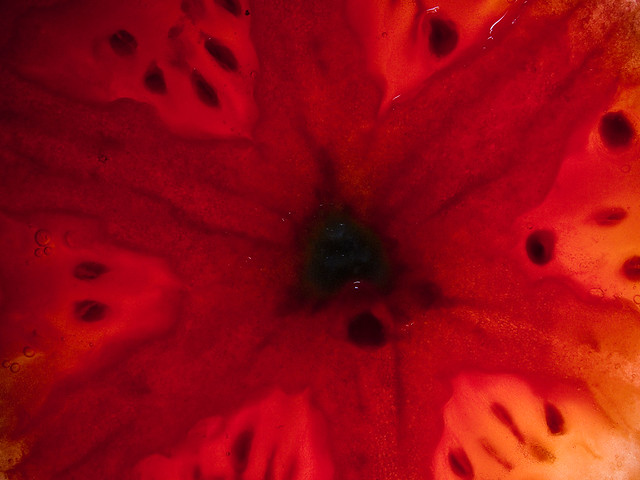
There are few things which are fun to say out loud as the phrase “Deadly Nightshade,” and the Tomato or Solanum lycopersicum is a member of the family. It’s regarded as a fruit, but in reality it’s another berry. The Conquistadors counted the Tomato as one of their many captured treasures after the conquest of the Mexica or Aztec Capital City of Tenochtitlan in 1521. The English word tomato hails from the Spanish word “tomate” which was lifted from the Nahuatl (the mesoamerican language) word tomatl. The Spaniards carried the plant around their empire, distributing it globally. It ended up all over the Mediterranean, and again it was the Arabs who first embraced the crop. Europeans were always uneasy about the deadly nightshade thing.
The Medici’s were growing tomatoes in 1548, over in Florence, Italy. For the fancy types, tomatoes were ornamental props and not for consumption as they grew too low to the ground. For the peasants – then as now, you eat what you can afford to eat. Mangiare.

– photo by Mitch Waxman
Just about everything you’ve seen in Monday’s, and today’s, posts were basically harvested from the food stuffs which Our Lady of the Pentacle and I normally keep on hand here at HQ. There were a few other options, incidentally – potatoes come to mind, but I was particularly keen on the sliced fruit (or berries) stuff, given their complex internal structures.
As mentioned earlier these shots were produced using a complicated setup on my countertop – a stage if you will, which was also harvested from stuff I had laying around. The transluscent stand was a plastic container with a slot cut into it for the strobe, and there’s also a flashlight or two gaff taped to table top tripods and a basic photographic “umbrella” light involved as well. The camera is wearing a flashgun as well, set to its lowest setting for some fill light, but its main job was to actuate the slave strobe that’s stuck under the subject to provide back light. So, there you are.

– photo by Mitch Waxman
Finally, a shot of my life savings.
“follow” me on Twitter- @newtownpentacle


 The Newtown Pentacle