Archive for the ‘Calvary Cemetery’ Category
Lurking… in fear- or Astoria to Calvary, part 2
Here’s a google map (including part 1 of this walk).

Dwyer Square -photo by Mitch Waxman
Perhaps…
The world knows all that it ought to know of Western Queens, and would remain merry in the satisfied ignorance of modernity- were it not for we Newtownicans who force it to disgorge its centuried secrets to feed the ravenous panopticon. Shudder at revelations of this history, found at our altar of a forgotten cosmos, for its implications may force one to experience monstrous alterations of dream. No rock in this part of the great city can be overturned without portent, or absent the mocking laughter of those who once walked these titan arcades of the Newtown Pentacle.
from the nyc.gov website
Located in the northwestern Queens neighborhood of Astoria, Dwyer Square lies near an old Native American trail (Woodside Avenue) that served as the main road from western Queens to the village of Newtown during the early American Colonial Period. The road ran along a tongue of dry land between the swamps of Long Trains Meadow (towards present day Jackson Heights), Wolf Swamp (towards present day Maspeth), and Burger’s Sluice (along present day Northern Boulevard). Hessians during the American Revolution (1775-1783) garrisoned this strategic point. In 1713 Isaac Bragaw, a descendant of one of the earliest French Huguenots in New Amsterdam, purchased this land. During the early 19th century, William Gosman purchased the farm. (Gosman is also known for having surveyed and laid out the area’s streets around 1875). Also nearby lies Northern Boulevard, an important six mile road connecting Flushing to Hunters Point.
It was originally named Jackson Avenue for Turnpike President John C. Jackson, whose leadership and efforts made the road possible. Costing nearly $40,000 and opening on July 13th, 1860, the highway was originally composed of milestones, a gravel roadbed and a tiny tollhouse and gate where travelers would pay a nine cents fee for passage. Foot traffic, however, was free.
In September 1980, the City of New York rededicated Dwyer Square. The square contains a flagpole with a yardarm that flies the United States, City of New York, and Parks flags; brick and concrete walkways; benches; and five trees, including three Japanese pagoda trees (Sophora japonica), a honey locust (Gleditsia tricanthos), and a green ash tree (Fraxinus pennsylvanica).

48th street between Northern Blvd. and 37th avenue looking west -photo by Mitch Waxman
At the commercialized intersection of 48th street and Northern Blvd. make a right and find the spot where- in 1932 the Madison Square Garden Bowl attracted a degenerate population of gamblers and all those friends and companions of night who accompany the sporting life- and near the spot selected by the US Army in WW2 to locate its titanic mail sorting and postal concentration operation– and close to where Ronzoni’s Pasta Mill stood- is today a shopping mall anchored by discount stores and an ice cream shop.
Gaze west upon the terrible grandeur of the shield wall of Manhattan, lying beyond Newtown across the River of Sound. By the 1970’s, this industrial complex had decayed and fallen prey to the greater malaise which infected New York until just recently. Described to the Newtown Pentacle as abandoned buildings and brick lots, it was home to vermin of all descriptions.
Apocryphal stories passed down by native Astorians speak of queer pock marked and needle scarred characters conducting odd rites in these ruined industrial sites as early as the 1970’s, with the officials in City government only intervening in these midnight gatherings when carelessly lit fires began to plague the area and a jump in the rate of suicide and violent robbery was commented on by many. A whispered Queens patois answers questions put to these lifelong Newtownicans about the place, apocryphally saying that it was where drug fiends and street gangs would hold congress, spending their nights amongst the oddly shaped shadows cast by streetlight streaming through broken windows (typical of similar vacant properties in the greater city, during that degenerate period of shattered and diminished expectations).

LIRR crossing at 48th street and 37th avenue -photo by Mitch Waxman
A side effect of the medications which maintain my frail physique in some semblance of balance- an exotic cocktail representing the highest pinnacle of the chemist’s art- is a vulnerability to an outward bodily manifestation of my subconscious notions- both gross and ridiculous. Without obvious provocation, a series of terrified and hysterical shrieks may emerge from my throat, owed entirely to my nervous and cowardly temperament. These nervous attacks are some surface manifestations of a deeper sensitivity, and suggest the buried neuroses which compel my quixotic and noisome nature. I have learned, when this humiliating condition is approaching, that by changing my course and altering my visual environment, I can often prevail against these terrors by resetting my nervous equilibrium.
It is terrible to have one’s mind couched in such an inferior physical example of the specie, and I have often considered alternatives. Oh, mankind, like a leaf- you.
So, we’re making a left onto a vestigial remnant of an earlier street grid, one that existed before the 800 pound gorilla and the Sunnyside Yard came to town- 37th avenue.

S.E.M./Signals Street Light Yard -photo by Mitch Waxman
On the south side of the street lies the elevated trackbed of the LIRR, and a series of garages which until recently served the nearby Sunnyside Yards. Many businesses in this area, which is defined by the gargantuan rail yard, have had their leases vacated by the MTA and LIRR recently. Sunnyside Yards is about to expand. On the north side of the street are two enormous structures, the first of which is a municipal building- the S.E.M./Signals Street Light Yard. Its yard, which consumes most of its lot, houses stores of street furniture and municipal hardware- and the sturdy employees of the place reveal their kind hearted nature by the carefully cared for colony of cats seen stalking the yard fencelines. Obviously capable hunters, some of the cats carry half eaten things that squeal and scream.

S.E.M./Signals Street Light Yard -photo by Mitch Waxman
I couldn’t find much out about this enigmatic and clearly decaying structure, but I did find a link to the New York City DOT Street design manual. (6.8 meg pdf). Other than that, I can find no proof at the Dept. of Buildings that this structure exists. It is anomalous, but clearly it can be photographed, which confirms it is no phantasmagoria nor an hallucination.

S.E.M./Signals Street Light Yard -photo by Mitch Waxman

“No Photography Allowed” -photo by Mitch Waxman
Across the street from the anomalous facility are a recently emptied series of garage sheds which were utilized by the Sunnyside Yards as some sort of machine shop. Signage disallows photography, but should mention grafiti instead. Such street scrawls, the joy of adolescent boys worldwide, is evidential of the lack of attention paid to security by civil and private authorities to these places that are not visible from their shining towers in Manhattan. Disturbingly, the graffiti writers are provided with both time and opportunity to pursue their art, which adorns every train viaducts and even the offshore Brooklyn Bridge moorings. One wonders who and what else may wander these streets looking for just such an opening, and what esoteric desires they may be seeking to fulfill.
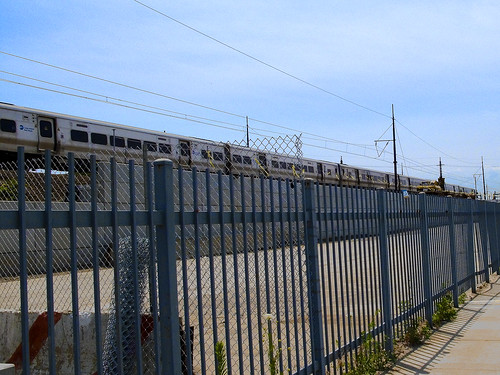
LIRR -photo by Mitch Waxman
Like Jason tied to his mast before the fabled Sirens, my attention was suddenly centered and transfixed. My eyes blurred as the powerful air horn of a LIRR train heading for eastern Long Island passed a construction site- screaming wildly in accordance with federal regulations. Unbalanced by the sudden rush of air and sound, I staggered forward several steps to avoid falling, and became transfixed by the nearby construction site. Such variability and inability to stay focused in the face of visual stimuli is undoubtedly the end product of an undisciplined childhood, an upbringing upon which I insisted on despite the best efforts of my simple parents.

LIRR track work -photo by Mitch Waxman
Up until just a year ago, this was a weed choked dumping ground for area residents and passing building contractors. The engineers of the LIRR have recently reinforced the track bed with structural steel and are in the process of armoring it in a wall of cement tile, as part of the larger East Side Access Project . I am not sorry, for I hated both antique wreckage and hellish vegetation which polluted the artificial ridge and occluded viewpoints of these gleaming trains as they carry their mutitudes back and forth to Manhattan.

New York Presbyterian Church – “stitched panorama” photo by Mitch Waxman
click here to see the ridiculously large original- warning-BIG FILE
Across the street is an enormous Church complex, the New York Presbyterian. It has all the appearance of a fortress, complete with a guardhouse possessed of mirrored windows and a retinue of antennae and cameras, but this would be normal for any structure of this size which abuts one of the largest and most important rail yards in North America. The curious asiatic script found on the church’s signage, and indeed the characteristic wide grin and relaxed countenance of the members of the congregation I have observed show all the hallmarks of origins on the Korean Peninsula. This is an assumption of course, based solely on study of New York’s ever shifting demography.
Here’s what archi-tourist had say:
This massive church is located in a strange area between the suburban, automobile landscape of Northern Boulevard and the planned community of Sunnyside Gardens. The LIRR passes alongside the church and 37th Avenue, adding to the feeling that the church doesn’t really belong to any place, any neighborhood.
The plan is basically split into three areas: a large congregation space fronted by the large wall of translucent panels and the church’s entry, the art-deco front on 37th Avenue now containing classrooms and other small spaces , and a series of metal-clad shells concealing the exit stairs required for the large, 2,500-seat sanctuary. All is surrounded by acres of parking, some at the level of the entry, some one-story below grade on the building’s north side.
It’s the building’s north side and its series of angular, metal scallops that gives the church its most striking feature, even though this facade is the most removed from the entry, the road, and the railway. It’s also ironic that so much effort was expended on a feature that’s rarely used, as these pieces cover the exit stairs from the sanctuary. But perhaps that’s the point; that the design needed some sort of POW or hidden surprise that couldn’t find its way into the art deco piece or the main sanctuary.
They seem like very nice people, despite the forbidding appearance of the structure that houses their church. The adoption of Protestant Christianity by a large segment of the Korean population was facilitated relatively recently, as it turns out.

New York Presbyterian Church – photo by Mitch Waxman
from wikipedia
In 1884, two American missionaries came to Korea: Henry Appenzeller, a Methodist, and Horace Underwood, a Presbyterian.[2] Emphasizing the mass-circulation of the Bible (which had been translated into Korean between 1881 and 1887 by the Reverend John Ross, a Scottish Presbyterian missionary inManchuria), the Protestant pioneers also established the first modern educational institutes in Korea. The Presbyterian Paichai School (배재고등학교) for boys was founded in 1885, and the Methodist Ehwa girls’ school (이화여자고등학교) followed a year later. These, and similar schools established soon afterwards, facilitated the rapid expansion of Protestantism among the common people, and in time enabled the Protestant faith to overtake Catholicism as the leading Christian voice in Korea.
and
Korean Americans in America have historically had a very strong fundamentalist and conservative Christian heritage. Between 70% and 80% identify as Christian; 40% of those consist of immigrants who were not Christians at the time of their arrival in the United States. There are about 2,800 Korean Christian churches in the United States, as compared to only 89 Korean Buddhist temples; the largest such temple, Los Angeles’ Sa Chal Temple, was established in 1974.

Stop, make left on 43rd street -photo by Mitch Waxman
A wall of shadowed brick will greet you as you reach 43rd street, and you must choose as I am forced to- do you return to Northern Blvd. and the greater world beyond- whose every path leads to the great gleaming metropolitan city and its myriad pleasures? Or will you choose to take a left handed path, and plunge deeper- ever deeper- worming your way into the darker heartlands of the Newtown Pentacle?

43rd street and 37th avenue -photo by Mitch Waxman
Steadying myself and resolute to continue, I stopped on the corner to consider 37th avenue and noted the sudden change in environmental conditions after crossing the street. A tenebrous darkness clings to this corner- the smell of mildewed wood and nitre dripping cement- mixed with urine- colors the air a yellowish brown. Somewhere nearby, is something that reeks of degenerate humanity.
note: I’m not kidding about the weird darkness here, check it out in google street view.
Moving south on 43rd street, and passing beneath a steel bridge which is manned by an actual troll… a sort of creature whose name the local Croatians might roughly translate into english as a “Sin-Eater“.

Crossing the angles between spaces -photo by Mitch Waxman
But brave this trollish hazard we will, my ladies and lords of Newtown, for the strange energies which course through the ground in these intermediate zones- which are neither one neighborhood nor another– these places- they are just existential hinterlands which reside in the angles found between them.
And we are on the verge of entering the most progressively designed, rationally proportioned, and ultimately verdant section of the long walk from Astoria to Calvary. Netownicans, we are about to pass under and over and enter into the Sunnyside.
Catching up with the Pentacle

Newtown Creek Bulkhead Fungus – photo by Mitch Waxman
Terms coined by the Newtown Pentacle in recent posts for future usage by the Real Estate Industry when the economy cycles back up-
DUPBO– Down under the Pulaski Bridge Onramp
DUGABO– Down under the Greenpoint avenue Bridge Onramp
DULIE– Down under the Long Island Expressway
DURFKO- Down under the Robert F. Kennedy Bridge Onramp
aka
DUTBO– Down under the Triborough Bridge Onramp
DUKBO– Down under the Kosciuszko Bridge Onramp
DUTZBO– Down under the Tappan Zee Bridge Onramp
DUGWO– Down under the George Washington Bridge Onramp
Sorry for the “clip show” today, I’m running a little late on my schedule, and the next “Astoria to Calvary” photowalk installment will be ready tomorrow.
also: Click here for a fascinating experience one pedestrian had down by Gantry Plaza Park. This is precisely the sort of thing that I’m constantly droning on about…
Also, something I found while doing research on Northern Blvd.- or how Robert Moses almost did to western Queens what he did to the South Bronx.
Up and Through Calvary
We’ve circled and stalked the place from the street, when we “Walked Widdershins to Calvary“. In the first full posting on Calvary, we walked from Laurel Hill Blvd. into the Necropolis of New York City and up Laurel Hill to its apex, overlooking the despoiled splendors of the Newtown Creek.
Today, we’re going to just wander around for a while and explore, and I finally unshackle a few observations about one of the three subjects you shouldn’t talk about in a NYC bar.

– photo by Mitch Waxman
Addled as we are by the manipulations of the political class during the 20th century, with its “ism’s” and “movements“, Newtownicans have lost sight of the fact that the Newtown Creek was the center of the world for those who dwelt here in the 19th century. Before the American Civil War, the banks of the Newtown Creek were lined with homes built to the highest aesthetic standard, and peppered with grand hotels which catered to the sportsman and recreational fisherman. It was into this pastoral wildrness that the Calvary Cemetery was embedded in 1848, and which it sought to blend into with its fine arboreal stock and tasteful mastery of the art of landscaping.
It seems odd to us- sitting in our comfortable climate controlled and fully electrified homes and offices, to put a cemetery like this- with its ornate stonework and elaborate masonry, so close to the polluted industrial zones of the nearby Newtown Creek. Calvary spreads atavistically across a deserted and blasted landscape in our 21st century, surrounded by the trampled nest and discarded remnants of the industrial revolution.

– photo by Mitch Waxman
My long walks around the Newtown Pentacle have often carried me through this curious place. A saturnine break from the monotony of gated industrial sites and their rusted wonders, the art of Calvary’s groundskeepers and architects is sublime to behold.
Fashionable to their particular time period and era, the wholesome multitudes of gravestones congregated here represent a century of New York’s aspirations. The early stones are humble in aspect, their faces displaying eroded and flaking cursive typography, and use a variegated stock of geologic sources for their composition- some are simple concrete. Their legends mention familial relations, and often the name of the bereaved or society which erected the monument to the fallen is included as a postscript.

– photo by Mitch Waxman
As the years progress, marble standardizes and Calvary’s hillocks gain an elaborate posture. The sculptural shaping and calligraphic quality of these stones is remarkable. Designed in a manner reminiscent of the early days of newspaper advertising, the creeds these reconstruction era markers bear boast of affiliations with immigrant societies– often mentioning their old address in Europe (County Cork, Sicily, etc.). The glittering polish of the approaching 20th century is accompanied by the appearance of a sort of resume on the stones, discussing achievements of the deceased in the newly quantized “professions” of law, or business, or medicine. 20th century mass production dominates near the edges of the property, and the familiar block printing and glittering finishes of a modern graveyard appear on the tomb markers.
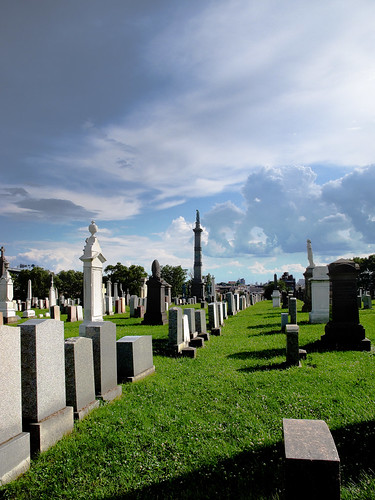
– photo by Mitch Waxman
As had been the case with the dynamic weather of the summer of 2009, in which New York was under the daily threat of violent thunderstorms, the sky was growing dark. In the distance, thunder rumbled loudly enough that I heard it through my ever present headphones and managed to somehow overpower the driving beat of the Mountain Goats song I was playing at the time. While taking this photo, I almost stumbled into a sinkhole- undoubtedly produced by the recent wet weather, nearly twenty inches across. Looking into the hole (sorry, my flash just couldn’t do the job) I could not see its bottom. Molehills, I thought.

– photo by Mitch Waxman
I am, as I’ve mentioned in previous posts, an inferior specimen and great physical coward- prone to metabolic manifestations of my inner timidity. Shaken by the ramifications of what would have happened if I’d stepped directly into that chasm, I instinctively started moving toward the safety of pavement. In this moment of self loathing and personal recrimination, I wandered past the Soldiers memorial, where the 21 noble dead have rested in centuried oblivion since 1866.
from nycgovparks.org
This park, in a triangle formed by First Calvary, Green Avenue, and Gale Street within Calvary Cemetery, has roots in the history of the Roman Catholic Church in Manhattan. In 1817, the Trustees of St. Patrick’s Cathedral (now called Old St. Patrick’s Cathedral) on Mott Street realized that their original cemetery on Mulberry Street was almost full. They drew up a charter for a burial ground in Queens, and on October 29, 1845, the Trustees bought 71 acres of land from John McMenoy and John McNolte. They named the cemetery after Mount Calvary, where Jesus Christ was crucified according to the New Testament. The first burial in Calvary Cemetery took place on July 31, 1848. Since then, the Roman Catholic cemetery, which now comprises Old Calvary Cemetery and New Calvary Cemetery, has expanded to 365 acres, and is the largest cemetery in the United States.
On April 28, 1863, the City of New York purchased the land for this park from the Trustees of St. Patrick’s Cathedral and granted Parks jurisdiction over it. The land transaction charter stated that Parks would use the land as a burial ground for soldiers who fought for the Union during the Civil War (1861-65) and died in New York hospitals. Parks is responsible for the maintenance of the Civil War monument, the statuary, and the surrounding vegetation. Twenty-one Roman Catholic Civil War Union soldiers are buried here. The last burial took place in 1909.
This park is one of many public parks that serve as burial grounds. There are burial sites in Fort Greene Park (the Prison Ship Martyrs’ Monument) and Prospect Park, in Brooklyn, and in Drake Park, Pelham Bay Park, and Van Cortlandt Park, in the Bronx. Other parks throughout the city were once potter’s fields which had no grave markers. Washington Square, Union Square, Madison Square, and James J. Walker Parks in Manhattan and Wayanda Park in Queens were all cemeteries for paupers and drifters.
The monument features bronze sculptures by Daniel Draddy, fabricated by Maurice J. Power, and was dedicated in 1866. Mayor John T. Hoffman (1866-68) and the Board of Aldermen donated it to the City of New York. The 50-foot granite obelisk, which stands on a 40 x 40 foot plot, originally had a cannon at each corner, and a bronze eagle once perched on a granite pedestal at each corner of the plot. The column is surmounted by a bronze figure representing peace. Four life-size figures of Civil War soldiers stand on the pedestals. In 1929, for $13,950, the monument was given a new fence, and its bronze and granite details replaced or restored. The granite column is decorated with bronze garlands and ornamental flags.

– photo by Mitch Waxman
Daniel Draddy was an irish speaker from County Cork, and the son of John Draddy- a stonecarver and prolific author in the Irish language who hailed from a family on Quaker Road. In context, they came from what modernity would describe as “an oppressed religious underclass involved in an ethnic and cultural war with an aggressive and powerful neighbor willing and and able to actively engage in state sponsored genocide and ethnic cleansing“ but which they would have called the Irish Potato Famine.
Daniel maintained his marble studios on 23rd street in Manhattan, near the east river. Known as a cultured and gracious host, he was beloved by the Tammany men. Contemporaries describe him as a first class carver, mechanic, historian, and he had the ability to write in the Irish language “druidically”.
Resemblance of the monuments to the tombs of ancient Egypt is no accident. The men who built this were Free and Accepted Masons.
This is masonic iconography, with its obelisk splitting the solar wisdom into the four cardinal directions and the four deities of the spaces found between standing watch at intersecting 45 degree vectors. Such falderol was quite in vogue after the Civil War, look at the Capitol Dome or Supreme Court building in Washington D.C. for similar thematic elements.
Don’t forget- Draddy was a stonecutter, from a family of stonecutters. That made him a Free and Accepted Mason, who’s existential threat was the subject of much Catholic liturgy. The Masons, especially after their successes in the Lowlands and North America in the 17th and 18th centuries, were considered a dangerous fifth column in the power structure of Europe. In the United States, the origins of the mythology surrounding them was beginning to form. In the 19th century men like Draddy would have been considered as subscribing to an “ism”, and its odd to find such iconography in a Catholic cemetery. The Church bore a special antipathy toward the Masons in this period of time, and even today they officially shun members.

– photo by Mitch Waxman
As with all designs that use esoteric 19th century schoolboy philosophies as their jumping off point, one must consider the numerical and iconic minutiae of the structure. The 40×40 yard plot- the 50 foot obelisk- these numbers and their factored multiplexes represent a hidden numerical code that initiates would find significant. Often, these numbers will refer back to a holy book or a date assigned to the matyrdom of a saint. Have no doubt that this was thought out and discussed by the designers and builders.
This is another difference between the generations that lie embraced in the earth here- and ourselves- what they built was often shaped by symbolism, we build for utilitarian usage.
They had magick as a part of their lives, whether it took the form of spiritualism, adherence to superstitious custom, or the mad passion of 19th century mass religion. In the 21st century- all we’re meant to have is a sense of hard reality, and our sacred sphere is a profanity, an understudy wearing the costume of a Maestro.

– photo by Mitch Waxman
The power of religion in the 19th century (and to a certain extent 20th, but not after the great depression) foment of immigrant New York City is impossible for us to conceive of today. The churches were part of “the system”. When you got off the boat and arrived in Manhattan, the first place you headed to was the congregation established by people from your region of origin. There, you would be inculcated into surviving the stinging whips of unregulated predatory capitalism which America (Chicago, and especially Manhattan) had so recently innovated. Many of these people had been recruited by agents of factory owners who traveled the back roads of Europe, whose pitch was the original “streets are paved with gold” story. Trapped by circumstance and poverty, the only break allowed by the bosses from the satanic schedules of mill work common to this period- called the industrial revolution- was obeyance to god. And the only place for “the deserving poor” to be buried for free- when this world eventually killed them, was in Calvary at the discretion of their local priest.
The priests of the time were not the isolated and dry cleaned empty cassocks seen scurrying around modern temples, shuttling into late model cars and thinking of their devotions as a career choice. These were brawlers from the working class, iron men (and women, of course) who had experienced the worst that this hostile environment could offer. When they talked, gangsters and cops listened. The churches one can find here in the Newtown Pentacle (Greenpoint especially) speak of the size and devotion of their congregations to the cause. Population numbers from the time are inaccurate at best, but there were a lot more people living in the very same rooms that we moderns now occupy. It was common to have 8-10 people living together in a what was called 1 bedroom tenement flat back then, but which is now a condo.
These were priests who could inspire men to build a Calvary Cemetery.

– photo by Mitch Waxman
These priests, the sort who produced Babe Ruth and Al Capone, could inspire men like the Johnston Brothers of Manhattan to build this mausoleum. In its decrepid state, colored by automobile exhaust and its delicate stained glass twisted and torn, only hints at its former glories can be discerned.
The Johnston Brothers were the proprietors of the J. & C. Johnston company, located ultimately at the corner of Broadway and 22nd street in Manhattan. They sold lady’s novelties, ribbons, parasols and other fripperies from their prestigious “ladies mile” location. Lady’s Mile was anchored on the busy industrial side by Union Square and Tammany Hall, and on the swank side by 23rd street with its new “department stores”. Theodore Roosevelt was born in the family home a few blocks away, and the prestigious townhouses that still line the surrounding area speak to the former exclusivity of the neighborhood.
There were three brothers- John, Robert, and Charles. Charles died in 1864, John in 1887 (possibly of a suicide). Robert, reknowned as an unlettered yet expert scholar in the fields of literature, mathematics and history, was so consumed by grief and longing for his siblings that he lost the family business in 1888, and then retired to a country house at Mount St. Vincent on the Hudson (near a convent). During a later foreclosure on his property- which he had financially mismanaged due to his grief, a fire broke out and nearly claimed Roberts life. In the end, he was found dying of pnemonia and suffering from madness by groundskeepers in a barn on the property.
Once more, a member of our Flickr group, sorabji, is the acknowledged Pentacle authority on this place. Check it out.

– photo by Mitch Waxman
Like other industrialists, the Johnstons often reached out to their contacts in their country of origin to recruit trustworthy laborers. Robert’s name appears as principal donor to the The Fermangh Relief society, offering to aid those deserving persons in destitute circumstance with the costs of emigration and freedom from the terror of landlords. The Johnstons were also Tammany men.
Like a stalking horse, magickal themes and ideas which were common notions at the time- like our “keeping it real” or “karma” memes are today- emerge. This kind of wholescale rending of the substance of your life was considered an appropriate response to death by the culture back then. When my grandfather died, my dad ripped his shirt in half- symbolically. When my dad died, I kissed him on the head. Think of all those old ladies in Brooklyn who have been wearing black for 40 years- they’re the last vestige of this supernatural cultural worldview that was so brutally crushed by “the -ism’s” in the 20th century. What would be considered a psychotic breakdown by our empiricist eyes- a medical event which could be managed and nursed delicately back to health- the Newtownicans of the late 19th and early 20th century saw as a metaphysical consequence of guilt and punishment. But- life in their time was not as it is now, despite superficial commonalities and vestigial building stock- these people were ruled by deep passions and motivations that modern cultures negate and control with psychoanalytic insight.
I won’t dare to question grave rituals, which I define as “deep down monkey stuff”. Like Patti Smith, I believe everything and everyplace is holy, especially the place between my ears- but that’s me- I’m all effed up- I hang around in graveyards, after all. I think elaborate sites like Calvary are very good news for 22nd century archaeologists, though.

– photo by Mitch Waxman
First, there was no electricity. Water came into the house in buckets carried up dark stairwells into smoky crowded rooms lit by candle. A single stove cooked whatever poor food was available, and provided meager heating. You defecated in a bucket and left the nightsoil in the alley for collection, or you just poured it out a window. Coal was expensive, its price controlled by mobsters and railroad chiefs, so you wore multiple layers of clothing all the time. Children slept in doorways and under wagons, their parents unknown. Work was hard to get, controlled by the Tammany men. Fraternal societies and lodges offered political affiliations and entry to the workforce.
The collected night soil was shipped to Newtown Creek’s offal docks. One of our first posts was on this topic, click here for “the Night soil and offal docks, and Jell-O“.
Ethnicity was what mattered to the politicians, who would lure their kin into great concentrations in certain districts to solidify their power. Other Tammany men would open factories and mills in these wards, employing the entire community as in the manner of a sharecropper and his serfs. These were the early stages of the process that gave New York’s neighborhoods their ethnic character, and which has evolved considerably since. Men didn’t drink back then, they just got drunk.
The most conspicuous modern examples of this “ethnic character” (which are stereotypes, I know, but are commonly referred to and repeated by area residents) would be Greek Astoria, Irish Woodside, Mexican Corona, Desi Jackson Heights, Russian Brighton Beach, and East Asian Flushing- but the circumstance and stories of these communities are considerably less brutal than the experiences of Irish, Italian, Pole, German, Negro, and Jewish Newtownicans in the 19th century.

– photo by Mitch Waxman
The first of the “ism’s” was progressivism, which believed that “the system” was broken as it was, but could be fine tuned via a more equanimously slanted division of the profits derived by labor. By enacting standards for industry to follow, and rules for worker safety and compensation, as well as the right to bargain collectively with the industrialists as part of a trade union, this fine balance could be found.
The progressives won many victories which are part of the american worker’s birthright today – adoption of the English or 8 hour day, meal breaks, coffee and bathroom breaks, medical insurance for injuries on the job, unemployment insurance, and they put child labor to an end. The people buried here are the battle hardened combatants, both bosses and workers, of a dynamic period in American politics that set the stage for a military and political collossus to emerge in the mid 20th century.
Simplistic modern jargon for this sort of political philosophy is “socialism”, which is a term which would have a great future in the 20th century.

– photo by Mitch Waxman
Still shaken by my near misstep into the sinkhole, I took to the paved road and was gratified to see St. Rafael’s loom large in an innocuously clear blue sky. However, the sounds of thunder, and an ever present and growing breeze were coming from the northwest. My attentions were drawn to the direction of the open ocean, where the storm was approaching from. I wondered, had I looked too closely at this place and stayed too long?
I headed for the Greenpoint avenue gates with all haste, knowing that I had a maximum of 30 minutes before I would be forced to find shelter in this verdant graveyard against the approaching storm. As I was the only person visible at the time in all of Calvary, and possessed of unnaturally bad luck- I figured lightning would hit me- so I quickened my pace to a dog trot and headed for the streets of Queens.

– photo by Mitch Waxman
As I hurried along my way through the enormity of Calvary, my mind was racing with endless speculations about the place, and all the crazy yarns and apocryphal stories I’ve been told about it.
Just so there’s no mistake- these are STORIES I’VE BEEN TOLD AND THINGS I’VE OBSERVED, NOT FACTS.
What happened here in the early 70’s, when cults and secret magickal societies conducted hippie rituals here? What about that grave robbing story dating from the crack years I heard from a drunken ex cop? How many low level mobsters have mentioned this place as being a convenient hiding place for contraband? What about the demon haunted catacombs below, where the church buries its priests?? What are those weird metal hinged hatches with the steel staircases leading down from ground level on the BQE side? Where do they go? Where is the sewer outfall from the extensive drainage system installed on these tumulous hills? Who lives downstream from the largest graveyard in the United States? Does Calvary pay taxes? What about the “shape” my neighbor described as “moving amongst the trees in a way that just wasn’t right” while riding his bicycle home from a job along Review Avenue one January night?

– photo by Mitch Waxman
In the distance, the storm had reached Manhattan, by all appearances. Luckily, a short walk returned me to the streets of 21st century Queens, where I hailed a livery cab and returned to my rooms in Astoria. In accordance with the traditions of my fathers- I washed my hands and took my shoes off before I entered the house. A little sympathetic magick never hurt anyone, I always say… and besides- this place is a block from the apocalyptic landscape of the Newtown Creek. God only knows what I walked through.
Anything you may experience, in situ, by following these walking directions is at your OWN RISK, and is offered by the Newtown Pentacle for documentary and entertainment purposes only. Remember- the rule we follow at the Newtown Pentacle is to NEVER trespass. Like Vampires, Newtownicans should wait to be invited into a house before they can do their work. Also, Please note — if something you read here is inaccurate, DO NOT BE SHY- contact me– additions and corrections are always welcome at the Newtown Pentacle.
Calvary Cemetery walk
feel like taking a walk? I’ll show you something cool… Bring your camera- and ID
Here’s a google map.
For a larger contextual view of Calvary Cemetery- check out our previous posts-
Walking Widdershins to Calvary
This post also intersects with
Dead Ends, A short walk from Maspeth to Calvary

-photo by Mitch Waxman
Just across the street from the site of the former LIRR Penny Bridge station. Easily accessed via the street, upon crossing the gates of Calvary, one will find a staircase carven into the hill by whose ascent the Newtown acropolis may be obtained. Cresting over the surrounding neighborhoods, and soaring over the Newtown Creek’s former wetlands, Calvary Cemetery keeps its secrets buried in centuried silence. Looking south toward Brooklyn, the Kosciuszko bridge approach of the Brooklyn Queens Expressway looms over its passage, carrying millions of vehicles over and across the necropolis of New York City.

-photo by Mitch Waxman
Phantoms of what could have been haunt Calvary, roaming in soliloquy amongst the avenues of nitre dripping marble. The 1918 superflu and an earlier cholera epidemic staffed the ranks here with both the sacred and the profane. St. Patrick’s in Manhattan used this place for the interment of New York’s best and brightest. This is where the ossified remnants of the men who died battling the traitorous slavers of the Confederate South can be found in the Newtown mud. In subterranean vaults of marble and basalt, and within leaden coffins, these gentlemen– the ultimate product of an age of victorian aspirations- lie in putrid splendor, alongside the occasional merchant and immigrant whose life savings were traded to purchase their final resting place.

-photo by Mitch Waxman
A member of our flickr group, sorabji, has written an excellent description- in some great detail on the Civil War monument and the Johnston mausoleum. Which you’ll find in concrete reality when you gaze from the summit of the great hill. I won’t attempt to better sorabji’s efforts, and will simply ask you to follow the link and check out the research.
At the apex of the hill, which is the acropolis of Calvary on the Newtown Creek side, there can be found a tree.

-photo by Mitch Waxman
Undoubtedly centenarian at the very least, the bark and leaves of this tree are of an unnaturally dark and forbidding aspect. Its branches sway in patterns that have nothing in common with the prevailing winds. Its trunk is observed wearing a a sickly blanket of moss. Vigorous and quite healthy despite its proximity to the poisons of the Newtown Creek, the tree is obviously nourished by some sort of morbid nutrition.

-photo by Mitch Waxman
An apocryphal story passed down by Brooklyn folks is that of the door to door salesman seeking to sell you a funeral plot “on a hill, under a shady tree, near a babbling brook”. The proper Brooklyn response is- ‘yeah? and I gots a bridge to sell youse”.
This, my friends, is the very archetype of that con job. The hill is called Laurel and the babbling brook is, and was, the Newtown Creek and the grave is in Calvary.

-photo by Mitch Waxman
How deep do the roots of this tree plunge into the tumulous earth? And where can they lead? What foul corruptions do they feed upon?

-photo by Mitch Waxman
Can it be, that just like every other place in New York’s megalopolis, Calvary’s “holy ground” is actually the roof of some cyclopean structure?
Anything you may experience, in situ, by following these walking directions is at your OWN RISK, and is offered by the Newtown Pentacle for documentary and entertainment purposes only. Remember- the rule we follow at the Newtown Pentacle is to NEVER trespass. Like Vampires, Newtownicans should wait to be invited into a house before they can do their work. Also, Please note — if something you read here is inaccurate, DO NOT BE SHY- contact me– additions and corrections are always welcome at the Newtown Pentacle.


 The Newtown Pentacle