Archive for the ‘Chinatown’ Category
torment of the Brachyura

– photo by Mitch Waxman
Your humble narrator is a carnivore, as mentioned in the past, despite a somewhat advanced state of understanding of the realities of feedlot and abattoir.
Human beings are ultimately predatory apes, and the greasy taste of flesh is prized by most. Displays of comestible items are commonly observed amongst the human hives, but when one is moving through a neighborhood whose residents enjoy exotic fare- like Manhattan’s famous Chinatown in this case – the careful observer might be rewarded with visions of the fanciful or alien.
from wikipedia
Homo Necans: the Anthropology of Ancient Greek Sacrificial Ritual and Myth is a book on ancient Greek religion and mythology by Walter Burkert, which won the Weaver Award for Scholarly Literature, awarded by the Ingersoll Foundation, in 1992. The book’s core thesis is that when paleolithic man became a hunter, in spite of the generally omnivorous orientation of the great apes, lack of a predator instinct was made up for by turning patterns of intra-species aggression against the prey: Homo necans means “man the killer”. Thus, the animal hunted by ancient man automatically acquired aspects of an equal, as if it were of one of the hunter’s relations. In a first attempt at applying ethology to religious history, Burkert confronts the power and effect of tradition in uncovering traces of ancient hunting rituals so motivated in historical animal sacrifice and human sacrifice (by his thesis unified as deriving from the same fundamental principle) in specific historical Greek rituals with relevance to human religious behaviour in general. Burkert admitted that a decisive impulse for the thesis of Homo Necans derived from Konrad Lorenz’ On Aggression (1963).
The thesis set out in the first chapter, “Sacrifice, hunting and funerary rituals”, is an extension of the hunting hypothesis, which states that hunting as a means of obtaining food was a dominant influence on human evolution and cultural development (as opposed to gathering vegetation or scavenging). The guilt incurred in the violence of the hunt was reflected in sacred crimes, which through rituals of cleansing and expiation served to unify communities.

– photo by Mitch Waxman
A carnivorous glutton your humble narrator may be, but empathy and indignation arose in him when confronted with this display.
Sure that this is a time tested and necessary technique intended to display the freshness and nutritional validity of this cast of crustaceans, demanded by clientele, a certain bile nevertheless rises. Western prejudice no doubt colors my point of view, as the same overt revulsion does not rise at the sight of a counter of European butchers meat.
Paradoxical, but to my reasoning, there isn’t a display of crucified and disemboweled cows overhanging the refrigerated section at the supermarket. Vegan friends would disagree, but I guess it depends on your point of view, and “Krabs ain’t Kosher” either.
from wikipedia
Crabs make up 20% of all marine crustaceans caught, farmed, and consumed worldwide, amounting to 1½ million tonnes annually. One species accounts for one fifth of that total: Portunus trituberculatus. Other commercially important taxa include Portunus pelagicus, several species in the genus Chionoecetes, the blue crab (Callinectes sapidus), Charybdis spp., Cancer pagurus, the Dungeness crab (Metacarcinus magister) and Scylla serrata, each of which yields more than 20,000 tonnes annually.

– photo by Mitch Waxman
It really was just the simple fact that the Cast of Crabs in the bushel bucket beneath this macabre marquee were subtly scuttling which disturbed me and drew this comment.
I am also aware, of course, that given the chance- those in the basket would consume those above them with abandon.
from wikipedia
The problem of animal suffering, and animal consciousness in general, arises primarily because animals have no language, leading scientists to argue that it is impossible to know when an animal is suffering. This situation may change as increasing numbers of chimps are taught sign language, although skeptics question whether their use of it portrays real understanding. Singer writes that, following the argument that language is needed to communicate pain, it would often be impossible to know when humans are in pain. All we can do is observe pain behavior, he writes, and make a calculated guess based on it. As Ludwig Wittgenstein argued, if someone is screaming, clutching a part of their body, moaning quietly, or apparently unable to function, especially when followed by an event that we believe would cause pain in ourselves, that is in large measure what it means to be in pain.[98] Singer argues that there is no reason to suppose animal pain behavior would have a different meaning.
Bottle Alley

– photo by Mitch Waxman
Baxter Street just past Leonard, I noticed this woman tending a little fire. She was part of a small group who were gathered at the Baxter Street side of the Mulberry Bend, where Jacob Riis described Bottle Alley. Getty Images has a watermarked preview image of the place, as photographed by Jacob Riis in 1901 here.
from wikipedia
In Chinese tradition, the fifteenth day of the seventh month in the lunar calendar is called Ghost Day and the seventh month in general is regarded as the Ghost Month (鬼月), in which ghosts and spirits, including those of the deceased ancestors, come out from the lower realm. Distinct from both the Qingming Festival (in Spring) and Chung Yeung Festival (in Autumn) in which living descendants pay homage to their deceased ancestors, on Ghost Day, the deceased are believed to visit the living.
On the fifteenth day the realms of Heaven and Hell and the realm of the living are open and both Taoists and Buddhists would perform rituals to transmute and absolve the sufferings of the deceased. Intrinsic to the Ghost Month is ancestor worship, where traditionally the filial piety of descendants extends to their ancestors even after their deaths. Activities during the month would include preparing ritualistic food offerings, burning incense, and burning joss paper, a papier-mache form of material items such as clothes, gold and other fine goods for the visiting spirits of the ancestors.
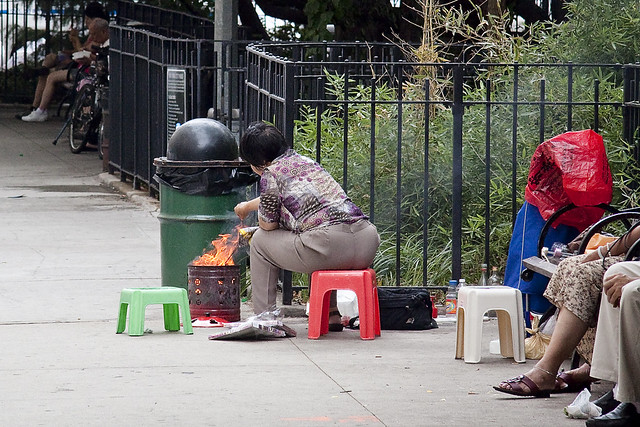
– photo by Mitch Waxman
Far eastern correspondent Armstrong happened to be with me this day, welcome company for my otherwise lonely walks, and informed me that this lady was burning “ghost items”- but that it was the wrong season for the Hungry Ghosts. Armstrong further iterated that someone dear to this lady had either died recently, or that it might be the anniversary of a death. Suddenly, your humble narrator remembered an enigmatic fixture observed within the section of St. Michael’s Cemetery in Astoria which is remarkable for the quantity of monuments which display asiatic scripts. Also, this is a photo of an offering of “ghost bucks“, also at St. Michael’s.
also from wikipedia
The Ghost Festival is celebrated during the seventh month of the Chinese Lunar calendar. It also falls at the same time as a full moon, the new season, the fall harvest, the peak of Buddhist monastic asceticism, the rebirth of ancestors, and the assembly of the local community. During this month, the gates of hell are opened up and ghosts are free to roam the earth where they seek food and entertainment. These ghosts are believed to be ancestors of those who have forgotten to pay tribute to them after they had died, or those who have suffered deaths and were never given a proper ritual for a send-off. They have long needle-thin necks because they have not been fed by their family, or it is a sign of punishment so they are unable to swallow. Family members offer prayers to their deceased relatives, offer food and drink and burn joss paper. Such paper items are only valid in the underworld, which is why they burn it as an offering to the ghosts that have come from the gates of hell. The afterlife is very similar in some aspects to the material world, and the paper effigies of material goods would provide comfort to in the afterlife. People would also burn other things such as paper houses, cars, servants and televisions to please the ghosts.[2] Families also pay tribute to other unknown wandering ghosts so that these homeless souls do not intrude on their lives and bring misfortune and bad luck. A large feast is held for the ghosts on the fourteenth day of the seventh month, where everyone brings samplings of food and places them on the offering table to please the ghosts and ward off bad luck.

– photo by Mitch Waxman
Photography makes you rude, exposing the nosey side of your personality- the “yenta”. You’re not just prying into someone else’s life, you are actually recording it and signing your name under their moment as “photgrapher”. Perhaps you really do steal a piece of someone’s soul when you take their picture… it would certainly explain why the politicians and Mel Gibson are the way they are.
Your humble narrator, who was once actually chased across Astoria by a crowd of old Greek ladies screaming “terrorist… camera… terrorist”, has learned the best thing to do is smile and feign genuine connection when they turn around and catch me. This is hard for me- a direct interaction with a stranger- but I’ve observed how humans act, and can create a convincing simulacra of the behavior set.
I’ve been told, though, that my attempt at acting nice is rather creepy- mainly this, but mixed with some of this and a smidge of that.
from wikipedia
There are many superstitions and taboos surrounding the Hungry Ghost Festival. Spirits are thought to be dangerous, and can take many forms, including snakes, moths, birds, foxes, wolves, and tigers. Some can even use the guise of a beautiful man or woman to seduce and possess. One story refers to a ghost who makes the form of a pretty girl and seduces a young man until a priest intervenes and sends the spirit back to hell. Possession can cause illness and/or mental disorders. During the 7th month children are advised (usually by an elder in the family) to be home before dark, and not to wander the streets at night for fear a ghost might possess them. Swimming is thought to be dangerous as well, as spirits are believed to have drowned people. People will generally avoid driving at night, for fear of a “collision”, or spiritual offence, which is any event leading to illness or misfortune. While “ghosts” is a common term used throughout the year, many people take on the phrase “backdoor god” or “good brother” instead so as not to anger the gods. Another thing to avoid is sampling any of the food placed on the offering table, as doing this can result in “mysterious illness”. Any person attending a show at an indoor entertainment venue (Getais) will notice the first row of chairs is left empty. These seats are reserved for the spirits, and it is considered bad form to sit in them. After an offering has been burnt to the spirits, stepping on or near the burnt area should be avoided, as it is considered an “opening” to the spirit world and touching it may cause the person to be possessed.

– photo by Mitch Waxman
The photo I’m not showing is the one after this, where this woman shot me a polite and slightly shy grin. I went on my way, hoping to minimize my intrusions, as she had ghosts that needed feeding.
from wikipedia
Yan Wang (traditional Chinese: 閻王), also called Yanluo (traditional Chinese: 閻羅) is the god of death and the sovereign of the underworld. He is also the judge of the underworld, and decides whether the dead will have good or miserable future lives. Although ultimately based on the god Yama of the Hindu Vedas, the Buddhist Yan Wang has developed different myths and different functions from the Hindu deity. Yan Wang is normally depicted wearing a Chinese judge’s cap in Chinese and Japanese art. He sometimes appears on Chinese Hell Bank Notes.
Guǐ (鬼) is the general Chinese term for ghost, used in combination with other symbols to give related meanings such as gweilo (鬼佬), literally “ghost man”, used to refer to white people, and mogwai (魔鬼) meaning “devil”. Derived symbols such as 魇 (chui) meaning “nightmare” also carry related meanings. There are many types of Guǐ:
- Diào Sǐ Guǐ (吊死鬼): The ghost of someone who has been hanged, either in execution or suicide
- Yóu Hún Yě Guǐ (游魂野鬼):
- The wandering ghost who has died far away from his/her hometown or family, especially when his/her body and spirit haven’t been sent back to home.
- The wandering ghost of the dead, including vengeful spirits who take their revenge, hungry ghosts and playful spirits who may cause trouble during the Hungry Ghost Festival.
- Guǐ Pó (鬼婆): A ghost that takes the form of a kind and friendly old woman. They may be the spirits of servants who used to work for rich families, and who have returned to help around the house.
- Nǚ Guǐ (女鬼): The ghost of a woman who has committed suicide due to some injustice such as being wronged or sexually abused. She returns to take her revenge.
- Yuān Guǐ (冤鬼): The ghost of someone who have died a wrongful death. They roam the world of the living, depressed and restless, seeking to have their grievances redressed.
- Shuǐ Guǐ (水鬼): The spirit of someone who drowned and continues living in the water. They attack unsuspecting victims by dragging them underwater and drowning them to take possession of the victim’s body.
- Wú Tóu Guǐ (无头鬼): A headless ghost who roams about aimlessly.
weird perfumes

– photo by Mitch Waxman
As mentioned earlier, my search for information on the questionable death of a merchant from Massachusetts named Gilman has led me to some of the stranger wards of our great city. On this day, a cursory questioning of caretakers at Old St. Patrick’s pointed me in the direction of a certain Chinese mystic who occupies a run down walk up flat some 4 stories above Henry Street in New York’s bustling Chinatown.
from wikipedia
Henry Street is a street in the Lower East Side of Manhattan in New York City. It runs in a northeasterly direction one-way eastbound from Oliver Street in the south and west, passing underneath the Manhattan Bridge and on to Grand Street in the north and east. The poor condition of immigrants living in squalid tenements on Henry Street and the surrounding neighborhood in the late 19th century prompted nurses Lillian Wald and Mary Maud Brewster to found the Henry Street Settlement in 1893. In recent times, Henry Street continues to be an immigrant neighborhood and has been absorbed into an expanding Chinatown.

– photo by Mitch Waxman
A self described healer who claims mastery over the orgone, or Qi as the Chinese call it, he was a disagreeable fellow. Rebuffed in my attempts to gain any knowledge from him, the old man admonished me to stop looking for this Gilman, lest I find something out that I don’t want to know.
from wikipedia
Although the concept of qi has been very important within many Chinese philosophies, over the centuries their descriptions of qi have been varied and may seem to be in conflict with each other. Understanding of these disputes is complicated for people who did not grow up using the Chinese concept and its associated concepts. Until China came into contact with Western scientific and philosophical ideas (primarily by way of Catholic missionaries), they knew about things like stones and lightning, but they would not have categorized them in terms of matter and energy. Qi and li (理, li, pattern) are their fundamental categories much as matter and energy have been fundamental categories for people in the West. Their use of qi (lifebreath) and li (pattern, regularity, form, order) as their primary categories leaves in question how to account for liquids and solids, and, once the Western idea of energy came on the scene, how to relate it to the native idea of “qi”. If Chinese and Western concepts are mixed in an attempt to characterize some of the problems that arise with the Chinese conceptual system, then one might ask whether qi exists as a “force” separate from “matter”, whether qi arises from “matter”, or whether “matter” arises from qi.
pitiful monomania

– photo by Mitch Waxman
East Broadway, in New York’s Chinatown, shot from the Manhattan Bridge.
I had other, mundane reasons for being in Chinatown that day, but my search for Gilman had led me to Old St. Patrick’s Cathedral in search of clues to the whereabouts of the enigmatic Massachusetts man’s grave at Calvary Cemetery.
from wikipedia
East Broadway is a two-way east-west street in the Chinatown and Lower East Side neighborhoods of the New York City borough of Manhattan. East Broadway begins at Chatham Square (also known as Kimlau Square) and runs eastward under the Manhattan Bridge, continues past Seward Park and the eastern end of Canal Street, and ends at Grand Street. The western portion of the street is primarily populated by Chinese immigrants (mainly Foochowese from Fuzhou, Fujian), while the eastern portion is home to a large number of Jews. One section in the eastern part of East Broadway, between Clinton Street and Pitt Street, is unofficially referred to by residents as Shteibel Way, since it’s lined with approximately ten small synagogues (“shteibels”).
Don’t Know Jack

– photo by Mitch Waxman
Social obligations carried your humble narrator to the teeming streets of New York City’s famous Chinatown over the weekend, where this enigmatic ovum was observed. Alien to my eyes, this is a Jack Fruit, which is apparently one of asian cuisine’s most popular cultivars. Ignorant of the pacific tropics and their unique biota, my initial thought upon encountering the Jack Fruit was that it was a pod not unlike those utilized by the “Body Snatchers” during one of the many attempts to infiltrate human society by extraterrestrials during the 1950’s. Turns out that the Jack Fruit has been a part of the Asian diet since Ashoka the Great ruled India in 250 BC. The name Jack Fruit is derived from the Portuguese term for it- Jaca, after the Malaysian Chakka.
from wikipedia
The jackfruit (Artocarpus heterophyllus or A. heterophylla) is a species of tree in the mulberry family (Moraceae), which is native to parts of South and Southeast Asia. It is the national fruit of Bangladesh. It is called Kanthal (কাঁঠাল) in Bangla, Katahar (कटहर) in Nepali, Panasa (पनस) in Sanskrit, Katahal (कटहल) in Hindi, Nangka in Bahasa Indonesia,Halasu (ಹಲಸು) in Kannada, Panasa in Telugu, Pala in Tamil (is one of the three auspicious fruits of Tamil Nadu),Chakka in Malayalam language, Phanas in Marathi language and पणस in Konkani language. It is well suited to tropical lowlands. Its fruit is the largest tree borne fruit in the world, seldom less than about 25 cm (10 in) in diameter.

photo from wikipedia

– photo by Mitch Waxman
Armstrong, the Newtown Pentacle’s far eastern correspondent and expert on asian dessert items, simply states that the Jack Fruit is delicious. After a lifetime spent in New York City, with the limited compliment of American staple fruits (banana, citrus, apple, grape, peach, tomato) and their variants available, it is a real pleasure to see that the latest waves of immigration are expanding the variety of foodstuffs. I’ve seen other exotic and alien crops, Durrians and Yuca for example, on sale in Queens markets in the last couple of years. Even the local supermarket here in Astoria carries a remarkable variety.
from crfg.org
In Malaysia and India there are named types of fruit. One that has caused a lot of interest is Singapore, or Ceylon, a remarkable yearly bearer producing fruit in 18 months to 2-1/2 years from transplanting. The fruit is of medium size with small, fibrous carpels which are very sweet. It was introduced into India from Ceylon and planted extensively in 1949. Other excellent varieties are Safeda, Khaja, Bhusila, Bhadaiyan and Handia. In Australia, some of the varieties are: Galaxy, Fitzroy, Nahen, Cheenax, Kapa, Mutton, and Varikkha. None of these appear to be available in the US at this time.
Yet, even as the ever changing ethnic waves bring new and exciting comestibles with them, other traditions fall away. Corned Beef does not sweat in bar room steam tables anymore, I haven’t seen the Krishnas making rice and beans in Thompson Square Park for a while, Jewish Deli is virtually extinct, and…
What ever happened to the Bear Claw?
do they still exist in sticky sweetness, within the City of New York?
more on this Bear Claw business to come…


 The Newtown Pentacle